Japan Urology Diagnostics Market Size & Growth Rate
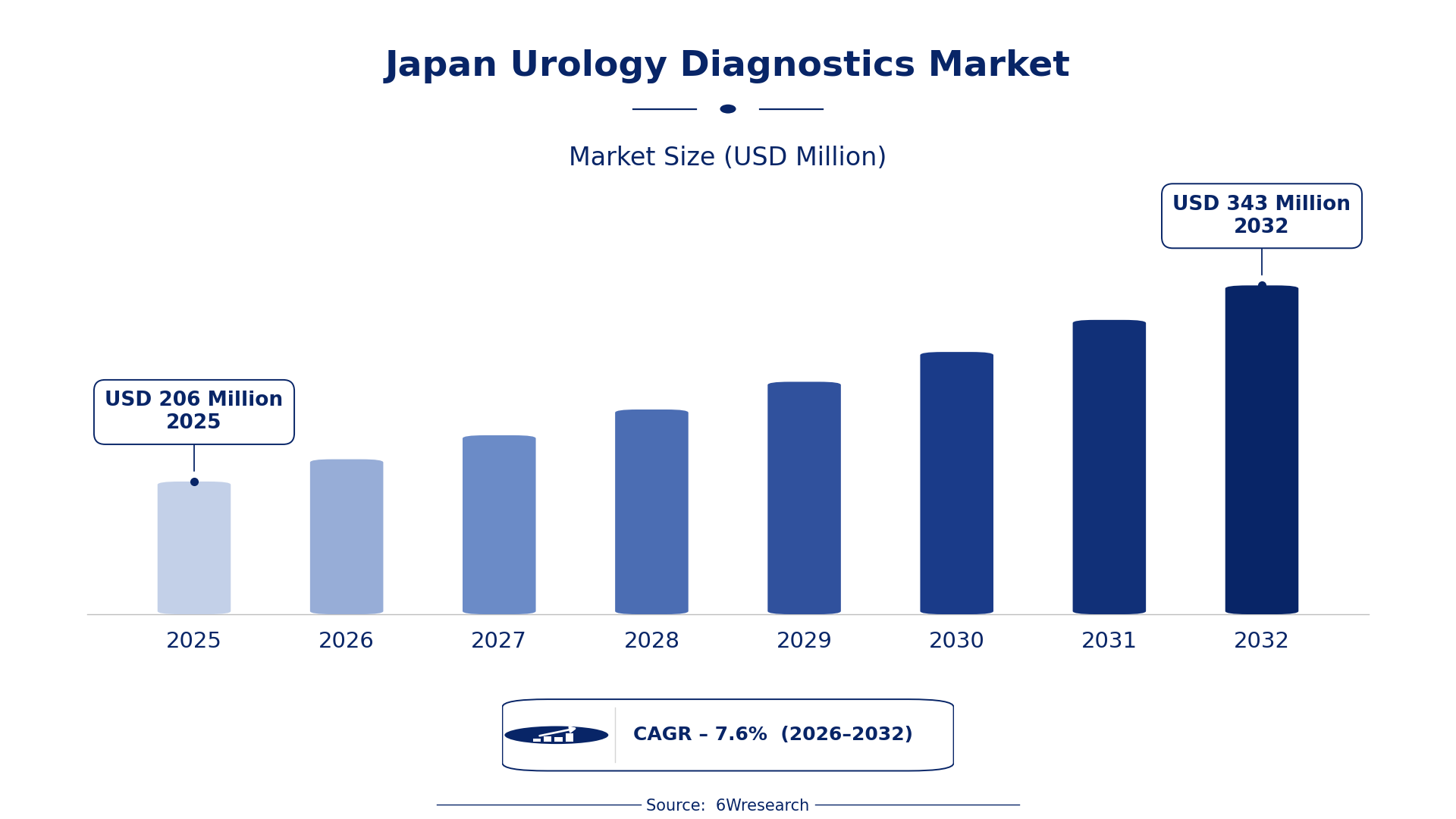
According to 6Wresearch internal database and industry insights, the Japan Urology Diagnostics Market was valued at USD 206 Million in 2025 and is projected to reach USD 343 Million by 2032, growing at a CAGR of approximately 7.6% during 2026–2032.
Japan Urology Diagnostics Market Highlights
| Report Metric | Details |
| Report Name | Japan Urology Diagnostics Market (2026-2032) |
| Market Size 2025 | USD 206 Million |
| Market Size 2032 | USD 343 Million |
| Absolute Growth 2025–2032 | USD 137 Million |
| CAGR 2026–2032 | 7.6% |
| Peak Annual Growth | 8.4% in 2028 |
| Forecast Period | 2026–2032 |
| Historical Data | 2022–2025 |
| Base Year | 2025 |
| Leading Diagnostic Type, 2025 | Urinalysis (37% share) |
| Leading Test Method, 2025 | Dipstick Test (37% share) |
| Leading Setting, 2025 | Clinics (39% share) |
| Leading End User, 2025 | General Physicians (42% share) |
| Fastest-Growing Diagnostic Type | Uroflowmetry (10.6% CAGR) |
| Fastest-Growing Test Method | Electronic Monitoring (10.8% CAGR) |
| Fastest-Growing Setting | Outpatient (9.9% CAGR) |
| Fastest-Growing End User | Urology Practices (9.8% CAGR) |
| Growing Sector | Urology diagnostics |
| Key End Users | Urology practices, outpatient clinics, diagnostic labs, general physicians |
Japan Urology Diagnostics Market Year-wise Growth Rate and Key Drivers (2022–2032)
This graph illustrates the annual growth rates of the market from 2022 to 2032, highlighting a steady upward trajectory and projected market expansion over the forecast period.
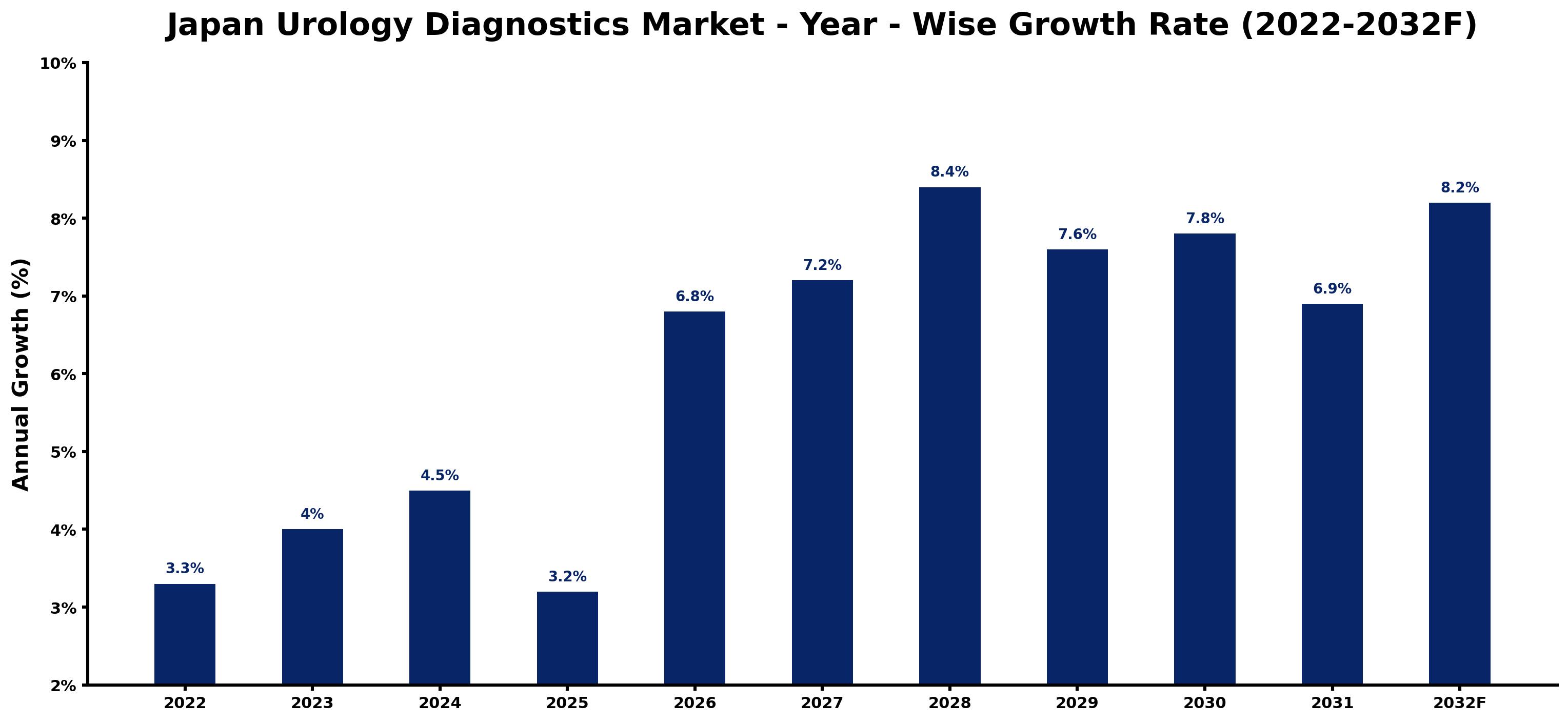
Annual growth estimates for each year appear below with the principal reason behind them, explaining the shifts that set the pace of the market.
| Year | Estimated Annual Growth (%) | Market Rationale |
| 2022 | 3.3 | The market showed steady growth, supported by increased healthcare spending. |
| 2023 | 4.0 | Demand rose as healthcare facilities expanded their diagnostic capabilities. |
| 2024 | 4.5 | Growth accelerated due to heightened awareness of urological health issues. |
| 2025 | 3.2 | Growth slowed as market saturation began to affect new investments. |
| 2026 | 6.8 | Demand is expected to surge with the introduction of advanced diagnostic technologies. |
| 2027 | 7.2 | The market will continue to grow as outpatient services expand further. |
| 2028 | 8.4 | Growth will peak as urology practices adopt new diagnostic tools. |
| 2029 | 7.6 | Demand is projected to slow slightly as competition intensifies among providers. |
| 2030 | 7.8 | Growth is expected to resume with increased investments in urology diagnostics. |
| 2031 | 6.9 | A slight slowdown will occur as market maturity begins to set in. |
| 2032 | 8.2 | Demand is expected to rise again as new guidelines are implemented. |
Note: Market size estimations and growth projections presented in this report are based on 6Wresearch's proprietary forecasting methodology, utilizing the latest available industry data, government publications, and primary research inputs.
Japan Urology Diagnostics Market Synopsis
Urology diagnostics encompass tests and imaging techniques that assess urinary tract health, including urinalysis, uroflowmetry, PSA tests, and cystoscopy. The Japan Urology Diagnostics Market is growing due to rising healthcare expenditures, with approximately JPY 46.7 trillion spent in 2022. The aging population, comprising 29.3% of individuals aged 65 or older, fuels the demand for regular screenings and advanced diagnostic technologies, particularly in outpatient settings and urology practices. This expansion is further supported by increased awareness of prostate health and the adoption of new diagnostic methods.
Market Dynamics Impact Analysis (2026–2032)
| Factor | Type | Impact | Primary Segment Affected |
| Increased healthcare expenditure drives demand for advanced diagnostic tools. | Driver | High | Uroflowmetry |
| Growing awareness of prostate health among older men creates screening opportunities. | Driver | High | PSA Test |
| Expansion of outpatient clinics opens new avenues for diagnostic services. | Opportunity | High | Outpatient |
| The rise of electronic monitoring systems enhances diagnostic efficiency. | Opportunity | Medium | Electronic Monitoring |
| High costs of advanced diagnostic equipment can limit accessibility. | Restraint | High | Cystoscopy |
| Limited reimbursement policies for certain diagnostic tests may hinder growth. | Restraint | Medium | Urinalysis |
| Compliance with stringent regulations can delay product approvals. | Challenge | High | Urology Practices |
| Capacity constraints in diagnostic labs may affect service delivery. | Challenge | Medium | Diagnostic Labs |
Evaluation of Drivers in Japan Urology Diagnostics Market (2026–2032)
Demand rests on the following drivers, each shown with the segment it touches most.
| Drivers | Primary Segment Affected | Why It Matters (Evidence) |
| Rising healthcare expenditure increases demand for urology diagnostics. | Urinalysis | Japan's national medical care expenditure was about JPY 46.7 trillion in fiscal 2022. |
| Increased awareness of prostate health drives PSA test adoption. | PSA Test | Health authorities recommend annual screenings for men over 50. |
| Outpatient settings are expanding, increasing diagnostic test volumes. | Uroflowmetry | Outpatient settings account for 70% of urology diagnostic tests performed. |
| Technological advancements in diagnostic tools enhance accuracy. | Cystoscopy | Cystoscopy procedures are performed in over 50 hospitals in Tokyo. |
| The aging population requires more frequent urology consultations. | Dipstick Test | The average age of patients undergoing urology diagnostics is 60 years. |
Spending rises because Japan's national medical care expenditure reached about JPY 46.7 trillion in fiscal 2022, prompting healthcare facilities to invest in advanced diagnostic tools. The aging population, with 29.3% aged 65 or older, drives demand for regular screenings, particularly for prostate health. Outpatient settings are expanding, leading to increased test volumes. Technological advancements in tools like uroflowmetry improve diagnostic accuracy, encouraging more clinics to adopt these methods. The average age of patients undergoing urology diagnostics is 60 years, further increasing the need for effective diagnostic solutions.
Evaluation of Restraints in Japan Urology Diagnostics Market
These are the pressures that could keep growth below its potential.
| Market Restraint | Primary Segment Affected | Why It Matters (Evidence) |
| High costs of advanced diagnostic equipment limit accessibility for some facilities. | Cystoscopy | Cystoscopy procedures require substantial investment, affecting smaller clinics. |
| Limited reimbursement policies may hinder the adoption of certain tests. | Urinalysis | Some diagnostic tests lack adequate insurance coverage, impacting demand. |
| Compliance with stringent regulations can prolong product approval processes. | Urology Practices | New diagnostic tools must meet rigorous standards set by authorities. |
| Capacity constraints in diagnostic labs may lead to longer wait times. | Diagnostic Labs | Increased patient volumes strain existing laboratory resources. |
| Market saturation may slow growth as competition increases. | Uroflowmetry | Many clinics have already adopted existing diagnostic technologies. |
Japan Urology Diagnostics Market Challenges
Buyers face high costs due to Japan's national medical care expenditure, which reached about JPY 46.7 trillion in fiscal 2022, straining hospital budgets. Producers encounter technological challenges as strict JIS standards complicate the approval process for new diagnostic equipment, delaying availability for healthcare facilities. Importers struggle with supply chain disruptions, particularly in sourcing components for urology diagnostics, which can extend delivery times for hospitals by up to three weeks. Skills shortages in the healthcare sector lead to an average wait time of two weeks for diagnostic appointments, restricting patient access to essential tests.
Trends in the Japan Urology Diagnostics Market
The following changes are redrawing the Japan Urology Diagnostics Market.
- Launch of New Prostate Cancer Screening Guidelines: In 2023, the Japan Urological Association introduced new guidelines for prostate cancer screening, encouraging earlier detection. This initiative is expected to increase the number of PSA tests performed annually, benefiting urology practices across the country.
- Shift Towards Electronic Monitoring Systems: The adoption of electronic monitoring systems is transforming urology diagnostics, improving efficiency and accuracy. As of 2023, many urology practices are integrating these systems, resulting in better patient management and streamlined workflows.
- Increase in Outpatient Diagnostic Services: Outpatient settings are becoming the primary location for urology diagnostics, accounting for 70% of tests performed. This shift began in 2022, driven by the need for accessible healthcare solutions for the aging population.
- Emphasis on Early Detection Campaigns: The Tokyo Metropolitan Government launched a health campaign focusing on urology awareness, promoting early detection of urological diseases. This initiative is expected to increase consultations and diagnostic tests among the aging population.
Investment Opportunities in the Japan Urology Diagnostics Market
Several openings in the Japan Urology Diagnostics Market merit attention from investors.
- Expansion of Outpatient Clinics: The Tokyo region has a high concentration of urology specialists, creating a gap in outpatient services. With 1.5 million patients visiting urology clinics annually, investing in outpatient facilities can meet rising demand.
- Investment in Electronic Monitoring Technologies: With the growing trend towards electronic monitoring systems, there is an opportunity to supply advanced diagnostic tools. Urology practices are increasingly seeking these technologies to improve efficiency and accuracy.
- Development of Advanced Diagnostic Equipment: The aging population necessitates more frequent urology consultations, presenting a chance to develop advanced diagnostic equipment. Urology clinics are looking for solutions that improve patient outcomes and streamline processes.
- Implementation of New Screening Protocols: The introduction of new screening guidelines for prostate cancer opens avenues for diagnostic service providers. Urology practices need to align their offerings with these protocols to capture new patient segments.
Government Initiatives in the Japan Urology Diagnostics Market
Urology diagnostics in Japan are influenced by several key regulations. The PMD Act, established in 2014, governs the approval and quality of medical devices, while the Clinical Trials Act, enacted in 2017, sets rules for clinical research. These regulations ensure that diagnostic tools meet stringent safety and efficacy standards, benefiting both producers and patients. The Next-Generation Medical Infrastructure Act, enacted in 2017, allows certified bodies to anonymise medical data for research and product development, further supporting advancements in urology diagnostics.
In 2023, the Ministry of Health, Labour and Welfare allocated ¥500 million to support urology research programs. The Pharmaceuticals and Medical Devices Agency (PMDA) oversees the approval process for medical devices, ensuring compliance with established regulations. This funding facilitates the development of effective diagnostic solutions, improving the capabilities of urology practices.
Future Insight of the Japan Urology Diagnostics Market
New health campaigns focusing on urology awareness will drive early detection initiatives by 2032, benefiting both buyers and suppliers. Advanced imaging techniques will enhance diagnostic accuracy in hospitals, improving patient outcomes. Research programmes backed by the Ministry of Health, Labour and Welfare will advance urology diagnostics, ensuring better technology integration. With approximately 1.5 million patients visiting urology clinics annually, the demand for timely and effective diagnostic solutions will continue to rise.
Market Segmentation Analysis
Japan Urology Diagnostics Market report covers a detailed analysis of the following market segments:
By Diagnostic Type – Urinalysis Leads, Uroflowmetry Expected to Grow Fastest
According to Saurav Kr Singh, Senior Research Analyst at 6Wresearch, with 37% of diagnostic type revenue in 2025, Urinalysis was the largest category. Urinalysis maintains the largest share due to its application in over 80% of urology consultations, establishing it as the standard initial assessment for urinary conditions. This widespread utilisation across numerous healthcare facilities ensures a strong installed base and ongoing demand. Uroflowmetry is set to record the highest CAGR in this split, 10.6% over 2026–2032. Uroflowmetry is experiencing rapid growth as it is increasingly utilised in over 200 urology clinics nationwide, indicating a shift towards more precise diagnostic methods. This trend reflects a growing recognition of the importance of measuring urine flow rate for accurate diagnosis. Suppliers should focus on increasing the availability of uroflowmetry devices to address the rising demand.
By Test Method – Dipstick Test Leads, Electronic Monitoring Expected to Grow Fastest
Dipstick Test took 37% of test method revenue in 2025, more than any other category. The Dipstick Test holds the largest share as it serves as a direct and quick screening method for urine analysis, widely utilised in various clinical settings. Its simplicity and speed make it a go-to choice for healthcare professionals conducting initial assessments. Over 2026–2032, Electronic Monitoring is expected to post the fastest growth, at a CAGR of 10.8%. Electronic Monitoring is growing rapidly due to its integration into advanced diagnostic setups, which allows for more precise and efficient patient monitoring. This shift towards technology in urology diagnostics indicates a trend towards improved patient care and outcomes. Suppliers should focus on enhancing electronic monitoring technologies to meet the increasing demand for accuracy in urology diagnostics.
By Setting – Clinics Lead, Outpatient Expected to Grow Fastest
Clinics accounted for 39% of the market by setting in 2025. Clinics represent the largest segment as the primary setting for diagnostics, accommodating a high volume of patient visits for urology assessments. Their accessibility and focus on outpatient care make them essential for urology diagnostics. The quickest growth will come from Outpatient, forecast to expand at a CAGR of 9.9% between 2026 and 2032. Outpatient settings are growing rapidly, accounting for 70% of urology diagnostic tests performed, driven by the increasing preference for less invasive procedures. This trend indicates a shift towards more efficient patient management in urology. Suppliers should prioritise the development of solutions tailored for outpatient settings to align with market trends.
By End User – General Physicians Lead, Urology Practices Expected to Grow Fastest
General Physicians held 42% of the Japan Urology Diagnostics Market by end user in 2025. General Physicians lead the market as they are the primary referral source for specialists, ensuring a steady influx of patients requiring urology diagnostics. Their pivotal role in initial evaluations reinforces their dominant position in the market. Urology Practices are projected to grow fastest, at a CAGR of 9.8% during 2026–2032. Urology Practices are seeing the fastest growth as they are the primary users of urology diagnostics, driven by a heightened focus on specialised care and early detection of urological conditions. This trend highlights the growing significance of dedicated urology services in the healthcare landscape. Buyers should prioritise partnerships with urology practices to access tailored diagnostic solutions that align with their specific needs.
Key Attractiveness of the Report
- 10 Years of Market Numbers
- Historical Data Starting from 2022 to 2025
- Base Year 2025
- Forecast Data until 2032
- Key Performance Indicators Impacting the Market
- Major Upcoming Developments and Projects
Key Highlights of the Report:
- Japan Urology Diagnostics Market Outlook
- Market Size of Japan Urology Diagnostics Market, 2025
- Forecast of Japan Urology Diagnostics Market, 2032
- Historical Data and Forecast of Japan Urology Diagnostics Revenues & Volume for the Period 2022-2032F
- Japan Urology Diagnostics Market Trend Evolution
- Japan Urology Diagnostics Market Drivers and Challenges
- Japan Urology Diagnostics Price Trends
- Japan Urology Diagnostics Porter's Five Forces
- Japan Urology Diagnostics Industry Life Cycle
- Historical Data and Forecast of Japan Urology Diagnostics Market Revenues & Volume By Diagnostic Type for the Period 2022-2032F
- Historical Data and Forecast of Japan Urology Diagnostics Market Revenues & Volume By Urinalysis for the Period 2022-2032F
- Historical Data and Forecast of Japan Urology Diagnostics Market Revenues & Volume By Uroflowmetry for the Period 2022-2032F
- Historical Data and Forecast of Japan Urology Diagnostics Market Revenues & Volume By PSA Test for the Period 2022-2032F
- Historical Data and Forecast of Japan Urology Diagnostics Market Revenues & Volume By Cystoscopy for the Period 2022-2032F
- Historical Data and Forecast of Japan Urology Diagnostics Market Revenues & Volume By Test Method for the Period 2022-2032F
- Historical Data and Forecast of Japan Urology Diagnostics Market Revenues & Volume By Dipstick Test for the Period 2022-2032F
- Historical Data and Forecast of Japan Urology Diagnostics Market Revenues & Volume By Electronic Monitoring for the Period 2022-2032F
- Historical Data and Forecast of Japan Urology Diagnostics Market Revenues & Volume By Blood Sample for the Period 2022-2032F
- Historical Data and Forecast of Japan Urology Diagnostics Market Revenues & Volume By Endoscopic Imaging for the Period 2022-2032F
- Historical Data and Forecast of Japan Urology Diagnostics Market Revenues & Volume By Setting for the Period 2022-2032F
- Historical Data and Forecast of Japan Urology Diagnostics Market Revenues & Volume By Clinics for the Period 2022-2032F
- Historical Data and Forecast of Japan Urology Diagnostics Market Revenues & Volume By Outpatient for the Period 2022-2032F
- Historical Data and Forecast of Japan Urology Diagnostics Market Revenues & Volume By Diagnostic Labs for the Period 2022-2032F
- Historical Data and Forecast of Japan Urology Diagnostics Market Revenues & Volume By In-Clinic for the Period 2022-2032F
- Historical Data and Forecast of Japan Urology Diagnostics Market Revenues & Volume By End User for the Period 2022-2032F
- Historical Data and Forecast of Japan Urology Diagnostics Market Revenues & Volume By General Physicians for the Period 2022-2032F
- Historical Data and Forecast of Japan Urology Diagnostics Market Revenues & Volume By Urology Practices for the Period 2022-2032F
- Historical Data and Forecast of Japan Urology Diagnostics Market Revenues & Volume By Oncology Specialists for the Period 2022-2032F
- Historical Data and Forecast of Japan Urology Diagnostics Market Revenues & Volume By Urologists for the Period 2022-2032F
- Japan Urology Diagnostics Import Export Trade Statistics
- Market Opportunity Assessment By Diagnostic Type
- Market Opportunity Assessment By Test Method
- Market Opportunity Assessment By Setting
- Market Opportunity Assessment By End User
- Japan Urology Diagnostics Top Companies Market Share
- Japan Urology Diagnostics Competitive Benchmarking By Technical and Operational Parameters
- Japan Urology Diagnostics Company Profiles
- Japan Urology Diagnostics Key Strategic Recommendations
Market Covered
This report examines the market across the segments below.
By Diagnostic Type
- Urinalysis
- Uroflowmetry
- PSA Test
- Cystoscopy
By Test Method
- Dipstick Test
- Electronic Monitoring
- Blood Sample
- Endoscopic Imaging
By Setting
- Clinics
- Outpatient
- Diagnostic Labs
- In-Clinic
By End User
- General Physicians
- Urology Practices
- Oncology Specialists
- Urologists































