Japan Utilities Metering Market Size & Growth Rate
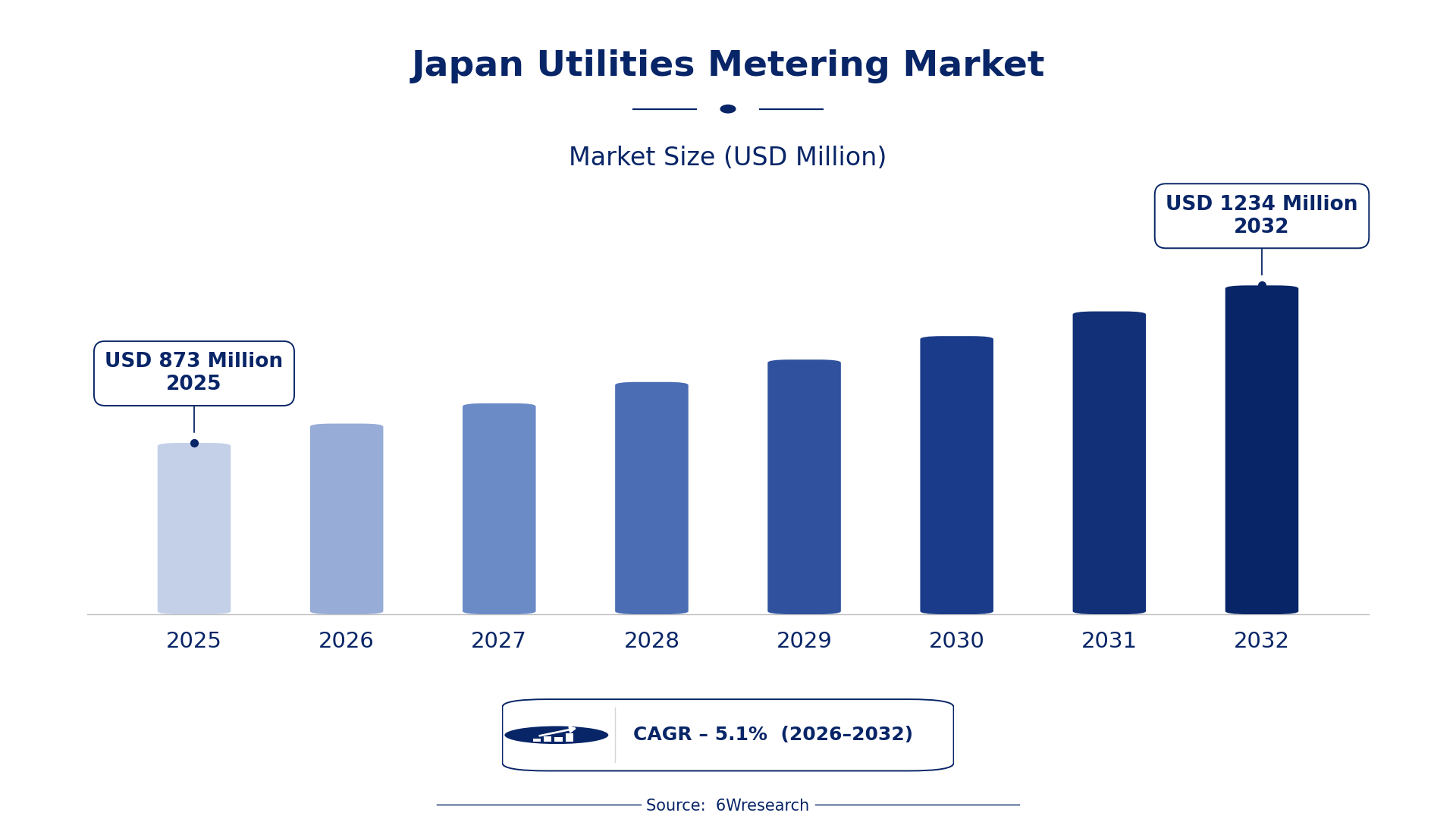
According to 6Wresearch internal database and industry insights, the Japan Utilities Metering Market was valued at USD 873 Million in 2025 and is projected to reach USD 1,234 Million by 2032, growing at a CAGR of approximately 5.1% during 2026–2032.
Japan Utilities Metering Market Highlights
| Report Metric | Details |
| Report Name | Japan Utilities Metering Market (2026-2032) |
| Market Size 2025 | USD 873 Million |
| Market Size 2032 | USD 1,234 Million |
| Absolute Growth 2025–2032 | USD 361 Million |
| CAGR 2026–2032 | 5.1% |
| Peak Annual Growth | 6.0% in 2028 |
| Forecast Period | 2026–2032 |
| Historical Data | 2022–2025 |
| Base Year | 2025 |
| Leading Meter Type, 2025 | Smart Electricity Meters (43% share) |
| Leading Utility Type, 2025 | Electricity (41% share) |
| Leading Communication Technology, 2025 | IoT/Cellular (43% share) |
| Leading End User, 2025 | Power Distribution Companies (48% share) |
| Fastest-Growing Meter Type | Smart Water Meters (7.5% CAGR) |
| Fastest-Growing Utility Type | Water (7.2% CAGR) |
| Fastest-Growing Communication Technology | LoRa/NB-IoT (7.7% CAGR) |
| Fastest-Growing End User | Municipal Utilities (6.5% CAGR) |
| Growing Sector | Municipal Utilities |
| Key End Users | Power Distribution Companies, Municipal Utilities, Utility Providers, Residential Consumers |
Japan Utilities Metering Market Year-wise Growth Rate and Key Drivers (2022–2032)
This graph illustrates the annual growth rates of the market from 2022 to 2032, highlighting a steady upward trajectory and projected market expansion over the forecast period.
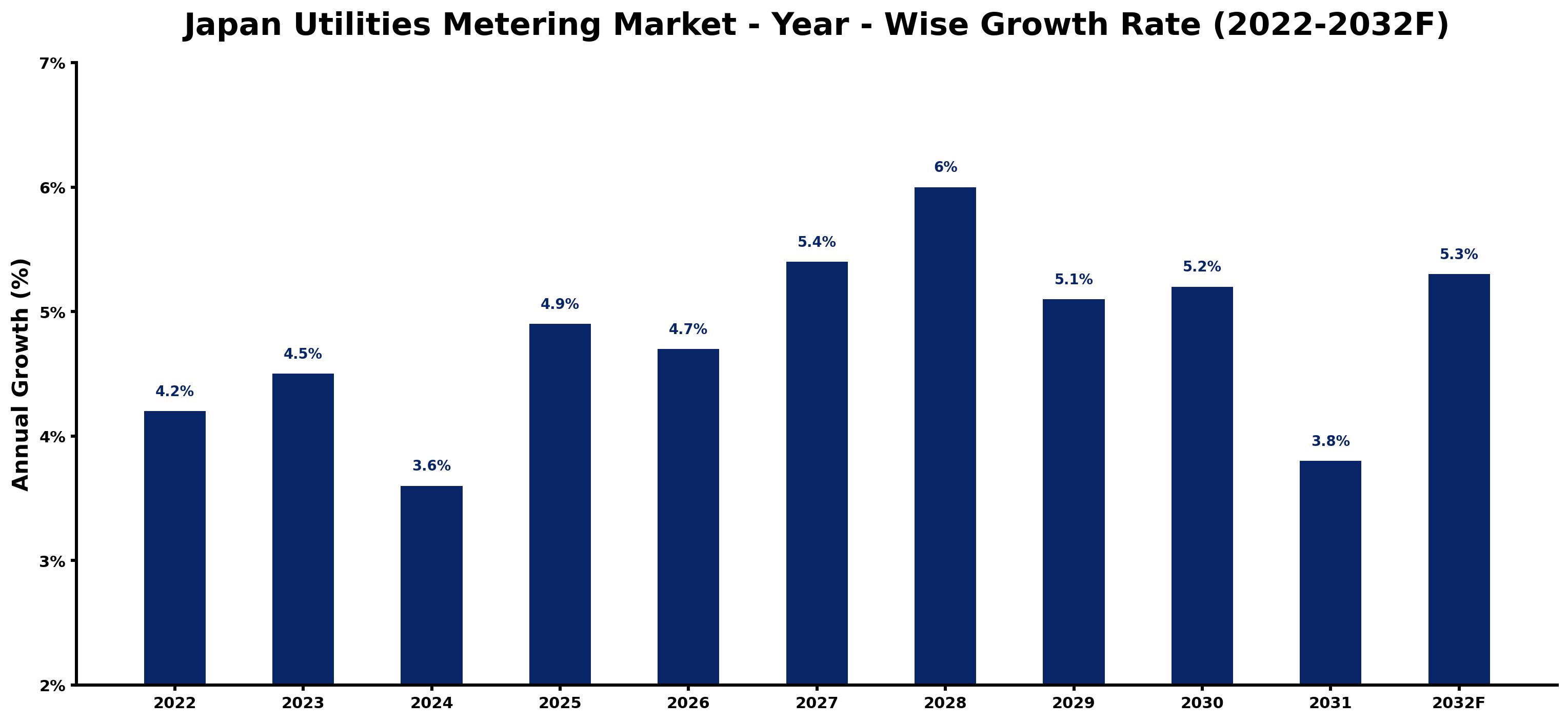
Annual growth estimates for each year appear below with the principal reason behind them, explaining the shifts that set the pace of the market.
| Year | Estimated Annual Growth (%) | Market Rationale |
| 2022 | 4.2 | The market experienced steady growth due to increased adoption of smart metering technologies. |
| 2023 | 4.5 | Demand rose as more households transitioned to smart electricity meters, improving billing accuracy. |
| 2024 | 3.6 | Growth slowed slightly as the market adjusted to earlier rapid expansions in smart meter installations. |
| 2025 | 4.9 | The market saw accelerated growth as the government targeted 100% smart meter deployment by 2025. |
| 2026 | 4.7 | Growth is expected to decelerate as the market stabilises after reaching installation milestones. |
| 2027 | 5.4 | Demand is projected to increase as utilities invest in advanced metering infrastructure to improve efficiency. |
| 2028 | 6.0 | The market is expected to peak with a surge in smart water meter installations across urban areas. |
| 2029 | 5.1 | Growth is projected to slow as the market matures and adoption rates reach saturation in some regions. |
| 2030 | 5.2 | Demand is expected to rise again as new technologies and standards emerge, improving utility management. |
| 2031 | 3.8 | Growth is projected to decelerate as market dynamics shift towards maintenance and upgrades of existing systems. |
| 2032 | 5.3 | The market is expected to grow as municipalities expand smart grid initiatives and technologies. |
Note: Market size estimations and growth projections presented in this report are based on 6Wresearch's proprietary forecasting methodology, utilizing the latest available industry data, government publications, and primary research inputs.
Japan Utilities Metering Market Synopsis
Utilities metering in Japan employs advanced technology to measure the consumption of electricity, gas, and water, facilitating monitoring and improving billing accuracy. The Japan Utilities Metering Market is growing, driven by domestic users and municipal utilities, with over 80 million smart electricity meters installed as of 2023. The government's goal for 100% smart meter deployment by 2025 and investments in smart grid technologies are crucial growth drivers, alongside the rising demand for efficient resource management in urban areas.
Market Dynamics Impact Analysis (2026–2032)
| Factor | Type | Impact | Primary Segment Affected |
| Rising adoption of smart electricity meters | Driver | High | Smart Electricity Meters |
| Government initiatives for smart meter deployment | Driver | High | Smart Gas Meters |
| Growing need for efficient water management | Opportunity | High | Smart Water Meters |
| Investment in smart grid technologies | Opportunity | High | Multi-Utility |
| High installation costs of advanced metering systems | Restraint | Medium | Smart Electricity Meters |
| Limited infrastructure in rural areas | Restraint | Medium | Smart Water Meters |
| Competition from alternative metering solutions | Challenge | High | Smart Gas Meters |
| Technological obsolescence of older systems | Challenge | Medium | Smart Electricity Meters |
Evaluation of Drivers in Japan Utilities Metering Market (2026–2032)
The factors lifting demand, and the evidence behind each, are summarised below.
| Drivers | Primary Segment Affected | Why It Matters (Evidence) |
| Increased utility efficiency through smart metering | Smart Electricity Meters | Over 80 million smart electricity meters installed as of 2023 improve monitoring and billing accuracy for consumers. |
| Government support for smart meter deployment | Smart Gas Meters | The government aims for 100% smart meter deployment by 2025, driving demand among utility providers. |
| Need for accurate water usage tracking | Smart Water Meters | The average water consumption per person in Japan is around 250 litres daily, necessitating smart meters for effective management. |
| Technological advancements in IoT communication | IoT/Cellular | IoT-enabled meters facilitate real-time data transmission, improving operational efficiency for utilities. |
| Growing urbanisation and infrastructure development | Municipal Utilities | Investment in smart water meters is increasing as municipalities prioritise efficient resource management. |
Behind the steady rise in orders sits the increased adoption of smart metering technologies. As of 2023, over 80 million smart electricity meters have been installed, leading to improved monitoring and billing accuracy for residential consumers. The average water consumption per person in Japan is around 250 litres daily, necessitating smart water meters for effective management. IoT-enabled meters facilitate real-time data transmission, allowing utilities to optimise their operations and reduce waste.
Evaluation of Restraints in Japan Utilities Metering Market
These are the pressures that could keep growth below its potential.
| Market Restraint | Primary Segment Affected | Why It Matters (Evidence) |
| High installation costs of smart metering systems | Smart Electricity Meters | Installation costs can exceed ¥10 billion for upgrades, limiting adoption. |
| Limited infrastructure in rural areas | Smart Water Meters | Over 1,200 municipal utilities face challenges in upgrading metering infrastructure, affecting service quality. |
| Competition from alternative metering solutions | Smart Gas Meters | The rise of prepaid meters in certain residential areas diverts investment from smart gas meters. |
| Technological obsolescence of older systems | Smart Electricity Meters | Older metering systems may not integrate with new technologies, increasing operational costs. |
| Regulatory compliance costs | Smart Water Meters | Compliance with standards like the Smart Metering Standard (JIS C 61000-3-2) adds to operational expenses. |
Japan Utilities Metering Market Challenges
Japan's advanced technology for utilities metering faces supply chain disruptions due to reliance on specialised components, causing delays in installations for utility providers. High production costs stem from strict regulations, which can raise prices by up to 15%, putting pressure on municipal utilities. Compliance with the Smart Metering Standard can prolong the introduction timeline for new technologies, affecting energy management efficiency for end users. Competitive pressures among manufacturers drive innovation but may lead to market saturation, complicating profitability for producers as they navigate a crowded market.
Trends in the Japan Utilities Metering Market
Buyers and suppliers in the Japan Utilities Metering Market are adjusting to the following trends.
- Shift from Traditional to Smart Metering: Since 2023, Japan has experienced a transition from traditional metering to smart metering technologies. The Tokyo metropolitan area is a key hub for this shift, with over 80 million smart electricity meters installed, enhancing utility management.
- Emergence of IoT-Enabled Metering Solutions: The adoption of IoT-enabled metering solutions has accelerated since 2021, enabling real-time data transmission. This trend is particularly noticeable in the Kansai region, where utilities are investing in advanced communication technologies.
- Focus on Water Management Technologies: Beginning in 2023, there has been a heightened focus on smart water meters to manage consumption effectively. With an average water usage of 250 litres per person daily, municipalities are prioritising these technologies.
- Integration of Multi-Utility Solutions: The trend towards multi-utility solutions has gained momentum since 2023, as utilities seek integrated systems for efficiency. The Smart City Strategy aims for improved utility management by 2025, driving demand for such solutions.
Investment Opportunities in the Japan Utilities Metering Market
The following areas offer the clearest openings for investors and suppliers in the Japan Utilities Metering Market.
- Power Distribution Companies: With over 80 million smart electricity meters installed, power distribution companies require advanced metering solutions to improve efficiency. Investing in IoT-enabled meters will enable them to manage resources effectively.
- Municipal Utilities: The average water consumption per person in Japan is around 250 litres daily, creating a demand for smart water meters. Municipalities can invest in these technologies to enhance management and reduce waste.
- Kansai Region: The Kansai region is recognised for its advanced utility infrastructure, presenting opportunities for suppliers of smart metering technologies. Collaborations with local utilities can facilitate market entry and growth.
- Smart Grid Technologies: Japan invested ¥10 billion in smart grid technologies in 2023, indicating a notable opportunity for suppliers. Partnering with municipal utilities can help meet the increasing demand for efficient energy management.
Government Initiatives in the Japan Utilities Metering Market
The Water Supply Act (1957) establishes standards for drinking-water quality and supply, while the Sewerage Act (1958) regulates sewerage systems and wastewater treatment. These laws ensure that utilities meet quality standards, influencing the deployment of smart water meters. Utilities must adhere to these regulations to maintain service quality and efficiency.
The Hydrogen Society Promotion Act (2024; METI) supports low-carbon hydrogen and ammonia supply chains, encouraging utilities to adopt advanced technologies. This initiative is expected to improve overall efficiency in utility management, allowing for better resource allocation and sustainability.
Future Insight of the Japan Utilities Metering Market
By 2032, the shift towards 100% smart meter deployment will revolutionise utility management, compelling suppliers to embrace new technologies. Investment in smart grid technologies is projected to reach ¥20 billion, improving energy efficiency across the sector. The integration of ISO 50001 standards will standardise energy management practices, enabling buyers to optimise consumption. Enhanced infrastructure in urban areas will provide better utility services, benefiting consumers with more accurate billing and improved energy management capabilities.
Market Segmentation Analysis
Japan Utilities Metering Market report covers a detailed analysis of the following market segments:
By Meter Type – Smart Electricity Meters Lead, Smart Water Meters Expected to Grow Fastest
According to Saurav Kr Singh, Senior Research Analyst at 6Wresearch, with 43% of meter type revenue in 2025, Smart Electricity Meters was the largest category. Smart electricity meters dominate the market due to their extensive use in real-time monitoring of electricity consumption across Japan. With over 80 million units installed, they serve both residential and commercial sectors effectively, ensuring accurate billing and energy management. The quickest growth will come from Smart Water Meters, forecast to expand at a CAGR of 7.5% between 2026 and 2032. Smart water meters are experiencing rapid growth as municipalities focus on managing water usage and reducing waste. The average water consumption per person in Japan is around 250 litres per day, highlighting the need for efficient monitoring solutions. Suppliers should prioritise the development of smart water metering technologies to capture this growing demand.
By Utility Type – Electricity Leads, Water Expected to Grow Fastest
Electricity accounted for 41% of the market by utility type in 2025. Electricity holds the largest share as it is the primary utility measured for both residential and commercial use in Japan. The government's commitment to achieving 100% smart meter deployment by 2025 further underscores the importance of accurate electricity consumption monitoring. Water is projected to grow fastest, at a CAGR of 7.2% during 2026–2032. Water is witnessing rapid growth as municipal utilities increasingly implement efficient water management strategies. With over 1,200 municipal utilities in Japan, there is a strong drive towards adopting advanced water metering technologies to meet rising demands. Suppliers should focus on developing tailored metering solutions for the water sector to capitalise on this growth opportunity.
By Communication Technology – IoT/Cellular Leads, LoRa/NB-IoT Expected to Grow Fastest
The largest communication technology category in 2025 was IoT/Cellular, at 43% of revenue. IoT/cellular technology leads the communication segment due to its capability to enable real-time data transmission and monitoring for utilities. This technology is crucial for the effective operation of smart meters across various utility applications in Japan. Over 2026–2032, LoRa/NB-IoT is expected to post the fastest growth, at a CAGR of 7.7%. LoRa/NB-IoT is the fastest-growing communication technology, driven by its suitability for low-power, wide-area communication in utility metering. The increasing need for efficient communication solutions aligns with the growing deployment of smart meters. Suppliers should explore integrating LoRa/NB-IoT capabilities into their metering products to meet evolving market demands.
By End User – Power Distribution Companies Lead, Municipal Utilities Expected to Grow Fastest
Power Distribution Companies took 48% of end user revenue in 2025, more than any other category. Power distribution companies represent the primary end users of metering technology, relying on accurate data for effective grid management. Their essential role in the energy sector guarantees a steady demand for advanced metering solutions. Municipal Utilities are set to record the highest CAGR in this split, 6.5% over 2026–2032. Municipal utilities are rapidly adopting metering technologies to improve the management of city-wide utility services. This trend is driven by the necessity for enhanced operational efficiency and resource management in urban settings. Suppliers should tailor their offerings to meet the specific requirements of municipal utilities to capture this expanding market segment.
Key Attractiveness of the Report
- 10 Years of Market Numbers
- Historical Data Starting from 2022 to 2025
- Base Year 2025
- Forecast Data until 2032
- Key Performance Indicators Impacting the Market
- Major Upcoming Developments and Projects
Key Highlights of the Report:
- Japan Utilities Metering Market Outlook
- Market Size of Japan Utilities Metering Market, 2025
- Forecast of Japan Utilities Metering Market, 2032
- Historical Data and Forecast of Japan Utilities Metering Revenues & Volume for the Period 2022-2032F
- Japan Utilities Metering Market Trend Evolution
- Japan Utilities Metering Market Drivers and Challenges
- Japan Utilities Metering Price Trends
- Japan Utilities Metering Porter's Five Forces
- Japan Utilities Metering Industry Life Cycle
- Historical Data and Forecast of Japan Utilities Metering Market Revenues & Volume By Meter Type for the Period 2022-2032F
- Historical Data and Forecast of Japan Utilities Metering Market Revenues & Volume By Smart Electricity Meters for the Period 2022-2032F
- Historical Data and Forecast of Japan Utilities Metering Market Revenues & Volume By Smart Gas Meters for the Period 2022-2032F
- Historical Data and Forecast of Japan Utilities Metering Market Revenues & Volume By Smart Water Meters for the Period 2022-2032F
- Historical Data and Forecast of Japan Utilities Metering Market Revenues & Volume By Prepaid Meters for the Period 2022-2032F
- Historical Data and Forecast of Japan Utilities Metering Market Revenues & Volume By Utility Type for the Period 2022-2032F
- Historical Data and Forecast of Japan Utilities Metering Market Revenues & Volume By Electricity for the Period 2022-2032F
- Historical Data and Forecast of Japan Utilities Metering Market Revenues & Volume By Natural Gas for the Period 2022-2032F
- Historical Data and Forecast of Japan Utilities Metering Market Revenues & Volume By Water for the Period 2022-2032F
- Historical Data and Forecast of Japan Utilities Metering Market Revenues & Volume By Multi-Utility for the Period 2022-2032F
- Historical Data and Forecast of Japan Utilities Metering Market Revenues & Volume By Communication Technology for the Period 2022-2032F
- Historical Data and Forecast of Japan Utilities Metering Market Revenues & Volume By IoT/Cellular for the Period 2022-2032F
- Historical Data and Forecast of Japan Utilities Metering Market Revenues & Volume By RF/Wireless for the Period 2022-2032F
- Historical Data and Forecast of Japan Utilities Metering Market Revenues & Volume By LoRa/NB-IoT for the Period 2022-2032F
- Historical Data and Forecast of Japan Utilities Metering Market Revenues & Volume By GSM/Edge for the Period 2022-2032F
- Historical Data and Forecast of Japan Utilities Metering Market Revenues & Volume By End User for the Period 2022-2032F
- Historical Data and Forecast of Japan Utilities Metering Market Revenues & Volume By Power Distribution Companies for the Period 2022-2032F
- Historical Data and Forecast of Japan Utilities Metering Market Revenues & Volume By Residential Consumers for the Period 2022-2032F
- Historical Data and Forecast of Japan Utilities Metering Market Revenues & Volume By Municipal Utilities for the Period 2022-2032F
- Historical Data and Forecast of Japan Utilities Metering Market Revenues & Volume By Utility Providers for the Period 2022-2032F
- Japan Utilities Metering Import Export Trade Statistics
- Market Opportunity Assessment By Meter Type
- Market Opportunity Assessment By Utility Type
- Market Opportunity Assessment By Communication Technology
- Market Opportunity Assessment By End User
- Japan Utilities Metering Top Companies Market Share
- Japan Utilities Metering Competitive Benchmarking By Technical and Operational Parameters
- Japan Utilities Metering Company Profiles
- Japan Utilities Metering Key Strategic Recommendations
Market Covered
Coverage by segment is as follows.
By Meter Type
- Smart Electricity Meters
- Smart Gas Meters
- Smart Water Meters
- Prepaid Meters
By Utility Type
- Electricity
- Natural Gas
- Water
- Multi-Utility
By Communication Technology
- IoT/Cellular
- RF/Wireless
- LoRa/NB-IoT
- GSM/Edge
By End User
- Power Distribution Companies
- Residential Consumers
- Municipal Utilities
- Utility Providers































