Japan Utility Analytics Market Size & Growth Rate
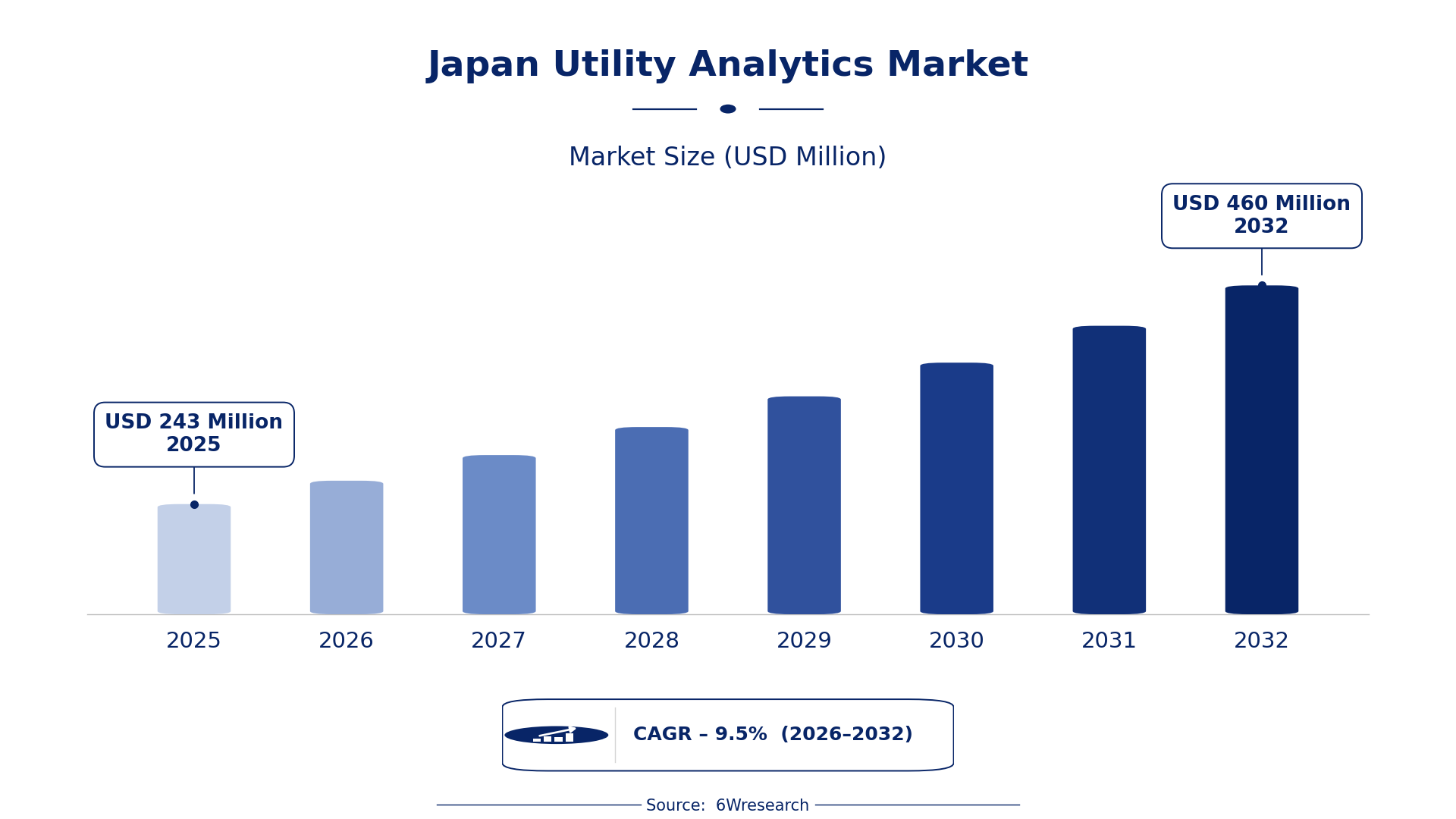
According to 6Wresearch internal database and industry insights, the Japan Utility Analytics Market was valued at USD 243 Million in 2025 and is projected to reach USD 460 Million by 2032, growing at a CAGR of approximately 9.5% during 2026–2032.
Japan Utility Analytics Market Highlights
| Report Metric | Details |
| Report Name | Japan Utility Analytics Market (2026-2032) |
| Market Size 2025 | USD 243 Million |
| Market Size 2032 | USD 460 Million |
| Absolute Growth 2025–2032 | USD 217 Million |
| CAGR 2026–2032 | 9.5% |
| Peak Annual Growth | 10.2% in 2028 |
| Forecast Period | 2026–2032 |
| Historical Data | 2022–2025 |
| Base Year | 2025 |
| Leading Analytics Type, 2025 | Load Forecasting (45% share) |
| Leading Application Area, 2025 | Energy Grids (52% share) |
| Leading Deployment Model, 2025 | Cloud-Based (38% share) |
| Leading End User, 2025 | Utility Companies (37% share) |
| Fastest-Growing Analytics Type | Predictive Maintenance (12.9% CAGR) |
| Fastest-Growing Application Area | Equipment & Assets (11.9% CAGR) |
| Fastest-Growing Deployment Model | On-Premise + Edge (13.6% CAGR) |
| Fastest-Growing End User | Grid Operators (12.6% CAGR) |
| Growing Sector | Utility sector |
| Key End Users | Utility Companies, Grid Operators, Energy Retailers, Smart City Planners |
Japan Utility Analytics Market Year-wise Growth Rate and Key Drivers (2022–2032)
This graph illustrates the annual growth rates of the market from 2022 to 2032, highlighting a steady upward trajectory and projected market expansion over the forecast period.
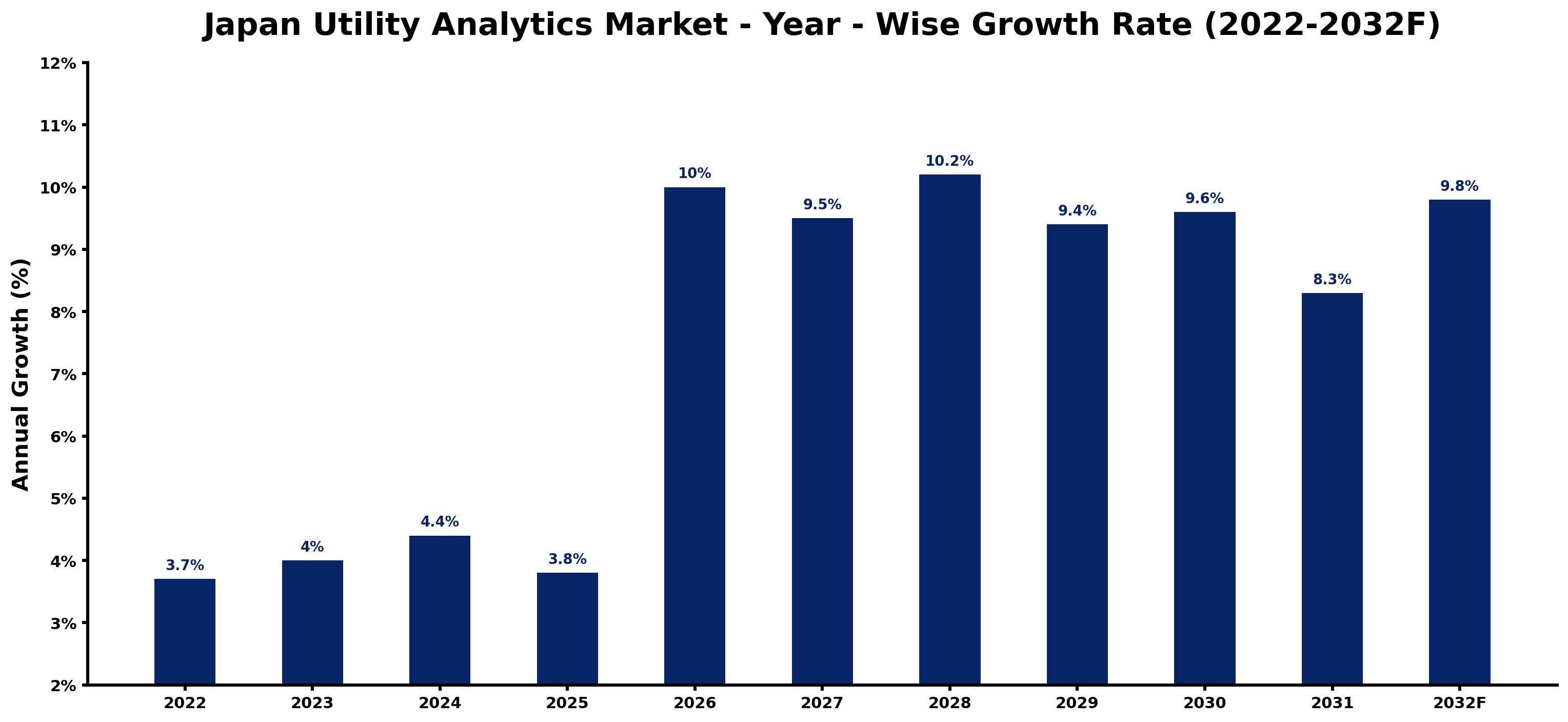
The yearly estimates that follow link every growth rate to its principal driver, so readers can see why the pace changed in each period.
| Year | Estimated Annual Growth (%) | Market Rationale |
| 2022 | 3.7 | The market showed steady growth due to ongoing analytics adoption among utility companies. |
| 2023 | 4.0 | Growth accelerated as utility companies increased investments in data-driven decision-making. |
| 2024 | 4.4 | The market continued to gain momentum with rising demand for predictive maintenance solutions. |
| 2025 | 3.8 | Growth slowed slightly as companies evaluated the effectiveness of existing analytics implementations. |
| 2026 | 10.0 | The market is expected to surge as utility companies embrace cloud-based analytics for improved efficiency. |
| 2027 | 9.5 | Growth is projected to decelerate as the market matures and competition intensifies among providers. |
| 2028 | 10.2 | Demand is anticipated to peak as utility companies expand their analytics capabilities for grid optimization. |
| 2029 | 9.4 | Growth is expected to slow again as market saturation begins to set in among established players. |
| 2030 | 9.6 | The market is projected to rebound with renewed focus on energy efficiency and sustainability initiatives. |
| 2031 | 8.3 | Growth is expected to moderate as utility companies consolidate their analytics investments and strategies. |
| 2032 | 9.8 | The market is anticipated to stabilise as analytics become standard practice across the sector. |
Note: Market size estimations and growth projections presented in this report are based on 6Wresearch's proprietary forecasting methodology, utilizing the latest available industry data, government publications, and primary research inputs.
Japan Utility Analytics Market Synopsis
Utility analytics involves data analysis tools to optimise operations, improve customer service, and boost energy efficiency. In Japan, over 1,000 utility companies utilise analytics, driven by the need for load forecasting, predictive maintenance, and grid optimisation. The market is growing as the government promotes smart grid initiatives and aims for a 46% reduction in greenhouse gas emissions by 2030, further driving analytics adoption across the sector. The total installed capacity of renewable energy reached 100 GW in 2023, highlighting the increasing reliance on advanced analytics.
Market Dynamics Impact Analysis (2026–2032)
| Factor | Type | Impact | Primary Segment Affected |
| Increasing demand for predictive maintenance solutions to reduce downtime and operational costs. | Driver | High | Predictive Maintenance |
| Rising focus on energy efficiency and sustainability initiatives among utility companies. | Driver | High | Energy Grids |
| Growing need for advanced analytics tools to manage increasing energy demands. | Opportunity | High | Load Forecasting |
| Expansion of smart grid initiatives creating demand for analytics in energy management. | Opportunity | High | Grid Optimization |
| High initial investment costs for implementing advanced analytics solutions. | Restraint | High | Predictive Maintenance |
| Limited availability of skilled professionals to manage and analyse data effectively. | Restraint | Medium | Energy Grids |
| Complexity in integrating new analytics systems with legacy infrastructure. | Challenge | High | Utility Companies |
| Rapid technological advancements leading to frequent updates and changes in analytics tools. | Challenge | Medium | Grid Operators |
Evaluation of Drivers in Japan Utility Analytics Market (2026–2032)
These are the developments adding the most demand over the forecast period.
| Drivers | Primary Segment Affected | Why It Matters (Evidence) |
| Increased investments in predictive maintenance tools. | Predictive Maintenance | Utility companies in the Tokyo metropolitan area invest heavily to minimise downtime, with analytics reducing maintenance costs by up to 30%. |
| Growing emphasis on energy efficiency initiatives. | Energy Grids | The target of reducing greenhouse gas emissions by 46% by 2030 prompts utilities to adopt advanced analytics for better energy management. |
| Rising electricity consumption necessitating accurate load forecasting. | Load Forecasting | With average household consumption at about 3,000 kWh annually, utility companies increasingly rely on analytics to predict demand accurately. |
| Expansion of smart grid initiatives across Japan. | Grid Optimization | Promotion of smart grid initiatives leads to increased analytics adoption for efficient energy distribution. |
| Widespread adoption of cloud-based analytics solutions. | Cloud-Based | Cloud-based models are preferred for their flexibility, with 38% of utilities in Japan using them to improve operational efficiency. |
Orders keep climbing as utility companies increasingly invest in predictive maintenance tools. In the Tokyo metropolitan area, these investments have reduced maintenance costs significantly. The push for energy efficiency drives utilities to adopt advanced analytics for improved management. With average household electricity consumption around 3,000 kWh annually, accurate load forecasting has become essential. The integration of IoT technologies is enhancing data collection, while cloud-based solutions are preferred for their flexibility and scalability, with 38% of utilities adopting them.
Evaluation of Restraints in Japan Utility Analytics Market
The main factors holding the market back are set out below.
| Market Restraint | Primary Segment Affected | Why It Matters (Evidence) |
| High initial investment costs for advanced analytics solutions. | Predictive Maintenance | Utility companies face substantial upfront costs, which can deter them from implementing new analytics systems. |
| Limited availability of skilled professionals in analytics. | Energy Grids | The shortage of qualified personnel hampers effective management and analysis of data, affecting operational efficiency. |
| Complex integration with existing legacy systems. | Utility Companies | Many utilities struggle to integrate new analytics solutions with outdated infrastructure, causing operational delays. |
| Rapid technological changes in analytics tools. | Grid Operators | The fast pace of technology evolution requires constant updates, which can strain resources and budgets. |
| Data privacy concerns impacting analytics adoption. | Load Forecasting | Utility companies must navigate strict data protection regulations, which can limit their ability to use customer data effectively. |
Japan Utility Analytics Market Challenges
High operational costs challenge utility companies, stemming from the need for advanced data analysis tools and IoT integration. A skills gap remains, as over 30% of power generation facilities are over 30 years old, necessitating specialised expertise for effective predictive maintenance. Intense competition among more than 1,000 utility companies pressures pricing, causing some to underinvest in critical data capabilities. Regulatory complexities, such as compliance with the ISO 50001 standard, can delay project implementations and increase costs for utilities striving to improve energy management systems.
Trends in the Japan Utility Analytics Market
Buyers and suppliers in the Japan Utility Analytics Market are adjusting to the following trends.
- Shift from On-Premise to Cloud-Based Analytics: Utility companies are increasingly adopting cloud-based analytics solutions for their flexibility and scalability. In 2023, 38% of utilities in Japan have transitioned to this model, allowing for better data management and analysis.
- Increasing Integration of IoT in Utility Analytics: The integration of IoT technologies in utility analytics is becoming more prevalent. In 2023, the installed base of smart meters reached 30 million units, enabling real-time data collection and analysis for improved decision-making.
- Focus on Predictive Maintenance Over Reactive Strategies: Utility companies are prioritising predictive maintenance analytics to minimise downtime. This shift is projected as the predictive maintenance segment is expected to grow at a CAGR of 12.9% through 2032.
- Expansion of Smart Grid Initiatives: The Hydrogen Society Promotion Act is driving the adoption of analytics for urban energy management. This initiative aims to improve energy efficiency and sustainability, aligning with the government's 2030 renewable energy targets.
Investment Opportunities in the Japan Utility Analytics Market
The following opportunities in the Japan Utility Analytics Market pair current demand with a clear way in.
- Supply of Advanced Predictive Maintenance Tools: With projected growth in predictive maintenance, suppliers can focus on utility companies seeking these tools to minimise downtime and costs. Collaborating with local firms can facilitate market entry.
- Investment in Cloud-Based Analytics Solutions: As 38% of utilities prefer cloud solutions, there is an expanding opportunity to provide these services. Forming joint ventures with local analytics providers can enhance market penetration.
- Development of IoT-Enabled Analytics Solutions: The demand for IoT integration is increasing, with 30 million smart meters installed. Suppliers can concentrate on developing IoT-enabled analytics for utility companies to boost operational efficiency.
- Provision of Training for Data Analytics Professionals: With a shortage of skilled professionals, there is a growing need for training services in analytics. Partnering with educational institutions can help address this gap.
Government Initiatives in the Japan Utility Analytics Market
The Industrial Safety and Health Act of 1972 mandates safety standards for hazardous substances and machinery, impacting utility companies by requiring them to invest in safety measures and reporting protocols. More recently, the Hydrogen Society Promotion Act of 2024 supports low-carbon hydrogen supply chains, encouraging utilities to adopt cleaner technologies and analytics for efficiency.
The Digital Agency established in 2021 leads government digital transformation initiatives. This agency supports the implementation of common system standards, enabling utilities to streamline their operations and improve data analytics capabilities.
Future Insight of the Japan Utility Analytics Market
Domestic utility companies will increasingly adopt advanced data analysis by 2032, influenced by government initiatives like the Green Growth Strategy. The installed base of smart meters is projected to reach 30 million units, improving data collection and operational efficiency. Energy efficiency programmes supported by the Ministry of Economy, Trade and Industry will further integrate data analysis into utility operations. As Japan aims for 20-22% of electricity from renewables by 2030, suppliers must innovate their offerings to align with evolving energy needs.
Market Segmentation Analysis
Japan Utility Analytics Market report covers a detailed analysis of the following market segments:
By Analytics Type – Load Forecasting Leads, Predictive Maintenance Expected to Grow Fastest
According to Saurav Kr Singh, Senior Research Analyst at 6Wresearch, Load Forecasting held 45% of the Japan Utility Analytics Market by analytics type in 2025. Load forecasting holds the largest share because it is essential for accurately predicting energy demand and managing supply effectively. For instance, Tokyo Electric Power Company relies heavily on load forecasting to optimise its operations and meet customer needs. Predictive Maintenance is set to record the highest CAGR in this split, 12.9% over 2026–2032. Predictive maintenance is growing rapidly due to the ageing power generation facilities, which average over 30 years, creating a pressing need for advanced analytics for upkeep. This growth is further supported by government initiatives focused on enhancing energy efficiency. Suppliers should prioritise the development of predictive maintenance solutions to meet the rising demand from utility companies.
By Application Area – Energy Grids Lead, Equipment & Assets Expected to Grow Fastest
The largest application area category in 2025 was Energy Grids, at 52% of revenue. Energy grids command the largest share as they are critical for managing energy distribution systems, which ensure supply reliability. The integration of analytics within energy grids is fundamental for utilities to optimise operations and adhere to regulatory standards. Over 2026–2032, Equipment & Assets are expected to post the fastest growth, at a CAGR of 11.9%. The equipment and assets segment is expanding quickly as utilities aim to minimise downtime and maintenance costs through advanced analytics. This trend is driven by the increasing complexity of managing a diverse range of energy assets. Buyers should focus on analytics solutions that improve equipment management to enhance operational efficiency.
By Deployment Model – Cloud-Based Leads, On-Premise + Edge Expected to Grow Fastest
Cloud-Based took 38% of deployment model revenue in 2025, more than any other category. Cloud-based deployment leads the market due to its flexibility and scalability, allowing utilities to adapt to changing demands effectively. The widespread adoption of cloud solutions among utility companies highlights their preference for modernising operations. The quickest growth will come from On-Premise + Edge, forecast to expand at a CAGR of 13.6% between 2026 and 2032. The on-premise and edge model is experiencing rapid growth as utilities seek tailored solutions that offer enhanced control over data management. This trend is particularly relevant for organisations with specific regulatory compliance needs. Suppliers must consider offering solutions that integrate cloud and on-premise capabilities to cater to diverse utility requirements.
By End User – Utility Companies Lead, Grid Operators Expected to Grow Fastest
Utility Companies accounted for 37% of the market by end user in 2025. Utility companies represent the largest share as they are the primary users of analytics for improving operational efficiency and service delivery. Their extensive use of analytics is evident from the over 1,000 utility companies employing these tools across Japan. Grid Operators are projected to grow fastest, at a CAGR of 12.6% during 2026–2032. Grid operators are witnessing the fastest growth as they increasingly rely on analytics for effective grid management and optimisation. The need for improved efficiency in grid operations drives this swift adoption. Providers should concentrate on developing specialised analytics solutions for grid operators to capitalise on this growth opportunity.
Key Attractiveness of the Report
- 10 Years of Market Numbers
- Historical Data Starting from 2022 to 2025
- Base Year 2025
- Forecast Data until 2032
- Key Performance Indicators Impacting the Market
- Major Upcoming Developments and Projects
Key Highlights of the Report:
- Japan Utility Analytics Market Outlook
- Market Size of Japan Utility Analytics Market, 2025
- Forecast of Japan Utility Analytics Market, 2032
- Historical Data and Forecast of Japan Utility Analytics Revenues & Volume for the Period 2022-2032F
- Japan Utility Analytics Market Trend Evolution
- Japan Utility Analytics Market Drivers and Challenges
- Japan Utility Analytics Price Trends
- Japan Utility Analytics Porter's Five Forces
- Japan Utility Analytics Industry Life Cycle
- Historical Data and Forecast of Japan Utility Analytics Market Revenues & Volume By Analytics Type for the Period 2022-2032F
- Historical Data and Forecast of Japan Utility Analytics Market Revenues & Volume By Load Forecasting for the Period 2022-2032F
- Historical Data and Forecast of Japan Utility Analytics Market Revenues & Volume By Predictive Maintenance for the Period 2022-2032F
- Historical Data and Forecast of Japan Utility Analytics Market Revenues & Volume By Consumption Pattern for the Period 2022-2032F
- Historical Data and Forecast of Japan Utility Analytics Market Revenues & Volume By Grid Optimization for the Period 2022-2032F
- Historical Data and Forecast of Japan Utility Analytics Market Revenues & Volume By Application Area for the Period 2022-2032F
- Historical Data and Forecast of Japan Utility Analytics Market Revenues & Volume By Energy Grids for the Period 2022-2032F
- Historical Data and Forecast of Japan Utility Analytics Market Revenues & Volume By Equipment & Assets for the Period 2022-2032F
- Historical Data and Forecast of Japan Utility Analytics Market Revenues & Volume By Customer Billing for the Period 2022-2032F
- Historical Data and Forecast of Japan Utility Analytics Market Revenues & Volume By Electricity Distribution for the Period 2022-2032F
- Historical Data and Forecast of Japan Utility Analytics Market Revenues & Volume By Deployment Model for the Period 2022-2032F
- Historical Data and Forecast of Japan Utility Analytics Market Revenues & Volume By Cloud-Based for the Period 2022-2032F
- Historical Data and Forecast of Japan Utility Analytics Market Revenues & Volume By On-Premise + Edge for the Period 2022-2032F
- Historical Data and Forecast of Japan Utility Analytics Market Revenues & Volume By SaaS for the Period 2022-2032F
- Historical Data and Forecast of Japan Utility Analytics Market Revenues & Volume By Hybrid for the Period 2022-2032F
- Historical Data and Forecast of Japan Utility Analytics Market Revenues & Volume By End User for the Period 2022-2032F
- Historical Data and Forecast of Japan Utility Analytics Market Revenues & Volume By Utility Companies for the Period 2022-2032F
- Historical Data and Forecast of Japan Utility Analytics Market Revenues & Volume By Grid Operators for the Period 2022-2032F
- Historical Data and Forecast of Japan Utility Analytics Market Revenues & Volume By Energy Retailers for the Period 2022-2032F
- Historical Data and Forecast of Japan Utility Analytics Market Revenues & Volume By Smart City Planners for the Period 2022-2032F
- Japan Utility Analytics Import Export Trade Statistics
- Market Opportunity Assessment By Analytics Type
- Market Opportunity Assessment By Application Area
- Market Opportunity Assessment By Deployment Model
- Market Opportunity Assessment By End User
- Japan Utility Analytics Top Companies Market Share
- Japan Utility Analytics Competitive Benchmarking By Technical and Operational Parameters
- Japan Utility Analytics Company Profiles
- Japan Utility Analytics Key Strategic Recommendations
Market Covered
Coverage by segment is as follows.
By Analytics Type
- Load Forecasting
- Predictive Maintenance
- Consumption Pattern
- Grid Optimization
By Application Area
- Energy Grids
- Equipment & Assets
- Customer Billing
- Electricity Distribution
By Deployment Model
- Cloud-Based
- On-Premise + Edge
- SaaS
- Hybrid
By End User
- Utility Companies
- Grid Operators
- Energy Retailers
- Smart City Planners































