Japan Utility Automation Market Size & Growth Rate
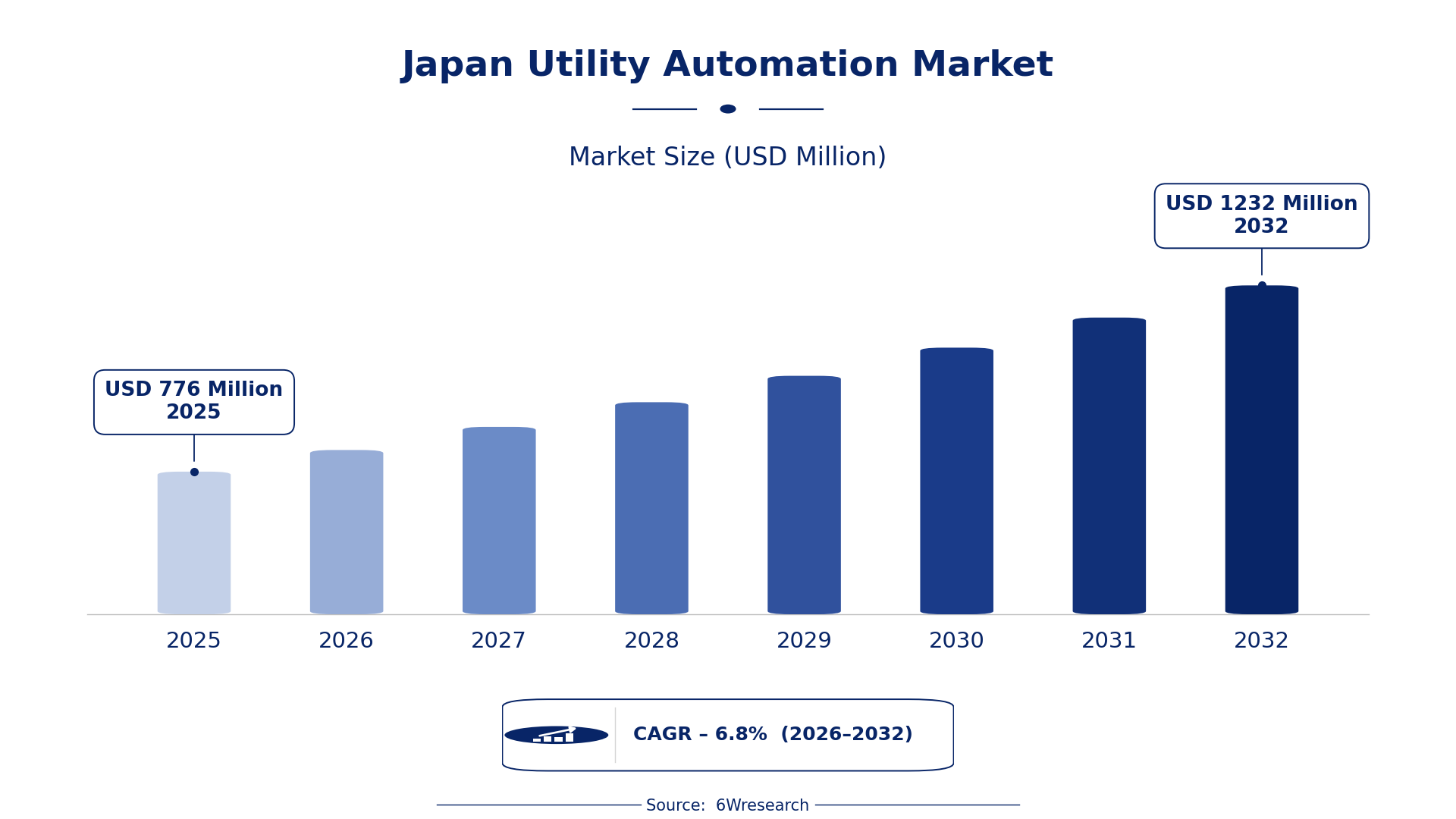
According to 6Wresearch internal database and industry insights, the Japan Utility Automation Market was valued at USD 776 Million in 2025 and is projected to reach USD 1,232 Million by 2032, growing at a CAGR of approximately 6.8% during 2026–2032.
Japan Utility Automation Market Highlights
| Report Metric | Details |
| Report Name | Japan Utility Automation Market (2026-2032) |
| Market Size 2025 | USD 776 Million |
| Market Size 2032 | USD 1,232 Million |
| Absolute Growth 2025–2032 | USD 456 Million |
| CAGR 2026–2032 | 6.8% |
| Peak Annual Growth | 8.8% in 2026 |
| Forecast Period | 2026–2032 |
| Historical Data | 2022–2025 |
| Base Year | 2025 |
| Leading Automation Segment, 2025 | Distribution Automation (36% share) |
| Leading Utility Area, 2025 | Electric Grids (42% share) |
| Leading Control System, 2025 | SCADA + DMS (35% share) |
| Leading End User, 2025 | Grid Operators (41% share) |
| Fastest-Growing Automation Segment | Substation Automation (9.3% CAGR) |
| Fastest-Growing Utility Area | Power Transmission (8.1% CAGR) |
| Fastest-Growing Control System | PLC/RTU/IED Integration (9.9% CAGR) |
| Fastest-Growing End User | Utility Companies (8.4% CAGR) |
| Growing Sector | Utility Automation |
| Key End Users | Utility Companies, Grid Operators, Municipal Authorities |
Japan Utility Automation Market Year-wise Growth Rate and Key Drivers (2022–2032)
This graph illustrates the annual growth rates of the market from 2022 to 2032, highlighting a steady upward trajectory and projected market expansion over the forecast period.
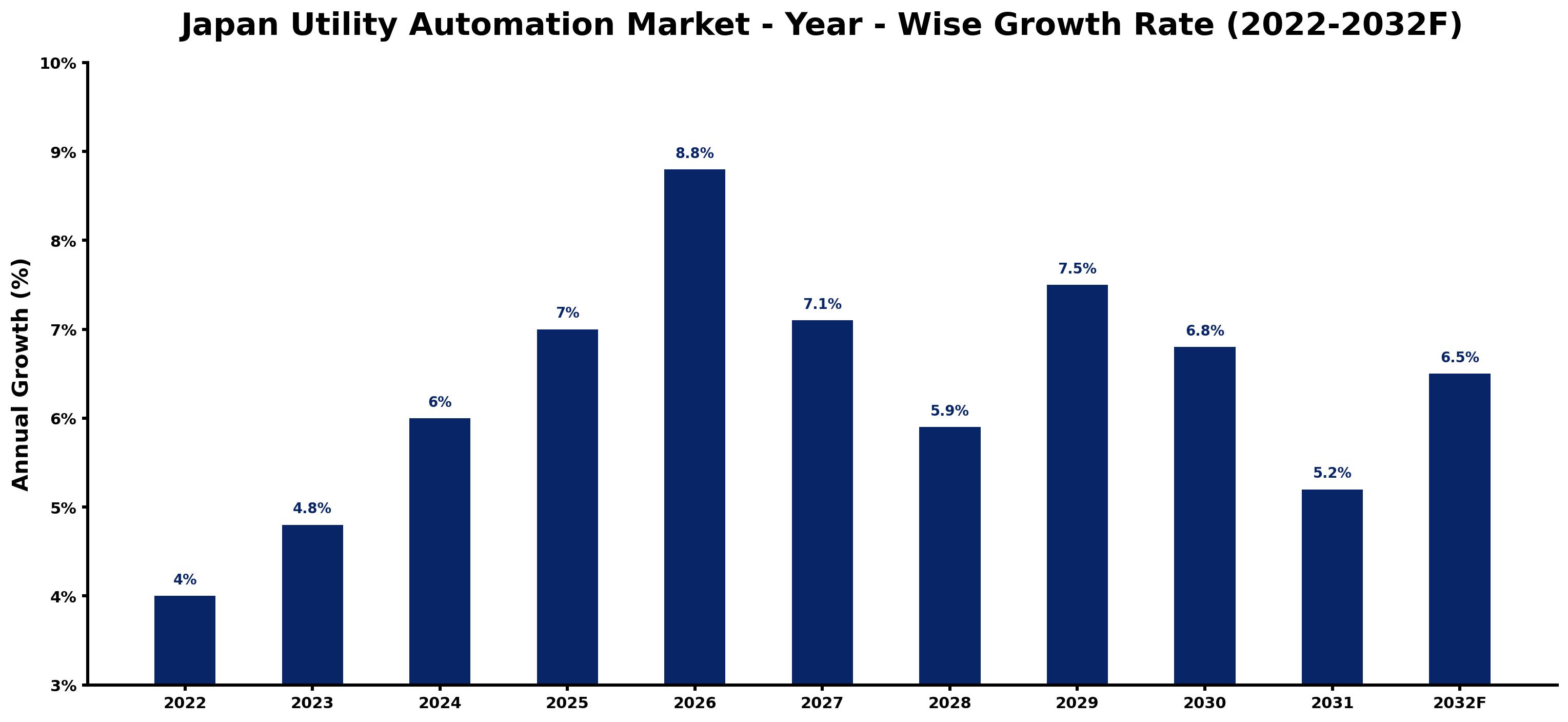
For each year, the table pairs the estimated growth rate with the leading influence on demand, showing how the drivers changed across the period.
| Year | Estimated Annual Growth (%) | Market Rationale |
| 2022 | 4.0 | The market experienced steady growth due to ongoing investments in utility infrastructure. |
| 2023 | 4.8 | Demand increased as more smart meters were installed across various utility sectors. |
| 2024 | 6.0 | Growth accelerated with the implementation of advanced SCADA systems for grid management. |
| 2025 | 7.0 | The market peaked as utility companies expanded automation technologies for efficiency. |
| 2026 | 8.8 | Growth reached its highest point, driven by substantial investments in smart grid technology. |
| 2027 | 7.1 | A slowdown in growth occurred as the market began to stabilise after rapid expansion. |
| 2028 | 5.9 | Growth continued to slow as companies focused on optimising existing systems. |
| 2029 | 7.5 | Demand rebounded as utility companies sought to improve service reliability through automation. |
| 2030 | 6.8 | Growth slowed again as market saturation began to affect new investments. |
| 2031 | 5.2 | The market maintained a slower growth rate as companies adjusted to new operational standards. |
| 2032 | 6.5 | Growth picked up slightly as utility companies renewed focus on decarbonisation efforts. |
Note: Market size estimations and growth projections presented in this report are based on 6Wresearch's proprietary forecasting methodology, utilizing the latest available industry data, government publications, and primary research inputs.
Japan Utility Automation Market Synopsis
Utility automation in Japan encompasses technologies that improve the efficiency and reliability of utility services, primarily in electricity, gas, and water sectors. The Japan Utility Automation Market is expanding due to ongoing investments in decarbonisation, with JPY 150 trillion targeted over the next decade. As of 2023, over 100,000 smart meters have been installed, driving demand for advanced automation technologies that improve operational performance and service reliability.
Market Dynamics Impact Analysis (2026–2032)
| Factor | Type | Impact | Primary Segment Affected |
| Increasing demand for smart grid technologies | Driver | High | Electric Grids |
| Government investments in decarbonisation initiatives | Driver | High | Utility Companies |
| Rising need for efficient energy management solutions | Opportunity | High | Meter Data Automation |
| Growing urbanisation leading to increased utility consumption | Opportunity | High | Field Force Automation |
| High initial investment costs for automation technologies | Restraint | Medium | Substation Automation |
| Limited awareness of automation benefits among smaller utilities | Restraint | Medium | Distribution Automation |
| Shortage of skilled workforce for advanced utility automation | Challenge | High | Distribution Automation |
| Regulatory complexities impacting project timelines | Challenge | Medium | Utility Companies |
Evaluation of Drivers in Japan Utility Automation Market (2026–2032)
The table below links each growth driver to the segment it affects and the evidence for it.
| Drivers | Primary Segment Affected | Why It Matters (Evidence) |
| Smart grid technologies are being adopted to improve efficiency and reliability. | Electric Grids | As of 2023, Japan has over 100,000 smart meters installed, improving monitoring capabilities. |
| Government funding is increasing for decarbonisation projects. | Utility Companies | Japan's GX Basic Policy targets JPY 150 trillion in decarbonisation investments over 10 years. |
| Demand for real-time data management is rising among utility firms. | Meter Data Automation | ISO 50001 standards are being adopted to improve energy management practices. |
| Urbanisation is increasing utility consumption and operational demands. | Field Force Automation | The total population served by utility automation systems exceeds 126 million. |
| Technological advancements are driving innovation in automation solutions. | Substation Automation | Advanced SCADA systems are being implemented for better grid management. |
Spending rises because Japan's energy sector aims to reduce carbon emissions by 26% by 2030, prompting firms to invest in automation technologies. Ongoing investments in decarbonisation are driving demand for advanced solutions. The total population served by utility automation systems exceeds 126 million, pushing firms to adopt real-time monitoring and data management solutions. As companies modernise their operations, the need for effective energy management practices is increasing, supported by the adoption of ISO 50001 standards.
Evaluation of Restraints in Japan Utility Automation Market
These restraints slow adoption and weigh on supplier margins.
| Market Restraint | Primary Segment Affected | Why It Matters (Evidence) |
| High initial costs for implementing automation technologies limit adoption. | Substation Automation | Many smaller utilities struggle to afford the upfront investments required for automation. |
| Limited understanding of automation benefits among smaller utilities hampers growth. | Distribution Automation | Smaller utility companies often lack the resources to explore advanced automation solutions. |
| Regulatory complexities can delay project approvals and implementation timelines. | Utility Companies | Navigating regulatory requirements can be challenging for firms seeking automation. |
| Shortage of skilled workforce for advanced utility automation technologies. | Distribution Automation | The demand for skilled workers in automation exceeds the current supply, affecting project execution. |
| Market saturation in certain regions may limit new investment opportunities. | Electric Grids | As more utilities adopt automation, finding new areas for investment becomes challenging. |
Japan Utility Automation Market Challenges
Chubu Electric Power Company faces a shortage of skilled technicians, which delays project timelines and raises costs for utility providers. Regulatory compliance with ISO 50001 standards imposes financial burdens, potentially costing JPY 50 million for each utility firm, straining budgets. Supply chain disruptions limit the availability of smart meters, causing installation delays that affect over 126 million consumers relying on dependable utility services. Competition from emerging tech firms in the Kansai region compels established players to innovate rapidly, threatening their market share and profitability.
Trends in the Japan Utility Automation Market
The shifts below are changing how Japan Utility Automation Market products are bought and supplied.
- Shift towards Smart Meter Implementation: The Smart Grid Implementation Strategy initiated in 2014 has led to a notable increase in smart meter installations, with over 100,000 units deployed as of 2023. This shift is improving real-time monitoring capabilities for utility companies.
- Transition to Advanced SCADA Systems: Since 2022, there has been a notable transition towards advanced SCADA systems, highlighted by the Chubu Electric Power Company's implementation. This change is improving grid management and operational efficiency across the sector.
- Emergence of IoT-Based Utility Solutions: The adoption of IoT-based systems is on the rise, driven by the National Institute of Advanced Industrial Science and Technology's research initiatives. These systems improve connectivity and data analysis capabilities, benefiting utility operations.
- Focus on Decarbonisation Initiatives: Japan's GX Basic Policy aims for substantial decarbonisation investments, targeting JPY 150 trillion over ten years. This focus is prompting utility companies to modernise their operations and adopt automation technologies.
Investment Opportunities in the Japan Utility Automation Market
The openings below show where demand in the Japan Utility Automation Market is visible and how suppliers can enter.
- Utility Companies Seeking Modernisation: Utility companies are increasingly looking to modernise their operations, with JPY 150 trillion targeted for decarbonisation investments over the next decade. Collaborating with local firms can facilitate entry into this growing market.
- Kansai Region as a Hub for Innovation: The Kansai region is emerging as a hub for utility automation technology development, hosting numerous tech firms. Investing in local partnerships can help suppliers tap into this vibrant market.
- Growing Demand for Energy Management Solutions: The need for efficient energy management solutions is rising, with ISO 50001 standards being adopted widely. Suppliers can meet this demand by offering advanced automation technologies to utility companies.
- Entry into Smart Grid Technology Development: With the government allocating ¥1 billion for smart grid technology development, there is an opportunity for investment. Collaborating with research institutions can enhance market entry and innovation.
Government Initiatives in the Japan Utility Automation Market
Utility automation producers must comply with various regulations, including the New Robot Strategy established in 2015, which promotes the use of robotics in multiple sectors. This strategy encourages automation in utility services, improving efficiency and reliability. In 2023, the government allocated ¥1 billion for smart grid technology development, administered by the Ministry of Economy, Trade and Industry. This funding supports projects that improve utility automation and promote energy efficiency.
The Ministry of Economy, Trade and Industry oversees the implementation of smart grid initiatives, ensuring that utility companies adhere to regulations while benefiting from government support. This agency plays a crucial role in facilitating advancements in utility automation technologies.
Future Insight of the Japan Utility Automation Market
Urban consumers will experience enhanced service reliability as the government's smart energy solutions programme progresses. By 2032, advancements in IoT technologies will streamline utility operations, enabling improved data management. With over 100,000 smart meters already installed, suppliers will have a solid foundation to build upon. The ongoing decarbonisation investment of JPY 150 trillion will drive suppliers to develop innovative and sustainable utility automation solutions.
Market Segmentation Analysis
Japan Utility Automation Market report covers a detailed analysis of the following market segments:
By Automation Segment – Distribution Automation Leads, Substation Automation Expected to Grow Fastest
According to Saurav Kr Singh, Senior Research Analyst at 6Wresearch, with 36% of automation segment revenue in 2025, Distribution Automation was the largest category. Distribution Automation holds the largest share as it is crucial for managing distribution networks effectively. The extensive systems employed by the Tokyo Electric Power Company illustrate its significance in enhancing service reliability across the region. Over 2026–2032, Substation Automation is expected to post the fastest growth, at a CAGR of 9.3%. Substation Automation is experiencing rapid growth due to the rising demand for efficient control of substations. The implementation of advanced SCADA systems signifies how utilities are prioritising this technology to boost operational efficiency. This trend suggests that suppliers should focus on developing solutions specifically for substation automation.
By Utility Area – Electric Grids Lead, Power Transmission Expected to Grow Fastest
The largest utility area category in 2025 was Electric Grids, at 42% of revenue. Electric Grids dominate the market as they are fundamental for managing electricity distribution across Japan. The total population served by utility automation systems exceeds 126 million, highlighting the extensive reliance on electric grids. Power Transmission is projected to grow fastest, at a CAGR of 8.1% during 2026–2032. Power Transmission is the fastest-growing segment, vital for transmitting electricity over long distances, especially with Japan's increasing investment in decarbonisation initiatives. The government's allocation of ¥1 billion for smart grid technology development supports this growth. Buyers must prioritise investments in power transmission technologies to meet future energy demands.
By Control System – SCADA + DMS Leads, PLC/RTU/IED Integration Expected to Grow Fastest
SCADA + DMS held 35% of the Japan Utility Automation Market by control system in 2025. SCADA + DMS leads the market as it is vital for operational control and data management within utility automation. Its integration enables utilities to maintain efficient operations while effectively responding to real-time data. The quickest growth will come from PLC/RTU/IED Integration, forecast to expand at a CAGR of 9.9% between 2026 and 2032. PLC/RTU/IED Integration is growing rapidly as it facilitates the seamless integration of various control devices, enhancing overall operational efficiency. This trend highlights the industry's shift towards more cohesive automation solutions. Suppliers should concentrate on improving their offerings in PLC/RTU/IED integration to align with market demands.
By End User – Grid Operators Lead, Utility Companies Expected to Grow Fastest
Grid Operators took 41% of end user revenue in 2025, more than any other category. Grid Operators account for the largest segment of end users for automation technologies, as they ensure the reliability and efficiency of electricity distribution. Their extensive operational requirements necessitate the adoption of advanced automation solutions to comply with regulatory and performance standards. Utility Companies are set to record the highest CAGR in this split, 8.4% over 2026–2032. Utility Companies are the fastest-growing end users, increasingly investing in advanced technologies to enhance their operations. Their focus on decarbonisation efforts significantly drives the demand for effective automation solutions. This growth indicates that suppliers must tailor their products to address the specific needs of utility companies.
Key Attractiveness of the Report
- 10 Years of Market Numbers
- Historical Data Starting from 2022 to 2025
- Base Year 2025
- Forecast Data until 2032
- Key Performance Indicators Impacting the Market
- Major Upcoming Developments and Projects
Key Highlights of the Report:
- Japan Utility Automation Market Outlook
- Market Size of Japan Utility Automation Market, 2025
- Forecast of Japan Utility Automation Market, 2032
- Historical Data and Forecast of Japan Utility Automation Revenues & Volume for the Period 2022-2032F
- Japan Utility Automation Market Trend Evolution
- Japan Utility Automation Market Drivers and Challenges
- Japan Utility Automation Price Trends
- Japan Utility Automation Porter's Five Forces
- Japan Utility Automation Industry Life Cycle
- Historical Data and Forecast of Japan Utility Automation Market Revenues & Volume By Automation Segment for the Period 2022-2032F
- Historical Data and Forecast of Japan Utility Automation Market Revenues & Volume By Distribution Automation for the Period 2022-2032F
- Historical Data and Forecast of Japan Utility Automation Market Revenues & Volume By Substation Automation for the Period 2022-2032F
- Historical Data and Forecast of Japan Utility Automation Market Revenues & Volume By Meter Data Automation for the Period 2022-2032F
- Historical Data and Forecast of Japan Utility Automation Market Revenues & Volume By Field Force Automation for the Period 2022-2032F
- Historical Data and Forecast of Japan Utility Automation Market Revenues & Volume By Utility Area for the Period 2022-2032F
- Historical Data and Forecast of Japan Utility Automation Market Revenues & Volume By Electric Grids for the Period 2022-2032F
- Historical Data and Forecast of Japan Utility Automation Market Revenues & Volume By Power Transmission for the Period 2022-2032F
- Historical Data and Forecast of Japan Utility Automation Market Revenues & Volume By Gas/Water Meters for the Period 2022-2032F
- Historical Data and Forecast of Japan Utility Automation Market Revenues & Volume By Inspection & Repair for the Period 2022-2032F
- Historical Data and Forecast of Japan Utility Automation Market Revenues & Volume By Control System for the Period 2022-2032F
- Historical Data and Forecast of Japan Utility Automation Market Revenues & Volume By SCADA + DMS for the Period 2022-2032F
- Historical Data and Forecast of Japan Utility Automation Market Revenues & Volume By PLC/RTU/IED Integration for the Period 2022-2032F
- Historical Data and Forecast of Japan Utility Automation Market Revenues & Volume By IoT-Based Systems for the Period 2022-2032F
- Historical Data and Forecast of Japan Utility Automation Market Revenues & Volume By Mobile + GPS for the Period 2022-2032F
- Historical Data and Forecast of Japan Utility Automation Market Revenues & Volume By End User for the Period 2022-2032F
- Historical Data and Forecast of Japan Utility Automation Market Revenues & Volume By Grid Operators for the Period 2022-2032F
- Historical Data and Forecast of Japan Utility Automation Market Revenues & Volume By Utility Companies for the Period 2022-2032F
- Historical Data and Forecast of Japan Utility Automation Market Revenues & Volume By Municipal Authorities for the Period 2022-2032F
- Historical Data and Forecast of Japan Utility Automation Market Revenues & Volume By Utility Contractors for the Period 2022-2032F
- Japan Utility Automation Import Export Trade Statistics
- Market Opportunity Assessment By Automation Segment
- Market Opportunity Assessment By Utility Area
- Market Opportunity Assessment By Control System
- Market Opportunity Assessment By End User
- Japan Utility Automation Top Companies Market Share
- Japan Utility Automation Competitive Benchmarking By Technical and Operational Parameters
- Japan Utility Automation Company Profiles
- Japan Utility Automation Key Strategic Recommendations
Market Covered
The study includes the following segmentation.
By Automation Segment
- Distribution Automation
- Substation Automation
- Meter Data Automation
- Field Force Automation
By Utility Area
- Electric Grids
- Power Transmission
- Gas/Water Meters
- Inspection & Repair
By Control System
- SCADA + DMS
- PLC/RTU/IED Integration
- IoT-Based Systems
- Mobile + GPS
By End User
- Grid Operators
- Utility Companies
- Municipal Authorities
- Utility Contractors































