Japan Utility Energy Management Market Size & Growth Rate
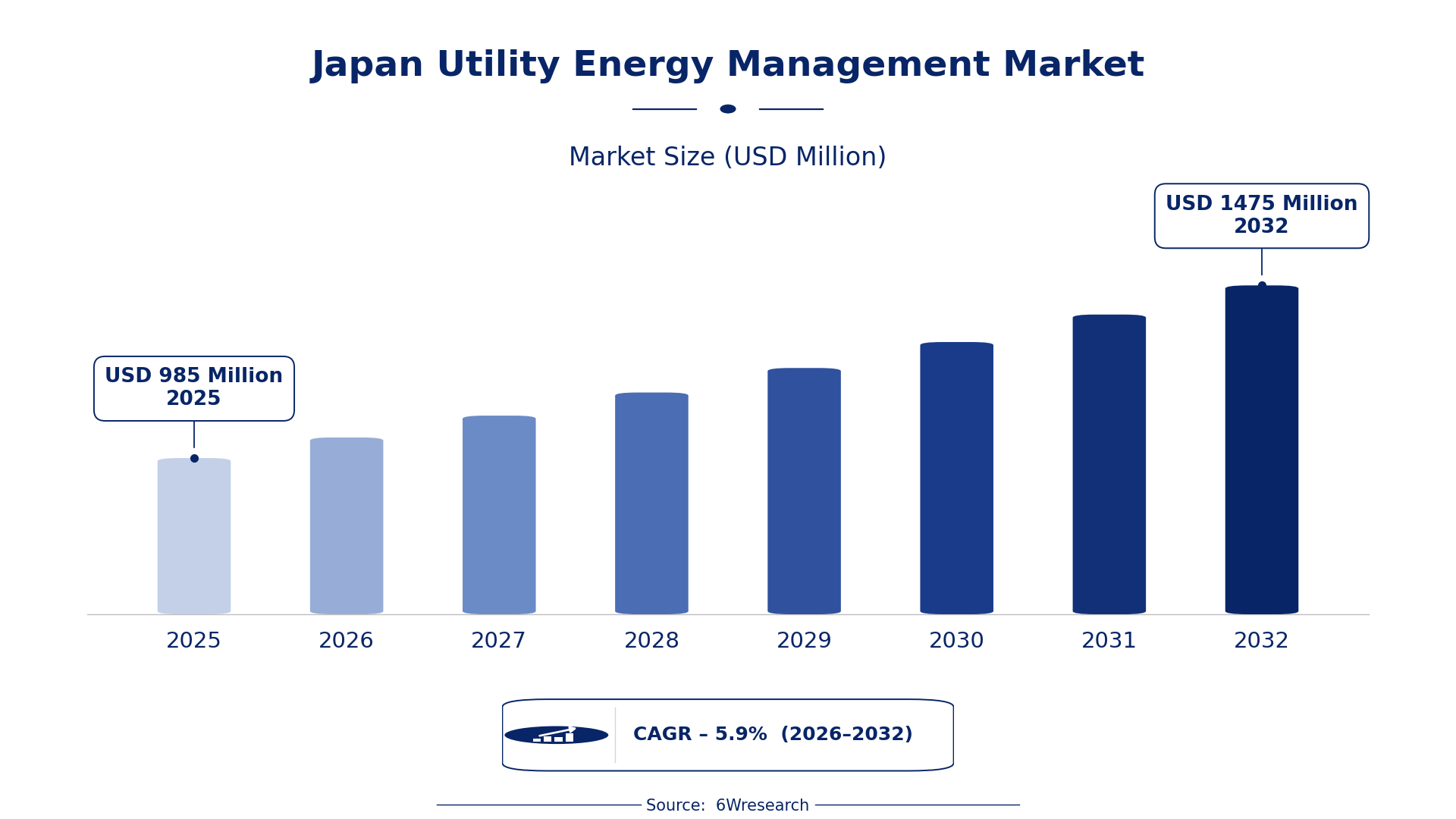
According to 6Wresearch internal database and industry insights, the Japan Utility Energy Management Market was valued at USD 985 Million in 2025 and is projected to reach USD 1,475 Million by 2032, growing at a CAGR of approximately 5.9% during 2026–2032.
Japan Utility Energy Management Market Highlights
| Report Metric | Details |
| Report Name | Japan Utility Energy Management Market (2026-2032) |
| Market Size 2025 | USD 985 Million |
| Market Size 2032 | USD 1,475 Million |
| Absolute Growth 2025–2032 | USD 490 Million |
| CAGR 2026–2032 | 5.9% |
| Peak Annual Growth | 7.6% in 2026 |
| Forecast Period | 2026–2032 |
| Historical Data | 2022–2025 |
| Base Year | 2025 |
| Leading Management Type, 2025 | Demand Response (49% share) |
| Leading Technology Used, 2025 | Smart Meters + AI (45% share) |
| Leading Implementation Model, 2025 | Centralized Control (48% share) |
| Leading End User, 2025 | Energy Utilities (44% share) |
| Fastest-Growing Management Type | Energy Efficiency Audit (7.9% CAGR) |
| Fastest-Growing Technology Used | Analytics Software (8.9% CAGR) |
| Fastest-Growing Implementation Model | Real-Time Monitoring (7.7% CAGR) |
| Fastest-Growing End User | Commercial Buildings (7.3% CAGR) |
| Growing Sector | Energy Utilities |
| Key End Users | Energy Utilities, Industrial Consumers, Commercial Buildings |
Japan Utility Energy Management Market Year-wise Growth Rate and Key Drivers (2022–2032)
This graph illustrates the annual growth rates of the market from 2022 to 2032, highlighting a steady upward trajectory and projected market expansion over the forecast period.
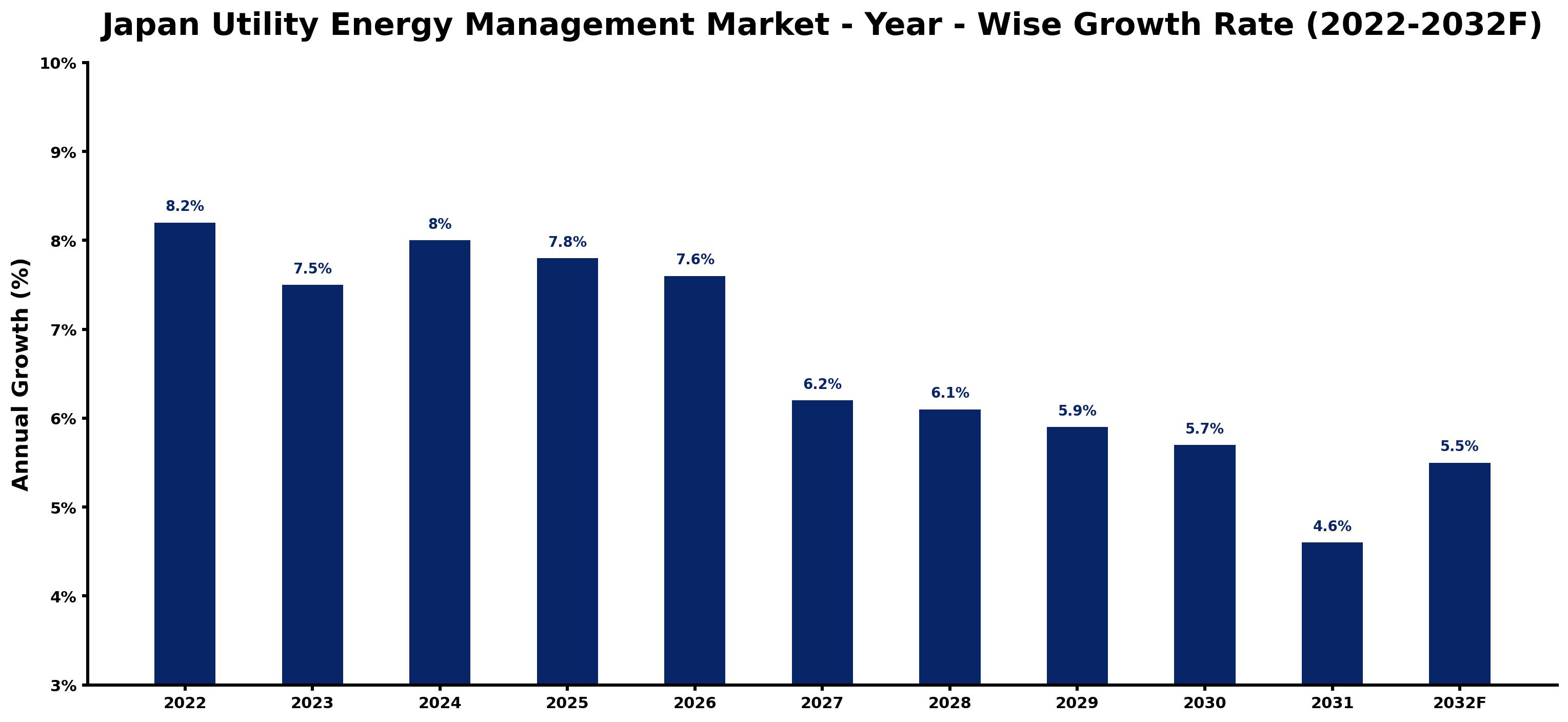
The yearly estimates that follow link every growth rate to its principal driver, so readers can see why the pace changed in each period.
| Year | Estimated Annual Growth (%) | Market Rationale |
| 2022 | 8.2 | Demand was strong due to rising energy costs and efficiency needs. |
| 2023 | 7.5 | Growth slowed as market adjustments took place after peak demand. |
| 2024 | 8.0 | Increased adoption of smart technologies drove faster growth this year. |
| 2025 | 7.8 | Market growth slowed again as the sector stabilised after rapid expansion. |
| 2026 | 7.6 | A slight slowdown occurred as the market adjusted to new regulations. |
| 2027 | 6.2 | Growth continued to slow as energy efficiency measures became widespread. |
| 2028 | 6.1 | The market saw another slowdown as demand stabilised at high levels. |
| 2029 | 5.9 | Growth slowed further as energy management systems matured in use. |
| 2030 | 5.7 | The market maintained growth as energy efficiency targets remained crucial. |
| 2031 | 4.6 | Slower growth reflected market saturation in energy management solutions. |
| 2032 | 5.5 | A slight increase in growth is expected as new technologies emerge. |
Note: Market size estimations and growth projections presented in this report are based on 6Wresearch's proprietary forecasting methodology, utilizing the latest available industry data, government publications, and primary research inputs.
Japan Utility Energy Management Market Synopsis
Utility Energy Management encompasses technologies and strategies designed to optimise energy consumption and improve efficiency. In Japan, the main buyers include energy utilities and industrial consumers, motivated by escalating energy costs and regulatory requirements. The market is expanding due to substantial investments in energy efficiency technologies, with a target of JPY 150 trillion for decarbonisation over the next decade. The demand for smart meters and AI integration further stimulates growth, creating a strong environment for energy management solutions.
Market Dynamics Impact Analysis (2026–2032)
| Factor | Type | Impact | Primary Segment Affected |
| The integration of smart meters facilitates real-time energy monitoring, driving demand for energy management solutions. | Driver | High | Smart Meters + AI |
| The growing focus on energy efficiency audits encourages utilities to enhance their operational practices, leading to increased investments. | Driver | High | Energy Efficiency Audit |
| The demand for energy efficiency technologies is rising due to the target of a 20% reduction in energy consumption by 2030. | Opportunity | High | Energy Efficiency Audit |
| The Tokyo metropolitan area is emerging as a hub for energy management solutions, attracting investments in advanced technologies. | Opportunity | High | Smart Meters + AI |
| Compliance with the Energy Conservation Law imposes additional costs on producers, affecting their operational budgets. | Restraint | High | Energy Efficiency Audit |
| The shortage of skilled professionals in energy management limits the capacity of producers to implement advanced solutions. | Restraint | Medium | Energy Efficiency Audit |
| Increased competition among energy utilities pressures suppliers to reduce prices, impacting service quality. | Challenge | High | Energy Utilities |
| Rising energy costs force buyers to seek cost-effective solutions, challenging suppliers to maintain profitability. | Challenge | Medium | Commercial Buildings |
Evaluation of Drivers in Japan Utility Energy Management Market (2026–2032)
The following drivers explain most of the expected growth.
| Drivers | Primary Segment Affected | Why It Matters (Evidence) |
| Increased energy costs | Energy Efficiency Audit | Higher energy costs prompt utilities to invest in audits to identify savings. |
| Government decarbonisation initiatives | Smart Meters + AI | Government targets for emissions reductions encourage utilities to adopt smart technologies. |
| Growing industrial demand for efficiency | Load Management | Industries seek load management solutions to balance supply and demand effectively. |
| Rising consumer awareness of energy usage | Real-Time Monitoring | Consumers increasingly demand real-time insights into consumption patterns. |
| Technological advancements in energy management | Analytics Software | Innovations in analytics tools improve data-driven decision-making for utilities. |
Most of the extra volume comes from the integration of over 30 million smart meters installed in Japan, enabling real-time monitoring of energy usage. This shift towards smart technology prompts utilities to invest in management solutions. The average energy cost for commercial buildings is around 15% of operational costs, leading businesses to seek efficiency audits to reduce expenses. The target of a 46% cut in greenhouse-gas emissions by 2030 supports demand for energy efficiency technologies, particularly in the Tokyo metropolitan area, which serves as a hub for energy utilities.
Evaluation of Restraints in Japan Utility Energy Management Market
These are the pressures that could keep growth below its potential.
| Market Restraint | Primary Segment Affected | Why It Matters (Evidence) |
| Regulatory compliance costs increase operational expenses | Load Management | Compliance with the Act on the Rational Use of Energy raises costs for large energy users. |
| High initial investment limits technology adoption | Demand Response | Utilities may hesitate to invest in demand response systems due to upfront costs. |
| Inadequate infrastructure hampers deployment of advanced systems | Centralized Control | Limited infrastructure in rural areas restricts the implementation of centralized systems. |
| A lack of trained personnel delays the adoption of advanced analytics tools | Analytics Software | A shortage of skilled workforce affects implementation of advanced technologies. |
| Market saturation reduces growth potential | Energy Efficiency Audit | As more facilities undergo audits, the market may face diminishing returns. |
Japan Utility Energy Management Market Challenges
Energy costs for commercial buildings average around 15% of operational costs, placing pressure on producers as they contend with rising expenses from stringent energy regulations. Compliance with Japan's Energy Conservation Law, which requires audits for large facilities, incurs additional costs that can delay project timelines for producers. A shortage of skilled professionals in energy management limits producers' ability to implement advanced technologies, resulting in inefficiencies that buyers must absorb. Heightened competition among energy utilities drives down prices, compelling suppliers to compromise on service quality, which leads to unreliable solutions for buyers.
Trends in the Japan Utility Energy Management Market
The shifts below are changing how Japan Utility Energy Management Market products are bought and supplied.
- Shift towards Smart Meter Integration: Energy utilities are increasingly adopting smart meters to enhance management capabilities, with over 30 million installed in 2022. This trend facilitates real-time monitoring and analytics, leading to improved operational efficiency.
- Transition from Manual to Automated Systems: The adoption of automated energy management systems is gaining momentum, driven by the need for efficiency. The Smart Energy Network initiative supports this transition, enabling better data collection and analysis.
- Emergence of Real-Time Monitoring Solutions: Real-time monitoring is becoming standard practice for utilities, allowing immediate responses to usage patterns. This shift is backed by advancements in analytics software, which are projected to grow by 8.9% annually.
- Prioritisation of Energy Efficiency Audits: Energy efficiency audits are increasingly prioritised as companies aim to reduce operational costs. The Act on the Rational Use of Energy mandates these audits for large facilities, driving demand for related services.
Investment Opportunities in the Japan Utility Energy Management Market
The openings below show where demand in the Japan Utility Energy Management Market is visible and how suppliers can enter.
- Investment in Smart Meter Infrastructure: The Tokyo metropolitan area is a prime location for investment in smart meter infrastructure, with over 30 million already installed. This presents opportunities for suppliers to improve capabilities in energy management.
- Supply of Energy Efficiency Audit Services: With the energy efficiency audit market expected to grow by 2025, energy utilities are seeking providers to conduct these audits. Entering this market requires local partnerships and expertise.
- Development of Advanced Analytics Software: The demand for analytics software is rising, driven by the need for data-driven decision-making. Suppliers can target utilities looking to improve operational efficiency through advanced solutions.
- Expansion of Real-Time Monitoring Technologies: As awareness of energy consumption increases, there is a growing need for real-time monitoring technologies. Suppliers can enter this market by collaborating with utilities to develop tailored solutions.
Government Initiatives in the Japan Utility Energy Management Market
The Hydrogen Society Promotion Act, enacted in 2024, supports the establishment of low-carbon hydrogen supply chains, complementing existing laws that require large energy users to improve efficiency and report energy usage. This reinforces compliance measures for energy management and encourages investment in new solutions.
The Agency for Natural Resources and Energy manages the implementation of energy efficiency programmes, including funding for audits. Their initiatives assist energy utilities in adopting advanced technologies, ensuring compliance with national efficiency targets and enhancing operational effectiveness.
Future Insight of the Japan Utility Energy Management Market
The integration of smart devices will transform energy management by 2032, enabling precise monitoring and optimisation of consumption. Government initiatives will stimulate investments in energy efficiency technologies, with JPY 150 trillion allocated for decarbonisation over ten years. The implementation of ISO 50001 will standardise energy management practices across sectors, improving operational efficiency. By 2030, the target to reduce energy consumption by 20% will reshape demand patterns, benefiting both buyers and suppliers as they adapt to more efficient energy solutions.
Market Segmentation Analysis
Japan Utility Energy Management Market report covers a detailed analysis of the following market segments:
By Management Type – Demand Response Leads, Energy Efficiency Audit Expected to Grow Fastest
According to Saurav Kr Singh, Senior Research Analyst at 6Wresearch, in 2025, Demand Response led the management type split with a 49% share. Demand Response holds the largest share as it allows utilities to effectively manage peak loads, crucial for maintaining grid stability. This approach is particularly prevalent among energy utilities in the Tokyo metropolitan area, where energy demand peaks significantly. Energy Efficiency Audit is set to record the highest CAGR in this split, 7.9% over 2026–2032. Energy Efficiency Audit is growing rapidly due to heightened regulatory requirements for energy savings, as mandated by the Energy Conservation Law for large facilities. This segment's growth is in line with Japan's ambition to achieve a 20% reduction in energy consumption by 2030. Suppliers should concentrate on enhancing Demand Response solutions while also investing in Energy Efficiency Audit capabilities to comply with regulatory standards.
By Technology Used – Smart Meters + AI Leads, Analytics Software Expected to Grow Fastest
Smart Meters + AI accounted for 45% of the market by technology used in 2025. Smart Meters + AI dominate the market as they facilitate real-time energy monitoring, essential for effective energy management. The integration of these technologies is prevalent in Japan's energy utilities, particularly in urban areas like Tokyo. The quickest growth will come from Analytics Software, forecast to expand at a CAGR of 8.9% between 2026 and 2032. Analytics Software is experiencing the fastest growth as it provides insights for energy usage patterns, enabling users to identify inefficiencies. This growth is driven by the increasing need for data-driven decision-making in energy management. Buyers will benefit from investing in Analytics Software to optimise their energy usage and reduce costs.
By Implementation Model – Centralized Control Leads, Real-Time Monitoring Expected to Grow Fastest
With 48% of implementation model revenue in 2025, Centralized Control was the largest category. Centralized Control is the leading model because it simplifies energy management processes, making it the preferred choice among energy utilities. This model effectively addresses the complexities associated with energy management in Japan's varied energy landscape. Over 2026–2032, Real-Time Monitoring is expected to post the fastest growth, at a CAGR of 7.7%. Real-Time Monitoring is the fastest-growing implementation model, facilitating immediate responses to energy usage, which is essential for operational efficiency. The increasing focus on real-time data analytics is a key factor propelling its swift adoption. Suppliers should prioritise the development of Real-Time Monitoring solutions to cater to the rising demand for prompt energy management capabilities.
By End User – Energy Utilities Lead, Commercial Buildings Expected to Grow Fastest
Energy Utilities took 44% of end user revenue in 2025, more than any other category. Energy Utilities represent the largest end user group, as they are the primary users of energy management solutions necessary for grid reliability. The concentration of energy utilities in regions like Tokyo further solidifies their market position. Commercial Buildings are projected to grow fastest, at a CAGR of 7.3% during 2026–2032. Commercial Buildings are the fastest-growing end user segment, driven by the need for energy cost reduction amidst rising operational expenses. The average energy cost for commercial buildings in Japan is around 15% of operational costs, prompting increased adoption of energy management solutions. Suppliers should tailor their offerings to address the specific needs of Commercial Buildings to capture this growing market.
Key Attractiveness of the Report
- 10 Years of Market Numbers
- Historical Data Starting from 2022 to 2025
- Base Year 2025
- Forecast Data until 2032
- Key Performance Indicators Impacting the Market
- Major Upcoming Developments and Projects
Key Highlights of the Report:
- Japan Utility Energy Management Market Outlook
- Market Size of Japan Utility Energy Management Market, 2025
- Forecast of Japan Utility Energy Management Market, 2032
- Historical Data and Forecast of Japan Utility Energy Management Revenues & Volume for the Period 2022-2032F
- Japan Utility Energy Management Market Trend Evolution
- Japan Utility Energy Management Market Drivers and Challenges
- Japan Utility Energy Management Price Trends
- Japan Utility Energy Management Porter's Five Forces
- Japan Utility Energy Management Industry Life Cycle
- Historical Data and Forecast of Japan Utility Energy Management Market Revenues & Volume By Management Type for the Period 2022-2032F
- Historical Data and Forecast of Japan Utility Energy Management Market Revenues & Volume By Demand Response for the Period 2022-2032F
- Historical Data and Forecast of Japan Utility Energy Management Market Revenues & Volume By Load Management for the Period 2022-2032F
- Historical Data and Forecast of Japan Utility Energy Management Market Revenues & Volume By Billing Optimization for the Period 2022-2032F
- Historical Data and Forecast of Japan Utility Energy Management Market Revenues & Volume By Energy Efficiency Audit for the Period 2022-2032F
- Historical Data and Forecast of Japan Utility Energy Management Market Revenues & Volume By Technology Used for the Period 2022-2032F
- Historical Data and Forecast of Japan Utility Energy Management Market Revenues & Volume By Smart Meters + AI for the Period 2022-2032F
- Historical Data and Forecast of Japan Utility Energy Management Market Revenues & Volume By EMS/SCADA for the Period 2022-2032F
- Historical Data and Forecast of Japan Utility Energy Management Market Revenues & Volume By Analytics Software for the Period 2022-2032F
- Historical Data and Forecast of Japan Utility Energy Management Market Revenues & Volume By Sensors + Smart Devices for the Period 2022-2032F
- Historical Data and Forecast of Japan Utility Energy Management Market Revenues & Volume By Implementation Model for the Period 2022-2032F
- Historical Data and Forecast of Japan Utility Energy Management Market Revenues & Volume By Centralized Control for the Period 2022-2032F
- Historical Data and Forecast of Japan Utility Energy Management Market Revenues & Volume By Real-Time Monitoring for the Period 2022-2032F
- Historical Data and Forecast of Japan Utility Energy Management Market Revenues & Volume By Cloud Hosted for the Period 2022-2032F
- Historical Data and Forecast of Japan Utility Energy Management Market Revenues & Volume By Manual + Automated for the Period 2022-2032F
- Historical Data and Forecast of Japan Utility Energy Management Market Revenues & Volume By End User for the Period 2022-2032F
- Historical Data and Forecast of Japan Utility Energy Management Market Revenues & Volume By Energy Utilities for the Period 2022-2032F
- Historical Data and Forecast of Japan Utility Energy Management Market Revenues & Volume By Industrial Consumers for the Period 2022-2032F
- Historical Data and Forecast of Japan Utility Energy Management Market Revenues & Volume By Retail Energy Providers for the Period 2022-2032F
- Historical Data and Forecast of Japan Utility Energy Management Market Revenues & Volume By Commercial Buildings for the Period 2022-2032F
- Japan Utility Energy Management Import Export Trade Statistics
- Market Opportunity Assessment By Management Type
- Market Opportunity Assessment By Technology Used
- Market Opportunity Assessment By Implementation Model
- Market Opportunity Assessment By End User
- Japan Utility Energy Management Top Companies Market Share
- Japan Utility Energy Management Competitive Benchmarking By Technical and Operational Parameters
- Japan Utility Energy Management Company Profiles
- Japan Utility Energy Management Key Strategic Recommendations
Market Covered
The following segment groups are covered in the report.
By Management Type
- Demand Response
- Load Management
- Billing Optimization
- Energy Efficiency Audit
By Technology Used
- Smart Meters + AI
- EMS/SCADA
- Analytics Software
- Sensors + Smart Devices
By Implementation Model
- Centralized Control
- Real-Time Monitoring
- Cloud Hosted
- Manual + Automated
By End User
- Energy Utilities
- Industrial Consumers
- Retail Energy Providers
- Commercial Buildings































