Japan Utility Management Software Market Size & Growth Rate
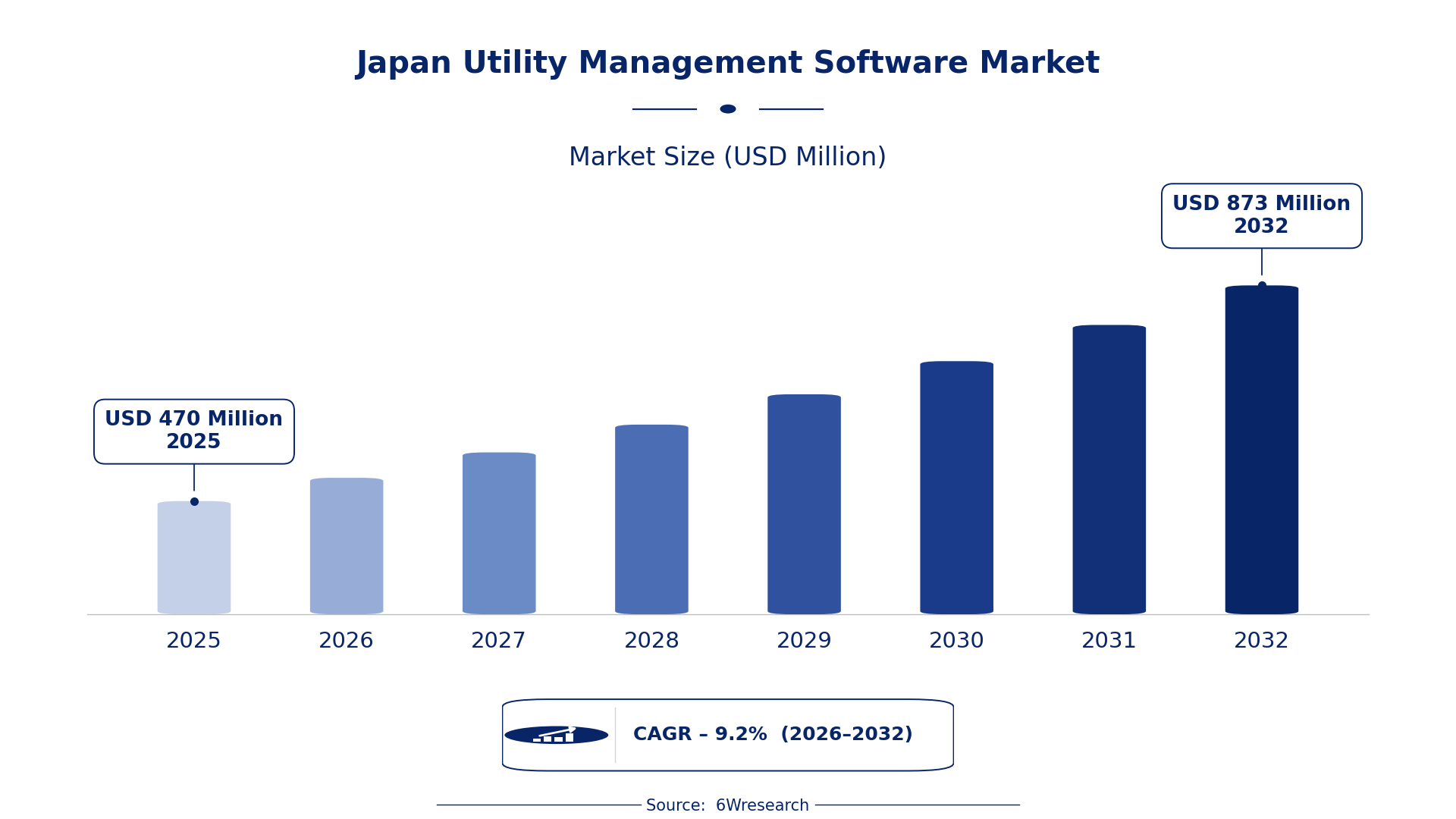
According to 6Wresearch internal database and industry insights, the Japan Utility Management Software Market was valued at USD 470 Million in 2025 and is projected to reach USD 873 Million by 2032, growing at a CAGR of approximately 9.2% during 2026–2032.
Japan Utility Management Software Market Highlights
| Report Metric | Details |
| Report Name | Japan Utility Management Software Market (2026-2032) |
| Market Size 2025 | USD 470 Million |
| Market Size 2032 | USD 873 Million |
| Absolute Growth 2025–2032 | USD 403 Million |
| CAGR 2026–2032 | 9.2% |
| Peak Annual Growth | 10.2% in 2032 |
| Forecast Period | 2026–2032 |
| Historical Data | 2022–2025 |
| Base Year | 2025 |
| Leading Software Type, 2025 | Billing & Customer Info (38% share) |
| Leading Deployment Model, 2025 | Cloud-Based (48% share) |
| Leading Utility Covered, 2025 | Electricity (50% share) |
| Leading End User, 2025 | Power Utilities (48% share) |
| Fastest-Growing Software Type | Energy Monitoring (13.1% CAGR) |
| Fastest-Growing Deployment Model | SaaS (13.5% CAGR) |
| Fastest-Growing Utility Covered | Water/Gas (12.8% CAGR) |
| Fastest-Growing End User | Municipal Providers (11.9% CAGR) |
| Growing Sector | Utility Management |
| Key End Users | Power Utilities, Municipal Providers, Industrial Users |
Japan Utility Management Software Market Year-wise Growth Rate and Key Drivers (2022–2032)
This graph illustrates the annual growth rates of the market from 2022 to 2032, highlighting a steady upward trajectory and projected market expansion over the forecast period.
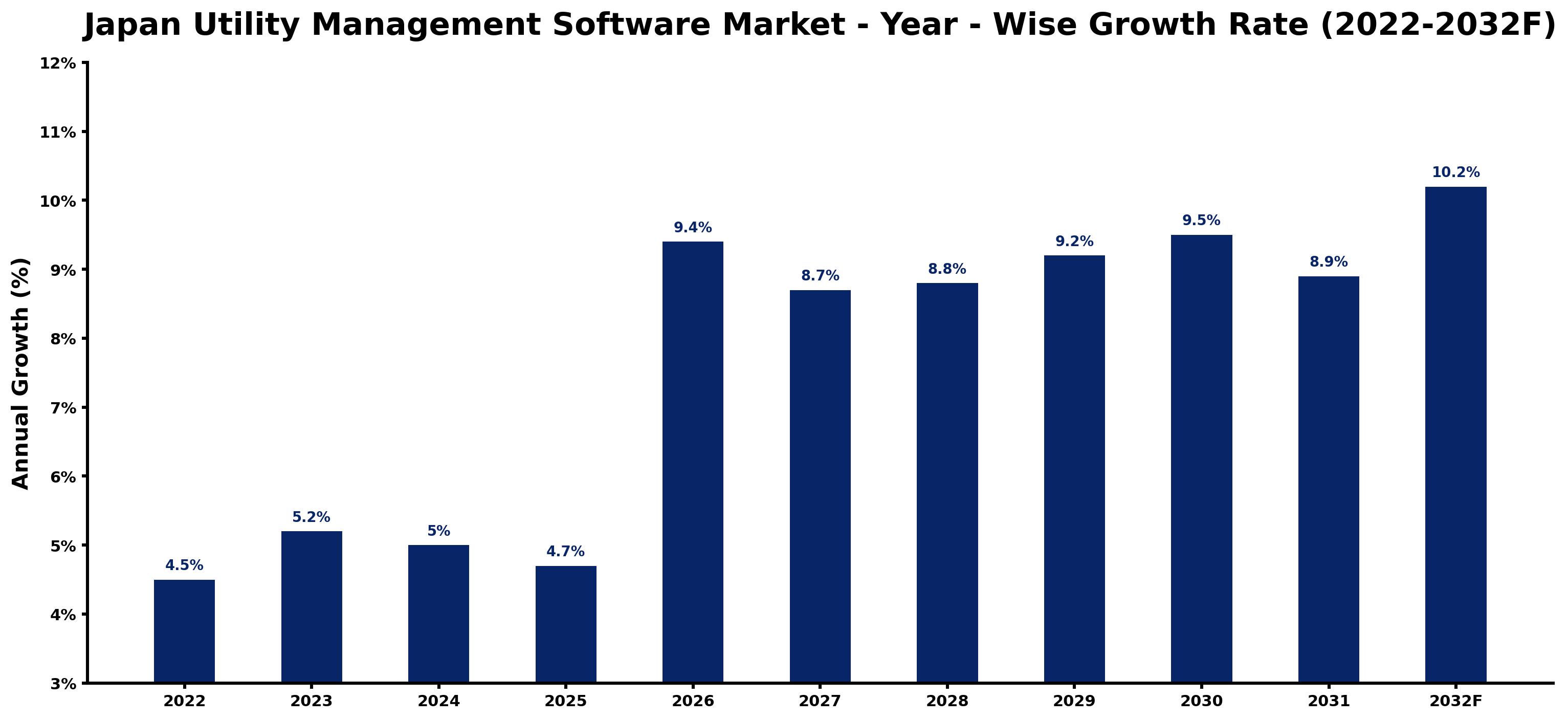
Annual growth estimates for each year appear below with the principal reason behind them, explaining the shifts that set the pace of the market.
| Year | Estimated Annual Growth (%) | Market Rationale |
| 2022 | 4.5 | The market showed steady growth due to existing demand from municipal providers. |
| 2023 | 5.2 | Growth faster than the previous year was driven by increased adoption of software solutions. |
| 2024 | 5.0 | Growth slowed as utilities evaluated their software investments amid economic conditions. |
| 2025 | 4.7 | The market continued to grow, albeit at a slower pace, as companies focused on efficiency. |
| 2026 | 9.4 | Growth accelerated as utilities embraced cloud-based solutions for greater flexibility. |
| 2027 | 8.7 | The market saw a slowdown in growth as competition intensified among software providers. |
| 2028 | 8.8 | Growth picked up again as energy monitoring solutions gained traction among utilities. |
| 2029 | 9.2 | Demand rose as municipalities sought to improve service delivery through technology. |
| 2030 | 9.5 | Growth continued due to rising investments in smart grid technologies and energy efficiency. |
| 2031 | 8.9 | The market grew at a slower rate as utilities adjusted to new operational standards. |
| 2032 | 10.2 | Growth peaked as the demand for advanced utility management solutions surged. |
Note: Market size estimations and growth projections presented in this report are based on 6Wresearch's proprietary forecasting methodology, utilizing the latest available industry data, government publications, and primary research inputs.
Japan Utility Management Software Market Synopsis
Utility Management Software serves as a critical technology for utility companies in Japan, facilitating operations such as asset management, billing, energy monitoring, and outage management. This growth reflects the ongoing transformation within the sector, as utilities seek to improve operational efficiency and service delivery.
Market Dynamics Impact Analysis (2026–2032)
| Factor | Type | Impact | Primary Segment Affected |
| Increasing adoption of cloud-based solutions | Driver | High | Cloud-Based |
| Growing demand for energy monitoring solutions | Driver | High | Energy Monitoring |
| Rising investments in smart grid technologies | Opportunity | High | Electricity |
| Expansion of municipal provider services | Opportunity | Medium | Municipal Providers |
| Competition among software providers | Restraint | High | Billing & Customer Info |
| Economic conditions affecting utility budgets | Restraint | Medium | Asset Management |
| Supply chain disruptions impacting software delivery | Challenge | High | Outage Management |
| Regulatory changes requiring software updates | Challenge | Medium | Energy Monitoring |
Evaluation of Drivers in Japan Utility Management Software Market (2026–2032)
Demand rests on the following drivers, each shown with the segment it touches most.
| Drivers | Primary Segment Affected | Why It Matters (Evidence) |
| Increased demand for efficient billing systems | Billing & Customer Info | Utilities are adopting solutions to manage customer accounts more effectively, leading to a 15% increase in adoption in 2023. |
| Adoption of energy monitoring technologies | Energy Monitoring | The average population served by a municipal provider is approximately 200,000. |
| Cloud-based solutions offering flexibility | Cloud-Based | Over 60% of new deployments in 2023 are cloud-based, allowing utilities to scale operations easily. |
| Support for renewable energy integration | Electricity | The Energy Agency of Japan promotes initiatives that facilitate the integration of renewable sources into the grid. |
| Growing municipal provider services | Municipal Providers | With an average population served of approximately 200,000, municipalities are investing in software to improve service delivery. |
Volumes grow on the back of increased demand for efficient billing systems, with a 15% rise in adoption among utilities in 2023. Utilities are increasingly investing in energy monitoring technologies to track consumption effectively, aiming for sustainability goals. Cloud-based solutions account for over 60% of new deployments in 2023, providing the flexibility needed for scaling operations. The Kansai region is notable for its advanced water utility management systems, highlighting a shift towards improved operational efficiency.
Evaluation of Restraints in Japan Utility Management Software Market
Below are the constraints most often cited by buyers and suppliers, with the segment each affects.
| Market Restraint | Primary Segment Affected | Why It Matters (Evidence) |
| Intense competition among software providers | Billing & Customer Info | This competition leads to pricing pressures, affecting the profitability of software solutions for utilities. |
| Economic conditions affecting utility budgets | Asset Management | Utilities are cautious with spending, impacting their ability to invest in new software solutions. |
| Delays in software updates hinder utilities' ability to manage service interruptions effectively. | Outage Management | Supply chain disruptions impact software delivery, causing delays in critical updates. |
| Regulatory changes requiring software updates | Energy Monitoring | Utilities must frequently update systems to comply with new regulations, straining resources. |
| Limited awareness of advanced software benefits | Cloud-Based | Some utilities are unaware of the advantages of cloud solutions, slowing adoption rates. |
Japan Utility Management Software Market Challenges
Municipal providers in Japan struggle with rising operational costs due to the national minimum wage increase to JPY 1,055 per hour, which raises staffing expenses for utility management. Skills shortages in data analytics hinder suppliers from implementing advanced utility management systems, delaying upgrades for utilities. Supply chain disruptions affect the availability of critical software components, resulting in extended timelines for system enhancements at utility companies. Increased competition among software developers leads to aggressive pricing strategies, which can compromise solution quality for buyers, ultimately impacting service reliability.
Trends in the Japan Utility Management Software Market
Buyers and suppliers in the Japan Utility Management Software Market are adjusting to the following trends.
- Shift to Cloud-Based Solutions: The trend towards cloud-based utility management software has accelerated since 2023, with over 60% of new deployments adopting this model. This shift allows utilities to improve operational flexibility and reduce costs.
- Emergence of Energy Monitoring Solutions: Since 2023, energy monitoring solutions have gained traction among utilities, driven by the need for efficiency. This focus is clear as utilities increasingly invest in technologies to track consumption accurately.
- Growth in Municipal Provider Services: The expansion of municipal provider services has been notable since 2023, with many municipalities investing in software solutions. Approximately 200,000 people are served on average, highlighting the demand for efficient management.
- Focus on Smart Grid Technologies: The launch of a program in 2023 to improve smart grid technologies marks a significant shift in Japan's utility sector. This initiative aims to enhance energy efficiency and integrate renewable sources into the grid.
Investment Opportunities in the Japan Utility Management Software Market
Investors looking at the Japan Utility Management Software Market should consider the following areas.
- Timing for Investment in Smart Grid Technologies: With Japan's target to reduce energy consumption by 20% by 2030, there is an opportunity to invest in smart grid technologies. Municipal providers are increasingly looking for solutions to improve efficiency.
- Expansion in the Kansai Region: The Kansai region is notable for its advanced water utility management systems, presenting an opportunity for software suppliers. Investing in local partnerships can facilitate market entry and growth.
- Supply of SaaS Models for Municipal Providers: As SaaS models are projected to grow among municipal providers by 2026, there is an opportunity to supply these solutions. Collaborating with local entities can ease market penetration.
- Investment in Energy Monitoring Solutions: The increasing focus on energy efficiency creates an opportunity to supply energy monitoring solutions. Engaging with power utilities can strengthen market presence and drive sales.
Government Initiatives in the Japan Utility Management Software Market
The Industrial Standardization Act of 1949 governs product and test standards in Japan, ensuring compliance for utility management software. This law requires producers to adhere to specific standards, impacting software development and deployment. Additionally, the Act against Unjustifiable Premiums and Misleading Representations, established in 1962, protects consumers by prohibiting misleading labelling and advertising of goods, which also applies to utility software.
The Digital Agency, established in September 2021, leads the government's digital transformation efforts. It supports initiatives that promote the adoption of utility management software, aiding municipal providers in improving service delivery through funding and common system standards.
Future Insight of the Japan Utility Management Software Market
The rollout of smart grid technologies will transform utility management by 2032, enabling more efficient energy distribution. The adoption of ISO 50001 will standardise energy management practices across utilities, promoting sustainability. By 2026, over 60% of new deployments will be cloud-based solutions, optimising operations for municipal providers. With a government target to reduce energy consumption by 20% by 2030, utilities will focus on integrating renewable energy sources into their services.
Market Segmentation Analysis
Japan Utility Management Software Market report covers a detailed analysis of the following market segments:
By Software Type – Billing & Customer Info Leads, Energy Monitoring Expected to Grow Fastest
According to Saurav Kr Singh, Senior Research Analyst at 6Wresearch, the largest software type category in 2025 was Billing & Customer Info, at 38% of revenue. Billing & Customer Info software holds the largest share as it is essential for managing customer accounts across over 1,200 municipalities. This widespread adoption is crucial for utilities to efficiently handle billing processes and ensure customer satisfaction. Energy Monitoring is projected to grow fastest, at a CAGR of 13.1% during 2026–2032. Energy Monitoring software is witnessing rapid growth as utilities focus on tracking energy consumption to meet government efficiency targets. The 15% increase in adoption among utilities in 2023 highlights the urgency for improved energy management solutions. Suppliers should prioritise the development of energy monitoring capabilities to meet the rising demand from utilities.
By Deployment Model – Cloud-Based Leads, SaaS Expected to Grow Fastest
Cloud-Based took 48% of deployment model revenue in 2025, more than any other category. Cloud-Based solutions dominate the market due to their flexibility and scalability, accounting for over 60% of new deployments in 2023. This trend reflects the utilities' need for accessible software that can adapt to their evolving operational requirements. Over 2026–2032, SaaS are expected to post the fastest growth, at a CAGR of 13.5%. SaaS models are projected to experience substantial growth among municipal providers by 2026, as they provide a cost-effective subscription model that aligns with budget constraints. This shift indicates a strong preference for affordable and manageable software solutions. Suppliers must integrate SaaS options to effectively cater to the expanding municipal provider market.
By Utility Covered – Electricity Leads, Water/Gas Expected to Grow Fastest
Electricity held 50% of the Japan Utility Management Software Market by utility covered in 2025. Electricity is the leading utility covered by software solutions, underscoring its significance within Japan's utility sector. The concentration of power utilities in the Tokyo metropolitan area further solidifies this dominant position. Water/Gas are set to record the highest CAGR in this split, 12.8% over 2026–2032. Water/Gas utilities are growing rapidly as they enhance their service capabilities and implement advanced management systems. This trend is particularly notable in the Kansai region, which is recognised for its sophisticated water utility management practices. Suppliers should focus on creating tailored solutions for water and gas utilities to capitalise on this fast-growing sector.
By End User – Power Utilities Lead, Municipal Providers Expected to Grow Fastest
Power Utilities accounted for 48% of the market by end user in 2025. Power Utilities are the largest end users of utility management software, necessitating sophisticated solutions for operational efficiency. Their established role in the sector guarantees a consistent demand for these software applications. The quickest growth will come from Municipal Providers, forecast to expand at a CAGR of 11.9% between 2026 and 2032. Municipal Providers are the fastest-growing user segment, driven by their need for efficient management of city services and utility operations. Their increasing reliance on software solutions highlights the importance of catering to local community requirements. Suppliers should tailor their offerings to meet the specific needs of municipal providers to capitalise on this growth opportunity.
Key Attractiveness of the Report
- 10 Years of Market Numbers
- Historical Data Starting from 2022 to 2025
- Base Year 2025
- Forecast Data until 2032
- Key Performance Indicators Impacting the Market
- Major Upcoming Developments and Projects
Key Highlights of the Report:
- Japan Utility Management Software Market Outlook
- Market Size of Japan Utility Management Software Market, 2025
- Forecast of Japan Utility Management Software Market, 2032
- Historical Data and Forecast of Japan Utility Management Software Revenues & Volume for the Period 2022-2032F
- Japan Utility Management Software Market Trend Evolution
- Japan Utility Management Software Market Drivers and Challenges
- Japan Utility Management Software Price Trends
- Japan Utility Management Software Porter's Five Forces
- Japan Utility Management Software Industry Life Cycle
- Historical Data and Forecast of Japan Utility Management Software Market Revenues & Volume By Software Type for the Period 2022-2032F
- Historical Data and Forecast of Japan Utility Management Software Market Revenues & Volume By Asset Management for the Period 2022-2032F
- Historical Data and Forecast of Japan Utility Management Software Market Revenues & Volume By Billing & Customer Info for the Period 2022-2032F
- Historical Data and Forecast of Japan Utility Management Software Market Revenues & Volume By Energy Monitoring for the Period 2022-2032F
- Historical Data and Forecast of Japan Utility Management Software Market Revenues & Volume By Outage Management for the Period 2022-2032F
- Historical Data and Forecast of Japan Utility Management Software Market Revenues & Volume By Deployment Model for the Period 2022-2032F
- Historical Data and Forecast of Japan Utility Management Software Market Revenues & Volume By On-Premise for the Period 2022-2032F
- Historical Data and Forecast of Japan Utility Management Software Market Revenues & Volume By Cloud-Based for the Period 2022-2032F
- Historical Data and Forecast of Japan Utility Management Software Market Revenues & Volume By SaaS for the Period 2022-2032F
- Historical Data and Forecast of Japan Utility Management Software Market Revenues & Volume By Hybrid for the Period 2022-2032F
- Historical Data and Forecast of Japan Utility Management Software Market Revenues & Volume By Utility Covered for the Period 2022-2032F
- Historical Data and Forecast of Japan Utility Management Software Market Revenues & Volume By Electricity for the Period 2022-2032F
- Historical Data and Forecast of Japan Utility Management Software Market Revenues & Volume By Water/Gas for the Period 2022-2032F
- Historical Data and Forecast of Japan Utility Management Software Market Revenues & Volume By Multi-Utility for the Period 2022-2032F
- Historical Data and Forecast of Japan Utility Management Software Market Revenues & Volume By Electricity for the Period 2022-2032F
- Historical Data and Forecast of Japan Utility Management Software Market Revenues & Volume By End User for the Period 2022-2032F
- Historical Data and Forecast of Japan Utility Management Software Market Revenues & Volume By Power Utilities for the Period 2022-2032F
- Historical Data and Forecast of Japan Utility Management Software Market Revenues & Volume By Municipal Providers for the Period 2022-2032F
- Historical Data and Forecast of Japan Utility Management Software Market Revenues & Volume By Industrial Users for the Period 2022-2032F
- Historical Data and Forecast of Japan Utility Management Software Market Revenues & Volume By Grid Operators for the Period 2022-2032F
- Japan Utility Management Software Import Export Trade Statistics
- Market Opportunity Assessment By Software Type
- Market Opportunity Assessment By Deployment Model
- Market Opportunity Assessment By Utility Covered
- Market Opportunity Assessment By End User
- Japan Utility Management Software Top Companies Market Share
- Japan Utility Management Software Competitive Benchmarking By Technical and Operational Parameters
- Japan Utility Management Software Company Profiles
- Japan Utility Management Software Key Strategic Recommendations
Market Covered
Segments analysed in this report are listed below.
By Software Type
- Asset Management
- Billing & Customer Info
- Energy Monitoring
- Outage Management
By Deployment Model
- On-Premise
- Cloud-Based
- SaaS
- Hybrid
By Utility Covered
- Electricity
- Water/Gas
- Multi-Utility
By End User
- Power Utilities
- Municipal Providers
- Industrial Users
- Grid Operators































