Japan Utility Metering Systems Market Size & Growth Rate
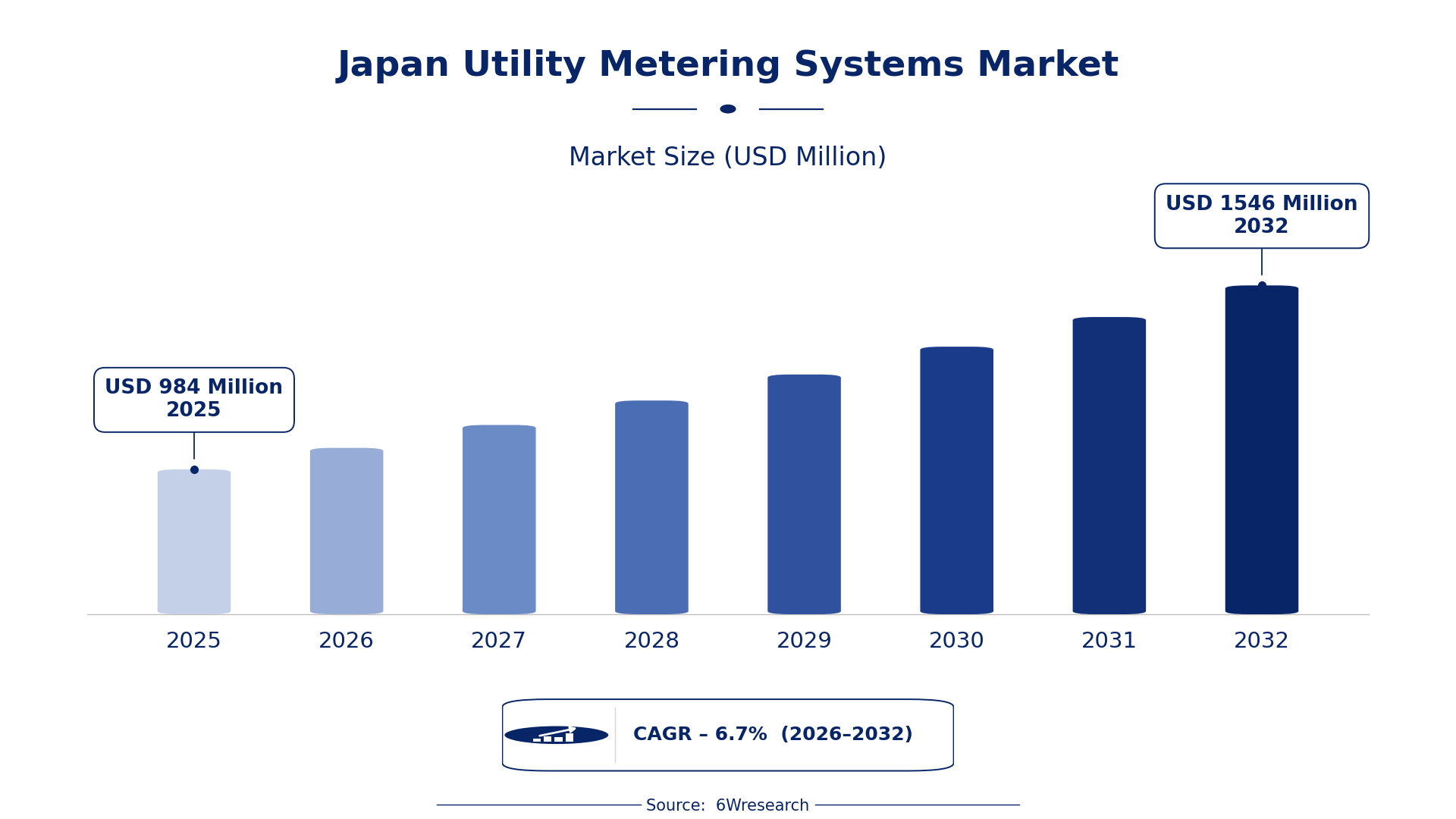
According to 6Wresearch internal database and industry insights, the Japan Utility Metering Systems Market was valued at USD 984 Million in 2025 and is projected to reach USD 1,546 Million by 2032, growing at a CAGR of approximately 6.7% during 2026–2032.
Japan Utility Metering Systems Market Highlights
| Report Metric | Details |
| Report Name | Japan Utility Metering Systems Market (2026-2032) |
| Market Size 2025 | USD 984 Million |
| Market Size 2032 | USD 1,546 Million |
| Absolute Growth 2025–2032 | USD 562 Million |
| CAGR 2026–2032 | 6.7% |
| Peak Annual Growth | 7.5% in 2028 |
| Forecast Period | 2026–2032 |
| Historical Data | 2022–2025 |
| Base Year | 2025 |
| Leading Meter Type, 2025 | Electric Metering (41% share) |
| Leading Technology, 2025 | Smart Meters (48% share) |
| Leading Application Type, 2025 | Residential (49% share) |
| Leading End User, 2025 | Power Distributors (48% share) |
| Fastest-Growing Meter Type | Multi-Utility Metering (9.2% CAGR) |
| Fastest-Growing Technology | IoT Integrated (9.7% CAGR) |
| Fastest-Growing Application Type | Smart Grids (9.1% CAGR) |
| Fastest-Growing End User | Smart Cities (8.8% CAGR) |
| Growing Sector | Utility Management |
| Key End Users | Power Distributors, Gas Utilities, Local Authorities, Smart Cities |
Japan Utility Metering Systems Market Year-wise Growth Rate and Key Drivers (2022–2032)
This graph illustrates the annual growth rates of the market from 2022 to 2032, highlighting a steady upward trajectory and projected market expansion over the forecast period.
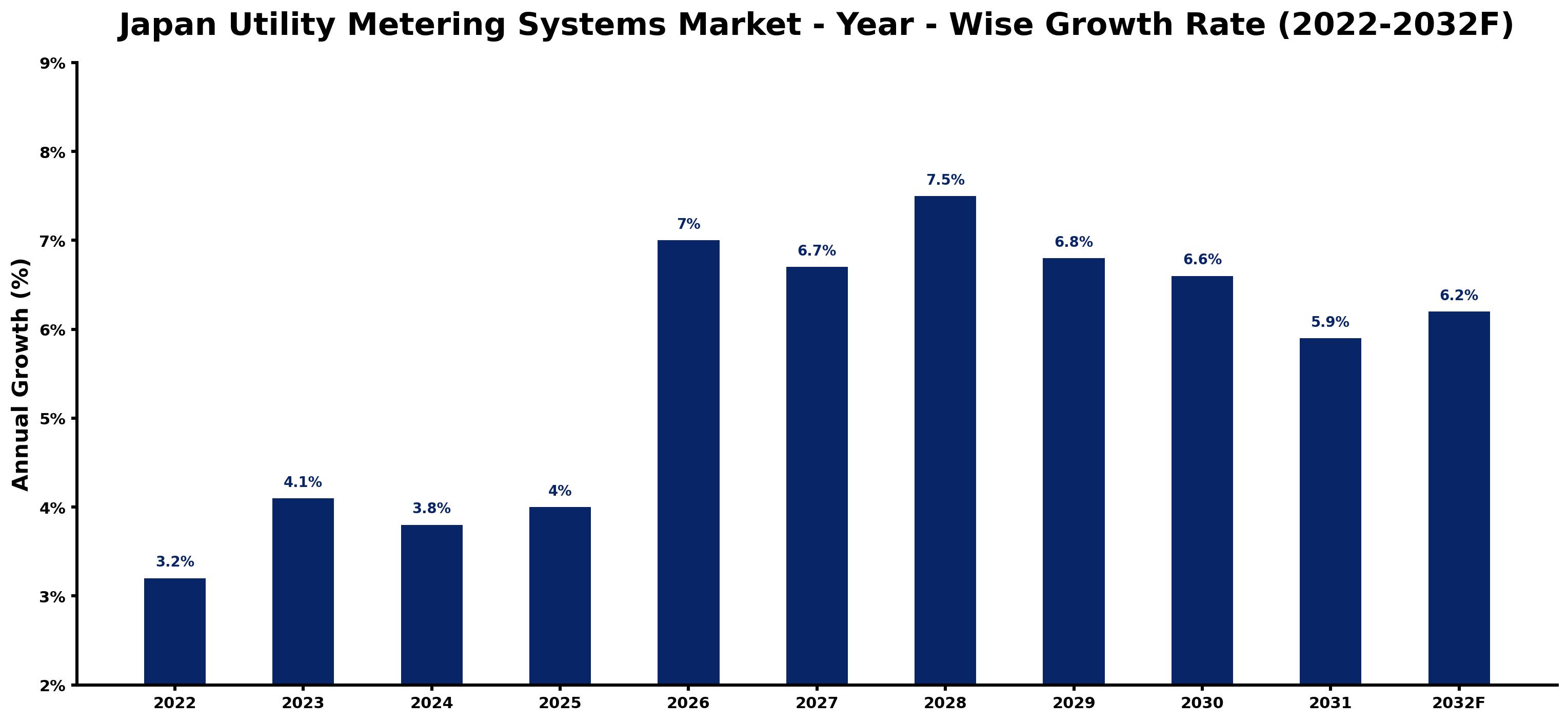
Each row of the following table gives one year's estimated growth and the event or demand shift that explains it.
| Year | Estimated Annual Growth (%) | Market Rationale |
| 2022 | 3.2 | The market experienced steady demand from utility providers and residential users. |
| 2023 | 4.1 | Growth accelerated due to increased smart meter installations across urban areas. |
| 2024 | 3.8 | Demand growth slowed as market saturation began to impact new installations. |
| 2025 | 4.0 | The market rebounded with renewed investments in smart city projects. |
| 2026 | 7.0 | Demand is expected to surge as smart meter adoption reaches 100% in major cities. |
| 2027 | 6.7 | Growth is projected to moderate as the market adjusts to high adoption rates. |
| 2028 | 7.5 | The peak growth will be driven by advancements in IoT integration. |
| 2029 | 6.8 | Demand growth is expected to slow as the market stabilises after rapid expansion. |
| 2030 | 6.6 | Growth will continue to slow as the market approaches saturation levels. |
| 2031 | 5.9 | The market will maintain growth due to ongoing infrastructure upgrades. |
| 2032 | 6.2 | Demand is expected to rise as new smart city initiatives are launched. |
Note: Market size estimations and growth projections presented in this report are based on 6Wresearch's proprietary forecasting methodology, utilizing the latest available industry data, government publications, and primary research inputs.
Japan Utility Metering Systems Market Synopsis
Utility Metering Systems are devices for measuring electricity, gas, and water consumption, primarily utilising smart meters and IoT technology. The Japan Utility Metering Systems Market is growing due to the rising adoption of smart meters, which reached 80% in 2023, alongside ongoing investments in smart city projects. Key drivers include the emphasis on energy efficiency and the integration of advanced technologies, transforming utility management across residential, industrial, and commercial sectors.
Market Dynamics Impact Analysis (2026–2032)
| Factor | Type | Impact | Primary Segment Affected |
| Increasing adoption of smart meters | Driver | High | Smart Meters |
| Government investment in smart grid initiatives | Driver | High | Smart Grids |
| Growing demand for energy efficiency solutions | Opportunity | High | IoT Integrated |
| Expansion of smart city projects | Opportunity | High | Multi-Utility Metering |
| Regulatory challenges in meter standardisation | Restraint | Medium | Gas Metering |
| High initial investment costs for smart metering systems | Restraint | Medium | Electric Metering |
| Competition from alternative metering technologies | Challenge | Medium | Ultrasonic/AMR |
| Slow adoption in rural areas due to infrastructure gaps | Challenge | Medium | Water Metering |
Evaluation of Drivers in Japan Utility Metering Systems Market (2026–2032)
Demand rests on the following drivers, each shown with the segment it touches most.
| Drivers | Primary Segment Affected | Why It Matters (Evidence) |
| Increased energy efficiency initiatives | Smart Meters | Energy efficiency initiatives have led to a rise in smart meter installations, with 60% of industrial facilities upgraded as of 2023. |
| Government funding for smart grid projects | Smart Grids | In 2023, ¥10 billion was allocated for smart grid initiatives, driving demand among local authorities for advanced metering solutions. |
| Rising urbanisation rates | Multi-Utility Metering | Urbanisation in the Tokyo metropolitan area is increasing demand for integrated solutions as the population grows. |
| Mandatory water metering regulations | Water Metering | Since 2020, urban areas have required water metering, boosting demand for compliant systems among local authorities. |
| Technological advancements in IoT | IoT Integrated | The adoption rate of IoT integrated meters is increasing by 15% annually, improving data collection and analysis capabilities. |
Several shifts outside the market lift sales. In 2023, ¥10 billion was allocated for smart grid projects, prompting local authorities to invest in smart metering technologies. Urbanisation in the Tokyo metropolitan area has resulted in a surge in demand for integrated solutions as the population continues to grow. The adoption of IoT integrated meters is rising by 15% annually, improving connectivity and data management in utility monitoring.
Evaluation of Restraints in Japan Utility Metering Systems Market
The table below lists the restraints and the evidence behind each.
| Market Restraint | Primary Segment Affected | Why It Matters (Evidence) |
| Challenges in standardising metering technologies | Gas Metering | Regulatory frameworks complicate the adoption of new technologies, impacting market growth. |
| High upfront costs for smart metering installations | Electric Metering | The initial investment required for smart meters can deter smaller utility providers from upgrading their systems. |
| Limited adoption in rural areas | Water Metering | Infrastructure gaps in rural regions hinder the implementation of mandatory water metering systems. |
| Competition from alternative measurement technologies | Ultrasonic/AMR | Emerging technologies may divert investment away from traditional metering systems, affecting market share. |
| Slow regulatory approvals for new technologies | Smart Meters | Lengthy approval processes for new metering technologies can delay market entry and adoption. |
Japan Utility Metering Systems Market Challenges
Buyers encounter supply delays as local producers rely on specific materials, which can extend lead times by three months. Increased material costs result in a 15% rise in installation expenses for buyers, straining budgets. Technology gaps persist, with 40% of current meters lacking IoT capabilities, limiting operational efficiency for producers. Regulatory updates to JIS standards impose upgrade costs exceeding ¥5 billion on producers, constraining their ability to invest in new technologies and improve service delivery.
Trends in the Japan Utility Metering Systems Market
Below are the shifts with the largest effect on the Japan Utility Metering Systems Market.
- Shift towards Integrated Utility Solutions: The Kansai region is increasingly adopting Multi-Utility Metering systems, integrating electricity, gas, and water management. This shift is evident as local authorities implement these systems in 50% of new residential developments.
- Transition from Traditional to Smart Metering: Smart meter adoption in Japan reached 80% in 2023, reflecting a change in utility management practices. This transition improves data accuracy and supports energy efficiency initiatives.
- Emergence of IoT in Metering: The integration of IoT technology in utility metering is gaining traction, with adoption rates increasing by 15% annually. This trend enables real-time data collection and improved energy management.
- Prioritisation of Energy Efficiency: The government’s focus on energy efficiency has led to increased investments in smart metering technologies. In 2023, ¥10 billion was allocated for smart grid initiatives, driving demand for advanced solutions.
Investment Opportunities in the Japan Utility Metering Systems Market
The following areas offer the clearest openings for investors and suppliers in the Japan Utility Metering Systems Market.
- Local Partnerships for Smart Metering: Investing in local partnerships for smart metering solutions is timely, as urban areas push for 100% smart meter deployment by 2030. Collaborating with local authorities can facilitate market entry.
- Investment in Smart City Projects: With local governments investing heavily in smart city projects, there is an opportunity for suppliers of Multi-Utility Metering systems. The Kansai region is a prime target for such investments.
- Expansion into Rural Markets: The gap in rural utility metering presents an opportunity for suppliers to introduce affordable solutions. Engaging with local authorities can help address infrastructure challenges.
- Development of IoT Integrated Solutions: The rising demand for IoT integrated meters, with a 15% annual growth rate, presents an opportunity for technology providers. Collaborating with municipalities can improve market penetration.
Government Initiatives in the Japan Utility Metering Systems Market
The Hydrogen Society Promotion Act, enacted in 2024, complements existing laws by supporting low-carbon hydrogen and ammonia supply chains, providing price-gap support. This measure encourages the adoption of cleaner technologies in utility metering, aligning with Japan's energy transition goals.
In 2023, ¥10 billion was allocated for smart grid initiatives by the Ministry of Internal Affairs and Communications, promoting the adoption of advanced metering technologies. This funding supports local authorities in implementing smart metering solutions across urban areas.
Future Insight of the Japan Utility Metering Systems Market
By 2032, Japan will see a policy-driven shift towards full smart meter deployment, enhancing utility management. The government’s investment in smart grid initiatives will drive technological advancements in metering systems. Local authorities are projected to implement smart metering in 50% of new residential developments, streamlining utility operations. With IoT integrated meter adoption increasing by 15% annually, suppliers will provide buyers with more accurate consumption data and improved energy efficiency.
Market Segmentation Analysis
Japan Utility Metering Systems Market report covers a detailed analysis of the following market segments:
By Meter Type – Electric Metering Leads, Multi-Utility Metering Expected to Grow Fastest
According to Saurav Kr Singh, Senior Research Analyst at 6Wresearch, with 41% of meter type revenue in 2025, Electric Metering was the largest category. Electric metering holds the largest share due to its essential role in measuring electricity consumption across various user categories. The Tokyo metropolitan area exemplifies this demand, showcasing a high installation rate of smart meters for accurate billing and energy management. Over 2026–2032, Multi-Utility Metering is expected to post the fastest growth, at a CAGR of 9.2%. The multi-utility metering segment is expanding rapidly as consumers increasingly prefer integrated solutions for monitoring multiple utilities. With local authorities implementing smart metering in 50% of new residential developments, this segment's growth trajectory is poised for acceleration. Suppliers should focus on developing multi-utility metering solutions to meet the rising market demand.
By Technology – Smart Meters Lead, IoT Integrated Expected to Grow Fastest
Smart Meters took 48% of technology revenue in 2025, more than any other category. Smart meters lead the market as they provide crucial real-time data collection and management capabilities for utility monitoring. Their widespread adoption is supported by compliance with JIS standards, ensuring reliability and efficiency in utility management practices. IoT Integrated is set to record the highest CAGR in this split, 9.7% over 2026–2032. IoT integrated meters are witnessing rapid growth, with a 15% annual increase, as they facilitate enhanced connectivity and data analysis. This growth is primarily driven by the increasing need for smarter energy management solutions in urban settings. Buyers should consider investing in IoT integrated meters to enhance their utility management and operational efficiency.
By Application Type – Residential Leads, Smart Grids Expected to Grow Fastest
Residential accounted for 49% of the market by application type in 2025. The residential segment dominates the market as utility metering is extensively used in homes for monitoring consumption and ensuring accurate billing. With the average household consuming 300 kWh of electricity monthly, this segment is crucial for utility providers' revenue streams. Smart Grids are projected to grow fastest, at a CAGR of 9.1% during 2026–2032. Smart grids are the fastest-growing application type, as they are vital for modern energy distribution systems that enhance efficiency and reliability. The government's allocation of ¥10 billion for smart grid initiatives further supports the growth potential of this segment. Suppliers must align their offerings with smart grid initiatives to capitalise on emerging market opportunities.
By End User – Power Distributors Lead, Smart Cities Expected to Grow Fastest
In 2025, Power Distributors led the end user split with a 48% share. Power distributors are the primary end users of utility metering data, relying on precise measurements for effective energy distribution and management. Their significance is underscored by the substantial upgrades to smart metering systems across various facilities throughout Japan. The quickest growth will come from Smart Cities, forecast to expand at a CAGR of 8.8% between 2026 and 2032. Smart cities represent the fastest-growing end user segment, driven by the pressing need for efficient urban infrastructure management. Investments in smart city projects are increasing, highlighting the importance of utility management and sustainability. Suppliers should target smart city projects to leverage the growing investments in urban infrastructure initiatives.
Key Attractiveness of the Report
- 10 Years of Market Numbers
- Historical Data Starting from 2022 to 2025
- Base Year 2025
- Forecast Data until 2032
- Key Performance Indicators Impacting the Market
- Major Upcoming Developments and Projects
Key Highlights of the Report:
- Japan Utility Metering Systems Market Outlook
- Market Size of Japan Utility Metering Systems Market, 2025
- Forecast of Japan Utility Metering Systems Market, 2032
- Historical Data and Forecast of Japan Utility Metering Systems Revenues & Volume for the Period 2022-2032F
- Japan Utility Metering Systems Market Trend Evolution
- Japan Utility Metering Systems Market Drivers and Challenges
- Japan Utility Metering Systems Price Trends
- Japan Utility Metering Systems Porter's Five Forces
- Japan Utility Metering Systems Industry Life Cycle
- Historical Data and Forecast of Japan Utility Metering Systems Market Revenues & Volume By Meter Type for the Period 2022-2032F
- Historical Data and Forecast of Japan Utility Metering Systems Market Revenues & Volume By Electric Metering for the Period 2022-2032F
- Historical Data and Forecast of Japan Utility Metering Systems Market Revenues & Volume By Gas Metering for the Period 2022-2032F
- Historical Data and Forecast of Japan Utility Metering Systems Market Revenues & Volume By Water Metering for the Period 2022-2032F
- Historical Data and Forecast of Japan Utility Metering Systems Market Revenues & Volume By Multi-Utility Metering for the Period 2022-2032F
- Historical Data and Forecast of Japan Utility Metering Systems Market Revenues & Volume By Technology for the Period 2022-2032F
- Historical Data and Forecast of Japan Utility Metering Systems Market Revenues & Volume By Smart Meters for the Period 2022-2032F
- Historical Data and Forecast of Japan Utility Metering Systems Market Revenues & Volume By Pulse + Wireless for the Period 2022-2032F
- Historical Data and Forecast of Japan Utility Metering Systems Market Revenues & Volume By Ultrasonic/AMR for the Period 2022-2032F
- Historical Data and Forecast of Japan Utility Metering Systems Market Revenues & Volume By IoT Integrated for the Period 2022-2032F
- Historical Data and Forecast of Japan Utility Metering Systems Market Revenues & Volume By Application Type for the Period 2022-2032F
- Historical Data and Forecast of Japan Utility Metering Systems Market Revenues & Volume By Residential for the Period 2022-2032F
- Historical Data and Forecast of Japan Utility Metering Systems Market Revenues & Volume By Industrial for the Period 2022-2032F
- Historical Data and Forecast of Japan Utility Metering Systems Market Revenues & Volume By Commercial for the Period 2022-2032F
- Historical Data and Forecast of Japan Utility Metering Systems Market Revenues & Volume By Smart Grids for the Period 2022-2032F
- Historical Data and Forecast of Japan Utility Metering Systems Market Revenues & Volume By End User for the Period 2022-2032F
- Historical Data and Forecast of Japan Utility Metering Systems Market Revenues & Volume By Power Distributors for the Period 2022-2032F
- Historical Data and Forecast of Japan Utility Metering Systems Market Revenues & Volume By Gas Utilities for the Period 2022-2032F
- Historical Data and Forecast of Japan Utility Metering Systems Market Revenues & Volume By Local Authorities for the Period 2022-2032F
- Historical Data and Forecast of Japan Utility Metering Systems Market Revenues & Volume By Smart Cities for the Period 2022-2032F
- Japan Utility Metering Systems Import Export Trade Statistics
- Market Opportunity Assessment By Meter Type
- Market Opportunity Assessment By Technology
- Market Opportunity Assessment By Application Type
- Market Opportunity Assessment By End User
- Japan Utility Metering Systems Top Companies Market Share
- Japan Utility Metering Systems Competitive Benchmarking By Technical and Operational Parameters
- Japan Utility Metering Systems Company Profiles
- Japan Utility Metering Systems Key Strategic Recommendations
Market Covered
The report covers the following segments.
By Meter Type
- Electric Metering
- Gas Metering
- Water Metering
- Multi-Utility Metering
By Technology
- Smart Meters
- Pulse + Wireless
- Ultrasonic/AMR
- IoT Integrated
By Application Type
- Residential
- Industrial
- Commercial
- Smart Grids
By End User
- Power Distributors
- Gas Utilities
- Local Authorities
- Smart Cities































