Japan Utility Vehicle Market Size & Growth Rate
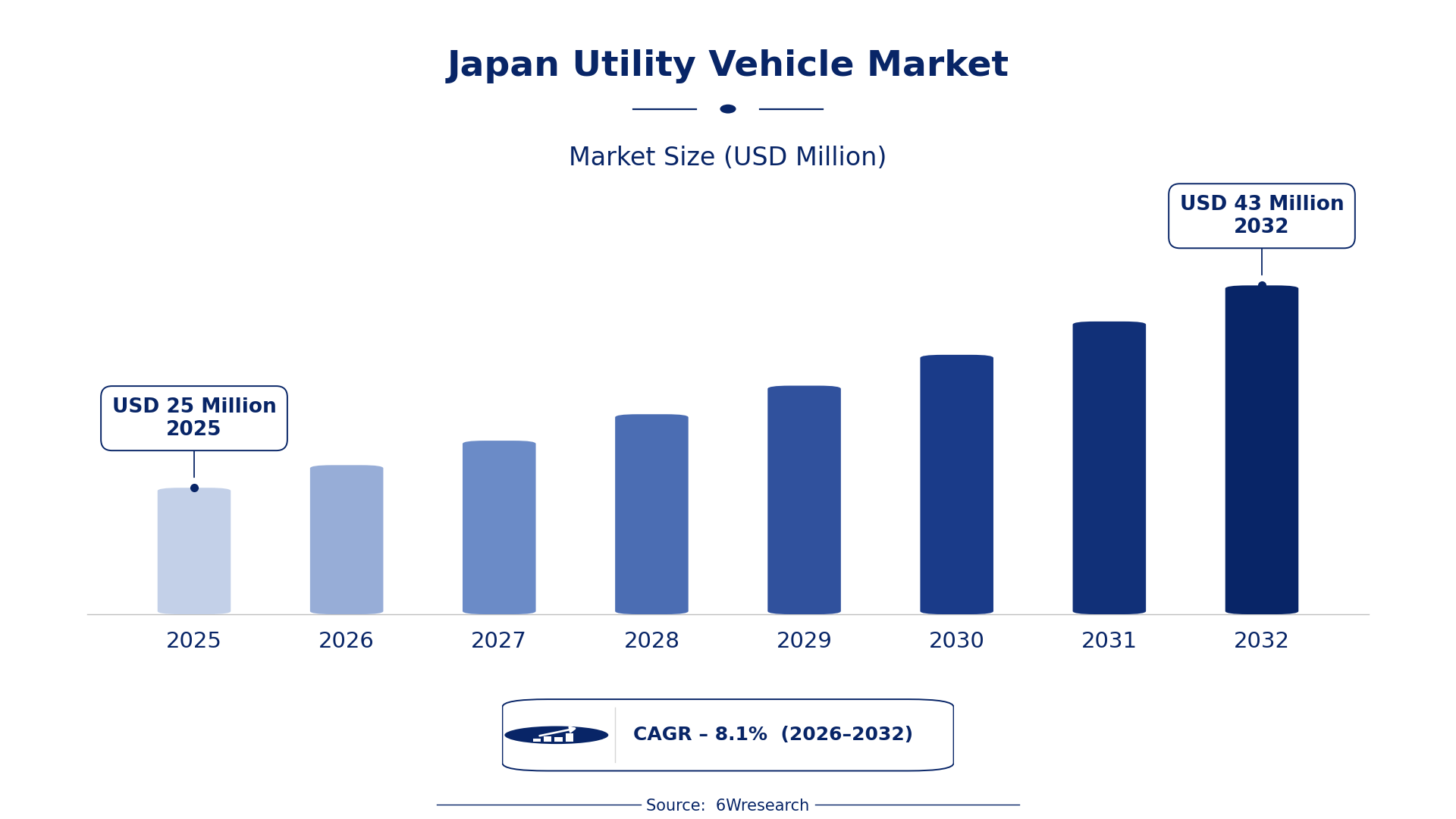
According to 6Wresearch internal database and industry insights, the Japan Utility Vehicle Market was valued at USD 25 Million in 2025 and is projected to reach USD 43 Million by 2032, growing at a CAGR of approximately 8.1% during 2026–2032.
Japan Utility Vehicle Market Highlights
| Report Metric | Details |
| Report Name | Japan Utility Vehicle Market (2026-2032) |
| Market Size 2025 | USD 25 Million |
| Market Size 2032 | USD 43 Million |
| Absolute Growth 2025–2032 | USD 18 Million |
| CAGR 2026–2032 | 8.1% |
| Peak Annual Growth | 9.1% in 2032 |
| Forecast Period | 2026–2032 |
| Historical Data | 2022–2025 |
| Base Year | 2025 |
| Leading Vehicle Type, 2025 | Side-by-Side (SxS) (37% share) |
| Leading Drive Train, 2025 | 4WD (53% share) |
| Leading Fuel Type, 2025 | Gasoline (46% share) |
| Leading End User, 2025 | Forest Rangers (50% share) |
| Fastest-Growing Vehicle Type | ATVs (11.4% CAGR) |
| Fastest-Growing Drive Train | 2WD/4WD (10.8% CAGR) |
| Fastest-Growing Fuel Type | Electric (12.0% CAGR) |
| Fastest-Growing End User | Recreational Users (10.6% CAGR) |
| Growing Sector | Agriculture and Construction |
| Key End Users | Farm Owners, Construction Firms, Recreational Users, Forest Rangers |
Japan Utility Vehicle Market Year-wise Growth Rate and Key Drivers (2022–2032)
This graph illustrates the annual growth rates of the market from 2022 to 2032, highlighting a steady upward trajectory and projected market expansion over the forecast period.
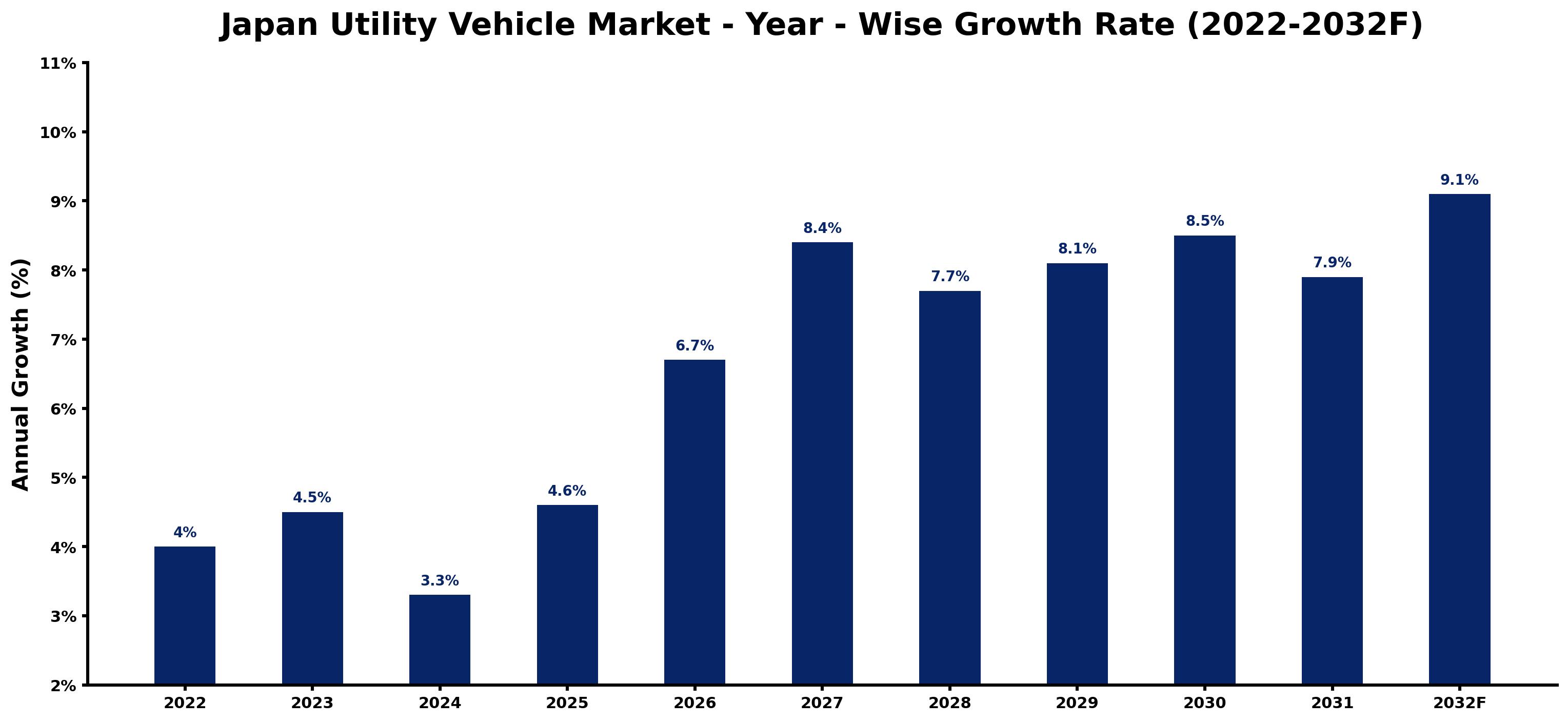
Annual growth estimates for each year appear below with the principal reason behind them, explaining the shifts that set the pace of the market.
| Year | Estimated Annual Growth (%) | Market Rationale |
| 2022 | 4.0 | The market experienced stable demand from agricultural users and recreational activities. |
| 2023 | 4.5 | Growth accelerated as utility vehicles gained popularity among farmers and construction firms. |
| 2024 | 3.3 | Demand growth slowed slightly due to market saturation in certain regions. |
| 2025 | 4.6 | Increased agricultural productivity initiatives drove higher utility vehicle sales. |
| 2026 | 6.7 | Rising investments in rural infrastructure will spur demand for utility vehicles. |
| 2027 | 8.4 | The construction sector's expansion will lead to increased utility vehicle purchases. |
| 2028 | 7.7 | Growth will decelerate as the market adjusts to previous high demand levels. |
| 2029 | 8.1 | Demand will surge again as rural development initiatives gain momentum. |
| 2030 | 8.5 | Continued investments in eco-friendly utility vehicles will support market growth. |
| 2031 | 7.9 | A slight slowdown will occur as the market stabilises after rapid growth. |
| 2032 | 9.1 | The market will peak as demand for utility vehicles reaches new heights. |
Note: Market size estimations and growth projections presented in this report are based on 6Wresearch's proprietary forecasting methodology, utilizing the latest available industry data, government publications, and primary research inputs.
Japan Utility Vehicle Market Synopsis
Utility vehicles are versatile off-road vehicles designed for various terrains, primarily used in agriculture, recreation, and construction. The Japan Utility Vehicle Market is expanding due to a growing population of farmers, which reached approximately 1.3 million in 2022, and increasing demand from the construction industry, employing over 4 million people. Government efforts to promote electric utility vehicles under the Green Growth Strategy stimulate market growth, improving the purchasing power of rural users and construction firms.
Market Dynamics Impact Analysis (2026–2032)
| Factor | Type | Impact | Primary Segment Affected |
| Growing agricultural productivity initiatives drive demand for utility vehicles. | Driver | High | Work UTVs |
| The increasing popularity of electric utility vehicles creates new market opportunities. | Opportunity | High | Electric |
| Aging population of farmers necessitates efficient farming tools like utility vehicles. | Restraint | High | Work UTVs |
| Market saturation in urban areas limits growth potential for utility vehicles. | Challenge | Medium | Side-by-Side (SxS) |
| The concentration of utility vehicle demand in rural prefectures may restrict market expansion. | Restraint | Medium | Side-by-Side (SxS) |
| Rising construction activities boost demand for utility vehicles in construction firms. | Driver | High | Work UTVs |
| The promotion of sustainable forest management encourages utility vehicle adoption. | Opportunity | Medium | Work UTVs |
| High costs of electric utility vehicles may deter some buyers from switching. | Challenge | Medium | Electric |
Evaluation of Drivers in Japan Utility Vehicle Market (2026–2032)
The factors lifting demand, and the evidence behind each, are summarised below.
| Drivers | Primary Segment Affected | Why It Matters (Evidence) |
| Increased agricultural productivity initiatives drive demand for utility vehicles. | Work UTVs | Promoting utility vehicle use leads to higher sales among farmers, contributing to the overall demand in rural areas. |
| Rising construction activities boost demand for utility vehicles. | Work UTVs | The construction industry employs over 4 million people, increasing the need for utility vehicles on job sites. |
| Growing interest in eco-friendly vehicles encourages utility vehicle adoption. | Electric | The government allocated ¥2 billion in 2023 for promoting electric vehicle adoption, including utility vehicles. |
| The aging population of farmers necessitates efficient farming tools like utility vehicles. | Work UTVs | With an average age of farmers being high, there is a pressing need for reliable vehicles to maintain productivity. |
| The concentration of utility vehicle demand in rural areas supports sales growth. | Work UTVs | Rural prefectures are key markets for utility vehicles, driving consistent demand. |
Purchasing is picking up as demand for utility vehicles rises among farmers and construction firms. The construction sector, employing over 4 million people, drives the need for efficient tools to improve site operations. The aging farmer population increases the need for reliable utility vehicles to maintain productivity. Rural areas remain key markets, further supporting growth in this sector.
Evaluation of Restraints in Japan Utility Vehicle Market
Below are the constraints most often cited by buyers and suppliers, with the segment each affects.
| Market Restraint | Primary Segment Affected | Why It Matters (Evidence) |
| High costs of electric utility vehicles may deter buyers from switching. | Electric | The premium pricing of electric models limits their adoption among cost-sensitive farmers. |
| Market saturation in urban areas limits growth potential for utility vehicles. | Side-by-Side (SxS) | Urban regions have less demand for utility vehicles, constraining overall market expansion. |
| The concentration of utility vehicle demand in rural prefectures restricts market expansion. | Side-by-Side (SxS) | Limited urban interest in utility vehicles may hinder growth opportunities in metropolitan areas. |
| Regulatory compliance costs can burden utility vehicle manufacturers. | Side-by-Side (SxS) | Manufacturers must adhere to JIS D 1002 standards, increasing production costs. |
| The aging farmer population may not adopt new technologies quickly. | Work UTVs | Older farmers may prefer traditional farming methods, slowing utility vehicle adoption. |
Japan Utility Vehicle Market Challenges
Limited skills among farmers hinder their ability to operate advanced utility vehicles, delaying agricultural tasks and reducing overall productivity. Regulatory complexities imposed by the Ministry of Agriculture, Forestry and Fisheries create compliance delays, extending product launches by up to six months for suppliers. Many buyers in rural prefectures encounter difficulties accessing modern utility vehicles, leading to a 20% decline in operational efficiency. Increased competition from imported models forces local producers to lower prices, which can erode profit margins and limit their capacity for innovation.
Trends in the Japan Utility Vehicle Market
The trends below show where the Japan Utility Vehicle Market is heading.
- Shift from Gasoline to Electric Utility Vehicles: Japan is transitioning towards electric utility vehicles, supported by government initiatives. In 2023, over ¥2 billion was allocated for promoting electric vehicle adoption, driving interest among farmers and construction firms.
- Transition from Traditional to Advanced Utility Vehicles: The introduction of advanced utility vehicles is changing market preferences. In 2023, registered ATVs surpassed 50,000, indicating a growing preference for versatile vehicles in recreational and agricultural sectors.
- Emergence of Eco-Friendly Utility Vehicles: The Green Growth Strategy encourages the adoption of eco-friendly utility vehicles. By 2030, Japan aims for a 46% reduction in greenhouse gas emissions, influencing buyers towards sustainable options.
- Growth in Utility Vehicle Usage Among Construction Firms: The construction sector's demand for utility vehicles is on the rise. With over 4 million workers in the industry, utility vehicles are becoming essential for site operations.
Investment Opportunities in the Japan Utility Vehicle Market
Where to invest in the Japan Utility Vehicle Market: the main openings are set out below.
- Rising Demand for Electric Utility Vehicles: With the government targeting a 46% cut in emissions by 2030, there is an opportunity for electric utility vehicle suppliers. Farmers and construction firms are increasingly interested in sustainable options.
- Investment in Rural Infrastructure: Ongoing investments in rural infrastructure create a demand for utility vehicles. Construction firms in rural prefectures are looking for reliable vehicles to support their operations.
- Expansion of Utility Vehicle Adoption in Forestry: The Forestry Agency supports utility vehicle use for sustainable management. This initiative opens avenues for manufacturers to supply vehicles tailored for forest management.
- Growing Interest in Recreational Utility Vehicles: The growing recreational user base for utility vehicles presents an opportunity. Suppliers can target this segment effectively as demand rises.
Government Initiatives in the Japan Utility Vehicle Market
The GX Promotion Act (2023) establishes a framework for promoting green technologies, including utility vehicles. This law builds on the Green Growth Strategy, which identifies growth sectors for decarbonisation, aiming for JPY 150 trillion in investments over ten years. These measures improve the regulatory environment for utility vehicle manufacturers, encouraging the development of eco-friendly models.
The Green Growth Strategy utilises government support to promote utility vehicle adoption among farmers. This initiative supports efficient farming practices, enabling farmers to claim benefits from using advanced vehicles, thereby increasing overall productivity.
Future Insight of the Japan Utility Vehicle Market
Investment in electric utility vehicles will rise, driven by government initiatives that allocate ¥2 billion to promote adoption. By 2032, advancements in battery technology will enhance vehicle range and efficiency, attracting more buyers in agriculture and construction. Rural development programmes will stimulate demand for versatile utility options, ensuring suppliers meet the needs of an ageing farmer demographic. The emphasis on sustainable practices will lead to the integration of eco-friendly features, making these vehicles essential for modern agricultural and forestry operations.
Market Segmentation Analysis
Japan Utility Vehicle Market report covers a detailed analysis of the following market segments:
By Vehicle Type – Side-by-Side (SxS) Leads, ATVs Expected to Grow Fastest
According to Saurav Kr Singh, Senior Research Analyst at 6Wresearch, Side-by-Side (SxS) accounted for 37% of the market by vehicle type in 2025. The Side-by-Side (SxS) segment holds the largest share due to its widespread application in agricultural and recreational activities, particularly in rural prefectures such as Hokkaido. The substantial population of approximately 1.3 million farmers drives the demand for versatile vehicles like SxS. Over 2026–2032, ATVs are expected to post the fastest growth, at a CAGR of 11.4%. The ATV segment is experiencing rapid growth, largely attributed to its rising popularity for recreational activities among younger demographics. The increase in registered ATVs, which exceeded 50,000 in 2023, underscores the trend towards recreational use. Suppliers should enhance their product offerings in the ATV segment to capitalise on the growing recreational market.
By Drive Train – 4WD Leads, 2WD/4WD Expected to Grow Fastest
With 53% of drive train revenue in 2025, 4WD was the largest category. The 4WD segment leads the market as it is essential for off-road capabilities, making it the preferred choice for users in challenging terrains. This is particularly important for the construction industry, which employs over 4 million people relying on dependable vehicles for demanding tasks. 2WD/4WD is projected to grow fastest, at a CAGR of 10.8% during 2026–2032. The 2WD/4WD segment is witnessing rapid growth, appealing to users operating in less demanding terrains while still requiring versatility. This growth is encouraged by the increasing adoption of utility vehicles in rural areas. Manufacturers should consider expanding their product lines to include more 2WD/4WD options to cater to a wider range of customer needs.
By Fuel Type – Gasoline Leads, Electric Expected to Grow Fastest
The largest fuel type category in 2025 was Gasoline, at 46% of revenue. Gasoline remains the predominant fuel type for utility vehicles, primarily due to its established infrastructure and familiarity among users. This is particularly relevant in rural areas where traditional fuel sources are readily accessible and preferred by farmers. Electric is set to record the highest CAGR in this split, 12.0% over 2026–2032. Electric utility vehicles are gaining traction as eco-friendly alternatives, supported by government initiatives promoting green growth. The ¥2 billion budget allocated in 2023 for electric vehicle adoption signifies a strong push towards sustainable practices. Suppliers must invest in electric vehicle technology to align with government policies and meet the evolving preferences of environmentally conscious consumers.
By End User – Forest Rangers Lead, Recreational Users Expected to Grow Fastest
In 2025, Forest Rangers led the end user split with a 50% share. Forest Rangers constitute the leading end-user group as they rely on utility vehicles for essential tasks such as patrolling and monitoring forest areas. Their specific operational needs necessitate robust vehicles, establishing them as a key segment in the market. The quickest growth will come from Recreational Users, forecast to expand at a CAGR of 10.6% between 2026 and 2032. Recreational Users represent the fastest-growing segment, driven by a rising interest in outdoor leisure activities. This shift is evident in the increasing popularity of utility vehicles for recreational purposes across various demographics. Companies should focus marketing efforts on recreational users to tap into the expanding leisure market for utility vehicles.
Key Attractiveness of the Report
- 10 Years of Market Numbers
- Historical Data Starting from 2022 to 2025
- Base Year 2025
- Forecast Data until 2032
- Key Performance Indicators Impacting the Market
- Major Upcoming Developments and Projects
Key Highlights of the Report:
- Japan Utility Vehicle Market Outlook
- Market Size of Japan Utility Vehicle Market, 2025
- Forecast of Japan Utility Vehicle Market, 2032
- Historical Data and Forecast of Japan Utility Vehicle Revenues & Volume for the Period 2022-2032F
- Japan Utility Vehicle Market Trend Evolution
- Japan Utility Vehicle Market Drivers and Challenges
- Japan Utility Vehicle Price Trends
- Japan Utility Vehicle Porter's Five Forces
- Japan Utility Vehicle Industry Life Cycle
- Historical Data and Forecast of Japan Utility Vehicle Market Revenues & Volume By Vehicle Type for the Period 2022-2032F
- Historical Data and Forecast of Japan Utility Vehicle Market Revenues & Volume By Side-by-Side (SxS) for the Period 2022-2032F
- Historical Data and Forecast of Japan Utility Vehicle Market Revenues & Volume By ATVs for the Period 2022-2032F
- Historical Data and Forecast of Japan Utility Vehicle Market Revenues & Volume By Work UTVs for the Period 2022-2032F
- Historical Data and Forecast of Japan Utility Vehicle Market Revenues & Volume By Crossover Utility for the Period 2022-2032F
- Historical Data and Forecast of Japan Utility Vehicle Market Revenues & Volume By Drive Train for the Period 2022-2032F
- Historical Data and Forecast of Japan Utility Vehicle Market Revenues & Volume By 4WD for the Period 2022-2032F
- Historical Data and Forecast of Japan Utility Vehicle Market Revenues & Volume By 2WD/4WD for the Period 2022-2032F
- Historical Data and Forecast of Japan Utility Vehicle Market Revenues & Volume By AWD for the Period 2022-2032F
- Historical Data and Forecast of Japan Utility Vehicle Market Revenues & Volume By 4WD for the Period 2022-2032F
- Historical Data and Forecast of Japan Utility Vehicle Market Revenues & Volume By Fuel Type for the Period 2022-2032F
- Historical Data and Forecast of Japan Utility Vehicle Market Revenues & Volume By Gasoline for the Period 2022-2032F
- Historical Data and Forecast of Japan Utility Vehicle Market Revenues & Volume By Electric for the Period 2022-2032F
- Historical Data and Forecast of Japan Utility Vehicle Market Revenues & Volume By Diesel for the Period 2022-2032F
- Historical Data and Forecast of Japan Utility Vehicle Market Revenues & Volume By Hybrid for the Period 2022-2032F
- Historical Data and Forecast of Japan Utility Vehicle Market Revenues & Volume By End User for the Period 2022-2032F
- Historical Data and Forecast of Japan Utility Vehicle Market Revenues & Volume By Forest Rangers for the Period 2022-2032F
- Historical Data and Forecast of Japan Utility Vehicle Market Revenues & Volume By Recreational Users for the Period 2022-2032F
- Historical Data and Forecast of Japan Utility Vehicle Market Revenues & Volume By Farm Owners for the Period 2022-2032F
- Historical Data and Forecast of Japan Utility Vehicle Market Revenues & Volume By Construction Firms for the Period 2022-2032F
- Japan Utility Vehicle Import Export Trade Statistics
- Market Opportunity Assessment By Vehicle Type
- Market Opportunity Assessment By Drive Train
- Market Opportunity Assessment By Fuel Type
- Market Opportunity Assessment By End User
- Japan Utility Vehicle Top Companies Market Share
- Japan Utility Vehicle Competitive Benchmarking By Technical and Operational Parameters
- Japan Utility Vehicle Company Profiles
- Japan Utility Vehicle Key Strategic Recommendations
Market Covered
The report covers the following segments.
By Vehicle Type
- Side-by-Side (SxS)
- ATVs
- Work UTVs
- Crossover Utility
By Drive Train
- 4WD
- 2WD/4WD
- AWD
By Fuel Type
- Gasoline
- Electric
- Diesel
- Hybrid
By End User
- Forest Rangers
- Recreational Users
- Farm Owners
- Construction Firms































