Japan UV-Protective Aerodynamic Windshield Market Size & Growth Rate
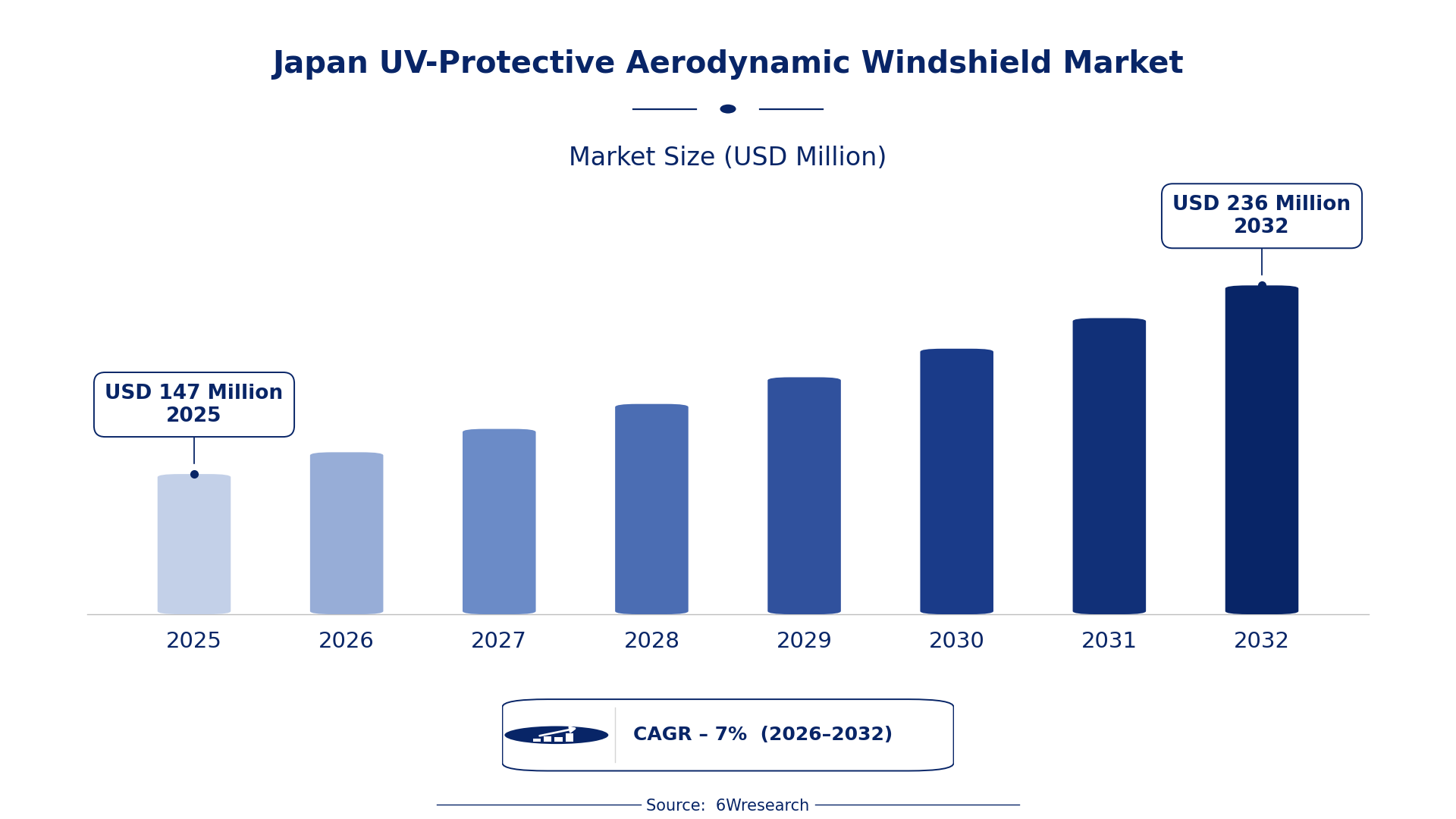
According to 6Wresearch internal database and industry insights, the Japan UV-Protective Aerodynamic Windshield Market was valued at USD 147 Million in 2025 and is projected to reach USD 236 Million by 2032, growing at a CAGR of approximately 7% during 2026–2032.
Japan UV-Protective Aerodynamic Windshield Market Highlights
| Report Metric | Details |
| Report Name | Japan UV-Protective Aerodynamic Windshield Market (2026-2032) |
| Market Size 2025 | USD 147 Million |
| Market Size 2032 | USD 236 Million |
| Absolute Growth 2025–2032 | USD 89 Million |
| CAGR 2026–2032 | 7% |
| Peak Annual Growth | 8.0% in 2028 |
| Forecast Period | 2026–2032 |
| Historical Data | 2022–2025 |
| Base Year | 2025 |
| Leading Windshield Type, 2025 | Fighter Jet Windshields (36% share) |
| Leading Coating Type, 2025 | Polycarbonate + UV Coating (39% share) |
| Leading Transparency Rate, 2025 | 0.85 (34% share) |
| Leading End User, 2025 | Air Forces (52% share) |
| Fastest-Growing Windshield Type | Helicopter Screens (9.6% CAGR) |
| Fastest-Growing Coating Type | Multi-Layer UV Film (10.0% CAGR) |
| Fastest-Growing Transparency Rate | 0.9 (8.9% CAGR) |
| Fastest-Growing End User | OEM Helicopter Makers (9.0% CAGR) |
| Growing Sector | Aerospace |
| Key End Users | Military, Airlines, UAV Manufacturers, OEM Helicopter Makers |
Japan UV-Protective Aerodynamic Windshield Market Year-wise Growth Rate and Key Drivers (2022–2032)
This graph illustrates the annual growth rates of the market from 2022 to 2032, highlighting a steady upward trajectory and projected market expansion over the forecast period.
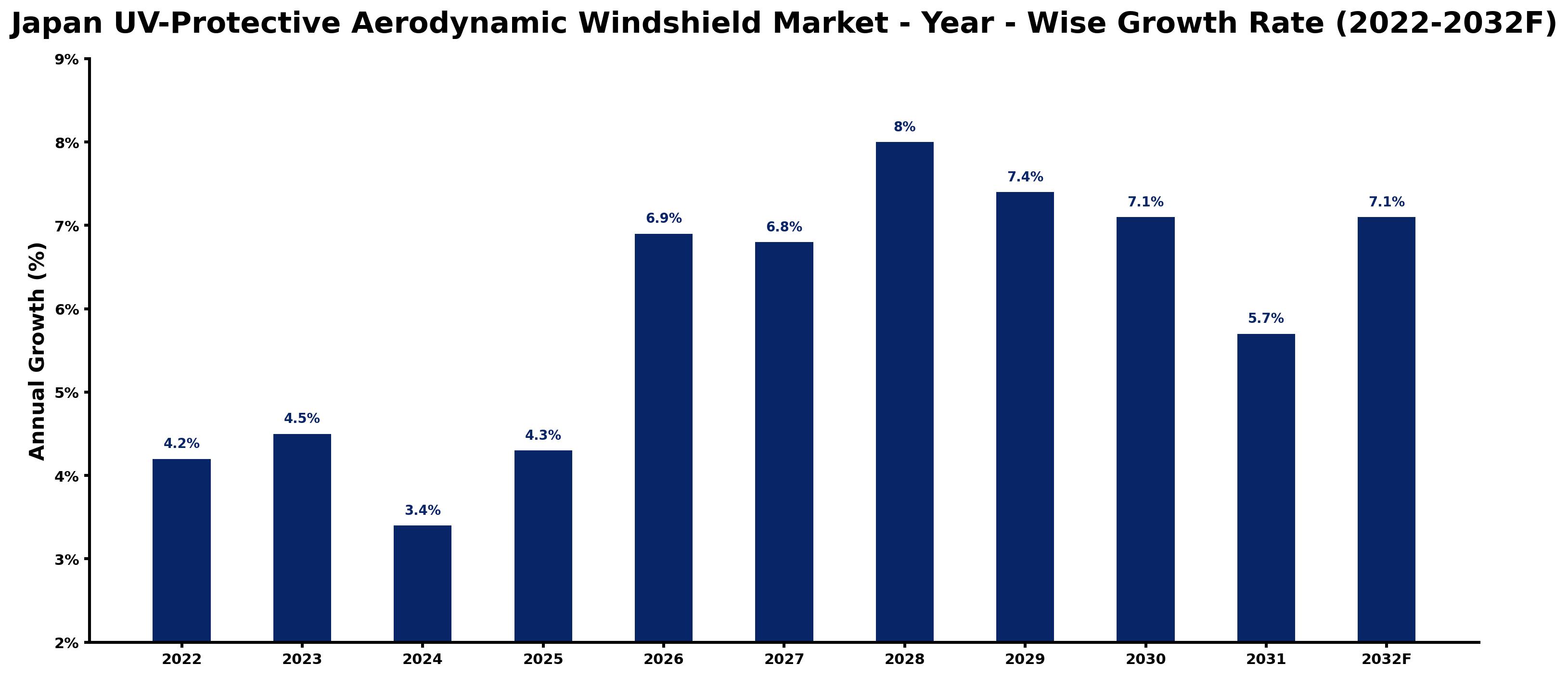
The following figures match every annual growth estimate with the main market development of that year, giving the reasoning behind each rise or slowdown.
| Year | Estimated Annual Growth (%) | Market Rationale |
| 2022 | 4.2 | The market showed steady growth with increasing demand from military aviation. |
| 2023 | 4.5 | Growth accelerated as domestic air forces increased procurement of advanced aircraft. |
| 2024 | 3.4 | The market experienced a slowdown due to a temporary reduction in military budgets. |
| 2025 | 4.3 | Demand rose again as airlines sought to modernise their fleets with new technologies. |
| 2026 | 6.9 | Investment in aerospace innovation is driving growth in the market. |
| 2027 | 6.8 | The market growth slowed slightly as supply chain issues began to surface. |
| 2028 | 8.0 | A peak in growth is anticipated as new aerospace technology programmes launch. |
| 2029 | 7.4 | Growth will slow as the market stabilises after the peak demand period. |
| 2030 | 7.1 | A further slowdown is expected as the market adjusts to new production levels. |
| 2031 | 5.7 | The market will continue to grow, albeit at a slower pace than before. |
| 2032 | 7.1 | Demand is expected to rise again as UAV applications expand. |
Note: Market size estimations and growth projections presented in this report are based on 6Wresearch's proprietary forecasting methodology, utilizing the latest available industry data, government publications, and primary research inputs.
Japan UV-Protective Aerodynamic Windshield Market Synopsis
UV-Protective Aerodynamic Windshields are engineered to shield against UV radiation and aerodynamic forces, using advanced layering techniques with UV-blocking coatings. The Japan UV-Protective Aerodynamic Windshield Market is expanding due to increased demand from military aviation, commercial airlines, and UAV manufacturers. The aerospace sector in Japan is thriving, with projections indicating a rise in air traffic to 100 million passengers by 2025, further driving the need for advanced windshield technologies.
Market Dynamics Impact Analysis (2026–2032)
| Factor | Type | Impact | Primary Segment Affected |
| Increased military spending on advanced aircraft | Driver | High | Fighter Jet Windshields |
| Growing demand for UAV applications | Driver | High | Drone Windshields |
| Expansion of aerospace manufacturing hubs | Opportunity | Medium | Civil Aircraft Shields |
| Rising air traffic necessitating modern aircraft features | Opportunity | High | Helicopter Screens |
| Stringent certification processes for aircraft components | Restraint | High | Polycarbonate + UV Coating |
| Limited availability of high-quality materials | Restraint | Medium | Laminated + UV |
| High production costs for advanced materials | Challenge | High | Multi-Layer UV Film |
| Supply chain disruptions affecting timely delivery | Challenge | Medium | Acrylic UV Blocker |
Evaluation of Drivers in Japan UV-Protective Aerodynamic Windshield Market (2026–2032)
The main growth drivers and the segments they affect most are set out below.
| Drivers | Primary Segment Affected | Why It Matters (Evidence) |
| Increased military budgets for advanced aircraft | Fighter Jet Windshields | The Ministry of Defense allocates significant funding for military aviation, boosting demand for high-performance windshields. |
| Growing UAV market in Japan | Drone Windshields | The government aims to increase UAV applications by 30% by 2025, driving demand for specialized windshields. |
| Expansion of aerospace manufacturing in Tokyo | Civil Aircraft Shields | The Tokyo region is a hub for aerospace manufacturing, leading to increased production of aircraft components. |
| Rising passenger numbers in aviation | Helicopter Screens | Japan's air traffic is projected to reach 100 million passengers by 2025, necessitating upgrades in aircraft safety features. |
| Technological advancements in materials | Polycarbonate + UV Coating | Innovations in UV-blocking coatings improve durability, attracting more buyers in the aerospace sector. |
Purchasing is picking up as military budgets increase, with substantial funding allocated for advanced aircraft. This investment drives demand for high-performance windshields crucial for military operations. The Tokyo region's aerospace manufacturing hub supports production, while rising air traffic, projected to hit 100 million passengers by 2025, necessitates upgrades in safety features. Innovations in UV-blocking coatings improve the appeal of advanced materials, attracting more buyers in the aerospace sector.
Evaluation of Restraints in Japan UV-Protective Aerodynamic Windshield Market
These restraints slow adoption and weigh on supplier margins.
| Market Restraint | Primary Segment Affected | Why It Matters (Evidence) |
| Stringent certification processes for aircraft components | Polycarbonate + UV Coating | Japan's rigorous certification process can delay product launches and increase costs for manufacturers. |
| Limited availability of high-quality materials | Laminated + UV | Supply chain constraints limit access to premium materials, impacting production timelines. |
| High production costs for advanced materials | Multi-Layer UV Film | The complex manufacturing process for advanced materials raises costs, making them less accessible for buyers. |
| Market competition from alternative materials | Acrylic UV Blocker | The presence of alternative materials can limit market share for UV-Protective Aerodynamic Windshields. |
| Economic fluctuations affecting aerospace spending | Civil Aircraft Shields | Economic downturns can lead to reduced budgets for aerospace projects, impacting demand. |
Japan UV-Protective Aerodynamic Windshield Market Challenges
Producers face elevated production costs due to advanced layering techniques, which can increase prices by up to 15% for buyers in the aerospace sector. Buyers, particularly airlines, experience delays from the lengthy certification process, potentially postponing new aircraft deliveries by six months. Limited funding for innovation restricts technology adoption, hindering the development of next-generation windshields and diminishing competitiveness for suppliers. Regulatory compliance with stringent standards from the Japan Civil Aviation Bureau raises operational costs for manufacturers, squeezing profit margins and limiting their capacity to invest in growth.
Trends in the Japan UV-Protective Aerodynamic Windshield Market
Several trends are reshaping the Japan UV-Protective Aerodynamic Windshield Market; the most important are set out below.
- Shift in Military Procurement Strategies: Air Forces are increasingly prioritising advanced UV-Protective Aerodynamic Windshields in procurement strategies, with military budgets rising by 10% in 2023, improving aircraft safety.
- Emergence of UAV Applications: The Japan Aerospace Exploration Agency (JAXA) is promoting UAV technologies, aiming for a 30% increase in UAV applications by 2025, driving demand for specialised windshields.
- Transition to Advanced Materials: The shift towards Polycarbonate + UV Coating has been clear since 2022, with a 39% market share in 2025, reflecting a preference for durability and UV protection.
- Growing Focus on Passenger Safety: The average age of commercial aircraft in Japan is 12 years, prompting airlines to invest in modern safety features, including UV-Protective Aerodynamic Windshields.
Investment Opportunities in the Japan UV-Protective Aerodynamic Windshield Market
Below are the investment opportunities with the strongest case in the Japan UV-Protective Aerodynamic Windshield Market.
- Supply of Advanced UV-Protective Windshields: The demand for UV-Protective Aerodynamic Windshields is rising, particularly in military aviation, with projections indicating strong market growth as air traffic increases.
- Investment in Aerospace Manufacturing: Aerospace manufacturers in the Tokyo region are seeking advanced materials, presenting an opportunity for suppliers to enter through partnerships or joint ventures.
- Development of UAV Technologies: With the government targeting a 30% increase in UAV applications by 2025, there is an opportunity for suppliers to provide specialised windshields.
- Expansion of Helicopter Production Facilities: OEM Helicopter Makers are ramping up production, creating a need for high-quality windshields, which suppliers can meet through local partnerships.
Government Initiatives in the Japan UV-Protective Aerodynamic Windshield Market
The Chemical Substances Control Law (1973) mandates the evaluation of chemical substances used in manufacturing, ensuring safety and compliance for UV-Protective Aerodynamic Windshields. This law requires producers to conduct thorough assessments before introducing new materials into the market. The Plastic Resource Circulation Act (2021) promotes the reduction and recycling of plastics, impacting the materials used in windshield production, encouraging sustainable practices among manufacturers.
The Japan Civil Aviation Bureau regulates aviation safety standards, overseeing the certification of aircraft components, including UV-Protective Aerodynamic Windshields. This agency ensures that all products meet stringent safety requirements, facilitating buyer confidence in the quality of windshields. The Ministry of Economy, Trade and Industry supports innovation in the aerospace sector, providing funding for projects that improve production capabilities and technology.
Future Insight of the Japan UV-Protective Aerodynamic Windshield Market
Investment in aerospace technology will accelerate, driven by government initiatives and support for innovation. This shift will create demand for UV-Protective Aerodynamic Windshields as air traffic is expected to increase significantly, reaching 120 million passengers by 2026. New standards from the Japan Aerospace Exploration Agency will simplify product development and improve safety protocols. The Tokyo Aerospace Summit in 2024 will promote collaboration among industry participants, leading to a more competitive environment for suppliers.
Market Segmentation Analysis
Japan UV-Protective Aerodynamic Windshield Market report covers a detailed analysis of the following market segments:
By Windshield Type – Fighter Jet Windshields Lead, Helicopter Screens Expected to Grow Fastest
According to Saurav Kr Singh, Senior Research Analyst at 6Wresearch, Fighter Jet Windshields took 36% of windshield type revenue in 2025, more than any other category. Fighter Jet Windshields dominate the market as they are essential for military aircraft protection, particularly in national defence operations. The substantial budget allocation by the Ministry of Defense ensures a consistent demand and a robust installed base for these windshields. Helicopter Screens are projected to grow fastest, at a CAGR of 9.6% during 2026–2032. Helicopter Screens are experiencing rapid growth as military strategies increasingly incorporate rotorcraft for diverse missions. The projected increase in military helicopter acquisitions will likely further drive this segment's expansion. Suppliers should focus on military applications to capitalise on the rising demand for advanced windshield solutions.
By Coating Type – Polycarbonate + UV Coating Leads, Multi-Layer UV Film Expected to Grow Fastest
In 2025, Polycarbonate + UV Coating led the coating type split with a 39% share. Polycarbonate + UV Coating leads the market due to its widespread use for durability and protective features in various aerospace applications. Its strong presence in both military and commercial sectors solidifies its dominant position. Multi-Layer UV Film is set to record the highest CAGR in this split, 10.0% over 2026–2032. Multi-Layer UV Film is gaining traction owing to its popularity in aftermarket applications, appealing to customers seeking enhanced UV protection. The growing awareness of UV exposure risks is expected to further boost this segment's growth. Buyers should consider advanced coating technologies to improve the longevity and safety of their windshields.
By Transparency Rate – 0.85 Leads, 0.9 Expected to Grow Fastest
0.85 accounted for 34% of the market by transparency rate in 2025. The 0.85 transparency rate is commonly used in specific applications where visibility and protection must be effectively balanced. Its established use in military and specialised aircraft reinforces its leading market position. The quickest growth will come from 0.9, forecast to expand at a CAGR of 8.9% between 2026 and 2032. The 0.9 transparency rate is becoming the standard for many windshields, driven by an increasing demand for optimal visibility in both military and commercial aviation. This trend indicates a shift towards higher transparency standards across the industry. Suppliers should adjust their production strategies to meet the growing preference for higher transparency rates in windshields.
By End User – Air Forces Lead, OEM Helicopter Makers Expected to Grow Fastest
With 52% of end user revenue in 2025, Air Forces was the largest category. Air Forces represent the largest share of the market as they are the primary users of military windshields, necessitating high-performance materials for combat readiness. The substantial budgets allocated for military aviation ensure consistent demand. Over 2026–2032, OEM Helicopter Makers are expected to post the fastest growth, at a CAGR of 9.0%. OEM Helicopter Makers are experiencing rapid growth as they cater to the rising production of new helicopters, driven by increased military and civil aviation needs. This segment's expansion reflects the broader growth in the aerospace sector. Manufacturers should align their strategies to support the needs of OEMs to capture growth opportunities in helicopter production.
Key Attractiveness of the Report
- 10 Years of Market Numbers
- Historical Data Starting from 2022 to 2025
- Base Year 2025
- Forecast Data until 2032
- Key Performance Indicators Impacting the Market
- Major Upcoming Developments and Projects
Key Highlights of the Report:
- Japan UV-Protective Aerodynamic Windshield Market Outlook
- Market Size of Japan UV-Protective Aerodynamic Windshield Market, 2025
- Forecast of Japan UV-Protective Aerodynamic Windshield Market, 2032
- Historical Data and Forecast of Japan UV-Protective Aerodynamic Windshield Revenues & Volume for the Period 2022-2032F
- Japan UV-Protective Aerodynamic Windshield Market Trend Evolution
- Japan UV-Protective Aerodynamic Windshield Market Drivers and Challenges
- Japan UV-Protective Aerodynamic Windshield Price Trends
- Japan UV-Protective Aerodynamic Windshield Porter's Five Forces
- Japan UV-Protective Aerodynamic Windshield Industry Life Cycle
- Historical Data and Forecast of Japan UV-Protective Aerodynamic Windshield Market Revenues & Volume By Windshield Type for the Period 2022-2032F
- Historical Data and Forecast of Japan UV-Protective Aerodynamic Windshield Market Revenues & Volume By Fighter Jet Windshields for the Period 2022-2032F
- Historical Data and Forecast of Japan UV-Protective Aerodynamic Windshield Market Revenues & Volume By Helicopter Screens for the Period 2022-2032F
- Historical Data and Forecast of Japan UV-Protective Aerodynamic Windshield Market Revenues & Volume By Civil Aircraft Shields for the Period 2022-2032F
- Historical Data and Forecast of Japan UV-Protective Aerodynamic Windshield Market Revenues & Volume By Drone Windshields for the Period 2022-2032F
- Historical Data and Forecast of Japan UV-Protective Aerodynamic Windshield Market Revenues & Volume By Coating Type for the Period 2022-2032F
- Historical Data and Forecast of Japan UV-Protective Aerodynamic Windshield Market Revenues & Volume By Polycarbonate + UV Coating for the Period 2022-2032F
- Historical Data and Forecast of Japan UV-Protective Aerodynamic Windshield Market Revenues & Volume By Multi-Layer UV Film for the Period 2022-2032F
- Historical Data and Forecast of Japan UV-Protective Aerodynamic Windshield Market Revenues & Volume By Laminated + UV for the Period 2022-2032F
- Historical Data and Forecast of Japan UV-Protective Aerodynamic Windshield Market Revenues & Volume By Acrylic UV Blocker for the Period 2022-2032F
- Historical Data and Forecast of Japan UV-Protective Aerodynamic Windshield Market Revenues & Volume By Transparency Rate for the Period 2022-2032F
- Historical Data and Forecast of Japan UV-Protective Aerodynamic Windshield Market Revenues & Volume By 0.85 for the Period 2022-2032F
- Historical Data and Forecast of Japan UV-Protective Aerodynamic Windshield Market Revenues & Volume By 0.9 for the Period 2022-2032F
- Historical Data and Forecast of Japan UV-Protective Aerodynamic Windshield Market Revenues & Volume By 0.95 for the Period 2022-2032F
- Historical Data and Forecast of Japan UV-Protective Aerodynamic Windshield Market Revenues & Volume By 0.92 for the Period 2022-2032F
- Historical Data and Forecast of Japan UV-Protective Aerodynamic Windshield Market Revenues & Volume By End User for the Period 2022-2032F
- Historical Data and Forecast of Japan UV-Protective Aerodynamic Windshield Market Revenues & Volume By Air Forces for the Period 2022-2032F
- Historical Data and Forecast of Japan UV-Protective Aerodynamic Windshield Market Revenues & Volume By OEM Helicopter Makers for the Period 2022-2032F
- Historical Data and Forecast of Japan UV-Protective Aerodynamic Windshield Market Revenues & Volume By Airlines for the Period 2022-2032F
- Historical Data and Forecast of Japan UV-Protective Aerodynamic Windshield Market Revenues & Volume By UAV Manufacturers for the Period 2022-2032F
- Japan UV-Protective Aerodynamic Windshield Import Export Trade Statistics
- Market Opportunity Assessment By Windshield Type
- Market Opportunity Assessment By Coating Type
- Market Opportunity Assessment By Transparency Rate
- Market Opportunity Assessment By End User
- Japan UV-Protective Aerodynamic Windshield Top Companies Market Share
- Japan UV-Protective Aerodynamic Windshield Competitive Benchmarking By Technical and Operational Parameters
- Japan UV-Protective Aerodynamic Windshield Company Profiles
- Japan UV-Protective Aerodynamic Windshield Key Strategic Recommendations
Market Covered
Segments analysed in this report are listed below.
By Windshield Type
- Fighter Jet Windshields
- Helicopter Screens
- Civil Aircraft Shields
- Drone Windshields
By Coating Type
- Polycarbonate + UV Coating
- Multi-Layer UV Film
- Laminated + UV
- Acrylic UV Blocker
By Transparency Rate
- 0.85
- 0.9
- 0.95
- 0.92
By End User
- Air Forces
- OEM Helicopter Makers
- Airlines
- UAV Manufacturers































