Japan UV‑Resistant Coating Market Size & Growth Rate

According to 6Wresearch internal database and industry insights, the Japan UV‑Resistant Coating Market was valued at USD 148 Million in 2025 and is projected to reach USD 214 Million by 2032, growing at a CAGR of approximately 5.4% during 2026–2032.
Japan UV‑Resistant Coating Market Highlights
| Report Metric | Details |
| Report Name | Japan UV‑Resistant Coating Market (2026-2032) |
| Market Size 2025 | USD 148 Million |
| Market Size 2032 | USD 214 Million |
| Absolute Growth 2025–2032 | USD 66 Million |
| CAGR 2026–2032 | 5.4% |
| Peak Annual Growth | 6.5% in 2028 |
| Forecast Period | 2026–2032 |
| Historical Data | 2022–2025 |
| Base Year | 2025 |
| Leading Coating Type, 2025 | Polyurethane Coating (40% share) |
| Leading Substrate, 2025 | Plastic (43% share) |
| Leading Application Method, 2025 | Spraying (41% share) |
| Leading End User, 2025 | Automotive OEMs (38% share) |
| Fastest-Growing Coating Type | Acrylic UV Coating (7.7% CAGR) |
| Fastest-Growing Substrate | Wood (6.8% CAGR) |
| Fastest-Growing End User | Furniture Makers (6.7% CAGR) |
| Growing Sector | automotive |
| Key End Users | automotive OEMs, furniture makers, electronics industry, optical labs |
Japan UV‑Resistant Coating Market Year-wise Growth Rate and Key Drivers (2022–2032)
This graph illustrates the annual growth rates of the market from 2022 to 2032, highlighting a steady upward trajectory and projected market expansion over the forecast period.
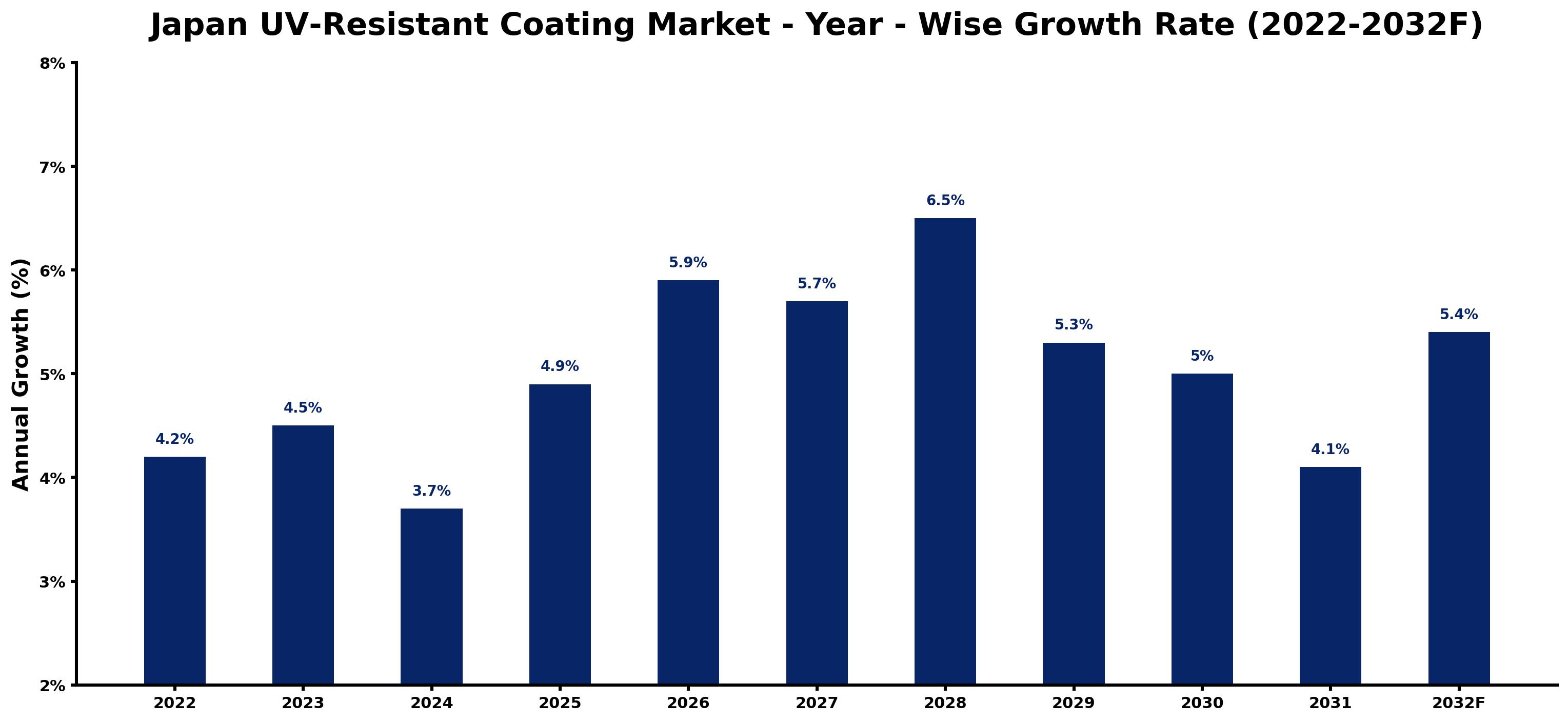
Each row of the following table gives one year's estimated growth and the event or demand shift that explains it.
| Year | Estimated Annual Growth (%) | Market Rationale |
| 2022 | 4.2 | The market was characterised by steady growth driven by automotive production. |
| 2023 | 4.5 | Demand increased as the automotive sector continued to thrive, boosting coating needs. |
| 2024 | 3.7 | Growth slowed due to market saturation in certain applications, yet remained positive. |
| 2025 | 4.9 | The automotive industry's output surged, leading to faster growth in coatings demand. |
| 2026 | 5.9 | Demand is expected to rise as manufacturers invest in advanced coating technologies and processes. |
| 2027 | 5.7 | Growth is projected to slow slightly as supply chain challenges impact production timelines. |
| 2028 | 6.5 | The market is expected to peak as eco-friendly coating technologies gain traction among buyers. |
| 2029 | 5.3 | Growth is projected to decelerate as competition intensifies among coating manufacturers. |
| 2030 | 5.0 | Demand will continue to rise, supported by ongoing innovations in coating applications. |
| 2031 | 4.1 | Growth is expected to slow as market maturity sets in, yet demand will remain strong. |
| 2032 | 5.4 | The market is expected to grow as investments in sustainable coatings increase. |
Note: Market size estimations and growth projections presented in this report are based on 6Wresearch's proprietary forecasting methodology, utilizing the latest available industry data, government publications, and primary research inputs.
Japan UV‑Resistant Coating Market Synopsis
UV-Resistant Coating serves as a protective layer against ultraviolet light degradation, made from polymers such as epoxy, polyurethane, and acrylic. The Japan UV-Resistant Coating Market is growing due to strong demand from the automotive industry, which produced 8.5 million vehicles in 2022, and a $100 billion electronics sector requiring durable coatings. Its primary applications span automotive, furniture, electronics, and optical sectors. The push for eco-friendly technologies and compliance with standards like ISO 9001 further drives this growth.
Market Dynamics Impact Analysis (2026–2032)
| Factor | Type | Impact | Primary Segment Affected |
| Strong automotive production | Driver | High | Epoxy UV Coating |
| Increasing demand for eco-friendly coatings | Driver | High | Polyurethane Coating |
| Growth in the furniture sector | Opportunity | Medium | Wood |
| Expansion of optical labs in urban areas | Opportunity | Medium | Glass |
| Competition among manufacturers | Restraint | High | Acrylic UV Coating |
| Supply chain disruptions | Restraint | Medium | Polyurethane Coating |
| High production costs due to raw material prices | Challenge | High | Epoxy UV Coating |
| Regulatory compliance requirements | Challenge | Medium | Acrylic UV Coating |
Evaluation of Drivers in Japan UV‑Resistant Coating Market (2026–2032)
These are the developments adding the most demand over the forecast period.
| Drivers | Primary Segment Affected | Why It Matters (Evidence) |
| Rising automotive production | Epoxy UV Coating | Japan's automotive industry produced 8.5 million vehicles in 2022, driving demand for durable coatings. |
| Growing electronics sector | Polyurethane Coating | The electronics sector, valued at approximately $100 billion, requires coatings for component protection. |
| Increase in furniture market size | Acrylic UV Coating | The furniture market in Japan is estimated at $18 billion, increasing the need for UV coatings. |
| Technological advancements in coatings | Nano-Coatings | The market for nano-coatings is expected to grow due to advancements in technology. |
| Demand for eco-friendly solutions | Polyurethane Coating | A government programme launched in 2023 promotes eco-friendly coating technologies. |
Orders keep climbing as the automotive sector's strong production drives demand for UV-resistant coatings. In 2022, Japan produced 8.5 million vehicles, increasing the need for durable coatings. The electronics industry, valued at approximately $100 billion, relies heavily on these coatings for component protection. The furniture market, estimated at $18 billion, increases product longevity through UV coatings.
Evaluation of Restraints in Japan UV‑Resistant Coating Market
The key brakes on demand, and where they bite hardest, are shown below.
| Market Restraint | Primary Segment Affected | Why It Matters (Evidence) |
| Intense competition among manufacturers | Acrylic UV Coating | Increased competition leads to price wars, impacting profit margins for producers. |
| Supply chain disruptions | Polyurethane Coating | Supply chain issues have delayed the availability of essential raw materials, affecting production timelines. |
| High production costs | Epoxy UV Coating | Rising raw material prices have increased production costs, impacting overall profitability. |
| Regulatory compliance costs | Acrylic UV Coating | Adhering to stringent regulations increases operational costs for manufacturers. |
| Market saturation in certain applications | Polyurethane Coating | Saturation in established markets limits growth opportunities for new entrants. |
Japan UV‑Resistant Coating Market Challenges
Japan's strict adherence to the JIS K 5600 standard complicates production for manufacturers, often delaying product launches by six months. Rising costs for eco-friendly materials burden buyers in the automotive and electronics sectors, potentially increasing their expenses by 15%. A shortage of skilled workers in the coatings industry stifles innovation, leading to slower product development timelines for suppliers. Intense competition among domestic manufacturers drives prices down, squeezing profit margins by up to 10%, which restricts producers' ability to invest in quality improvements.
Trends in the Japan UV‑Resistant Coating Market
Buyers and suppliers in the Japan UV‑Resistant Coating Market are adjusting to the following trends.
- Shift towards Eco-Friendly Coatings: Furniture makers are increasingly adopting eco-friendly UV coatings, reflecting a growing consumer preference for sustainable products. In 2023, the Japanese government launched a programme to promote such technologies, driving innovation in the coatings sector.
- Transition from Traditional to Advanced Coating Technologies: Since 2022, manufacturers have shifted towards advanced coating technologies to meet evolving market demands. The annual investment in the coatings industry in Japan is estimated at $2 billion, facilitating this transition.
- Emergence of Nano-Coatings in Specialized Applications: The use of nano-coatings is gaining traction in high-tech applications, particularly in electronics. The market for nano-coatings is projected to expand due to advancements in technology.
- Growing Demand for UV Coatings in Construction: The construction sector is increasingly using UV-resistant coatings for exterior applications, driven by the need for durability. The government's target to reduce VOC emissions by 30% by 2025 supports this trend.
Investment Opportunities in the Japan UV‑Resistant Coating Market
Investors looking at the Japan UV‑Resistant Coating Market should consider the following areas.
- Partnerships with Local Manufacturers: Now is the ideal time to partner with local manufacturers in the automotive sector, which produced 8.5 million vehicles in 2022, to supply UV-resistant coatings.
- Investment in Eco-Friendly Coatings: With the government's push for eco-friendly technologies, investing in sustainable UV coatings presents an opportunity for manufacturers, especially in urban areas like Tokyo.
- Expansion into the Furniture Market: Furniture makers are seeking durable UV coatings to improve product longevity, making this a prime opportunity for suppliers in the Kansai region, valued at $18 billion.
- Entering the Optical Lab Sector: Optical labs in the Tokyo Metropolitan area require high-quality UV coatings, creating an opportunity for suppliers to meet this demand.
Government Initiatives in the Japan UV‑Resistant Coating Market
The Food Sanitation Act amendment in 2018 requires UV-resistant coating manufacturers to comply with safety standards by using only approved substances in their products. This measure protects consumer safety and product reliability, ensuring that manufacturers meet stringent requirements to maintain market access. The amendment has led to increased testing and certification efforts, impacting production processes.
The Chemical Substances Control Law mandates evaluation and control of chemical substances, affecting producers of UV-resistant coatings. Agencies like METI and MHLW oversee compliance, ensuring that manufacturers adhere to safety regulations, which can involve significant testing and reporting to meet industry standards.
Future Insight of the Japan UV‑Resistant Coating Market
Investment in the coatings industry will reach $2 billion annually, creating demand for advanced products. By 2032, advancements in coating technology will improve durability and performance, benefiting both buyers and suppliers. The government's initiative to cut VOC emissions by 30% by 2025 will encourage innovation in formulation techniques. As the automotive sector grows, producers will focus on developing high-performance coatings tailored for this expanding market.
Market Segmentation Analysis
Japan UV‑Resistant Coating Market report covers a detailed analysis of the following market segments:
By Coating Type – Polyurethane Coating Leads, Acrylic UV Coating Expected to Grow Fastest
According to Saurav Kr Singh, Senior Research Analyst at 6Wresearch, Polyurethane Coating took 40% of coating type revenue in 2025, more than any other category. Polyurethane coatings dominate the market due to their extensive use in the automotive and furniture sectors, where flexibility and durability are crucial. Their application in the automotive industry, which produced 8.5 million vehicles in 2022, highlights the strong demand for these coatings. Acrylic UV Coating is set to record the highest CAGR in this split, 7.7% over 2026–2032. Acrylic UV coatings are growing rapidly, particularly in the electronics sector, where their clarity and protective properties are essential for component longevity. The electronics industry, valued at approximately $100 billion, offers a significant opportunity for acrylic coatings. Suppliers should focus on developing acrylic formulations to address the rising demand in the electronics sector.
By Substrate – Plastic Leads, Wood Expected to Grow Fastest
In 2025, Plastic led the substrate split with a 43% share. Plastic substrates lead the market as they are extensively used in the automotive and electronics industries for their lightweight characteristics and aesthetic appeal. The automotive sector's production of 8.5 million vehicles in 2022 underscores the reliance on plastic components. Over 2026–2032, Wood is expected to post the fastest growth, at a CAGR of 6.8%. Wood substrates are experiencing the fastest growth, driven by the furniture market's increasing demand for enhanced durability and visual appeal. The estimated $18 billion furniture market indicates a substantial opportunity for wood applications. Buyers in the furniture sector should seek suppliers that offer advanced wood coating solutions to improve product longevity.
By Application Method – Spraying Leads and Records the Fastest Growth
Spraying accounted for 41% of the market by application method in 2025. Spraying is the predominant application method, ensuring uniform coating and efficiency across various sectors. Its widespread use in automotive and furniture applications highlights its critical role in achieving high-quality finishes. The same category is also set to grow fastest, at a CAGR of 7.1% during 2026–2032. Spraying is also the fastest-growing method, as it satisfies the rising demand for rapid application in large-scale manufacturing. This efficiency aligns with the production requirements of both the automotive and furniture industries. Suppliers should invest in advanced spraying technologies to cater to the increasing demand for efficient application methods.
By End User – Automotive OEMs Lead, Furniture Makers Expected to Grow Fastest
With 38% of end user revenue in 2025, Automotive OEMs was the largest category. Automotive OEMs constitute the largest end-user group, as they are significant consumers of UV-resistant coatings needed for vehicle exteriors that demand durability and aesthetic quality. The robust vehicle production in Japan highlights the critical role of these coatings in the automotive sector. The quickest growth will come from Furniture Makers, forecast to expand at a CAGR of 6.7% between 2026 and 2032. Furniture makers represent the fastest-growing end-user segment, motivated by the need for superior wood finishes and durability in a competitive market. The estimated $18 billion furniture market reflects strong demand for quality coatings among manufacturers. Suppliers should customise their offerings to meet the specific requirements of furniture makers to leverage this growth.
Key Attractiveness of the Report
- 10 Years of Market Numbers
- Historical Data Starting from 2022 to 2025
- Base Year 2025
- Forecast Data until 2032
- Key Performance Indicators Impacting the Market
- Major Upcoming Developments and Projects
Key Highlights of the Report:
- Japan UV‑Resistant Coating Market Outlook
- Market Size of Japan UV‑Resistant Coating Market, 2025
- Forecast of Japan UV‑Resistant Coating Market, 2032
- Historical Data and Forecast of Japan UV‑Resistant Coating Revenues & Volume for the Period 2022-2032F
- Japan UV‑Resistant Coating Market Trend Evolution
- Japan UV‑Resistant Coating Market Drivers and Challenges
- Japan UV‑Resistant Coating Price Trends
- Japan UV‑Resistant Coating Porter's Five Forces
- Japan UV‑Resistant Coating Industry Life Cycle
- Historical Data and Forecast of Japan UV‑Resistant Coating Market Revenues & Volume By Coating Type for the Period 2022-2032F
- Historical Data and Forecast of Japan UV‑Resistant Coating Market Revenues & Volume By Epoxy UV Coating for the Period 2022-2032F
- Historical Data and Forecast of Japan UV‑Resistant Coating Market Revenues & Volume By Polyurethane Coating for the Period 2022-2032F
- Historical Data and Forecast of Japan UV‑Resistant Coating Market Revenues & Volume By Acrylic UV Coating for the Period 2022-2032F
- Historical Data and Forecast of Japan UV‑Resistant Coating Market Revenues & Volume By Nano-Coatings for the Period 2022-2032F
- Historical Data and Forecast of Japan UV‑Resistant Coating Market Revenues & Volume By Substrate for the Period 2022-2032F
- Historical Data and Forecast of Japan UV‑Resistant Coating Market Revenues & Volume By Metal for the Period 2022-2032F
- Historical Data and Forecast of Japan UV‑Resistant Coating Market Revenues & Volume By Wood for the Period 2022-2032F
- Historical Data and Forecast of Japan UV‑Resistant Coating Market Revenues & Volume By Plastic for the Period 2022-2032F
- Historical Data and Forecast of Japan UV‑Resistant Coating Market Revenues & Volume By Glass for the Period 2022-2032F
- Historical Data and Forecast of Japan UV‑Resistant Coating Market Revenues & Volume By Application Method for the Period 2022-2032F
- Historical Data and Forecast of Japan UV‑Resistant Coating Market Revenues & Volume By Spraying for the Period 2022-2032F
- Historical Data and Forecast of Japan UV‑Resistant Coating Market Revenues & Volume By Brushing/Rolling for the Period 2022-2032F
- Historical Data and Forecast of Japan UV‑Resistant Coating Market Revenues & Volume By Dip Coating for the Period 2022-2032F
- Historical Data and Forecast of Japan UV‑Resistant Coating Market Revenues & Volume By Vapor Deposition for the Period 2022-2032F
- Historical Data and Forecast of Japan UV‑Resistant Coating Market Revenues & Volume By End User for the Period 2022-2032F
- Historical Data and Forecast of Japan UV‑Resistant Coating Market Revenues & Volume By Automotive OEMs for the Period 2022-2032F
- Historical Data and Forecast of Japan UV‑Resistant Coating Market Revenues & Volume By Furniture Makers for the Period 2022-2032F
- Historical Data and Forecast of Japan UV‑Resistant Coating Market Revenues & Volume By Electronics Industry for the Period 2022-2032F
- Historical Data and Forecast of Japan UV‑Resistant Coating Market Revenues & Volume By Optical Labs for the Period 2022-2032F
- Japan UV‑Resistant Coating Import Export Trade Statistics
- Market Opportunity Assessment By Coating Type
- Market Opportunity Assessment By Substrate
- Market Opportunity Assessment By Application Method
- Market Opportunity Assessment By End User
- Japan UV‑Resistant Coating Top Companies Market Share
- Japan UV‑Resistant Coating Competitive Benchmarking By Technical and Operational Parameters
- Japan UV‑Resistant Coating Company Profiles
- Japan UV‑Resistant Coating Key Strategic Recommendations
Market Covered
Segments analysed in this report are listed below.
By Coating Type
- Epoxy UV Coating
- Polyurethane Coating
- Acrylic UV Coating
- Nano-Coatings
By Substrate
- Metal
- Wood
- Plastic
- Glass
By Application Method
- Spraying
- Brushing/Rolling
- Dip Coating
- Vapor Deposition
By End User
- Automotive OEMs
- Furniture Makers
- Electronics Industry
- Optical Labs































