Japan Value-Based Care Solutions Market Size & Growth Rate
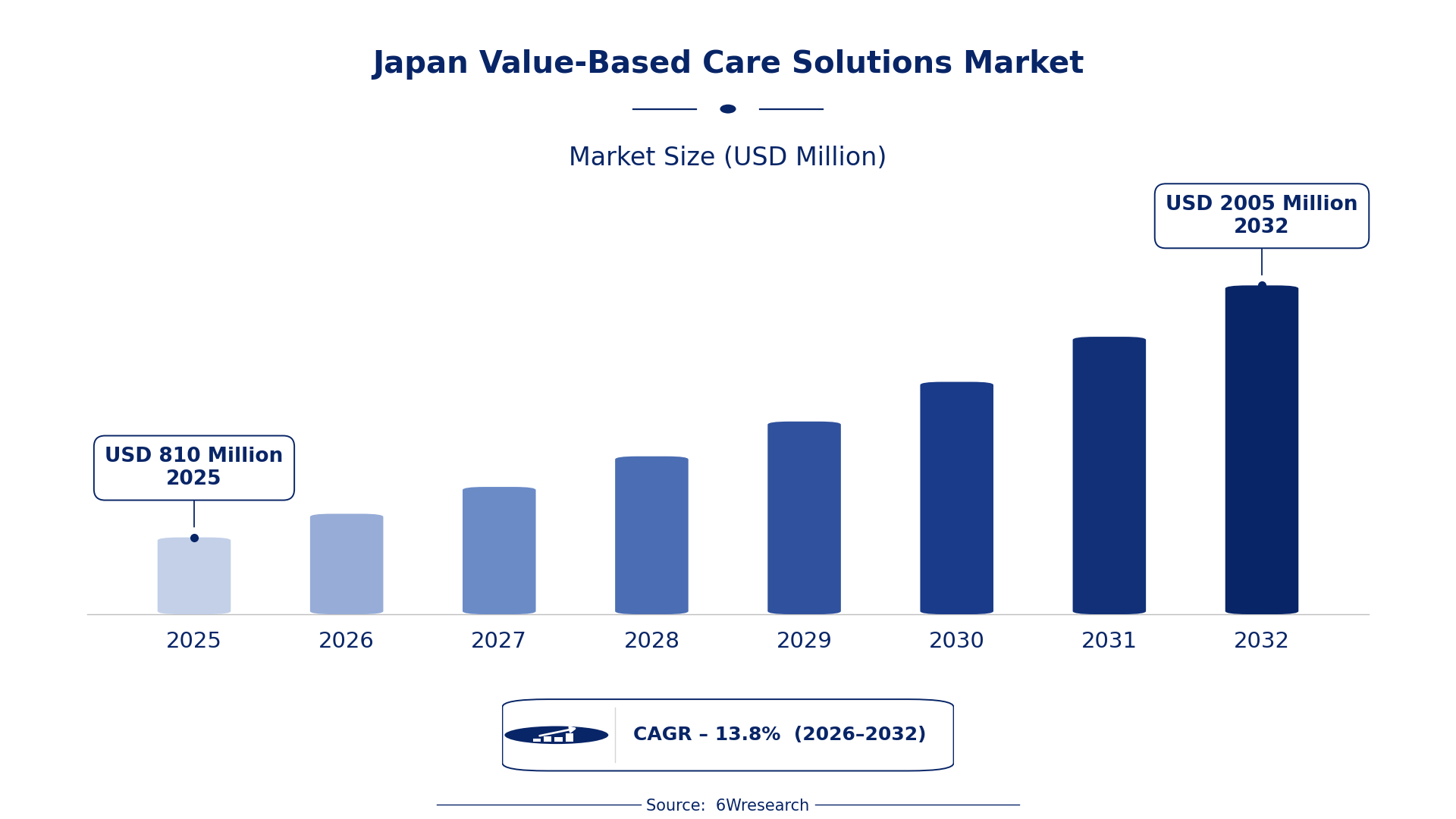
According to 6Wresearch internal database and industry insights, the Japan Value-Based Care Solutions Market was valued at USD 810 Million in 2025 and is projected to reach USD 2,005 Million by 2032, growing at a CAGR of approximately 13.8% during 2026–2032.
Japan Value-Based Care Solutions Market Highlights
| Report Metric | Details |
| Report Name | Japan Value-Based Care Solutions Market (2026-2032) |
| Market Size 2025 | USD 810 Million |
| Market Size 2032 | USD 2,005 Million |
| Absolute Growth 2025–2032 | USD 1,195 Million |
| CAGR 2026–2032 | 13.8% |
| Peak Annual Growth | 14.9% in 2032 |
| Forecast Period | 2026–2032 |
| Historical Data | 2022–2025 |
| Base Year | 2025 |
| Leading Solution Type, 2025 | Population Health Mgmt. (48% share) |
| Leading Delivery Platform, 2025 | SaaS (51% share) |
| Leading User Role, 2025 | Payer/Provider (49% share) |
| Leading End User, 2025 | Insurance Companies (44% share) |
| Fastest-Growing Solution Type | Care Coordination Tools (19.2% CAGR) |
| Fastest-Growing Delivery Platform | Cloud-Based (19.9% CAGR) |
| Fastest-Growing User Role | Physicians (18.4% CAGR) |
| Fastest-Growing End User | Hospitals (17.7% CAGR) |
| Growing Sector | Healthcare Technology |
| Key End Users | Hospitals, Insurance Companies, Healthcare Administrators |
Japan Value-Based Care Solutions Market Year-wise Growth Rate and Key Drivers (2022–2032)
This graph illustrates the annual growth rates of the market from 2022 to 2032, highlighting a steady upward trajectory and projected market expansion over the forecast period.
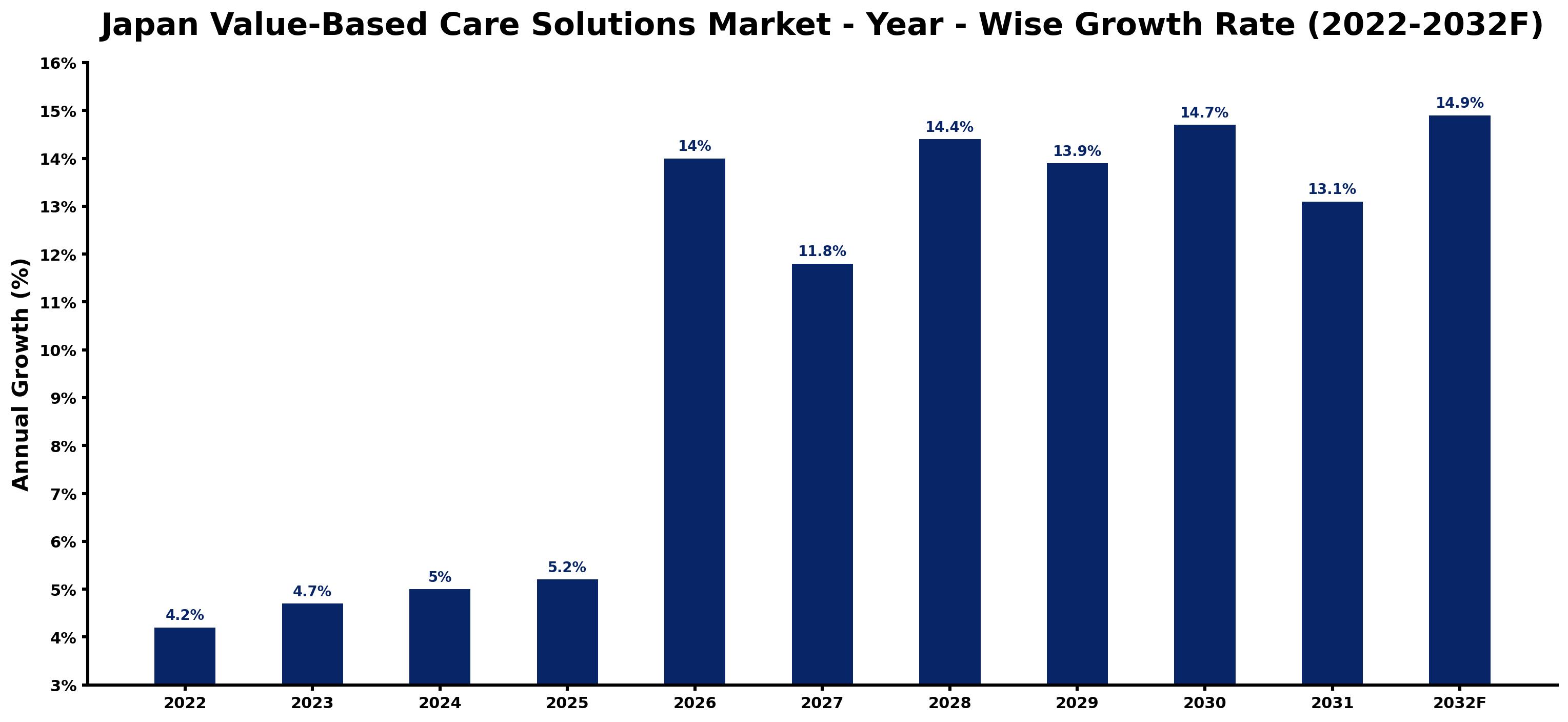
The table below sets out the estimated growth rate for each year and the main factor behind it.
| Year | Estimated Annual Growth (%) | Market Rationale |
| 2022 | 4.2 | The market experienced steady growth with increasing healthcare demands from an aging population. |
| 2023 | 4.7 | Growth accelerated due to heightened investments in value-based care solutions across healthcare facilities. |
| 2024 | 5.0 | The introduction of new healthcare reforms further boosted the adoption of value-based care technologies. |
| 2025 | 5.2 | Growth peaked as hospitals increasingly implemented care coordination tools to improve patient outcomes. |
| 2026 | 14.0 | A surge in demand for advanced healthcare solutions is expected to drive market expansion. |
| 2027 | 11.8 | Growth is projected to slow slightly as the market stabilises after rapid expansion in previous years. |
| 2028 | 14.4 | Demand is expected to increase again as healthcare providers invest more in digital health technologies. |
| 2029 | 13.9 | Growth is projected to moderate as the market adjusts to the high adoption rates of previous years. |
| 2030 | 14.7 | The market is expected to rebound with renewed interest in AI-based solutions for healthcare management. |
| 2031 | 13.1 | Growth is projected to decelerate as the market matures and competition intensifies among providers. |
| 2032 | 14.9 | The market is expected to reach its peak growth as value-based care becomes a standard practice in healthcare. |
Note: Market size estimations and growth projections presented in this report are based on 6Wresearch's proprietary forecasting methodology, utilizing the latest available industry data, government publications, and primary research inputs.
Japan Value-Based Care Solutions Market Synopsis
Value-Based Care Solutions focus on improving patient outcomes while managing costs through advanced analytics and data integration. The Japan Value-Based Care Solutions Market is experiencing rapid expansion, driven by a growing aging population and ongoing healthcare reforms. Key buyer groups include hospitals and insurance companies, both of which are increasingly adopting these solutions. The 2023 healthcare reform programme aims to improve care efficiency and quality across the healthcare sector, further supporting market growth.
Market Dynamics Impact Analysis (2026–2032)
| Factor | Type | Impact | Primary Segment Affected |
| Aging population increases demand for efficient healthcare solutions. | Driver | High | Population Health Mgmt. |
| Healthcare providers are adopting digital solutions to improve care coordination. | Driver | High | Care Coordination Tools |
| Growing investment in healthcare IT solutions presents opportunities for new entrants. | Opportunity | High | Cloud-Based |
| Insurance companies are increasingly adopting value-based reimbursement models. | Opportunity | High | Insurance Companies |
| High costs associated with implementing new technologies can deter adoption. | Restraint | Medium | Cost-Reduction Systems |
| Limited awareness among smaller healthcare providers about value-based care benefits. | Restraint | Medium | Outcome Analytics |
| Competition among providers can lead to price wars, affecting profitability. | Challenge | High | SaaS |
| Rapid technological advancements can outpace regulatory frameworks, causing compliance issues. | Challenge | Medium | AI-Based |
Evaluation of Drivers in Japan Value-Based Care Solutions Market (2026–2032)
The table below links each growth driver to the segment it affects and the evidence for it.
| Drivers | Primary Segment Affected | Why It Matters (Evidence) |
| Increased healthcare expenditure drives demand for effective solutions. | Population Health Mgmt. | Japan's national medical care expenditure reached JPY 46.7 trillion in fiscal 2022, prompting hospitals to seek cost-effective care management. |
| The aging population necessitates improved care coordination tools. | Care Coordination Tools | With 29.3% of the population aged 65 or older, healthcare providers are investing in tools to manage complex care needs. |
| Reforms are encouraging the adoption of digital health solutions. | Cloud-Based | The 2023 healthcare reform programme aims to increase digital health adoption by 30% by 2025, pushing providers to invest in cloud solutions. |
| Insurance companies are shifting towards value-based reimbursement models. | Insurance Companies | This shift encourages hospitals to adopt value-based care solutions to align with new reimbursement strategies. |
| Growing awareness of patient outcomes drives demand for analytics solutions. | Outcome Analytics | As hospitals focus on improving patient care quality, the need for data-driven insights has increased. |
Spending rises because Japan's substantial healthcare expenditure, which reached JPY 46.7 trillion in fiscal 2022, compels hospitals to seek effective solutions. The aging population, with 29.3% aged 65 or older, necessitates improved care coordination tools. Insurance companies are increasingly embracing value-based reimbursement models, which encourages hospitals to implement value-based care solutions. Awareness of patient outcomes has led to a rising demand for analytics solutions that provide data-driven insights for better management.
Evaluation of Restraints in Japan Value-Based Care Solutions Market
The table below lists the restraints and the evidence behind each.
| Market Restraint | Primary Segment Affected | Why It Matters (Evidence) |
| High implementation costs can deter smaller healthcare providers from adopting new solutions. | Cost-Reduction Systems | With healthcare expenditure reaching JPY 42 trillion in 2022, smaller providers struggle to invest in advanced technologies. |
| Limited awareness of value-based care benefits among smaller providers hampers market growth. | Outcome Analytics | Many smaller healthcare facilities lack knowledge about the advantages of adopting value-based care models. |
| Regulatory compliance can be complex and costly for new entrants. | AI-Based | Rapid technological advancements often lead to evolving regulations, creating challenges for compliance. |
| Market saturation in urban areas limits growth potential for new providers. | SaaS | With 60% of hospitals in urban regions already using care coordination tools, new entrants face stiff competition. |
| Inconsistent data integration across systems can hinder effective implementation. | Cloud-Based | Healthcare providers often struggle with integrating cloud solutions into existing workflows, affecting efficiency. |
Japan Value-Based Care Solutions Market Challenges
Japan's intricate healthcare regulations create compliance difficulties, causing delays in value-based care solution deployment for producers. These regulatory hurdles can extend project timelines by up to six months, increasing costs for hospitals that rely on timely implementation. Rapid technological changes leave many healthcare providers struggling, as 40% report challenges in adopting new digital tools, resulting in inefficiencies that affect patient care quality. A projected shortage of 1 million skilled professionals by 2030 will escalate costs for buyers, as service delivery across the healthcare sector becomes increasingly strained.
Trends in the Japan Value-Based Care Solutions Market
Several trends are reshaping the Japan Value-Based Care Solutions Market; the most important are set out below.
- Transition from Traditional to Value-Based Care Models: Japan is moving from traditional fee-for-service models to value-based care, as seen in the 2023 healthcare reform programme. This shift aims to improve patient outcomes and reduce costs, with 60% of hospitals adopting care coordination tools.
- Emergence of AI in Healthcare Decision-Making: The integration of AI-based solutions in healthcare is gaining traction, with guidelines set for implementation by 2024. This trend is expected to improve decision-making processes in patient care, enhancing overall efficiency.
- Increased Adoption of Cloud-Based Solutions: Cloud-based healthcare solutions are becoming more prevalent, with 50% of urban healthcare providers adopting them. This trend reflects the growing need for remote access to patient data and improved care coordination.
- Focus on Improved Patient Outcomes through Analytics: Healthcare providers are increasingly using outcome analytics to improve patient care, with substantial investments in data-driven solutions. This trend is supported by the Japan Medical Association, promoting best practices in healthcare management.
Investment Opportunities in the Japan Value-Based Care Solutions Market
The openings below show where demand in the Japan Value-Based Care Solutions Market is visible and how suppliers can enter.
- Ideal Timing for Investment in Cloud-Based Solutions: With 50% of urban healthcare providers adopting cloud solutions, now is an ideal time to invest in these technologies. Partnering with hospitals in Tokyo can facilitate market entry and growth.
- Insurance Companies Seeking Value-Based Care Solutions: Insurance companies are actively searching for effective solutions to support value-based reimbursement models. Investing in care coordination tools can meet their needs and improve service offerings.
- Growing Demand for Outcome Analytics: The rising focus on patient outcomes creates an opportunity to supply advanced analytics solutions. Engaging with hospitals in Osaka can help capture this growing market segment.
- Entry into the SaaS Market: The SaaS segment is expanding rapidly, with hospitals increasingly adopting software solutions. Establishing joint ventures with local healthcare providers can streamline market entry.
Government Initiatives in the Japan Value-Based Care Solutions Market
The Medical Care Act of 1948 establishes standards for hospitals and clinics, ensuring quality delivery of healthcare services. The Long-Term Care Insurance Act, enacted in 1997, provides funding for nursing care and support services for the elderly, reflecting Japan's commitment to improving healthcare for its aging population.
In 2023, JPY 150 trillion was allocated for public-private decarbonisation investment, overseen by the Ministry of Health, Labour and Welfare. This funding supports initiatives aimed at improving value-based care solutions in Japan.
Future Insight of the Japan Value-Based Care Solutions Market
By 2032, the shift towards value-based care will prompt a significant transformation in healthcare delivery, with hospitals increasingly utilising advanced analytics and digital health solutions. The integration of AI in healthcare will improve care coordination, supported by guidelines set for implementation by 2024. The government plans to increase the adoption of digital health solutions, which will enhance patient outcomes. Healthcare IT investments are expected to exceed 1 trillion JPY by 2025, enabling suppliers to innovate and effectively address buyer demands.
Market Segmentation Analysis
Japan Value-Based Care Solutions Market report covers a detailed analysis of the following market segments:
By Solution Type – Population Health Mgmt. Leads, Care Coordination Tools Expected to Grow Fastest
According to Saurav Kr Singh, Senior Research Analyst at 6Wresearch, Population Health Mgmt. held 48% of the Japan Value-Based Care Solutions Market by solution type in 2025. Population Health Management holds the largest share because it is essential for proactive care management, particularly for Japan's ageing population. This approach is crucial for hospitals aiming to enhance patient outcomes and control costs effectively. Care Coordination Tools are set to record the highest CAGR in this split, 19.2% over 2026–2032. The rapid adoption of Care Coordination Tools is driven by the need for better communication among providers, with 60% of hospitals already employing these tools. This trend is expected to continue as healthcare reforms push for improved care integration. Suppliers should focus on developing solutions that enhance care coordination to meet the increasing demand from hospitals.
By Delivery Platform – SaaS Lead, Cloud-Based Expected to Grow Fastest
With 51% of delivery platform revenue in 2025, SaaS was the largest category. SaaS leads the market due to its provision of scalable software solutions essential for healthcare providers managing large volumes of data. Its flexibility allows for smoother integration into existing systems across various healthcare settings. Cloud-Based is projected to grow fastest, at a CAGR of 19.9% during 2026–2032. Cloud-Based solutions are experiencing the fastest growth because they enable remote access to data, which is becoming increasingly vital as the industry shifts towards digital platforms. The government's push for digital health solutions further fuels this trend. Suppliers must prioritise cloud-based offerings to align with the industry's shift towards remote healthcare access.
By User Role – Payer/Provider Leads, Physicians Expected to Grow Fastest
Payer/Provider took 49% of user role revenue in 2025, more than any other category. Payer/Provider roles dominate the market because they are essential for reimbursement processes, ensuring that value-based care models are financially viable. Their involvement is critical in the decision-making processes regarding healthcare expenditures. The quickest growth will come from Physicians, forecast to expand at a CAGR of 18.4% between 2026 and 2032. Physicians are the fastest-growing user role as they are directly involved in patient care improvement initiatives, which are increasingly emphasised in value-based care frameworks. Their engagement is vital for the successful implementation of these solutions. Suppliers should tailor their offerings to meet the specific needs of physicians to capture this growing segment.
By End User – Insurance Companies Lead, Hospitals Expected to Grow Fastest
Insurance Companies accounted for 44% of the market by end user in 2025. Insurance Companies represent the largest share as they play a pivotal role in shaping value-based reimbursement models, which influence the adoption of care solutions across the healthcare sector. Their participation is key in determining the financial structure of healthcare delivery. Over 2026–2032, Hospitals are expected to post the fastest growth, at a CAGR of 17.7%. Hospitals are the fastest-growing end user, focusing on the implementation of care solutions to enhance patient outcomes and operational efficiency. As more hospitals adopt these solutions, their demand is projected to increase significantly. Suppliers should customise their products to address the specific requirements of hospitals to leverage this growing demand.
Key Attractiveness of the Report
- 10 Years of Market Numbers
- Historical Data Starting from 2022 to 2025
- Base Year 2025
- Forecast Data until 2032
- Key Performance Indicators Impacting the Market
- Major Upcoming Developments and Projects
Key Highlights of the Report:
- Japan Value-Based Care Solutions Market Outlook
- Market Size of Japan Value-Based Care Solutions Market, 2025
- Forecast of Japan Value-Based Care Solutions Market, 2032
- Historical Data and Forecast of Japan Value-Based Care Solutions Revenues & Volume for the Period 2022-2032F
- Japan Value-Based Care Solutions Market Trend Evolution
- Japan Value-Based Care Solutions Market Drivers and Challenges
- Japan Value-Based Care Solutions Price Trends
- Japan Value-Based Care Solutions Porter's Five Forces
- Japan Value-Based Care Solutions Industry Life Cycle
- Historical Data and Forecast of Japan Value-Based Care Solutions Market Revenues & Volume By Solution Type for the Period 2022-2032F
- Historical Data and Forecast of Japan Value-Based Care Solutions Market Revenues & Volume By Population Health Mgmt. for the Period 2022-2032F
- Historical Data and Forecast of Japan Value-Based Care Solutions Market Revenues & Volume By Care Coordination Tools for the Period 2022-2032F
- Historical Data and Forecast of Japan Value-Based Care Solutions Market Revenues & Volume By Outcome Analytics for the Period 2022-2032F
- Historical Data and Forecast of Japan Value-Based Care Solutions Market Revenues & Volume By Cost-Reduction Systems for the Period 2022-2032F
- Historical Data and Forecast of Japan Value-Based Care Solutions Market Revenues & Volume By Delivery Platform for the Period 2022-2032F
- Historical Data and Forecast of Japan Value-Based Care Solutions Market Revenues & Volume By SaaS for the Period 2022-2032F
- Historical Data and Forecast of Japan Value-Based Care Solutions Market Revenues & Volume By Cloud-Based for the Period 2022-2032F
- Historical Data and Forecast of Japan Value-Based Care Solutions Market Revenues & Volume By AI-Based for the Period 2022-2032F
- Historical Data and Forecast of Japan Value-Based Care Solutions Market Revenues & Volume By EHR Integrated for the Period 2022-2032F
- Historical Data and Forecast of Japan Value-Based Care Solutions Market Revenues & Volume By User Role for the Period 2022-2032F
- Historical Data and Forecast of Japan Value-Based Care Solutions Market Revenues & Volume By Payer/Provider for the Period 2022-2032F
- Historical Data and Forecast of Japan Value-Based Care Solutions Market Revenues & Volume By Physicians for the Period 2022-2032F
- Historical Data and Forecast of Japan Value-Based Care Solutions Market Revenues & Volume By Healthcare Admins for the Period 2022-2032F
- Historical Data and Forecast of Japan Value-Based Care Solutions Market Revenues & Volume By CFO/Claims Analyst for the Period 2022-2032F
- Historical Data and Forecast of Japan Value-Based Care Solutions Market Revenues & Volume By End User for the Period 2022-2032F
- Historical Data and Forecast of Japan Value-Based Care Solutions Market Revenues & Volume By Insurance Companies for the Period 2022-2032F
- Historical Data and Forecast of Japan Value-Based Care Solutions Market Revenues & Volume By Hospitals for the Period 2022-2032F
- Historical Data and Forecast of Japan Value-Based Care Solutions Market Revenues & Volume By Accountable Care Orgs for the Period 2022-2032F
- Historical Data and Forecast of Japan Value-Based Care Solutions Market Revenues & Volume By Health Systems for the Period 2022-2032F
- Japan Value-Based Care Solutions Import Export Trade Statistics
- Market Opportunity Assessment By Solution Type
- Market Opportunity Assessment By Delivery Platform
- Market Opportunity Assessment By User Role
- Market Opportunity Assessment By End User
- Japan Value-Based Care Solutions Top Companies Market Share
- Japan Value-Based Care Solutions Competitive Benchmarking By Technical and Operational Parameters
- Japan Value-Based Care Solutions Company Profiles
- Japan Value-Based Care Solutions Key Strategic Recommendations
Market Covered
The following segment groups are covered in the report.
By Solution Type
- Population Health Mgmt.
- Care Coordination Tools
- Outcome Analytics
- Cost-Reduction Systems
By Delivery Platform
- SaaS
- Cloud-Based
- AI-Based
- EHR Integrated
By User Role
- Payer/Provider
- Physicians
- Healthcare Admins
- CFO/Claims Analyst
By End User
- Insurance Companies
- Hospitals
- Accountable Care Orgs
- Health Systems































