Japan Valve Automation Market Size & Growth Rate
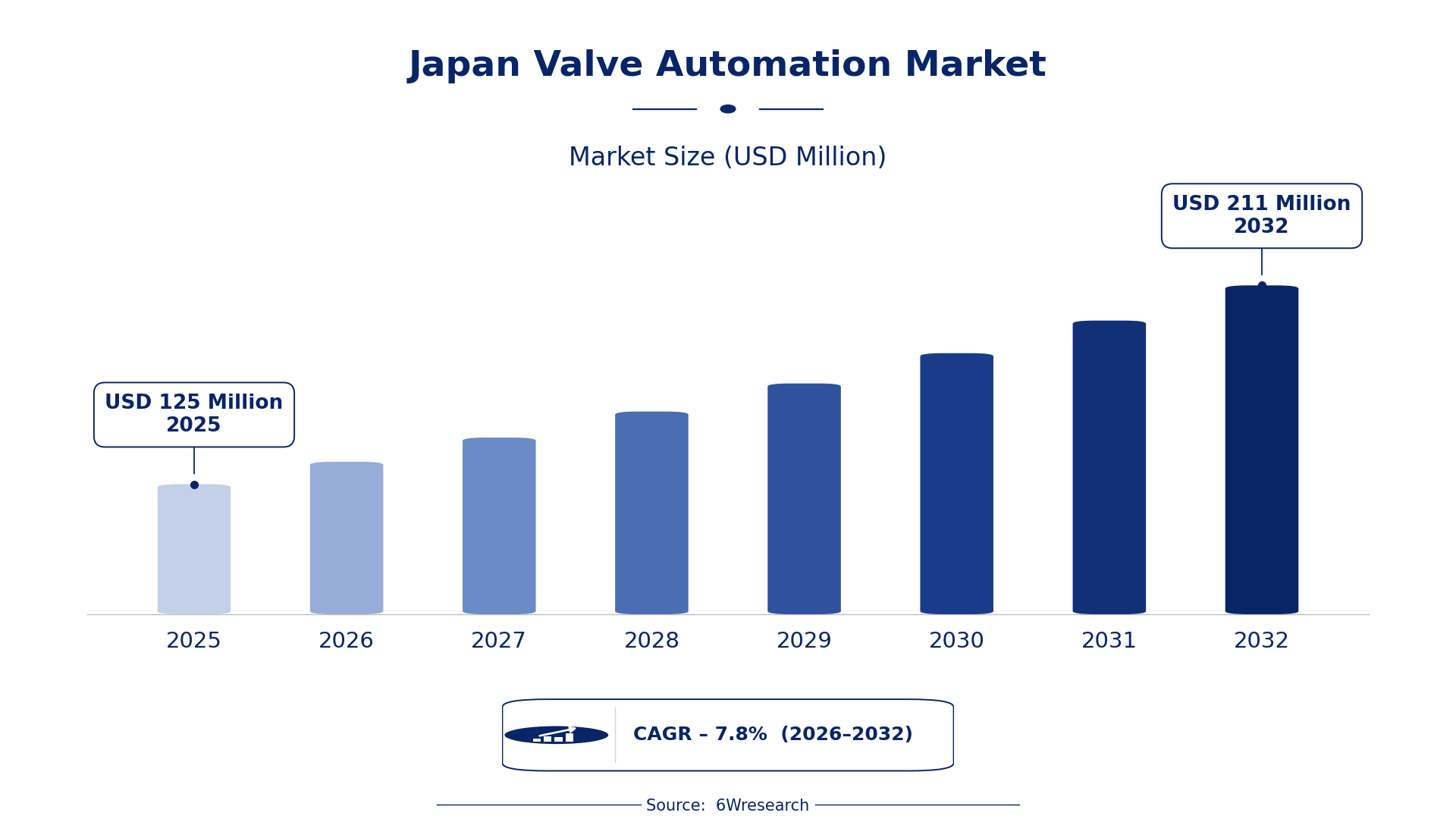
According to 6Wresearch internal database and industry insights, the Japan Valve Automation Market was valued at USD 125 Million in 2025 and is projected to reach USD 211 Million by 2032, growing at a CAGR of approximately 7.8% during 2026–2032.
Japan Valve Automation Market Highlights
| Report Metric | Details |
| Report Name | Japan Valve Automation Market (2026-2032) |
| Market Size 2025 | USD 125 Million |
| Market Size 2032 | USD 211 Million |
| Absolute Growth 2025–2032 | USD 86 Million |
| CAGR 2026–2032 | 7.8% |
| Peak Annual Growth | 8.6% in 2029 |
| Forecast Period | 2026–2032 |
| Historical Data | 2022–2025 |
| Base Year | 2025 |
| Leading Valve Type, 2025 | Ball Valves (43% share) |
| Leading Automation Type, 2025 | Pneumatic (49% share) |
| Leading Control Interface, 2025 | PLC/SCADA (36% share) |
| Leading End User, 2025 | Refinery Plants (38% share) |
| Fastest-Growing Valve Type | Gate Valves (10.8% CAGR) |
| Fastest-Growing Automation Type | Electric Actuator (11.1% CAGR) |
| Fastest-Growing Control Interface | DCS (10.7% CAGR) |
| Fastest-Growing End User | Pipeline Operators (9.9% CAGR) |
| Growing Sector | Water Treatment |
| Key End Users | Refinery Plants, Pipeline Operators, Water Treatment Plants, Power Plants |
Japan Valve Automation Market Year-wise Growth Rate and Key Drivers (2022–2032)
This graph illustrates the annual growth rates of the market from 2022 to 2032, highlighting a steady upward trajectory and projected market expansion over the forecast period.
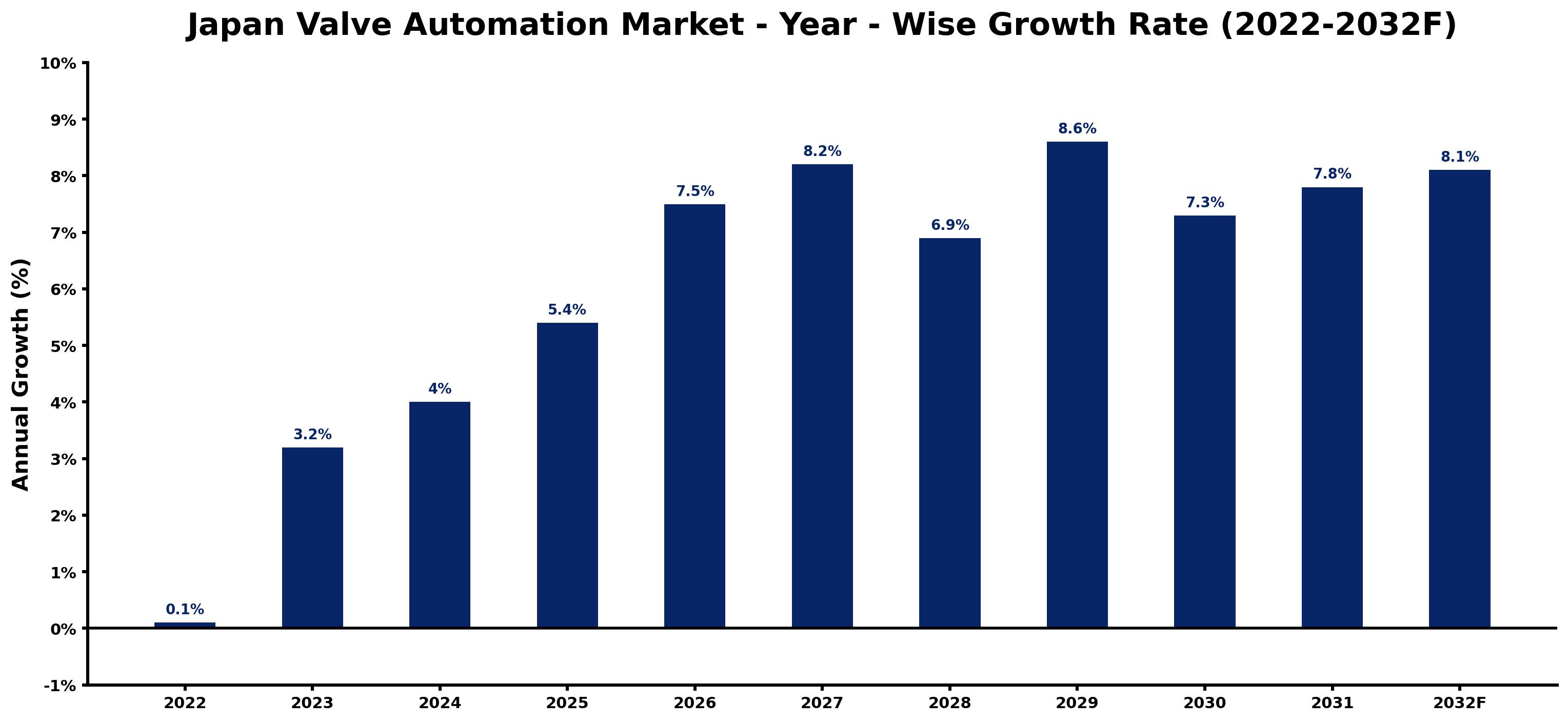
For each year, the table pairs the estimated growth rate with the leading influence on demand, showing how the drivers changed across the period.
| Year | Estimated Annual Growth (%) | Market Rationale |
| 2022 | 0.1 | The market showed minimal growth due to ongoing adjustments in industrial processes. |
| 2023 | 3.2 | Demand increased as industries began adopting more efficient automation technologies. |
| 2024 | 4.0 | Growth continued as investments in smart manufacturing technologies gained momentum. |
| 2025 | 5.4 | The market peaked historically as energy efficiency initiatives drove higher automation needs. |
| 2026 | 7.5 | Demand is expected to rise with the growing adoption of electric actuators in various sectors. |
| 2027 | 8.2 | The market is projected to grow as the focus on decarbonisation intensifies across industries. |
| 2028 | 6.9 | Growth is anticipated to slow as the market stabilises after rapid expansion. |
| 2029 | 8.6 | The peak growth year will see a surge in demand for automation in refinery plants. |
| 2030 | 7.3 | Growth is expected to moderate as the market adjusts to new technological standards. |
| 2031 | 7.8 | Demand will rise as industries continue to modernise their automation systems. |
| 2032 | 8.1 | The market is projected to grow steadily with increasing investments in automation technologies. |
Note: Market size estimations and growth projections presented in this report are based on 6Wresearch's proprietary forecasting methodology, utilizing the latest available industry data, government publications, and primary research inputs.
Japan Valve Automation Market Synopsis
Valve automation involves controlling valves in industrial processes through mechanical and electronic integration. Key sectors in Japan include oil refining and water treatment, where efficient flow regulation is essential. The Japan Valve Automation Market is expanding due to rising investments in decarbonisation technologies, with an estimated JPY 150 trillion allocated for such initiatives over the next decade. The emphasis on energy efficiency and the adoption of advanced automation systems are driving demand across various industries, particularly in the Tokyo region, a major manufacturing hub.
Market Dynamics Impact Analysis (2026–2032)
| Factor | Type | Impact | Primary Segment Affected |
| Growing investments in decarbonisation technologies | Driver | High | Electric Actuator |
| Increased focus on energy efficiency in industrial processes | Driver | High | Pneumatic |
| Expansion of water treatment facilities | Opportunity | Medium | Water Treatment Plants |
| Rising demand for automation in pipeline operations | Opportunity | Medium | Pipeline Operators |
| High costs of advanced automation systems | Restraint | High | Electric Actuator |
| Limited availability of skilled workforce for automation installation | Restraint | Medium | Pneumatic |
| Compliance with stringent environmental regulations | Challenge | High | Refinery Plants |
| Capacity constraints in manufacturing facilities | Challenge | Medium | Water Treatment Plants |
Evaluation of Drivers in Japan Valve Automation Market (2026–2032)
The following drivers explain most of the expected growth.
| Drivers | Primary Segment Affected | Why It Matters (Evidence) |
| Increased investment in smart manufacturing technologies | Electric Actuator | This investment supports precision in automation, particularly in refinery plants. |
| Focus on energy efficiency initiatives | Pneumatic | These initiatives drive the adoption of pneumatic actuators, especially in chemical processing facilities. |
| Expansion of water treatment infrastructure | Water Treatment Plants | This expansion necessitates advanced valve automation systems for effective water management. |
| Growing pipeline operations requiring automation | Pipeline Operators | Improved automation improves safety and efficiency in transporting fluids, prompting higher purchases. |
| Rising environmental standards | Refinery Plants | Compliance with these standards increases the need for reliable valve automation solutions. |
The strongest pull on demand comes from increased investment in smart manufacturing technologies, which reached approximately JPY 150 trillion over ten years. This investment supports precision in automation, particularly in refinery plants. Energy efficiency goals drive the adoption of electric actuators, increasingly used in chemical processing facilities. Expansion of water treatment infrastructure necessitates advanced valve automation systems for effective management. Pipeline operations require improved automation to enhance safety and efficiency in transporting fluids, prompting higher purchases. Environmental standards compel refinery plants to invest in reliable valve automation solutions.
Evaluation of Restraints in Japan Valve Automation Market
Below are the constraints most often cited by buyers and suppliers, with the segment each affects.
| Market Restraint | Primary Segment Affected | Why It Matters (Evidence) |
| High costs of advanced automation systems | Electric Actuator | These costs can deter smaller facilities from upgrading their systems, limiting market growth. |
| Limited availability of skilled workforce for automation installation | Pneumatic | A shortage of trained personnel can delay project timelines and increase operational costs. |
| Compliance with stringent environmental regulations | Refinery Plants | Meeting these regulations often requires costly upgrades and certifications, impacting budgets. |
| Capacity constraints in manufacturing facilities | Water Treatment Plants | These constraints can lead to delays in project completions and affect service delivery. |
| Market competition driving prices down | Pipeline Operators | Intense competition can reduce profit margins for suppliers, affecting investment in innovation. |
Japan Valve Automation Market Challenges
In Japan, disruptions in the supply of pneumatic actuators can halt production in chemical processing facilities, causing delays of up to three weeks for manufacturers. This issue arises from a limited number of local suppliers, which restricts availability and increases lead times. Increased competition from international valve automation producers forces local firms to lower prices, squeezing profit margins for suppliers by as much as 15%. Compliance with the JIS B 2002 standard raises manufacturing costs, potentially increasing prices for buyers by 10%. A lack of skilled workers in advanced automation technologies limits producers' ability to innovate, reducing their competitiveness in the market.
Trends in the Japan Valve Automation Market
Buyers and suppliers in the Japan Valve Automation Market are adjusting to the following trends.
- Shift towards Electric Actuators in Refinery Plants: Refinery plants are increasingly adopting electric actuators for their precision and efficiency. In 2023, the adoption rate rose to 30%, reflecting a shift in automation preferences.
- Transition from Pneumatic to Electric Automation: The change from pneumatic to electric automation systems began in 2022, driven by energy efficiency goals. This transition is evident as electric actuators now account for 25% of new installations.
- Emergence of DCS Systems in Power Generation: DCS systems have become prevalent in power generation facilities since 2021, with a 15% increase in installations. This trend enhances centralized control and operational efficiency.
- Integration of Remote Access Technologies: Remote access technologies are being integrated into existing valve automation systems, with a 20% increase in adoption since 2022, enabling better monitoring and control.
Investment Opportunities in the Japan Valve Automation Market
The following opportunities in the Japan Valve Automation Market pair current demand with a clear way in.
- Timing for Investment in Smart Manufacturing: With Japan targeting a 46% reduction in greenhouse gas emissions by 2030, there is a pressing need for smart manufacturing technologies. Investing in automation systems now can position suppliers favourably in the market.
- Gap in Water Treatment Infrastructure: Japan's water treatment plants are expanding, with over 100 facilities in operation. This presents a significant opportunity for suppliers to provide advanced valve automation solutions.
- Focus on Pipeline Operations: Pipeline operators are increasingly seeking automation solutions to enhance safety and efficiency. Entering this market through partnerships with local firms can facilitate access to new projects.
- Approval Pathways for New Technologies: The Japan Industrial Standards Committee oversees standards for valve automation. Gaining ISO 9001 certification can enhance market credibility and facilitate entry into new sectors.
Government Initiatives in the Japan Valve Automation Market
The Water Supply Act of 1957 sets essential standards for drinking-water quality and supply, impacting valve automation producers by mandating compliance with safety regulations. This law ensures that manufacturers must meet specific criteria to supply automation solutions to water treatment facilities, driving demand for compliant products.
The Ministry of the Environment promotes water conservation technologies, including valve automation, through various funding initiatives. In 2023, the ministry allocated JPY 10 billion to support projects that improve energy efficiency in industrial plants, benefiting manufacturers and buyers alike by encouraging the adoption of advanced automation technologies.
Future Insight of the Japan Valve Automation Market
The integration of remote access technologies will transform demand for valve automation, enabling real-time monitoring and control across various sectors. Investment in smart manufacturing technologies will streamline operations and reduce costs for suppliers. The government’s decarbonisation programme will drive the shift towards energy-efficient valve solutions, with a target of JPY 150 trillion in investments over the next decade. As Japan's population continues to grow, the need for efficient water management will further elevate the importance of advanced valve automation systems.
Market Segmentation Analysis
Japan Valve Automation Market report covers a detailed analysis of the following market segments:
By Valve Type – Ball Valves Lead, Gate Valves Expected to Grow Fastest
According to Saurav Kr Singh, Senior Research Analyst at 6Wresearch, Ball Valves accounted for 43% of the market by valve type in 2025. Ball valves dominate the market due to their reliability and versatility in flow control, particularly in applications like oil refining. Their widespread adoption across Japan's industrial sectors, especially in the Tokyo region, reinforces their leading position. Gate Valves are set to record the highest CAGR in this split, 10.8% over 2026–2032. Gate valves are experiencing rapid growth as they are increasingly preferred for on/off control in pipeline systems, crucial for Japan's fluid transportation infrastructure. This trend is supported by government initiatives aimed at enhancing energy efficiency in industrial processes. Suppliers should focus on the rising demand for gate valves to capture new opportunities in pipeline applications.
By Automation Type – Pneumatic Leads, Electric Actuator Expected to Grow Fastest
Pneumatic took 49% of automation type revenue in 2025, more than any other category. Pneumatic actuators lead the market as they are widely employed for actuating valves in various industries, ensuring effective operation in critical processes. Their strong presence in sectors like chemical processing reinforces their dominant market share. The quickest growth will come from Electric Actuator, forecast to expand at a CAGR of 11.1% between 2026 and 2032. Electric actuators are experiencing the highest growth rate due to their effectiveness in providing precise control in automation, particularly within refinery plants where accuracy is critical. This trend aligns with Japan's industrial strategy prioritising smart manufacturing technologies. Buyers should explore investments in electric actuators to improve precision and operational efficiency in their automation systems.
By Control Interface – PLC/SCADA Leads, DCS Expected to Grow Fastest
With 36% of control interface revenue in 2025, PLC/SCADA was the largest category. PLC/SCADA systems are integral for process control and monitoring, making them essential in various industrial applications across Japan. Their established role in managing complex processes in facilities, especially in the Tokyo region, solidifies their market leadership. DCS is projected to grow fastest, at a CAGR of 10.7% during 2026–2032. DCS systems are rapidly gaining traction as they provide centralized control in large facilities, which is increasingly important for efficient operations in sectors like power generation. The growing complexity of industrial processes drives this demand. Suppliers must prioritise DCS solutions to meet the rising need for centralised control in large-scale operations.
By End User – Refinery Plants Lead, Pipeline Operators Expected to Grow Fastest
In 2025, Refinery Plants led the end user split with a 38% share. Refinery plants represent the largest end user of valve automation because they are vital for oil and gas processing, which is critical for Japan's energy needs. The high concentration of these facilities in regions like Chubu highlights their importance in the market. Over 2026–2032, Pipeline Operators are expected to post the fastest growth, at a CAGR of 9.9%. Pipeline operators are seeing the fastest growth as they require advanced automation solutions for the safe transport of fluids, essential for maintaining efficiency in Japan's extensive pipeline network. This demand is driven by regulatory pressures prioritising safety and operational efficiency. Suppliers should target pipeline operators to leverage the increasing need for advanced automation solutions in fluid transportation.
Key Attractiveness of the Report
- 10 Years of Market Numbers
- Historical Data Starting from 2022 to 2025
- Base Year 2025
- Forecast Data until 2032
- Key Performance Indicators Impacting the Market
- Major Upcoming Developments and Projects
Key Highlights of the Report:
- Japan Valve Automation Market Outlook
- Market Size of Japan Valve Automation Market, 2025
- Forecast of Japan Valve Automation Market, 2032
- Historical Data and Forecast of Japan Valve Automation Revenues & Volume for the Period 2022-2032F
- Japan Valve Automation Market Trend Evolution
- Japan Valve Automation Market Drivers and Challenges
- Japan Valve Automation Price Trends
- Japan Valve Automation Porter's Five Forces
- Japan Valve Automation Industry Life Cycle
- Historical Data and Forecast of Japan Valve Automation Market Revenues & Volume By Valve Type for the Period 2022-2032F
- Historical Data and Forecast of Japan Valve Automation Market Revenues & Volume By Ball Valves for the Period 2022-2032F
- Historical Data and Forecast of Japan Valve Automation Market Revenues & Volume By Gate Valves for the Period 2022-2032F
- Historical Data and Forecast of Japan Valve Automation Market Revenues & Volume By Butterfly Valves for the Period 2022-2032F
- Historical Data and Forecast of Japan Valve Automation Market Revenues & Volume By Globe Valves for the Period 2022-2032F
- Historical Data and Forecast of Japan Valve Automation Market Revenues & Volume By Automation Type for the Period 2022-2032F
- Historical Data and Forecast of Japan Valve Automation Market Revenues & Volume By Pneumatic for the Period 2022-2032F
- Historical Data and Forecast of Japan Valve Automation Market Revenues & Volume By Electric Actuator for the Period 2022-2032F
- Historical Data and Forecast of Japan Valve Automation Market Revenues & Volume By Hydraulic Actuation for the Period 2022-2032F
- Historical Data and Forecast of Japan Valve Automation Market Revenues & Volume By Electro-Mechanical for the Period 2022-2032F
- Historical Data and Forecast of Japan Valve Automation Market Revenues & Volume By Control Interface for the Period 2022-2032F
- Historical Data and Forecast of Japan Valve Automation Market Revenues & Volume By PLC/SCADA for the Period 2022-2032F
- Historical Data and Forecast of Japan Valve Automation Market Revenues & Volume By DCS for the Period 2022-2032F
- Historical Data and Forecast of Japan Valve Automation Market Revenues & Volume By Remote Access for the Period 2022-2032F
- Historical Data and Forecast of Japan Valve Automation Market Revenues & Volume By IoT-Based for the Period 2022-2032F
- Historical Data and Forecast of Japan Valve Automation Market Revenues & Volume By End User for the Period 2022-2032F
- Historical Data and Forecast of Japan Valve Automation Market Revenues & Volume By Refinery Plants for the Period 2022-2032F
- Historical Data and Forecast of Japan Valve Automation Market Revenues & Volume By Pipeline Operators for the Period 2022-2032F
- Historical Data and Forecast of Japan Valve Automation Market Revenues & Volume By Water Treatment Plants for the Period 2022-2032F
- Historical Data and Forecast of Japan Valve Automation Market Revenues & Volume By Power Plants for the Period 2022-2032F
- Japan Valve Automation Import Export Trade Statistics
- Market Opportunity Assessment By Valve Type
- Market Opportunity Assessment By Automation Type
- Market Opportunity Assessment By Control Interface
- Market Opportunity Assessment By End User
- Japan Valve Automation Top Companies Market Share
- Japan Valve Automation Competitive Benchmarking By Technical and Operational Parameters
- Japan Valve Automation Company Profiles
- Japan Valve Automation Key Strategic Recommendations
Market Covered
The report covers the following segments.
By Valve Type
- Ball Valves
- Gate Valves
- Butterfly Valves
- Globe Valves
By Automation Type
- Pneumatic
- Electric Actuator
- Hydraulic Actuation
- Electro-Mechanical
By Control Interface
- PLC/SCADA
- DCS
- Remote Access
- IoT-Based
By End User
- Refinery Plants
- Pipeline Operators
- Water Treatment Plants
- Power Plants































