Japan Valve Timing Control Components Market Size & Growth Rate
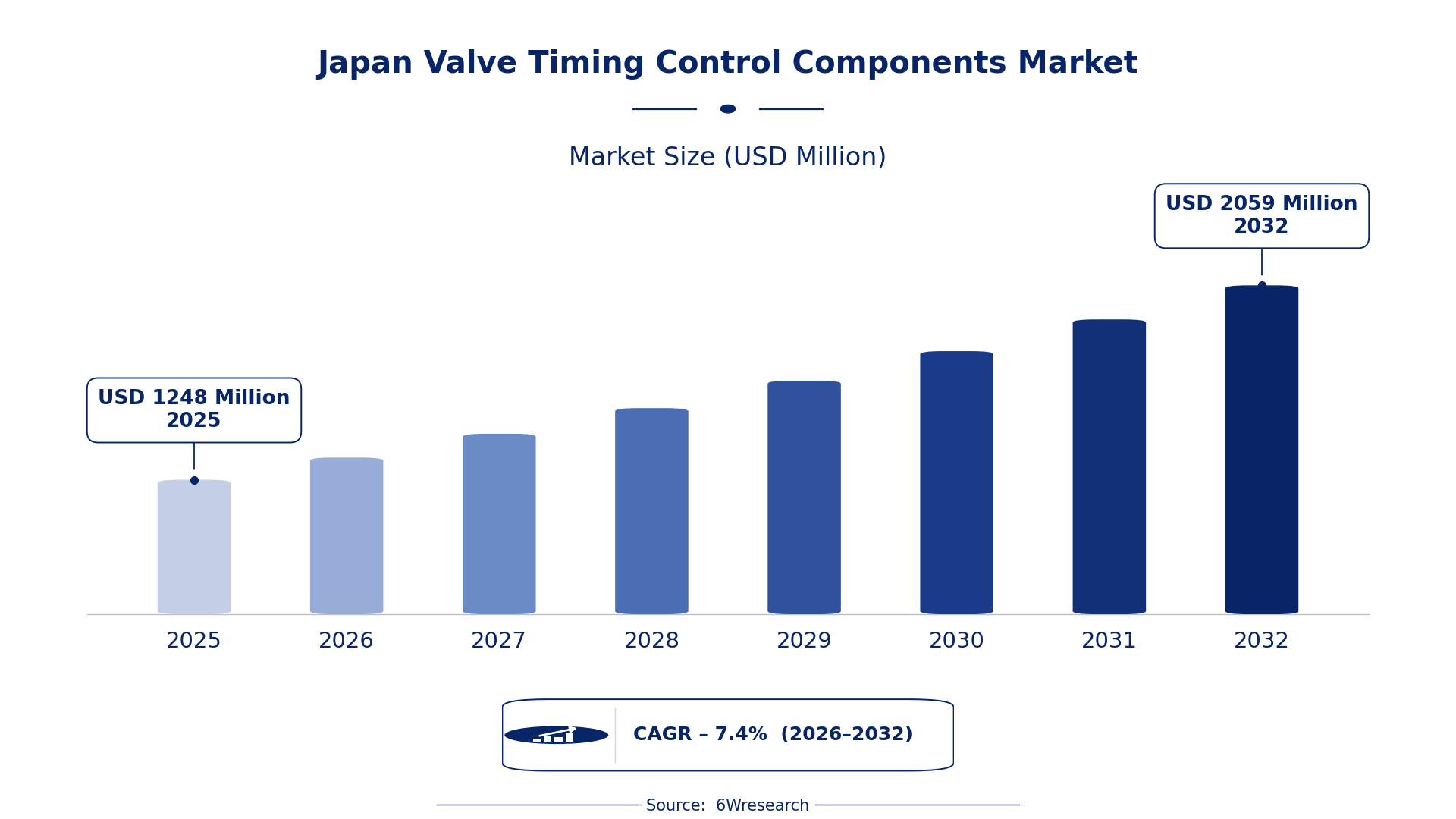
According to 6Wresearch internal database and industry insights, the Japan Valve Timing Control Components Market was valued at USD 1,248 Million in 2025 and is projected to reach USD 2,059 Million by 2032, growing at a CAGR of approximately 7.4% during 2026–2032.
Japan Valve Timing Control Components Market Highlights
| Report Metric | Details |
| Report Name | Japan Valve Timing Control Components Market (2026-2032) |
| Market Size 2025 | USD 1,248 Million |
| Market Size 2032 | USD 2,059 Million |
| Absolute Growth 2025–2032 | USD 811 Million |
| CAGR 2026–2032 | 7.4% |
| Peak Annual Growth | 8.3% in 2028 |
| Forecast Period | 2026–2032 |
| Historical Data | 2022–2025 |
| Base Year | 2025 |
| Leading Component Type, 2025 | Cam Phasers (50% share) |
| Leading Vehicle Segment, 2025 | Passenger Cars (47% share) |
| Leading Control Mechanism, 2025 | Hydraulic (47% share) |
| Leading End User, 2025 | OEM Suppliers (41% share) |
| Fastest-Growing Component Type | Timing Gears (10.9% CAGR) |
| Fastest-Growing Vehicle Segment | Light Commercial (10.0% CAGR) |
| Fastest-Growing Control Mechanism | Mechanical (10.1% CAGR) |
| Fastest-Growing End User | Auto Assemblers (9.5% CAGR) |
| Growing Sector | automotive industry |
| Key End Users | OEM Suppliers, Auto Assemblers, Performance Brands, Service Centers |
Japan Valve Timing Control Components Market Year-wise Growth Rate and Key Drivers (2022–2032)
This graph illustrates the annual growth rates of the market from 2022 to 2032, highlighting a steady upward trajectory and projected market expansion over the forecast period.
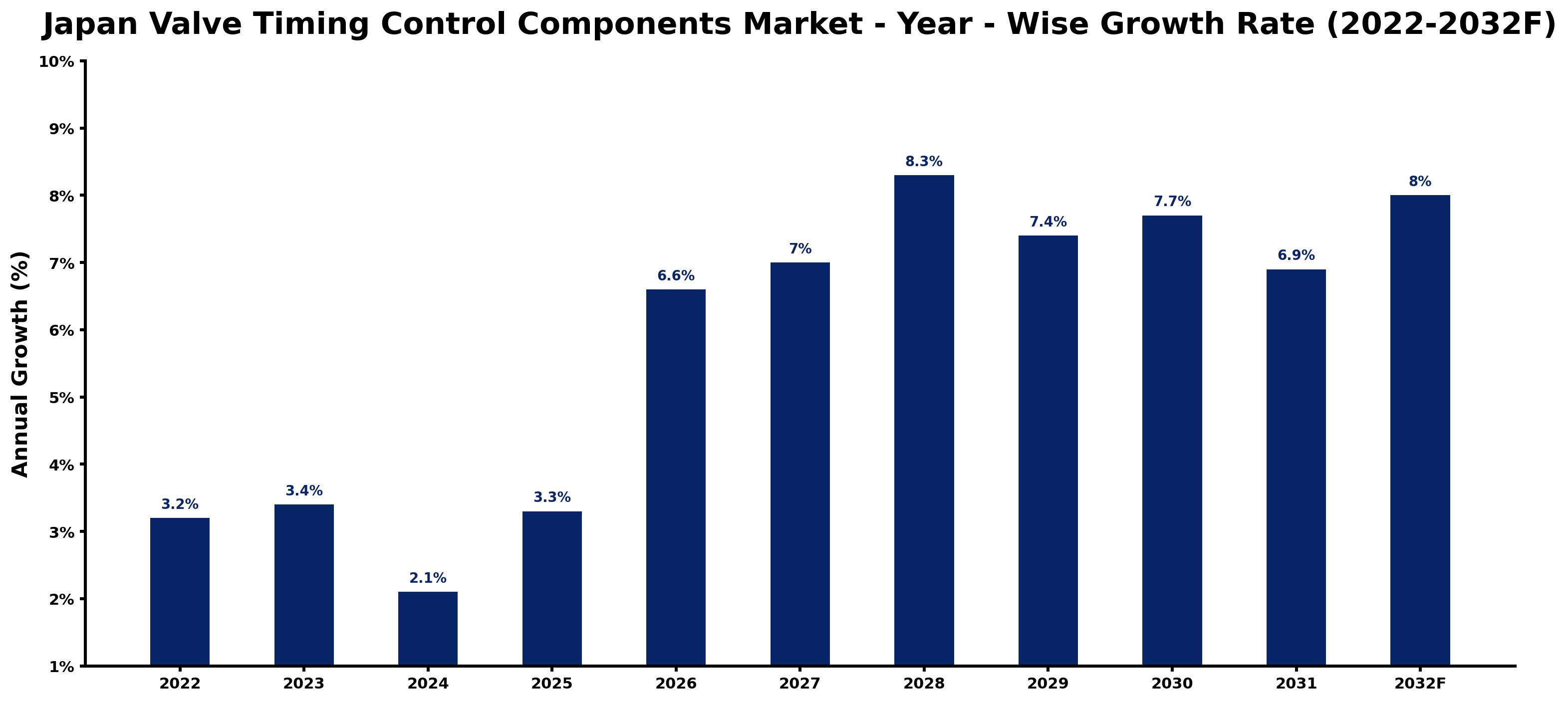
For each year, the table pairs the estimated growth rate with the leading influence on demand, showing how the drivers changed across the period.
| Year | Estimated Annual Growth (%) | Market Rationale |
| 2022 | 3.2 | The market exhibited steady growth due to consistent vehicle production levels. |
| 2023 | 3.4 | Growth accelerated as domestic manufacturers increased output and innovation. |
| 2024 | 2.1 | A slowdown occurred as manufacturers adjusted to market saturation and demand fluctuations. |
| 2025 | 3.3 | Growth resumed as investments in R&D revitalised the sector's momentum. |
| 2026 | 6.6 | Demand surged as new technologies improve vehicle performance and efficiency. |
| 2027 | 7.0 | Growth continued with rising consumer interest in high-performance vehicles. |
| 2028 | 8.3 | The market peaked as advanced valve timing technologies gained widespread adoption. |
| 2029 | 7.4 | Growth slowed slightly as manufacturers faced increased competition and pricing pressures. |
| 2030 | 7.7 | Demand rose again as eco-friendly vehicle technologies became more prevalent. |
| 2031 | 6.9 | A slight slowdown occurred as the market stabilised after rapid expansion. |
| 2032 | 8.0 | Growth accelerated again, driven by the continued shift towards electric vehicles. |
Note: Market size estimations and growth projections presented in this report are based on 6Wresearch's proprietary forecasting methodology, utilizing the latest available industry data, government publications, and primary research inputs.
Japan Valve Timing Control Components Market Synopsis
Valve Timing Control Components are mechanical devices in internal combustion engines that optimise valve timing to improve performance and fuel efficiency. The Japan Valve Timing Control Components Market is expanding due to strong automotive production, with 4.5 million vehicles manufactured in 2022. Key growth drivers include investments in advanced technologies, with ¥1 trillion allocated for R&D in 2023, and a rising trend towards high-performance vehicles, increasing at 5% annually. The focus on eco-friendly technologies and innovations in valve timing is propelling market growth.
Market Dynamics Impact Analysis (2026–2032)
| Factor | Type | Impact | Primary Segment Affected |
| Growing production of 4.5 million vehicles in 2022 drives demand for valve timing control components, particularly in the Passenger Cars segment. | Driver | High | Passenger Cars |
| Investment of ¥1 trillion in R&D for advanced automotive technologies enhances performance, prompting OEM Suppliers to increase component purchases. | Driver | High | OEM Suppliers |
| Increasing demand for high-performance cars, projected to grow at 5% annually, presents opportunities for suppliers to innovate and expand product lines. | Opportunity | High | High-Performance Cars |
| The average age of passenger cars in Japan is 13 years, creating a significant market for replacement valve timing control components. | Opportunity | High | Passenger Cars |
| Rising production costs due to Japan's minimum wage increase to JPY 1,055 per hour constrain profit margins for manufacturers of valve timing control components. | Restraint | High | OEM Suppliers |
| Competition for skilled labour in the automotive sector, which employs about 5 million people, limits the ability of manufacturers to meet rising demand. | Restraint | High | OEM Suppliers |
| Regulatory pressures from the government aiming to reduce CO2 emissions by 30% by 2030 increase compliance costs for manufacturers. | Challenge | High | OEM Suppliers |
| The shift towards eco-friendly technologies requires significant investment in new production methods, posing challenges for existing manufacturers. | Challenge | High | OEM Suppliers |
Evaluation of Drivers in Japan Valve Timing Control Components Market (2026–2032)
Below are the drivers that matter most for revenue growth, with supporting evidence.
| Drivers | Primary Segment Affected | Why It Matters (Evidence) |
| High automotive production levels fuel demand for valve timing components. | Passenger Cars | Japan produced 4.5 million vehicles in 2022, increasing the need for these components. |
| Growing investments in R&D improve vehicle performance. | High-Performance Cars | In 2023, Japan's automotive industry invested ¥1 trillion in advanced technologies. |
| The trend towards eco-friendly vehicles drives innovation in valve timing technologies. | Electric | The government aims to reduce CO2 emissions from vehicles by 30% by 2030. |
| The increasing average age of vehicles necessitates replacement parts. | Passenger Cars | The average age of passenger cars in Japan is 13 years, boosting demand for components. |
| Rising consumer interest in performance enhancements increases component purchases. | High-Performance Cars | The demand for high-performance cars is growing at 5% annually in Japan. |
Much of the new demand traces back to the automotive production levels, with 4.5 million vehicles produced in 2022, leading to increased purchases of valve timing components. Investments in R&D, amounting to ¥1 trillion in 2023, are improving vehicle performance, prompting suppliers to buy more advanced components. The average age of passenger cars, currently 13 years, necessitates the replacement of outdated parts, further driving demand. The growing trend towards eco-friendly vehicles aligns with targets to reduce CO2 emissions by 30% by 2030, encouraging manufacturers to invest in new technologies.
Evaluation of Restraints in Japan Valve Timing Control Components Market
These restraints slow adoption and weigh on supplier margins.
| Market Restraint | Primary Segment Affected | Why It Matters (Evidence) |
| The average age of vehicles may slow new purchases of advanced components. | Passenger Cars | With the average age at 13 years, consumers may delay upgrades, impacting sales. |
| Competition from electric vehicles may limit demand for traditional components. | Electric | As electric vehicles gain market share, demand for valve timing components could decline. |
| Supply chain disruptions can lead to delays in component availability. | OEM Suppliers | Manufacturers may face challenges in sourcing materials, affecting production timelines. |
| The dominance of hydraulic mechanisms may stifle innovation in control types. | Hydraulic | With 60% of new vehicles using hydraulic systems, alternative technologies may struggle to gain traction. |
| Economic fluctuations can impact consumer spending on vehicle upgrades. | Passenger Cars | Economic uncertainty may lead consumers to postpone investments in high-performance vehicles. |
Japan Valve Timing Control Components Market Challenges
Producers face rising costs as Japan's national minimum wage increased to JPY 1,055 per hour, which raises production expenses for valve timing control components. Buyers encounter difficulties due to skills shortages; the automotive industry employs about 5 million people, yet the demand for advanced technologies exceeds the skilled workforce, causing delays in component availability. Importers face intense competition as the demand for high-performance cars grows at 5% annually, compelling them to adopt new strategies to retain market share. Manufacturers contend with regulatory pressures; the government's goal to cut CO2 emissions from vehicles by 30% by 2030 escalates compliance costs significantly.
Trends in the Japan Valve Timing Control Components Market
The trends below show where the Japan Valve Timing Control Components Market is heading.
- Shift Towards Eco-Friendly Vehicle Technologies: The 2023 government strategy promotes eco-friendly vehicle technologies, aligning with sustainability trends. This shift is reflected as manufacturers invest heavily in innovations, targeting a 30% reduction in CO2 emissions by 2030.
- Rise of High-Performance Vehicle Demand: The growing consumer interest in high-performance vehicles is reshaping the market. With demand increasing at 5% annually, suppliers are adapting their offerings to meet this trend, adjusting their product portfolios accordingly.
- Transition from Hydraulic to Electric Control Mechanisms: The automotive industry is transitioning from hydraulic to electric control mechanisms. This change is driven by the need for precision, with electric systems gaining traction in new vehicle models, reflecting a shift in consumer preferences.
- Focus on Standardisation in Automotive Components: The Japan Automotive Standards Partnership Association promotes standardisation in automotive components to improve quality and interoperability. This initiative supports manufacturers in meeting evolving consumer and regulatory demands.
Investment Opportunities in the Japan Valve Timing Control Components Market
Where to invest in the Japan Valve Timing Control Components Market: the main openings are set out below.
- OEM Suppliers Seeking Advanced Components: OEM suppliers are increasingly looking for advanced valve timing components to improve vehicle performance. With the automotive industry investing ¥1 trillion in R&D in 2023, there is an opportunity for suppliers to meet this demand.
- Aichi Prefecture's Component Manufacturing Hub: Aichi Prefecture, a major hub for automotive component manufacturing, presents opportunities for suppliers. With 4.5 million vehicles produced in 2022, investing in local partnerships can facilitate market entry.
- Growing Demand for High-Performance Vehicles: The increasing demand for high-performance vehicles, growing at 5% annually, creates opportunities for suppliers. Engaging with performance brands can help capture this expanding market segment.
- Need for Replacement Parts in Aging Vehicles: With the average age of passenger cars at 13 years, there is a pressing need for replacement parts. Suppliers can tap into this market by offering high-quality valve timing components.
Government Initiatives in the Japan Valve Timing Control Components Market
The Water Supply Act (1957) and the Sewerage Act (1958) set essential standards for quality and safety in the automotive sector. These laws ensure that manufacturers comply with environmental regulations while producing components, impacting the overall quality of valve timing control components.
The Ministry of Economy, Trade and Industry oversees automotive innovation funding, approving projects that support technology and sustainability in the sector. In 2023, this agency backed initiatives aimed at reducing CO2 emissions from vehicles by 30% by 2030, encouraging manufacturers to adopt eco-friendly practices.
Future Insight of the Japan Valve Timing Control Components Market
The introduction of advanced valve timing technologies will transform the market by 2032, as the focus on performance and efficiency intensifies. Investment in R&D reached ¥1 trillion, which will lead to innovations that improve fuel efficiency and lower emissions. The push for eco-friendly vehicle technologies will prompt suppliers to create compliant components that align with new standards. Increased consumer interest in high-performance vehicles will drive producers to enhance manufacturing processes, ensuring they meet specific performance requirements.
Market Segmentation Analysis
Japan Valve Timing Control Components Market report covers a detailed analysis of the following market segments:
By Component Type – Cam Phasers Lead, Timing Gears Expected to Grow Fastest
According to Saurav Kr Singh, Senior Research Analyst at 6Wresearch, Cam Phasers took 50% of component type revenue in 2025, more than any other category. Cam Phasers hold the largest share as they are essential for adjusting valve timing, which optimises engine performance. The production of 4.5 million vehicles in Japan in 2022 has significantly increased the demand for these components. The quickest growth will come from Timing Gears, forecast to expand at a CAGR of 10.9% between 2026 and 2032. Timing Gears are experiencing rapid growth due to their critical role in synchronising engine components, especially with the rising production of light commercial vehicles. The increasing demand for delivery and utility vehicles is propelling this segment forward. Suppliers should focus on enhancing their Timing Gears offerings to capitalise on the growing market demand.
By Vehicle Segment – Passenger Cars Lead, Light Commercial Expected to Grow Fastest
Passenger Cars accounted for 47% of the market by vehicle segment in 2025. Passenger Cars dominate the market as they represent the largest segment utilising valve timing control components in Japan. The average age of passenger cars being 13 years increases the need for replacement parts, solidifying their market position. Light Commercial is set to record the highest CAGR in this split, 10.0% over 2026–2032. Light Commercial vehicles are the fastest-growing segment, driven by the rising demand for delivery and utility vehicles. This sector's growth is further supported by the increasing automotive exports, which reached ¥11 trillion in 2022. Buyers in the Light Commercial segment should prepare for an increase in availability and innovation in valve timing components.
By Control Mechanism – Hydraulic Leads, Mechanical Expected to Grow Fastest
The largest control mechanism category in 2025 was Hydraulic, at 47% of revenue. Hydraulic control mechanisms dominate the market, accounting for 60% of new vehicles manufactured in Japan, owing to their reliability in valve control. Their widespread adoption in the automotive sector underscores their importance in enhancing engine efficiency. Over 2026–2032, Mechanical is expected to post the fastest growth, at a CAGR of 10.1%. Mechanical control mechanisms are witnessing accelerated growth as manufacturers explore alternatives to hydraulic systems, driven by the industry's push for varied technologies in valve timing. This shift is indicative of a broader trend towards innovation in automotive engineering. Suppliers should consider integrating Mechanical control mechanisms into their product lines to stay aligned with emerging market trends.
By End User – OEM Suppliers Lead, Auto Assemblers Expected to Grow Fastest
In 2025, OEM Suppliers led the end user split with a 41% share. OEM Suppliers lead the market as they are the primary manufacturers of valve timing control components, catering to the extensive automotive production in Japan. Their established relationships with manufacturers ensure a steady demand for these components. Auto Assemblers are projected to grow fastest, at a CAGR of 9.5% during 2026–2032. Auto Assemblers are experiencing the fastest growth as they assemble vehicles using these parts, driven by the overall increase in vehicle production. The ongoing investment in R&D for advanced technologies is boosting the assembly sector's growth. Buyers should engage more closely with Auto Assemblers to ensure timely access to the latest valve timing technologies.
Key Attractiveness of the Report
- 10 Years of Market Numbers
- Historical Data Starting from 2022 to 2025
- Base Year 2025
- Forecast Data until 2032
- Key Performance Indicators Impacting the Market
- Major Upcoming Developments and Projects
Key Highlights of the Report:
- Japan Valve Timing Control Components Market Outlook
- Market Size of Japan Valve Timing Control Components Market, 2025
- Forecast of Japan Valve Timing Control Components Market, 2032
- Historical Data and Forecast of Japan Valve Timing Control Components Revenues & Volume for the Period 2022-2032F
- Japan Valve Timing Control Components Market Trend Evolution
- Japan Valve Timing Control Components Market Drivers and Challenges
- Japan Valve Timing Control Components Price Trends
- Japan Valve Timing Control Components Porter's Five Forces
- Japan Valve Timing Control Components Industry Life Cycle
- Historical Data and Forecast of Japan Valve Timing Control Components Market Revenues & Volume By Component Type for the Period 2022-2032F
- Historical Data and Forecast of Japan Valve Timing Control Components Market Revenues & Volume By Cam Phasers for the Period 2022-2032F
- Historical Data and Forecast of Japan Valve Timing Control Components Market Revenues & Volume By Timing Gears for the Period 2022-2032F
- Historical Data and Forecast of Japan Valve Timing Control Components Market Revenues & Volume By Actuators for the Period 2022-2032F
- Historical Data and Forecast of Japan Valve Timing Control Components Market Revenues & Volume By VTC Sensors for the Period 2022-2032F
- Historical Data and Forecast of Japan Valve Timing Control Components Market Revenues & Volume By Vehicle Segment for the Period 2022-2032F
- Historical Data and Forecast of Japan Valve Timing Control Components Market Revenues & Volume By Passenger Cars for the Period 2022-2032F
- Historical Data and Forecast of Japan Valve Timing Control Components Market Revenues & Volume By Light Commercial for the Period 2022-2032F
- Historical Data and Forecast of Japan Valve Timing Control Components Market Revenues & Volume By High-Performance Cars for the Period 2022-2032F
- Historical Data and Forecast of Japan Valve Timing Control Components Market Revenues & Volume By SUVs for the Period 2022-2032F
- Historical Data and Forecast of Japan Valve Timing Control Components Market Revenues & Volume By Control Mechanism for the Period 2022-2032F
- Historical Data and Forecast of Japan Valve Timing Control Components Market Revenues & Volume By Hydraulic for the Period 2022-2032F
- Historical Data and Forecast of Japan Valve Timing Control Components Market Revenues & Volume By Mechanical for the Period 2022-2032F
- Historical Data and Forecast of Japan Valve Timing Control Components Market Revenues & Volume By Electric for the Period 2022-2032F
- Historical Data and Forecast of Japan Valve Timing Control Components Market Revenues & Volume By Sensor-Based for the Period 2022-2032F
- Historical Data and Forecast of Japan Valve Timing Control Components Market Revenues & Volume By End User for the Period 2022-2032F
- Historical Data and Forecast of Japan Valve Timing Control Components Market Revenues & Volume By OEM Suppliers for the Period 2022-2032F
- Historical Data and Forecast of Japan Valve Timing Control Components Market Revenues & Volume By Auto Assemblers for the Period 2022-2032F
- Historical Data and Forecast of Japan Valve Timing Control Components Market Revenues & Volume By Performance Brands for the Period 2022-2032F
- Historical Data and Forecast of Japan Valve Timing Control Components Market Revenues & Volume By Service Centers for the Period 2022-2032F
- Japan Valve Timing Control Components Import Export Trade Statistics
- Market Opportunity Assessment By Component Type
- Market Opportunity Assessment By Vehicle Segment
- Market Opportunity Assessment By Control Mechanism
- Market Opportunity Assessment By End User
- Japan Valve Timing Control Components Top Companies Market Share
- Japan Valve Timing Control Components Competitive Benchmarking By Technical and Operational Parameters
- Japan Valve Timing Control Components Company Profiles
- Japan Valve Timing Control Components Key Strategic Recommendations
Market Covered
The study includes the following segmentation.
By Component Type
- Cam Phasers
- Timing Gears
- Actuators
- VTC Sensors
By Vehicle Segment
- Passenger Cars
- Light Commercial
- High-Performance Cars
- SUVs
By Control Mechanism
- Hydraulic
- Mechanical
- Electric
- Sensor-Based
By End User
- OEM Suppliers
- Auto Assemblers
- Performance Brands
- Service Centers































