Japan Variable Air Volume (VAV) Market Size & Growth Rate
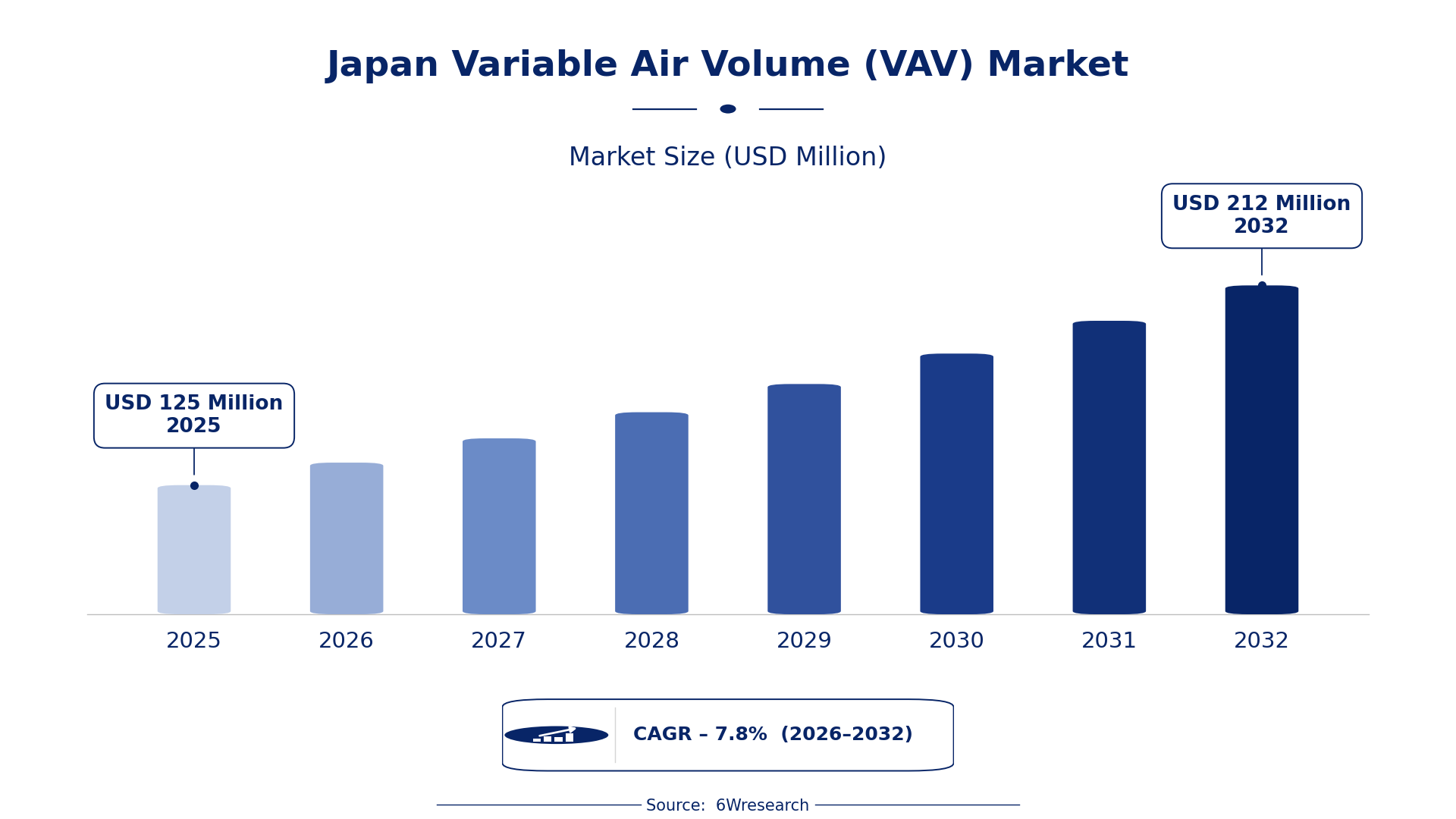
According to 6Wresearch internal database and industry insights, the Japan Variable Air Volume (VAV) Market was valued at USD 125 Million in 2025 and is projected to reach USD 212 Million by 2032, growing at a CAGR of approximately 7.8% during 2026–2032.
Japan Variable Air Volume (VAV) Market Highlights
| Report Metric | Details |
| Report Name | Japan Variable Air Volume (VAV) Market (2026-2032) |
| Market Size 2025 | USD 125 Million |
| Market Size 2032 | USD 212 Million |
| Absolute Growth 2025–2032 | USD 87 Million |
| CAGR 2026–2032 | 7.8% |
| Peak Annual Growth | 8.8% in 2032 |
| Forecast Period | 2026–2032 |
| Historical Data | 2022–2025 |
| Base Year | 2025 |
| Leading Box Type, 2025 | Single Duct VAV (43% share) |
| Leading Control Type, 2025 | Analog/Digital (40% share) |
| Leading Application Area, 2025 | Commercial Buildings (37% share) |
| Leading End User, 2025 | HVAC Contractors (48% share) |
| Fastest-Growing Box Type | Dual Duct VAV (11.0% CAGR) |
| Fastest-Growing Control Type | Pneumatic (11.2% CAGR) |
| Fastest-Growing Application Area | Hospitals (9.3% CAGR) |
| Fastest-Growing End User | Mechanical Engineers (10.0% CAGR) |
| Growing Sector | HVAC systems |
| Key End Users | HVAC Contractors, Facility Managers, Mechanical Engineers, Energy Consultants |
Japan Variable Air Volume (VAV) Market Year-wise Growth Rate and Key Drivers (2022–2032)
This graph illustrates the annual growth rates of the market from 2022 to 2032, highlighting a steady upward trajectory and projected market expansion over the forecast period.
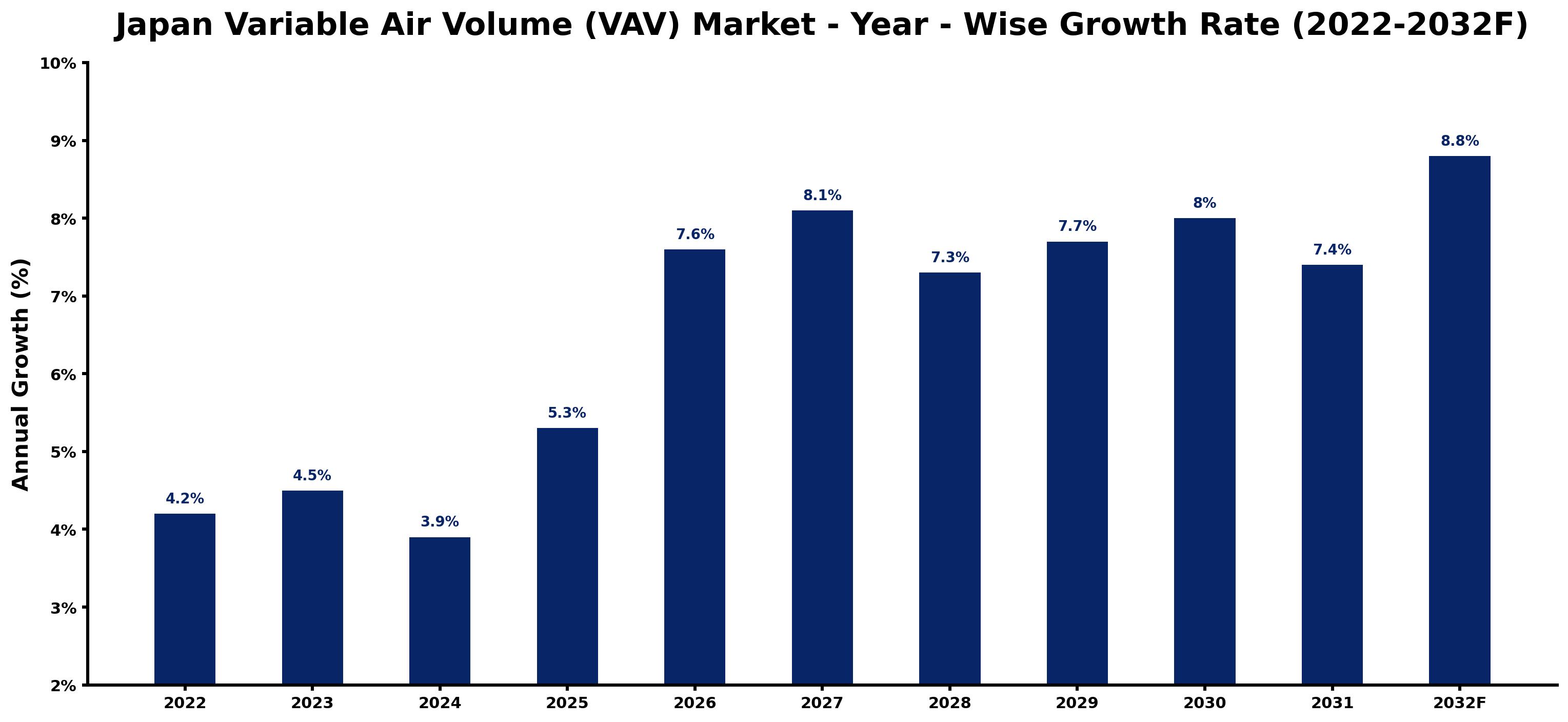
The following figures match every annual growth estimate with the main market development of that year, giving the reasoning behind each rise or slowdown.
| Year | Estimated Annual Growth (%) | Market Rationale |
| 2022 | 4.2 | The market experienced steady growth, supported by increasing construction activities. |
| 2023 | 4.5 | Demand continued to rise as energy efficiency became a priority for builders. |
| 2024 | 3.9 | Growth slowed slightly due to market saturation in some regions. |
| 2025 | 5.3 | A surge in new commercial projects boosted demand for VAV systems. |
| 2026 | 7.6 | Investment in smart building technologies is anticipated to lead to a faster growth rate. |
| 2027 | 8.1 | Increased focus on indoor air quality will further accelerate market expansion. |
| 2028 | 7.3 | Growth is projected to moderate as the market adjusts to previous high levels. |
| 2029 | 7.7 | Demand is expected to rise again as more facilities adopt energy-efficient solutions. |
| 2030 | 8.0 | Technological advancements in HVAC systems will spur renewed interest in energy efficiency. |
| 2031 | 7.4 | Growth is projected to slow as the market approaches maturity in key sectors. |
| 2032 | 8.8 | A peak growth rate is anticipated, reflecting strong ongoing investments. |
Note: Market size estimations and growth projections presented in this report are based on 6Wresearch's proprietary forecasting methodology, utilizing the latest available industry data, government publications, and primary research inputs.
Japan Variable Air Volume (VAV) Market Synopsis
Variable Air Volume (VAV) systems adjust airflow in buildings to improve energy efficiency and maintain indoor air quality. These systems are primarily used in commercial and institutional buildings across Japan. The Japan Variable Air Volume (VAV) Market is expanding due to rising construction investments, with over 10 trillion yen allocated in 2022, and increasing demand from sectors like healthcare and education, where VAV systems are essential for comfort and efficiency. The Tokyo metropolitan area remains a key hub for installations, further driving market growth.
Market Dynamics Impact Analysis (2026–2032)
| Factor | Type | Impact | Primary Segment Affected |
| Increasing construction activities in commercial buildings | Driver | High | Commercial Buildings |
| Focus on energy efficiency and indoor air quality | Driver | High | Single Duct VAV |
| Growing adoption of smart building technologies | Opportunity | High | Commercial Buildings |
| Investment in energy-efficient infrastructure post-Olympics | Opportunity | High | Hospitals |
| High initial installation costs for VAV systems | Restraint | Medium | Single Duct VAV |
| Limited awareness among smaller contractors about VAV benefits | Restraint | Medium | HVAC Contractors |
| Competition from alternative HVAC solutions | Challenge | High | Single Duct VAV |
| Supply chain disruptions affecting component availability | Challenge | Medium | Single Duct VAV |
Evaluation of Drivers in Japan Variable Air Volume (VAV) Market (2026–2032)
Key forces behind demand, with the segment each one moves most, are listed below.
| Drivers | Primary Segment Affected | Why It Matters (Evidence) |
| Rising construction investments | Commercial Buildings | In 2022, Japan's construction sector saw over 10 trillion yen in investments, increasing demand for VAV systems. |
| Focus on energy efficiency | Hospitals | The average energy savings from VAV systems can reach 30%, prompting hospitals to adopt these systems. |
| Technological advancements in HVAC systems | Office Spaces | Smart technologies in HVAC systems enhance energy management, improving operational efficiency. |
| Growing awareness of indoor air quality | Schools | Educational institutions are increasingly adopting VAV systems to improve air quality for students. |
| Support from industry associations | HVAC Contractors | The Japan HVAC Association promotes best practices, encouraging contractors to adopt VAV systems. |
Much of the new demand traces back to rising construction investments, with over 10 trillion yen allocated in 2022, driving the need for efficient HVAC solutions. The healthcare sector is increasingly adopting VAV systems, as they can achieve average energy savings of 30%, improving patient comfort. Recent technological advancements have improved energy management capabilities in office spaces, leading to higher adoption rates. Awareness of indoor air quality has prompted educational institutions to implement VAV systems, creating healthier environments for students. Industry associations are actively promoting best practices, which encourages HVAC contractors to integrate VAV solutions into their projects.
Evaluation of Restraints in Japan Variable Air Volume (VAV) Market
The following restraints limit how fast demand can grow.
| Market Restraint | Primary Segment Affected | Why It Matters (Evidence) |
| High initial installation costs | Single Duct VAV | The upfront costs of VAV systems can deter some buyers, limiting market expansion. |
| Limited awareness of VAV benefits among smaller contractors | HVAC Contractors | Many smaller contractors lack knowledge about VAV systems, hindering their adoption. |
| Competition from alternative HVAC solutions | Single Duct VAV | Alternative systems may offer lower initial costs, attracting budget-conscious buyers. |
| Supply chain disruptions | Single Duct VAV | Component shortages can delay project timelines, affecting overall market growth. |
| Regulatory compliance costs | Single Duct VAV | Meeting energy efficiency regulations may impose additional costs on buyers. |
Japan Variable Air Volume (VAV) Market Challenges
Buyers incur high costs due to a shortage of skilled technicians for VAV system installation, leading to project delays and increased expenses. Regulatory demands for energy-efficient technologies require significant upfront investments, raising costs for buyers by up to 15%. Supply chain disruptions hinder the healthcare sector, delaying necessary upgrades for around 8,500 hospitals that depend on advanced HVAC components. Producers struggle to source materials compliant with JIS B 8620 standards, extending lead times and inflating costs for buyers by approximately 10%.
Trends in the Japan Variable Air Volume (VAV) Market
The shifts below are changing how Japan Variable Air Volume (VAV) Market products are bought and supplied.
- Shift towards Smart Building Technologies: In 2023, a government campaign promoted smart building technologies, including VAV systems, to improve energy efficiency. This initiative aims to modernise infrastructure, targeting a reduction in energy consumption by 20% by 2030.
- Increased Adoption in Healthcare Facilities: Since 2022, hospitals have increasingly adopted VAV systems for improved patient comfort. With around 8,500 hospitals in Japan, many are now implementing advanced HVAC solutions to improve air quality.
- Transition from Traditional to Energy-Efficient Systems: The Tokyo 2020 Olympics spurred investments in energy-efficient infrastructure, leading to a shift towards VAV systems in commercial buildings. Over 70% of newly constructed buildings now utilise these technologies.
- Emergence of Programmable Control Systems: Since 2025, programmable control systems have gained traction in VAV applications, allowing for customised airflow management. This trend aligns with the growing demand for tailored HVAC solutions in various sectors.
Investment Opportunities in the Japan Variable Air Volume (VAV) Market
Investors looking at the Japan Variable Air Volume (VAV) Market should consider the following areas.
- Partnerships with Local Contractors: With a projected 20% reduction in energy consumption by 2030, there is a gap for energy-efficient solutions. Partnering with HVAC contractors in the Tokyo metropolitan area can facilitate market entry.
- Investment in Commercial Building Projects: The construction sector's investment of over 10 trillion yen in 2022 presents an opportunity to supply VAV systems. Focusing on commercial buildings can yield substantial returns.
- Expansion in Healthcare Sector: The healthcare sector's growing adoption of VAV systems indicates a strong demand. Suppliers can enter by collaborating with facility managers in hospitals across Japan.
- Certification for Energy-Efficient Solutions: The need for compliance with energy efficiency regulations creates an opportunity for certification services. Engaging with energy consultants can help navigate this process.
Government Initiatives in the Japan Variable Air Volume (VAV) Market
The Semiconductor and Digital Industry Strategy, introduced in June 2021, supports domestic semiconductor manufacturing, which indirectly benefits VAV system producers by improving technology availability. The Act on the Rational Use of Energy from 1979 mandates large energy users to improve efficiency, impacting VAV system adoption.
In 2023, the Building Energy Efficiency Program allocated funds to improve energy performance in public buildings, overseen by the Ministry of Land, Infrastructure, Transport and Tourism. This initiative aims to promote the installation of energy-efficient HVAC systems, including VAV technologies.
Future Insight of the Japan Variable Air Volume (VAV) Market
Hospitals will increasingly implement smart building technologies by 2032, driven by government campaigns promoting energy efficiency. The construction sector is set to invest over 10 trillion yen in energy-efficient infrastructure, creating new opportunities for VAV systems. The adoption of ISO 50001 will standardise energy management practices, benefiting both buyers and suppliers. Energy efficiency measures are projected to cut energy consumption by 20% in commercial buildings, leading to reduced operational costs for buyers.
Market Segmentation Analysis
Japan Variable Air Volume (VAV) Market report covers a detailed analysis of the following market segments:
By Box Type – Single Duct VAV Leads, Dual Duct VAV Expected to Grow Fastest
According to Saurav Kr Singh, Senior Research Analyst at 6Wresearch, Single Duct VAV held 43% of the Japan Variable Air Volume (VAV) Market by box type in 2025. Single Duct VAV systems dominate the market as they are widely used for effective airflow management in a variety of building types. Their prevalence in over 70% of newly constructed commercial buildings in urban centres like Tokyo underscores their importance in the HVAC sector. Dual Duct VAV is set to record the highest CAGR in this split, 11.0% over 2026–2032. Dual Duct VAV systems are experiencing rapid growth due to their ability to provide superior temperature control, which is crucial for larger commercial environments. The ongoing investments in energy-efficient infrastructure, particularly following the Tokyo 2020 Olympics, are propelling their adoption. Suppliers should focus on enhancing the features of Dual Duct VAV systems to meet the rising demand for improved temperature regulation.
By Control Type – Analog/Digital Leads, Pneumatic Expected to Grow Fastest
In 2025, Analog/Digital led the control type split with a 40% share. Analog/Digital controls are prevalent in the VAV market as they are essential for effectively managing system operations and ensuring energy efficiency. Their integration into most VAV systems has solidified their position as the preferred control type. Pneumatic is projected to grow fastest, at a CAGR of 11.2% during 2026–2032. Pneumatic controls are gaining traction due to their simplicity and reliability, appealing to specific segments of the market. As building owners seek cost-effective solutions, this control type's adoption is likely to increase. Buyers may benefit from exploring pneumatic control options as a cost-effective alternative to more advanced systems.
By Application Area – Commercial Buildings Lead, Hospitals Expected to Grow Fastest
The largest application area category in 2025 was Commercial Buildings, at 37% of revenue. Commercial Buildings represent the largest application area for VAV systems, accounting for over 70% of installations in newly constructed facilities. This high adoption rate is driven by the need for energy efficiency and indoor air quality in urban environments. Over 2026–2032, Hospitals are expected to post the fastest growth, at a CAGR of 9.3%. Hospitals are the fastest-growing application area as they require advanced HVAC solutions to maintain strict air quality standards and patient comfort. The total number of hospitals in Japan underscores the potential for growth in this segment. Suppliers should tailor their offerings to meet the specific needs of the healthcare sector to capitalise on this growth opportunity.
By End User – HVAC Contractors Lead, Mechanical Engineers Expected to Grow Fastest
With 48% of end user revenue in 2025, HVAC Contractors was the largest category. HVAC Contractors are the leading end users as they are essential for the installation and ongoing maintenance of VAV systems in various projects. Their strong relationships with building developers and owners create a consistent demand for these systems across the market. The quickest growth will come from Mechanical Engineers, forecast to expand at a CAGR of 10.0% between 2026 and 2032. Mechanical Engineers are witnessing rapid growth in their engagement with VAV systems, driven by the increasing emphasis on energy-efficient designs in new buildings. Their integral role in the design phase is becoming more critical as energy regulations become stricter. Suppliers should engage with Mechanical Engineers to ensure their products meet the evolving design and efficiency standards.
Key Attractiveness of the Report
- 10 Years of Market Numbers
- Historical Data Starting from 2022 to 2025
- Base Year 2025
- Forecast Data until 2032
- Key Performance Indicators Impacting the Market
- Major Upcoming Developments and Projects
Key Highlights of the Report:
- Japan Variable Air Volume (VAV) Market Outlook
- Market Size of Japan Variable Air Volume (VAV) Market, 2025
- Forecast of Japan Variable Air Volume (VAV) Market, 2032
- Historical Data and Forecast of Japan Variable Air Volume (VAV) Revenues & Volume for the Period 2022-2032F
- Japan Variable Air Volume (VAV) Market Trend Evolution
- Japan Variable Air Volume (VAV) Market Drivers and Challenges
- Japan Variable Air Volume (VAV) Price Trends
- Japan Variable Air Volume (VAV) Porter's Five Forces
- Japan Variable Air Volume (VAV) Industry Life Cycle
- Historical Data and Forecast of Japan Variable Air Volume (VAV) Market Revenues & Volume By Box Type for the Period 2022-2032F
- Historical Data and Forecast of Japan Variable Air Volume (VAV) Market Revenues & Volume By Single Duct VAV for the Period 2022-2032F
- Historical Data and Forecast of Japan Variable Air Volume (VAV) Market Revenues & Volume By Dual Duct VAV for the Period 2022-2032F
- Historical Data and Forecast of Japan Variable Air Volume (VAV) Market Revenues & Volume By Fan-Powered VAV for the Period 2022-2032F
- Historical Data and Forecast of Japan Variable Air Volume (VAV) Market Revenues & Volume By Series/Parallel VAV for the Period 2022-2032F
- Historical Data and Forecast of Japan Variable Air Volume (VAV) Market Revenues & Volume By Control Type for the Period 2022-2032F
- Historical Data and Forecast of Japan Variable Air Volume (VAV) Market Revenues & Volume By Analog/Digital for the Period 2022-2032F
- Historical Data and Forecast of Japan Variable Air Volume (VAV) Market Revenues & Volume By Pneumatic for the Period 2022-2032F
- Historical Data and Forecast of Japan Variable Air Volume (VAV) Market Revenues & Volume By ECM Motor for the Period 2022-2032F
- Historical Data and Forecast of Japan Variable Air Volume (VAV) Market Revenues & Volume By Programmable for the Period 2022-2032F
- Historical Data and Forecast of Japan Variable Air Volume (VAV) Market Revenues & Volume By Application Area for the Period 2022-2032F
- Historical Data and Forecast of Japan Variable Air Volume (VAV) Market Revenues & Volume By Commercial Buildings for the Period 2022-2032F
- Historical Data and Forecast of Japan Variable Air Volume (VAV) Market Revenues & Volume By Hospitals for the Period 2022-2032F
- Historical Data and Forecast of Japan Variable Air Volume (VAV) Market Revenues & Volume By Schools for the Period 2022-2032F
- Historical Data and Forecast of Japan Variable Air Volume (VAV) Market Revenues & Volume By Office Spaces for the Period 2022-2032F
- Historical Data and Forecast of Japan Variable Air Volume (VAV) Market Revenues & Volume By End User for the Period 2022-2032F
- Historical Data and Forecast of Japan Variable Air Volume (VAV) Market Revenues & Volume By HVAC Contractors for the Period 2022-2032F
- Historical Data and Forecast of Japan Variable Air Volume (VAV) Market Revenues & Volume By Mechanical Engineers for the Period 2022-2032F
- Historical Data and Forecast of Japan Variable Air Volume (VAV) Market Revenues & Volume By Facility Managers for the Period 2022-2032F
- Historical Data and Forecast of Japan Variable Air Volume (VAV) Market Revenues & Volume By Energy Consultants for the Period 2022-2032F
- Japan Variable Air Volume (VAV) Import Export Trade Statistics
- Market Opportunity Assessment By Box Type
- Market Opportunity Assessment By Control Type
- Market Opportunity Assessment By Application Area
- Market Opportunity Assessment By End User
- Japan Variable Air Volume (VAV) Top Companies Market Share
- Japan Variable Air Volume (VAV) Competitive Benchmarking By Technical and Operational Parameters
- Japan Variable Air Volume (VAV) Company Profiles
- Japan Variable Air Volume (VAV) Key Strategic Recommendations
Market Covered
Coverage by segment is as follows.
By Box Type
- Single Duct VAV
- Dual Duct VAV
- Fan-Powered VAV
- Series/Parallel VAV
By Control Type
- Analog/Digital
- Pneumatic
- ECM Motor
- Programmable
By Application Area
- Commercial Buildings
- Hospitals
- Schools
- Office Spaces
By End User
- HVAC Contractors
- Mechanical Engineers
- Facility Managers
- Energy Consultants































