Japan Variable Frequency Drive Market Size & Growth Rate
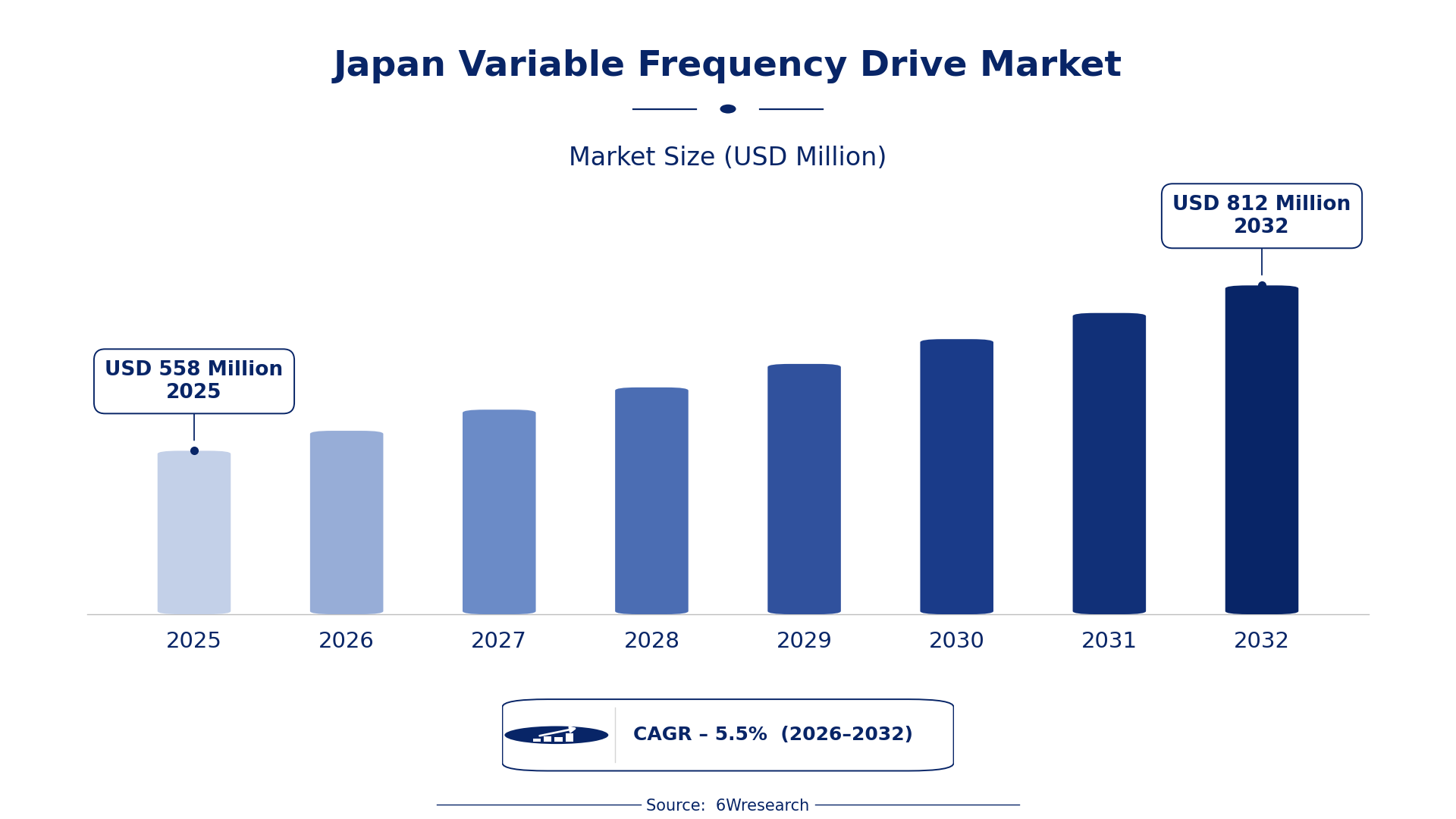
According to 6Wresearch internal database and industry insights, the Japan Variable Frequency Drive Market was valued at USD 558 Million in 2025 and is projected to reach USD 812 Million by 2032, growing at a CAGR of approximately 5.5% during 2026–2032.
Japan Variable Frequency Drive Market Highlights
| Report Metric | Details |
| Report Name | Japan Variable Frequency Drive Market (2026-2032) |
| Market Size 2025 | USD 558 Million |
| Market Size 2032 | USD 812 Million |
| Absolute Growth 2025–2032 | USD 254 Million |
| CAGR 2026–2032 | 5.5% |
| Peak Annual Growth | 6.2% in 2028 |
| Forecast Period | 2026–2032 |
| Historical Data | 2022–2025 |
| Base Year | 2025 |
| Leading Type, 2025 | AC Drive (42% share) |
| Leading Voltage Type, 2025 | Low Voltage (67% share) |
| Leading Power Rating, 2025 | Low Power Drive (42% share) |
| Leading Application, 2025 | Pumps (48% share) |
| Leading End User, 2025 | Industrial (52% share) |
| Fastest-Growing Type | Servo Drive (7.5% CAGR) |
| Fastest-Growing Voltage Type | Medium Voltage (7.4% CAGR) |
| Fastest-Growing Power Rating | Medium Power Drive (7.6% CAGR) |
| Fastest-Growing Application | Compressors (7.3% CAGR) |
| Fastest-Growing End User | Infrastructure (7.1% CAGR) |
| Growing Sector | Industrial Automation |
| Key End Users | Manufacturers, Infrastructure Developers, Power Generation Companies, Heavy Industries |
Japan Variable Frequency Drive Market Year-wise Growth Rate and Key Drivers (2022–2032)
This graph illustrates the annual growth rates of the market from 2022 to 2032, highlighting a steady upward trajectory and projected market expansion over the forecast period.
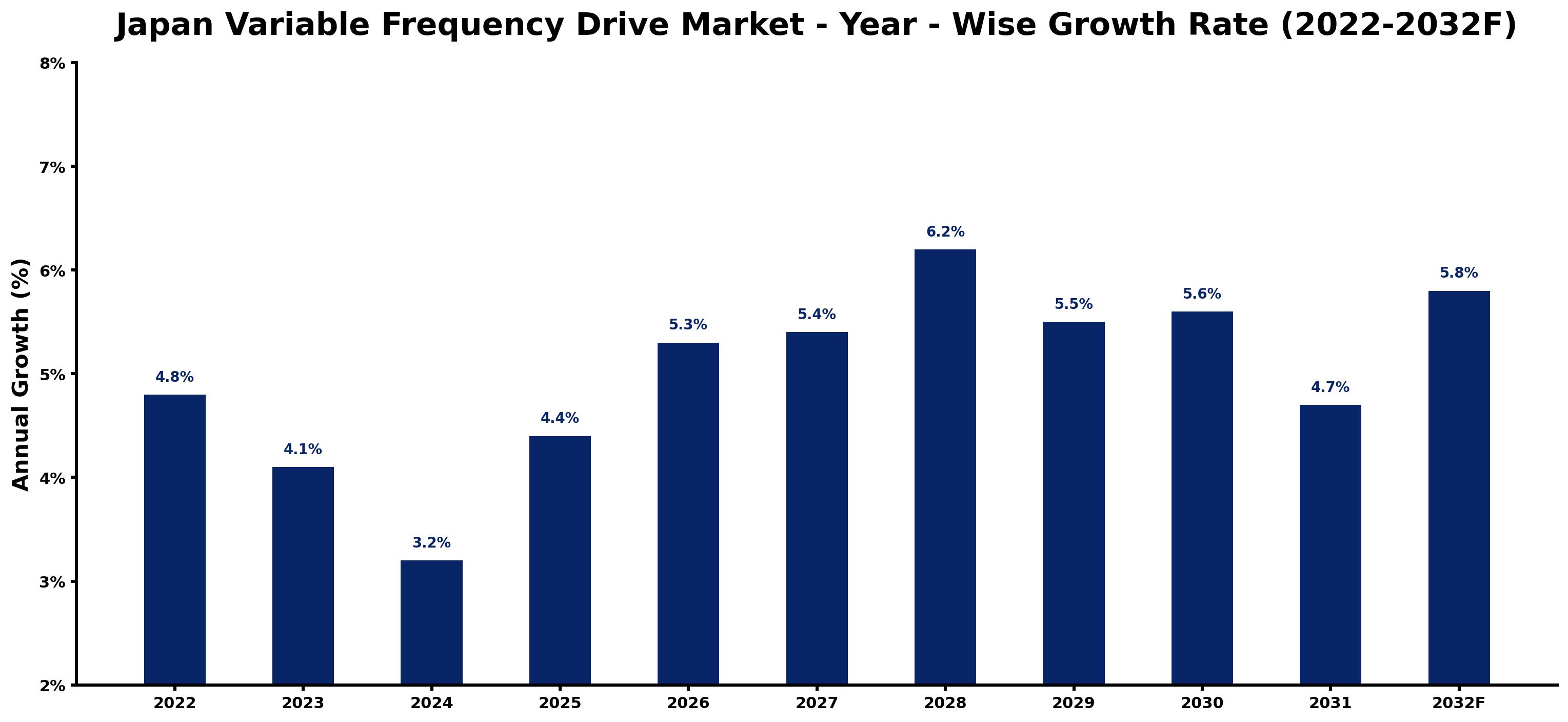
The table below sets out the estimated growth rate for each year and the main factor behind it.
| Year | Estimated Annual Growth (%) | Market Rationale |
| 2022 | 4.8 | The market showed strong activity due to high industrial automation in manufacturing. |
| 2023 | 4.1 | Growth slowed as industries adjusted to previous investments in automation technology. |
| 2024 | 3.2 | Continued investment in energy efficiency led to further growth despite slower rates. |
| 2025 | 4.4 | Increased industrial automation spending spurred a faster growth rate compared to 2024. |
| 2026 | 5.3 | Rising demand for energy-efficient solutions is expected to drive growth in variable frequency drives. |
| 2027 | 5.4 | The ongoing shift towards automation will maintain a steady growth rate for VFDs. |
| 2028 | 6.2 | The peak growth year reflects heightened investments in energy-efficient technologies. |
| 2029 | 5.5 | A slight slowdown is projected as the market stabilises after peak growth in 2028. |
| 2030 | 5.6 | Demand for VFDs is expected to increase again as industries focus on improving operational efficiency. |
| 2031 | 4.7 | Growth is projected to slow as the market reaches a more mature phase in its development. |
| 2032 | 5.8 | A resurgence in investments in automation technologies is expected to boost demand. |
Note: Market size estimations and growth projections presented in this report are based on 6Wresearch's proprietary forecasting methodology, utilizing the latest available industry data, government publications, and primary research inputs.
Japan Variable Frequency Drive Market Synopsis
Variable Frequency Drives are electronic devices that control motor speed and torque by adjusting power supply frequency and voltage. They are crucial in sectors such as manufacturing and infrastructure, where energy savings and process control matter. The Japan Variable Frequency Drive Market is growing due to investments in industrial automation, especially in the manufacturing sector, which represented 20% of the country's GDP in 2022. Government initiatives for energy-efficient technologies further stimulate demand, with projections indicating a robust market outlook by 2032.
Market Dynamics Impact Analysis (2026–2032)
| Factor | Type | Impact | Primary Segment Affected |
| Increased industrial automation investments | Driver | High | AC Drive |
| Rising demand for energy-efficient solutions | Driver | High | Low Voltage |
| Growing focus on renewable energy generation | Opportunity | High | Medium Voltage |
| Expansion of infrastructure projects | Opportunity | High | Pumps |
| High initial costs of VFD installation | Restraint | High | Servo Drive |
| Limited awareness of VFD benefits among small manufacturers | Restraint | Medium | Low Power Drive |
| Competition from alternative motor control technologies | Challenge | High | Medium Power Drive |
| Regulatory compliance costs for manufacturers | Challenge | Medium | High Power Drive |
Evaluation of Drivers in Japan Variable Frequency Drive Market (2026–2032)
Key forces behind demand, with the segment each one moves most, are listed below.
| Drivers | Primary Segment Affected | Why It Matters (Evidence) |
| Investment in industrial automation | AC Drive | The manufacturing sector's investment in automation is projected to reach ¥1 trillion by 2025, driving demand for VFDs. |
| Energy efficiency initiatives | Low Voltage | The Japanese government allocated ¥500 million for energy efficiency programs in manufacturing, increasing VFD adoption. |
| Renewable energy projects | Medium Voltage | The power generation sector's focus on renewables boosts demand for VFDs in energy management applications. |
| Infrastructure development | Pumps | The Kansai region's heavy industries are expanding, necessitating more VFDs for efficient pump operations. |
| Technological advancements in VFDs | Servo Drive | New microcontroller technologies improve VFD performance, attracting more buyers in automation. |
What keeps demand rising is the projected ¥1 trillion investment in industrial automation by 2025, which increases the need for VFDs. The emphasis on renewable energy generation in the power sector drives demand for VFDs, particularly in energy management applications. Expanding heavy industries require more VFDs for efficient operations. Advancements in microcontroller designs improve VFD performance, attracting buyers in automation and robotics.
Evaluation of Restraints in Japan Variable Frequency Drive Market
These are the pressures that could keep growth below its potential.
| Market Restraint | Primary Segment Affected | Why It Matters (Evidence) |
| High initial costs of VFD installation | Servo Drive | The installation costs deter small manufacturers from adopting VFDs, limiting market growth. |
| Limited awareness of VFD benefits among small manufacturers | Low Power Drive | Many small manufacturers are unaware of the energy savings VFDs can provide, hindering demand. |
| Competition from alternative motor control technologies | Medium Power Drive | Emerging technologies can offer similar benefits, creating challenges for VFD market penetration. |
| Regulatory compliance costs for manufacturers | High Power Drive | Compliance with safety and environmental regulations increases operational costs for VFD producers. |
| Market saturation in certain segments | AC Drive | In mature markets, growth is constrained as many facilities already use VFDs. |
Japan Variable Frequency Drive Market Challenges
Producers face a skills shortage in the variable frequency drive sector, as educational institutions cannot meet the demand for trained professionals, leading to production delays for manufacturers. High upgrade costs for existing systems, expected to reach ¥1 trillion in the industrial sector by 2025, restrict access to modern solutions for users. Intense competition from international markets pressures local producers, resulting in squeezed profit margins that compel buyers to absorb higher prices. Supply chain disruptions create price volatility for VFDs, which can escalate operational costs and postpone projects for end-users.
Trends in the Japan Variable Frequency Drive Market
Four trends stand out in the Japan Variable Frequency Drive Market.
- Shift towards Energy-Efficient Technologies: The Japanese government launched a program in 2023 to promote energy-efficient technologies, influencing industries to adopt VFDs. This initiative is expected to increase energy savings across various sectors.
- Transition from Traditional to Smart Automation: The manufacturing sector is increasingly adopting smart automation solutions, with a projected investment of ¥1 trillion by 2025. This shift drives demand for advanced VFDs capable of integrating with smart systems.
- Infrastructure Projects Prioritised: Infrastructure development is being prioritised in the Kansai region, where heavy industries are expanding. This growth is expected to boost the demand for VFDs, particularly in pump applications.
- Emergence of Renewable Energy Applications: The power generation sector is increasingly utilising VFDs for renewable energy applications, with a focus on efficiency. This trend is anticipated to grow as the sector expands.
Investment Opportunities in the Japan Variable Frequency Drive Market
Where to invest in the Japan Variable Frequency Drive Market: the main openings are set out below.
- Timing for Energy Efficiency Investments: With the Japanese government allocating ¥500 million for energy efficiency programs, there is a strong opportunity for suppliers to provide VFDs to manufacturers looking to reduce costs.
- Kansai Region's Heavy Industries: The Kansai region's heavy industries are expanding, creating a demand for VFDs in pump applications. Suppliers can enter this market by partnering with local manufacturers.
- Infrastructure Development Needs: The ongoing infrastructure projects in Japan are driving demand for VFDs, particularly in the pump sector. Suppliers can tap into this market by offering tailored solutions.
- Gap in Small Manufacturer Awareness: Many small manufacturers lack awareness of VFD benefits, presenting an opportunity for educational initiatives and targeted marketing to increase adoption.
Government Initiatives in the Japan Variable Frequency Drive Market
The Hydrogen Society Promotion Act, enacted in 2024, supports low-carbon hydrogen supply chains, enhancing the existing Waste Management and Public Cleansing Act from 1970. This new measure encourages industries to adopt cleaner technologies, including VFDs, to reduce carbon emissions in production processes.
The Ministry of Economy, Trade and Industry's initiatives fund energy efficiency programs that help manufacturers implement VFDs, improving their operational efficiency and reducing energy costs. In 2023, these programs received an allocation of ¥500 million, benefiting numerous industrial users across the country.
Future Insight of the Japan Variable Frequency Drive Market
By 2032, advancements in energy-efficient technology will reshape demand for variable frequency drives, driven by government initiatives promoting sustainability. The implementation of standards like JIS C 61000-3-2 will enhance product reliability and compatibility, benefiting both suppliers and users. Integration of smart automation will allow producers to streamline operations and reduce costs. The power generation sector is projected to adopt VFDs more widely, particularly in renewable energy applications, creating fresh opportunities for suppliers.
Market Segmentation Analysis
Japan Variable Frequency Drive Market report covers a detailed analysis of the following market segments:
By Type – AC Drive Leads, Servo Drive Expected to Grow Fastest
According to Shubham Deep, Research Manager at 6Wresearch, AC Drive took 42% of type revenue in 2025, more than any other category. AC Drives dominate the market as they are extensively used for controlling AC motors in various applications, especially within Japan's manufacturing sector. The Tokyo metropolitan area showcases this trend with its high level of industrial automation and reliance on AC Drives. Over 2026–2032, Servo Drive is expected to post the fastest growth, at a CAGR of 7.5%. The Servo Drive segment is experiencing rapid growth due to the increasing need for precise control in automation and robotics. This demand is driven by significant investments in advanced automation technologies, with the industrial sector projected to invest ¥1 trillion by 2025. Suppliers should focus on enhancing offerings in Servo Drives to capture the increasing demand for precision automation.
By Voltage Type – Low Voltage Leads, Medium Voltage Expected to Grow Fastest
The largest voltage type category in 2025 was Low Voltage, at 67% of revenue. Low Voltage VFDs hold the largest market share as they are commonly used in numerous industrial applications, making them essential for operational efficiency. Their prevalence is particularly notable in the Kansai region, known for its heavy industries. Medium Voltage is projected to grow fastest, at a CAGR of 7.4% during 2026–2032. Medium Voltage VFDs are growing quickly due to their critical role in larger industrial systems and infrastructure projects. This growth is driven by increasing investments in automation and energy efficiency in Japan's industrial sector. Buyers should consider investing in Medium Voltage VFDs to meet the demands of larger scale operations.
By Power Rating – Low Power Drive Leads, Medium Power Drive Expected to Grow Fastest
With 42% of power rating revenue in 2025, Low Power Drive was the largest category. Low Power Drives are the most widely used VFDs, frequently employed in small machinery and equipment across various industries. Their common application in numerous sectors solidifies their leading position in the market. Medium Power Drive is set to record the highest CAGR in this split, 7.6% over 2026–2032. Medium Power Drives are growing quickly as they are increasingly utilised in a variety of industrial applications, reflecting a shift towards more efficient motor control solutions. This trend aligns with the overall investment in automation within the industrial sector. Suppliers must enhance their Medium Power Drive offerings to meet the rising demand in industrial applications.
By Application – Pumps Lead, Compressors Expected to Grow Fastest
In 2025, Pumps led the application split with a 48% share. Pumps are the leading application for VFDs, extensively used to control pump speeds for improved energy efficiency across various sectors. This is particularly relevant in the power generation sector, where VFDs optimise performance and reduce energy consumption. The quickest growth will come from Compressors, forecast to expand at a CAGR of 7.3% between 2026 and 2032. Compressors are witnessing the fastest growth as their role in refrigeration and air conditioning systems becomes more critical. The increasing emphasis on energy efficiency and sustainability in these systems drives this demand. Suppliers should prioritise the development of VFD solutions tailored for compressor applications to capitalise on this growth.
By End User – Industrial Leads, Infrastructure Expected to Grow Fastest
Industrial accounted for 52% of the market by end user in 2025. The industrial sector leads the VFD market, driven by substantial demand from manufacturing and infrastructure applications. This sector's significant contribution to Japan's GDP underscores its importance in the VFD landscape. Over 2026–2032, Infrastructure is expected to post the fastest growth, at a CAGR of 7.1%. Infrastructure is the fastest-growing end user segment, propelled by considerable government investments in energy-efficient technologies and infrastructure development. This trend is evident in the allocation of ¥500 million for energy efficiency programmes in manufacturing. Buyers in the infrastructure sector should seek advanced VFD solutions to leverage government support for energy efficiency.
Key Attractiveness of the Report
- 10 Years of Market Numbers
- Historical Data Starting from 2022 to 2025
- Base Year 2025
- Forecast Data until 2032
- Key Performance Indicators Impacting the Market
- Major Upcoming Developments and Projects
Key Highlights of the Report:
- Japan Variable Frequency Drive Market Outlook
- Market Size of Japan Variable Frequency Drive Market, 2025
- Forecast of Japan Variable Frequency Drive Market, 2032
- Historical Data and Forecast of Japan Variable Frequency Drive Revenues & Volume for the Period 2022-2032
- Japan Variable Frequency Drive Market Trend Evolution
- Japan Variable Frequency Drive Market Drivers and Challenges
- Japan Variable Frequency Drive Price Trends
- Japan Variable Frequency Drive Porter's Five Forces
- Japan Variable Frequency Drive Industry Life Cycle
- Historical Data and Forecast of Japan Variable Frequency Drive Market Revenues & Volume By Type for the Period 2022-2032
- Historical Data and Forecast of Japan Variable Frequency Drive Market Revenues & Volume By AC Drive for the Period 2022-2032
- Historical Data and Forecast of Japan Variable Frequency Drive Market Revenues & Volume By DC Drive for the Period 2022-2032
- Historical Data and Forecast of Japan Variable Frequency Drive Market Revenues & Volume By Servo Drive for the Period 2022-2032
- Historical Data and Forecast of Japan Variable Frequency Drive Market Revenues & Volume By Voltage Type for the Period 2022-2032
- Historical Data and Forecast of Japan Variable Frequency Drive Market Revenues & Volume By Low Voltage for the Period 2022-2032
- Historical Data and Forecast of Japan Variable Frequency Drive Market Revenues & Volume By Medium Voltage for the Period 2022-2032
- Historical Data and Forecast of Japan Variable Frequency Drive Market Revenues & Volume By Power Rating for the Period 2022-2032
- Historical Data and Forecast of Japan Variable Frequency Drive Market Revenues & Volume By Micro Power Drive for the Period 2022-2032
- Historical Data and Forecast of Japan Variable Frequency Drive Market Revenues & Volume By Low Power Drive for the Period 2022-2032
- Historical Data and Forecast of Japan Variable Frequency Drive Market Revenues & Volume By Medium Power Drive for the Period 2022-2032
- Historical Data and Forecast of Japan Variable Frequency Drive Market Revenues & Volume By High Power Drive for the Period 2022-2032
- Historical Data and Forecast of Japan Variable Frequency Drive Market Revenues & Volume By Application for the Period 2022-2032
- Historical Data and Forecast of Japan Variable Frequency Drive Market Revenues & Volume By Pumps for the Period 2022-2032
- Historical Data and Forecast of Japan Variable Frequency Drive Market Revenues & Volume By Conveyors for the Period 2022-2032
- Historical Data and Forecast of Japan Variable Frequency Drive Market Revenues & Volume By Fans for the Period 2022-2032
- Historical Data and Forecast of Japan Variable Frequency Drive Market Revenues & Volume By Compressors for the Period 2022-2032
- Historical Data and Forecast of Japan Variable Frequency Drive Market Revenues & Volume By Others for the Period 2022-2032
- Historical Data and Forecast of Japan Variable Frequency Drive Market Revenues & Volume By End User for the Period 2022-2032
- Historical Data and Forecast of Japan Variable Frequency Drive Market Revenues & Volume By Oil & gas for the Period 2022-2032
- Historical Data and Forecast of Japan Variable Frequency Drive Market Revenues & Volume By Industrial for the Period 2022-2032
- Historical Data and Forecast of Japan Variable Frequency Drive Market Revenues & Volume By Power for the Period 2022-2032
- Historical Data and Forecast of Japan Variable Frequency Drive Market Revenues & Volume By Infrastructure for the Period 2022-2032
- Japan Variable Frequency Drive Import Export Trade Statistics
- Market Opportunity Assessment By Type
- Market Opportunity Assessment By Voltage Type
- Market Opportunity Assessment By Power Rating
- Market Opportunity Assessment By Application
- Market Opportunity Assessment By End User
- Japan Variable Frequency Drive Top Companies Market Share
- Japan Variable Frequency Drive Competitive Benchmarking By Technical and Operational Parameters
- Japan Variable Frequency Drive Company Profiles
- Japan Variable Frequency Drive Key Strategic Recommendations
Market Covered
Segments analysed in this report are listed below.
By Type
- AC Drive
- DC Drive
- Servo Drive
By Voltage Type
- Low Voltage
- Medium Voltage
By Power Rating
- Micro Power Drive
- Low Power Drive
- Medium Power Drive
- High Power Drive
By Application
- Pumps
- Conveyors
- Fans
- Compressors
- Others
By End User
- Oil & gas
- Industrial
- Power
- Infrastructure































