Japan Variable Pitch Blade Market Size & Growth Rate
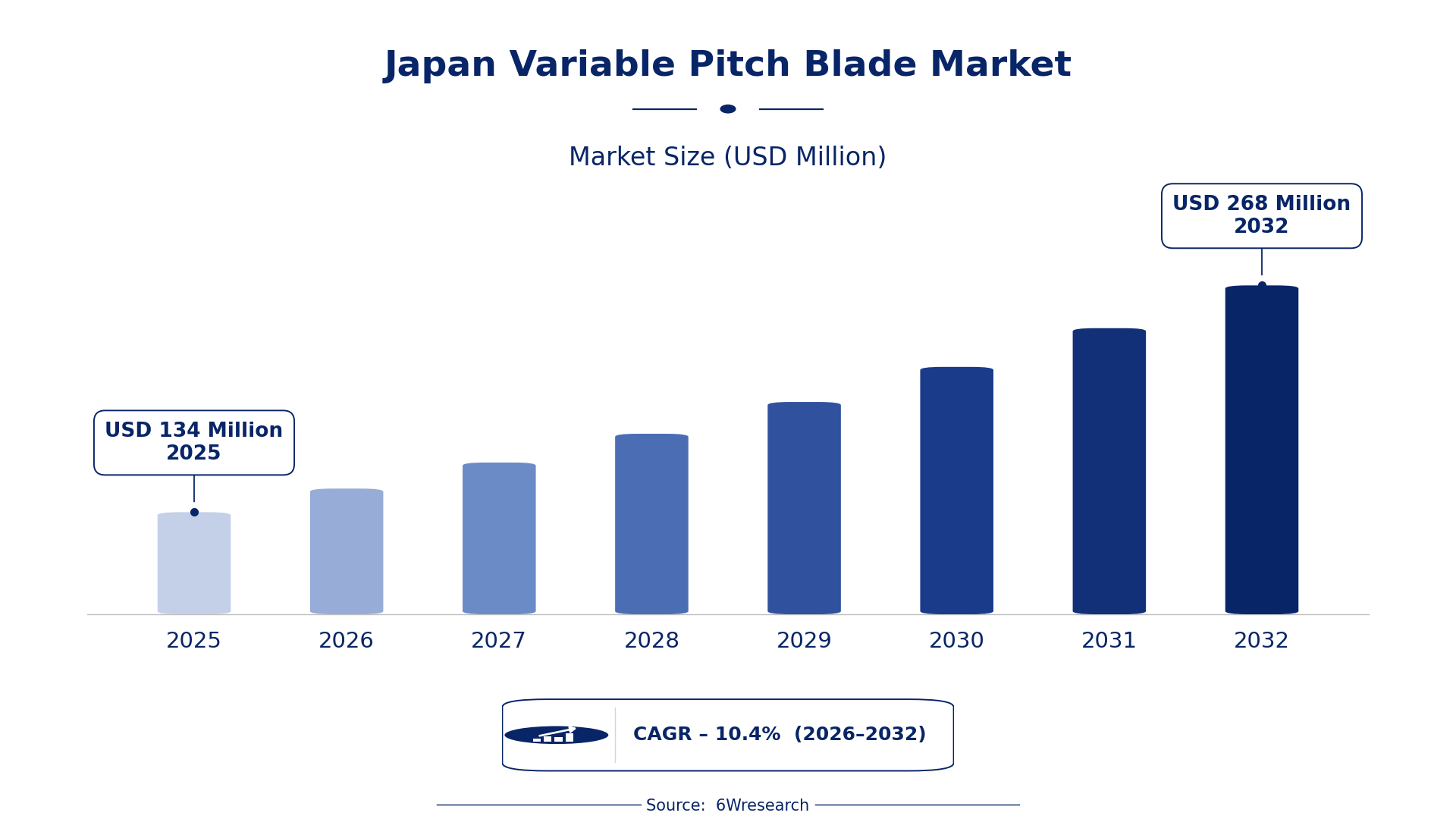
According to 6Wresearch internal database and industry insights, the Japan Variable Pitch Blade Market was valued at USD 134 Million in 2025 and is projected to reach USD 268 Million by 2032, growing at a CAGR of approximately 10.4% during 2026–2032.
Japan Variable Pitch Blade Market Highlights
| Report Metric | Details |
| Report Name | Japan Variable Pitch Blade Market (2026-2032) |
| Market Size 2025 | USD 134 Million |
| Market Size 2032 | USD 268 Million |
| Absolute Growth 2025–2032 | USD 134 Million |
| CAGR 2026–2032 | 10.4% |
| Peak Annual Growth | 14.8% in 2026 |
| Forecast Period | 2026–2032 |
| Historical Data | 2022–2025 |
| Base Year | 2025 |
| Leading Blade Type, 2025 | Composite Propeller Blade (41% share) |
| Leading Control Mechanism, 2025 | Hydraulic Actuation (39% share) |
| Leading Aircraft Type, 2025 | Fixed-Wing Aircraft (45% share) |
| Leading End User, 2025 | Defense OEMs (52% share) |
| Fastest-Growing Blade Type | Aluminum Alloy Blade (14.5% CAGR) |
| Fastest-Growing Control Mechanism | Manual Pitch Control (13.5% CAGR) |
| Fastest-Growing Aircraft Type | UAVs (13.9% CAGR) |
| Fastest-Growing End User | UAV Makers (13.1% CAGR) |
| Growing Sector | UAV Makers |
| Key End Users | Defense OEMs, UAV Makers, Aircraft Manufacturers, General Aviation Users |
Japan Variable Pitch Blade Market Year-wise Growth Rate and Key Drivers (2022–2032)
This graph illustrates the annual growth rates of the market from 2022 to 2032, highlighting a steady upward trajectory and projected market expansion over the forecast period.
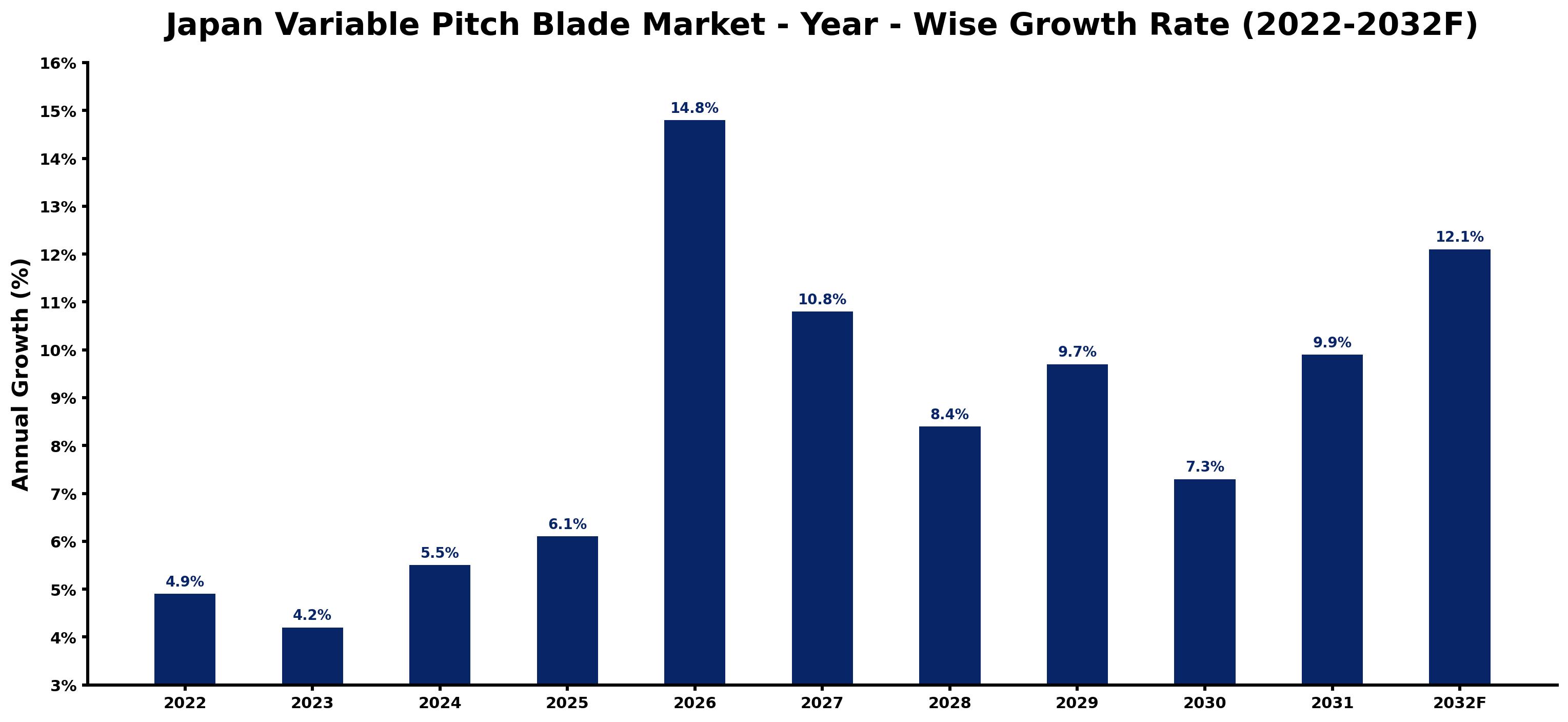
Below, each year's estimated growth is shown next to the factor that most influenced it.
| Year | Estimated Annual Growth (%) | Market Rationale |
| 2022 | 4.9 | The market experienced steady growth due to ongoing demand from the aerospace sector. |
| 2023 | 4.2 | Growth slowed as the market adjusted to previous high levels of activity. |
| 2024 | 5.5 | Increased production capacity and technological advancements spurred faster growth. |
| 2025 | 6.1 | The market saw a peak in growth as modernization efforts intensified across the industry. |
| 2026 | 14.8 | Demand is expected to surge dramatically as new UAV applications emerge in various sectors. |
| 2027 | 10.8 | Growth will slow as the market stabilises after the previous year's peak. |
| 2028 | 8.4 | The market is projected to continue growing, albeit at a slower pace, reflecting ongoing demand. |
| 2029 | 9.7 | A resurgence in interest from UAV makers will lead to faster growth rates. |
| 2030 | 7.3 | Growth is expected to slow as the market adjusts to the saturation of certain segments. |
| 2031 | 9.9 | Increased investment in aerospace technologies will drive demand higher once again. |
| 2032 | 12.1 | The market will grow as UAV production targets are pursued aggressively. |
Note: Market size estimations and growth projections presented in this report are based on 6Wresearch's proprietary forecasting methodology, utilizing the latest available industry data, government publications, and primary research inputs.
Japan Variable Pitch Blade Market Synopsis
Variable pitch blades are advanced components in aircraft propellers that adjust blade angles during flight, optimising performance and efficiency. The Japan Variable Pitch Blade Market is expanding, driven by the aerospace industry's growth, particularly in UAV applications, projected to increase by 30% by 2025. Government investment in aerospace R&D and the push for modernisation in the aircraft fleet are generating new demand, creating opportunities for manufacturers and suppliers.
Market Dynamics Impact Analysis (2026–2032)
| Factor | Type | Impact | Primary Segment Affected |
| Technological advancements in UAV applications are driving demand for variable pitch blades. | Driver | High | UAVs |
| Increased investment in aerospace R&D is enhancing production capabilities. | Driver | High | Composite Propeller Blade |
| The growing UAV market presents opportunities for innovative blade designs. | Opportunity | High | UAVs |
| The rising need for efficient aircraft propellers opens new markets for suppliers. | Opportunity | High | Fixed-Wing Aircraft |
| Cost pressures from material sourcing can limit production capacity. | Restraint | Medium | Aluminum Alloy Blade |
| Regulatory compliance can slow down the introduction of new products. | Restraint | Medium | Carbon Fiber Blade |
| Supply chain disruptions can delay production timelines for manufacturers. | Challenge | High | Adjustable Propellers |
| Competition from alternative technologies can impact market share. | Challenge | Medium | Hydraulic Actuation |
Evaluation of Drivers in Japan Variable Pitch Blade Market (2026–2032)
The table below links each growth driver to the segment it affects and the evidence for it.
| Drivers | Primary Segment Affected | Why It Matters (Evidence) |
| Growing demand for UAVs is increasing the need for variable pitch blades. | UAVs | The installed base of UAVs is set to reach 10,000 units by 2025, driving purchases. |
| Investment in aerospace R&D is boosting production capabilities. | Composite Propeller Blade | The Japanese government allocated 50 billion JPY for aerospace R&D in 2024, fostering innovation. |
| Modernisation of the aircraft fleet is driving demand for advanced propeller technologies. | Fixed-Wing Aircraft | The average age of aircraft in Japan is 12 years, necessitating upgrades and replacements. |
| The push for efficiency in aviation is increasing the adoption of variable pitch systems. | Carbon Fiber Blade | ISO 9001 standards are widely adopted, ensuring quality and reliability in production processes. |
| Collaboration between domestic manufacturers and international partners is expanding market reach. | Adjustable Propellers | Tokyo and Nagoya are key regions for aerospace collaboration, enhancing market growth. |
Buyers are adding capacity as the installed base of UAVs is set to reach 10,000 units by 2025, increasing demand for variable pitch blades. Investment in aerospace R&D, with 50 billion JPY allocated for 2024, boosts production capabilities and drives innovation in blade design. The average age of aircraft in Japan is 12 years, prompting modernisation efforts that drive demand for advanced propeller technologies. Widespread adoption of ISO 9001 standards ensures quality in manufacturing, supporting market growth. Collaboration in regions like Tokyo and Nagoya expands market reach for suppliers, creating additional opportunities.
Evaluation of Restraints in Japan Variable Pitch Blade Market
The following restraints limit how fast demand can grow.
| Market Restraint | Primary Segment Affected | Why It Matters (Evidence) |
| Cost pressures from material sourcing can limit production capacity. | Aluminum Alloy Blade | Material costs have risen by 20%, impacting profitability and production timelines for manufacturers. |
| Regulatory compliance can slow down the introduction of new products. | Carbon Fiber Blade | Stringent safety regulations require extensive testing, delaying market entry for new designs by up to 6 months. |
| Supply chain disruptions can delay production timelines for manufacturers. | Adjustable Propellers | Global supply chain issues have led to shortages of critical components, affecting delivery schedules by 3 months. |
| Market saturation in certain segments can limit growth potential. | Fixed-Wing Aircraft | The high number of existing aircraft limits the demand for new variable pitch blades, constraining market expansion. |
| Competition from alternative technologies can impact market share. | Hydraulic Actuation | Emerging technologies may offer more cost-effective solutions, challenging traditional products and reducing market presence. |
Japan Variable Pitch Blade Market Challenges
Japan's aerospace industry suffers from supply chain disruptions due to reliance on specific material imports, causing production delays for local manufacturers of up to six months. Technological advancements are stifled by high R&D costs, forcing buyers to accept less efficient products that fail to meet modern performance standards. Educational institutions are unable to produce enough skilled aerospace engineers, leading to a potential workforce gap of 20% by 2032. Evolving safety regulations impose additional pressures on buyers, with compliance costs potentially increasing project budgets by 15% annually.
Trends in the Japan Variable Pitch Blade Market
The shifts below are changing how Japan Variable Pitch Blade Market products are bought and supplied.
- Shift in UAV Applications: UAV makers are increasingly adopting variable pitch blades to improve performance, with the installed base projected to reach 10,000 units by 2025. This shift drives demand for new designs and materials.
- Growing Focus on Efficiency: The Tokyo Metropolitan Government has invested 10 billion JPY in aerospace technology research, promoting the use of variable pitch blades to improve fuel efficiency. This trend is reshaping the market for suppliers.
- Transition to Advanced Materials: The aerospace industry is moving towards carbon fiber blades for their lightweight and high-strength properties, supported by the Japan Aerospace Exploration Agency's initiatives. This transition enhances aircraft performance.
- Increased Collaboration in Aerospace: The Japan Aerospace Association is facilitating industry collaboration, leading to the development of new standards and technologies. This cooperation is improving the competitive environment for variable pitch blades.
Investment Opportunities in the Japan Variable Pitch Blade Market
Below are the investment opportunities with the strongest case in the Japan Variable Pitch Blade Market.
- Investment in UAV Technology: With the installed base of UAVs projected to reach 10,000 units by 2025, manufacturers should invest in variable pitch blades to meet rising demand. UAV makers in Tokyo are actively seeking advanced solutions.
- Expansion of Aerospace R&D: The Japanese government's allocation of 50 billion JPY for aerospace R&D in 2024 presents an opportunity for suppliers to innovate. Collaborating with research institutions can improve product development.
- Modernisation of Aircraft Fleet: As the average age of aircraft in Japan is 12 years, there is a growing need for upgrades. Aircraft manufacturers are looking for advanced propeller technologies to improve performance.
- Growth in General Aviation: The number of registered general aviation aircraft in Japan is around 3,000, indicating a need for efficient solutions. Suppliers can target this segment by offering tailored variable pitch blades.
Government Initiatives in the Japan Variable Pitch Blade Market
The Economic Security Promotion Act (2022) supports supply-chain resilience for critical products and materials, ensuring that producers of variable pitch blades can secure necessary components. This law aims to strengthen domestic manufacturing capabilities and reduce reliance on imports, with a focus on enhancing local production by 20% by 2025.
The Japan Aerospace Exploration Agency (JAXA) oversees various aerospace initiatives, including funding for R&D projects that promote technology development. JAXA's support is vital for manufacturers seeking to innovate and comply with safety regulations, with an aim to approve 15 new projects annually.
Future Insight of the Japan Variable Pitch Blade Market
By 2032, a policy-driven shift will lead to increased UAV integration, compelling suppliers to innovate their product offerings. The introduction of stricter safety regulations will establish advanced technology standards, ensuring improved operational reliability. The installed base of UAVs is expected to reach 10,000 units by 2025, driving demand for variable pitch blades. With 50 billion JPY allocated for aerospace R&D in 2024, technological advancements will accelerate, enhancing competitive positioning for local suppliers.
Market Segmentation Analysis
Japan Variable Pitch Blade Market report covers a detailed analysis of the following market segments:
By Blade Type – Composite Propeller Blade Leads, Aluminum Alloy Blade Expected to Grow Fastest
According to Saurav Kr Singh, Senior Research Analyst at 6Wresearch, in 2025, Composite Propeller Blade led the blade type split with a 41% share. The composite propeller blade holds the largest share due to its extensive use in modern aircraft, optimising performance and efficiency. Its importance is highlighted in various military and commercial aircraft prevalent in Japan's aerospace sector. The quickest growth will come from Aluminum Alloy Blade, forecast to expand at a CAGR of 14.5% between 2026 and 2032. The aluminum alloy blade is experiencing rapid growth as it is cost-effective for different aircraft types, particularly in the expanding UAV market. This growth is further supported by the Japanese government's aim to double UAV production by 2030. Suppliers should enhance the cost-effectiveness of aluminum alloy blades to capture the growing UAV market.
By Control Mechanism – Hydraulic Actuation Leads, Manual Pitch Control Expected to Grow Fastest
Hydraulic Actuation held 39% of the Japan Variable Pitch Blade Market by control mechanism in 2025. Hydraulic actuation is the leading control mechanism due to its critical importance for precise control in variable pitch systems, particularly in advanced aircraft. Its reliability in military applications solidifies its dominant position in the market. Manual Pitch Control is set to record the highest CAGR in this split, 13.5% over 2026–2032. Manual pitch control is growing rapidly as it remains prevalent in older aircraft models, which are still in operation. The need for maintenance and upgrades in these aircraft contributes to the increasing demand for manual systems. Suppliers may need to consider offering retrofitting solutions for older aircraft to meet the demand for manual pitch control.
By Aircraft Type – Fixed-Wing Aircraft Leads, UAVs Expected to Grow Fastest
Fixed-Wing Aircraft took 45% of aircraft type revenue in 2025, more than any other category. Fixed-wing aircraft dominate the market as they are significant users of variable pitch blades, especially in commercial and military applications. The existing infrastructure and operational requirements of these aircraft ensure sustained demand in Japan. UAVs are projected to grow fastest, at a CAGR of 13.9% during 2026–2032. UAVs are the fastest-growing segment, driven by their increasing applications in sectors such as agriculture and surveillance. The installed base of UAVs in Japan is projected to reach 10,000 units by 2025, indicating robust growth. Suppliers should invest in UAV-specific solutions to capitalise on the rapid growth of this segment.
By End User – Defense OEMs Lead, UAV Makers Expected to Grow Fastest
The largest end user category in 2025 was Defense OEMs, at 52% of revenue. Defense OEMs represent the largest end user group as they are major consumers of variable pitch blades for military applications, ensuring consistent demand. The ongoing investments by the Japan Defense Agency in advanced aerospace technologies further solidify this segment's leadership. Over 2026–2032, UAV Makers are expected to post the fastest growth, at a CAGR of 13.1%. UAV makers are witnessing the fastest growth, propelled by rising demand for UAVs in various applications. The Japanese government's initiative to boost UAV usage in agriculture by 30% by 2025 exemplifies this trend. Suppliers should align their offerings with the needs of UAV makers to leverage the growth potential in this emerging market.
Key Attractiveness of the Report
- 10 Years of Market Numbers
- Historical Data Starting from 2022 to 2025
- Base Year 2025
- Forecast Data until 2032
- Key Performance Indicators Impacting the Market
- Major Upcoming Developments and Projects
Key Highlights of the Report:
- Japan Variable Pitch Blade Market Outlook
- Market Size of Japan Variable Pitch Blade Market, 2025
- Forecast of Japan Variable Pitch Blade Market, 2032
- Historical Data and Forecast of Japan Variable Pitch Blade Revenues & Volume for the Period 2022-2032F
- Japan Variable Pitch Blade Market Trend Evolution
- Japan Variable Pitch Blade Market Drivers and Challenges
- Japan Variable Pitch Blade Price Trends
- Japan Variable Pitch Blade Porter's Five Forces
- Japan Variable Pitch Blade Industry Life Cycle
- Historical Data and Forecast of Japan Variable Pitch Blade Market Revenues & Volume By Blade Type for the Period 2022-2032F
- Historical Data and Forecast of Japan Variable Pitch Blade Market Revenues & Volume By Composite Propeller Blade for the Period 2022-2032F
- Historical Data and Forecast of Japan Variable Pitch Blade Market Revenues & Volume By Aluminum Alloy Blade for the Period 2022-2032F
- Historical Data and Forecast of Japan Variable Pitch Blade Market Revenues & Volume By Carbon Fiber Blade for the Period 2022-2032F
- Historical Data and Forecast of Japan Variable Pitch Blade Market Revenues & Volume By Adjustable Propellers for the Period 2022-2032F
- Historical Data and Forecast of Japan Variable Pitch Blade Market Revenues & Volume By Control Mechanism for the Period 2022-2032F
- Historical Data and Forecast of Japan Variable Pitch Blade Market Revenues & Volume By Hydraulic Actuation for the Period 2022-2032F
- Historical Data and Forecast of Japan Variable Pitch Blade Market Revenues & Volume By Manual Pitch Control for the Period 2022-2032F
- Historical Data and Forecast of Japan Variable Pitch Blade Market Revenues & Volume By Electric Pitch Control for the Period 2022-2032F
- Historical Data and Forecast of Japan Variable Pitch Blade Market Revenues & Volume By Servo-Mechanical for the Period 2022-2032F
- Historical Data and Forecast of Japan Variable Pitch Blade Market Revenues & Volume By Aircraft Type for the Period 2022-2032F
- Historical Data and Forecast of Japan Variable Pitch Blade Market Revenues & Volume By Fixed-Wing Aircraft for the Period 2022-2032F
- Historical Data and Forecast of Japan Variable Pitch Blade Market Revenues & Volume By UAVs for the Period 2022-2032F
- Historical Data and Forecast of Japan Variable Pitch Blade Market Revenues & Volume By Helicopters for the Period 2022-2032F
- Historical Data and Forecast of Japan Variable Pitch Blade Market Revenues & Volume By Light Aircraft for the Period 2022-2032F
- Historical Data and Forecast of Japan Variable Pitch Blade Market Revenues & Volume By End User for the Period 2022-2032F
- Historical Data and Forecast of Japan Variable Pitch Blade Market Revenues & Volume By Defense OEMs for the Period 2022-2032F
- Historical Data and Forecast of Japan Variable Pitch Blade Market Revenues & Volume By UAV Makers for the Period 2022-2032F
- Historical Data and Forecast of Japan Variable Pitch Blade Market Revenues & Volume By Aircraft Manufacturers for the Period 2022-2032F
- Historical Data and Forecast of Japan Variable Pitch Blade Market Revenues & Volume By General Aviation Users for the Period 2022-2032F
- Japan Variable Pitch Blade Import Export Trade Statistics
- Market Opportunity Assessment By Blade Type
- Market Opportunity Assessment By Control Mechanism
- Market Opportunity Assessment By Aircraft Type
- Market Opportunity Assessment By End User
- Japan Variable Pitch Blade Top Companies Market Share
- Japan Variable Pitch Blade Competitive Benchmarking By Technical and Operational Parameters
- Japan Variable Pitch Blade Company Profiles
- Japan Variable Pitch Blade Key Strategic Recommendations
Market Covered
Coverage by segment is as follows.
By Blade Type
- Composite Propeller Blade
- Aluminum Alloy Blade
- Carbon Fiber Blade
- Adjustable Propellers
By Control Mechanism
- Hydraulic Actuation
- Manual Pitch Control
- Electric Pitch Control
- Servo-Mechanical
By Aircraft Type
- Fixed-Wing Aircraft
- UAVs
- Helicopters
- Light Aircraft
By End User
- Defense OEMs
- UAV Makers
- Aircraft Manufacturers
- General Aviation Users































