Japan Variable Rate Spraying Systems Market Size & Growth Rate
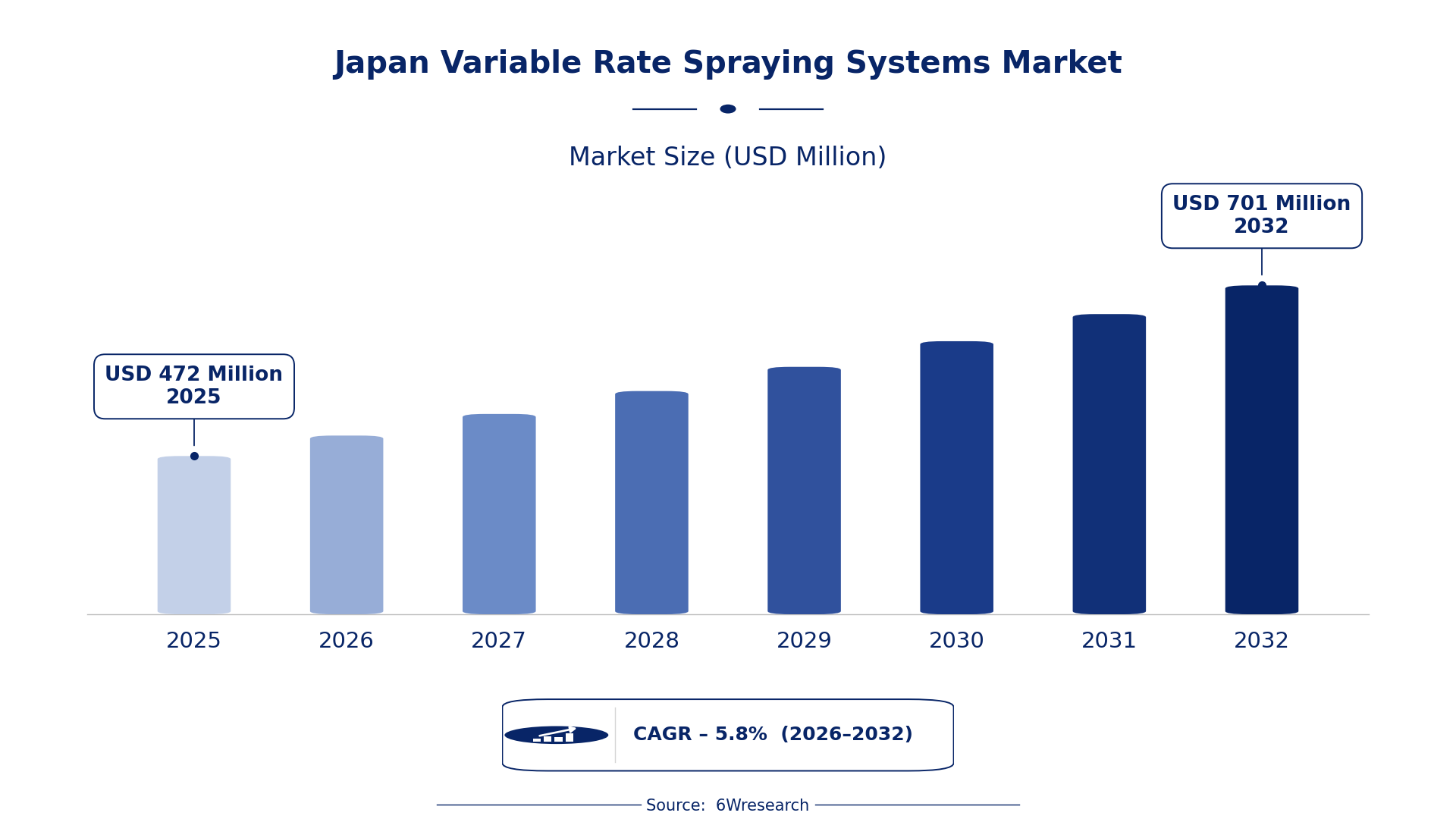
According to 6Wresearch internal database and industry insights, the Japan Variable Rate Spraying Systems Market was valued at USD 472 Million in 2025 and is projected to reach USD 701 Million by 2032, growing at a CAGR of approximately 5.8% during 2026–2032.
Japan Variable Rate Spraying Systems Market Highlights
| Report Metric | Details |
| Report Name | Japan Variable Rate Spraying Systems Market (2026-2032) |
| Market Size 2025 | USD 472 Million |
| Market Size 2032 | USD 701 Million |
| Absolute Growth 2025–2032 | USD 229 Million |
| CAGR 2026–2032 | 5.8% |
| Peak Annual Growth | 6.7% in 2026 |
| Forecast Period | 2026–2032 |
| Historical Data | 2022–2025 |
| Base Year | 2025 |
| Leading Sprayer Type, 2025 | Boom Sprayers (42% share) |
| Leading Control System, 2025 | Sensor-Based (36% share) |
| Leading Crop Type, 2025 | Cereals/Grains (42% share) |
| Leading End User, 2025 | Large-Scale Farmers (42% share) |
| Fastest-Growing Sprayer Type | Aerial Sprayers (7.9% CAGR) |
| Fastest-Growing Control System | Drone-Guided (8.3% CAGR) |
| Fastest-Growing Crop Type | Fruits & Vegetables (8.2% CAGR) |
| Fastest-Growing End User | Precision Ag Firms (7.5% CAGR) |
| Growing Sector | Precision Agriculture |
| Key End Users | Large-Scale Farmers, Precision Ag Firms, Orchard Growers |
Japan Variable Rate Spraying Systems Market Year-wise Growth Rate and Key Drivers (2022–2032)
This graph illustrates the annual growth rates of the market from 2022 to 2032, highlighting a steady upward trajectory and projected market expansion over the forecast period.
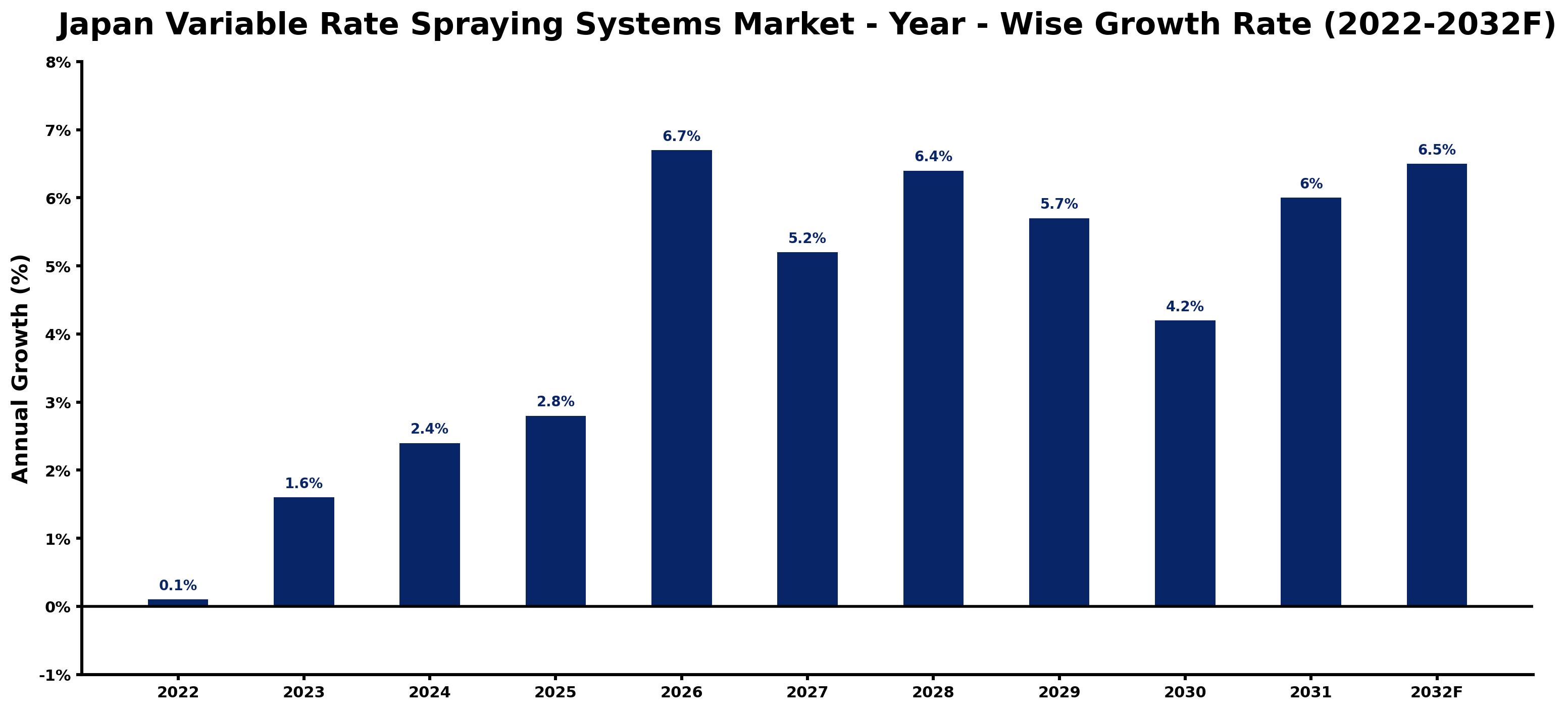
Year by year, the estimates below pair each growth rate with the development that shaped it.
| Year | Estimated Annual Growth (%) | Market Rationale |
| 2022 | 0.1 | The market exhibited minimal growth as precision agriculture adoption was still emerging. |
| 2023 | 1.6 | Increased awareness of sustainable farming practices drove faster growth compared to the previous year. |
| 2024 | 2.4 | The rise in crop production demands led to improved adoption of advanced spraying technologies. |
| 2025 | 2.8 | Continued investment in agricultural innovation contributed to a higher growth rate than before. |
| 2026 | 6.7 | The introduction of new technologies boosted demand, marking the peak growth year. |
| 2027 | 5.2 | Growth slowed slightly as the market adjusted to the rapid advancements in technology. |
| 2028 | 6.4 | An uptick in precision agriculture initiatives prompted renewed interest and growth in the market. |
| 2029 | 5.7 | The market experienced a slowdown as growth stabilised after the peak in 2026. |
| 2030 | 4.2 | Demand growth continued to slow, reflecting market maturation and technology integration. |
| 2031 | 6.0 | A resurgence in investment in agricultural technology led to increased growth rates. |
| 2032 | 6.5 | The market is expected to maintain strong growth as new technologies become widely adopted. |
Note: Market size estimations and growth projections presented in this report are based on 6Wresearch's proprietary forecasting methodology, utilizing the latest available industry data, government publications, and primary research inputs.
Japan Variable Rate Spraying Systems Market Synopsis
Variable Rate Spraying Systems are advanced technologies that optimise pesticide and fertiliser applications using real-time data. These technologies improve efficiency, reduce waste, and promote sustainable farming practices. In Japan, the agricultural sector is increasingly adopting these systems, driven by the need for precision agriculture and environmental sustainability. The investment of ¥10 billion in agricultural innovation in 2023 and the 50% increase in drone applications in agriculture are key factors driving market growth. The Japan Variable Rate Spraying Systems Market is projected to grow substantially, reflecting the increasing demand for efficient agricultural practices.
Market Dynamics Impact Analysis (2026–2032)
| Factor | Type | Impact | Primary Segment Affected |
| Rising investment in agricultural technology | Driver | High | Sensor-Based |
| Growing demand for sustainable farming practices | Driver | High | Drone-Guided |
| Emerging demand for precision agriculture | Opportunity | Medium | Aerial Sprayers |
| Increasing adoption of advanced spraying technologies | Opportunity | Medium | Boom Sprayers |
| High average age of farmers affecting technology uptake | Restraint | High | Tractor-Mounted Systems |
| Limited awareness of VRT benefits among small-scale farmers | Restraint | Medium | Orchard Sprayers |
| Challenges in integrating new technology into existing practices | Challenge | High | Sensor-Based |
| High initial investment costs for advanced systems | Challenge | Medium | Drone-Guided |
Evaluation of Drivers in Japan Variable Rate Spraying Systems Market (2026–2032)
The following drivers explain most of the expected growth.
| Drivers | Primary Segment Affected | Why It Matters (Evidence) |
| Increased investment in agricultural innovation | Aerial Sprayers | Japan invested ¥10 billion in agricultural innovation in 2023, leading to greater adoption of advanced spraying systems. |
| Growing focus on sustainable farming | Boom Sprayers | The government aims for a 30% reduction in pesticide use by 2030, driving demand for efficient spraying technologies. |
| Rising crop production needs | Tractor-Mounted Systems | Japan produced 7.5 million tons of rice in 2022, increasing the need for efficient application methods. |
| Expansion of precision agriculture | Sensor-Based | The precision agriculture adoption rate is around 20%, encouraging investment in technologies that enhance efficiency. |
| Increase in drone applications | Drone-Guided | The number of drone applications in agriculture increased by 50% in 2023, expanding the market for precision spraying. |
Most of the extra volume comes from increased investment in agricultural innovation, with Japan allocating ¥10 billion in 2023 to boost technology adoption. With rice production reaching 7.5 million tons in 2022, the demand for efficient application methods continues to rise. The adoption rate of precision agriculture is around 20%, encouraging investment in technologies that improve efficiency. The 50% increase in drone applications in agriculture in 2023 indicates a shift towards more efficient spraying solutions.
Evaluation of Restraints in Japan Variable Rate Spraying Systems Market
Below are the constraints most often cited by buyers and suppliers, with the segment each affects.
| Market Restraint | Primary Segment Affected | Why It Matters (Evidence) |
| High average age of farmers affecting technology uptake | Tractor-Mounted Systems | The average age of farmers in Japan is 67 years, leading to slower adoption of new technologies. |
| Limited awareness of VRT benefits among small-scale farmers | Orchard Sprayers | Many small-scale farmers lack knowledge about the advantages of variable rate technology, hindering market growth. |
| Challenges in integrating new technology into existing practices | Sensor-Based | Farmers encounter difficulties adapting new systems to traditional farming methods, impacting uptake. |
| High initial investment costs for advanced systems | Drone-Guided | The cost of advanced spraying systems can be prohibitive for smaller operations, restricting market access. |
| Regulatory hurdles for new technology implementation | Aerial Sprayers | JIS standards for agricultural machinery impose strict requirements, slowing the introduction of new products. |
Japan Variable Rate Spraying Systems Market Challenges
Aging farmers create a skills gap in adopting Variable Rate Spraying Systems, as the average age is 67 years, leading to delays in technology uptake and lower productivity for producers. High initial costs of these systems discourage many buyers, resulting in missed opportunities to improve crop yields in a sector valued at ¥1 trillion annually. Insufficient technological infrastructure in rural areas limits access to efficient solutions, causing longer lead times and operational inefficiencies for clinics and farms. Compliance with JIS standards imposes additional costs on suppliers, hindering their ability to provide timely solutions to farmers.
Trends in the Japan Variable Rate Spraying Systems Market
The following changes are redrawing the Japan Variable Rate Spraying Systems Market.
- Shift towards Drone-Guided Spraying: In 2023, the number of drone applications in agriculture increased by 50%, reflecting a growing trend towards drone-guided spraying systems. This shift allows for more precise application over large areas, benefiting large-scale farmers.
- Increase in Sensor-Based Systems: Since 2022, the adoption of sensor-based systems has risen, driven by the need for real-time data in agriculture. This trend is evident in the Tohoku region, where advanced spraying systems are improving fruit production.
- Growth of Aerial Sprayers: The demand for aerial sprayers has surged, with a projected CAGR of 7.9% from 2026 to 2032. This growth is largely due to their effectiveness in reaching hard-to-access crops, particularly in mountainous regions.
- Emphasis on Sustainable Practices: The Japanese government aims for a 30% reduction in pesticide use by 2030, promoting sustainable practices in agriculture. This initiative is encouraging the adoption of variable rate spraying systems across various crop types.
Investment Opportunities in the Japan Variable Rate Spraying Systems Market
Below are the investment opportunities with the strongest case in the Japan Variable Rate Spraying Systems Market.
- Timing for Investment in Precision Agriculture: With the precision agriculture adoption rate at 20%, now is the time to invest in sensor-based technologies. Large-scale farmers are increasingly looking for solutions to improve efficiency and sustainability.
- Entry into the Drone-Guided Market: The rise in drone applications presents an opportunity for partnerships with precision ag firms. Collaborating with local firms can facilitate entry into the growing drone-guided spraying market.
- Focus on Large-Scale Farmers: The average size of a large-scale farm in Japan is 30 hectares, indicating a need for advanced spraying systems. Suppliers can target this segment to meet the demand for efficiency in crop production.
- Expansion in the Tohoku Region: The Tohoku region is known for its fruit production, creating a demand for advanced spraying systems. Investing in this area can yield significant returns as farmers seek to improve yields.
Government Initiatives in the Japan Variable Rate Spraying Systems Market
The Waste Management and Public Cleansing Act regulates the treatment and disposal of agricultural waste, ensuring that producers adhere to environmental standards. Compliance with JIS standards for agricultural machinery is mandatory, impacting the production processes of spraying systems. In 2023, over 200,000 registered farms must follow these regulations to maintain operational compliance, influencing the market for Variable Rate Spraying Systems.
The Ministry of Agriculture, Forestry and Fisheries promotes precision agriculture through various funding schemes. These initiatives support farmers in adopting advanced technologies, improving productivity and sustainability in the agricultural sector. In 2023, the ministry allocated ¥10 billion to these efforts, benefiting thousands of farmers seeking to modernise their practices.
Future Insight of the Japan Variable Rate Spraying Systems Market
By 2032, advancements in precision agriculture will transform the demand for Variable Rate Spraying Systems, with government initiatives aiming for a 30% reduction in pesticide use by 2030. Increased investment in agricultural innovation will lead to the development of more efficient systems. The surge in drone applications, which rose by 50% in 2023, will enable more precise spraying practices. As the Tokyo region solidifies its role as a hub for agricultural technology, buyers will access improved solutions while suppliers must adapt to evolving market requirements.
Market Segmentation Analysis
Japan Variable Rate Spraying Systems Market report covers a detailed analysis of the following market segments:
By Sprayer Type – Boom Sprayers Lead, Aerial Sprayers Expected to Grow Fastest
According to Saurav Kr Singh, Senior Research Analyst at 6Wresearch, with 42% of sprayer type revenue in 2025, Boom Sprayers was the largest category. Boom Sprayers hold the largest share due to their extensive use in large field applications, making them indispensable for farmers managing Japan's vast arable land. Their efficiency in covering large areas aligns with the needs of modern agricultural practices. Aerial Sprayers are projected to grow fastest, at a CAGR of 7.9% during 2026–2032. Aerial Sprayers are experiencing rapid growth as they effectively cater to large areas and hard-to-reach crops, which is becoming increasingly important in agriculture. The 50% increase in drone applications in 2023 indicates a strong trend towards aerial solutions. Suppliers should focus on enhancing aerial spraying technologies to meet the growing demands of farmers.
By Control System – Sensor-Based Leads, Drone-Guided Expected to Grow Fastest
Sensor-Based held 36% of the Japan Variable Rate Spraying Systems Market by control system in 2025. Sensor-Based control systems dominate the market as they are essential for real-time data collection, allowing farmers to optimise their spraying processes effectively. This technology is critical for ensuring precision in pesticide and fertiliser applications across various crops. The quickest growth will come from Drone-Guided, forecast to expand at a CAGR of 8.3% between 2026 and 2032. Drone-Guided systems are the fastest-growing segment, driven by their emerging role in precision application that supports the increasing adoption of advanced agricultural technologies. The rise in the number of precision agriculture firms in Japan is propelling this segment's growth. Buyers should invest in drone-guided systems to improve efficiency and sustainability in their agricultural practices.
By Crop Type – Cereals/Grains Lead, Fruits & Vegetables Expected to Grow Fastest
The largest crop type category in 2025 was Cereals/Grains, at 42% of revenue. Cereals/Grains represent the largest crop type in Japan, significantly contributing to agricultural output and driving demand for variable rate spraying systems. The focus on maximising yields in this sector makes it a priority for farmers. Fruits & Vegetables are set to record the highest CAGR in this split, 8.2% over 2026–2032. Fruits & Vegetables are the fastest-growing segment, reflecting a vital sector for precision spraying due to increasing consumer demand for high-quality produce. The emphasis on sustainable practices in this area is accelerating its growth. Suppliers should tailor their offerings to meet the specific needs of fruit and vegetable growers, capitalising on this growth opportunity.
By End User – Large-Scale Farmers Lead, Precision Ag Firms Expected to Grow Fastest
In 2025, Large-Scale Farmers led the end user split with a 42% share. Large-Scale Farmers are the primary users of advanced spraying systems, managing extensive arable land and necessitating efficient crop management solutions. Their established infrastructure and investment capabilities position them as key players in this market. Over 2026–2032, Precision Ag Firms are expected to post the fastest growth, at a CAGR of 7.5%. Precision Ag Firms are rapidly expanding as they focus on technology-driven agriculture, which is essential for meeting modern farming demands. Their commitment to efficiency and innovation is reshaping the agricultural landscape in Japan. Suppliers must engage with precision ag firms to stay competitive in a market increasingly influenced by technological advancements.
Key Attractiveness of the Report
- 10 Years of Market Numbers
- Historical Data Starting from 2022 to 2025
- Base Year 2025
- Forecast Data until 2032
- Key Performance Indicators Impacting the Market
- Major Upcoming Developments and Projects
Key Highlights of the Report:
- Japan Variable Rate Spraying Systems Market Outlook
- Market Size of Japan Variable Rate Spraying Systems Market, 2025
- Forecast of Japan Variable Rate Spraying Systems Market, 2032
- Historical Data and Forecast of Japan Variable Rate Spraying Systems Revenues & Volume for the Period 2022-2032F
- Japan Variable Rate Spraying Systems Market Trend Evolution
- Japan Variable Rate Spraying Systems Market Drivers and Challenges
- Japan Variable Rate Spraying Systems Price Trends
- Japan Variable Rate Spraying Systems Porter's Five Forces
- Japan Variable Rate Spraying Systems Industry Life Cycle
- Historical Data and Forecast of Japan Variable Rate Spraying Systems Market Revenues & Volume By Sprayer Type for the Period 2022-2032F
- Historical Data and Forecast of Japan Variable Rate Spraying Systems Market Revenues & Volume By Boom Sprayers for the Period 2022-2032F
- Historical Data and Forecast of Japan Variable Rate Spraying Systems Market Revenues & Volume By Aerial Sprayers for the Period 2022-2032F
- Historical Data and Forecast of Japan Variable Rate Spraying Systems Market Revenues & Volume By Orchard Sprayers for the Period 2022-2032F
- Historical Data and Forecast of Japan Variable Rate Spraying Systems Market Revenues & Volume By Tractor-Mounted Systems for the Period 2022-2032F
- Historical Data and Forecast of Japan Variable Rate Spraying Systems Market Revenues & Volume By Control System for the Period 2022-2032F
- Historical Data and Forecast of Japan Variable Rate Spraying Systems Market Revenues & Volume By Sensor-Based for the Period 2022-2032F
- Historical Data and Forecast of Japan Variable Rate Spraying Systems Market Revenues & Volume By Drone-Guided for the Period 2022-2032F
- Historical Data and Forecast of Japan Variable Rate Spraying Systems Market Revenues & Volume By Camera-Assisted for the Period 2022-2032F
- Historical Data and Forecast of Japan Variable Rate Spraying Systems Market Revenues & Volume By GPS + VRT Software for the Period 2022-2032F
- Historical Data and Forecast of Japan Variable Rate Spraying Systems Market Revenues & Volume By Crop Type for the Period 2022-2032F
- Historical Data and Forecast of Japan Variable Rate Spraying Systems Market Revenues & Volume By Cereals/Grains for the Period 2022-2032F
- Historical Data and Forecast of Japan Variable Rate Spraying Systems Market Revenues & Volume By Fruits & Vegetables for the Period 2022-2032F
- Historical Data and Forecast of Japan Variable Rate Spraying Systems Market Revenues & Volume By Vineyards for the Period 2022-2032F
- Historical Data and Forecast of Japan Variable Rate Spraying Systems Market Revenues & Volume By Oilseeds for the Period 2022-2032F
- Historical Data and Forecast of Japan Variable Rate Spraying Systems Market Revenues & Volume By End User for the Period 2022-2032F
- Historical Data and Forecast of Japan Variable Rate Spraying Systems Market Revenues & Volume By Large-Scale Farmers for the Period 2022-2032F
- Historical Data and Forecast of Japan Variable Rate Spraying Systems Market Revenues & Volume By Precision Ag Firms for the Period 2022-2032F
- Historical Data and Forecast of Japan Variable Rate Spraying Systems Market Revenues & Volume By Orchard Growers for the Period 2022-2032F
- Historical Data and Forecast of Japan Variable Rate Spraying Systems Market Revenues & Volume By Farming Co-ops for the Period 2022-2032F
- Japan Variable Rate Spraying Systems Import Export Trade Statistics
- Market Opportunity Assessment By Sprayer Type
- Market Opportunity Assessment By Control System
- Market Opportunity Assessment By Crop Type
- Market Opportunity Assessment By End User
- Japan Variable Rate Spraying Systems Top Companies Market Share
- Japan Variable Rate Spraying Systems Competitive Benchmarking By Technical and Operational Parameters
- Japan Variable Rate Spraying Systems Company Profiles
- Japan Variable Rate Spraying Systems Key Strategic Recommendations
Market Covered
The report covers the following segments.
By Sprayer Type
- Boom Sprayers
- Aerial Sprayers
- Orchard Sprayers
- Tractor-Mounted Systems
By Control System
- Sensor-Based
- Drone-Guided
- Camera-Assisted
- GPS + VRT Software
By Crop Type
- Cereals/Grains
- Fruits & Vegetables
- Vineyards
- Oilseeds
By End User
- Large-Scale Farmers
- Precision Ag Firms
- Orchard Growers
- Farming Co-ops































