Japan Vascular Graft Market Size & Growth Rate
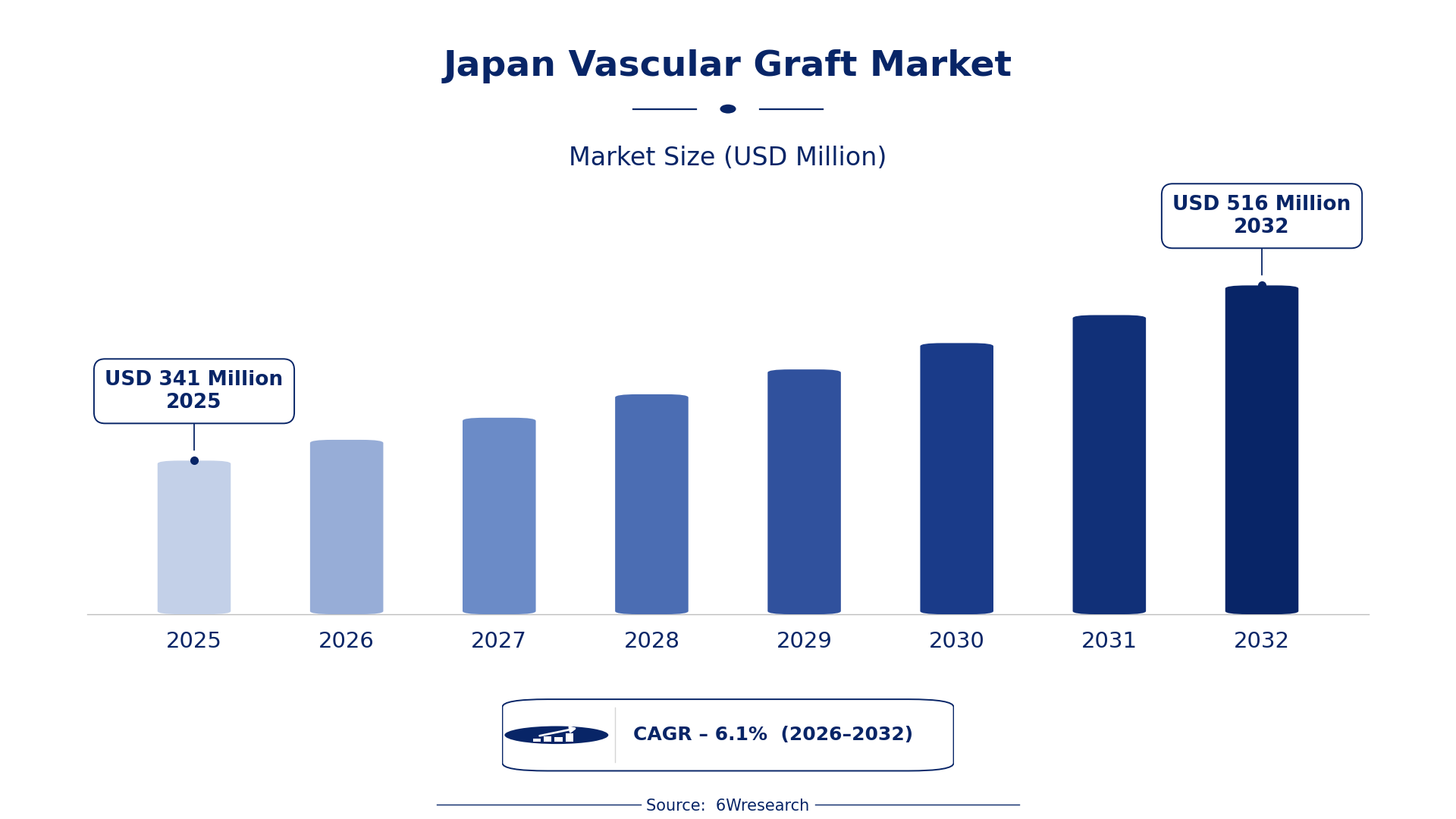
According to 6Wresearch internal database and industry insights, the Japan Vascular Graft Market was valued at USD 341 Million in 2025 and is projected to reach USD 516 Million by 2032, growing at a CAGR of approximately 6.1% during 2026–2032.
Japan Vascular Graft Market Highlights
| Report Metric | Details |
| Report Name | Japan Vascular Graft Market (2026-2032) |
| Market Size 2025 | USD 341 Million |
| Market Size 2032 | USD 516 Million |
| Absolute Growth 2025–2032 | USD 175 Million |
| CAGR 2026–2032 | 6.1% |
| Peak Annual Growth | 6.9% in 2026 |
| Forecast Period | 2026–2032 |
| Historical Data | 2022–2025 |
| Base Year | 2025 |
| Leading Graft Source, 2025 | Synthetic Grafts (47% share) |
| Leading Configuration, 2025 | Tubular/Bifurcated (45% share) |
| Leading Fixation Type, 2025 | Stapled/Sutured (40% share) |
| Leading End User, 2025 | Hospitals (49% share) |
| Fastest-Growing Graft Source | Biological Grafts (8.6% CAGR) |
| Fastest-Growing Configuration | 3D Printed (8.4% CAGR) |
| Fastest-Growing Fixation Type | Self-Expanding (8.8% CAGR) |
| Fastest-Growing End User | Cardiovascular Clinics (7.6% CAGR) |
| Growing Sector | Healthcare |
| Key End Users | Hospitals, Cardiovascular Clinics, Surgical Centers |
Japan Vascular Graft Market Year-wise Growth Rate and Key Drivers (2022–2032)
This graph illustrates the annual growth rates of the market from 2022 to 2032, highlighting a steady upward trajectory and projected market expansion over the forecast period.
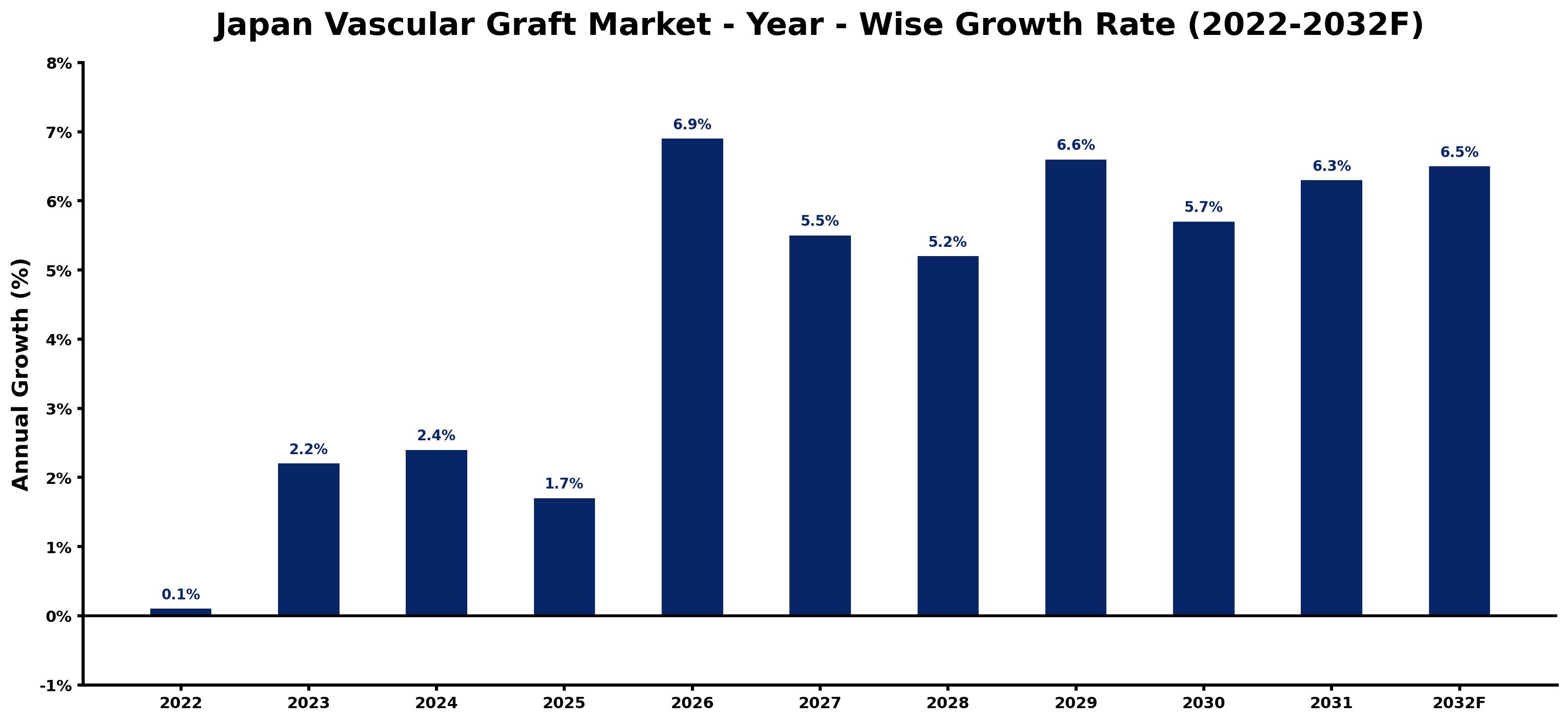
Annual growth estimates for each year appear below with the principal reason behind them, explaining the shifts that set the pace of the market.
| Year | Estimated Annual Growth (%) | Market Rationale |
| 2022 | 0.1 | The market showed minimal growth, reflecting stable healthcare demands and existing infrastructure. |
| 2023 | 2.2 | Growth accelerated as hospitals increased vascular procedures, responding to rising patient needs. |
| 2024 | 2.4 | Continued growth was driven by advancements in surgical techniques and increased awareness of vascular health. |
| 2025 | 1.7 | Growth slowed as hospitals faced resource allocation challenges amid competing healthcare priorities. |
| 2026 | 6.9 | A surge in demand is expected to result from improved vascular surgery training programs boosting surgical capabilities. |
| 2027 | 5.5 | Demand growth is projected to slow as hospitals adjust to new surgical protocols and patient management strategies. |
| 2028 | 5.2 | The market is expected to continue growing, supported by increasing adoption of biological grafts in surgeries. |
| 2029 | 6.6 | Growth is projected to resume as hospitals expand their vascular surgery services to meet patient needs. |
| 2030 | 5.7 | A slight slowdown is expected as hospitals face operational constraints and resource limitations. |
| 2031 | 6.3 | Demand is anticipated to increase as advancements in graft technology improve surgical outcomes and patient recovery. |
| 2032 | 6.5 | Growth is projected to remain strong as hospitals continue to adopt advanced graft solutions for complex cases. |
Note: Market size estimations and growth projections presented in this report are based on 6Wresearch's proprietary forecasting methodology, utilizing the latest available industry data, government publications, and primary research inputs.
Japan Vascular Graft Market Synopsis
Vascular grafts are critical medical devices used to replace or repair damaged blood vessels, typically made from synthetic materials or biological tissues. The Japan Vascular Graft Market is expanding, supported by over 8,000 hospitals performing around 1.5 million cardiovascular procedures annually. Factors such as the rising use of biological grafts due to lower rejection rates and ongoing improvements in surgical training programs are propelling market growth, with the Tokyo region accounting for a substantial share of surgeries.
Market Dynamics Impact Analysis (2026–2032)
| Factor | Type | Impact | Primary Segment Affected |
| Growing number of cardiovascular procedures performed annually | Driver | High | Synthetic Grafts |
| Increased adoption of biological grafts for their biocompatibility | Driver | High | Biological Grafts |
| Rising demand for innovative graft technologies in surgical procedures | Opportunity | High | 3D Printed |
| Expansion of cardiovascular clinics focusing on advanced treatments | Opportunity | Medium | Cardiovascular Clinics |
| Regulatory compliance requirements for medical devices | Restraint | High | Synthetic Grafts |
| Limited awareness of newer graft technologies among healthcare providers | Restraint | Medium | 3D Printed |
| High costs associated with advanced graft technologies | Challenge | High | Synthetic Grafts |
| Capacity constraints in hospitals affecting surgical throughput | Challenge | Medium | Hospitals |
Evaluation of Drivers in Japan Vascular Graft Market (2026–2032)
Demand rests on the following drivers, each shown with the segment it touches most.
| Drivers | Primary Segment Affected | Why It Matters (Evidence) |
| Increasing number of cardiovascular procedures | Synthetic Grafts | Approximately 1.5 million procedures performed annually drive demand for reliable graft solutions. |
| Higher biocompatibility of biological grafts | Biological Grafts | Lower rejection rates lead to increased usage, particularly in complex surgeries. |
| Technological advancements in graft manufacturing | 3D Printed | Emerging technologies are being tested in clinical trials across five major hospitals. |
| Growing focus on vascular health awareness | Cardiovascular Clinics | Increased patient education leads to higher demand for specialized vascular treatments. |
| Investment in surgical training programs | Hospitals | The 2023 program improves skills, leading to more complex procedures and graft usage. |
Volumes grow on the back of a rising number of cardiovascular procedures, with approximately 1.5 million performed annually. Increased awareness of vascular health drives demand for synthetic grafts, as hospitals seek reliable solutions. The adoption of biological grafts is rising due to their lower rejection rates, particularly in complex surgeries. Technological advancements in graft manufacturing, including 3D printing, are being tested in clinical trials across five major hospitals. Enhanced surgical training improves capabilities, resulting in more complex procedures and higher graft usage.
Evaluation of Restraints in Japan Vascular Graft Market
The table below lists the restraints and the evidence behind each.
| Market Restraint | Primary Segment Affected | Why It Matters (Evidence) |
| Regulatory compliance requirements for medical devices | Synthetic Grafts | Strict regulations necessitate extensive testing and certification, increasing costs and time to market. |
| Limited awareness of newer graft technologies among healthcare providers | 3D Printed | Healthcare providers often prefer established solutions, slowing the adoption of newer grafts. |
| High costs associated with advanced graft technologies | Hospitals | The financial burden may deter hospitals from investing in newer graft options. |
| Insufficient training on advanced surgical techniques | Cardiovascular Clinics | Lack of training may limit the effective use of advanced graft technologies. |
| Market saturation in urban areas | Hospitals | High competition among hospitals in urban regions can limit growth opportunities. |
Japan Vascular Graft Market Challenges
Buyers encounter strict regulations from the Ministry of Health, Labour and Welfare, which can delay new vascular graft approvals and raise compliance costs by 15%. Producers face intense competition, resulting in price wars that can reduce profit margins by 20%. Technology adoption is sluggish; many clinics continue to rely on traditional grafts, which can extend patient recovery times. A shortage of skilled surgeons hinders the effective implementation of new techniques, potentially lengthening surgery durations by 30%, affecting patient throughput for hospitals.
Trends in the Japan Vascular Graft Market
The following changes are redrawing the Japan Vascular Graft Market.
- Shift towards Biological Grafts: Japan is seeing a shift towards biological grafts due to their lower rejection rates. In 2023, the use of biological grafts rose by 10%, indicating a growing preference among surgeons.
- Emergence of 3D Printed Grafts: 3D printed grafts are emerging as a new technology in Japan, currently undergoing clinical trials in five major hospitals. This advancement is expected to improve customization in vascular surgeries.
- Focus on Surgical Training: In 2023, Japan initiated a program to enhance vascular surgery training for surgeons. This initiative aims to improve surgical outcomes and increase the adoption of advanced graft technologies.
- Growth of Cardiovascular Clinics: The number of cardiovascular clinics is increasing, driven by rising patient demand for specialised treatments. This growth is apparent as these clinics concentrate on advanced vascular procedures.
Investment Opportunities in the Japan Vascular Graft Market
The following opportunities in the Japan Vascular Graft Market pair current demand with a clear way in.
- Expansion in the Tokyo Region: The Tokyo region, which accounts for 30% of vascular surgeries, offers an opportunity to supply grafts. Hospitals in this area are increasingly investing in advanced surgical technologies.
- Rising Demand for Biological Grafts: With a reported 10% increase in biological graft usage, suppliers can focus on enhancing their offerings in this segment. Hospitals are the primary buyers, seeking dependable solutions.
- Investment in 3D Printing Technology: The ongoing trials of 3D printed grafts suggest a growing market for this technology. Suppliers should collaborate with hospitals to develop customised graft solutions.
- Enhancement of Surgical Training Programs: The recent program launched in 2023 to improve surgical training provides an opportunity for suppliers to offer educational materials and advanced graft technologies to hospitals.
Government Initiatives in the Japan Vascular Graft Market
The regulatory framework for vascular grafts in Japan is shaped by laws such as the PRTR Law of 1999 and the Chemical Substances Control Law of 1973. These laws require strict reporting and evaluation of chemical substances used in medical devices, ensuring safety and compliance for producers and buyers alike.
The Ministry of Health, Labour and Welfare oversees the approval of medical devices, including vascular grafts. In 2023, the agency allocated approximately $200 million to fund medical device innovation, supporting the development and certification of new graft technologies.
Future Insight of the Japan Vascular Graft Market
Hospitals will adopt advanced surgical techniques by 2032, driven by improved training programs for surgeons that enhance patient outcomes. Updated JIS standards will elevate the quality of vascular grafts, ensuring better performance and safety for patients. Technological advancements will enable more tailored solutions for individual patient needs. By 2032, the annual budget for medical device innovation could reach approximately $300 million, encouraging greater competition among suppliers.
Market Segmentation Analysis
Japan Vascular Graft Market report covers a detailed analysis of the following market segments:
By Graft Source – Synthetic Grafts Lead, Biological Grafts Expected to Grow Fastest
According to Saurav Kr Singh, Senior Research Analyst at 6Wresearch, in 2025, Synthetic Grafts led the graft source split with a 47% share. Synthetic grafts dominate the market in Japan because they are widely used in vascular repairs, particularly in hospitals that conduct around 1.5 million cardiovascular procedures each year. Their established reliability and compatibility with surgical practices make them the preferred choice for healthcare providers throughout the country. Biological Grafts are set to record the highest CAGR in this split, 8.6% over 2026–2032. The growth of biological grafts is driven by their increasing acceptance due to lower rejection rates and better biocompatibility, which are crucial for patient outcomes. This trend is reflected in the rising preference for biological materials reported by hospitals in surgical applications. Suppliers should focus on expanding their biological graft offerings to meet the increasing demand from healthcare providers.
By Configuration – Tubular/Bifurcated Leads, 3D Printed Expected to Grow Fastest
Tubular/Bifurcated accounted for 45% of the market by configuration in 2025. Tubular/bifurcated configurations are the predominant types of vascular grafts used in Japan, serving as the standard for a variety of surgical procedures. Their versatility in addressing different vascular issues solidifies their leading position in the market. The quickest growth will come from 3D Printed, forecast to expand at a CAGR of 8.4% between 2026 and 2032. Interest in 3D printed grafts is growing because of their potential for customised solutions, although their current use is primarily experimental. As clinical trials progress in major hospitals, expectations for this technology's future advantages are likely to increase significantly. Buyers should stay informed about advancements in 3D printed grafts to leverage potential future benefits in surgical applications.
By Fixation Type – Stapled/Sutured Leads, Self-Expanding Expected to Grow Fastest
The largest fixation type category in 2025 was Stapled/Sutured, at 40% of revenue. Stapled fixation methods are widely adopted in vascular surgeries, ensuring a strong hold during procedures and contributing to their leading market share. Their reliability and familiarity among surgeons make them the preferred choice in many surgical settings. Over 2026–2032, Self-Expanding is expected to post the fastest growth, at a CAGR of 8.8%. Self-expanding fixation types are gaining traction in specific scenarios due to their ease of use and adaptability. As awareness of their benefits increases, the adoption rate is likely to rise, albeit from a smaller base. Suppliers must educate healthcare providers on the advantages of self-expanding fixation types to encourage their broader adoption.
By End User – Hospitals Lead, Cardiovascular Clinics Expected to Grow Fastest
Hospitals held 49% of the Japan Vascular Graft Market by end user in 2025. Hospitals are the primary users of vascular grafts, performing the majority of surgeries that require these devices. Their extensive infrastructure and patient volume make them the largest segment in the market. Cardiovascular Clinics are projected to grow fastest, at a CAGR of 7.6% during 2026–2032. Cardiovascular clinics are experiencing rapid growth as they increasingly utilise grafts for specialised treatments, reflecting a shift towards outpatient care. This trend is supported by the rising number of procedures being performed in these facilities. Suppliers should target cardiovascular clinics to capture the growing segment of the market.
Key Attractiveness of the Report
- 10 Years of Market Numbers
- Historical Data Starting from 2022 to 2025
- Base Year 2025
- Forecast Data until 2032
- Key Performance Indicators Impacting the Market
- Major Upcoming Developments and Projects
Key Highlights of the Report:
- Japan Vascular Graft Market Outlook
- Market Size of Japan Vascular Graft Market, 2025
- Forecast of Japan Vascular Graft Market, 2032
- Historical Data and Forecast of Japan Vascular Graft Revenues & Volume for the Period 2022-2032F
- Japan Vascular Graft Market Trend Evolution
- Japan Vascular Graft Market Drivers and Challenges
- Japan Vascular Graft Price Trends
- Japan Vascular Graft Porter's Five Forces
- Japan Vascular Graft Industry Life Cycle
- Historical Data and Forecast of Japan Vascular Graft Market Revenues & Volume By Graft Source for the Period 2022-2032F
- Historical Data and Forecast of Japan Vascular Graft Market Revenues & Volume By Synthetic Grafts for the Period 2022-2032F
- Historical Data and Forecast of Japan Vascular Graft Market Revenues & Volume By Biological Grafts for the Period 2022-2032F
- Historical Data and Forecast of Japan Vascular Graft Market Revenues & Volume By Hybrid Grafts for the Period 2022-2032F
- Historical Data and Forecast of Japan Vascular Graft Market Revenues & Volume By Custom Grafts for the Period 2022-2032F
- Historical Data and Forecast of Japan Vascular Graft Market Revenues & Volume By Configuration for the Period 2022-2032F
- Historical Data and Forecast of Japan Vascular Graft Market Revenues & Volume By Tubular/Bifurcated for the Period 2022-2032F
- Historical Data and Forecast of Japan Vascular Graft Market Revenues & Volume By Human/Animal Derived for the Period 2022-2032F
- Historical Data and Forecast of Japan Vascular Graft Market Revenues & Volume By Composite Material for the Period 2022-2032F
- Historical Data and Forecast of Japan Vascular Graft Market Revenues & Volume By 3D Printed for the Period 2022-2032F
- Historical Data and Forecast of Japan Vascular Graft Market Revenues & Volume By Fixation Type for the Period 2022-2032F
- Historical Data and Forecast of Japan Vascular Graft Market Revenues & Volume By Stapled/Sutured for the Period 2022-2032F
- Historical Data and Forecast of Japan Vascular Graft Market Revenues & Volume By Sutured for the Period 2022-2032F
- Historical Data and Forecast of Japan Vascular Graft Market Revenues & Volume By Self-Expanding for the Period 2022-2032F
- Historical Data and Forecast of Japan Vascular Graft Market Revenues & Volume By Personalized Fit for the Period 2022-2032F
- Historical Data and Forecast of Japan Vascular Graft Market Revenues & Volume By End User for the Period 2022-2032F
- Historical Data and Forecast of Japan Vascular Graft Market Revenues & Volume By Hospitals for the Period 2022-2032F
- Historical Data and Forecast of Japan Vascular Graft Market Revenues & Volume By Cardiovascular Clinics for the Period 2022-2032F
- Historical Data and Forecast of Japan Vascular Graft Market Revenues & Volume By Surgical Centers for the Period 2022-2032F
- Historical Data and Forecast of Japan Vascular Graft Market Revenues & Volume By Specialized Labs for the Period 2022-2032F
- Japan Vascular Graft Import Export Trade Statistics
- Market Opportunity Assessment By Graft Source
- Market Opportunity Assessment By Configuration
- Market Opportunity Assessment By Fixation Type
- Market Opportunity Assessment By End User
- Japan Vascular Graft Top Companies Market Share
- Japan Vascular Graft Competitive Benchmarking By Technical and Operational Parameters
- Japan Vascular Graft Company Profiles
- Japan Vascular Graft Key Strategic Recommendations
Market Covered
The study includes the following segmentation.
By Graft Source
- Synthetic Grafts
- Biological Grafts
- Hybrid Grafts
- Custom Grafts
By Configuration
- Tubular/Bifurcated
- Human/Animal Derived
- Composite Material
- 3D Printed
By Fixation Type
- Stapled/Sutured
- Sutured
- Self-Expanding
- Personalized Fit
By End User
- Hospitals
- Cardiovascular Clinics
- Surgical Centers
- Specialized Labs































