Japan Vasculitis Drugs Market Size & Growth Rate
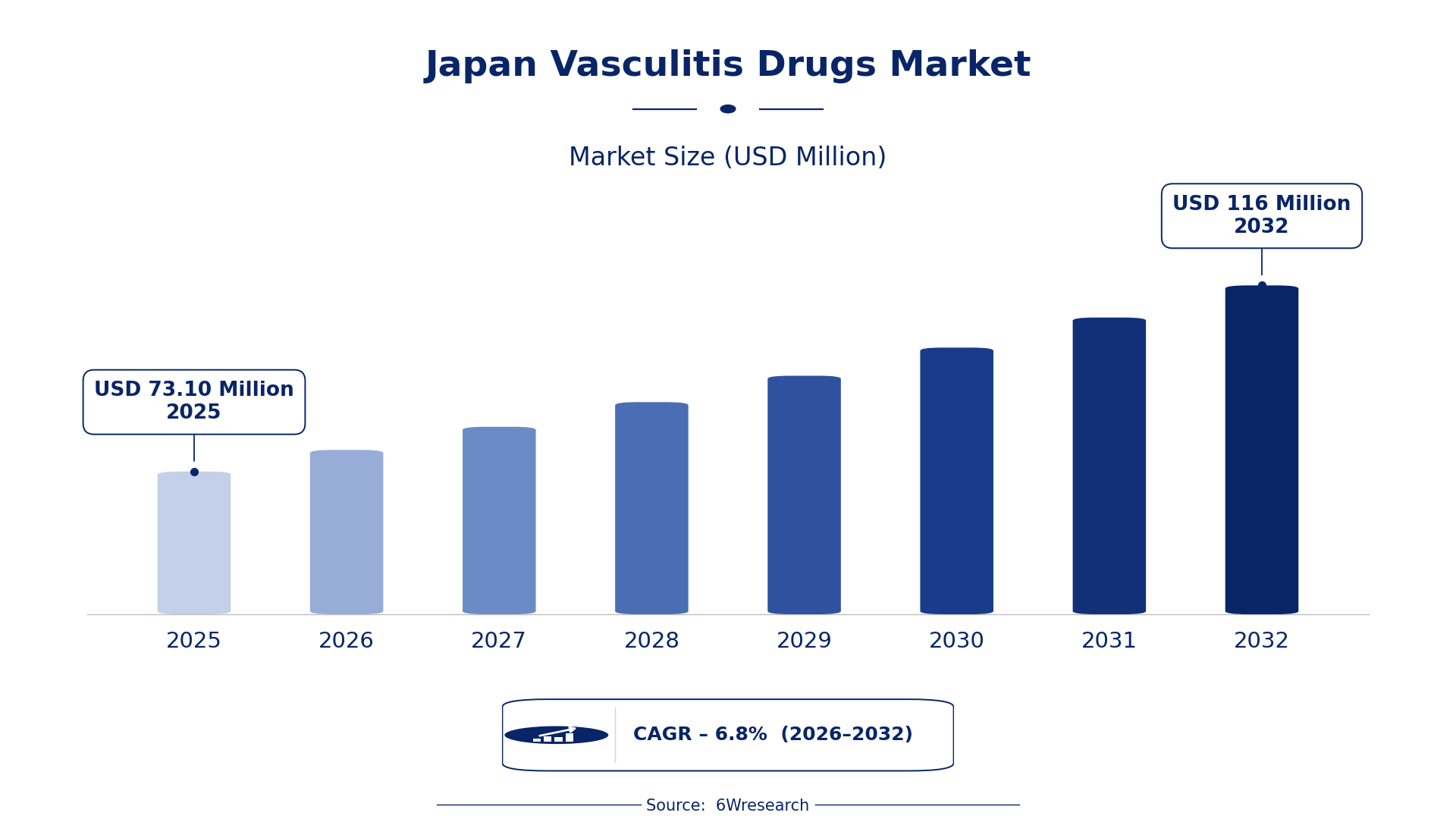
According to 6Wresearch internal database and industry insights, the Japan Vasculitis Drugs Market was valued at USD 73.10 Million in 2025 and is projected to reach USD 116 Million by 2032, growing at a CAGR of approximately 6.8% during 2026–2032.
Japan Vasculitis Drugs Market Highlights
| Report Metric | Details |
| Report Name | Japan Vasculitis Drugs Market (2026-2032) |
| Market Size 2025 | USD 73.10 Million |
| Market Size 2032 | USD 116 Million |
| Absolute Growth 2025–2032 | USD 42.90 Million |
| CAGR 2026–2032 | 6.8% |
| Peak Annual Growth | 7.3% in 2032 |
| Forecast Period | 2026–2032 |
| Historical Data | 2022–2025 |
| Base Year | 2025 |
| Leading Drug Type, 2025 | Corticosteroids (41% share) |
| Leading Administration Route, 2025 | Oral/IV (43% share) |
| Leading Disease Stage, 2025 | Acute Phase (53% share) |
| Leading End User, 2025 | Hospitals (50% share) |
| Fastest-Growing Drug Type | Immunosuppressants (10.0% CAGR) |
| Fastest-Growing Administration Route | Oral/Injectable (9.4% CAGR) |
| Fastest-Growing Disease Stage | Maintenance Therapy (9.6% CAGR) |
| Fastest-Growing End User | Rheumatology Clinics (9.2% CAGR) |
| Growing Sector | Healthcare |
| Key End Users | Hospitals, Rheumatology Clinics, Specialty Pharmacies |
Japan Vasculitis Drugs Market Year-wise Growth Rate and Key Drivers (2022–2032)
This graph illustrates the annual growth rates of the market from 2022 to 2032, highlighting a steady upward trajectory and projected market expansion over the forecast period.
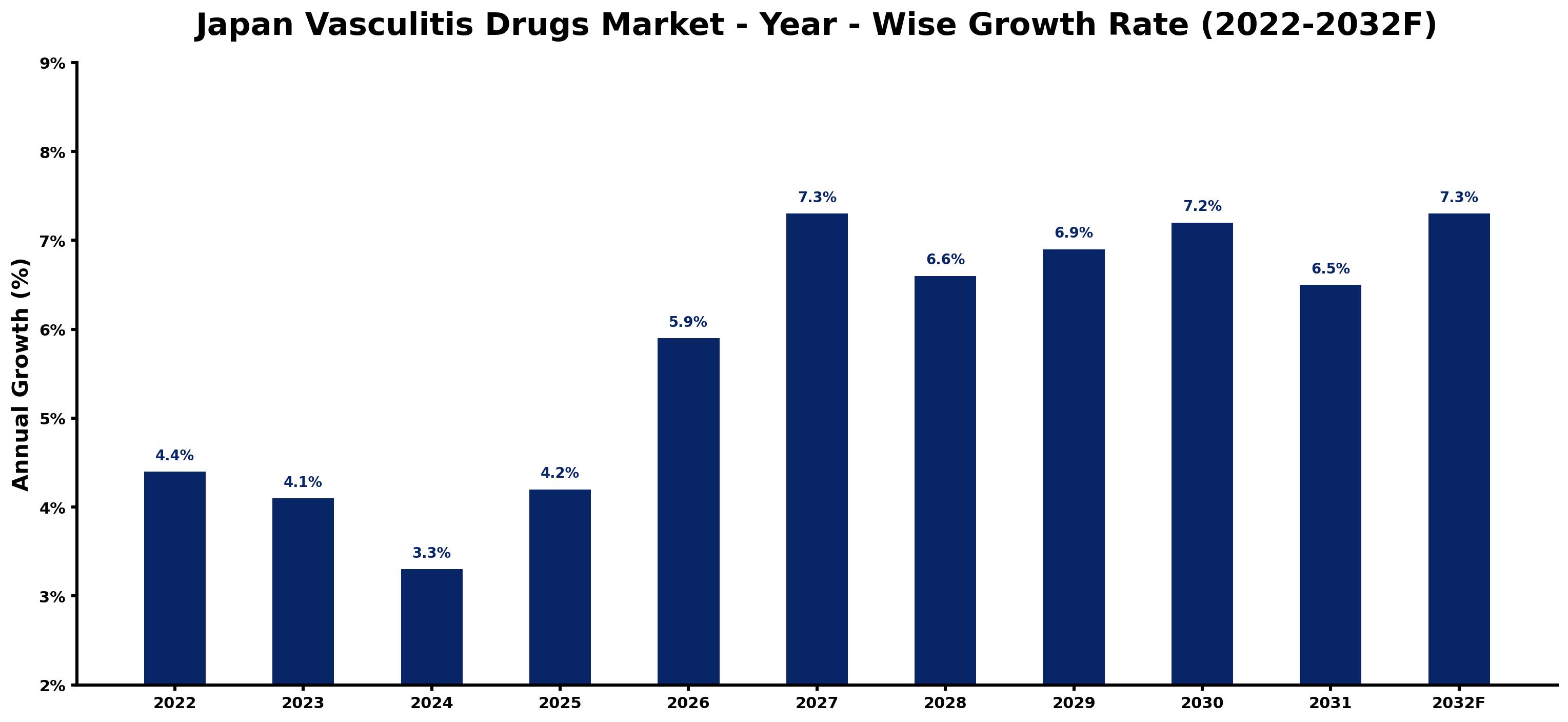
The following figures match every annual growth estimate with the main market development of that year, giving the reasoning behind each rise or slowdown.
| Year | Estimated Annual Growth (%) | Market Rationale |
| 2022 | 4.4 | The market experienced steady growth with strong demand from healthcare providers. |
| 2023 | 4.1 | Demand growth slowed as the market adjusted to previous high rates of expansion. |
| 2024 | 3.3 | A further slowdown occurred as competition intensified among treatment options. |
| 2025 | 4.2 | Growth accelerated again due to increased patient awareness and treatment access. |
| 2026 | 5.9 | The market is projected to grow faster as biologics gain wider acceptance. |
| 2027 | 7.3 | Demand is expected to peak as new therapies are introduced. |
| 2028 | 6.6 | Growth will slow slightly as the market stabilises after rapid expansion. |
| 2029 | 6.9 | An increase in patient numbers will drive growth as awareness improves. |
| 2030 | 7.2 | The market will continue to grow as treatment protocols evolve. |
| 2031 | 6.5 | Growth is expected to slow as market saturation begins to set in. |
| 2032 | 7.3 | The market will peak again as new therapies are introduced. |
Note: Market size estimations and growth projections presented in this report are based on 6Wresearch's proprietary forecasting methodology, utilizing the latest available industry data, government publications, and primary research inputs.
Japan Vasculitis Drugs Market Synopsis
Vasculitis drugs are immunosuppressive medications designed to treat inflammation of blood vessels, primarily used in managing autoimmune conditions. The Japan Vasculitis Drugs Market is growing due to an increasing population affected by autoimmune diseases and a rise in specialised healthcare facilities. In 2022, more than 50,000 patients were treated for vasculitis in hospitals, underscoring the demand for effective therapies. The adoption of biologics since 2019 has accelerated market expansion, with over 10,000 patients receiving these treatments annually, reflecting the ongoing evolution in available treatment options.
Market Dynamics Impact Analysis (2026–2032)
| Factor | Type | Impact | Primary Segment Affected |
| Rising prevalence of autoimmune diseases | Driver | High | Corticosteroids |
| Increased adoption of biologics | Driver | High | Biologics |
| Growing need for specialized care | Opportunity | High | Rheumatology Clinics |
| Expansion of specialty pharmacies | Opportunity | Medium | Specialty Pharmacies |
| High treatment costs | Restraint | High | Immunosuppressants |
| Limited access in rural areas | Restraint | Medium | Hospitals |
| Competition from alternative therapies | Challenge | High | Immunosuppressants |
| Regulatory hurdles for new treatments | Challenge | Medium | Biologics |
Evaluation of Drivers in Japan Vasculitis Drugs Market (2026–2032)
Key forces behind demand, with the segment each one moves most, are listed below.
| Drivers | Primary Segment Affected | Why It Matters (Evidence) |
| Increasing patient population | Corticosteroids | With approximately 126 million people in Japan, the demand for corticosteroids is rising as they are the first-line treatment for vasculitis. |
| Growing healthcare infrastructure | Biologics | The number of rheumatology clinics exceeds 2,000, improving access to biologics for over 10,000 patients annually. |
| Patient awareness programs | Immunosuppressants | Awareness initiatives have led to more patients seeking treatment, increasing the need for immunosuppressants. |
| Government support for rare disease treatments | Specialty Pharmacies | The 2021 program improving access to biologics has increased demand for specialty pharmacies. |
| Technological advancements in drug development | Biologics | Advancements in biopharmaceutical methods have improved the efficacy of biologics, attracting more patients. |
Several shifts outside the market lift sales. The increasing patient population in Japan drives demand for corticosteroids, which are the first-line treatment for vasculitis. The growing healthcare infrastructure, with over 2,000 rheumatology clinics, improves access to biologics, benefiting over 10,000 patients annually.
Evaluation of Restraints in Japan Vasculitis Drugs Market
The table below lists the restraints and the evidence behind each.
| Market Restraint | Primary Segment Affected | Why It Matters (Evidence) |
| High treatment costs | Immunosuppressants | The average annual cost of vasculitis treatment ranges from ¥500,000 to ¥1,500,000, limiting access for some patients. |
| Limited access in rural areas | Hospitals | Patients in rural regions face challenges accessing specialized care, impacting treatment availability. |
| Inconsistent treatment protocols | Corticosteroids | Variability in treatment protocols across facilities can lead to suboptimal patient outcomes. |
| Competition from alternative therapies | Immunosuppressants | The emergence of alternative treatments can divert patients from traditional immunosuppressants. |
| Regulatory hurdles for new treatments | Biologics | Stringent approval processes delay the introduction of new therapies, affecting market growth. |
Japan Vasculitis Drugs Market Challenges
Rheumatology clinics in Japan face a shortage of trained specialists, resulting in longer wait times for vasculitis patients. This shortage arises from inadequate training programmes, which delays patient care and intensifies pressure on existing healthcare providers. Buyers encounter high treatment costs, with annual expenses reaching ¥1,500,000 per patient, straining healthcare budgets. The lengthy drug approval process overseen by the Ministry of Health, Labour and Welfare can postpone new therapies, affecting patient access. Limited investment in drug development technologies constrains innovation, leading to fewer effective treatment options for patients in need.
Trends in the Japan Vasculitis Drugs Market
The following changes are redrawing the Japan Vasculitis Drugs Market.
- Shift in Treatment Protocols: Rheumatology clinics are increasingly adopting biologics since 2019, with over 50,000 patients treated annually. This shift reflects a growing preference for targeted therapies in managing vasculitis.
- Transition to Specialty Pharmacies: In 2023, the role of specialty pharmacies has expanded, managing complex medication regimens for vasculitis patients. This trend supports over 50,000 patients treated annually.
- Emergence of Maintenance Therapy: The focus has shifted towards maintenance therapy for vasculitis patients, with a CAGR of 9.6% expected from 2026 to 2032. This trend is driven by the need for long-term disease control.
- Prioritisation of Patient Education: Patient education initiatives have gained traction since 2021, improving treatment adherence. Awareness programmes are essential for managing over 50,000 patients annually.
Investment Opportunities in the Japan Vasculitis Drugs Market
Several openings in the Japan Vasculitis Drugs Market merit attention from investors.
- Rheumatology Clinics Expansion: Rheumatology clinics are expanding their services to meet the rising demand for vasculitis treatments. With over 2,000 clinics in Japan, there is an opportunity to invest in specialised care.
- Investment in Specialty Pharmacies: Specialty pharmacies are critical for managing complex medication regimens, making this an opportune time to invest in their services. With over 50,000 patients treated annually, the demand is strong.
- Launch of New Biologics: The introduction of new biologics presents an opportunity for suppliers to meet increasing demand. The 2021 programme improving access to these treatments highlights the need for effective solutions.
- Development of Cost-Effective Treatments: There is a pressing need for cost-effective vasculitis treatments, especially given the average annual treatment cost of ¥500,000 to ¥1,500,000. Investing in affordable options can attract a larger patient base.
Government Initiatives in the Japan Vasculitis Drugs Market
The NHI drug price standard, revised regularly, sets reimbursement prices for vasculitis drugs, ensuring that patients have access to necessary treatments. This complements the Clinical Trials Act of 2017, which establishes rules for clinical research, facilitating the development of new therapies.
The PMDA oversees the implementation of the NHI drug price standard, ensuring that hospitals can afford to provide vasculitis treatments. This framework supports healthcare providers in managing over 50,000 patients treated annually.
Future Insight of the Japan Vasculitis Drugs Market
By 2032, a policy-driven shift will improve access to biologics for rare diseases, leading to changes in treatment protocols. This will prompt specialty pharmacies to expand their services, providing better patient management. The adoption of ISO 9001 standards in pharmaceutical manufacturing will ensure higher quality and safety in drug production. With over 10,000 patients receiving biologics annually, the focus on advanced treatment options will likely improve patient outcomes and drive demand for new therapies.
Market Segmentation Analysis
Japan Vasculitis Drugs Market report covers a detailed analysis of the following market segments:
By Drug Type – Corticosteroids Lead, Immunosuppressants Expected to Grow Fastest
According to Saurav Kr Singh, Senior Research Analyst at 6Wresearch, in 2025, Corticosteroids led the drug type split with a 41% share. Corticosteroids hold the largest market share due to their established role as the first-line treatment for acute inflammation in vasculitis. Their effectiveness is evidenced by the treatment of over 50,000 patients annually in hospitals across Japan. Immunosuppressants are set to record the highest CAGR in this split, 10.0% over 2026–2032. Immunosuppressants are experiencing rapid growth as they are essential for the long-term management of vasculitis, reflecting a shift towards comprehensive treatment strategies. The increasing number of patients requiring ongoing therapy is propelling this segment's expansion. Suppliers should focus on improving the availability of immunosuppressants to address the rising demand for long-term management of vasculitis.
By Administration Route – Oral/IV Leads, Oral/Injectable Expected to Grow Fastest
The largest administration route category in 2025 was Oral/IV, at 43% of revenue. The Oral/IV route is prevalent as it is commonly employed for drug administration in acute situations, ensuring rapid therapeutic effects for patients. This method aligns with treatment protocols established by the Japanese Society of Rheumatology, reinforcing its importance. Oral/Injectable is projected to grow fastest, at a CAGR of 9.4% during 2026–2032. Oral/Injectable routes are gaining traction due to their convenience, facilitating easier self-administration and adherence to treatment regimens. This trend is critical as healthcare providers aim to improve patient compliance and overall treatment outcomes. Suppliers may need to invest in developing more injectable formulations to meet the preferences of patients and healthcare providers.
By Disease Stage – Acute Phase Leads, Maintenance Therapy Expected to Grow Fastest
Acute Phase held 53% of the Japan Vasculitis Drugs Market by disease stage in 2025. The Acute Phase leads the market as it signifies a critical stage necessitating immediate intervention to prevent severe complications from vasculitis. The urgency of treatment in hospitals for acute cases underscores the significance of this segment. Over 2026–2032, Maintenance Therapy is expected to post the fastest growth, at a CAGR of 9.6%. Maintenance Therapy is rapidly growing as it is crucial for long-term disease control, indicating a trend towards more effective management of chronic conditions. As more patients transition to this stage, the demand for maintenance therapies is expected to increase. Suppliers should prioritise the development of effective maintenance therapies to support long-term outcomes in vasculitis management.
By End User – Hospitals Lead, Rheumatology Clinics Expected to Grow Fastest
Hospitals took 50% of end user revenue in 2025, more than any other category. Hospitals are the primary setting for acute treatment of vasculitis, which explains their leading market share. With over 50,000 patients treated annually, hospitals play a vital role in providing immediate care for these individuals. The quickest growth will come from Rheumatology Clinics, forecast to expand at a CAGR of 9.2% between 2026 and 2032. Rheumatology Clinics are experiencing the fastest growth as they offer specialised care tailored to vasculitis patients, reflecting a broader trend towards specialised healthcare services. The increasing number of rheumatology clinics enhances access to expert treatment for patients. Suppliers should consider partnerships with rheumatology clinics to ensure their products are accessible in these specialised care environments.
Key Attractiveness of the Report
- 10 Years of Market Numbers
- Historical Data Starting from 2022 to 2025
- Base Year 2025
- Forecast Data until 2032
- Key Performance Indicators Impacting the Market
- Major Upcoming Developments and Projects
Key Highlights of the Report:
- Japan Vasculitis Drugs Market Outlook
- Market Size of Japan Vasculitis Drugs Market, 2025
- Forecast of Japan Vasculitis Drugs Market, 2032
- Historical Data and Forecast of Japan Vasculitis Drugs Revenues & Volume for the Period 2022-2032F
- Japan Vasculitis Drugs Market Trend Evolution
- Japan Vasculitis Drugs Market Drivers and Challenges
- Japan Vasculitis Drugs Price Trends
- Japan Vasculitis Drugs Porter's Five Forces
- Japan Vasculitis Drugs Industry Life Cycle
- Historical Data and Forecast of Japan Vasculitis Drugs Market Revenues & Volume By Drug Type for the Period 2022-2032F
- Historical Data and Forecast of Japan Vasculitis Drugs Market Revenues & Volume By Corticosteroids for the Period 2022-2032F
- Historical Data and Forecast of Japan Vasculitis Drugs Market Revenues & Volume By Immunosuppressants for the Period 2022-2032F
- Historical Data and Forecast of Japan Vasculitis Drugs Market Revenues & Volume By Biologics for the Period 2022-2032F
- Historical Data and Forecast of Japan Vasculitis Drugs Market Revenues & Volume By NSAIDs for the Period 2022-2032F
- Historical Data and Forecast of Japan Vasculitis Drugs Market Revenues & Volume By Administration Route for the Period 2022-2032F
- Historical Data and Forecast of Japan Vasculitis Drugs Market Revenues & Volume By Oral/IV for the Period 2022-2032F
- Historical Data and Forecast of Japan Vasculitis Drugs Market Revenues & Volume By Oral/Injectable for the Period 2022-2032F
- Historical Data and Forecast of Japan Vasculitis Drugs Market Revenues & Volume By IV/Subcutaneous for the Period 2022-2032F
- Historical Data and Forecast of Japan Vasculitis Drugs Market Revenues & Volume By Oral for the Period 2022-2032F
- Historical Data and Forecast of Japan Vasculitis Drugs Market Revenues & Volume By Disease Stage for the Period 2022-2032F
- Historical Data and Forecast of Japan Vasculitis Drugs Market Revenues & Volume By Acute Phase for the Period 2022-2032F
- Historical Data and Forecast of Japan Vasculitis Drugs Market Revenues & Volume By Maintenance Therapy for the Period 2022-2032F
- Historical Data and Forecast of Japan Vasculitis Drugs Market Revenues & Volume By Refractory Cases for the Period 2022-2032F
- Historical Data and Forecast of Japan Vasculitis Drugs Market Revenues & Volume By Mild Symptoms for the Period 2022-2032F
- Historical Data and Forecast of Japan Vasculitis Drugs Market Revenues & Volume By End User for the Period 2022-2032F
- Historical Data and Forecast of Japan Vasculitis Drugs Market Revenues & Volume By Hospitals for the Period 2022-2032F
- Historical Data and Forecast of Japan Vasculitis Drugs Market Revenues & Volume By Rheumatology Clinics for the Period 2022-2032F
- Historical Data and Forecast of Japan Vasculitis Drugs Market Revenues & Volume By Specialty Pharmacies for the Period 2022-2032F
- Historical Data and Forecast of Japan Vasculitis Drugs Market Revenues & Volume By Outpatient Settings for the Period 2022-2032F
- Japan Vasculitis Drugs Import Export Trade Statistics
- Market Opportunity Assessment By Drug Type
- Market Opportunity Assessment By Administration Route
- Market Opportunity Assessment By Disease Stage
- Market Opportunity Assessment By End User
- Japan Vasculitis Drugs Top Companies Market Share
- Japan Vasculitis Drugs Competitive Benchmarking By Technical and Operational Parameters
- Japan Vasculitis Drugs Company Profiles
- Japan Vasculitis Drugs Key Strategic Recommendations
Market Covered
The study includes the following segmentation.
By Drug Type
- Corticosteroids
- Immunosuppressants
- Biologics
- NSAIDs
By Administration Route
- Oral/IV
- Oral/Injectable
- IV/Subcutaneous
- Oral
By Disease Stage
- Acute Phase
- Maintenance Therapy
- Refractory Cases
- Mild Symptoms
By End User
- Hospitals
- Rheumatology Clinics
- Specialty Pharmacies
- Outpatient Settings































