Japan VDI Market Size & Growth Rate
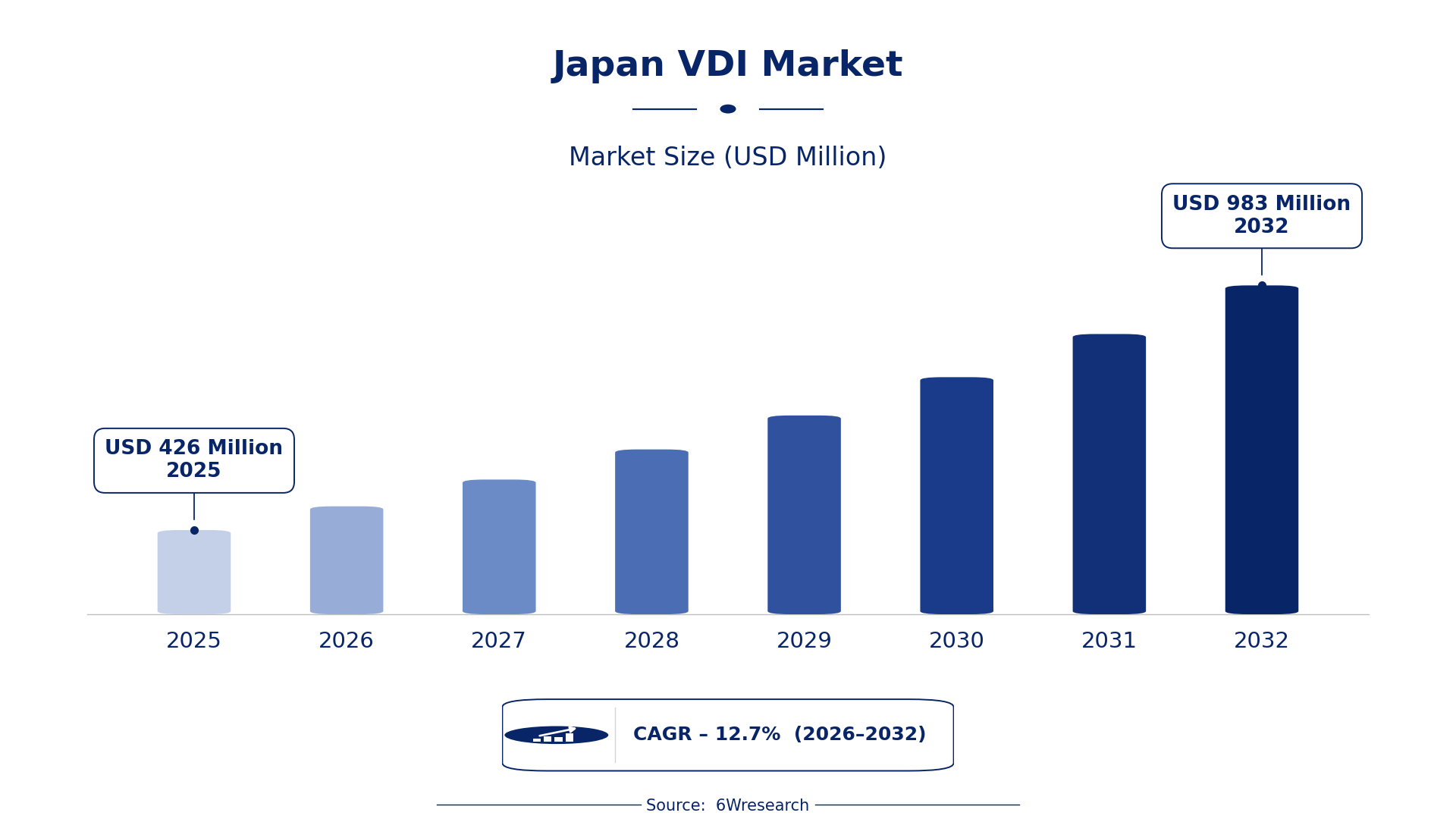
According to 6Wresearch internal database and industry insights, the Japan VDI Market was valued at USD 426 Million in 2025 and is projected to reach USD 983 Million by 2032, growing at a CAGR of approximately 12.7% during 2026–2032.
Japan VDI Market Highlights
| Report Metric | Details |
| Report Name | Japan VDI Market (2026-2032) |
| Market Size 2025 | USD 426 Million |
| Market Size 2032 | USD 983 Million |
| Absolute Growth 2025–2032 | USD 557 Million |
| CAGR 2026–2032 | 12.7% |
| Peak Annual Growth | 14.5% in 2032 |
| Forecast Period | 2026–2032 |
| Historical Data | 2022–2025 |
| Base Year | 2025 |
| Leading Deployment Model, 2025 | On-Premises VDI (45% share) |
| Leading Device Access Type, 2025 | Thin Clients (48% share) |
| Leading Use Case, 2025 | Secure Access (34% share) |
| Leading End User, 2025 | Corporates (39% share) |
| Fastest-Growing Deployment Model | Cloud-Based VDI (18.6% CAGR) |
| Fastest-Growing Device Access Type | Mobile/Desktop (19.1% CAGR) |
| Fastest-Growing Use Case | Remote Work (17.2% CAGR) |
| Fastest-Growing End User | IT Enterprises (16.5% CAGR) |
| Growing Sector | IT and Corporate Sectors |
| Key End Users | Corporates, IT Enterprises, Government Agencies, Managed Service Providers |
Japan VDI Market Year-wise Growth Rate and Key Drivers (2022–2032)
This graph illustrates the annual growth rates of the market from 2022 to 2032, highlighting a steady upward trajectory and projected market expansion over the forecast period.
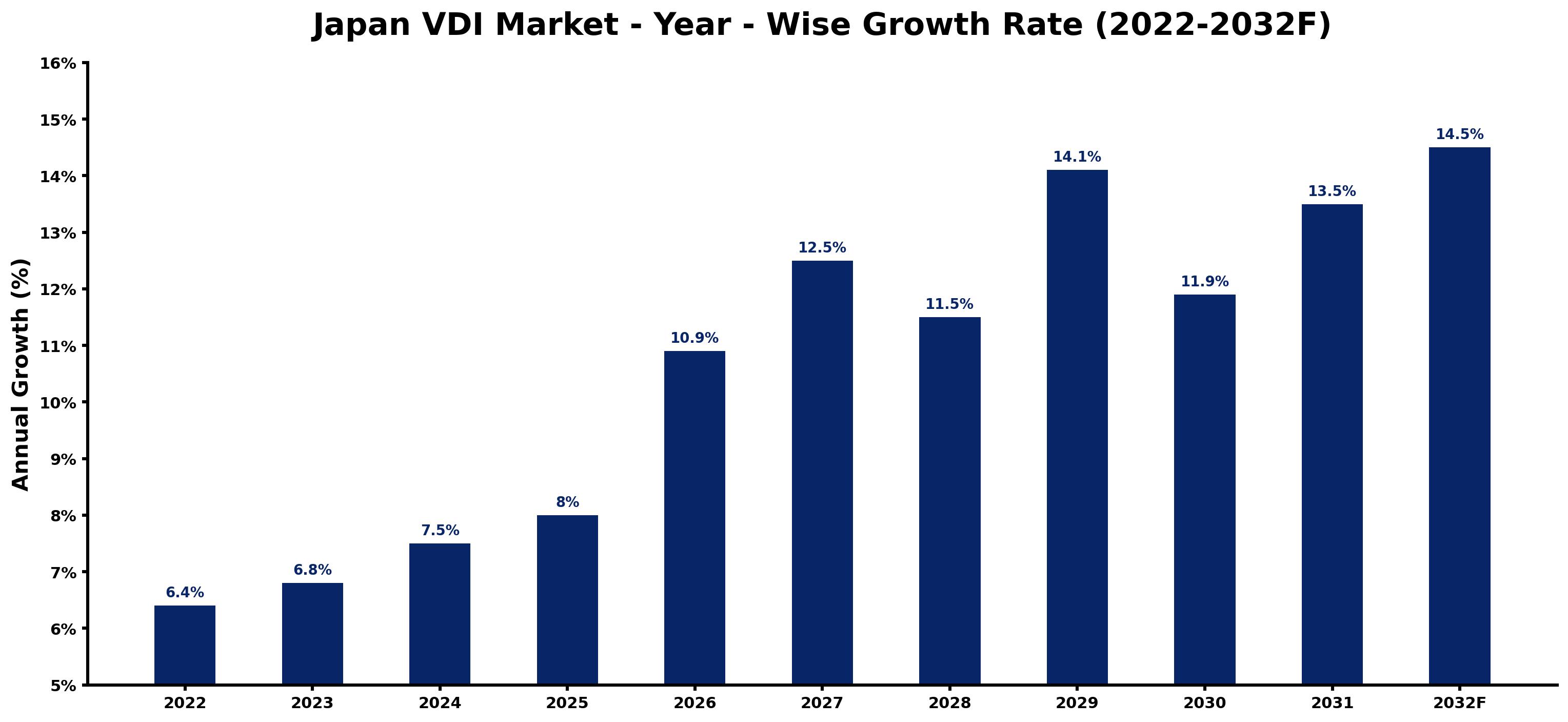
The yearly estimates that follow link every growth rate to its principal driver, so readers can see why the pace changed in each period.
| Year | Estimated Annual Growth (%) | Market Rationale |
| 2022 | 6.4 | Remote work policies were increasingly adopted by large corporations, driving demand for VDI solutions. |
| 2023 | 6.8 | The number of remote workers reached 8 million, boosting the need for virtual desktop solutions. |
| 2024 | 7.5 | Cloud-Based VDI adoption accelerated among SMEs, improving flexibility and scalability for users. |
| 2025 | 8.0 | The Tokyo metropolitan area emerged as a major hub for VDI adoption, supporting corporate needs. |
| 2026 | 10.9 | The government launched a program to improve cybersecurity in remote work environments, increasing demand. |
| 2027 | 12.5 | IT enterprises continued to expand their use of VDI solutions, reflecting a growing trend in the sector. |
| 2028 | 11.5 | The market experienced a slight slowdown in growth as adoption reached maturity among key sectors. |
| 2029 | 14.1 | Remote work remained a priority for many organizations, sustaining demand for VDI solutions. |
| 2030 | 11.9 | Cybersecurity concerns continued to drive investments in VDI technologies across various industries. |
| 2031 | 13.5 | The number of Managed Service Providers offering VDI solutions increased, boosting market competition. |
| 2032 | 14.5 | Investment in digital transformation initiatives is expected to peak, further driving VDI adoption. |
Note: Market size estimations and growth projections presented in this report are based on 6Wresearch's proprietary forecasting methodology, utilizing the latest available industry data, government publications, and primary research inputs.
Japan VDI Market Synopsis
Virtual Desktop Infrastructure (VDI) allows users to access desktop environments hosted on remote servers through virtualization software. In Japan, corporate users, especially in IT and large enterprises, are driving the demand for VDI as they seek secure access to resources and solutions for remote work. The number of remote workers reached 8 million in 2023, while government initiatives are enhancing cybersecurity in remote environments. This combination is propelling the Japan VDI Market towards growth, with a projected size of USD 983 million by 2032.
Market Dynamics Impact Analysis (2026–2032)
| Factor | Type | Impact | Primary Segment Affected |
| Increased remote work policies among large corporations | Driver | High | Remote Work |
| Growing adoption of Cloud-Based VDI solutions among SMEs | Driver | High | Cloud-Based VDI |
| Expansion of cybersecurity initiatives by the government | Opportunity | High | Secure Access |
| Rising number of Managed Service Providers offering VDI solutions | Opportunity | Medium | DaaS (Desktop-as-Service) |
| Concerns over data security in remote work environments | Restraint | High | Secure Access |
| Limited awareness of VDI benefits among smaller enterprises | Restraint | Medium | Cloud-Based VDI |
| High initial costs associated with VDI implementation | Challenge | High | On-Premises VDI |
| Rapid technological changes requiring constant updates | Challenge | Medium | Hybrid VDI |
Evaluation of Drivers in Japan VDI Market (2026–2032)
Key forces behind demand, with the segment each one moves most, are listed below.
| Drivers | Primary Segment Affected | Why It Matters (Evidence) |
| Increased remote work policies | Remote Work | The adoption of remote work policies by 70% of large corporations has driven demand for VDI solutions, facilitating secure access to corporate resources. |
| Growing adoption of Cloud-Based VDI solutions | Cloud-Based VDI | Cloud-Based VDI solutions are increasingly adopted by SMEs, allowing them to scale operations efficiently and reduce costs. |
| Expansion of cybersecurity initiatives | Secure Access | The government's program to improve cybersecurity in remote work environments is prompting businesses to invest in secure VDI solutions. |
| Rising number of Managed Service Providers | DaaS (Desktop-as-Service) | With over 1,200 registered Managed Service Providers, the market is seeing increased competition and innovation in VDI offerings. |
| High number of IT enterprises utilizing VDI | On-Premises VDI | Over 2,000 IT enterprises in Japan are using VDI solutions to improve operational flexibility and security. |
The rise in remote workers to 8 million in 2023 has intensified the need for secure access to corporate resources. An estimated 2,000 IT enterprises are utilising VDI, indicating a strong shift towards virtualised environments. The Tokyo metropolitan area serves as a key hub for VDI adoption, boosting the overall market.
Evaluation of Restraints in Japan VDI Market
These are the pressures that could keep growth below its potential.
| Market Restraint | Primary Segment Affected | Why It Matters (Evidence) |
| Concerns over data security | Secure Access | Data security remains a concern, impacting the adoption of VDI solutions among corporations due to potential breaches. |
| Limited awareness of VDI benefits | Cloud-Based VDI | Many smaller enterprises lack awareness of the advantages of VDI, hindering broader adoption of cloud-based solutions. |
| High initial costs of implementation | On-Premises VDI | The upfront costs associated with On-Premises VDI deter some organizations from investing in these solutions. |
| Complexity of managing hybrid environments | Hybrid VDI | Managing hybrid VDI environments can be complex, leading to potential operational inefficiencies for businesses. |
| Lack of skilled professionals in VDI technology | DaaS (Desktop-as-Service) | A shortage of skilled professionals limits producers' capacity to deliver solutions, resulting in project delays. |
Japan VDI Market Challenges
Initial investments for VDI implementation can exceed ¥5 million, burdening SMEs that struggle to allocate funds for setup and infrastructure. Competition among over 1,200 Managed Service Providers drives down prices, which can compromise service quality and reliability for corporate users. Regulatory compliance with JIS X 6005 increases costs for producers, forcing them to invest in security measures that can delay project timelines by up to six months. A shortage of skilled professionals in VDI technology limits producers' capacity to deliver solutions, resulting in project delays that can extend beyond a year for end users.
Trends in the Japan VDI Market
Several trends are reshaping the Japan VDI Market; the most important are set out below.
- Growth of Cloud-Based VDI Solutions: In 2023, Cloud-Based VDI solutions gained traction among SMEs, with adoption rates increasing to 30%. This shift allows businesses to scale operations and reduce costs, reflecting a broader trend in digital transformation.
- Focus on Cybersecurity Improvements: The government launched a program in 2023 to improve cybersecurity in remote work environments. This initiative has led to increased investments in secure VDI solutions, ensuring data protection for users.
- Adoption of Remote Work Policies: Since 2022, remote work policies have been adopted by 70% of large corporations, driving demand for VDI solutions. This trend highlights the importance of secure access to corporate resources.
- Growth of Managed Service Providers: The number of Managed Service Providers offering VDI solutions has grown substantially, with over 1,200 registered in Japan. This emergence is fostering competition and innovation in the VDI market.
Investment Opportunities in the Japan VDI Market
Below are the investment opportunities with the strongest case in the Japan VDI Market.
- Tokyo Metropolitan Area: The Tokyo metropolitan area is a major hub for VDI adoption, with a growing number of corporations seeking secure access solutions. Investment in VDI infrastructure is essential for meeting this demand.
- Collaboration with Managed Service Providers: Partnering with Managed Service Providers can facilitate entry into the VDI market. These collaborations can improve service delivery and expand market reach for new entrants.
- Investment in Cybersecurity Solutions: With the government's allocation of ¥10 billion for digital transformation initiatives, there is an opportunity to supply cybersecurity solutions for VDI environments.
- Focus on IT Enterprises: IT enterprises represent a major user group for VDI solutions, with over 2,000 utilizing these technologies. Targeting this sector can yield substantial returns on investment.
Government Initiatives in the Japan VDI Market
The Digital Agency, established in September 2021, is leading government digital transformation efforts, including VDI initiatives. The agency promotes common system standards and supports various sectors in adopting VDI technologies, ensuring compliance with relevant standards such as JIS X 6005.
In 2023, the government allocated ¥10 billion for digital transformation initiatives, including VDI solutions. The Ministry of Internal Affairs and Communications oversees these efforts, funding projects that improve cybersecurity and promote the adoption of VDI among government agencies.
Future Insight of the Japan VDI Market
Investment in digital transformation initiatives will surpass ¥10 billion by 2032, generating demand for VDI solutions. New cybersecurity programmes will strengthen the security of remote work environments, prompting more businesses to adopt VDI. The adoption of ISO/IEC 27001 standards will standardise security practices, benefiting both suppliers and users. As the number of remote workers is projected to increase to 12 million, suppliers must prepare to address the needs of this growing workforce.
Market Segmentation Analysis
Japan VDI Market report covers a detailed analysis of the following market segments:
By Deployment Model – On-Premises VDI Leads, Cloud-Based VDI Expected to Grow Fastest
According to Saurav Kr Singh, Senior Research Analyst at 6Wresearch, On-Premises VDI took 45% of deployment model revenue in 2025, more than any other category. On-Premises VDI commands the largest share because it is favoured by large corporations that require secure and controlled environments for sensitive data. Many organisations in the Tokyo metropolitan area implement this model to ensure robust data protection measures are effectively maintained. The quickest growth will come from Cloud-Based VDI, forecast to expand at a CAGR of 18.6% between 2026 and 2032. Cloud-Based VDI is experiencing rapid growth as SMEs increasingly adopt these solutions for their flexibility and scalability, bolstered by government support for digital transformation initiatives. The ¥10 billion allocated in 2023 has played a crucial role in accelerating this trend. Suppliers should enhance cloud-based offerings to effectively target the expanding SME market.
By Device Access Type – Thin Clients Lead, Mobile/Desktop Expected to Grow Fastest
With 48% of device access type revenue in 2025, Thin Clients was the largest category. Thin Clients dominate the market as they are commonly used for accessing VDI environments, providing a cost-effective solution for corporates. Their simplicity and efficiency make them the preferred choice for many organisations in Japan. Mobile/Desktop is projected to grow fastest, at a CAGR of 19.1% during 2026–2032. Mobile/Desktop access is growing quickly as remote work becomes essential, with 8 million remote workers in Japan relying on these devices for connectivity. This trend is likely to continue as remote work policies gain traction across various sectors. Buyers must ensure compatibility of their VDI solutions with mobile and desktop devices to support remote work effectively.
By Use Case – Secure Access Leads, Remote Work Expected to Grow Fastest
In 2025, Secure Access led the use case split with a 34% share. Secure Access leads the use case segment due to its essential role in safeguarding sensitive information, particularly in sectors that prioritise data security. The adoption of standards such as JIS X 6005 highlights the focus on maintaining secure VDI environments. Remote Work is set to record the highest CAGR in this split, 17.2% over 2026–2032. Remote Work is the fastest-growing use case, driven by the rising demand for work-from-home arrangements, with 70% of large corporations adopting remote work policies. This trend is likely to persist as more organisations embrace flexible working models. Suppliers should focus on features that enhance remote work capabilities to address the rising demand.
By End User – Corporates Lead, IT Enterprises Expected to Grow Fastest
The largest end user category in 2025 was Corporates, at 39% of revenue. Corporates constitute the largest segment of VDI users, necessitating comprehensive solutions for managing extensive workforces and sensitive data. The average corporate user base of approximately 500 employees underscores the scale at which these organisations operate. Over 2026–2032, IT Enterprises are expected to post the fastest growth, at a CAGR of 16.5%. IT Enterprises represent the fastest-growing end user group, propelled by their need for flexibility and quick deployment of VDI solutions. With over 2,000 IT enterprises currently utilising VDI, this segment is poised for further expansion. Suppliers should tailor their offerings to meet the specific needs of IT enterprises, emphasising flexibility and rapid deployment.
Key Attractiveness of the Report
- 10 Years of Market Numbers
- Historical Data Starting from 2022 to 2025
- Base Year 2025
- Forecast Data until 2032
- Key Performance Indicators Impacting the Market
- Major Upcoming Developments and Projects
Key Highlights of the Report:
- Japan VDI Market Outlook
- Market Size of Japan VDI Market, 2025
- Forecast of Japan VDI Market, 2032
- Historical Data and Forecast of Japan VDI Revenues & Volume for the Period 2022-2032F
- Japan VDI Market Trend Evolution
- Japan VDI Market Drivers and Challenges
- Japan VDI Price Trends
- Japan VDI Porter's Five Forces
- Japan VDI Industry Life Cycle
- Historical Data and Forecast of Japan VDI Market Revenues & Volume By Deployment Model for the Period 2022-2032F
- Historical Data and Forecast of Japan VDI Market Revenues & Volume By On-Premises VDI for the Period 2022-2032F
- Historical Data and Forecast of Japan VDI Market Revenues & Volume By Cloud-Based VDI for the Period 2022-2032F
- Historical Data and Forecast of Japan VDI Market Revenues & Volume By Hybrid VDI for the Period 2022-2032F
- Historical Data and Forecast of Japan VDI Market Revenues & Volume By DaaS (Desktop-as-Service) for the Period 2022-2032F
- Historical Data and Forecast of Japan VDI Market Revenues & Volume By Device Access Type for the Period 2022-2032F
- Historical Data and Forecast of Japan VDI Market Revenues & Volume By Thin Clients for the Period 2022-2032F
- Historical Data and Forecast of Japan VDI Market Revenues & Volume By Mobile/Desktop for the Period 2022-2032F
- Historical Data and Forecast of Japan VDI Market Revenues & Volume By BYOD Devices for the Period 2022-2032F
- Historical Data and Forecast of Japan VDI Market Revenues & Volume By Subscription for the Period 2022-2032F
- Historical Data and Forecast of Japan VDI Market Revenues & Volume By Use Case for the Period 2022-2032F
- Historical Data and Forecast of Japan VDI Market Revenues & Volume By Secure Access for the Period 2022-2032F
- Historical Data and Forecast of Japan VDI Market Revenues & Volume By Remote Work for the Period 2022-2032F
- Historical Data and Forecast of Japan VDI Market Revenues & Volume By Disaster Recovery for the Period 2022-2032F
- Historical Data and Forecast of Japan VDI Market Revenues & Volume By SMBs for the Period 2022-2032F
- Historical Data and Forecast of Japan VDI Market Revenues & Volume By End User for the Period 2022-2032F
- Historical Data and Forecast of Japan VDI Market Revenues & Volume By Corporates for the Period 2022-2032F
- Historical Data and Forecast of Japan VDI Market Revenues & Volume By IT Enterprises for the Period 2022-2032F
- Historical Data and Forecast of Japan VDI Market Revenues & Volume By Government Agencies for the Period 2022-2032F
- Historical Data and Forecast of Japan VDI Market Revenues & Volume By Managed Service Providers for the Period 2022-2032F
- Japan VDI Import Export Trade Statistics
- Market Opportunity Assessment By Deployment Model
- Market Opportunity Assessment By Device Access Type
- Market Opportunity Assessment By Use Case
- Market Opportunity Assessment By End User
- Japan VDI Top Companies Market Share
- Japan VDI Competitive Benchmarking By Technical and Operational Parameters
- Japan VDI Company Profiles
- Japan VDI Key Strategic Recommendations
Market Covered
Segments analysed in this report are listed below.
By Deployment Model
- On-Premises VDI
- Cloud-Based VDI
- Hybrid VDI
- DaaS (Desktop-as-Service)
By Device Access Type
- Thin Clients
- Mobile/Desktop
- BYOD Devices
- Subscription
By Use Case
- Secure Access
- Remote Work
- Disaster Recovery
- SMBs
By End User
- Corporates
- IT Enterprises
- Government Agencies
- Managed Service Providers































