Japan Vector-Borne Disease Diagnostics Market Size & Growth Rate
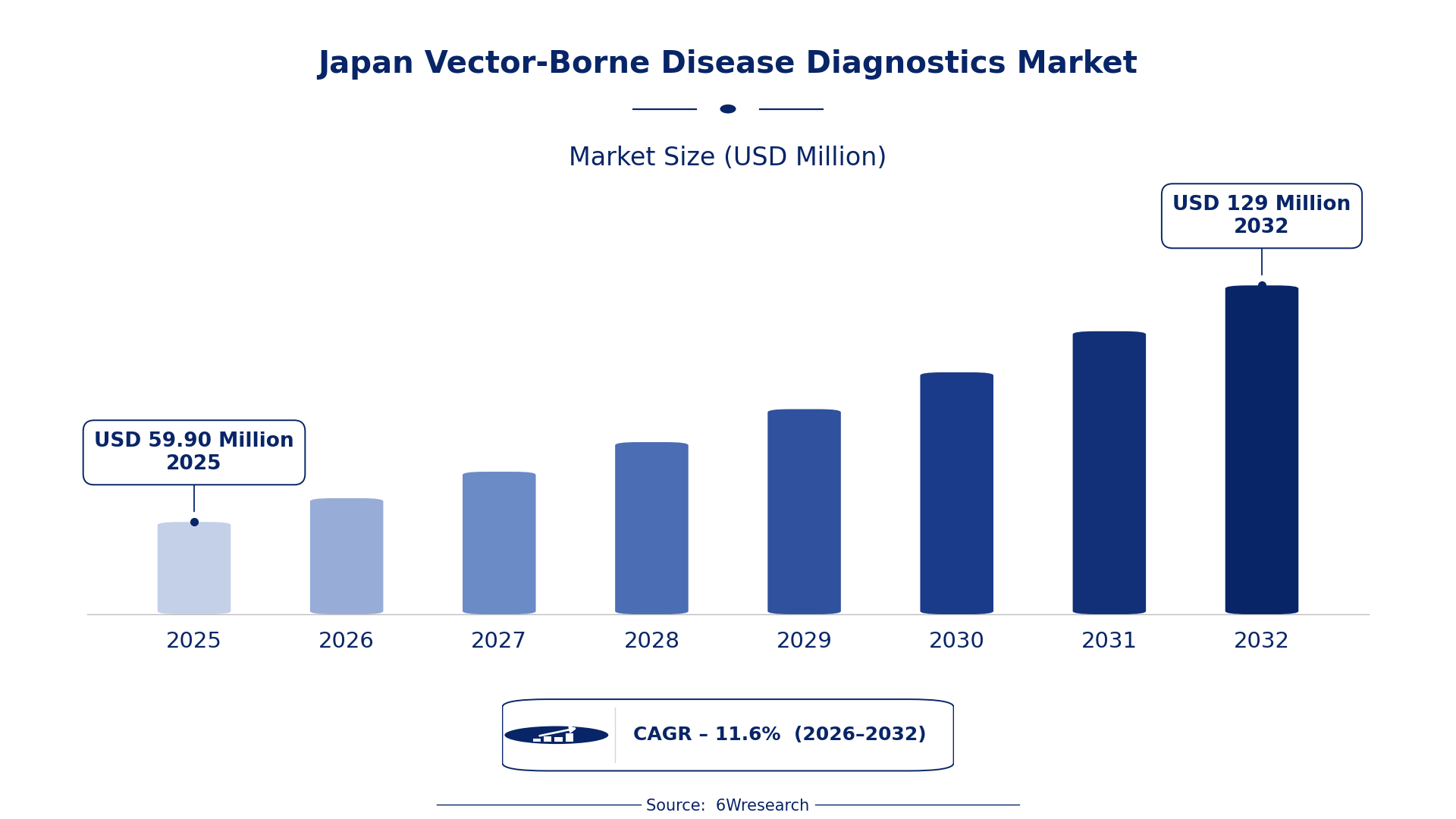
According to 6Wresearch internal database and industry insights, the Japan Vector-Borne Disease Diagnostics Market was valued at USD 59.90 Million in 2025 and is projected to reach USD 129 Million by 2032, growing at a CAGR of approximately 11.6% during 2026–2032.
Japan Vector-Borne Disease Diagnostics Market Highlights
| Report Metric | Details |
| Report Name | Japan Vector-Borne Disease Diagnostics Market (2026-2032) |
| Market Size 2025 | USD 59.90 Million |
| Market Size 2032 | USD 129 Million |
| Absolute Growth 2025–2032 | USD 69.10 Million |
| CAGR 2026–2032 | 11.6% |
| Peak Annual Growth | 13.3% in 2032 |
| Forecast Period | 2026–2032 |
| Historical Data | 2022–2025 |
| Base Year | 2025 |
| Leading Disease Type, 2025 | Malaria (40% share) |
| Leading Test Type, 2025 | Rapid Diagnostic Test (40% share) |
| Leading Sample Type, 2025 | Blood (42% share) |
| Leading End User, 2025 | Primary Health Clinics (44% share) |
| Fastest-Growing Disease Type | Dengue (16.4% CAGR) |
| Fastest-Growing Test Type | PCR/ELISA (16.9% CAGR) |
| Fastest-Growing Sample Type | Serum/Plasma (17.4% CAGR) |
| Fastest-Growing End User | Pathology Labs (15.1% CAGR) |
| Growing Sector | Pathology Labs |
| Key End Users | Primary Health Clinics, Pathology Labs, Hospitals, Travel Clinics |
Japan Vector-Borne Disease Diagnostics Market Year-wise Growth Rate and Key Drivers (2022–2032)
This graph illustrates the annual growth rates of the market from 2022 to 2032, highlighting a steady upward trajectory and projected market expansion over the forecast period.
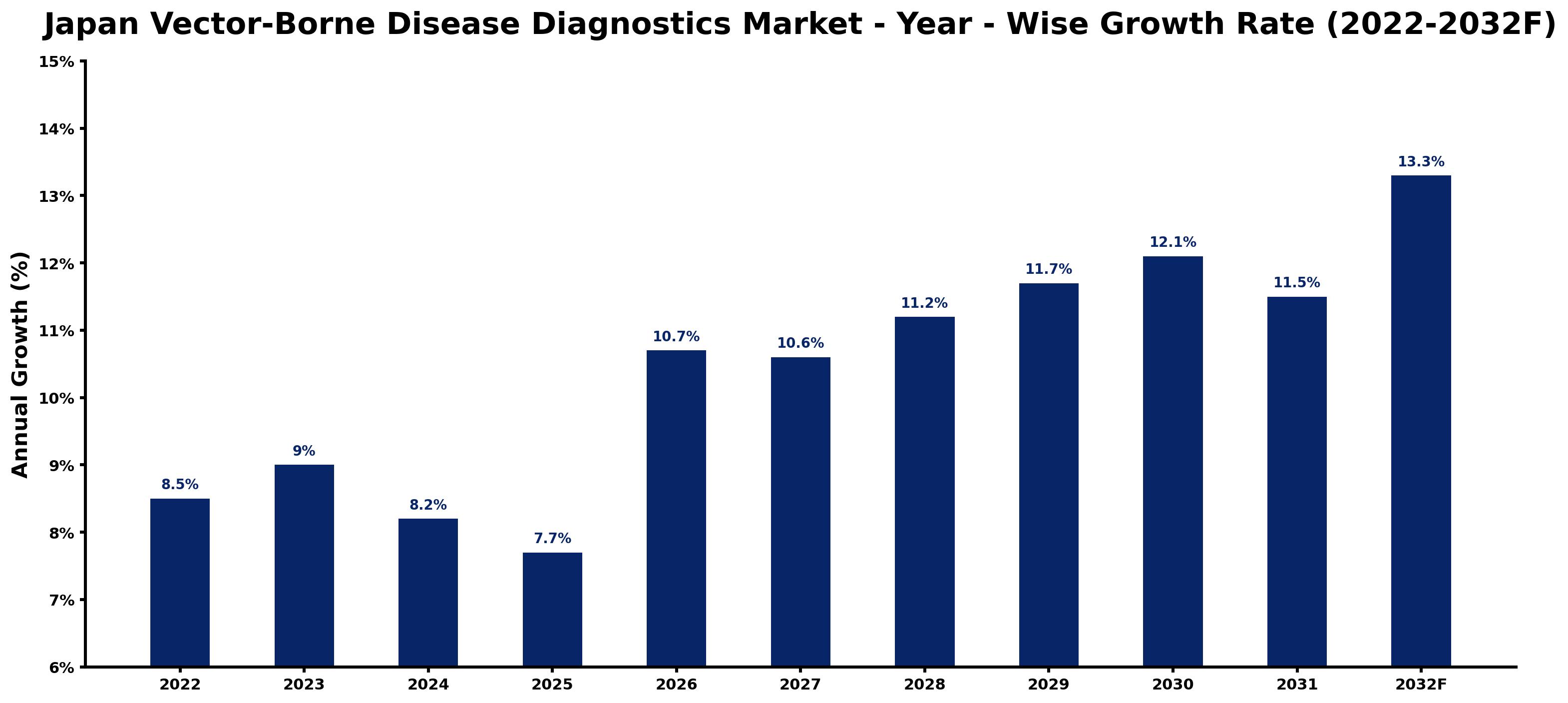
Below, each year's estimated growth is shown next to the factor that most influenced it.
| Year | Estimated Annual Growth (%) | Market Rationale |
| 2022 | 8.5 | The market showed steady growth, reflecting ongoing healthcare investments. |
| 2023 | 9.0 | Growth accelerated due to rising dengue fever cases in urban areas. |
| 2024 | 8.2 | Growth slowed as demand stabilised after the previous year's surge. |
| 2025 | 7.7 | Market growth continued to decelerate amid increasing competition. |
| 2026 | 10.7 | Demand is expected to increase as healthcare facilities expand diagnostic capabilities. |
| 2027 | 10.6 | A slight slowdown will occur as market saturation begins to set in. |
| 2028 | 11.2 | Growth is projected to pick up again with advancements in diagnostic technologies. |
| 2029 | 11.7 | Continued investment in healthcare infrastructure will spur further demand. |
| 2030 | 12.1 | Demand is expected to rise as awareness of vector-borne diseases increases. |
| 2031 | 11.5 | Growth will moderate as the market approaches maturity. |
| 2032 | 13.3 | The market is projected to peak with advancements in rapid testing. |
Note: Market size estimations and growth projections presented in this report are based on 6Wresearch's proprietary forecasting methodology, utilizing the latest available industry data, government publications, and primary research inputs.
Japan Vector-Borne Disease Diagnostics Market Synopsis
Vector-Borne Disease Diagnostics encompasses tests that detect diseases transmitted by vectors such as mosquitoes and ticks, primarily through blood samples. In Japan, the healthcare sector utilises these diagnostics to manage vector-borne diseases like malaria and dengue. The Japan Vector-Borne Disease Diagnostics Market is growing due to rising incidences of these diseases, especially in densely populated areas like Tokyo, coupled with advancements in diagnostic technologies and increased healthcare spending, which reached approximately JPY 46.7 trillion in fiscal 2022.
Market Dynamics Impact Analysis (2026–2032)
| Factor | Type | Impact | Primary Segment Affected |
| Rising incidence of vector-borne diseases such as dengue and malaria | Driver | High | Dengue |
| Increased healthcare spending leading to enhanced diagnostic capabilities | Driver | High | Primary Health Clinics |
| Growing demand for rapid diagnostic tests in primary health settings | Opportunity | High | Rapid Diagnostic Test |
| Expansion of pathology labs adopting advanced testing methods | Opportunity | Medium | Pathology Labs |
| Regulatory challenges in implementing new diagnostic technologies | Restraint | High | PCR/ELISA |
| Limited awareness in rural areas affecting testing rates | Restraint | Medium | Malaria |
| High costs associated with advanced diagnostic equipment | Challenge | High | PCR/ELISA |
| Shortage of trained personnel for conducting complex tests | Challenge | Medium | Pathology Labs |
Evaluation of Drivers in Japan Vector-Borne Disease Diagnostics Market (2026–2032)
The table below links each growth driver to the segment it affects and the evidence for it.
| Drivers | Primary Segment Affected | Why It Matters (Evidence) |
| Increased dengue fever cases | Dengue | Over 1,000 cases reported in 2023, driving demand for diagnostics in urban health facilities. |
| Healthcare expenditure growth | Primary Health Clinics | Japan's medical care expenditure reached JPY 46.7 trillion in 2022, enhancing diagnostic investments. |
| High adoption of rapid diagnostic tests | Rapid Diagnostic Test | Over 70% of primary health clinics use rapid tests for quick diagnosis, boosting demand. |
| Technological advancements in diagnostics | PCR/ELISA | Approximately 5,000 PCR machines installed in hospitals by 2023, improving testing capacity. |
| Increased focus on disease surveillance | Malaria | The Ministry of Health launched a program in 2023 to enhance vector-borne disease monitoring. |
Volumes grow on the back of rising incidences of vector-borne diseases, particularly dengue fever, with over 1,000 cases reported in 2023. Healthcare expenditure has surged, reaching JPY 46.7 trillion in fiscal 2022, allowing for more investments in diagnostic technologies. The widespread adoption of rapid diagnostic tests, now used in over 70% of primary health clinics, boosts demand for immediate results. Advancements in PCR technology have led to improved testing capacity across hospitals.
Evaluation of Restraints in Japan Vector-Borne Disease Diagnostics Market
The key brakes on demand, and where they bite hardest, are shown below.
| Market Restraint | Primary Segment Affected | Why It Matters (Evidence) |
| High competition among diagnostic providers | Malaria | Numerous companies offer similar tests, forcing suppliers to lower prices and reducing profitability by up to 15%. |
| Supply chain disruptions | Malaria | Delays in obtaining essential testing materials can extend testing times by an average of two days. |
| Limited availability of advanced diagnostic technologies | Malaria | This scarcity can lead to increased healthcare costs, potentially rising by ¥500 million annually. |
| High initial investment costs for technology adoption | Malaria | These costs limit suppliers' ability to innovate and meet evolving market needs. |
| Regulatory hurdles in testing approvals | Malaria | Complex approval processes can delay the introduction of new diagnostic tests. |
Japan Vector-Borne Disease Diagnostics Market Challenges
Intense competition among diagnostic providers compels suppliers to lower prices, potentially reducing profitability by up to 15%. Supply chain disruptions frequently delay the delivery of essential testing materials, affecting clinics that depend on timely diagnostics and extending testing times by an average of two days. Buyers encounter difficulties in accessing advanced diagnostic technologies due to high acquisition costs, which can postpone diagnosis and treatment by up to five days, impacting patient outcomes. Additionally, the rapid rise in vector-borne disease cases, with over 1,000 dengue cases reported in 2023, escalates the demand for effective diagnostics, straining existing resources.
Trends in the Japan Vector-Borne Disease Diagnostics Market
The following changes are redrawing the Japan Vector-Borne Disease Diagnostics Market.
- Increase in Rapid Diagnostic Tests Adoption: In 2023, over 70% of primary health clinics in Japan adopted rapid diagnostic tests, reflecting a shift towards quicker disease identification. This trend improves patient care and increases demand for testing supplies.
- Surge in Healthcare Spending: Japan's national medical care expenditure reached JPY 46.7 trillion in fiscal 2022, driving investment in advanced diagnostic technologies. This increase supports the growth of the vector-borne disease diagnostics market.
- Focus on Disease Surveillance Enhancement: The Ministry of Health launched a program in 2023 aimed at improving vector-borne disease monitoring. This initiative is expected to boost the demand for effective diagnostic solutions.
- Growth in Technological Advancements: The installed base of PCR machines in hospitals reached approximately 5,000 units in 2023, enabling more precise testing. This technological growth is essential for improving diagnostic capabilities.
Investment Opportunities in the Japan Vector-Borne Disease Diagnostics Market
Where to invest in the Japan Vector-Borne Disease Diagnostics Market: the main openings are set out below.
- Investment in Advanced Diagnostic Technologies: With Japan's healthcare expenditure at JPY 46.7 trillion, there is a strong opportunity to supply advanced diagnostic technologies. Collaborating with primary health clinics can facilitate market entry.
- Expansion of Rapid Diagnostic Test Offerings: The rising demand for rapid diagnostic tests presents an opportunity to supply these products. Partnering with hospitals can enhance distribution and accessibility for patients.
- Development of Disease Surveillance Solutions: The Ministry of Health's 2023 program creates an opportunity to invest in disease surveillance technologies. Engaging with local healthcare providers can assist in product development.
- Enhancement of Testing Capabilities in Clinics: The increasing need for efficient testing solutions in primary health clinics offers a chance to supply innovative diagnostic tools. Forming joint ventures with local suppliers can facilitate market penetration.
Government Initiatives in the Japan Vector-Borne Disease Diagnostics Market
The Next-Generation Medical Infrastructure Act, enacted in 2017, permits certified bodies to anonymise medical data for research and product development, strengthening the regulatory framework for diagnostics. This act complements existing laws by improving data accessibility for innovation in vector-borne disease diagnostics.
In 2023, the budget for vector-borne disease research was approximately ¥2 billion, administered by the Japan Agency for Medical Research and Development. This funding supports various projects aimed at improving diagnostic technologies and disease monitoring.
Future Insight of the Japan Vector-Borne Disease Diagnostics Market
Investment in vector-borne disease diagnostics will see a substantial boost as the national budget allocates approximately ¥2 billion for research, driving demand for improved testing solutions. By 2032, the installed base of PCR machines in hospitals will expand, facilitating faster diagnoses. The Ministry of Health, Labour and Welfare's new program will strengthen disease surveillance, creating opportunities for suppliers. Enhanced collaboration between research agencies and healthcare providers will lead to the development of more effective diagnostic technologies, benefiting both buyers and suppliers.
Market Segmentation Analysis
Japan Vector-Borne Disease Diagnostics Market report covers a detailed analysis of the following market segments:
By Disease Type – Malaria Leads, Dengue Expected to Grow Fastest
According to Saurav Kr Singh, Senior Research Analyst at 6Wresearch, in 2025, Malaria led the disease type split with a 40% share. Malaria diagnostics command the largest share as Japan experiences a consistent but low incidence of imported cases, mainly from overseas travellers. Established testing protocols regulated by the Japan Society of Tropical Medicine ensure reliable identification of malaria infections, reinforcing its strong market position. Dengue is projected to grow fastest, at a CAGR of 16.4% during 2026–2032. Dengue diagnostics are expanding rapidly, driven by a notable rise in reported cases, with over 1,000 instances in 2023. The Ministry of Health, Labour and Welfare's recent programme to enhance surveillance further supports this segment's growth trajectory. Suppliers should concentrate on developing targeted solutions for dengue diagnostics to address the increasing demand.
By Test Type – Rapid Diagnostic Test Leads, PCR/ELISA Expected to Grow Fastest
Rapid Diagnostic Test took 40% of test type revenue in 2025, more than any other category. Rapid Diagnostic Tests dominate the market as they are extensively utilised in over 70% of primary health clinics for their quick results. This widespread adoption among healthcare providers underscores their vital role in the timely diagnosis of vector-borne diseases. Over 2026–2032, PCR/ELISA is expected to post the fastest growth, at a CAGR of 16.9%. PCR/ELISA tests are experiencing swift growth due to their precision in pathogen detection, which is increasingly favoured in clinical environments. The growing complexity of vector-borne diseases necessitates advanced testing methods, propelling this segment's expansion. Buyers will gain from investing in advanced testing technologies to enhance diagnostic accuracy and improve patient outcomes.
By Sample Type – Blood Leads, Serum/Plasma Expected to Grow Fastest
Blood accounted for 42% of the market by sample type in 2025. Blood samples are the primary type employed for diagnostics, as they are crucial for accurately detecting vector-borne diseases. This established practice in healthcare facilities ensures a steady demand for blood-based diagnostic tests. The quickest growth will come from Serum/Plasma, forecast to expand at a CAGR of 17.4% between 2026 and 2032. Serum/Plasma samples are seeing increased adoption owing to their utility in various serological tests, which are becoming more common in diagnostics. The rising emphasis on comprehensive testing methodologies is likely to drive further growth in this segment. Suppliers should prioritise the development of serum/plasma testing solutions to align with the changing preferences in diagnostic practices.
By End User – Primary Health Clinics Lead, Pathology Labs Expected to Grow Fastest
Primary Health Clinics held 44% of the Japan Vector-Borne Disease Diagnostics Market by end user in 2025. Primary Health Clinics lead the market as they are frequently utilized for initial diagnosis and treatment of vector-borne diseases. Their accessibility and widespread presence in communities make them critical for managing public health effectively. Pathology Labs are set to record the highest CAGR in this split, 15.1% over 2026–2032. Pathology Labs are experiencing rapid growth as they conduct detailed testing and analysis of samples, which is increasingly required for accurate diagnosis. The rising complexity of vector-borne diseases necessitates the expertise offered by these facilities, driving their demand. Suppliers must ensure that their products meet the specific needs of pathology labs to capitalise on this growing market segment.
Key Attractiveness of the Report
- 10 Years of Market Numbers
- Historical Data Starting from 2022 to 2025
- Base Year 2025
- Forecast Data until 2032
- Key Performance Indicators Impacting the Market
- Major Upcoming Developments and Projects
Key Highlights of the Report:
- Japan Vector-Borne Disease Diagnostics Market Outlook
- Market Size of Japan Vector-Borne Disease Diagnostics Market, 2025
- Forecast of Japan Vector-Borne Disease Diagnostics Market, 2032
- Historical Data and Forecast of Japan Vector-Borne Disease Diagnostics Revenues & Volume for the Period 2022-2032F
- Japan Vector-Borne Disease Diagnostics Market Trend Evolution
- Japan Vector-Borne Disease Diagnostics Market Drivers and Challenges
- Japan Vector-Borne Disease Diagnostics Price Trends
- Japan Vector-Borne Disease Diagnostics Porter's Five Forces
- Japan Vector-Borne Disease Diagnostics Industry Life Cycle
- Historical Data and Forecast of Japan Vector-Borne Disease Diagnostics Market Revenues & Volume By Disease Type for the Period 2022-2032F
- Historical Data and Forecast of Japan Vector-Borne Disease Diagnostics Market Revenues & Volume By Malaria for the Period 2022-2032F
- Historical Data and Forecast of Japan Vector-Borne Disease Diagnostics Market Revenues & Volume By Dengue for the Period 2022-2032F
- Historical Data and Forecast of Japan Vector-Borne Disease Diagnostics Market Revenues & Volume By Lyme Disease for the Period 2022-2032F
- Historical Data and Forecast of Japan Vector-Borne Disease Diagnostics Market Revenues & Volume By Chikungunya for the Period 2022-2032F
- Historical Data and Forecast of Japan Vector-Borne Disease Diagnostics Market Revenues & Volume By Test Type for the Period 2022-2032F
- Historical Data and Forecast of Japan Vector-Borne Disease Diagnostics Market Revenues & Volume By Rapid Diagnostic Test for the Period 2022-2032F
- Historical Data and Forecast of Japan Vector-Borne Disease Diagnostics Market Revenues & Volume By PCR/ELISA for the Period 2022-2032F
- Historical Data and Forecast of Japan Vector-Borne Disease Diagnostics Market Revenues & Volume By Western Blot/ELISA for the Period 2022-2032F
- Historical Data and Forecast of Japan Vector-Borne Disease Diagnostics Market Revenues & Volume By Antibody Testing for the Period 2022-2032F
- Historical Data and Forecast of Japan Vector-Borne Disease Diagnostics Market Revenues & Volume By Sample Type for the Period 2022-2032F
- Historical Data and Forecast of Japan Vector-Borne Disease Diagnostics Market Revenues & Volume By Blood for the Period 2022-2032F
- Historical Data and Forecast of Japan Vector-Borne Disease Diagnostics Market Revenues & Volume By Serum/Plasma for the Period 2022-2032F
- Historical Data and Forecast of Japan Vector-Borne Disease Diagnostics Market Revenues & Volume By Blood/CSF for the Period 2022-2032F
- Historical Data and Forecast of Japan Vector-Borne Disease Diagnostics Market Revenues & Volume By Whole Blood for the Period 2022-2032F
- Historical Data and Forecast of Japan Vector-Borne Disease Diagnostics Market Revenues & Volume By End User for the Period 2022-2032F
- Historical Data and Forecast of Japan Vector-Borne Disease Diagnostics Market Revenues & Volume By Primary Health Clinics for the Period 2022-2032F
- Historical Data and Forecast of Japan Vector-Borne Disease Diagnostics Market Revenues & Volume By Pathology Labs for the Period 2022-2032F
- Historical Data and Forecast of Japan Vector-Borne Disease Diagnostics Market Revenues & Volume By Hospitals for the Period 2022-2032F
- Historical Data and Forecast of Japan Vector-Borne Disease Diagnostics Market Revenues & Volume By Travel Clinics for the Period 2022-2032F
- Japan Vector-Borne Disease Diagnostics Import Export Trade Statistics
- Market Opportunity Assessment By Disease Type
- Market Opportunity Assessment By Test Type
- Market Opportunity Assessment By Sample Type
- Market Opportunity Assessment By End User
- Japan Vector-Borne Disease Diagnostics Top Companies Market Share
- Japan Vector-Borne Disease Diagnostics Competitive Benchmarking By Technical and Operational Parameters
- Japan Vector-Borne Disease Diagnostics Company Profiles
- Japan Vector-Borne Disease Diagnostics Key Strategic Recommendations
Market Covered
This report examines the market across the segments below.
By Disease Type
- Malaria
- Dengue
- Lyme Disease
- Chikungunya
By Test Type
- Rapid Diagnostic Test
- PCR/ELISA
- Western Blot/ELISA
- Antibody Testing
By Sample Type
- Blood
- Serum/Plasma
- Blood/CSF
- Whole Blood
By End User
- Primary Health Clinics
- Pathology Labs
- Hospitals
- Travel Clinics































