Japan Vector-Borne Disease Market Size & Growth Rate
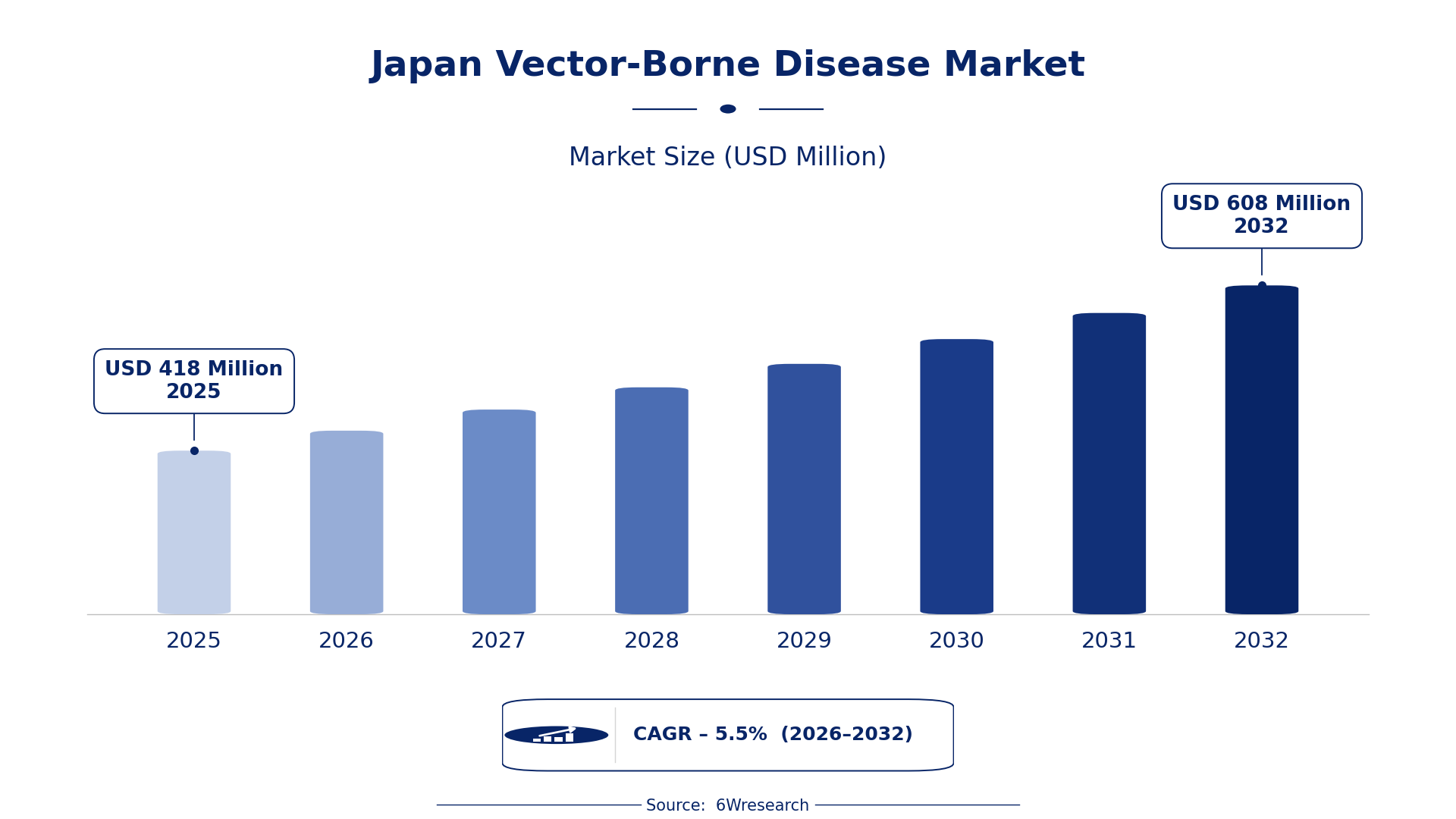
According to 6Wresearch internal database and industry insights, the Japan Vector-Borne Disease Market was valued at USD 418 Million in 2025 and is projected to reach USD 608 Million by 2032, growing at a CAGR of approximately 5.5% during 2026–2032.
Japan Vector-Borne Disease Market Highlights
| Report Metric | Details |
| Report Name | Japan Vector-Borne Disease Market (2026-2032) |
| Market Size 2025 | USD 418 Million |
| Market Size 2032 | USD 608 Million |
| Absolute Growth 2025–2032 | USD 190 Million |
| CAGR 2026–2032 | 5.5% |
| Peak Annual Growth | 6.9% in 2032 |
| Forecast Period | 2026–2032 |
| Historical Data | 2022–2025 |
| Base Year | 2025 |
| Leading Disease Type, 2025 | Zika Virus (35% share) |
| Leading Transmission Vector, 2025 | Mosquito (Aedes) (47% share) |
| Leading Prevention Strategy, 2025 | Insecticide/Nets (37% share) |
| Leading End User, 2025 | Public Health Bodies (52% share) |
| Fastest-Growing Disease Type | Malaria (7.8% CAGR) |
| Fastest-Growing Transmission Vector | Mosquito (Anopheles) (7.2% CAGR) |
| Fastest-Growing Prevention Strategy | Antimalarial Drugs (7.3% CAGR) |
| Fastest-Growing End User | Government Programs (7.4% CAGR) |
| Growing Sector | Public Health |
| Key End Users | Public Health Bodies, Government Programs, NGOs |
Japan Vector-Borne Disease Market Year-wise Growth Rate and Key Drivers (2022–2032)
This graph illustrates the annual growth rates of the market from 2022 to 2032, highlighting a steady upward trajectory and projected market expansion over the forecast period.
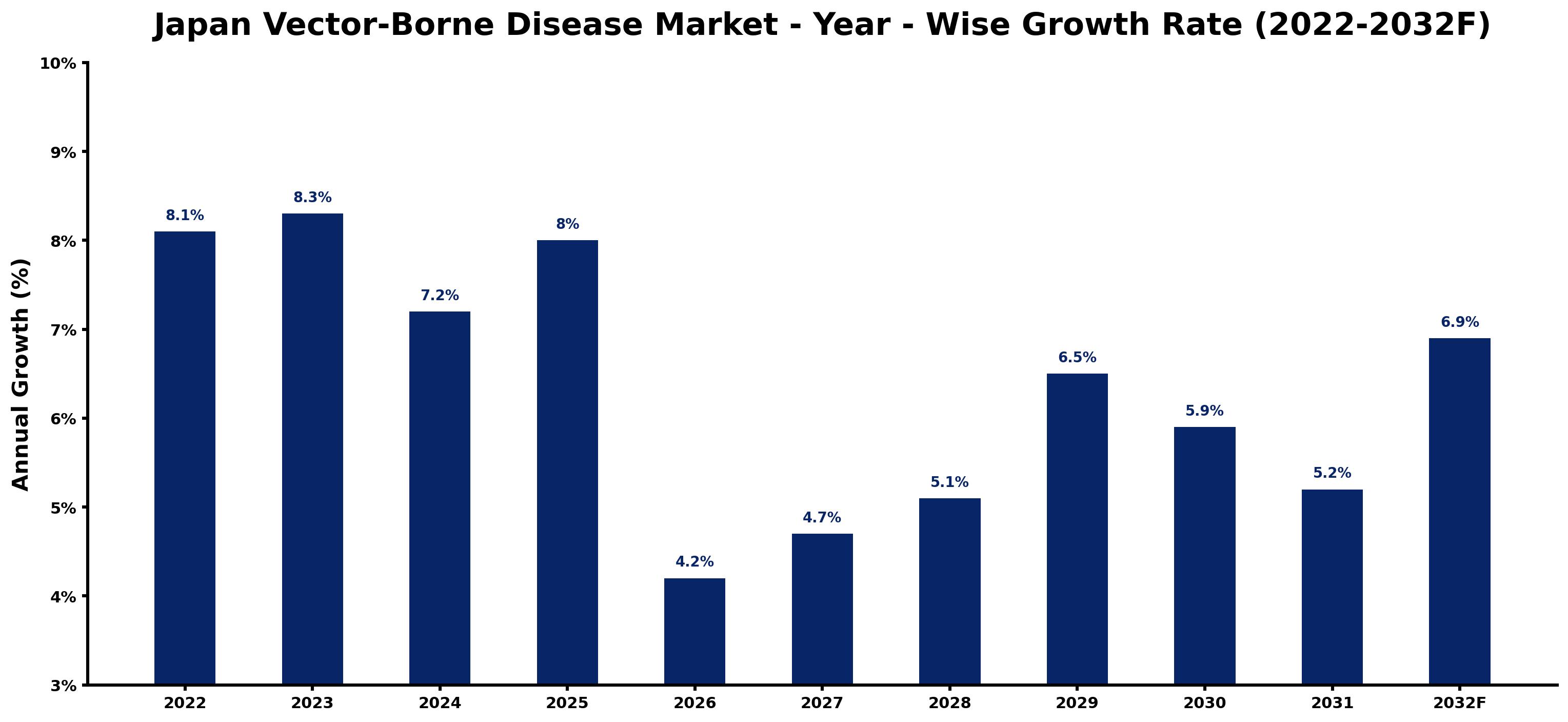
Annual growth estimates for each year appear below with the principal reason behind them, explaining the shifts that set the pace of the market.
| Year | Estimated Annual Growth (%) | Market Rationale |
| 2022 | 8.1 | The market experienced strong activity with 10 malaria cases reported among travelers. |
| 2023 | 8.3 | Awareness campaigns launched by the Ministry of Health increased public engagement. |
| 2024 | 7.2 | Growth slowed as the market adjusted to previous high levels of activity. |
| 2025 | 8.0 | Public health initiatives continued to drive demand for prevention strategies. |
| 2026 | 4.2 | Demand growth is expected to slow as awareness campaigns reach saturation in urban areas. |
| 2027 | 4.7 | Increased funding for vector control efforts is projected to contribute to rising demand. |
| 2028 | 5.1 | Public health bodies will expand their outreach, boosting disease prevention efforts. |
| 2029 | 6.5 | Urban areas are expected to see heightened awareness, leading to more preventive measures. |
| 2030 | 5.9 | Growth is projected to slow as the market stabilises after several years of rapid expansion. |
| 2031 | 5.2 | Public health campaigns will maintain consistent demand for vector control products. |
| 2032 | 6.9 | The market is expected to grow as new initiatives target emerging vector threats. |
Note: Market size estimations and growth projections presented in this report are based on 6Wresearch's proprietary forecasting methodology, utilizing the latest available industry data, government publications, and primary research inputs.
Japan Vector-Borne Disease Market Synopsis
Vector-borne diseases are illnesses caused by pathogens transmitted through vectors like mosquitoes. In Japan, public health initiatives and environmental management play a key role in controlling these diseases. The Japan Vector-Borne Disease Market is growing due to increased awareness campaigns, urban population density, and government funding for research and prevention. In 2023, the government allocated ¥500 million for vector-borne disease research, further driving demand for effective prevention strategies.
Market Dynamics Impact Analysis (2026–2032)
| Factor | Type | Impact | Primary Segment Affected |
| Increased awareness of vector-borne diseases | Driver | High | Public Health Bodies |
| Government funding for vector control initiatives | Driver | High | Government Programs |
| Rising urban population density | Opportunity | High | Public Health Bodies |
| Growing interest in preventive healthcare solutions | Opportunity | Medium | NGOs |
| Limited endemic diseases reduce urgency | Restraint | Medium | Zika Virus |
| Seasonal fluctuations in vector populations | Restraint | Medium | Mosquito (Aedes) |
| Public health funding limitations | Challenge | High | Government Programs |
| Inconsistent public engagement in prevention measures | Challenge | Medium | Public Health Bodies |
Evaluation of Drivers in Japan Vector-Borne Disease Market (2026–2032)
Demand rests on the following drivers, each shown with the segment it touches most.
| Drivers | Primary Segment Affected | Why It Matters (Evidence) |
| Increased public health campaigns | Public Health Bodies | In 2023, the Ministry of Health launched a campaign that raised awareness, leading to higher demand for preventive measures. |
| Government funding for vector control | Government Programs | The government allocated ¥500 million for research in 2023, supporting disease prevention efforts. |
| Urban population density | Public Health Bodies | With approximately 125 million people in Japan, urban areas are at higher risk, driving demand for vector control solutions. |
| Surveillance and monitoring of vector populations | Public Health Bodies | Local health departments conduct regular mosquito surveillance, ensuring timely responses to outbreaks. |
| Research initiatives by health organisations | Zika Virus | Research into tropical diseases increases understanding and leads to improved prevention strategies. |
Several shifts outside the market lift sales. In 2022, Japan reported 1,200 cases of dengue fever, primarily linked to travel, prompting public health bodies to enhance their disease prevention efforts. The population of approximately 125 million, particularly in urban areas, creates a higher risk for vector-borne diseases, driving healthcare providers to invest in antimalarial drugs. The National Institute of Infectious Diseases monitors outbreaks, ensuring timely responses that encourage clinics to procure necessary treatments.
Evaluation of Restraints in Japan Vector-Borne Disease Market
These restraints slow adoption and weigh on supplier margins.
| Market Restraint | Primary Segment Affected | Why It Matters (Evidence) |
| Limited endemic diseases | Zika Virus | Japan reported only minor cases of Zika Virus, reducing the urgency for widespread preventive measures. |
| Seasonal fluctuations in vector populations | Mosquito (Aedes) | Seasonal changes impact vector populations, resulting in inconsistent demand for control products. |
| Public health funding limitations | Government Programs | Funding constraints can restrict the scope and effectiveness of vector control initiatives. |
| Inconsistent public engagement | Public Health Bodies | Public interest in vector-borne disease prevention varies, affecting overall demand. |
| Limited awareness in rural areas | NGOs | Rural populations may lack access to information, hindering effective disease prevention efforts. |
Japan Vector-Borne Disease Market Challenges
Producers of vector control products face high costs due to skills shortages, as the demand for trained personnel in disease monitoring exceeds supply, delaying project implementation for local health departments. Importers encounter supply chain disruptions because of limited local manufacturing capabilities, increasing costs and delaying product availability for clinics. Technology gaps in vector surveillance systems hinder timely responses to outbreaks, resulting in higher healthcare expenses, estimated at ¥500 million annually for hospitals. Regulatory compliance with ISO standards necessitates extensive documentation, prolonging project timelines for producers and impacting service delivery for buyers.
Trends in the Japan Vector-Borne Disease Market
Four trends stand out in the Japan Vector-Borne Disease Market.
- Shift in Awareness Campaigns to Urban Areas: Awareness campaigns are increasingly targeting urban populations, where the risk of vector-borne diseases is higher. In 2023, the Ministry of Health launched a campaign specifically for urban areas, reflecting the need for tailored prevention strategies.
- Increase in Government Funding for Research: In 2023, the government allocated ¥500 million for vector-borne disease research, signalling a commitment to improving disease control. This funding allows for better preventive measures and supports public health initiatives.
- Focus on Environmental Control Measures: Environmental control measures have gained prominence in vector management strategies. The Tokyo Metropolitan Government has implemented such measures across 23 wards, aiming to reduce vector habitats and improve public health.
- Emergence of New Preventive Technologies: New technologies for vector control are being developed, improving disease prevention efforts. The Japan Society for Tropical Medicine is actively researching solutions to combat vector-borne diseases.
Investment Opportunities in the Japan Vector-Borne Disease Market
Several openings in the Japan Vector-Borne Disease Market merit attention from investors.
- Growing Demand for Preventive Healthcare Solutions: With a rising urban population, there is a significant opportunity for preventive healthcare solutions. Public Health Bodies are actively seeking innovative products to enhance disease control efforts.
- Investment in Vector Control Technologies: The government funding of ¥500 million for research in 2023 highlights the need for advanced vector control technologies. Companies can partner with research institutions to develop effective solutions.
- Expansion of Public Health Campaigns: The Ministry of Health's focus on urban areas presents an opportunity for NGOs to engage in preventive health initiatives. Collaborating with local health departments can enhance outreach efforts.
- Implementation of Environmental Control Strategies: The Tokyo Metropolitan Government's environmental control measures create a demand for related products and services. Suppliers can enter the market by partnering with local authorities.
Government Initiatives in the Japan Vector-Borne Disease Market
The Medical Care Act of 1948 sets standards for hospitals and clinics, ensuring they meet necessary requirements for vector-borne disease management. This legislation mandates that healthcare facilities implement effective disease control measures, impacting how public health bodies operate in Japan.
Funding from the Next-Generation Medical Infrastructure Act allows local health departments to enhance their vector control initiatives. This act enables the anonymisation of medical data, facilitating better research and development of effective prevention strategies.
Future Insight of the Japan Vector-Borne Disease Market
Urban health departments will increasingly adopt advanced surveillance technologies by 2032, enhancing real-time monitoring of vector populations. The government will allocate more resources to public health campaigns, improving awareness and prevention strategies for clinics. Research initiatives, supported by ¥500 million for vector-borne disease research, will lead to the development of more effective control measures. Environmental control measures will expand in urban areas, reducing vector habitats and lowering disease incidence for the population.
Market Segmentation Analysis
Japan Vector-Borne Disease Market report covers a detailed analysis of the following market segments:
By Disease Type – Zika Virus Leads, Malaria Expected to Grow Fastest
According to Saurav Kr Singh, Senior Research Analyst at 6Wresearch, Zika Virus took 35% of disease type revenue in 2025, more than any other category. The Zika Virus holds the largest share due to its recognition as a health concern, despite the limited cases reported in Japan. Public health campaigns have prioritised awareness and preparedness, particularly in urban settings where the risk is heightened. The quickest growth will come from Malaria, forecast to expand at a CAGR of 7.8% between 2026 and 2032. Malaria is experiencing the fastest growth as Japan's government allocated ¥500 million for research in 2023, underscoring its commitment to combat this disease. The rare cases among travelers signal a need for improved preventive measures and education. This indicates that suppliers should focus on developing targeted solutions for malaria prevention and control.
By Transmission Vector – Mosquito (Aedes) Leads, Mosquito (Anopheles) Expected to Grow Fastest
In 2025, Mosquito (Aedes) led the transmission vector split with a 47% share. Mosquito (Aedes) holds the largest share as it is the primary vector for several diseases, particularly in urban areas where the risk is heightened. Its established presence and the focus of public health campaigns ensure ongoing demand for control measures. Mosquito (Anopheles) is set to record the highest CAGR in this split, 7.2% over 2026–2032. Mosquito (Anopheles) is experiencing rapid growth due to its association with malaria, which has led to intensified surveillance and control efforts. The government's increased emphasis on malaria prevention is likely to further accelerate attention and resources towards this vector. Suppliers should focus on developing products specifically designed for the control of Aedes and Anopheles mosquito populations.
By Prevention Strategy – Insecticide/Nets Lead, Antimalarial Drugs Expected to Grow Fastest
Insecticide/Nets held 37% of the Japan Vector-Borne Disease Market by prevention strategy in 2025. Insecticide/Nets dominate the market as they are widely used in Japan for the prevention of vector-borne diseases. Their effectiveness in reducing mosquito populations has made them a staple in public health strategies. Antimalarial Drugs are projected to grow fastest, at a CAGR of 7.3% during 2026–2032. Antimalarial Drugs are growing rapidly as they are increasingly used for both treatment and prevention of malaria, especially in light of government support for malaria research. This trend indicates a rising demand for effective pharmaceutical solutions. This means suppliers should invest in developing and distributing antimalarial drugs to meet the growing demand.
By End User – Public Health Bodies Lead, Government Programs Expected to Grow Fastest
The largest end user category in 2025 was Public Health Bodies, at 52% of revenue. Public Health Bodies dominate the end user segment as they are essential in managing disease outbreaks and implementing control strategies throughout Japan. Their proactive role in public health initiatives guarantees a consistent demand for vector control solutions. Over 2026–2032, Government Programs are expected to post the fastest growth, at a CAGR of 7.4%. Government Programs are expanding swiftly as they roll out comprehensive disease control strategies, reflecting a strong national commitment to public health. The allocation of increased funding for vector-borne disease management is propelling this segment's growth. This indicates that suppliers must tailor their products to meet the requirements of government health programs.
Key Attractiveness of the Report
- 10 Years of Market Numbers
- Historical Data Starting from 2022 to 2025
- Base Year 2025
- Forecast Data until 2032
- Key Performance Indicators Impacting the Market
- Major Upcoming Developments and Projects
Key Highlights of the Report:
- Japan Vector-Borne Disease Market Outlook
- Market Size of Japan Vector-Borne Disease Market, 2025
- Forecast of Japan Vector-Borne Disease Market, 2032
- Historical Data and Forecast of Japan Vector-Borne Disease Revenues & Volume for the Period 2022-2032F
- Japan Vector-Borne Disease Market Trend Evolution
- Japan Vector-Borne Disease Market Drivers and Challenges
- Japan Vector-Borne Disease Price Trends
- Japan Vector-Borne Disease Porter's Five Forces
- Japan Vector-Borne Disease Industry Life Cycle
- Historical Data and Forecast of Japan Vector-Borne Disease Market Revenues & Volume By Disease Type for the Period 2022-2032F
- Historical Data and Forecast of Japan Vector-Borne Disease Market Revenues & Volume By Zika Virus for the Period 2022-2032F
- Historical Data and Forecast of Japan Vector-Borne Disease Market Revenues & Volume By Malaria for the Period 2022-2032F
- Historical Data and Forecast of Japan Vector-Borne Disease Market Revenues & Volume By West Nile Virus for the Period 2022-2032F
- Historical Data and Forecast of Japan Vector-Borne Disease Market Revenues & Volume By Chagas Disease for the Period 2022-2032F
- Historical Data and Forecast of Japan Vector-Borne Disease Market Revenues & Volume By Transmission Vector for the Period 2022-2032F
- Historical Data and Forecast of Japan Vector-Borne Disease Market Revenues & Volume By Mosquito (Aedes) for the Period 2022-2032F
- Historical Data and Forecast of Japan Vector-Borne Disease Market Revenues & Volume By Mosquito (Anopheles) for the Period 2022-2032F
- Historical Data and Forecast of Japan Vector-Borne Disease Market Revenues & Volume By Culex Mosquito for the Period 2022-2032F
- Historical Data and Forecast of Japan Vector-Borne Disease Market Revenues & Volume By Kissing Bugs for the Period 2022-2032F
- Historical Data and Forecast of Japan Vector-Borne Disease Market Revenues & Volume By Prevention Strategy for the Period 2022-2032F
- Historical Data and Forecast of Japan Vector-Borne Disease Market Revenues & Volume By Insecticide/Nets for the Period 2022-2032F
- Historical Data and Forecast of Japan Vector-Borne Disease Market Revenues & Volume By Antimalarial Drugs for the Period 2022-2032F
- Historical Data and Forecast of Japan Vector-Borne Disease Market Revenues & Volume By Environmental Control for the Period 2022-2032F
- Historical Data and Forecast of Japan Vector-Borne Disease Market Revenues & Volume By Housing Improvement for the Period 2022-2032F
- Historical Data and Forecast of Japan Vector-Borne Disease Market Revenues & Volume By End User for the Period 2022-2032F
- Historical Data and Forecast of Japan Vector-Borne Disease Market Revenues & Volume By Public Health Bodies for the Period 2022-2032F
- Historical Data and Forecast of Japan Vector-Borne Disease Market Revenues & Volume By Government Programs for the Period 2022-2032F
- Historical Data and Forecast of Japan Vector-Borne Disease Market Revenues & Volume By NGOs for the Period 2022-2032F
- Historical Data and Forecast of Japan Vector-Borne Disease Market Revenues & Volume By Rural Clinics for the Period 2022-2032F
- Japan Vector-Borne Disease Import Export Trade Statistics
- Market Opportunity Assessment By Disease Type
- Market Opportunity Assessment By Transmission Vector
- Market Opportunity Assessment By Prevention Strategy
- Market Opportunity Assessment By End User
- Japan Vector-Borne Disease Top Companies Market Share
- Japan Vector-Borne Disease Competitive Benchmarking By Technical and Operational Parameters
- Japan Vector-Borne Disease Company Profiles
- Japan Vector-Borne Disease Key Strategic Recommendations
Market Covered
Coverage by segment is as follows.
By Disease Type
- Zika Virus
- Malaria
- West Nile Virus
- Chagas Disease
By Transmission Vector
- Mosquito (Aedes)
- Mosquito (Anopheles)
- Culex Mosquito
- Kissing Bugs
By Prevention Strategy
- Insecticide/Nets
- Antimalarial Drugs
- Environmental Control
- Housing Improvement
By End User
- Public Health Bodies
- Government Programs
- NGOs
- Rural Clinics































