Japan VEGF Inhibitors Market Size & Growth Rate
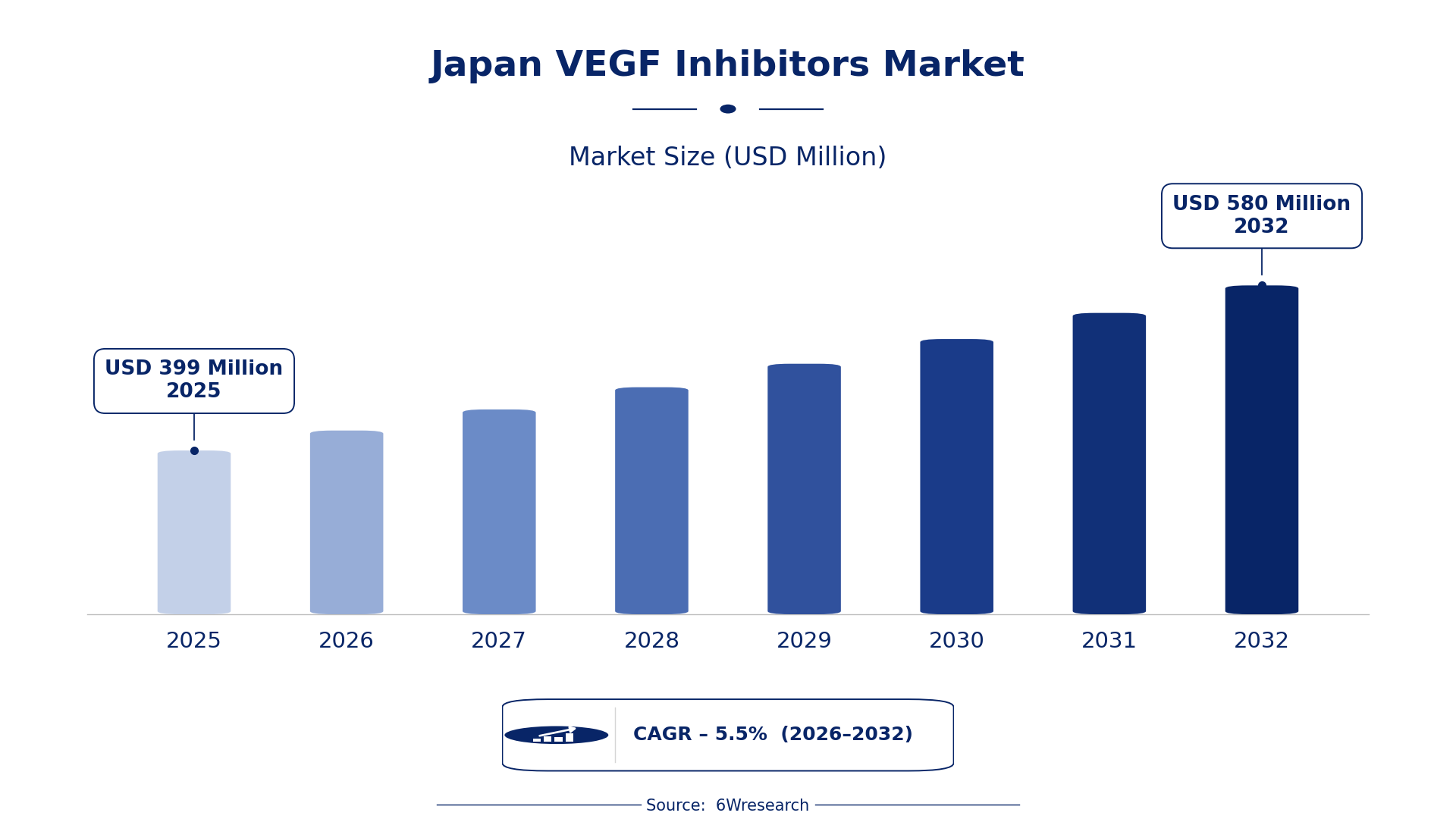
According to 6Wresearch internal database and industry insights, the Japan VEGF Inhibitors Market was valued at USD 399 Million in 2025 and is projected to reach USD 580 Million by 2032, growing at a CAGR of approximately 5.5% during 2026–2032.
Japan VEGF Inhibitors Market Highlights
| Report Metric | Details |
| Report Name | Japan VEGF Inhibitors Market (2026-2032) |
| Market Size 2025 | USD 399 Million |
| Market Size 2032 | USD 580 Million |
| Absolute Growth 2025–2032 | USD 181 Million |
| CAGR 2026–2032 | 5.5% |
| Peak Annual Growth | 6.3% in 2028 |
| Forecast Period | 2026–2032 |
| Historical Data | 2022–2025 |
| Base Year | 2025 |
| Leading Drug Class, 2025 | Monoclonal Antibodies (51% share) |
| Leading Delivery Route, 2025 | Intravenous (35% share) |
| Leading Application, 2025 | Cancer Therapy (46% share) |
| Leading End User, 2025 | Hospitals (43% share) |
| Fastest-Growing Drug Class | Small Molecule Inhibitors (7.5% CAGR) |
| Fastest-Growing Delivery Route | Oral (7.2% CAGR) |
| Fastest-Growing Application | Ophthalmic Conditions (7.3% CAGR) |
| Fastest-Growing End User | Specialty Clinics (7.4% CAGR) |
| Growing Sector | Ophthalmic Conditions |
| Key End Users | Cancer Therapy, Ophthalmic Conditions, Age-Related Macular Deg., Renal Cell Carcinoma |
Japan VEGF Inhibitors Market Year-wise Growth Rate and Key Drivers (2022–2032)
This graph illustrates the annual growth rates of the market from 2022 to 2032, highlighting a steady upward trajectory and projected market expansion over the forecast period.
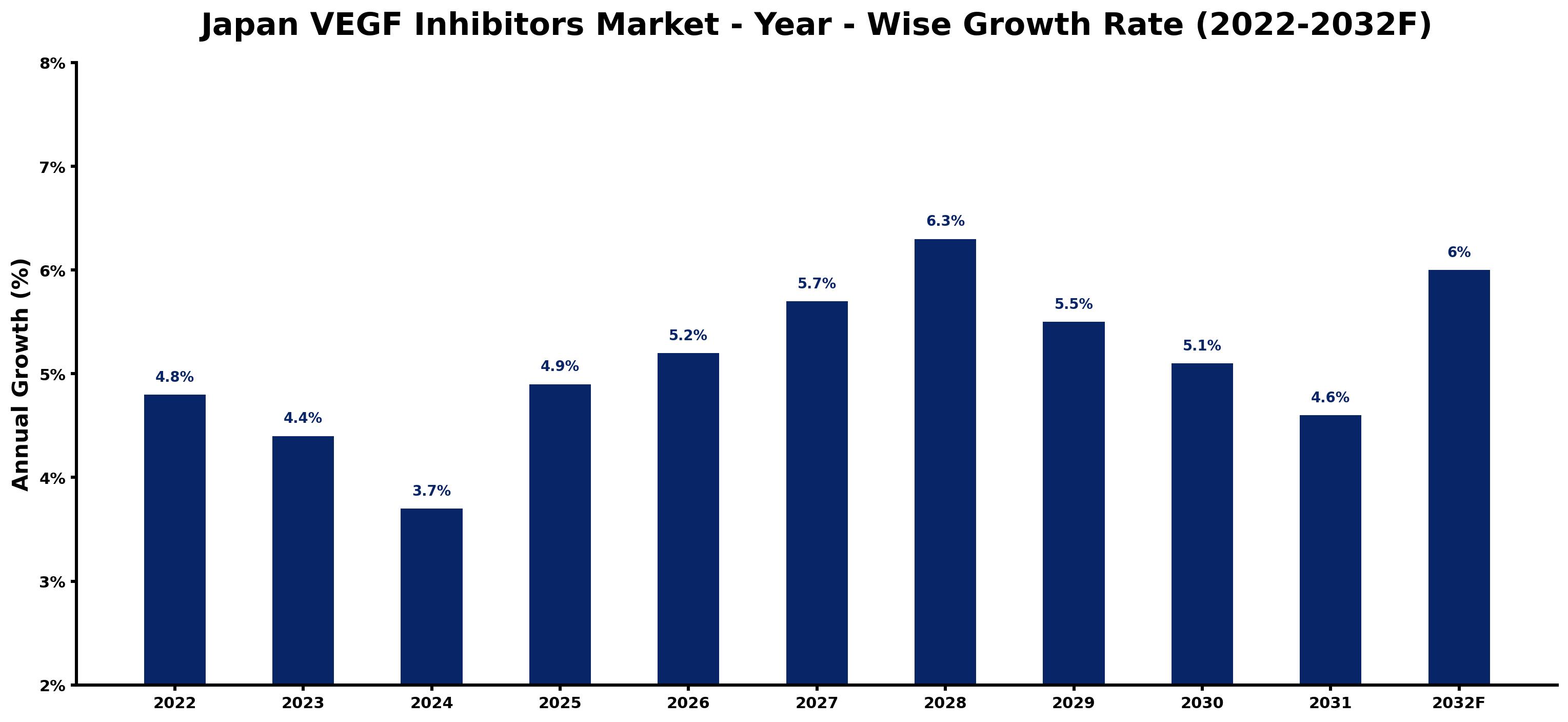
The following figures match every annual growth estimate with the main market development of that year, giving the reasoning behind each rise or slowdown.
| Year | Estimated Annual Growth (%) | Market Rationale |
| 2022 | 4.8 | The market exhibited steady growth, reflecting strong demand for cancer treatments. |
| 2023 | 4.4 | Growth slowed as the market adjusted to increased competition and pricing pressures. |
| 2024 | 3.7 | Continued adjustments in the market led to a further slowdown in growth rates. |
| 2025 | 4.9 | A surge in cancer cases contributed to a faster growth rate than the previous year. |
| 2026 | 5.2 | Healthcare investments and research initiatives are expected to drive growth higher. |
| 2027 | 5.7 | Demand for new therapies is projected to continue rising, boosting market performance. |
| 2028 | 6.3 | The introduction of new therapies will lead to peak growth in the market. |
| 2029 | 5.5 | Growth will slow slightly as market saturation begins to take effect. |
| 2030 | 5.1 | Stable demand for established therapies will contribute to moderate growth. |
| 2031 | 4.6 | The market will experience a slowdown as competition intensifies among providers. |
| 2032 | 6.0 | A resurgence in research and development efforts is projected to drive growth. |
Note: Market size estimations and growth projections presented in this report are based on 6Wresearch's proprietary forecasting methodology, utilizing the latest available industry data, government publications, and primary research inputs.
Japan VEGF Inhibitors Market Synopsis
VEGF inhibitors are pharmaceuticals that block vascular endothelial growth factor, which is vital for tumor growth and ocular diseases. Produced through biotechnology processes, they are primarily used to treat various cancers and eye conditions like age-related macular degeneration. The Japan VEGF Inhibitors Market is expanding due to a growing number of cancer patients, projected to exceed 1.5 million in 2022, along with an increasing elderly population expected to reach 36 million by 2030. Accessibility programs, particularly in rural areas, are further driving demand for these treatments.
Market Dynamics Impact Analysis (2026–2032)
| Factor | Type | Impact | Primary Segment Affected |
| Increasing cancer prevalence drives demand for effective treatments. | Driver | High | Cancer Therapy |
| Rising elderly population boosts need for age-related treatments. | Driver | High | Ophthalmic Conditions |
| Expansion of oncology departments enhances treatment availability. | Opportunity | High | Hospitals |
| Growing interest in biosimilars presents new market avenues. | Opportunity | Medium | Biosimilars |
| High production costs limit the affordability of VEGF inhibitors. | Restraint | High | Monoclonal Antibodies |
| Strict regulatory requirements can delay product approvals. | Restraint | Medium | Small Molecule Inhibitors |
| Intense competition among providers can pressure pricing strategies. | Challenge | High | Fusion Proteins |
| Limited awareness of new therapies among healthcare providers hampers uptake. | Challenge | Medium | Oral |
Evaluation of Drivers in Japan VEGF Inhibitors Market (2026–2032)
Key forces behind demand, with the segment each one moves most, are listed below.
| Drivers | Primary Segment Affected | Why It Matters (Evidence) |
| Rising cancer patient numbers increase the demand for effective therapies. | Cancer Therapy | In 2022, over 1.5 million cancer patients in Japan necessitate advanced treatment options. |
| An ageing population drives the need for treatments for age-related conditions. | Ophthalmic Conditions | The population aged 65 and older is projected to reach 36 million by 2030. |
| Research funding for new therapies supports treatment options. | Small Molecule Inhibitors | Funding for cancer research is increasing, facilitating the development of new therapies. |
| Guidelines from the Japan Society of Clinical Oncology support treatment standardisation. | Monoclonal Antibodies | These guidelines encourage the use of VEGF inhibitors in cancer treatment. |
| Increased healthcare spending supports the development of new therapies. | Biosimilars | The Japanese market for biosimilars is projected to grow significantly by 2025. |
Orders keep climbing as the prevalence of cancer continues to rise, with over 1.5 million patients reported in 2022. The ageing population, projected to reach 36 million by 2030, creates further demand for effective treatments. Increased funding for research drives innovation in therapies. Guidelines from the Japan Society of Clinical Oncology promote the use of VEGF inhibitors, ensuring standardised treatment protocols. Healthcare spending is also on the rise, with investments expected in the biosimilars market, projected to grow by 2025.
Evaluation of Restraints in Japan VEGF Inhibitors Market
The table below lists the restraints and the evidence behind each.
| Market Restraint | Primary Segment Affected | Why It Matters (Evidence) |
| High production costs limit the affordability of new therapies. | Monoclonal Antibodies | Production costs for advanced therapies can exceed several million yen per batch. |
| Regulatory hurdles can delay the approval of new treatments. | Small Molecule Inhibitors | The Pharmaceuticals and Medical Devices Agency oversees strict approval processes. |
| Limited awareness of new therapies affects their adoption in clinical settings. | Fusion Proteins | Healthcare providers may lack information on the latest treatment options. |
| Market saturation can lead to intense competition among providers. | Biosimilars | An influx of similar products can reduce profit margins for manufacturers. |
| Pricing pressures from insurance coverage may limit profitability. | Cancer Therapy | Insurance coverage can restrict the prices that can be charged for treatments. |
Japan VEGF Inhibitors Market Challenges
High training costs for healthcare professionals hinder effective administration of VEGF inhibitors, delaying treatment for hospitals. Rural healthcare providers face challenges in accessing these drugs, resulting in longer wait times for over 1.5 million cancer patients. Insufficient technological integration in treatment protocols complicates the use of VEGF inhibitors, leading to inconsistent outcomes and increased operational costs for clinics. Intense competition among suppliers for market share drives down prices, compelling producers to compromise on quality, which ultimately jeopardises patient safety and treatment efficacy.
Trends in the Japan VEGF Inhibitors Market
Buyers and suppliers in the Japan VEGF Inhibitors Market are adjusting to the following trends.
- Shift in Treatment Focus to Ocular Conditions: Healthcare providers are increasingly prioritising ocular conditions, with a rise in VEGF inhibitors used for age-related macular degeneration. In 2023, approximately 20% of VEGF inhibitor prescriptions were for ocular conditions, reflecting a notable shift in treatment focus.
- Transition from Intravenous to Oral Delivery: The year 2026 marked a notable transition towards oral delivery methods for VEGF inhibitors, with an anticipated CAGR of 7.2%. This shift improves patient convenience and adherence to treatment regimens.
- Emergence of Biosimilars in Oncology: The interest in biosimilars has surged since 2023, with the market projected to grow significantly by 2025. This trend is driven by the need for cost-effective alternatives to traditional therapies.
- Increased Accessibility in Rural Areas: A new programme launched in 2023 aims to improve cancer treatment accessibility in rural regions. This initiative is expected to enhance treatment rates in underserved areas.
Investment Opportunities in the Japan VEGF Inhibitors Market
The opportunities below stand out in the Japan VEGF Inhibitors Market for new entrants and existing suppliers.
- Investment in Rural Healthcare Facilities: Now is an opportune time to invest in rural healthcare facilities, as the demand for cancer treatment accessibility is rising. Programmes aimed at improving treatment in these areas are gaining traction.
- Supply of Oral VEGF Inhibitors: The shift towards oral delivery methods creates opportunities for suppliers of oral VEGF inhibitors. The anticipated growth in patient convenience will drive demand significantly.
- Expansion of Oncology Research: With increased funding for oncology research, there is a strong opportunity to supply innovative therapies. Collaborating with research institutions can facilitate entry into this market.
- Development of Biosimilars: The growing interest in biosimilars presents an opportunity for suppliers to develop cost-effective alternatives. Engaging with healthcare providers can strengthen market presence.
Government Initiatives in the Japan VEGF Inhibitors Market
The Long-Term Care Insurance Act (1997, in force 2000; MHLW) provides funding for care and support services for older people, ensuring that VEGF inhibitors are accessible to this demographic. This law complements existing regulations by increasing the financial support available for treatments.
Healthcare providers conduct research on VEGF inhibitors under the Clinical Trials Act (2017, in force 2018; MHLW), ensuring compliance with standards for clinical research. This act facilitates the development of new therapies, benefiting both producers and patients.
Future Insight of the Japan VEGF Inhibitors Market
Healthcare providers will increasingly utilise advanced treatment protocols by 2032, enhancing patient outcomes and operational efficiency. Government-funded research initiatives will promote the development of new therapies, broadening options for healthcare providers. The application of ISO 9001 standards will elevate production quality, benefiting both suppliers and patients. With the elderly population projected to reach 36 million by 2030, demand for age-related treatments will surge, encouraging suppliers to expand their product offerings significantly.
Market Segmentation Analysis
Japan VEGF Inhibitors Market report covers a detailed analysis of the following market segments:
By Drug Class – Monoclonal Antibodies Lead, Small Molecule Inhibitors Expected to Grow Fastest
According to Saurav Kr Singh, Senior Research Analyst at 6Wresearch, Monoclonal Antibodies took 51% of drug class revenue in 2025, more than any other category. Monoclonal antibodies hold the largest market share due to their widespread use in treating various cancers and eye conditions, supported by healthcare providers' preferences. Their inclusion in the Japanese National Health Insurance coverage further solidifies their position as a primary treatment option. The quickest growth will come from Small Molecule Inhibitors, forecast to expand at a CAGR of 7.5% between 2026 and 2032. Small molecule inhibitors are experiencing rapid growth because of their effectiveness in treating multiple cancers and their ease of administration, appealing to both patients and healthcare professionals. Ongoing clinical trials in regions such as Tokyo and Osaka are expected to boost their adoption rates significantly. Suppliers should consider expanding their offerings to include more small molecule inhibitors in response to increasing demand.
By Delivery Route – Intravenous Leads, Oral Expected to Grow Fastest
Intravenous held 35% of the Japan VEGF Inhibitors Market by delivery route in 2025. Intravenous delivery is the most common method for administering VEGF inhibitors, providing immediate therapeutic effects essential for urgent care scenarios. This method is predominantly used in hospitals, where timely interventions can greatly influence patient outcomes. Oral is set to record the highest CAGR in this split, 7.2% over 2026–2032. Oral delivery methods are gaining traction due to their convenience, which enhances patient adherence to treatment regimens. The growing preference for oral formulations among patients is likely to drive further adoption in the coming years. Buyers may benefit from improved treatment compliance by seeking a broader range of oral delivery options.
By Application – Cancer Therapy Leads, Ophthalmic Conditions Expected to Grow Fastest
Cancer Therapy accounted for 46% of the market by application in 2025. Cancer therapy represents the primary application for VEGF inhibitors, driven by the high number of cancer patients in Japan, exceeding 1.5 million. This substantial patient population necessitates effective treatment options, making cancer therapy a focal point for healthcare providers. Over 2026–2032, Ophthalmic Conditions are expected to post the fastest growth, at a CAGR of 7.3%. Ophthalmic conditions are emerging as the fastest-growing application, reflecting the increasing recognition of the importance of treating eye diseases. The ageing population, projected to reach 36 million by 2030, is a key factor in this growth. Suppliers should consider expanding their product lines to address the rising demand for treatments targeting ophthalmic conditions.
By End User – Hospitals Lead, Specialty Clinics Expected to Grow Fastest
The largest end user category in 2025 was Hospitals, at 43% of revenue. Hospitals are the leading users of VEGF inhibitors, equipped to provide comprehensive oncology services and manage complex treatment protocols. The approximately 8,200 hospitals in Japan play a vital role in sustaining their dominant market position. Specialty Clinics are projected to grow fastest, at a CAGR of 7.4% during 2026–2032. Specialty clinics are rapidly emerging as significant players, focusing on specific treatments tailored for patients requiring targeted therapies. This growth is supported by new subsidy programs aimed at enhancing access to oncology treatments. Suppliers should strategically engage with specialty clinics to capitalise on the increasing demand for specialised treatment solutions.
Key Attractiveness of the Report
- 10 Years of Market Numbers
- Historical Data Starting from 2022 to 2025
- Base Year 2025
- Forecast Data until 2032
- Key Performance Indicators Impacting the Market
- Major Upcoming Developments and Projects
Key Highlights of the Report:
- Japan VEGF Inhibitors Market Outlook
- Market Size of Japan VEGF Inhibitors Market, 2025
- Forecast of Japan VEGF Inhibitors Market, 2032
- Historical Data and Forecast of Japan VEGF Inhibitors Revenues & Volume for the Period 2022-2032F
- Japan VEGF Inhibitors Market Trend Evolution
- Japan VEGF Inhibitors Market Drivers and Challenges
- Japan VEGF Inhibitors Price Trends
- Japan VEGF Inhibitors Porter's Five Forces
- Japan VEGF Inhibitors Industry Life Cycle
- Historical Data and Forecast of Japan VEGF Inhibitors Market Revenues & Volume By Drug Class for the Period 2022-2032F
- Historical Data and Forecast of Japan VEGF Inhibitors Market Revenues & Volume By Monoclonal Antibodies for the Period 2022-2032F
- Historical Data and Forecast of Japan VEGF Inhibitors Market Revenues & Volume By Small Molecule Inhibitors for the Period 2022-2032F
- Historical Data and Forecast of Japan VEGF Inhibitors Market Revenues & Volume By Fusion Proteins for the Period 2022-2032F
- Historical Data and Forecast of Japan VEGF Inhibitors Market Revenues & Volume By Biosimilars for the Period 2022-2032F
- Historical Data and Forecast of Japan VEGF Inhibitors Market Revenues & Volume By Delivery Route for the Period 2022-2032F
- Historical Data and Forecast of Japan VEGF Inhibitors Market Revenues & Volume By Intravenous for the Period 2022-2032F
- Historical Data and Forecast of Japan VEGF Inhibitors Market Revenues & Volume By Oral for the Period 2022-2032F
- Historical Data and Forecast of Japan VEGF Inhibitors Market Revenues & Volume By Subcutaneous for the Period 2022-2032F
- Historical Data and Forecast of Japan VEGF Inhibitors Market Revenues & Volume By IV/SC for the Period 2022-2032F
- Historical Data and Forecast of Japan VEGF Inhibitors Market Revenues & Volume By Application for the Period 2022-2032F
- Historical Data and Forecast of Japan VEGF Inhibitors Market Revenues & Volume By Cancer Therapy for the Period 2022-2032F
- Historical Data and Forecast of Japan VEGF Inhibitors Market Revenues & Volume By Ophthalmic Conditions for the Period 2022-2032F
- Historical Data and Forecast of Japan VEGF Inhibitors Market Revenues & Volume By Age-Related Macular Deg. for the Period 2022-2032F
- Historical Data and Forecast of Japan VEGF Inhibitors Market Revenues & Volume By Renal Cell Carcinoma for the Period 2022-2032F
- Historical Data and Forecast of Japan VEGF Inhibitors Market Revenues & Volume By End User for the Period 2022-2032F
- Historical Data and Forecast of Japan VEGF Inhibitors Market Revenues & Volume By Hospitals for the Period 2022-2032F
- Historical Data and Forecast of Japan VEGF Inhibitors Market Revenues & Volume By Specialty Clinics for the Period 2022-2032F
- Historical Data and Forecast of Japan VEGF Inhibitors Market Revenues & Volume By Eye Care Centers for the Period 2022-2032F
- Historical Data and Forecast of Japan VEGF Inhibitors Market Revenues & Volume By Oncology Departments for the Period 2022-2032F
- Japan VEGF Inhibitors Import Export Trade Statistics
- Market Opportunity Assessment By Drug Class
- Market Opportunity Assessment By Delivery Route
- Market Opportunity Assessment By Application
- Market Opportunity Assessment By End User
- Japan VEGF Inhibitors Top Companies Market Share
- Japan VEGF Inhibitors Competitive Benchmarking By Technical and Operational Parameters
- Japan VEGF Inhibitors Company Profiles
- Japan VEGF Inhibitors Key Strategic Recommendations
Market Covered
This report examines the market across the segments below.
By Drug Class
- Monoclonal Antibodies
- Small Molecule Inhibitors
- Fusion Proteins
- Biosimilars
By Delivery Route
- Intravenous
- Oral
- Subcutaneous
- IV/SC
By Application
- Cancer Therapy
- Ophthalmic Conditions
- Age-Related Macular Deg.
- Renal Cell Carcinoma
By End User
- Hospitals
- Specialty Clinics
- Eye Care Centers
- Oncology Departments































