Japan Vehicle ABS and ESC Systems Market Size & Growth Rate
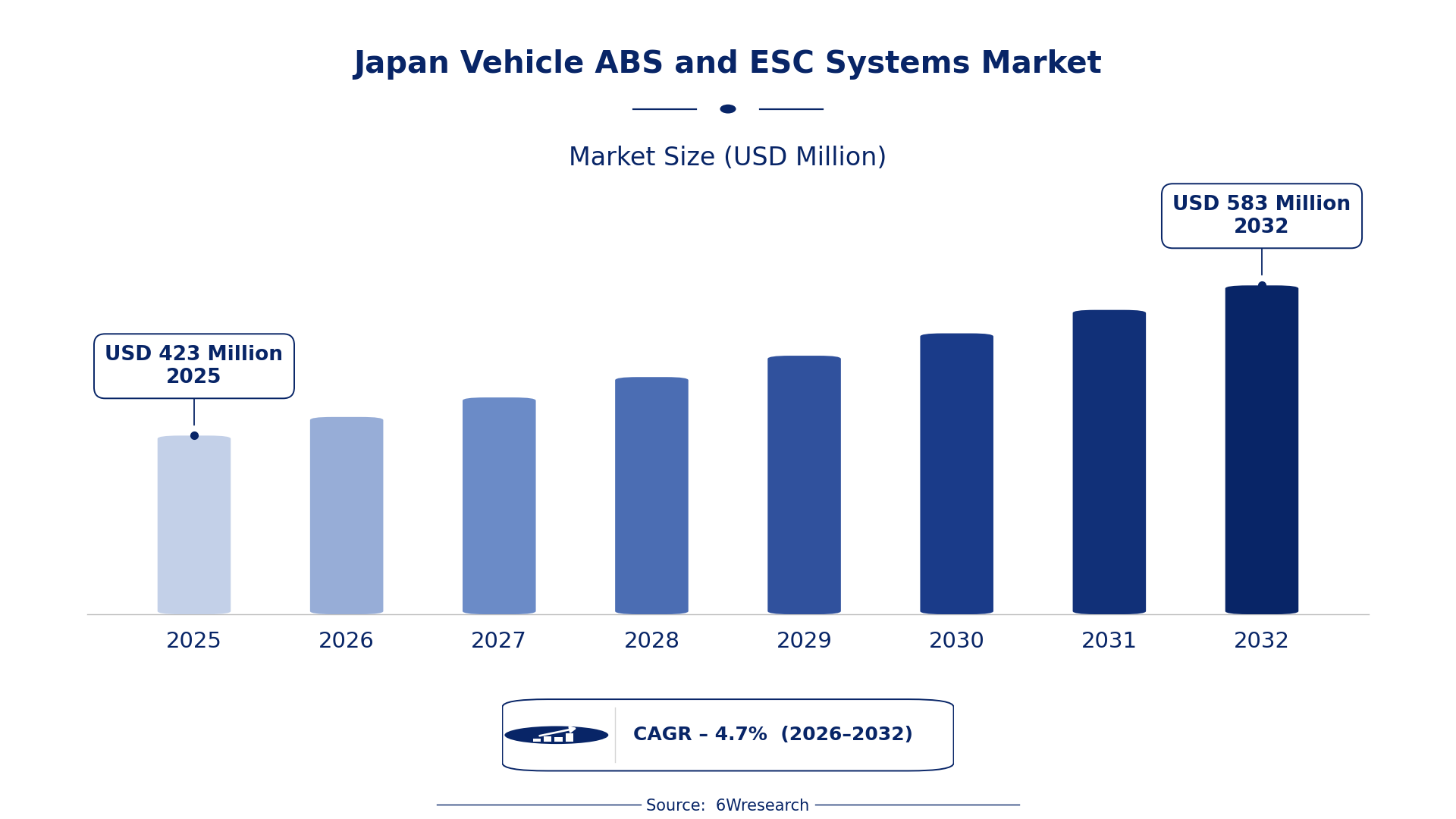
According to 6Wresearch internal database and industry insights, the Japan Vehicle ABS and ESC Systems Market was valued at USD 423 Million in 2025 and is projected to reach USD 583 Million by 2032, growing at a CAGR of approximately 4.7% during 2026–2032.
Japan Vehicle ABS and ESC Systems Market Highlights
| Report Metric | Details |
| Report Name | Japan Vehicle ABS and ESC Systems Market (2026-2032) |
| Market Size 2025 | USD 423 Million |
| Market Size 2032 | USD 583 Million |
| Absolute Growth 2025–2032 | USD 160 Million |
| CAGR 2026–2032 | 4.7% |
| Peak Annual Growth | 5.5% in 2028 |
| Forecast Period | 2026–2032 |
| Historical Data | 2022–2025 |
| Base Year | 2025 |
| Leading System Type, 2025 | ABS (Anti-lock) (37% share) |
| Leading Vehicle Type, 2025 | Passenger Cars (52% share) |
| Leading Technology Integration, 2025 | Hydraulic/Electronic (36% share) |
| Leading End User, 2025 | OEMs (44% share) |
| Fastest-Growing System Type | ESC (Stability) (7.0% CAGR) |
| Fastest-Growing Vehicle Type | Commercial Vehicles (6.7% CAGR) |
| Fastest-Growing Technology Integration | Sensor-Driven Control (7.2% CAGR) |
| Fastest-Growing End User | Fleet Operators (6.1% CAGR) |
| Growing Sector | automotive safety technologies |
| Key End Users | OEMs, Fleet Operators, Auto Manufacturers |
Japan Vehicle ABS and ESC Systems Market Year-wise Growth Rate and Key Drivers (2022–2032)
This graph illustrates the annual growth rates of the market from 2022 to 2032, highlighting a steady upward trajectory and projected market expansion over the forecast period.
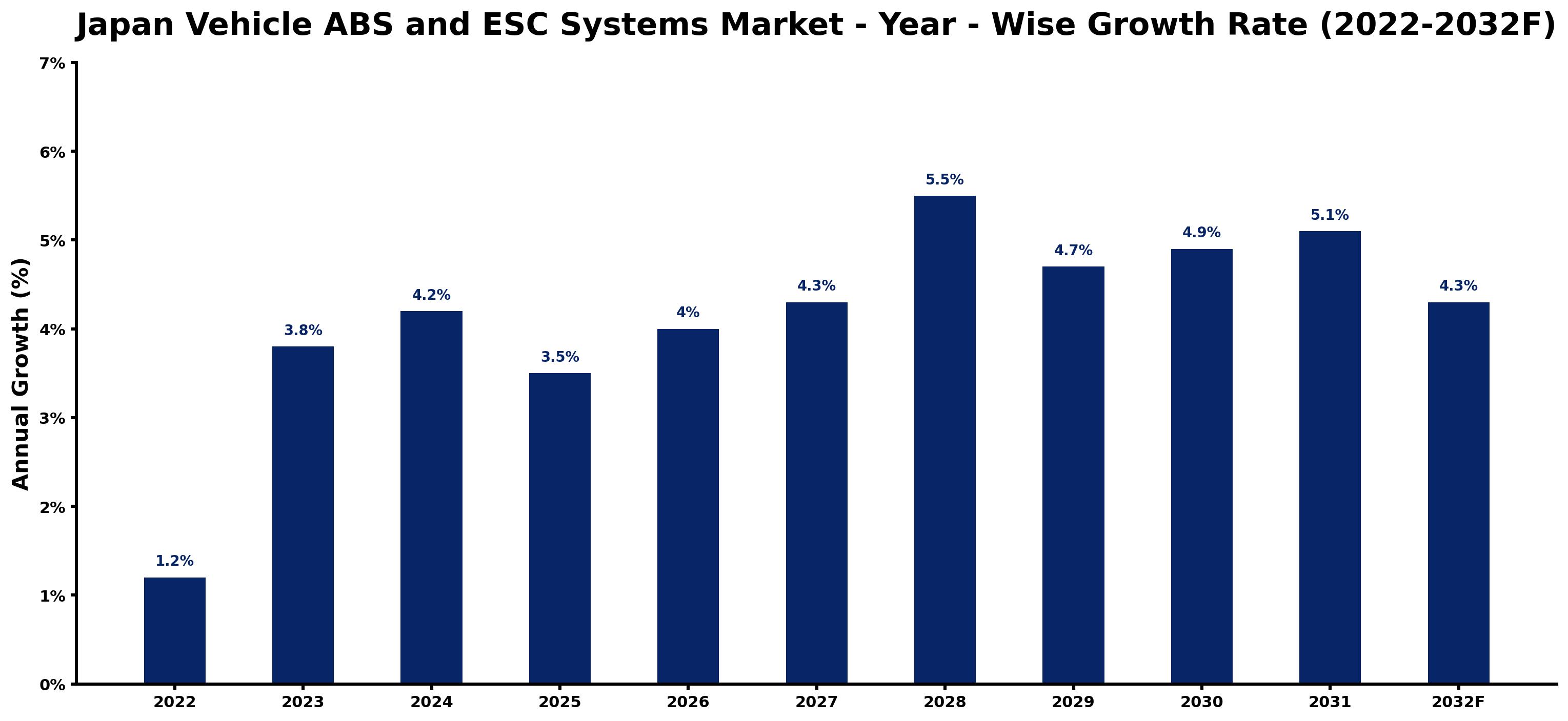
The following figures match every annual growth estimate with the main market development of that year, giving the reasoning behind each rise or slowdown.
| Year | Estimated Annual Growth (%) | Market Rationale |
| 2022 | 1.2 | The market exhibited modest growth due to steady demand for vehicle safety technologies. |
| 2023 | 3.8 | Growth accelerated as manufacturers focused on improving vehicle safety features. |
| 2024 | 4.2 | Increased consumer awareness about safety drove stronger demand for ABS and ESC systems. |
| 2025 | 3.5 | Growth slowed slightly as the market adjusted to previous high demand levels. |
| 2026 | 4.0 | Demand is expected to rise as new safety regulations come into effect. |
| 2027 | 4.3 | The market is projected to grow as technological advancements improve system capabilities. |
| 2028 | 5.5 | Peak growth is anticipated as the integration of advanced safety systems gains traction. |
| 2029 | 4.7 | Growth is expected to moderate as the market reaches a more stable phase. |
| 2030 | 4.9 | Demand will increase as manufacturers adopt greener technologies in vehicle production. |
| 2031 | 5.1 | Investment in safety technologies will continue to drive market expansion. |
| 2032 | 4.3 | Growth is expected to slow as market saturation approaches. |
Note: Market size estimations and growth projections presented in this report are based on 6Wresearch's proprietary forecasting methodology, utilizing the latest available industry data, government publications, and primary research inputs.
Japan Vehicle ABS and ESC Systems Market Synopsis
Vehicle ABS and ESC systems are crucial technologies that prevent wheel lock-up during braking and improve vehicle stability. In Japan, the automotive industry produced over 8 million vehicles in 2022, with around 70% of new vehicles featuring these systems. The Japan Vehicle ABS and ESC Systems Market is growing due to rising consumer awareness of safety, government initiatives promoting strict vehicle safety standards, and continuous technological progress in automotive safety features, especially in the passenger car segment.
Market Dynamics Impact Analysis (2026–2032)
| Factor | Type | Impact | Primary Segment Affected |
| Increasing consumer awareness of vehicle safety features | Driver | High | ABS (Anti-lock) |
| Government initiatives promoting safety standards in vehicles | Driver | High | ESC (Stability) |
| Growing demand for advanced safety technologies in electric vehicles | Opportunity | Medium | EVs |
| Expansion of the commercial vehicle market requiring enhanced safety systems | Opportunity | Medium | Commercial Vehicles |
| High costs associated with advanced safety technology development | Restraint | High | Combined ABS+ESC |
| Limited consumer awareness about the benefits of advanced systems | Restraint | Medium | Advanced Systems |
| Challenges in integrating new technologies with existing vehicle systems | Challenge | High | Sensor-Driven Control |
| Competition from alternative safety technologies and systems | Challenge | Medium | Hydraulic/Electronic |
Evaluation of Drivers in Japan Vehicle ABS and ESC Systems Market (2026–2032)
Below are the drivers that matter most for revenue growth, with supporting evidence.
| Drivers | Primary Segment Affected | Why It Matters (Evidence) |
| Rising consumer demand for vehicle safety features | ABS (Anti-lock) | Approximately 70% of new vehicles in Japan are equipped with ABS, increasing purchases. |
| Government regulations mandating safety standards | ESC (Stability) | The Japan Automobile Manufacturers Association promotes safety standards, driving demand for ESC systems. |
| Technological advancements in vehicle safety systems | Combined ABS+ESC | Integration of advanced driver-assistance systems (ADAS) is improving overall vehicle safety. |
| Growth in electric vehicle adoption | EVs | The increasing number of registered electric vehicles is boosting demand for safety technologies. |
| Expansion of the commercial vehicle sector | Commercial Vehicles | The production of over 8 million vehicles in 2022 includes a significant number of commercial vehicles. |
Buyers are adding capacity as the automotive sector in Japan produced over 8 million vehicles in 2022, leading to higher demand for safety technologies. Approximately 70% of new vehicles are equipped with ABS and ESC systems, reflecting consumer preferences for improved safety. The integration of advanced driver-assistance systems (ADAS) is driving further demand, as manufacturers focus on increasing vehicle safety. The growing electric vehicle market is another factor, as more consumers seek advanced safety features in their vehicles.
Evaluation of Restraints in Japan Vehicle ABS and ESC Systems Market
The following restraints limit how fast demand can grow.
| Market Restraint | Primary Segment Affected | Why It Matters (Evidence) |
| High development costs for advanced safety technologies | Combined ABS+ESC | Developing integrated systems requires substantial investment, limiting affordability for some manufacturers. |
| Limited consumer awareness about advanced safety systems | Advanced Systems | Many consumers remain unaware of the benefits of advanced safety technologies, hindering market growth. |
| Challenges in integrating new technologies with existing vehicles | Sensor-Driven Control | Existing vehicles may require extensive modifications to accommodate new safety systems. |
| Competition from alternative safety technologies | Hydraulic/Electronic | Emerging technologies may divert attention and investment away from traditional ABS and ESC systems. |
| Regulatory compliance costs for manufacturers | ESC (Stability) | Compliance with safety regulations can increase operational costs for vehicle manufacturers. |
Japan Vehicle ABS and ESC Systems Market Challenges
Japan's vehicle safety regulations, highlighted by JIS B 1001, impose high compliance costs on manufacturers, reaching up to 15% of production expenses, particularly impacting smaller producers. Rising material costs, worsened by global supply chain issues, have increased component prices by around 20%, forcing buyers to adjust budgets. A shortage of skilled technicians in the automotive sector has caused project delays, costing manufacturers approximately 10% in potential revenue due to unfilled positions. Rapid technological changes necessitate ongoing investment, straining the financial resources of many suppliers.
Trends in the Japan Vehicle ABS and ESC Systems Market
Four trends stand out in the Japan Vehicle ABS and ESC Systems Market.
- Shift towards Advanced Driver-Assistance Systems: In 2023, the integration of advanced driver-assistance systems (ADAS) with ABS and ESC technologies is becoming standard in new vehicles, with approximately 70% adoption in Japan. This trend improves overall vehicle safety.
- Transition from Hydraulic to Sensor-Driven Control: Since 2026, the automotive industry has been moving towards sensor-driven control systems, improving responsiveness in ABS and ESC technologies. This shift is evident in the increasing adoption of these systems in passenger cars.
- Emergence of Electric Vehicles with Enhanced Safety Features: The growing electric vehicle market is prioritising safety technologies, with a rise in demand for ABS and ESC systems. In 2022, registered electric vehicles increased by 20% in Japan.
- Focus on Reducing Traffic Fatalities: Japan's government aims to reduce traffic fatalities by 50% by 2030 through improved vehicle safety measures. This initiative is driving investments in ABS and ESC systems across the automotive sector.
Investment Opportunities in the Japan Vehicle ABS and ESC Systems Market
The following areas offer the clearest openings for investors and suppliers in the Japan Vehicle ABS and ESC Systems Market.
- Partnerships with Local Manufacturers: Now is an ideal time to enter the market through partnerships with local manufacturers, as demand for ABS and ESC systems is rising. The Tokyo region is a major hub for automotive innovation.
- Supply of Advanced Safety Technologies: With a target of reducing traffic fatalities by 50% by 2030, there is a growing opportunity to supply advanced safety technologies. OEMs are key buyers in this segment.
- Investment in Electric Vehicle Safety Systems: The increasing adoption of electric vehicles presents an opportunity to invest in safety technologies. Fleet operators are actively seeking these systems to enhance safety in their vehicles.
- Approval for New Safety Standards: Engaging in the certification process for new safety standards can open doors for suppliers. The Japan Automobile Manufacturers Association is instrumental in setting these standards.
Government Initiatives in the Japan Vehicle ABS and ESC Systems Market
The GX Promotion Act (2023) establishes a legal framework for promoting decarbonisation in the automotive sector, impacting vehicle safety technology producers. This act aims to facilitate investments in advanced safety systems, ensuring compliance with new environmental standards and improving features in vehicles. The act is part of a broader strategy to achieve net-zero emissions by 2050, with a focus on enhancing vehicle safety technologies and standards.
In 2023, the government announced a program to improve vehicle safety technologies, overseen by the Ministry of Land, Infrastructure, Transport and Tourism. This initiative aims to enhance safety standards and has a budget of JPY 150 billion for implementation, directly benefiting manufacturers of ABS and ESC systems.
Future Insight of the Japan Vehicle ABS and ESC Systems Market
The shift towards enhanced vehicle safety technologies will reshape demand for ABS and ESC systems by 2032. Japan's target to reduce traffic fatalities by 50% will drive innovation, prompting suppliers to create advanced safety features. The government's new programme to boost vehicle safety will encourage collaboration between manufacturers and technology developers. With over 60 million registered passenger cars, the automotive sector will increasingly adopt these advancements, providing buyers with safer and more reliable vehicles.
Market Segmentation Analysis
Japan Vehicle ABS and ESC Systems Market report covers a detailed analysis of the following market segments:
By System Type – ABS (Anti-lock) Leads, ESC (Stability) Expected to Grow Fastest
According to Saurav Kr Singh, Senior Research Analyst at 6Wresearch, ABS (Anti-lock) held 37% of the Japan Vehicle ABS and ESC Systems Market by system type in 2025. ABS holds the largest share due to its essential function in preventing wheel lock-up during braking, which is vital for vehicle safety. In Japan, approximately 70% of new vehicles are equipped with ABS, highlighting its critical role in the automotive sector. ESC (Stability) is projected to grow fastest, at a CAGR of 7.0% during 2026–2032. The ESC segment is growing rapidly as it becomes increasingly integrated with advanced driver-assistance systems, which enhance vehicle stability. The government's target to reduce traffic fatalities by 50% by 2030 further propels the demand for ESC technologies in vehicles. Suppliers should focus on enhancing ESC offerings to capitalise on the rising safety standards and regulations.
By Vehicle Type – Passenger Cars Lead, Commercial Vehicles Expected to Grow Fastest
In 2025, Passenger Cars led the vehicle type split with a 52% share. Passenger cars dominate the market as they represent the largest segment utilising ABS and ESC systems, driven by consumer demand for enhanced safety features. With over 8 million vehicles produced in Japan in 2022, this segment remains crucial for both manufacturers and suppliers. Over 2026–2032, Commercial Vehicles are expected to post the fastest growth, at a CAGR of 6.7%. Commercial vehicles are experiencing the fastest growth due to stricter safety regulations and the increasing necessity for improved safety in larger vehicles. Ongoing government initiatives aimed at enhancing vehicle safety technologies directly influence the adoption of ABS and ESC in this segment. Buyers in the commercial vehicle sector should prioritise safety technologies to comply with regulations and enhance operational safety.
By Technology Integration – Hydraulic/Electronic Leads, Sensor-Driven Control Expected to Grow Fastest
With 36% of technology integration revenue in 2025, Hydraulic/Electronic was the largest category. Hydraulic/Electronic technology leads the market as it is the traditional and widely accepted method in ABS and ESC systems. This established technology benefits from a strong installed base, ensuring its ongoing relevance in vehicle safety applications. The quickest growth will come from Sensor-Driven Control, forecast to expand at a CAGR of 7.2% between 2026 and 2032. Sensor-Driven Control technology is gaining momentum as it significantly enhances system responsiveness and overall vehicle safety. The industry's push for smarter safety solutions aligns with this modern approach, making it a key area for growth. Suppliers must invest in sensor-driven technologies to maintain competitiveness and meet the evolving demands of the automotive market.
By End User – OEMs Lead, Fleet Operators Expected to Grow Fastest
OEMs accounted for 44% of the market by end user in 2025. OEMs are the primary users of ABS and ESC systems in new vehicles, driving the largest share in the market. Their continuous innovation and focus on safety standards ensure a steady demand for these technologies in vehicle production. Fleet Operators are set to record the highest CAGR in this split, 6.1% over 2026–2032. Fleet Operators are experiencing the fastest growth as they increasingly recognise the importance of safety technologies for effective fleet management. The rising emphasis on safety and efficiency in fleet operations propels the demand for ABS and ESC systems. Suppliers should tailor their offerings to meet the specific safety needs of fleet operators to capture this growing market segment.
Key Attractiveness of the Report
- 10 Years of Market Numbers
- Historical Data Starting from 2022 to 2025
- Base Year 2025
- Forecast Data until 2032
- Key Performance Indicators Impacting the Market
- Major Upcoming Developments and Projects
Key Highlights of the Report:
- Japan Vehicle ABS and ESC Systems Market Outlook
- Market Size of Japan Vehicle ABS and ESC Systems Market, 2025
- Forecast of Japan Vehicle ABS and ESC Systems Market, 2032
- Historical Data and Forecast of Japan Vehicle ABS and ESC Systems Revenues & Volume for the Period 2022-2032F
- Japan Vehicle ABS and ESC Systems Market Trend Evolution
- Japan Vehicle ABS and ESC Systems Market Drivers and Challenges
- Japan Vehicle ABS and ESC Systems Price Trends
- Japan Vehicle ABS and ESC Systems Porter's Five Forces
- Japan Vehicle ABS and ESC Systems Industry Life Cycle
- Historical Data and Forecast of Japan Vehicle ABS and ESC Systems Market Revenues & Volume By System Type for the Period 2022-2032F
- Historical Data and Forecast of Japan Vehicle ABS and ESC Systems Market Revenues & Volume By ABS (Anti-lock) for the Period 2022-2032F
- Historical Data and Forecast of Japan Vehicle ABS and ESC Systems Market Revenues & Volume By ESC (Stability) for the Period 2022-2032F
- Historical Data and Forecast of Japan Vehicle ABS and ESC Systems Market Revenues & Volume By Combined ABS+ESC for the Period 2022-2032F
- Historical Data and Forecast of Japan Vehicle ABS and ESC Systems Market Revenues & Volume By Advanced Systems for the Period 2022-2032F
- Historical Data and Forecast of Japan Vehicle ABS and ESC Systems Market Revenues & Volume By Vehicle Type for the Period 2022-2032F
- Historical Data and Forecast of Japan Vehicle ABS and ESC Systems Market Revenues & Volume By Passenger Cars for the Period 2022-2032F
- Historical Data and Forecast of Japan Vehicle ABS and ESC Systems Market Revenues & Volume By Commercial Vehicles for the Period 2022-2032F
- Historical Data and Forecast of Japan Vehicle ABS and ESC Systems Market Revenues & Volume By SUVs/Trucks for the Period 2022-2032F
- Historical Data and Forecast of Japan Vehicle ABS and ESC Systems Market Revenues & Volume By EVs for the Period 2022-2032F
- Historical Data and Forecast of Japan Vehicle ABS and ESC Systems Market Revenues & Volume By Technology Integration for the Period 2022-2032F
- Historical Data and Forecast of Japan Vehicle ABS and ESC Systems Market Revenues & Volume By Hydraulic/Electronic for the Period 2022-2032F
- Historical Data and Forecast of Japan Vehicle ABS and ESC Systems Market Revenues & Volume By Sensor-Driven Control for the Period 2022-2032F
- Historical Data and Forecast of Japan Vehicle ABS and ESC Systems Market Revenues & Volume By AI & Sensor Fusion for the Period 2022-2032F
- Historical Data and Forecast of Japan Vehicle ABS and ESC Systems Market Revenues & Volume By Integrated Braking AI for the Period 2022-2032F
- Historical Data and Forecast of Japan Vehicle ABS and ESC Systems Market Revenues & Volume By End User for the Period 2022-2032F
- Historical Data and Forecast of Japan Vehicle ABS and ESC Systems Market Revenues & Volume By OEMs for the Period 2022-2032F
- Historical Data and Forecast of Japan Vehicle ABS and ESC Systems Market Revenues & Volume By Fleet Operators for the Period 2022-2032F
- Historical Data and Forecast of Japan Vehicle ABS and ESC Systems Market Revenues & Volume By Auto Manufacturers for the Period 2022-2032F
- Historical Data and Forecast of Japan Vehicle ABS and ESC Systems Market Revenues & Volume By Aftermarket Suppliers for the Period 2022-2032F
- Japan Vehicle ABS and ESC Systems Import Export Trade Statistics
- Market Opportunity Assessment By System Type
- Market Opportunity Assessment By Vehicle Type
- Market Opportunity Assessment By Technology Integration
- Market Opportunity Assessment By End User
- Japan Vehicle ABS and ESC Systems Top Companies Market Share
- Japan Vehicle ABS and ESC Systems Competitive Benchmarking By Technical and Operational Parameters
- Japan Vehicle ABS and ESC Systems Company Profiles
- Japan Vehicle ABS and ESC Systems Key Strategic Recommendations
Market Covered
Segments analysed in this report are listed below.
By System Type
- ABS (Anti-lock)
- ESC (Stability)
- Combined ABS+ESC
- Advanced Systems
By Vehicle Type
- Passenger Cars
- Commercial Vehicles
- SUVs/Trucks
- EVs
By Technology Integration
- Hydraulic/Electronic
- Sensor-Driven Control
- AI & Sensor Fusion
- Integrated Braking AI
By End User
- OEMs
- Fleet Operators
- Auto Manufacturers
- Aftermarket Suppliers































