Japan Vehicle ABS Market Size & Growth Rate
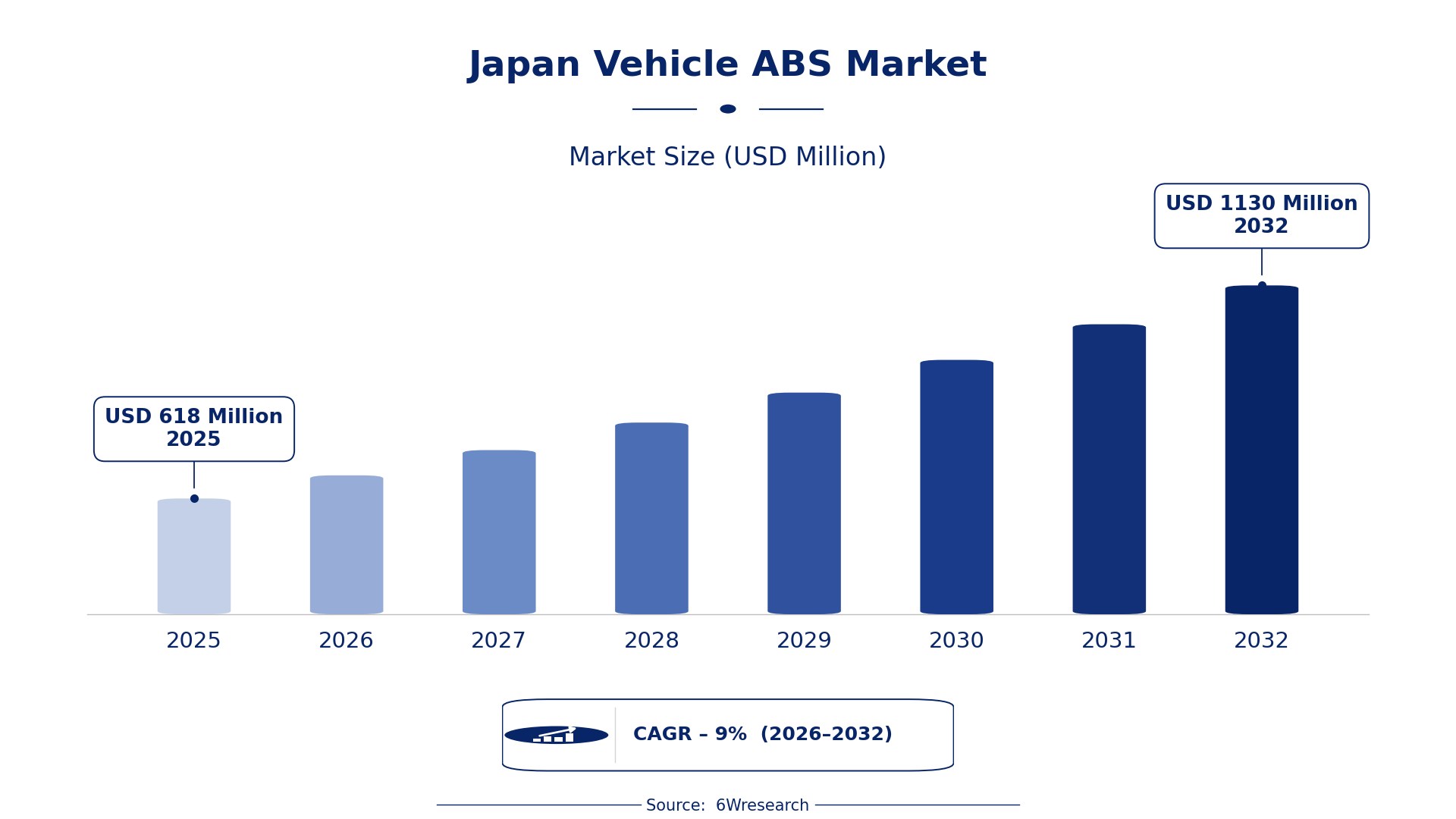
According to 6Wresearch internal database and industry insights, the Japan Vehicle ABS Market was valued at USD 618 Million in 2025 and is projected to reach USD 1,130 Million by 2032, growing at a CAGR of approximately 9% during 2026–2032.
Japan Vehicle ABS Market Highlights
| Report Metric | Details |
| Report Name | Japan Vehicle ABS Market (2026-2032) |
| Market Size 2025 | USD 618 Million |
| Market Size 2032 | USD 1,130 Million |
| Absolute Growth 2025–2032 | USD 512 Million |
| CAGR 2026–2032 | 9% |
| Peak Annual Growth | 9.4% in 2029 |
| Forecast Period | 2026–2032 |
| Historical Data | 2022–2025 |
| Base Year | 2025 |
| Leading ABS Type, 2025 | Four-Channel ABS (46% share) |
| Leading Sensor Type, 2025 | Wheel Speed Sensor (45% share) |
| Leading Vehicle Class, 2025 | Luxury Vehicles (44% share) |
| Leading End User, 2025 | OEMs (48% share) |
| Fastest-Growing ABS Type | Regenerative ABS (13.1% CAGR) |
| Fastest-Growing Sensor Type | Integrated Systems (12.7% CAGR) |
| Fastest-Growing Vehicle Class | EVs (11.6% CAGR) |
| Fastest-Growing End User | EV Manufacturers (12.3% CAGR) |
| Growing Sector | automotive safety technology |
| Key End Users | OEMs, Tier 1 Suppliers, EV Manufacturers, Garage/Service Centers |
Japan Vehicle ABS Market Year-wise Growth Rate and Key Drivers (2022–2032)
This graph illustrates the annual growth rates of the market from 2022 to 2032, highlighting a steady upward trajectory and projected market expansion over the forecast period.
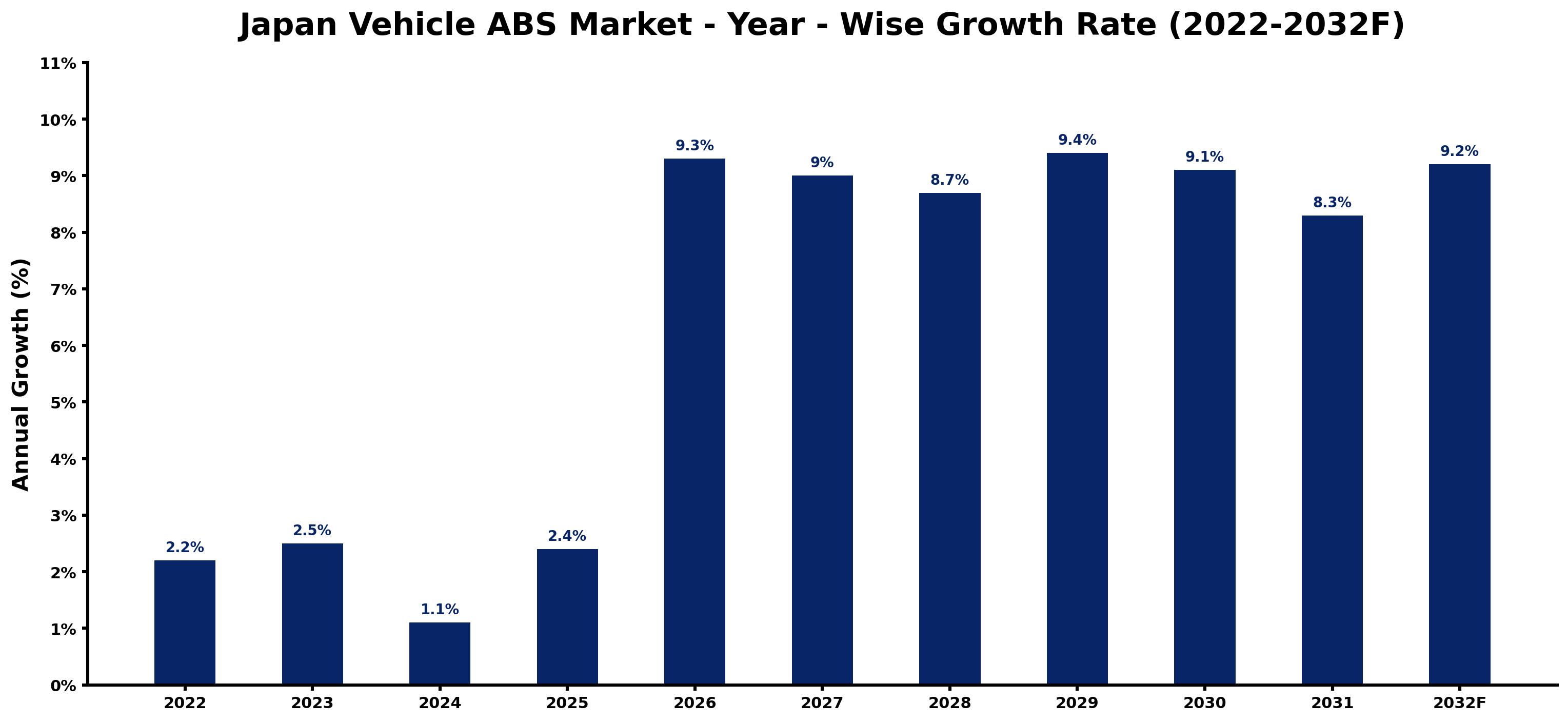
The yearly estimates that follow link every growth rate to its principal driver, so readers can see why the pace changed in each period.
| Year | Estimated Annual Growth (%) | Market Rationale |
| 2022 | 2.2 | The market experienced steady growth with increasing vehicle production and heightened safety awareness. |
| 2023 | 2.5 | Demand rose as vehicle manufacturers prioritised safety features in new models. |
| 2024 | 1.1 | Growth slowed due to market saturation and a higher average vehicle age affecting ABS adoption rates. |
| 2025 | 2.4 | The introduction of advanced safety regulations spurred renewed interest in ABS technology. |
| 2026 | 9.3 | Demand is expected to surge as manufacturers ramp up production of electric vehicles equipped with ABS. |
| 2027 | 9.0 | Growth is projected to slow slightly, reflecting market adjustments after a period of rapid expansion. |
| 2028 | 8.7 | Continued focus on safety standards is expected to maintain demand, though at a reduced growth rate. |
| 2029 | 9.4 | A peak in growth is anticipated, driven by a surge in new vehicle registrations and safety upgrades. |
| 2030 | 9.1 | Demand is expected to remain strong, supported by ongoing investments in ABS technology for EVs. |
| 2031 | 8.3 | Growth is projected to slow as the market stabilises after reaching high adoption rates in recent years. |
| 2032 | 9.2 | The market is expected to grow as new safety regulations are implemented for all vehicles. |
Note: Market size estimations and growth projections presented in this report are based on 6Wresearch's proprietary forecasting methodology, utilizing the latest available industry data, government publications, and primary research inputs.
Japan Vehicle ABS Market Synopsis
Vehicle ABS is a critical safety technology that prevents wheel lock-up during braking, manufactured using electronic control units, hydraulic valves, and sensors. The Japan Vehicle ABS Market is driven by a focus on safety features, with 70% of new vehicles equipped with ABS. The automotive industry in Japan produced 8.3 million vehicles in 2022, with demand supported by local manufacturers and imports. A government programme in 2023 aims to improve EV safety features, further stimulating market growth.
Market Dynamics Impact Analysis (2026–2032)
| Factor | Type | Impact | Primary Segment Affected |
| Increasing vehicle production and safety standards drive demand for ABS technology. | Driver | High | Four-Channel ABS |
| The shift towards electric vehicles necessitates advanced ABS systems for safety and performance. | Driver | High | Regenerative ABS |
| Growing consumer awareness of vehicle safety features presents opportunities for suppliers. | Opportunity | High | Luxury Vehicles |
| The push for sustainability in automotive manufacturing opens avenues for innovative ABS solutions. | Opportunity | Medium | EVs |
| The average age of vehicles in Japan limits the adoption of newer ABS technologies. | Restraint | High | Mid-Range Cars |
| Cost constraints in the economy segment restrict the use of advanced ABS systems. | Restraint | Medium | Economy Segment |
| High investment costs for upgrading ABS technology can deter manufacturers. | Challenge | High | OEMs |
| The need for compliance with stringent safety regulations can delay product development. | Challenge | Medium | Tier 1 Suppliers |
Evaluation of Drivers in Japan Vehicle ABS Market (2026–2032)
Demand rests on the following drivers, each shown with the segment it touches most.
| Drivers | Primary Segment Affected | Why It Matters (Evidence) |
| Rising vehicle production in Japan fuels demand for ABS systems. | Four-Channel ABS | In 2022, Japan produced 8.3 million vehicles, many equipped with ABS. |
| The transition to electric vehicles increases the need for advanced ABS technology. | Regenerative ABS | The government aims for net zero emissions by 2050, driving EV adoption. |
| Consumer demand for enhanced safety features leads to increased ABS installations. | Luxury Vehicles | 70% of new vehicles sold in 2022 were equipped with ABS. |
| Investment in automotive technology upgrades supports ABS development. | OEMs | Tier 1 suppliers are investing significantly in ABS technology enhancements. |
| Government regulations promote the adoption of advanced safety systems in vehicles. | EVs | A target for all new vehicles to have advanced safety systems by 2025 is set. |
What keeps demand rising is the increasing production of vehicles in Japan, with 8.3 million units manufactured in 2022, many equipped with ABS technology. Consumer awareness of safety features is growing, leading to a high percentage of new vehicles sold in 2022 being equipped with ABS. Investment in automotive technology upgrades supports ABS development, as suppliers are investing heavily in technology enhancements to meet evolving standards.
Evaluation of Restraints in Japan Vehicle ABS Market
These restraints slow adoption and weigh on supplier margins.
| Market Restraint | Primary Segment Affected | Why It Matters (Evidence) |
| The average age of vehicles in Japan limits the adoption of newer ABS technologies. | Mid-Range Cars | With an average vehicle age of 13 years, many lack modern ABS systems. |
| Cost constraints in the economy segment restrict the use of advanced ABS systems. | Economy Segment | Limited budgets prevent the installation of high-end ABS technology. |
| High investment costs for upgrading ABS technology can deter manufacturers. | OEMs | The initial costs of implementing advanced ABS systems can be prohibitive. |
| The need for compliance with stringent safety regulations can delay product development. | Tier 1 Suppliers | Manufacturers face challenges in meeting evolving safety standards promptly. |
| Market saturation in certain vehicle classes slows down ABS adoption rates. | Luxury Vehicles | High penetration of ABS in luxury vehicles limits further growth opportunities. |
Japan Vehicle ABS Market Challenges
Supply chain disruptions in the ABS production process lead to delays, causing manufacturers to experience production lags of up to three months. Increased competition from international markets forces local producers to lower prices, which can reduce profit margins for suppliers by around 15%. A shortage of skilled technicians in advanced automotive technologies limits workforce capabilities, slowing innovation for clinics and aftermarket services. The average vehicle age of 13 years restricts the adoption of modern ABS systems, resulting in safety improvements being delayed for buyers.
Trends in the Japan Vehicle ABS Market
The following changes are redrawing the Japan Vehicle ABS Market.
- Shift from Conventional to Advanced ABS Systems: Since 2023, the automotive industry in Japan has been transitioning towards advanced ABS systems integrated with electric vehicles. This shift is highlighted by the Tokyo Motor Show 2023, showcasing new ABS technologies designed for EVs, reflecting a growing emphasis on safety.
- Emergence of Regenerative ABS in EVs: Beginning in 2026, regenerative ABS technology is gaining traction in electric vehicles. This trend is driven by the need for energy recovery systems, with a projected CAGR of 13.1% for regenerative ABS, indicating a shift in the market.
- Focus on Safety Standards for New Vehicles: In 2025, Japan aims for all new vehicles to be equipped with advanced safety systems. This initiative is backed by the Japan Automobile Manufacturers Association, which promotes stringent safety standards, ensuring higher ABS adoption rates.
- Integration of ABS in Aftermarket Services: Starting in 2023, the automotive aftermarket in Japan, valued at ¥3 trillion, is increasingly focusing on ABS components. This trend indicates a growing demand for maintenance and upgrades in existing vehicles, particularly those over 13 years old.
Investment Opportunities in the Japan Vehicle ABS Market
The openings below show where demand in the Japan Vehicle ABS Market is visible and how suppliers can enter.
- Growing Demand for EV Safety Features: With a target for net zero emissions by 2050, there is a rising need for advanced ABS systems in electric vehicles. The automotive sector is investing heavily in this area, particularly among EV manufacturers looking to improve safety features.
- Investment in ABS Technology Upgrades: The Japanese government allocated ¥100 billion for automotive technology advancements in 2023, creating opportunities for suppliers to develop effective ABS solutions. This funding is essential for OEMs seeking to meet new safety standards.
- Expansion of ABS in Luxury Vehicles: As consumer awareness of safety features increases, luxury vehicle manufacturers are prioritising advanced ABS systems. This presents an opportunity for suppliers to collaborate with OEMs in the luxury segment to improve safety offerings.
- Growing Aftermarket for ABS Components: The automotive aftermarket, valued at ¥3 trillion, is expanding its focus on ABS components. Service centres and garages can capitalise on this trend by offering maintenance and upgrades for older vehicles.
Government Initiatives in the Japan Vehicle ABS Market
Recent measures have been implemented to improve vehicle safety in Japan, including the Green Growth Strategy, which identifies growth sectors for automotive technology and promotes the adoption of advanced safety features, including ABS, across all vehicle classes. This strategy aims to improve the overall safety of vehicles on the road and support compliance with evolving regulations.
In 2023, ¥100 billion was allocated for automotive technology advancements, overseen by the Ministry of Land, Infrastructure, Transport and Tourism. This funding supports the development and integration of ABS technology in new vehicle models, ensuring compliance with safety regulations.
Future Insight of the Japan Vehicle ABS Market
A policy-driven shift towards enhanced vehicle safety standards will reshape the automotive landscape in Japan. Suppliers will need to invest in advanced ABS technologies to meet the government's target for all new vehicles to feature sophisticated safety systems by 2025. The automotive aftermarket, valued at ¥3 trillion, will see increased opportunities for innovation as demand for ABS components rises. The Tokyo Motor Show will play a crucial role in showcasing advancements in ABS technology, influencing buyer preferences and future vehicle designs.
Market Segmentation Analysis
Japan Vehicle ABS Market report covers a detailed analysis of the following market segments:
By ABS Type – Four-Channel ABS Leads, Regenerative ABS Expected to Grow Fastest
According to Saurav Kr Singh, Senior Research Analyst at 6Wresearch, the largest abs type category in 2025 was Four-Channel ABS, at 46% of revenue. Four-Channel ABS holds the largest share because it is extensively used in most modern vehicles, ensuring optimal safety during braking. This technology is crucial for meeting the JIS D 5010 standard, which governs ABS performance in Japan. The quickest growth will come from Regenerative ABS, forecast to expand at a CAGR of 13.1% between 2026 and 2032. Regenerative ABS is experiencing rapid growth due to its integration in electric vehicles, designed to recover energy during braking. The government's 2023 initiative to enhance EV safety features further accelerates this segment's expansion. Suppliers must focus on developing regenerative ABS technologies to cater to the increasing demand from the electric vehicle market.
By Sensor Type – Wheel Speed Sensor Leads, Integrated Systems Expected to Grow Fastest
Wheel Speed Sensor accounted for 45% of the market by sensor type in 2025. The Wheel Speed Sensor is the leading type as it is essential for the proper functionality of ABS, making it indispensable in modern vehicles. Its widespread use underscores its importance in maintaining safety during braking operations. Integrated Systems are set to record the highest CAGR in this split, 12.7% over 2026–2032. Integrated Systems are growing quickly as they are increasingly adopted in modern vehicles for their advanced safety capabilities. This trend is driven by the automotive industry's focus on enhancing safety features to comply with regulations. Buyers should consider investing in integrated systems to ensure compliance with the latest safety standards and meet consumer expectations.
By Vehicle Class – Luxury Vehicles Lead, EVs Expected to Grow Fastest
Luxury Vehicles held 44% of the Japan Vehicle ABS Market by vehicle class in 2025. Luxury Vehicles dominate the market due to a high demand for advanced safety features that enhance both performance and security. Consumers in this segment are willing to invest significantly in premium safety technologies, reflecting their value in the automotive sector. EVs are projected to grow fastest, at a CAGR of 11.6% during 2026–2032. EVs are the fastest-growing segment, becoming vital for performance and safety as the industry shifts towards sustainable transportation. The government's target for all new vehicles to have advanced safety systems by 2025 is propelling this growth. Suppliers need to adapt their products to meet the specific safety requirements of the rapidly expanding electric vehicle market.
By End User – OEMs Lead, EV Manufacturers Expected to Grow Fastest
With 48% of end user revenue in 2025, OEMs was the largest category. OEMs are the largest end user group for ABS technology, as they are the primary manufacturers of vehicles equipped with this critical safety system. Their central role in vehicle production ensures consistent demand for ABS to adhere to safety regulations. Over 2026–2032, EV Manufacturers are expected to post the fastest growth, at a CAGR of 12.3%. EV Manufacturers are increasingly incorporating advanced ABS technologies to enhance vehicle safety and performance, reflecting the industry's shift towards electrification. Government support for automotive technology advancements is facilitating this transition. Suppliers should establish partnerships with EV manufacturers to capitalise on the growing demand for advanced ABS solutions.
Key Attractiveness of the Report
- 10 Years of Market Numbers
- Historical Data Starting from 2022 to 2025
- Base Year 2025
- Forecast Data until 2032
- Key Performance Indicators Impacting the Market
- Major Upcoming Developments and Projects
Key Highlights of the Report:
- Japan Vehicle ABS Market Outlook
- Market Size of Japan Vehicle ABS Market, 2025
- Forecast of Japan Vehicle ABS Market, 2032
- Historical Data and Forecast of Japan Vehicle ABS Revenues & Volume for the Period 2022-2032F
- Japan Vehicle ABS Market Trend Evolution
- Japan Vehicle ABS Market Drivers and Challenges
- Japan Vehicle ABS Price Trends
- Japan Vehicle ABS Porter's Five Forces
- Japan Vehicle ABS Industry Life Cycle
- Historical Data and Forecast of Japan Vehicle ABS Market Revenues & Volume By ABS Type for the Period 2022-2032F
- Historical Data and Forecast of Japan Vehicle ABS Market Revenues & Volume By Four-Channel ABS for the Period 2022-2032F
- Historical Data and Forecast of Japan Vehicle ABS Market Revenues & Volume By Three-Channel ABS for the Period 2022-2032F
- Historical Data and Forecast of Japan Vehicle ABS Market Revenues & Volume By Single-Channel ABS for the Period 2022-2032F
- Historical Data and Forecast of Japan Vehicle ABS Market Revenues & Volume By Regenerative ABS for the Period 2022-2032F
- Historical Data and Forecast of Japan Vehicle ABS Market Revenues & Volume By Sensor Type for the Period 2022-2032F
- Historical Data and Forecast of Japan Vehicle ABS Market Revenues & Volume By Wheel Speed Sensor for the Period 2022-2032F
- Historical Data and Forecast of Japan Vehicle ABS Market Revenues & Volume By Hydraulic Valves for the Period 2022-2032F
- Historical Data and Forecast of Japan Vehicle ABS Market Revenues & Volume By Basic Sensor Unit for the Period 2022-2032F
- Historical Data and Forecast of Japan Vehicle ABS Market Revenues & Volume By Integrated Systems for the Period 2022-2032F
- Historical Data and Forecast of Japan Vehicle ABS Market Revenues & Volume By Vehicle Class for the Period 2022-2032F
- Historical Data and Forecast of Japan Vehicle ABS Market Revenues & Volume By Luxury Vehicles for the Period 2022-2032F
- Historical Data and Forecast of Japan Vehicle ABS Market Revenues & Volume By Mid-Range Cars for the Period 2022-2032F
- Historical Data and Forecast of Japan Vehicle ABS Market Revenues & Volume By Economy Segment for the Period 2022-2032F
- Historical Data and Forecast of Japan Vehicle ABS Market Revenues & Volume By EVs for the Period 2022-2032F
- Historical Data and Forecast of Japan Vehicle ABS Market Revenues & Volume By End User for the Period 2022-2032F
- Historical Data and Forecast of Japan Vehicle ABS Market Revenues & Volume By OEMs for the Period 2022-2032F
- Historical Data and Forecast of Japan Vehicle ABS Market Revenues & Volume By Tier 1 Suppliers for the Period 2022-2032F
- Historical Data and Forecast of Japan Vehicle ABS Market Revenues & Volume By Garage/Service Centers for the Period 2022-2032F
- Historical Data and Forecast of Japan Vehicle ABS Market Revenues & Volume By EV Manufacturers for the Period 2022-2032F
- Japan Vehicle ABS Import Export Trade Statistics
- Market Opportunity Assessment By ABS Type
- Market Opportunity Assessment By Sensor Type
- Market Opportunity Assessment By Vehicle Class
- Market Opportunity Assessment By End User
- Japan Vehicle ABS Top Companies Market Share
- Japan Vehicle ABS Competitive Benchmarking By Technical and Operational Parameters
- Japan Vehicle ABS Company Profiles
- Japan Vehicle ABS Key Strategic Recommendations
Market Covered
This report examines the market across the segments below.
By ABS Type
- Four-Channel ABS
- Three-Channel ABS
- Single-Channel ABS
- Regenerative ABS
By Sensor Type
- Wheel Speed Sensor
- Hydraulic Valves
- Basic Sensor Unit
- Integrated Systems
By Vehicle Class
- Luxury Vehicles
- Mid-Range Cars
- Economy Segment
- EVs
By End User
- OEMs
- Tier 1 Suppliers
- Garage/Service Centers
- EV Manufacturers































