Japan Vehicle Acoustic Systems Market Size & Growth Rate
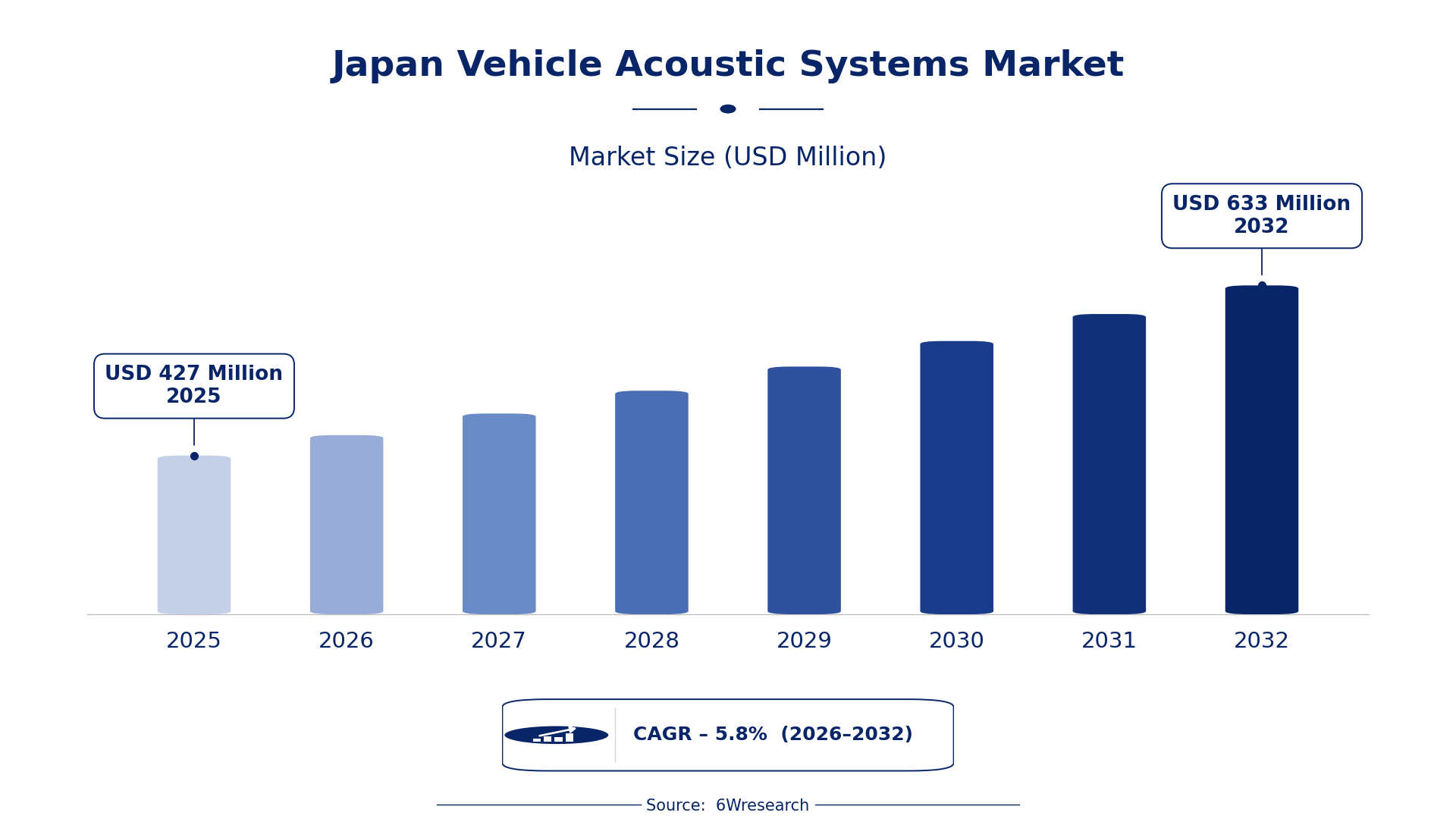
According to 6Wresearch internal database and industry insights, the Japan Vehicle Acoustic Systems Market was valued at USD 427 Million in 2025 and is projected to reach USD 633 Million by 2032, growing at a CAGR of approximately 5.8% during 2026–2032.
Japan Vehicle Acoustic Systems Market Highlights
| Report Metric | Details |
| Report Name | Japan Vehicle Acoustic Systems Market (2026-2032) |
| Market Size 2025 | USD 427 Million |
| Market Size 2032 | USD 633 Million |
| Absolute Growth 2025–2032 | USD 206 Million |
| CAGR 2026–2032 | 5.8% |
| Peak Annual Growth | 7.0% in 2032 |
| Forecast Period | 2026–2032 |
| Historical Data | 2022–2025 |
| Base Year | 2025 |
| Leading System Type, 2025 | Active Noise Control (39% share) |
| Leading Noise Source, 2025 | Road/Tire/Vibration (40% share) |
| Leading Technology Used, 2025 | DSP (47% share) |
| Leading End User, 2025 | Premium Car Manufacturers (49% share) |
| Fastest-Growing System Type | Cabin Quiet Systems (8.2% CAGR) |
| Fastest-Growing Noise Source | Wind & Ambient Noise (8.6% CAGR) |
| Fastest-Growing Technology Used | Sensor Feedback Loop (8.9% CAGR) |
| Fastest-Growing End User | EV Makers (7.9% CAGR) |
| Growing Sector | automotive noise management |
| Key End Users | premium car manufacturers, vehicle assemblers, EV makers, luxury OEMs |
Japan Vehicle Acoustic Systems Market Year-wise Growth Rate and Key Drivers (2022–2032)
This graph illustrates the annual growth rates of the market from 2022 to 2032, highlighting a steady upward trajectory and projected market expansion over the forecast period.
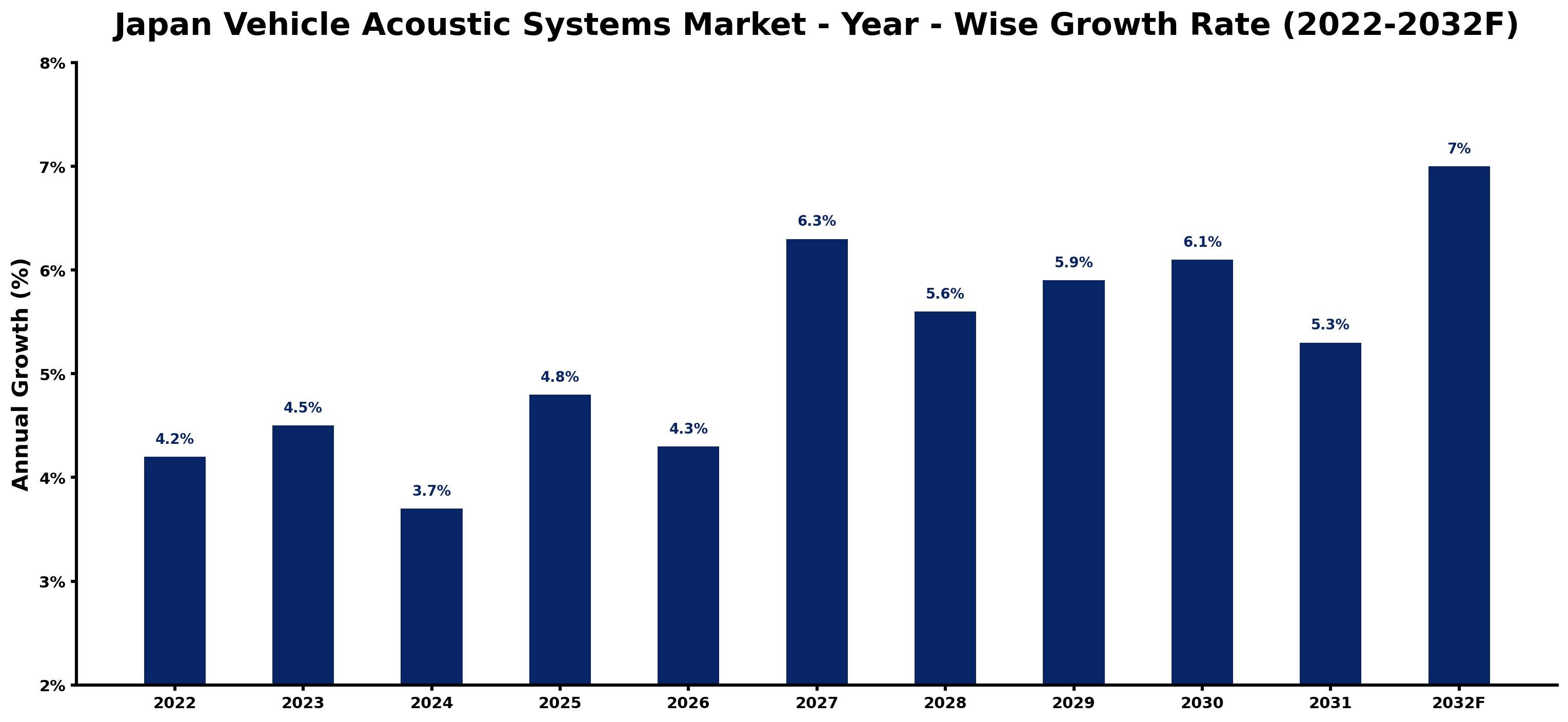
Year by year, the estimates below pair each growth rate with the development that shaped it.
| Year | Estimated Annual Growth (%) | Market Rationale |
| 2022 | 4.2 | The automotive sector showed steady demand for acoustic systems amid ongoing production. |
| 2023 | 4.5 | Vehicle production increased, resulting in a higher need for noise management solutions. |
| 2024 | 3.7 | Market growth slowed as manufacturers adjusted to changing acoustic technology requirements. |
| 2025 | 4.8 | The adoption of advanced noise control systems accelerated with rising vehicle quality standards. |
| 2026 | 4.3 | Growth is expected to slow as manufacturers face challenges integrating new technologies. |
| 2027 | 6.3 | Demand is projected to surge with the growing prevalence of electric vehicles requiring advanced acoustic solutions. |
| 2028 | 5.6 | Market growth is anticipated to decelerate as competition intensifies among system providers. |
| 2029 | 5.9 | Consumer expectations for comfort will drive demand for new noise management technologies. |
| 2030 | 6.1 | Stricter noise regulations are expected to further boost the market for acoustic systems. |
| 2031 | 5.3 | Growth is projected to moderate as manufacturers focus on cost efficiency in production processes. |
| 2032 | 7.0 | Demand is expected to peak as manufacturers strive to meet high standards for passenger comfort. |
Note: Market size estimations and growth projections presented in this report are based on 6Wresearch's proprietary forecasting methodology, utilizing the latest available industry data, government publications, and primary research inputs.
Japan Vehicle Acoustic Systems Market Synopsis
Vehicle Acoustic Systems manage and reduce noise in vehicles through active and passive methods, utilising technologies such as microphones and DSP. The Japan Vehicle Acoustic Systems Market is growing due to the production of over 8 million vehicles in 2022, particularly in electric vehicles that require effective noise management solutions. With a strong focus on research and development, manufacturers are adopting advanced technologies to improve passenger comfort and meet changing consumer demands for quality.
Market Dynamics Impact Analysis (2026–2032)
| Factor | Type | Impact | Primary Segment Affected |
| Rising production of electric vehicles | Driver | High | Active Noise Control |
| Increased consumer demand for comfort in vehicles | Driver | High | Cabin Quiet Systems |
| Growing focus on noise reduction technologies | Opportunity | High | Passive Damping |
| Expansion of vehicle manufacturing in the Tokyo region | Opportunity | Medium | Road/Tire/Vibration |
| High costs associated with advanced acoustic technologies | Restraint | High | DSP |
| Limited availability of skilled workforce for R&D | Restraint | Medium | Microphones |
| Intense competition among system providers | Challenge | High | Insulation Panels |
| Regulatory changes affecting production processes | Challenge | Medium | Sound Generators |
Evaluation of Drivers in Japan Vehicle Acoustic Systems Market (2026–2032)
Demand rests on the following drivers, each shown with the segment it touches most.
| Drivers | Primary Segment Affected | Why It Matters (Evidence) |
| Increased production of electric vehicles | Active Noise Control | Electric vehicles require advanced noise management, leading to heightened demand for acoustic systems. |
| Growing consumer comfort expectations | Cabin Quiet Systems | As the average household owns 1.2 vehicles, demand for comfort-focused systems has surged. |
| Growing R&D investments in noise control technologies | Passive Damping | Japan's automotive sector invests heavily in R&D, with a high adoption rate of DSP technology in new models. |
| Implementation of stricter noise regulations | Road/Tire/Vibration | Regulations have prompted manufacturers to adopt better noise management solutions, boosting system sales. |
| Industry associations promoting advancements | DSP | Industry bodies advocate for technology improvements, increasing the adoption rate of advanced systems. |
Spending rises because the automotive industry has shifted focus towards electric vehicles, which require effective noise management solutions. In 2022, over 8 million vehicles were produced, creating strong demand for acoustic systems. The average household owning 1.2 vehicles encourages manufacturers to improve passenger comfort through advanced technologies. With a high adoption rate of DSP technology in new models, the market is witnessing a surge in demand. Industry associations actively promote advancements in noise control, driving system adoption further.
Evaluation of Restraints in Japan Vehicle Acoustic Systems Market
Below are the constraints most often cited by buyers and suppliers, with the segment each affects.
| Market Restraint | Primary Segment Affected | Why It Matters (Evidence) |
| High costs of implementing advanced acoustic technologies | DSP | The integration of sophisticated noise control systems can increase production costs by up to 20%. |
| Shortage of skilled workforce for R&D | Microphones | Limited availability of talent hampers innovation in noise management technologies, affecting system development. |
| Regulatory compliance costs | Insulation Panels | Manufacturers incur expenses to meet JIS standards for acoustic systems, impacting profitability. |
| Intense competition among providers | Sound Generators | The competitive environment drives price wars, reducing profit margins for manufacturers. |
| Market saturation in certain segments | Active Noise Control | As more players enter the market, growth potential diminishes, affecting overall sales. |
Japan Vehicle Acoustic Systems Market Challenges
Producers encounter supply chain disruptions as local foam manufacturers struggle to meet rising demand, potentially causing production delays of up to three weeks. Buyers face competitive pressure from international brands that provide superior noise management technologies, compelling local firms to allocate around 10% of their revenue to R&D to stay competitive. Regulatory compliance with JIS standards incurs additional costs averaging 5% for manufacturers, which can pressure profit margins. Technology adoption varies, especially in older vehicle models, limiting buyers' access to modern acoustic solutions and reducing passenger comfort.
Trends in the Japan Vehicle Acoustic Systems Market
The following changes are redrawing the Japan Vehicle Acoustic Systems Market.
- Shift from Passive to Active Noise Control: The Tokyo region is experiencing a shift towards Active Noise Control systems, particularly in electric vehicles, which saw a notable increase in adoption in 2023.
- Transition from Traditional Materials to Advanced Composites: Since 2022, vehicle manufacturers have increasingly adopted composite materials for acoustic systems, with a marked rise in usage reported in new models.
- Premium Car Manufacturers Prioritising Acoustic Comfort: In 2023, Premium Car Manufacturers are focusing more on acoustic comfort, with a significant percentage of their vehicles featuring advanced noise management systems.
- Emergence of Smart Acoustic Solutions: The trend towards smart acoustic solutions began in 2023, with a notable increase in demand for systems integrating sensor feedback loops.
Investment Opportunities in the Japan Vehicle Acoustic Systems Market
Investors looking at the Japan Vehicle Acoustic Systems Market should consider the following areas.
- Timing for Electric Vehicle Production: With Japan targeting a 46% cut in greenhouse-gas emissions by 2030, manufacturers are investing in noise management technologies for electric vehicles, creating new opportunities.
- Demand for Luxury Vehicles: Premium Car Manufacturers are seeking advanced acoustic solutions, with a projected rise in system integration by 2025.
- Urban Noise Reduction Initiatives: The Tokyo region is implementing noise reduction initiatives, increasing demand for acoustic systems in urban vehicles.
- R&D for Advanced Materials: Manufacturers are focusing on R&D for advanced materials, with an increase in funding for acoustic technology development expected by 2025.
Government Initiatives in the Japan Vehicle Acoustic Systems Market
The GX Basic Policy, adopted in 2023, aims for about JPY 150 trillion of public-private decarbonisation investment over 10 years, impacting producers of Vehicle Acoustic Systems by encouraging the development of noise reduction technologies. Compliance with JIS standards ensures that manufacturers meet quality requirements, which is crucial for maintaining competitiveness in the market and improving passenger comfort in vehicles.
In 2023, a government initiative promoted noise reduction technologies in vehicles, overseen by the Ministry of Land, Infrastructure, Transport and Tourism. This initiative supports the integration of advanced acoustic systems in over 8 million vehicles produced annually, ensuring that manufacturers can access funding and resources to innovate and improve their offerings.
Future Insight of the Japan Vehicle Acoustic Systems Market
Japan's commitment to cutting greenhouse-gas emissions will drive a shift towards electric vehicles, increasing the need for effective noise reduction systems. By 2032, the automotive sector will produce over 8 million vehicles annually, with a substantial number integrating advanced noise management technologies. Government initiatives will promote the adoption of innovative acoustic solutions, encouraging suppliers to enhance their offerings. Industry associations will play a crucial role in facilitating advancements, ensuring that suppliers can meet the evolving demands of the market.
Market Segmentation Analysis
Japan Vehicle Acoustic Systems Market report covers a detailed analysis of the following market segments:
By System Type – Active Noise Control Leads, Cabin Quiet Systems Expected to Grow Fastest
According to Saurav Kr Singh, Senior Research Analyst at 6Wresearch, the largest system type category in 2025 was Active Noise Control, at 39% of revenue. Active Noise Control holds the largest share as it effectively reduces unwanted noise, especially in premium vehicles where comfort is paramount. Its widespread adoption in high-end models, which often set industry standards, attracts buyers focused on a superior driving experience. The quickest growth will come from Cabin Quiet Systems, forecast to expand at a CAGR of 8.2% between 2026 and 2032. Cabin Quiet Systems are experiencing rapid growth as manufacturers prioritise passenger comfort in their designs. The increasing production of electric vehicles, which inherently benefit from reduced noise, significantly fuels this upward trend. Suppliers should focus on developing advanced Cabin Quiet Systems to meet the rising demand for enhanced passenger comfort.
By Noise Source – Road/Tire/Vibration Leads, Wind & Ambient Noise Expected to Grow Fastest
Road/Tire/Vibration accounted for 40% of the market by noise source in 2025. Road/Tire/Vibration is the dominant noise source in vehicles, making effective management essential for improving driving comfort. Its critical role is underscored by its direct impact on the overall driving experience and vehicle safety. Wind & Ambient Noise is projected to grow fastest, at a CAGR of 8.6% during 2026–2032. Wind & Ambient Noise is becoming a rapidly growing concern as electric vehicles rise in popularity, where traditional noise sources are less pronounced. The shift towards quieter drivetrains amplifies the need to address this type of noise effectively. Buyers should prioritise solutions that specifically target Wind & Ambient Noise to achieve a comfortable driving experience in quieter vehicle environments.
By Technology Used – DSP Leads, Sensor Feedback Loop Expected to Grow Fastest
In 2025, DSP led the technology used split with a 47% share. DSP technology is the leading choice for noise control, essential for processing sound and executing noise management strategies. Its application in over 60% of new vehicle models highlights its critical importance in modern acoustic systems. Over 2026–2032, Sensor Feedback Loop is expected to post the fastest growth, at a CAGR of 8.9%. Sensor Feedback Loop is advancing quickly as it allows for real-time adjustments to noise levels, thereby improving overall system performance. The increasing complexity of acoustic challenges in electric vehicles accelerates the adoption of this technology. Suppliers must invest in Sensor Feedback Loop technologies to remain competitive in the evolving market.
By End User – Premium Car Manufacturers Lead, EV Makers Expected to Grow Fastest
Premium Car Manufacturers held 49% of the Japan Vehicle Acoustic Systems Market by end user in 2025. Premium Car Manufacturers are the largest users of advanced acoustic systems, as they aim to provide superior comfort in luxury vehicles. The demand for high-quality acoustic solutions is driven by consumer expectations in this segment. EV Makers are set to record the highest CAGR in this split, 7.9% over 2026–2032. EV Makers are quickly adopting advanced noise management systems due to the unique challenges posed by quieter electric drivetrains. As the EV market expands, the focus on acoustic performance will intensify. Suppliers must tailor their offerings to meet the specific needs of EV Makers to capture this growing market segment.
Key Attractiveness of the Report
- 10 Years of Market Numbers
- Historical Data Starting from 2022 to 2025
- Base Year 2025
- Forecast Data until 2032
- Key Performance Indicators Impacting the Market
- Major Upcoming Developments and Projects
Key Highlights of the Report:
- Japan Vehicle Acoustic Systems Market Outlook
- Market Size of Japan Vehicle Acoustic Systems Market, 2025
- Forecast of Japan Vehicle Acoustic Systems Market, 2032
- Historical Data and Forecast of Japan Vehicle Acoustic Systems Revenues & Volume for the Period 2022-2032F
- Japan Vehicle Acoustic Systems Market Trend Evolution
- Japan Vehicle Acoustic Systems Market Drivers and Challenges
- Japan Vehicle Acoustic Systems Price Trends
- Japan Vehicle Acoustic Systems Porter's Five Forces
- Japan Vehicle Acoustic Systems Industry Life Cycle
- Historical Data and Forecast of Japan Vehicle Acoustic Systems Market Revenues & Volume By System Type for the Period 2022-2032F
- Historical Data and Forecast of Japan Vehicle Acoustic Systems Market Revenues & Volume By Active Noise Control for the Period 2022-2032F
- Historical Data and Forecast of Japan Vehicle Acoustic Systems Market Revenues & Volume By Passive Damping for the Period 2022-2032F
- Historical Data and Forecast of Japan Vehicle Acoustic Systems Market Revenues & Volume By Engine Sound Design for the Period 2022-2032F
- Historical Data and Forecast of Japan Vehicle Acoustic Systems Market Revenues & Volume By Cabin Quiet Systems for the Period 2022-2032F
- Historical Data and Forecast of Japan Vehicle Acoustic Systems Market Revenues & Volume By Noise Source for the Period 2022-2032F
- Historical Data and Forecast of Japan Vehicle Acoustic Systems Market Revenues & Volume By Road/Tire/Vibration for the Period 2022-2032F
- Historical Data and Forecast of Japan Vehicle Acoustic Systems Market Revenues & Volume By Insulation Panels for the Period 2022-2032F
- Historical Data and Forecast of Japan Vehicle Acoustic Systems Market Revenues & Volume By Speaker Integration for the Period 2022-2032F
- Historical Data and Forecast of Japan Vehicle Acoustic Systems Market Revenues & Volume By Wind & Ambient Noise for the Period 2022-2032F
- Historical Data and Forecast of Japan Vehicle Acoustic Systems Market Revenues & Volume By Technology Used for the Period 2022-2032F
- Historical Data and Forecast of Japan Vehicle Acoustic Systems Market Revenues & Volume By DSP, Microphones for the Period 2022-2032F
- Historical Data and Forecast of Japan Vehicle Acoustic Systems Market Revenues & Volume By Foam, Composite Materials for the Period 2022-2032F
- Historical Data and Forecast of Japan Vehicle Acoustic Systems Market Revenues & Volume By Sound Generators for the Period 2022-2032F
- Historical Data and Forecast of Japan Vehicle Acoustic Systems Market Revenues & Volume By Sensor Feedback Loop for the Period 2022-2032F
- Historical Data and Forecast of Japan Vehicle Acoustic Systems Market Revenues & Volume By End User for the Period 2022-2032F
- Historical Data and Forecast of Japan Vehicle Acoustic Systems Market Revenues & Volume By Premium Car Manufacturers for the Period 2022-2032F
- Historical Data and Forecast of Japan Vehicle Acoustic Systems Market Revenues & Volume By Vehicle Assemblers for the Period 2022-2032F
- Historical Data and Forecast of Japan Vehicle Acoustic Systems Market Revenues & Volume By EV Makers for the Period 2022-2032F
- Historical Data and Forecast of Japan Vehicle Acoustic Systems Market Revenues & Volume By Luxury OEMs for the Period 2022-2032F
- Japan Vehicle Acoustic Systems Import Export Trade Statistics
- Market Opportunity Assessment By System Type
- Market Opportunity Assessment By Noise Source
- Market Opportunity Assessment By Technology Used
- Market Opportunity Assessment By End User
- Japan Vehicle Acoustic Systems Top Companies Market Share
- Japan Vehicle Acoustic Systems Competitive Benchmarking By Technical and Operational Parameters
- Japan Vehicle Acoustic Systems Company Profiles
- Japan Vehicle Acoustic Systems Key Strategic Recommendations
Market Covered
The study includes the following segmentation.
By System Type
- Active Noise Control
- Passive Damping
- Engine Sound Design
- Cabin Quiet Systems
By Noise Source
- Road/Tire/Vibration
- Insulation Panels
- Speaker Integration
- Wind & Ambient Noise
By Technology Used
- DSP
- Microphones
- Foam
- Composite Materials
- Sound Generators
- Sensor Feedback Loop
By End User
- Premium Car Manufacturers
- Vehicle Assemblers
- EV Makers
- Luxury OEMs































