Japan Vehicle Aerodynamics Market Size & Growth Rate
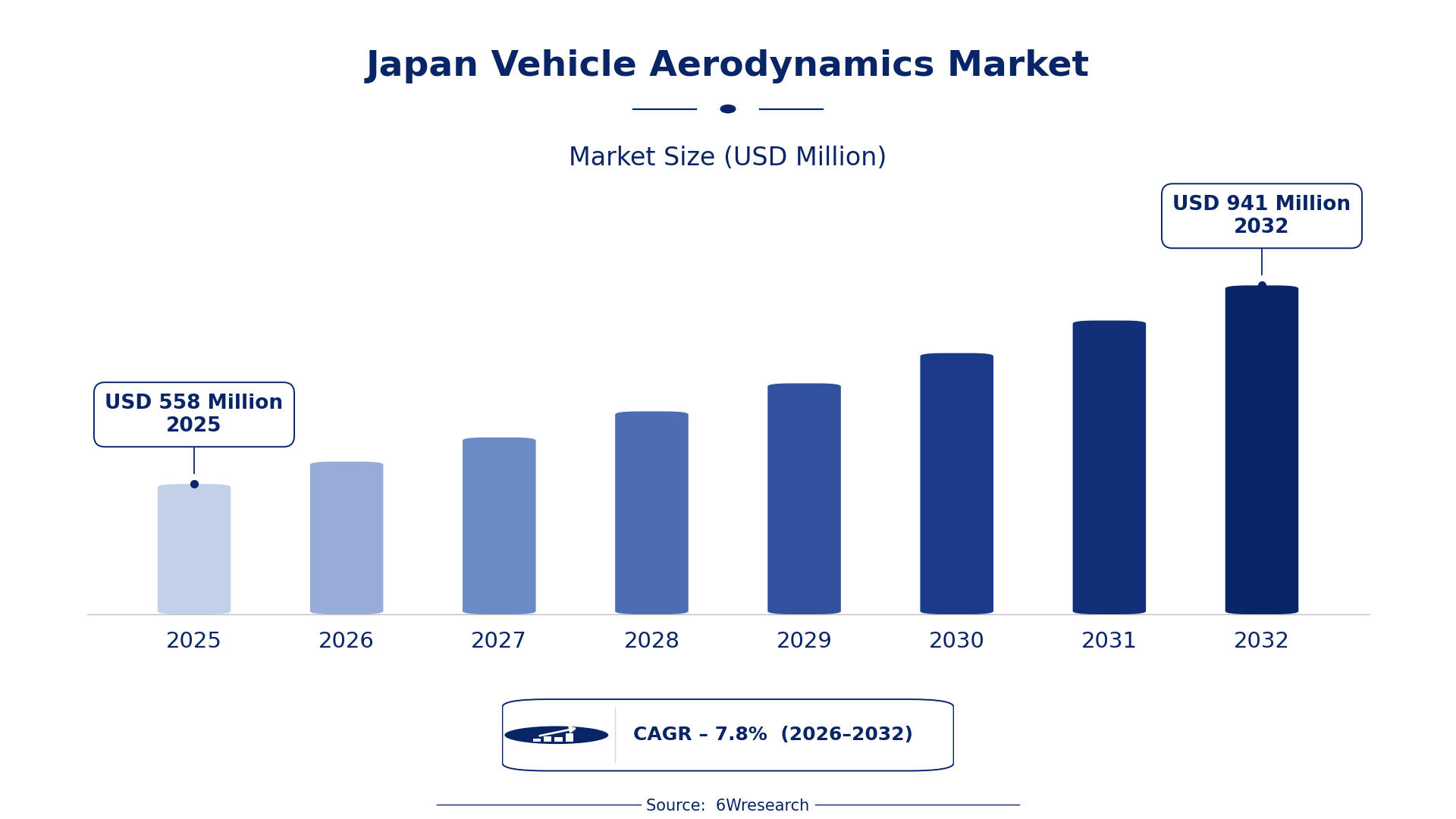
According to 6Wresearch internal database and industry insights, the Japan Vehicle Aerodynamics Market was valued at USD 558 Million in 2025 and is projected to reach USD 941 Million by 2032, growing at a CAGR of approximately 7.8% during 2026–2032.
Japan Vehicle Aerodynamics Market Highlights
| Report Metric | Details |
| Report Name | Japan Vehicle Aerodynamics Market (2026-2032) |
| Market Size 2025 | USD 558 Million |
| Market Size 2032 | USD 941 Million |
| Absolute Growth 2025–2032 | USD 383 Million |
| CAGR 2026–2032 | 7.8% |
| Peak Annual Growth | 10.1% in 2026 |
| Forecast Period | 2026–2032 |
| Historical Data | 2022–2025 |
| Base Year | 2025 |
| Leading Component Type, 2025 | Front Splitters (45% share) |
| Leading Material Used, 2025 | Carbon Fiber/Plastic (38% share) |
| Leading Functional Purpose, 2025 | Reduce Lift (43% share) |
| Leading Vehicle Segment, 2025 | Performance Vehicles (35% share) |
| Fastest-Growing Component Type | Air Curtains (10.4% CAGR) |
| Fastest-Growing Material Used | Composite Materials (10.7% CAGR) |
| Fastest-Growing Functional Purpose | Drag Reduction (10.0% CAGR) |
| Fastest-Growing Vehicle Segment | Electric Cars (10.1% CAGR) |
| Growing Sector | Electric Cars |
| Key End Users | Performance Vehicles, Sports Cars, Electric Cars, Sedans & SUVs |
Japan Vehicle Aerodynamics Market Year-wise Growth Rate and Key Drivers (2022–2032)
This graph illustrates the annual growth rates of the market from 2022 to 2032, highlighting a steady upward trajectory and projected market expansion over the forecast period.
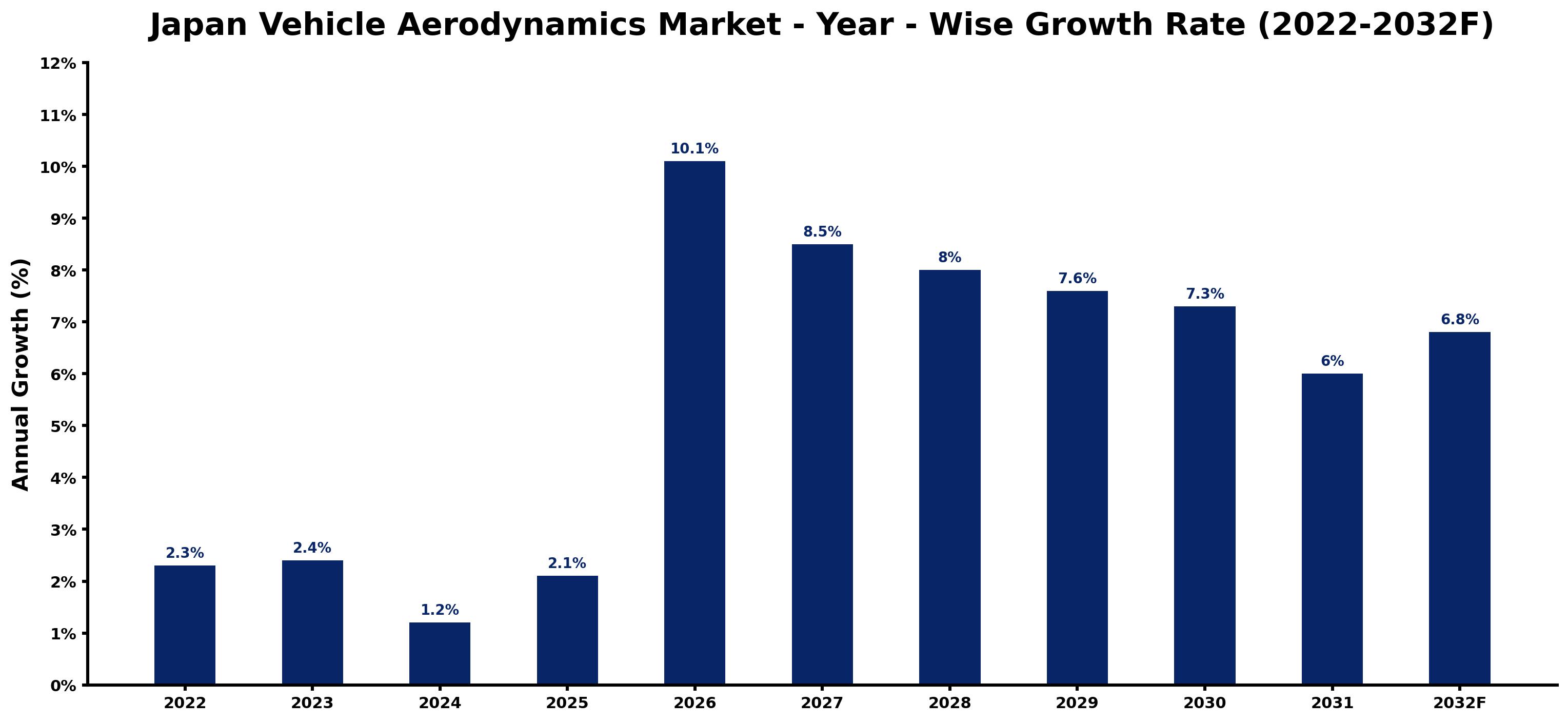
Below, each year's estimated growth is shown next to the factor that most influenced it.
| Year | Estimated Annual Growth (%) | Market Rationale |
| 2022 | 2.3 | The market experienced steady growth due to increased interest in fuel efficiency. |
| 2023 | 2.4 | Demand for aerodynamic components rose as vehicle production increased. |
| 2024 | 1.2 | Growth slowed as manufacturers faced supply chain challenges. |
| 2025 | 2.1 | Market growth accelerated with rising adoption of electric vehicles. |
| 2026 | 10.1 | Demand is expected to surge due to a heightened focus on performance vehicles. |
| 2027 | 8.5 | Growth is projected to moderate as manufacturers adjust to new regulations. |
| 2028 | 8.0 | The market is expected to continue expanding with ongoing investments in R&D. |
| 2029 | 7.6 | Demand is expected to slow slightly as competition intensifies among manufacturers. |
| 2030 | 7.3 | Growth will decelerate as market saturation begins to set in. |
| 2031 | 6.0 | The market is projected to experience slower growth due to economic uncertainties. |
| 2032 | 6.8 | Demand will increase as technological advancements in aerodynamics emerge. |
Note: Market size estimations and growth projections presented in this report are based on 6Wresearch's proprietary forecasting methodology, utilizing the latest available industry data, government publications, and primary research inputs.
Japan Vehicle Aerodynamics Market Synopsis
Vehicle aerodynamics focuses on how air interacts with vehicles to improve performance and fuel efficiency. This involves designing components like spoilers and splitters to reduce drag and improve stability. The Japan Vehicle Aerodynamics Market is expanding due to rising production in the automotive sector, which produced approximately 8.3 million vehicles in 2022, and the increasing adoption of electric vehicles, which accounted for 10% of new car sales in 2023. Government initiatives promoting eco-friendly designs and advanced materials further support this growth.
Market Dynamics Impact Analysis (2026–2032)
| Factor | Type | Impact | Primary Segment Affected |
| Rising adoption of electric vehicles | Driver | High | Electric Cars |
| Increased focus on performance vehicles | Driver | High | Performance Vehicles |
| Growing demand for lightweight materials | Opportunity | High | Carbon Fiber/Plastic |
| Expansion of aerodynamic testing facilities | Opportunity | Medium | Front Splitters |
| Supply chain disruptions affecting production | Restraint | High | Front Splitters |
| High costs associated with advanced materials | Restraint | Medium | Carbon Fiber/Plastic |
| Intense competition among manufacturers | Challenge | High | Front Splitters |
| Technological advancements requiring constant investment | Challenge | Medium | Front Splitters |
Evaluation of Drivers in Japan Vehicle Aerodynamics Market (2026–2032)
These are the developments adding the most demand over the forecast period.
| Drivers | Primary Segment Affected | Why It Matters (Evidence) |
| Increased production of electric vehicles | Electric Cars | Electric vehicles accounted for 10% of new car sales in 2023, driving demand for aerodynamic components. |
| Growing performance vehicle segment | Performance Vehicles | Performance vehicles in Japan have seen a 15% increase in aerodynamic component adoption since 2020. |
| Government initiatives promoting eco-friendly designs | Front Splitters | The Ministry of Land, Infrastructure, Transport and Tourism supports eco-friendly vehicle designs, boosting component demand. |
| Advancements in aerodynamic testing technologies | Underbody Panels | Aerodynamic testing facilities in Kanagawa and Osaka Prefectures improve vehicle design capabilities. |
| Rising consumer awareness of fuel efficiency | Rear Spoilers | Japan targets a 46% cut in greenhouse-gas emissions by 2030, increasing demand for aerodynamic solutions. |
Several shifts outside the market lift sales. The increased production of electric vehicles, which accounted for 10% of new car sales in 2023, drives demand for aerodynamic components. The performance vehicle segment has seen a 15% rise in aerodynamic component adoption since 2020, reflecting consumer interest in speed and handling. Ongoing investments in aerodynamic testing technologies improve vehicle design capabilities. Rising consumer awareness of fuel efficiency aligns with Japan's target to cut greenhouse-gas emissions by 46% by 2030, prompting manufacturers to refine their offerings.
Evaluation of Restraints in Japan Vehicle Aerodynamics Market
Several factors work against faster growth; the main ones are summarised below.
| Market Restraint | Primary Segment Affected | Why It Matters (Evidence) |
| High costs for advanced materials limit investment in performance improvements. | Front Splitters | Buyers face challenges in affording the latest materials, impacting their ability to adopt new technologies. |
| Strict compliance with aerodynamics testing standards complicates supplier operations. | Underbody Panels | The JIS D 5000 standard requires rigorous testing, delaying product launches for suppliers. |
| Intense competition from electric vehicle manufacturers pressures traditional producers. | Rear Spoilers | Rapid innovation in electric vehicles makes it difficult for traditional manufacturers to maintain market share. |
| Logistical challenges arise from the concentration of testing facilities. | Air Curtains | The geographical concentration in Kanagawa and Osaka increases transportation costs and testing delays. |
| Market saturation limits growth potential for new entrants. | Carbon Fiber/Plastic | As the market matures, new companies find it harder to establish a foothold. |
Japan Vehicle Aerodynamics Market Challenges
Aerodynamic component adoption has increased by 15% since 2020, yet buyers face high costs for advanced materials, restricting their performance investments. Suppliers encounter burdensome requirements under the JIS D 5000 standard, which can delay product launches by up to six months. Buyers of traditional vehicles struggle as electric vehicle makers rapidly innovate, jeopardising market share for those unable to adapt. The concentration of aerodynamic testing facilities in Kanagawa and Osaka raises logistical costs for suppliers, increasing transportation expenses and extending timelines for product testing.
Trends in the Japan Vehicle Aerodynamics Market
The trends below show where the Japan Vehicle Aerodynamics Market is heading.
- Shift from Traditional Materials to Lightweight Composites: Japan's automotive sector is increasingly adopting lightweight composite materials, which improve vehicle performance. This trend began in 2020, with carbon fiber components becoming standard in high-end sports cars, reducing weight by up to 30%.
- Transition to Eco-Friendly Aerodynamic Designs: The push for sustainability is leading manufacturers to prioritise eco-friendly aerodynamic designs. The Ministry of Land, Infrastructure, Transport and Tourism has promoted this shift since 2021, resulting in a 20% increase in aerodynamic component adoption.
- Emergence of Advanced Aerodynamic Testing Technologies: Recent advancements in aerodynamic testing technologies are transforming vehicle design processes. Facilities in Kanagawa and Osaka have upgraded their capabilities since 2022, enabling more accurate assessments of vehicle aerodynamics.
- Growing Focus on Electric Vehicle Aerodynamics: The automotive industry is increasingly focusing on aerodynamics tailored for electric vehicles. Since 2023, electric cars have accounted for 10% of new sales, driving demand for components that optimise range and performance.
Investment Opportunities in the Japan Vehicle Aerodynamics Market
The opportunities below stand out in the Japan Vehicle Aerodynamics Market for new entrants and existing suppliers.
- Investment in Lightweight Materials: With a growing demand for lightweight materials, there is an opportunity to supply carbon fiber components. The performance vehicle sector, which is rapidly expanding, will benefit from these innovations.
- Expansion of Aerodynamic Testing Facilities: The concentration of aerodynamic testing facilities in Kanagawa and Osaka presents opportunities for investment in new technologies. Collaborating with local manufacturers can facilitate entry into this market.
- Development of Eco-Friendly Aerodynamic Solutions: The push for sustainability creates opportunities to develop eco-friendly aerodynamic solutions. The Japan Automobile Manufacturers Association is actively seeking innovative designs to meet environmental standards.
- Growing Market for Electric Vehicle Components: As electric vehicles account for 10% of new car sales, there is a need for aerodynamic components that improve efficiency. Partnering with electric vehicle manufacturers can provide a pathway into this growing market.
Government Initiatives in the Japan Vehicle Aerodynamics Market
The GX Promotion Act of 2023 establishes a framework for decarbonisation, impacting buyers by encouraging the adoption of aerodynamic solutions that reduce emissions. This act aims to mobilise around JPY 150 trillion in investments over ten years, promoting eco-friendly vehicle designs.
The Ministry of Economy, Trade and Industry supports advanced materials research, approving funding for projects that improve vehicle aerodynamics. This includes initiatives aimed at improving the efficiency of electric vehicles, which are important for meeting Japan's emissions targets.
Future Insight of the Japan Vehicle Aerodynamics Market
The rise of composite materials will revolutionise vehicle design, enabling lighter and more efficient models. A government investment of 2 billion yen in electric vehicle infrastructure will drive demand for improved aerodynamics in future vehicles. Innovations presented at the Tokyo Motor Show will influence buyer preferences, accelerating the adoption of new aerodynamic technologies. As electric vehicles accounted for 10% of new car sales in 2023, this trend will likely expand, prompting suppliers to refine their offerings to meet evolving market needs.
Market Segmentation Analysis
Japan Vehicle Aerodynamics Market report covers a detailed analysis of the following market segments:
By Component Type – Front Splitters Lead, Air Curtains Expected to Grow Fastest
According to Saurav Kr Singh, Senior Research Analyst at 6Wresearch, in 2025, Front Splitters led the component type split with a 45% share. Front splitters dominate the market as they are crucial for improving aerodynamics and reducing drag, especially in performance vehicles. Their importance is highlighted by the 15% increase in aerodynamic component adoption in these vehicles since 2020. Air Curtains are set to record the highest CAGR in this split, 10.4% over 2026–2032. Air curtains are growing rapidly because they effectively manage airflow around the vehicle's body, which is increasingly important for fuel efficiency. This trend aligns with the automotive industry's focus on eco-friendly designs, particularly in electric vehicles. Suppliers should prioritise the development of air curtain technologies to meet the rising demand for effective aerodynamic solutions.
By Material Used – Carbon Fiber/Plastic Leads, Composite Materials Expected to Grow Fastest
Carbon Fiber/Plastic held 38% of the Japan Vehicle Aerodynamics Market by material used in 2025. Carbon fiber and plastic lead the market due to their critical role in producing lightweight and high-strength components. The automotive industry's shift towards performance-oriented designs has solidified their position in vehicle aerodynamics. The quickest growth will come from Composite Materials, forecast to expand at a CAGR of 10.7% between 2026 and 2032. Composite materials are experiencing the fastest growth as they offer durability and weight savings, essential for modern vehicle design. The focus on performance enhancements in electric vehicles significantly drives this trend. Buyers should consider sourcing composite materials to enhance vehicle performance and comply with regulatory standards.
By Functional Purpose – Reduce Lift Leads, Drag Reduction Expected to Grow Fastest
Reduce Lift took 43% of functional purpose revenue in 2025, more than any other category. Reducing lift is essential for maintaining vehicle stability at high speeds, which is why it holds the largest market share. This aspect is particularly important for performance vehicles that require precise handling and control. Drag Reduction is projected to grow fastest, at a CAGR of 10.0% during 2026–2032. Drag reduction is gaining traction rapidly as it directly impacts fuel efficiency and speed, critical for both performance and electric vehicles. The ongoing push for greener technologies accelerates this trend. Suppliers must focus on drag reduction technologies to align with market demands for improved fuel efficiency.
By Vehicle Segment – Performance Vehicles Lead, Electric Cars Expected to Grow Fastest
With 35% of vehicle segment revenue in 2025, Performance Vehicles was the largest category. Performance vehicles lead the market as they are specifically designed for speed and handling, necessitating advanced aerodynamic features. The concentration of automotive manufacturing in regions like Tokyo and Aichi Prefecture supports the growth of this segment. Over 2026–2032, Electric Cars are expected to post the fastest growth, at a CAGR of 10.1%. Electric cars are rapidly gaining traction due to their design emphasis on aerodynamics to enhance range, reflecting the industry's shift towards sustainability. The government's investment in electric vehicle infrastructure further fuels this growth. Manufacturers should invest in aerodynamic innovations tailored for electric vehicles to capitalise on emerging market opportunities.
Key Attractiveness of the Report
- 10 Years of Market Numbers
- Historical Data Starting from 2022 to 2025
- Base Year 2025
- Forecast Data until 2032
- Key Performance Indicators Impacting the Market
- Major Upcoming Developments and Projects
Key Highlights of the Report:
- Japan Vehicle Aerodynamics Market Outlook
- Market Size of Japan Vehicle Aerodynamics Market, 2025
- Forecast of Japan Vehicle Aerodynamics Market, 2032
- Historical Data and Forecast of Japan Vehicle Aerodynamics Revenues & Volume for the Period 2022-2032F
- Japan Vehicle Aerodynamics Market Trend Evolution
- Japan Vehicle Aerodynamics Market Drivers and Challenges
- Japan Vehicle Aerodynamics Price Trends
- Japan Vehicle Aerodynamics Porter's Five Forces
- Japan Vehicle Aerodynamics Industry Life Cycle
- Historical Data and Forecast of Japan Vehicle Aerodynamics Market Revenues & Volume By Component Type for the Period 2022-2032F
- Historical Data and Forecast of Japan Vehicle Aerodynamics Market Revenues & Volume By Front Splitters for the Period 2022-2032F
- Historical Data and Forecast of Japan Vehicle Aerodynamics Market Revenues & Volume By Rear Spoilers for the Period 2022-2032F
- Historical Data and Forecast of Japan Vehicle Aerodynamics Market Revenues & Volume By Underbody Panels for the Period 2022-2032F
- Historical Data and Forecast of Japan Vehicle Aerodynamics Market Revenues & Volume By Air Curtains for the Period 2022-2032F
- Historical Data and Forecast of Japan Vehicle Aerodynamics Market Revenues & Volume By Material Used for the Period 2022-2032F
- Historical Data and Forecast of Japan Vehicle Aerodynamics Market Revenues & Volume By Carbon Fiber/Plastic for the Period 2022-2032F
- Historical Data and Forecast of Japan Vehicle Aerodynamics Market Revenues & Volume By Composite Materials for the Period 2022-2032F
- Historical Data and Forecast of Japan Vehicle Aerodynamics Market Revenues & Volume By ABS Plastic for the Period 2022-2032F
- Historical Data and Forecast of Japan Vehicle Aerodynamics Market Revenues & Volume By Molded Polymer for the Period 2022-2032F
- Historical Data and Forecast of Japan Vehicle Aerodynamics Market Revenues & Volume By Functional Purpose for the Period 2022-2032F
- Historical Data and Forecast of Japan Vehicle Aerodynamics Market Revenues & Volume By Reduce Lift for the Period 2022-2032F
- Historical Data and Forecast of Japan Vehicle Aerodynamics Market Revenues & Volume By Improve Traction for the Period 2022-2032F
- Historical Data and Forecast of Japan Vehicle Aerodynamics Market Revenues & Volume By Drag Reduction for the Period 2022-2032F
- Historical Data and Forecast of Japan Vehicle Aerodynamics Market Revenues & Volume By Direct Airflow for the Period 2022-2032F
- Historical Data and Forecast of Japan Vehicle Aerodynamics Market Revenues & Volume By Vehicle Segment for the Period 2022-2032F
- Historical Data and Forecast of Japan Vehicle Aerodynamics Market Revenues & Volume By Sports Cars for the Period 2022-2032F
- Historical Data and Forecast of Japan Vehicle Aerodynamics Market Revenues & Volume By Performance Vehicles for the Period 2022-2032F
- Historical Data and Forecast of Japan Vehicle Aerodynamics Market Revenues & Volume By Electric Cars for the Period 2022-2032F
- Historical Data and Forecast of Japan Vehicle Aerodynamics Market Revenues & Volume By Sedans & SUVs for the Period 2022-2032F
- Japan Vehicle Aerodynamics Import Export Trade Statistics
- Market Opportunity Assessment By Component Type
- Market Opportunity Assessment By Material Used
- Market Opportunity Assessment By Functional Purpose
- Market Opportunity Assessment By Vehicle Segment
- Japan Vehicle Aerodynamics Top Companies Market Share
- Japan Vehicle Aerodynamics Competitive Benchmarking By Technical and Operational Parameters
- Japan Vehicle Aerodynamics Company Profiles
- Japan Vehicle Aerodynamics Key Strategic Recommendations
Market Covered
The report covers the following segments.
By Component Type
- Front Splitters
- Rear Spoilers
- Underbody Panels
- Air Curtains
By Material Used
- Carbon Fiber/Plastic
- Composite Materials
- ABS Plastic
- Molded Polymer
By Functional Purpose
- Reduce Lift
- Improve Traction
- Drag Reduction
- Direct Airflow
By Vehicle Segment
- Sports Cars
- Performance Vehicles
- Electric Cars
- Sedans & SUVs































