Japan Vehicle Air Filtration System Market Size & Growth Rate
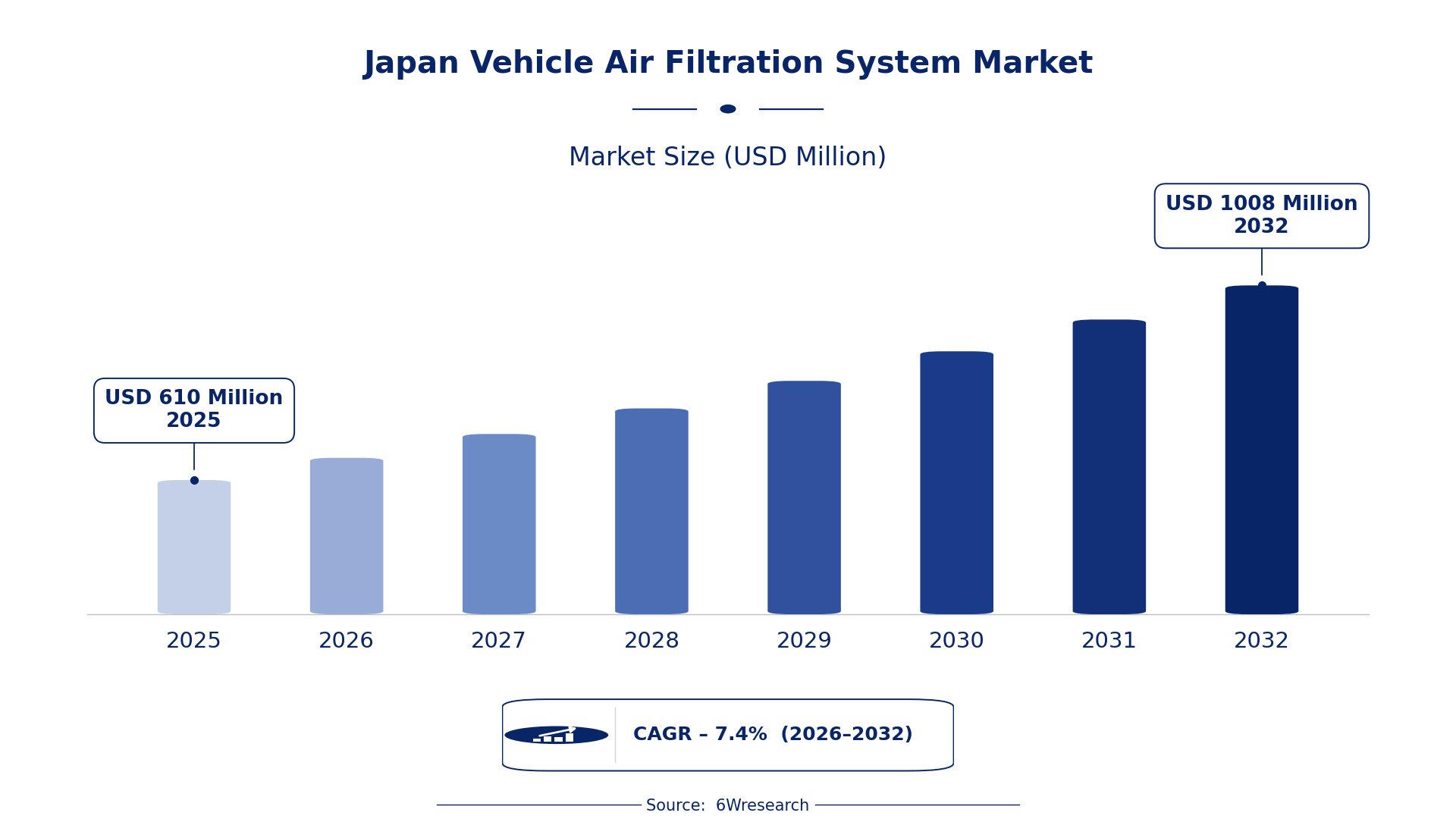
According to 6Wresearch internal database and industry insights, the Japan Vehicle Air Filtration System Market was valued at USD 610 Million in 2025 and is projected to reach USD 1,008 Million by 2032, growing at a CAGR of approximately 7.4% during 2026–2032.
Japan Vehicle Air Filtration System Market Highlights
| Report Metric | Details |
| Report Name | Japan Vehicle Air Filtration System Market (2026-2032) |
| Market Size 2025 | USD 610 Million |
| Market Size 2032 | USD 1,008 Million |
| Absolute Growth 2025–2032 | USD 398 Million |
| CAGR 2026–2032 | 7.4% |
| Peak Annual Growth | 9.3% in 2026 |
| Forecast Period | 2026–2032 |
| Historical Data | 2022–2025 |
| Base Year | 2025 |
| Leading Filter Type, 2025 | Cabin Air Filter (49% share) |
| Leading Filter Material, 2025 | HEPA (29% share) |
| Leading Functionality, 2025 | Pollen & Dust Filtration (35% share) |
| Leading End User, 2025 | Auto Service Centers (51% share) |
| Fastest-Growing Filter Type | Engine Air Filter (10.0% CAGR) |
| Fastest-Growing Filter Material | Activated Carbon (11.1% CAGR) |
| Fastest-Growing Functionality | Engine Protection (9.9% CAGR) |
| Fastest-Growing End User | OEMs (9.7% CAGR) |
| Growing Sector | automotive aftermarket |
| Key End Users | OEMs, Auto Service Centers, Luxury Segment Automakers, EV & Hybrid Vehicles |
Japan Vehicle Air Filtration System Market Year-wise Growth Rate and Key Drivers (2022–2032)
This graph illustrates the annual growth rates of the market from 2022 to 2032, highlighting a steady upward trajectory and projected market expansion over the forecast period.
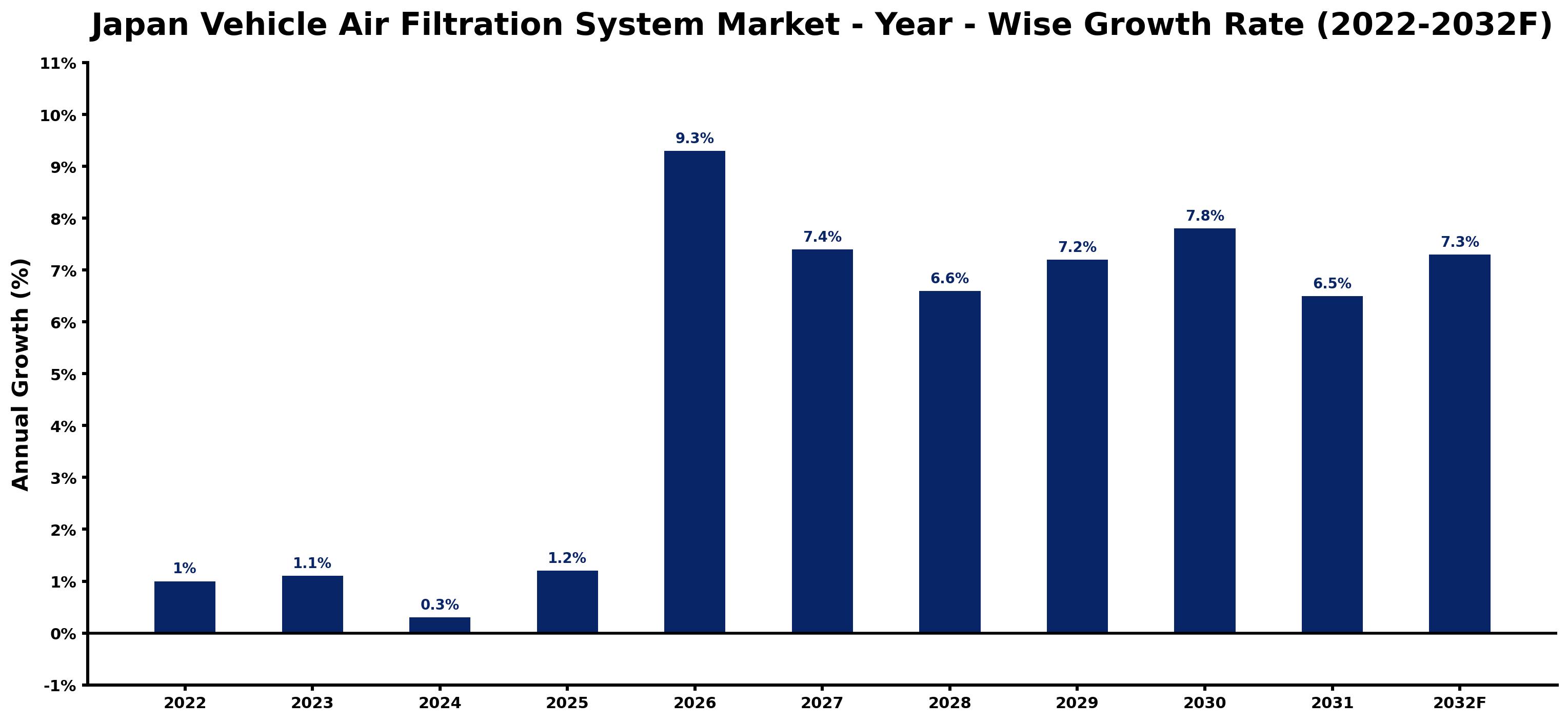
The yearly estimates that follow link every growth rate to its principal driver, so readers can see why the pace changed in each period.
| Year | Estimated Annual Growth (%) | Market Rationale |
| 2022 | 1.0 | The market experienced steady growth due to ongoing demand from domestic users. |
| 2023 | 1.1 | Growth accelerated as consumer awareness of air quality increased significantly. |
| 2024 | 0.3 | The market saw a slowdown as supply chain issues impacted production rates. |
| 2025 | 1.2 | Demand rose as more vehicles adopted advanced filtration technologies. |
| 2026 | 9.3 | The market surged as investments in electric vehicle air quality systems increased. |
| 2027 | 7.4 | Growth moderated as the market adjusted to previous high demand levels. |
| 2028 | 6.6 | A further slowdown occurred as production stabilised following rapid growth. |
| 2029 | 7.2 | Demand picked up again as urban air quality concerns intensified. |
| 2030 | 7.8 | The market benefited from rising electric vehicle registrations and standards. |
| 2031 | 6.5 | Growth slowed as the market matured and competition intensified. |
| 2032 | 7.3 | Demand increased again as new technologies improved filtration efficiency. |
Note: Market size estimations and growth projections presented in this report are based on 6Wresearch's proprietary forecasting methodology, utilizing the latest available industry data, government publications, and primary research inputs.
Japan Vehicle Air Filtration System Market Synopsis
Vehicle Air Filtration Systems filter air entering vehicle cabins and engines, using materials like HEPA and activated carbon. The market is expanding, driven by Japan's vehicle population of 78 million and a growing consumer emphasis on air quality, with 40% of drivers prioritising it. The automotive sector's commitment to lowering emissions and improving air quality standards is further stimulating demand, particularly in urban areas and luxury vehicles.
Market Dynamics Impact Analysis (2026–2032)
| Factor | Type | Impact | Primary Segment Affected |
| Rising consumer awareness of air quality and health impacts | Driver | High | Cabin Air Filter |
| Increased adoption of electric vehicles requiring advanced filtration | Driver | High | Engine Air Filter |
| Growing demand for luxury vehicles with superior air quality features | Opportunity | High | HEPA |
| Expansion of the automotive aftermarket driven by maintenance needs | Opportunity | Medium | Auto Service Centers |
| Supply chain disruptions affecting filter material availability | Restraint | High | Activated Carbon |
| High competition among manufacturers leading to price pressures | Restraint | Medium | Synthetic Fiber |
| Technological challenges in developing new filtration materials | Challenge | High | Nanofiber |
| Regulatory compliance costs impacting smaller manufacturers | Challenge | Medium | Particulate Filter |
Evaluation of Drivers in Japan Vehicle Air Filtration System Market (2026–2032)
The main growth drivers and the segments they affect most are set out below.
| Drivers | Primary Segment Affected | Why It Matters (Evidence) |
| Increased vehicle population | Cabin Air Filter | Japan's vehicle population reached 78 million in 2023, boosting demand for air filtration systems. |
| Focus on air quality | Engine Air Filter | Research indicates that 40% of Japanese drivers prioritise air quality in vehicles, driving filter adoption. |
| Demand for premium filtration solutions | HEPA | Luxury vehicles are incorporating advanced filtration systems to enhance passenger comfort and air quality. |
| Regulatory standards | Particulate Filter | Air quality standards promote the adoption of compliant filtration systems, driving market growth. |
| Aftermarket growth | Auto Service Centers | The automotive aftermarket in Japan is projected to grow, increasing demand for filter replacement services. |
Much of the new demand traces back to the increasing vehicle population, which reached 78 million in 2023, leading to more purchases of air filtration systems. Consumer focus on air quality is strong, as 40% of Japanese drivers prioritise it, resulting in the adoption of advanced filters. The luxury segment is incorporating advanced filtration systems to improve passenger comfort, reflecting a growing trend. The automotive aftermarket is expected to expand by 2025, increasing filter replacement needs as vehicle ownership rises.
Evaluation of Restraints in Japan Vehicle Air Filtration System Market
These restraints slow adoption and weigh on supplier margins.
| Market Restraint | Primary Segment Affected | Why It Matters (Evidence) |
| Supply chain disruptions affecting filter material availability | Activated Carbon | Recent supply chain issues have limited the availability of activated carbon, impacting production timelines. |
| High competition among manufacturers leading to price pressures | Synthetic Fiber | Intense competition has resulted in price reductions, affecting profit margins for synthetic fiber manufacturers. |
| Technological challenges in developing new filtration materials | Nanofiber | Emerging nanofiber technology faces development hurdles, delaying its market entry and adoption. |
| Regulatory compliance costs impacting smaller manufacturers | Particulate Filter | Smaller manufacturers struggle with compliance costs, hindering their ability to compete effectively. |
| Market saturation in urban areas | Cabin Air Filter | Urban areas are nearing saturation in cabin air filter adoption, limiting growth potential. |
Japan Vehicle Air Filtration System Market Challenges
Cabin air quality monitoring is mandatory in urban areas, raising compliance costs for vehicle manufacturers. The Ministry of the Environment's air quality standards require upgrades to filtration systems, which can delay production timelines for suppliers by up to six months. Many buyers contend with outdated technologies that do not meet air quality regulations, limiting their ability to satisfy consumer demands. Competition intensifies as 40% of Japanese drivers prioritise air quality, compelling producers to innovate rapidly or risk losing market share to those with superior filtration solutions.
Trends in the Japan Vehicle Air Filtration System Market
Buyers and suppliers in the Japan Vehicle Air Filtration System Market are adjusting to the following trends.
- Shift from Traditional to Advanced Filtration Technologies: Since 2023, the automotive sector has shifted towards advanced filtration technologies, with HEPA filters becoming standard in luxury vehicles. Approximately 95% of new vehicles sold now include cabin air filters, reflecting this trend.
- Increase in Electric Vehicle Filtration Needs: In 2025, the number of electric vehicles in Japan is projected to exceed 1 million, driving demand for specialised air filtration systems. This shift highlights the need for effective filtration in EVs to ensure passenger comfort.
- Growing Focus on Urban Air Quality Standards: The Tokyo metropolitan area has seen increased regulations on air quality, prompting manufacturers to improve filtration systems. This change is vital for compliance with health standards and enhancing urban air quality.
- Expansion of Automotive Aftermarket Services: The automotive aftermarket in Japan is projected to grow by 2025, creating opportunities for filter replacement services. This growth is driven by rising vehicle ownership and maintenance needs.
Investment Opportunities in the Japan Vehicle Air Filtration System Market
The following areas offer the clearest openings for investors and suppliers in the Japan Vehicle Air Filtration System Market.
- Investment in HEPA Filters for Luxury Vehicles: With HEPA filters increasingly utilised in luxury vehicles, suppliers can target this segment to meet rising demand. Luxury automakers are seeking high-quality filtration solutions to improve passenger comfort.
- Supply of Activated Carbon Filters: Investing in activated carbon filters is timely, as they are favoured for their odour removal capabilities. Auto service centres are looking for reliable suppliers to meet growing consumer expectations.
- Development of Nanofiber Technology: Investing in nanofiber technology presents an opportunity as it is being explored for future vehicle air filters. Research institutions and manufacturers in urban areas are collaborating to advance this technology.
- Expansion of Aftermarket Services: The automotive aftermarket is expanding, creating demand for maintenance services and filter replacements. Auto service centres are seeking partners to enhance their service offerings.
Government Initiatives in the Japan Vehicle Air Filtration System Market
The Green Growth Strategy adopted in December 2020 sets ambitious targets for reducing greenhouse gas emissions, influencing vehicle manufacturers to adopt cleaner technologies, including advanced air filtration systems, to comply with environmental standards. This strategy encourages innovation in filtration technologies that improve air quality in vehicles.
Funding for innovation in filtration technologies is overseen by the Japan Automobile Manufacturers Association, which ensures compliance with air quality measures. The association supports projects aimed at enhancing air quality in vehicles, with substantial investments in research and development.
Future Insight of the Japan Vehicle Air Filtration System Market
By 2032, vehicle users will benefit from improved air quality due to advancements in filtration technologies like synthetic fibres. The automotive aftermarket will expand as consumers increasingly demand high-performance air filtration systems. Standards such as ISO 16890 will drive suppliers to innovate, ensuring compliance with stricter regulations. With the vehicle population projected to exceed 80 million by 2030, the demand for efficient air filtration solutions will surge, prompting suppliers to upgrade their offerings to meet evolving consumer expectations.
Market Segmentation Analysis
Japan Vehicle Air Filtration System Market report covers a detailed analysis of the following market segments:
By Filter Type – Cabin Air Filter Leads, Engine Air Filter Expected to Grow Fastest
According to Saurav Kr Singh, Senior Research Analyst at 6Wresearch, with 49% of filter type revenue in 2025, Cabin Air Filter was the largest category. Cabin air filters hold the largest share due to their essential role in ensuring passenger air quality, with 95% of new vehicles in Japan equipped with them. This widespread adoption is particularly crucial in densely populated areas like Tokyo, where air quality is a significant concern. Engine Air Filter is set to record the highest CAGR in this split, 10.0% over 2026–2032. Engine air filters are experiencing the highest growth because they are essential for maintaining engine performance and longevity, especially with Japan's vehicle population reaching 78 million. The increasing focus on vehicle efficiency will likely drive further demand for these filters. Suppliers need to focus on enhancing the performance and quality of engine air filters to meet growing market demands.
By Filter Material – HEPA Leads, Activated Carbon Expected to Grow Fastest
The largest filter material category in 2025 was HEPA, at 29% of revenue. HEPA filters dominate the market due to their high-efficiency filtration capabilities, making them a preferred choice in luxury vehicles where air quality is paramount. Their adoption aligns with Japan's stringent air quality standards and consumer preferences for superior filtration. Over 2026–2032, Activated Carbon is expected to post the fastest growth, at a CAGR of 11.1%. Activated carbon filters are rapidly gaining traction because of their effectiveness in removing odours and pollutants, which appeals to consumers prioritising a pleasant driving experience. As awareness of air quality issues increases, this segment is likely to see accelerated growth. Buyers should consider integrating activated carbon filters into their offerings to meet consumer expectations for improved air quality.
By Functionality – Pollen & Dust Filtration Leads, Engine Protection Expected to Grow Fastest
Pollen & Dust Filtration took 35% of functionality revenue in 2025, more than any other category. Pollen and dust filtration leads the market as it is vital for allergy sufferers, ensuring a comfortable driving environment. This functionality is particularly important in urban areas where air quality can be compromised. Engine Protection is projected to grow fastest, at a CAGR of 9.9% during 2026–2032. Engine protection is the fastest-growing functionality as it is critical for maintaining engine health, especially with the rising vehicle population and emphasis on vehicle longevity. As consumers become more aware of maintenance costs, demand for effective engine protection will surge. Suppliers must highlight the benefits of engine protection features to attract customers focused on long-term vehicle maintenance.
By End User – Auto Service Centers Lead, OEMs Expected to Grow Fastest
Auto Service Centers held 51% of the Japan Vehicle Air Filtration System Market by end user in 2025. Auto service centers dominate the market as they are the primary installation and maintenance providers for vehicle air filtration systems. Their extensive network and expertise make them indispensable for vehicle owners seeking reliable and efficient service. The quickest growth will come from OEMs, forecast to expand at a CAGR of 9.7% between 2026 and 2032. OEMs are witnessing the fastest growth as they are the main manufacturers of vehicle air filtration systems, driven by the rising vehicle production in Japan. Their commitment to developing advanced filtration technologies will likely continue to propel their growth. This indicates that suppliers should strengthen partnerships with OEMs to stay aligned with manufacturing advancements and standards.
Key Attractiveness of the Report
- 10 Years of Market Numbers
- Historical Data Starting from 2022 to 2025
- Base Year 2025
- Forecast Data until 2032
- Key Performance Indicators Impacting the Market
- Major Upcoming Developments and Projects
Key Highlights of the Report:
- Japan Vehicle Air Filtration System Market Outlook
- Market Size of Japan Vehicle Air Filtration System Market, 2025
- Forecast of Japan Vehicle Air Filtration System Market, 2032
- Historical Data and Forecast of Japan Vehicle Air Filtration System Revenues & Volume for the Period 2022-2032F
- Japan Vehicle Air Filtration System Market Trend Evolution
- Japan Vehicle Air Filtration System Market Drivers and Challenges
- Japan Vehicle Air Filtration System Price Trends
- Japan Vehicle Air Filtration System Porter's Five Forces
- Japan Vehicle Air Filtration System Industry Life Cycle
- Historical Data and Forecast of Japan Vehicle Air Filtration System Market Revenues & Volume By Filter Type for the Period 2022-2032F
- Historical Data and Forecast of Japan Vehicle Air Filtration System Market Revenues & Volume By Cabin Air Filter for the Period 2022-2032F
- Historical Data and Forecast of Japan Vehicle Air Filtration System Market Revenues & Volume By Engine Air Filter for the Period 2022-2032F
- Historical Data and Forecast of Japan Vehicle Air Filtration System Market Revenues & Volume By Particulate Filter for the Period 2022-2032F
- Historical Data and Forecast of Japan Vehicle Air Filtration System Market Revenues & Volume By Recirculation Filters for the Period 2022-2032F
- Historical Data and Forecast of Japan Vehicle Air Filtration System Market Revenues & Volume By Filter Material for the Period 2022-2032F
- Historical Data and Forecast of Japan Vehicle Air Filtration System Market Revenues & Volume By HEPA, Activated Carbon for the Period 2022-2032F
- Historical Data and Forecast of Japan Vehicle Air Filtration System Market Revenues & Volume By Synthetic Fiber for the Period 2022-2032F
- Historical Data and Forecast of Japan Vehicle Air Filtration System Market Revenues & Volume By Nanofiber, Paper for the Period 2022-2032F
- Historical Data and Forecast of Japan Vehicle Air Filtration System Market Revenues & Volume By Carbon-Embedded Media for the Period 2022-2032F
- Historical Data and Forecast of Japan Vehicle Air Filtration System Market Revenues & Volume By Functionality for the Period 2022-2032F
- Historical Data and Forecast of Japan Vehicle Air Filtration System Market Revenues & Volume By Pollen & Dust Filtration for the Period 2022-2032F
- Historical Data and Forecast of Japan Vehicle Air Filtration System Market Revenues & Volume By Engine Protection for the Period 2022-2032F
- Historical Data and Forecast of Japan Vehicle Air Filtration System Market Revenues & Volume By Pollution Reduction for the Period 2022-2032F
- Historical Data and Forecast of Japan Vehicle Air Filtration System Market Revenues & Volume By Interior Air Recycling for the Period 2022-2032F
- Historical Data and Forecast of Japan Vehicle Air Filtration System Market Revenues & Volume By End User for the Period 2022-2032F
- Historical Data and Forecast of Japan Vehicle Air Filtration System Market Revenues & Volume By Auto Service Centers for the Period 2022-2032F
- Historical Data and Forecast of Japan Vehicle Air Filtration System Market Revenues & Volume By OEMs for the Period 2022-2032F
- Historical Data and Forecast of Japan Vehicle Air Filtration System Market Revenues & Volume By EV & Hybrid Vehicles for the Period 2022-2032F
- Historical Data and Forecast of Japan Vehicle Air Filtration System Market Revenues & Volume By Luxury Segment Automakers for the Period 2022-2032F
- Japan Vehicle Air Filtration System Import Export Trade Statistics
- Market Opportunity Assessment By Filter Type
- Market Opportunity Assessment By Filter Material
- Market Opportunity Assessment By Functionality
- Market Opportunity Assessment By End User
- Japan Vehicle Air Filtration System Top Companies Market Share
- Japan Vehicle Air Filtration System Competitive Benchmarking By Technical and Operational Parameters
- Japan Vehicle Air Filtration System Company Profiles
- Japan Vehicle Air Filtration System Key Strategic Recommendations
Market Covered
Segments analysed in this report are listed below.
By Filter Type
- Cabin Air Filter
- Engine Air Filter
- Particulate Filter
- Recirculation Filters
By Filter Material
- HEPA
- Activated Carbon
- Synthetic Fiber
- Nanofiber
- Paper
- Carbon-Embedded Media
By Functionality
- Pollen & Dust Filtration
- Engine Protection
- Pollution Reduction
- Interior Air Recycling
By End User
- Auto Service Centers
- OEMs
- EV & Hybrid Vehicles
- Luxury Segment Automakers































