Japan Vehicle Alignment and Balancing Market Size & Growth Rate
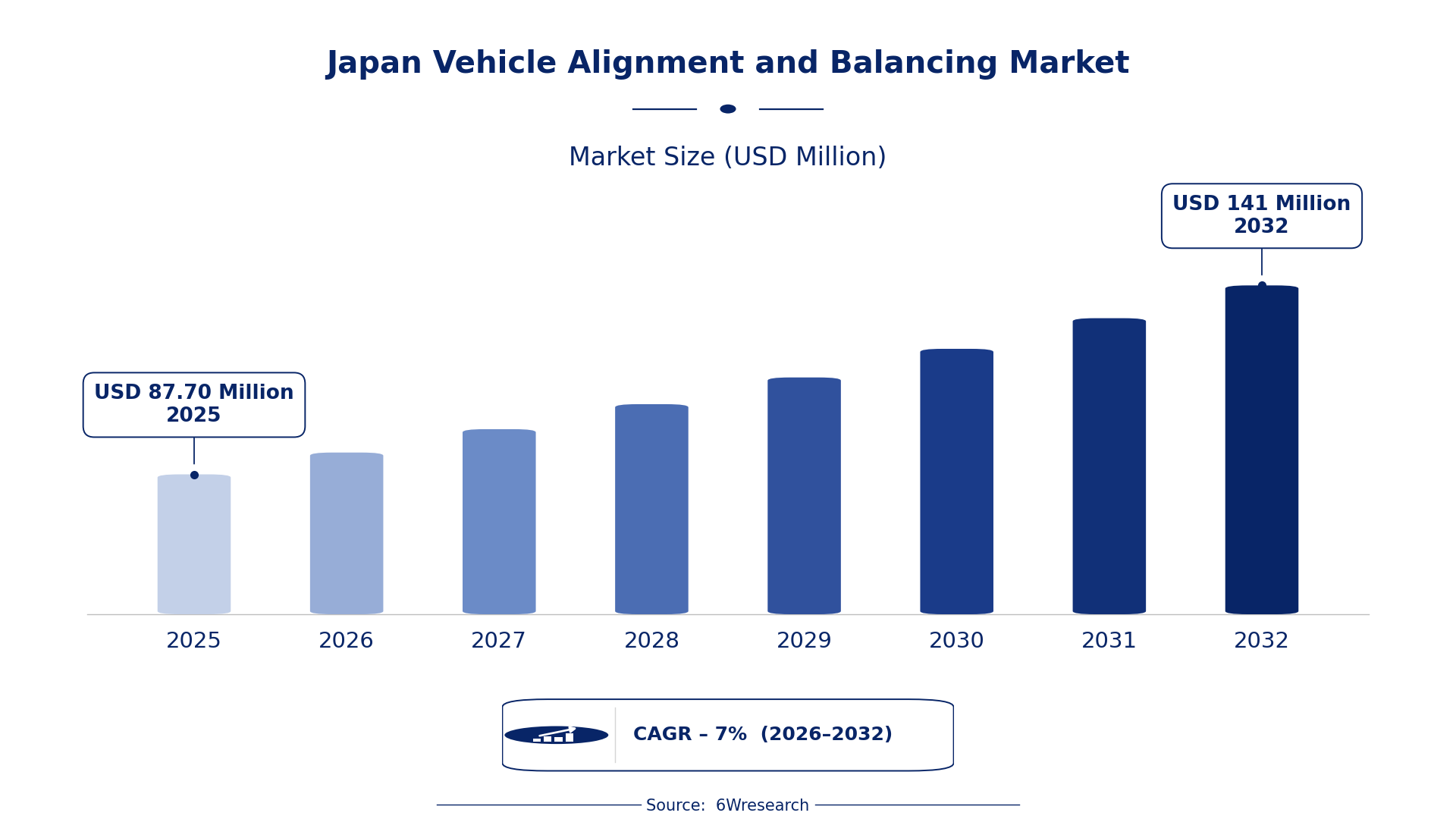
According to 6Wresearch internal database and industry insights, the Japan Vehicle Alignment and Balancing Market was valued at USD 87.70 Million in 2025 and is projected to reach USD 141 Million by 2032, growing at a CAGR of approximately 7% during 2026–2032.
Japan Vehicle Alignment and Balancing Market Highlights
| Report Metric | Details |
| Report Name | Japan Vehicle Alignment and Balancing Market (2026-2032) |
| Market Size 2025 | USD 87.70 Million |
| Market Size 2032 | USD 141 Million |
| Absolute Growth 2025–2032 | USD 53.30 Million |
| CAGR 2026–2032 | 7% |
| Peak Annual Growth | 7.9% in 2026 |
| Forecast Period | 2026–2032 |
| Historical Data | 2022–2025 |
| Base Year | 2025 |
| Leading Service Type, 2025 | Wheel Alignment (36% share) |
| Leading Equipment Used, 2025 | Laser/Camera Systems (48% share) |
| Leading Vehicle Class, 2025 | Passenger Cars (39% share) |
| Leading End User, 2025 | Service Centers (39% share) |
| Fastest-Growing Service Type | 3D Alignment (9.7% CAGR) |
| Fastest-Growing Vehicle Class | Luxury & Sports Cars (9.2% CAGR) |
| Fastest-Growing End User | Tire Workshops (9.4% CAGR) |
| Growing Sector | automotive service industry |
| Key End Users | service centres, tire workshops, automotive repair shops, mobile mechanics |
Japan Vehicle Alignment and Balancing Market Year-wise Growth Rate and Key Drivers (2022–2032)
This graph illustrates the annual growth rates of the market from 2022 to 2032, highlighting a steady upward trajectory and projected market expansion over the forecast period.
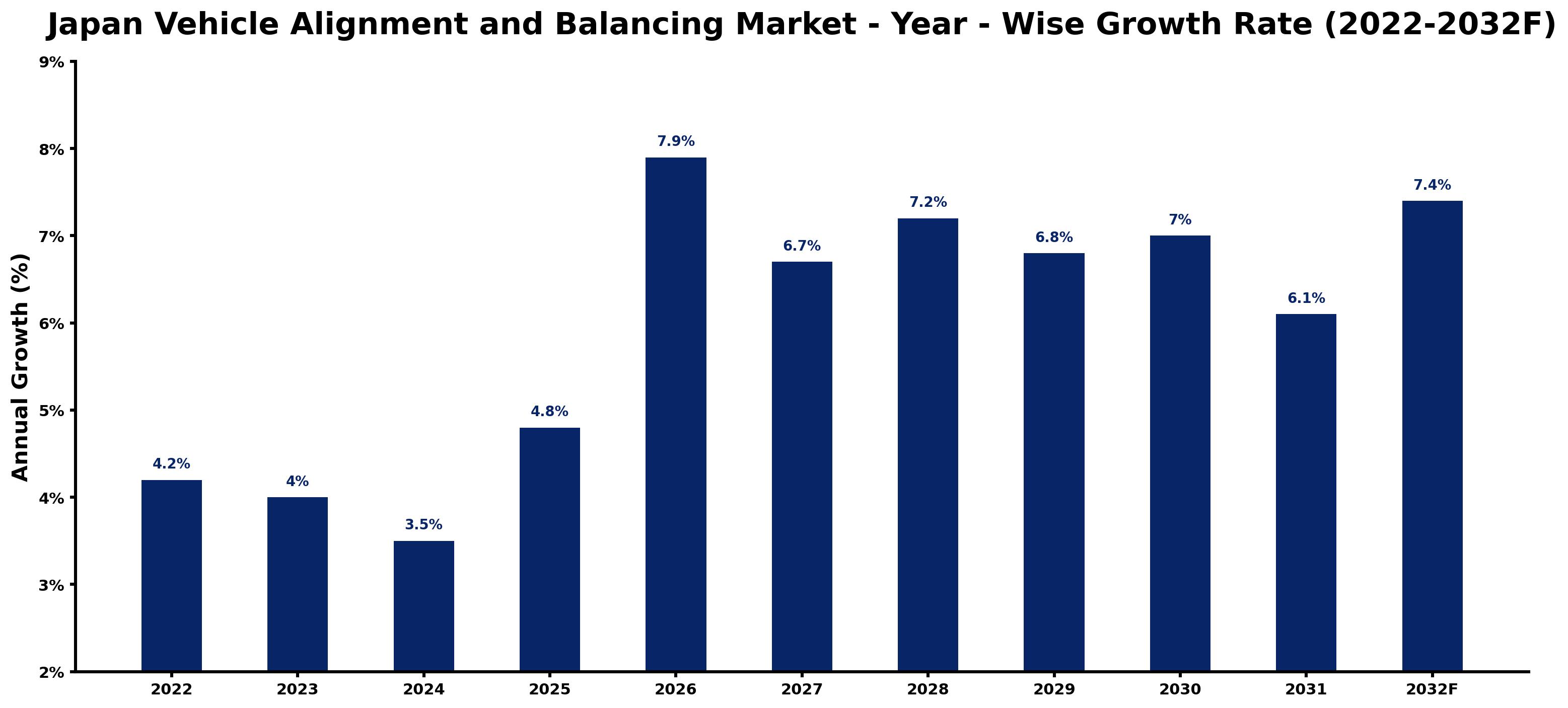
The table below sets out the estimated growth rate for each year and the main factor behind it.
| Year | Estimated Annual Growth (%) | Market Rationale |
| 2022 | 4.2 | The market experienced steady growth due to consistent vehicle maintenance needs. |
| 2023 | 4.0 | Demand growth slowed slightly as vehicle service centres adjusted to market conditions. |
| 2024 | 3.5 | Growth continued to slow as the average vehicle age increased maintenance requirements. |
| 2025 | 4.8 | Demand rose as service centres expanded their offerings to meet customer needs. |
| 2026 | 7.9 | The market is expected to surge with the adoption of advanced alignment technologies. |
| 2027 | 6.7 | Growth is projected to slow as the market adjusts to the peak demand from the previous year. |
| 2028 | 7.2 | Demand is expected to increase again, driven by rising vehicle ownership and maintenance needs. |
| 2029 | 6.8 | The market is projected to experience a slowdown as competition intensifies among service providers. |
| 2030 | 7.0 | Demand is expected to rise as service centres invest in technology to improve service quality. |
| 2031 | 6.1 | Growth is projected to slow as the market stabilises after several years of rapid expansion. |
| 2032 | 7.4 | Demand is projected to rise with increasing vehicle maintenance awareness. |
Note: Market size estimations and growth projections presented in this report are based on 6Wresearch's proprietary forecasting methodology, utilizing the latest available industry data, government publications, and primary research inputs.
Japan Vehicle Alignment and Balancing Market Synopsis
Vehicle alignment and balancing involves adjusting wheel angles to ensure safety, tyre longevity, and fuel efficiency. The Japan Vehicle Alignment and Balancing Market is growing due to strong demand from service centres and domestic users, driven by the adoption of advanced technologies like 3D alignment systems. The average vehicle age exceeds 13 years, leading to increased maintenance needs, particularly in urban areas such as Tokyo, which accounts for 25% of vehicle service demand. This environment encourages service centres to diversify their offerings to meet changing consumer expectations.
Market Dynamics Impact Analysis (2026–2032)
| Factor | Type | Impact | Primary Segment Affected |
| Increasing vehicle age drives demand for maintenance services. | Driver | High | Wheel Alignment |
| Adoption of 3D alignment technology enhances service accuracy. | Driver | High | 3D Alignment |
| Growing number of service centres creates opportunities for equipment suppliers. | Opportunity | High | Laser/Camera Systems |
| Rising awareness of vehicle safety standards boosts demand for alignment services. | Opportunity | Medium | Tire Balancing |
| High competition among service centres may limit profit margins. | Restraint | Medium | Service Centers |
| The average cost of alignment services may deter some customers. | Restraint | Medium | Tire Workshops |
| Limited availability of skilled technicians affects service quality. | Challenge | High | Service Centers |
| Technological advancements require continuous investment from service providers. | Challenge | Medium | 3D Alignment |
Evaluation of Drivers in Japan Vehicle Alignment and Balancing Market (2026–2032)
Demand rests on the following drivers, each shown with the segment it touches most.
| Drivers | Primary Segment Affected | Why It Matters (Evidence) |
| Growing vehicle maintenance needs due to aging fleet. | Wheel Alignment | With the average vehicle age over 13 years, service centres see increased demand for alignment services. |
| Rising adoption of 3D alignment technology improves service precision. | 3D Alignment | Urban service centres are increasingly using 3D systems, improving customer satisfaction and repeat business. |
| Expansion of service centres in urban areas boosts accessibility. | Laser/Camera Systems | The Tokyo region, accounting for 25% of service demand, drives growth in alignment services. |
| Increased awareness of vehicle safety standards leads to more alignments. | Tire Balancing | Promoted safe vehicle maintenance practices encourage regular alignment checks among vehicle owners. |
| Technological advancements in alignment equipment attract investment. | Dynamic Balancer | Service centres are investing in modern equipment to stay competitive, resulting in higher service demand. |
Volumes rise as the average vehicle age surpasses 13 years, creating increased maintenance needs. Urban service centres are adopting laser alignment systems, which improve service accuracy and customer satisfaction. The integration of advanced alignment technologies is increasing, as centres improve service precision. The promotion of safe vehicle maintenance practices encourages regular alignment checks among vehicle owners, resulting in higher service frequency and customer loyalty.
Evaluation of Restraints in Japan Vehicle Alignment and Balancing Market
Below are the constraints most often cited by buyers and suppliers, with the segment each affects.
| Market Restraint | Primary Segment Affected | Why It Matters (Evidence) |
| High competition among service centres limits pricing flexibility. | Service Centers | With numerous service centres in urban areas, price competition can reduce profit margins for providers. |
| The average cost of alignment services may deter some customers. | Tire Workshops | At around 5,000 JPY per service, some vehicle owners may postpone necessary alignments. |
| Limited availability of skilled technicians affects service quality. | Wheel Alignment | The shortage of trained personnel can lead to inconsistent service levels across centres. |
| Technological investments may be challenging for smaller service centres. | 3D Alignment | Smaller operators may struggle to afford advanced alignment systems, limiting their competitive edge. |
| Economic fluctuations can impact consumer spending on vehicle maintenance. | Laser/Camera Systems | During economic downturns, consumers may delay maintenance, affecting service demand. |
Japan Vehicle Alignment and Balancing Market Challenges
Buyers encounter rising costs due to stringent vehicle safety regulations from the Ministry of Land, Infrastructure, Transport and Tourism, which can delay compliance updates by up to two weeks. Service centres face challenges with limited availability of advanced alignment technology, leading to reliance on outdated equipment that can extend service times by 30%. An ageing technician workforce contributes to skills shortages, potentially reducing service capacity by 20% for workshops. Competition intensifies as urban centres adopt advanced technologies, compelling traditional workshops to invest heavily or risk losing clients.
Trends in the Japan Vehicle Alignment and Balancing Market
Several trends are reshaping the Japan Vehicle Alignment and Balancing Market; the most important are set out below.
- Adoption of Advanced 3D Alignment Technology: The integration of 3D alignment technology is becoming standard in urban service centres, improving precision in vehicle maintenance. Over 60% of service centres now utilise these systems, indicating a shift towards technological integration.
- Service Centres Emphasising Quality Assurance: Service centres are increasingly pursuing ISO 9001 certification to ensure quality in their offerings. This trend is evident as more than 50% of centres in urban areas have achieved this certification, enhancing consumer confidence.
- Shift Towards Eco-Friendly Practices: The automotive service industry is moving towards greener practices, influenced by Japan's Green Growth Strategy. This shift is apparent as service centres adopt eco-friendly materials and processes, aligning with national sustainability goals.
- Focus on Vehicle Safety Standards: The Ministry of Land, Infrastructure, Transport and Tourism is prioritising vehicle safety standards, prompting service centres to improve their alignment offerings. This focus is reflected in the increasing number of alignment checks performed annually.
Investment Opportunities in the Japan Vehicle Alignment and Balancing Market
The openings below show where demand in the Japan Vehicle Alignment and Balancing Market is visible and how suppliers can enter.
- Supply of Advanced Laser Alignment Systems: There is a notable opportunity for suppliers of advanced laser alignment systems, particularly in urban service centres. With over 60% of centres employing these technologies, targeting this market can yield substantial growth.
- Establishment of New Service Centres in Tokyo: The Tokyo region presents a prime opportunity for new service centres, given its 25% share of vehicle service demand. Establishing facilities here can capture a significant customer base.
- Provision of Eco-Friendly Maintenance Solutions: With Japan's commitment to carbon neutrality, there is a rising demand for eco-friendly vehicle maintenance solutions. Service centres are increasingly seeking sustainable products to meet consumer expectations.
- Expansion of Mobile Alignment Services: Mobile alignment services are gaining traction as consumers seek convenience. Targeting urban areas with high vehicle density can provide a profitable market for mobile mechanics.
Government Initiatives in the Japan Vehicle Alignment and Balancing Market
The Ministry of Land, Infrastructure, Transport and Tourism enforces vehicle safety standards, ensuring alignment services comply with regulatory requirements. This includes adherence to ISO 9001 certification, which is common among service centres, improving service quality and consumer trust. The ministry's initiatives aim to enhance the overall safety of vehicles, benefiting both service providers and vehicle owners.
Service centres benefit from the Battery Industry Strategy, which targets domestic battery manufacturing capacity by 2030. This initiative supports the automotive sector by ensuring a reliable supply of batteries, indirectly improving vehicle maintenance services. The strategy aims to strengthen the infrastructure necessary for effective vehicle servicing, enhancing the overall service environment.
Future Insight of the Japan Vehicle Alignment and Balancing Market
The market will evolve as buyers benefit from increased adoption of advanced technologies like laser alignment systems, improving efficiency in maintenance processes. By 2032, the average vehicle age will surpass 15 years, significantly increasing demand for alignment and balancing services. The Tokyo region is expected to maintain its dominance, accounting for around 30% of overall service demand. Improved vehicle maintenance practices, supported by initiatives from the Japan Automobile Federation, will redefine service standards and expectations.
Market Segmentation Analysis
Japan Vehicle Alignment and Balancing Market report covers a detailed analysis of the following market segments:
By Service Type – Wheel Alignment Leads, 3D Alignment Expected to Grow Fastest
According to Saurav Kr Singh, Senior Research Analyst at 6Wresearch, in 2025, Wheel Alignment led the service type split with a 36% share. Wheel alignment commands the largest share due to its critical role in ensuring vehicle safety and performance, with many service centers in Japan focusing on this essential service. The average vehicle age exceeding 13 years necessitates regular wheel alignment to uphold safety standards, particularly in urban areas. 3D Alignment is projected to grow fastest, at a CAGR of 9.7% during 2026–2032. 3D alignment technology is growing rapidly because it offers precise measurements for alignment, a feature that urban service centers increasingly demand. This technology's adoption is likely to continue expanding as it meets the needs of modern vehicles more effectively than traditional methods. Suppliers should prioritise the development of advanced alignment technologies to address the rising demand from service centers.
By Equipment Used – Laser/Camera Systems Lead and Record the Fastest Growth
Laser/Camera Systems accounted for 48% of the market by equipment used in 2025. Laser and camera systems hold the largest share in the market due to their critical role in modern alignment processes that ensure precision. Their presence in over 60% of urban service centers underscores their importance in maintaining vehicle safety and performance. Its lead should widen, with a projected CAGR of 9.6% during 2026–2032, the highest in this split. The increasing need for accurate alignment services in densely populated urban areas is propelling the growth of laser and camera systems. As these systems continue to advance, their market share will likely expand further due to their effectiveness in service delivery. Suppliers must prioritise the development of advanced laser and camera systems to meet the growing demand for precision in vehicle alignment.
By Vehicle Class – Passenger Cars Lead, Luxury & Sports Cars Expected to Grow Fastest
Passenger Cars took 39% of vehicle class revenue in 2025, more than any other category. Passenger cars represent the largest share of the market as they constitute the majority of vehicles serviced in Japan, reflecting the high demand for alignment services. This segment's prominence is further supported by the extensive network of service centers catering specifically to these vehicles. Luxury & Sports Cars are set to record the highest CAGR in this split, 9.2% over 2026–2032. Luxury and sports cars are experiencing the fastest growth due to their specific alignment needs for high-performance vehicles, which require more precise adjustments. This trend is driven by the increasing popularity of luxury vehicles among consumers, necessitating specialised services. Service centers should consider expanding their offerings to include specialised alignment services for luxury and sports cars to capture this growing market.
By End User – Service Centers Lead, Tire Workshops Expected to Grow Fastest
With 39% of end user revenue in 2025, Service Centers was the largest category. Service centers are the leading end users of alignment and balancing services, essential for maintaining a large volume of vehicles. Their established role in the automotive service sector makes them a crucial target for suppliers aiming to penetrate the market. Over 2026–2032, Tire Workshops are expected to post the fastest growth, at a CAGR of 9.4%. Tire workshops are rapidly growing as they specialise in tire services, including alignment, addressing a significant customer base. The servicing of around 30 million tires annually highlights the increasing demand for comprehensive tire-related services. Suppliers should focus on providing tailored solutions that cater specifically to the needs of tire workshops to capitalise on their growth.
Key Attractiveness of the Report
- 10 Years of Market Numbers
- Historical Data Starting from 2022 to 2025
- Base Year 2025
- Forecast Data until 2032
- Key Performance Indicators Impacting the Market
- Major Upcoming Developments and Projects
Key Highlights of the Report:
- Japan Vehicle Alignment and Balancing Market Outlook
- Market Size of Japan Vehicle Alignment and Balancing Market, 2025
- Forecast of Japan Vehicle Alignment and Balancing Market, 2032
- Historical Data and Forecast of Japan Vehicle Alignment and Balancing Revenues & Volume for the Period 2022-2032F
- Japan Vehicle Alignment and Balancing Market Trend Evolution
- Japan Vehicle Alignment and Balancing Market Drivers and Challenges
- Japan Vehicle Alignment and Balancing Price Trends
- Japan Vehicle Alignment and Balancing Porter's Five Forces
- Japan Vehicle Alignment and Balancing Industry Life Cycle
- Historical Data and Forecast of Japan Vehicle Alignment and Balancing Market Revenues & Volume By Service Type for the Period 2022-2032F
- Historical Data and Forecast of Japan Vehicle Alignment and Balancing Market Revenues & Volume By Wheel Alignment for the Period 2022-2032F
- Historical Data and Forecast of Japan Vehicle Alignment and Balancing Market Revenues & Volume By Tire Balancing for the Period 2022-2032F
- Historical Data and Forecast of Japan Vehicle Alignment and Balancing Market Revenues & Volume By 3D Alignment for the Period 2022-2032F
- Historical Data and Forecast of Japan Vehicle Alignment and Balancing Market Revenues & Volume By Mobile Alignment for the Period 2022-2032F
- Historical Data and Forecast of Japan Vehicle Alignment and Balancing Market Revenues & Volume By Equipment Used for the Period 2022-2032F
- Historical Data and Forecast of Japan Vehicle Alignment and Balancing Market Revenues & Volume By Laser/Camera Systems for the Period 2022-2032F
- Historical Data and Forecast of Japan Vehicle Alignment and Balancing Market Revenues & Volume By Dynamic Balancer for the Period 2022-2032F
- Historical Data and Forecast of Japan Vehicle Alignment and Balancing Market Revenues & Volume By Optical Scanners for the Period 2022-2032F
- Historical Data and Forecast of Japan Vehicle Alignment and Balancing Market Revenues & Volume By Portable Equipment for the Period 2022-2032F
- Historical Data and Forecast of Japan Vehicle Alignment and Balancing Market Revenues & Volume By Vehicle Class for the Period 2022-2032F
- Historical Data and Forecast of Japan Vehicle Alignment and Balancing Market Revenues & Volume By Light & Heavy Vehicles for the Period 2022-2032F
- Historical Data and Forecast of Japan Vehicle Alignment and Balancing Market Revenues & Volume By Passenger Cars for the Period 2022-2032F
- Historical Data and Forecast of Japan Vehicle Alignment and Balancing Market Revenues & Volume By Luxury & Sports Cars for the Period 2022-2032F
- Historical Data and Forecast of Japan Vehicle Alignment and Balancing Market Revenues & Volume By Commercial Fleets for the Period 2022-2032F
- Historical Data and Forecast of Japan Vehicle Alignment and Balancing Market Revenues & Volume By End User for the Period 2022-2032F
- Historical Data and Forecast of Japan Vehicle Alignment and Balancing Market Revenues & Volume By Service Centers for the Period 2022-2032F
- Historical Data and Forecast of Japan Vehicle Alignment and Balancing Market Revenues & Volume By Tire Workshops for the Period 2022-2032F
- Historical Data and Forecast of Japan Vehicle Alignment and Balancing Market Revenues & Volume By Premium Dealers for the Period 2022-2032F
- Historical Data and Forecast of Japan Vehicle Alignment and Balancing Market Revenues & Volume By Mobile Mechanics for the Period 2022-2032F
- Japan Vehicle Alignment and Balancing Import Export Trade Statistics
- Market Opportunity Assessment By Service Type
- Market Opportunity Assessment By Equipment Used
- Market Opportunity Assessment By Vehicle Class
- Market Opportunity Assessment By End User
- Japan Vehicle Alignment and Balancing Top Companies Market Share
- Japan Vehicle Alignment and Balancing Competitive Benchmarking By Technical and Operational Parameters
- Japan Vehicle Alignment and Balancing Company Profiles
- Japan Vehicle Alignment and Balancing Key Strategic Recommendations
Market Covered
This report examines the market across the segments below.
By Service Type
- Wheel Alignment
- Tire Balancing
- 3D Alignment
- Mobile Alignment
By Equipment Used
- Laser/Camera Systems
- Dynamic Balancer
- Optical Scanners
- Portable Equipment
By Vehicle Class
- Light & Heavy Vehicles
- Passenger Cars
- Luxury & Sports Cars
- Commercial Fleets
By End User
- Service Centers
- Tire Workshops
- Premium Dealers
- Mobile Mechanics































