Japan Vehicle Ancillary Components Market Size & Growth Rate
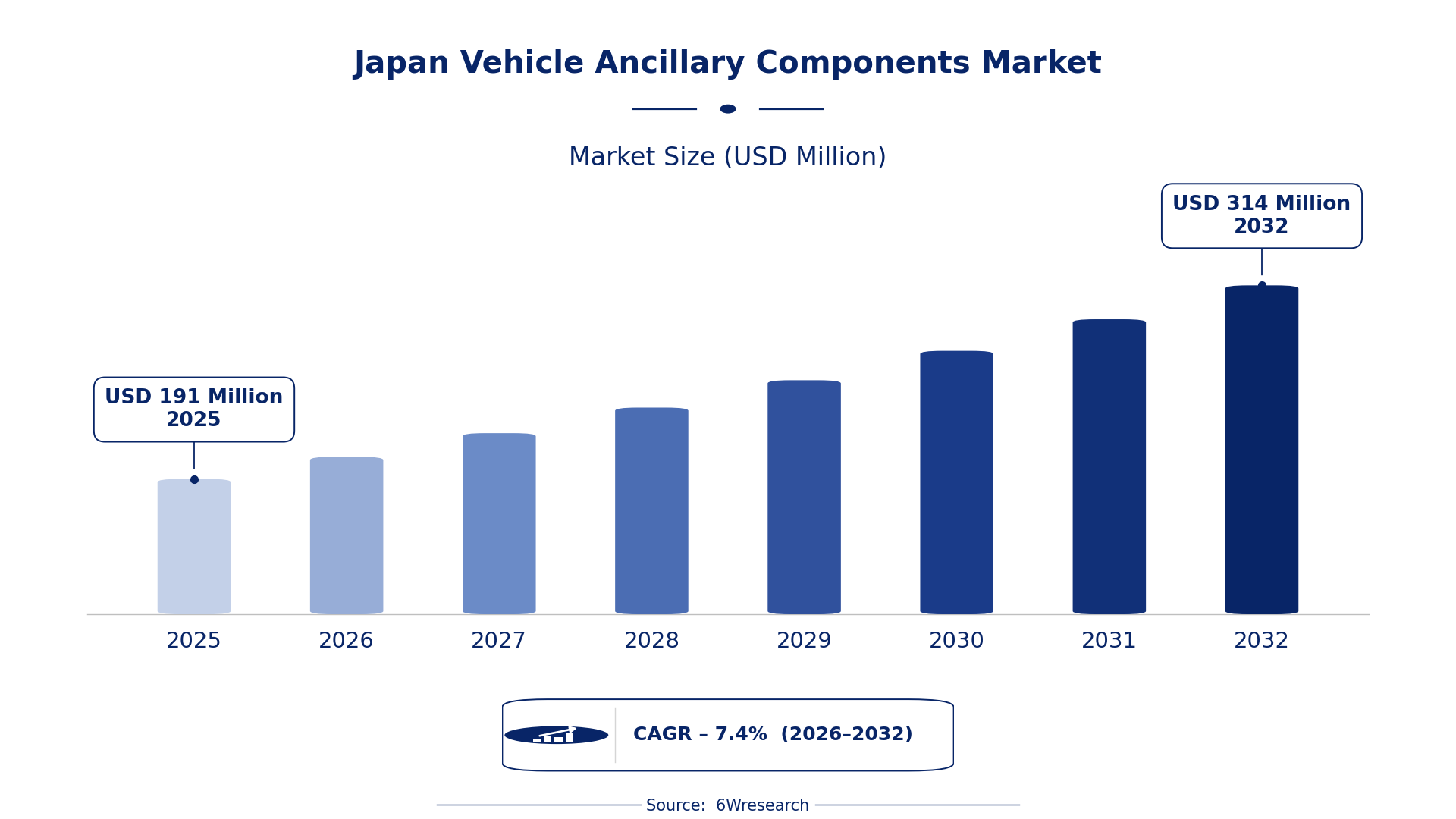
According to 6Wresearch internal database and industry insights, the Japan Vehicle Ancillary Components Market was valued at USD 191 Million in 2025 and is projected to reach USD 314 Million by 2032, growing at a CAGR of approximately 7.4% during 2026–2032.
Japan Vehicle Ancillary Components Market Highlights
| Report Metric | Details |
| Report Name | Japan Vehicle Ancillary Components Market (2026-2032) |
| Market Size 2025 | USD 191 Million |
| Market Size 2032 | USD 314 Million |
| Absolute Growth 2025–2032 | USD 123 Million |
| CAGR 2026–2032 | 7.4% |
| Peak Annual Growth | 8.8% in 2026 |
| Forecast Period | 2026–2032 |
| Historical Data | 2022–2025 |
| Base Year | 2025 |
| Leading Component Type, 2025 | Wiper Blades (48% share) |
| Leading Functionality, 2025 | Visibility Maintenance (40% share) |
| Leading Material Used, 2025 | Rubber/Composite (47% share) |
| Leading End User, 2025 | OEMs (50% share) |
| Fastest-Growing Component Type | Interior Lighting (10.0% CAGR) |
| Fastest-Growing Functionality | Cabin Illumination (9.3% CAGR) |
| Fastest-Growing Material Used | LED Modules (10.2% CAGR) |
| Fastest-Growing End User | Aftermarket Suppliers (9.2% CAGR) |
| Growing Sector | automotive components |
| Key End Users | OEMs, aftermarket suppliers, Tier 1 suppliers |
Japan Vehicle Ancillary Components Market Year-wise Growth Rate and Key Drivers (2022–2032)
This graph illustrates the annual growth rates of the market from 2022 to 2032, highlighting a steady upward trajectory and projected market expansion over the forecast period.
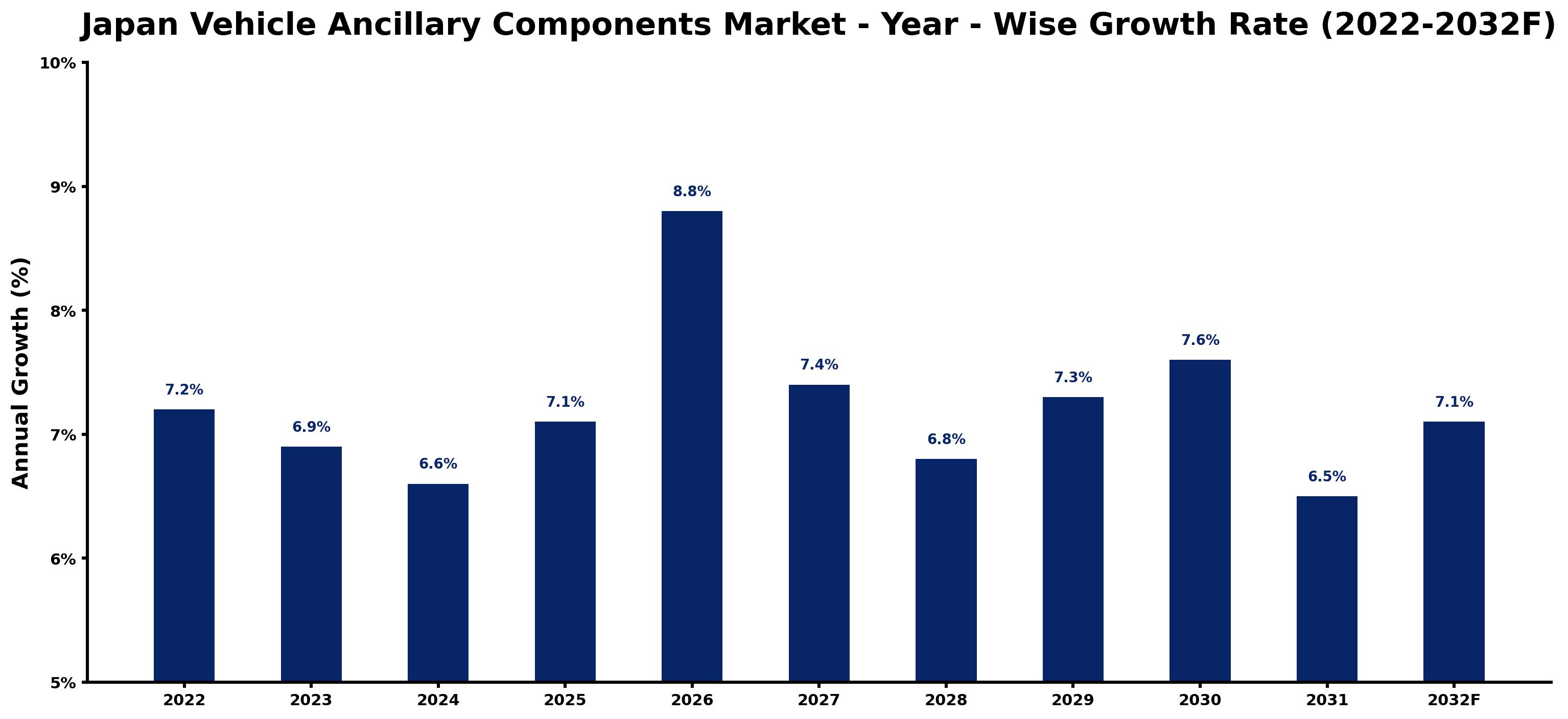
For each year, the table pairs the estimated growth rate with the leading influence on demand, showing how the drivers changed across the period.
| Year | Estimated Annual Growth (%) | Market Rationale |
| 2022 | 7.2 | The market showed steady growth as demand for vehicle safety components increased. |
| 2023 | 6.9 | Growth slowed due to market saturation and evolving consumer preferences. |
| 2024 | 6.6 | Continued demand for visibility maintenance components supported market expansion. |
| 2025 | 7.1 | The market rebounded with rising production levels in the automotive sector. |
| 2026 | 8.8 | Demand surged as electric vehicle components gained traction in the market. |
| 2027 | 7.4 | Growth is expected to slow as manufacturers face challenges in sourcing materials. |
| 2028 | 6.8 | Market expansion is projected to continue, driven by increased consumer focus on safety features. |
| 2029 | 7.3 | Demand for advanced lighting solutions is expected to boost market performance. |
| 2030 | 7.6 | Growth is projected to accelerate with the adoption of eco-friendly materials in production. |
| 2031 | 6.5 | Market growth is expected to slow as competition intensifies among suppliers. |
| 2032 | 7.1 | Demand rises again as technological advancements improve component functionality. |
Note: Market size estimations and growth projections presented in this report are based on 6Wresearch's proprietary forecasting methodology, utilizing the latest available industry data, government publications, and primary research inputs.
Japan Vehicle Ancillary Components Market Synopsis
Vehicle ancillary components improve vehicle functionality and safety, including wiper blades, horn systems, and interior lighting. The Japan Vehicle Ancillary Components Market is growing due to a robust automotive sector, with over 60 million passenger vehicles in operation. Annual investment in R&D exceeds 1 trillion yen, driving advancements in safety and user experience. Government initiatives for electric vehicle components and eco-friendly materials are stimulating market growth, creating opportunities for manufacturers and suppliers.
Market Dynamics Impact Analysis (2026–2032)
| Factor | Type | Impact | Primary Segment Affected |
| Growing demand for electric vehicle components | Driver | High | Interior Lighting |
| Increased focus on vehicle safety features | Driver | High | Visibility Maintenance |
| Rising interest in eco-friendly materials | Opportunity | Medium | Wiper Blades |
| Expansion of the aftermarket supply chain | Opportunity | Medium | Horn Systems |
| Material sourcing challenges affecting production | Restraint | High | Accessory Switches |
| Regulatory compliance costs impacting manufacturers | Restraint | High | Interior Lighting |
| Intense competition among suppliers | Challenge | High | Wiper Blades |
| Technological advancements requiring constant innovation | Challenge | Medium | Horn Systems |
Evaluation of Drivers in Japan Vehicle Ancillary Components Market (2026–2032)
The table below links each growth driver to the segment it affects and the evidence for it.
| Drivers | Primary Segment Affected | Why It Matters (Evidence) |
| Increased production of electric vehicles | Interior Lighting | This shift drives demand for advanced lighting solutions, with R&D investments exceeding 1 trillion yen annually. |
| Rising consumer demand for safety features | Visibility Maintenance | The installed base of over 60 million passenger vehicles creates a strong market for safety components. |
| Growing aftermarket for replacement parts | Horn Systems | The average lifespan of horns influences replacement demand, leading to increased sales. |
| Investment in sustainable materials | Accessory Switches | The push for eco-friendly materials is supported by government subsidies for manufacturers adopting sustainable practices. |
| Technological advancements in vehicle design | Interior Lighting | The popularity of LED technology is transforming lighting systems, appealing to modern consumers. |
Several shifts outside the market lift sales. The automotive sector's focus on electric vehicles is driving demand for advanced interior lighting solutions, with over 60 million passenger vehicles in Japan creating a strong market for safety components. Investment in R&D exceeds 1 trillion yen annually, promoting innovation in safety features. The aftermarket for replacement parts is expanding, particularly for horn systems, as consumers seek reliable components.
Evaluation of Restraints in Japan Vehicle Ancillary Components Market
The main factors holding the market back are set out below.
| Market Restraint | Primary Segment Affected | Why It Matters (Evidence) |
| Challenges in sourcing sustainable materials | Accessory Switches | Manufacturers face difficulties in obtaining eco-friendly materials, which can delay production timelines. |
| High compliance costs for safety regulations | Interior Lighting | Strict adherence to safety standards increases operational costs for manufacturers, impacting pricing. |
| Intense competition among suppliers | Wiper Blades | The pressure from competitors forces suppliers to lower prices, squeezing profit margins. |
| Technological advancements requiring constant updates | Horn Systems | Suppliers must invest continuously in technology to keep pace with changing consumer preferences. |
| Market saturation limiting growth potential | Visibility Maintenance | The established market for visibility components faces challenges in attracting new customers. |
Japan Vehicle Ancillary Components Market Challenges
Sourcing eco-friendly materials presents a major hurdle for producers, as Japan's stringent regulations can delay timelines by three months, impacting their ability to fulfil orders. Technology integration poses difficulties; many manufacturers hesitate to adopt new systems, which can increase production costs by 15% for ancillary components. Importers face intense competition from domestic suppliers, resulting in price wars that can reduce profit margins by 10%, complicating their financial sustainability. Buyers experience fluctuating prices for essential components, which can disrupt budgeting and lead to delays in vehicle production schedules.
Trends in the Japan Vehicle Ancillary Components Market
The shifts below are changing how Japan Vehicle Ancillary Components Market products are bought and supplied.
- Shift to LED Technology in Interior Lighting: In 2023, the adoption of LED technology in interior lighting systems is gaining momentum, with a 25% increase in consumer preference for energy-efficient solutions. This trend is transforming the overall user experience in vehicles.
- Growing Demand for Eco-Friendly Materials: Japan's automotive industry is increasingly prioritising eco-friendly materials, driven by the GX Promotion Act of 2023. This shift is altering component production, with manufacturers focusing on sustainability and aiming for a 46% reduction in greenhouse-gas emissions by 2030.
- Expansion of Aftermarket Supply Chains: The aftermarket for vehicle components is expanding, particularly in regions like Tokyo and Aichi, where demand for replacement parts is increasing due to the aging vehicle population. This growth offers new opportunities for suppliers, with a projected 15% rise in sales.
- Focus on Enhanced Safety Features: Since 2022, there has been a notable increase in consumer demand for advanced safety features in vehicles. This trend is encouraging manufacturers to innovate and improve component designs to meet evolving safety standards, with a 20% increase in safety-related component sales.
Investment Opportunities in the Japan Vehicle Ancillary Components Market
Investors looking at the Japan Vehicle Ancillary Components Market should consider the following areas.
- Supply of Eco-Friendly Ancillary Components: With Japan aiming for a 46% reduction in greenhouse-gas emissions by 2030, there is a growing opportunity to supply eco-friendly ancillary components. Manufacturers can enter this market by forming partnerships with local suppliers to meet the demand.
- Investment in Advanced Interior Lighting Solutions: The shift towards LED technology in interior lighting systems presents an opportunity, with the market expected to grow rapidly by 10% annually. Suppliers can target OEMs in Tokyo and Aichi to satisfy this demand.
- Expansion in Aftermarket Replacement Parts: The aging vehicle population in Japan creates a gap in the aftermarket for replacement parts, projected to grow by 12% over the next five years. Suppliers can establish joint ventures with local distributors to capture this expanding market.
- Development of Advanced Safety Components: The focus on advanced safety features in vehicles offers a promising opportunity for manufacturers. Investing in R&D for safety components can attract OEMs seeking reliable solutions, with a potential market growth of 15%.
Government Initiatives in the Japan Vehicle Ancillary Components Market
The regulatory framework for vehicle ancillary components is shaped by laws such as the Green Growth Strategy, adopted in 2020, which identifies key growth sectors including automotive components. The GX Promotion Act, enacted in 2023, supports the transition towards eco-friendly materials in production, compelling manufacturers to adapt their practices accordingly.
The Ministry of Economy, Trade and Industry (METI) oversees several programs, including the Battery Industry Strategy, which aims to boost domestic battery manufacturing. This agency also funds initiatives promoting the use of sustainable materials in automotive production, ensuring compliance with environmental standards.
Future Insight of the Japan Vehicle Ancillary Components Market
The emergence of smart vehicle systems will transform demand for ancillary components by 2032, as consumers increasingly seek advanced functionalities. Investment in automotive R&D will surpass 1 trillion yen annually, facilitating breakthroughs in safety and efficiency. The Japanese government’s commitment to a 46% reduction in greenhouse-gas emissions by 2030 will drive the adoption of sustainable materials across the sector. Enhanced standards for vehicle safety will further spur innovation in component design and production.
Market Segmentation Analysis
Japan Vehicle Ancillary Components Market report covers a detailed analysis of the following market segments:
By Component Type – Wiper Blades Lead, Interior Lighting Expected to Grow Fastest
According to Saurav Kr Singh, Senior Research Analyst at 6Wresearch, Wiper Blades took 48% of component type revenue in 2025, more than any other category. Wiper blades hold the largest share due to their critical role in ensuring visibility, particularly during Japan's frequent rain. With over 60 million passenger vehicles in the country, the demand for reliable wiper blades remains consistently high. Over 2026–2032, Interior Lighting is expected to post the fastest growth, at a CAGR of 10.0%. Interior lighting is expanding rapidly as consumers increasingly prefer LED technology for its energy efficiency and modern appeal. This shift is evident in the growing number of vehicles incorporating advanced interior lighting systems, enhancing overall cabin experience. Suppliers should focus on delivering high-quality wiper blades and innovative interior lighting solutions to meet the evolving demands of the automotive market.
By Functionality – Visibility Maintenance Leads, Cabin Illumination Expected to Grow Fastest
The largest functionality category in 2025 was Visibility Maintenance, at 40% of revenue. Visibility maintenance is the leading functionality because it is vital for safe driving in Japan's varied weather conditions. The substantial vehicle population necessitates effective solutions to ensure driver safety and adherence to stringent regulations. Cabin Illumination is set to record the highest CAGR in this split, 9.3% over 2026–2032. Cabin illumination is growing quickly as consumers prioritise comfort and modern aesthetics in their vehicles. This trend is prompting manufacturers to invest in advanced lighting technologies that significantly enhance the passenger experience. Manufacturers must concentrate on technologies that improve both visibility and cabin comfort to maintain competitiveness in the automotive components sector.
By Material Used – Rubber/Composite Leads, LED Modules Expected to Grow Fastest
In 2025, Rubber/Composite led the material used split with a 47% share. Rubber and composite materials dominate the market as they provide the necessary durability and performance required for vehicle components. Their widespread use in various ancillary parts ensures a consistent demand from both OEMs and aftermarket suppliers. LED Modules are projected to grow fastest, at a CAGR of 10.2% during 2026–2032. LED modules are rapidly gaining traction as a modern solution for vehicle lighting, driven by their energy efficiency and longevity. The shift towards eco-friendly materials aligns with Japan's sustainability goals, further propelling this segment's growth. Suppliers should consider expanding their product lines to include advanced materials like LED modules to align with market trends and consumer preferences.
By End User – OEMs Lead, Aftermarket Suppliers Expected to Grow Fastest
OEMs accounted for 50% of the market by end user in 2025. OEMs dominate the market as they manufacture original components for Japan's robust automotive industry, playing a crucial role in the economy. Their established relationships with vehicle manufacturers ensure a steady demand for high-quality ancillary components. The quickest growth will come from Aftermarket Suppliers, forecast to expand at a CAGR of 9.2% between 2026 and 2032. Aftermarket suppliers are experiencing the fastest growth due to an increasing need for replacement parts, driven by the rising number of older vehicles on the road. This trend underscores the importance of reliable aftermarket solutions in fulfilling consumer requirements. Suppliers should develop targeted strategies to effectively cater to both OEMs and aftermarket channels, maximising their market presence and revenue opportunities.
Key Attractiveness of the Report
- 10 Years of Market Numbers
- Historical Data Starting from 2022 to 2025
- Base Year 2025
- Forecast Data until 2032
- Key Performance Indicators Impacting the Market
- Major Upcoming Developments and Projects
Key Highlights of the Report:
- Japan Vehicle Ancillary Components Market Outlook
- Market Size of Japan Vehicle Ancillary Components Market, 2025
- Forecast of Japan Vehicle Ancillary Components Market, 2032
- Historical Data and Forecast of Japan Vehicle Ancillary Components Revenues & Volume for the Period 2022-2032F
- Japan Vehicle Ancillary Components Market Trend Evolution
- Japan Vehicle Ancillary Components Market Drivers and Challenges
- Japan Vehicle Ancillary Components Price Trends
- Japan Vehicle Ancillary Components Porter's Five Forces
- Japan Vehicle Ancillary Components Industry Life Cycle
- Historical Data and Forecast of Japan Vehicle Ancillary Components Market Revenues & Volume By Component Type for the Period 2022-2032F
- Historical Data and Forecast of Japan Vehicle Ancillary Components Market Revenues & Volume By Wiper Blades for the Period 2022-2032F
- Historical Data and Forecast of Japan Vehicle Ancillary Components Market Revenues & Volume By Horn Systems for the Period 2022-2032F
- Historical Data and Forecast of Japan Vehicle Ancillary Components Market Revenues & Volume By Interior Lighting for the Period 2022-2032F
- Historical Data and Forecast of Japan Vehicle Ancillary Components Market Revenues & Volume By Accessory Switches for the Period 2022-2032F
- Historical Data and Forecast of Japan Vehicle Ancillary Components Market Revenues & Volume By Functionality for the Period 2022-2032F
- Historical Data and Forecast of Japan Vehicle Ancillary Components Market Revenues & Volume By Visibility Maintenance for the Period 2022-2032F
- Historical Data and Forecast of Japan Vehicle Ancillary Components Market Revenues & Volume By Alert Mechanism for the Period 2022-2032F
- Historical Data and Forecast of Japan Vehicle Ancillary Components Market Revenues & Volume By Cabin Illumination for the Period 2022-2032F
- Historical Data and Forecast of Japan Vehicle Ancillary Components Market Revenues & Volume By User Interface for the Period 2022-2032F
- Historical Data and Forecast of Japan Vehicle Ancillary Components Market Revenues & Volume By Material Used for the Period 2022-2032F
- Historical Data and Forecast of Japan Vehicle Ancillary Components Market Revenues & Volume By Rubber/Composite for the Period 2022-2032F
- Historical Data and Forecast of Japan Vehicle Ancillary Components Market Revenues & Volume By Electromechanical Units for the Period 2022-2032F
- Historical Data and Forecast of Japan Vehicle Ancillary Components Market Revenues & Volume By LED Modules for the Period 2022-2032F
- Historical Data and Forecast of Japan Vehicle Ancillary Components Market Revenues & Volume By Polycarbonate Housings for the Period 2022-2032F
- Historical Data and Forecast of Japan Vehicle Ancillary Components Market Revenues & Volume By End User for the Period 2022-2032F
- Historical Data and Forecast of Japan Vehicle Ancillary Components Market Revenues & Volume By Aftermarket Suppliers for the Period 2022-2032F
- Historical Data and Forecast of Japan Vehicle Ancillary Components Market Revenues & Volume By OEMs for the Period 2022-2032F
- Historical Data and Forecast of Japan Vehicle Ancillary Components Market Revenues & Volume By Passenger Vehicles for the Period 2022-2032F
- Historical Data and Forecast of Japan Vehicle Ancillary Components Market Revenues & Volume By Tier 1 Suppliers for the Period 2022-2032F
- Japan Vehicle Ancillary Components Import Export Trade Statistics
- Market Opportunity Assessment By Component Type
- Market Opportunity Assessment By Functionality
- Market Opportunity Assessment By Material Used
- Market Opportunity Assessment By End User
- Japan Vehicle Ancillary Components Top Companies Market Share
- Japan Vehicle Ancillary Components Competitive Benchmarking By Technical and Operational Parameters
- Japan Vehicle Ancillary Components Company Profiles
- Japan Vehicle Ancillary Components Key Strategic Recommendations
Market Covered
The following segment groups are covered in the report.
By Component Type
- Wiper Blades
- Horn Systems
- Interior Lighting
- Accessory Switches
By Functionality
- Visibility Maintenance
- Alert Mechanism
- Cabin Illumination
- User Interface
By Material Used
- Rubber/Composite
- Electromechanical Units
- LED Modules
- Polycarbonate Housings
By End User
- Aftermarket Suppliers
- OEMs
- Passenger Vehicles
- Tier 1 Suppliers































