Japan Vehicle AR Interface Market Size & Growth Rate
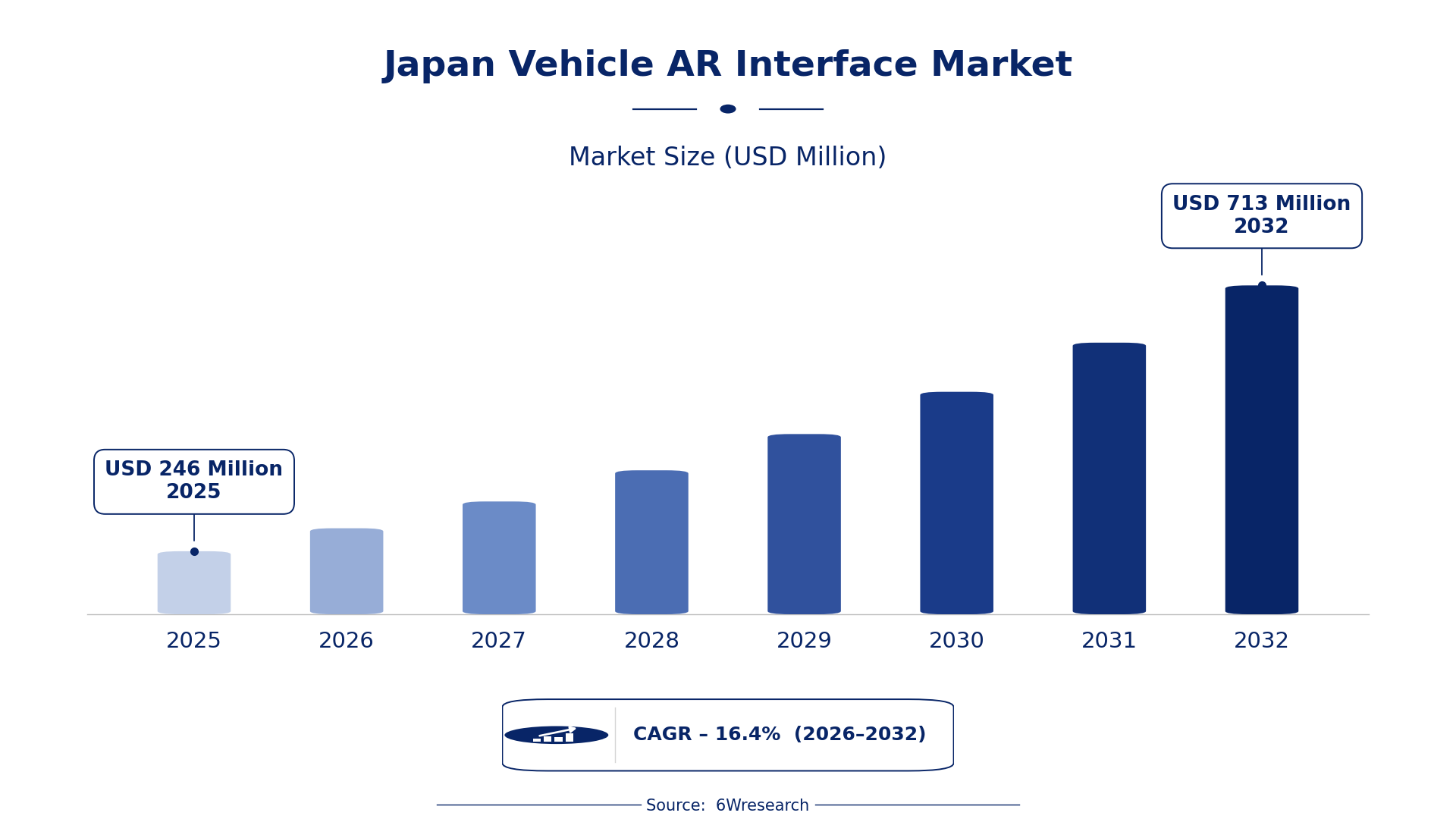
According to 6Wresearch internal database and industry insights, the Japan Vehicle AR Interface Market was valued at USD 246 Million in 2025 and is projected to reach USD 713 Million by 2032, growing at a CAGR of approximately 16.4% during 2026–2032.
Japan Vehicle AR Interface Market Highlights
| Report Metric | Details |
| Report Name | Japan Vehicle AR Interface Market (2026-2032) |
| Market Size 2025 | USD 246 Million |
| Market Size 2032 | USD 713 Million |
| Absolute Growth 2025–2032 | USD 467 Million |
| CAGR 2026–2032 | 16.4% |
| Peak Annual Growth | 17.9% in 2032 |
| Forecast Period | 2026–2032 |
| Historical Data | 2022–2025 |
| Base Year | 2025 |
| Leading Interface Type, 2025 | Head-Up Display (HUD) (41% share) |
| Leading Display Technology, 2025 | Projection/Optical Lens (47% share) |
| Leading Application, 2025 | Navigation (36% share) |
| Leading End User, 2025 | EV and Premium OEMs (44% share) |
| Fastest-Growing Interface Type | Windshield Display (18.3% CAGR) |
| Fastest-Growing Display Technology | Augmented Overlay (17.5% CAGR) |
| Fastest-Growing Application | Speed (18.3% CAGR) |
| Fastest-Growing End User | Advanced Driver Assist (22.7% CAGR) |
| Growing Sector | automotive technology |
| Key End Users | premium OEMs, advanced driver assist systems, connected vehicle manufacturers |
Japan Vehicle AR Interface Market Year-wise Growth Rate and Key Drivers (2022–2032)
This graph illustrates the annual growth rates of the market from 2022 to 2032, highlighting a steady upward trajectory and projected market expansion over the forecast period.
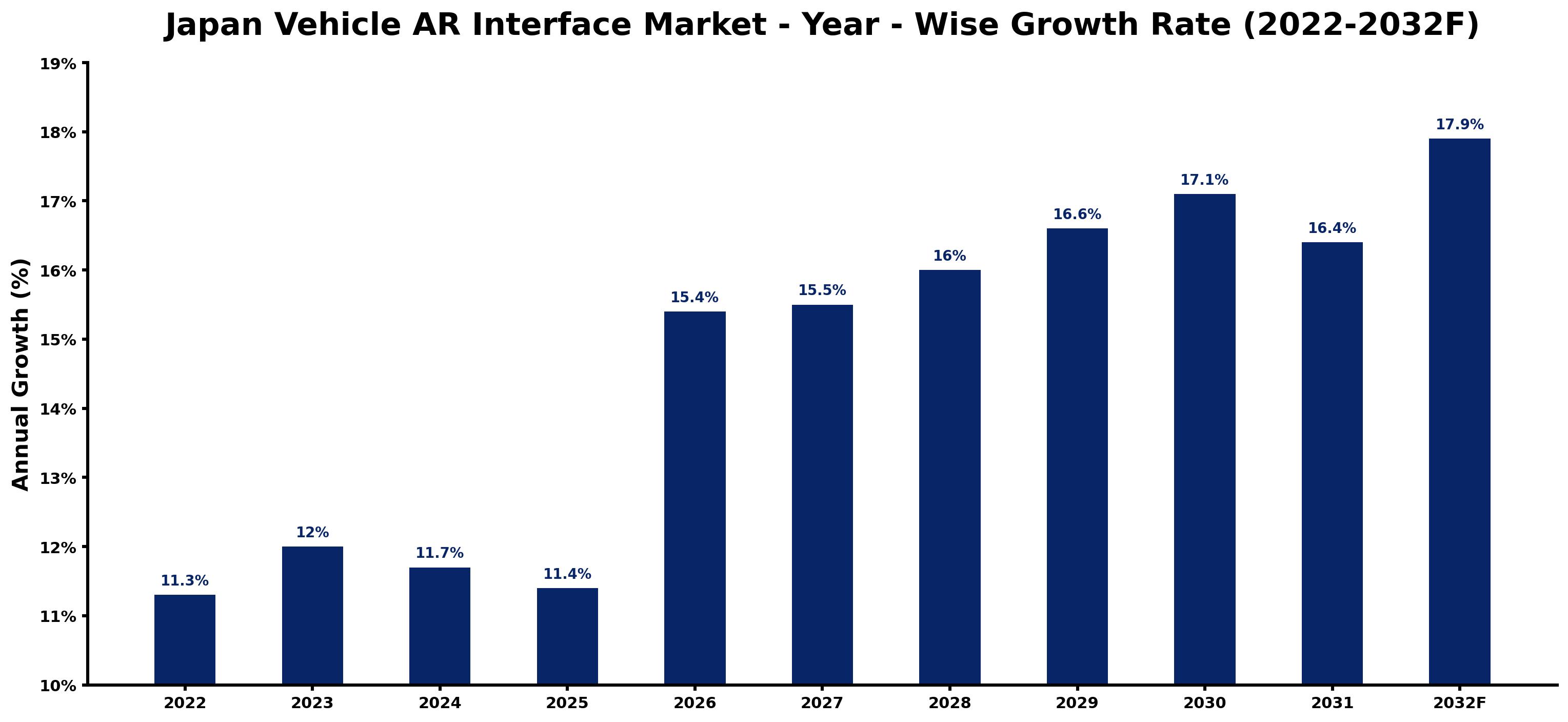
Each row of the following table gives one year's estimated growth and the event or demand shift that explains it.
| Year | Estimated Annual Growth (%) | Market Rationale |
| 2022 | 11.3 | The market exhibited steady growth, driven by increasing interest in AR technologies among manufacturers. |
| 2023 | 12.0 | Demand surged as premium OEMs adopted AR interfaces for enhanced user experiences and safety. |
| 2024 | 11.7 | Growth slowed slightly as market saturation began to affect new installations and upgrades. |
| 2025 | 11.4 | The market continued to grow, albeit at a slower pace due to competitive pressures and innovation challenges. |
| 2026 | 15.4 | Growth is expected to accelerate as investments in AR technology gain traction among manufacturers and users. |
| 2027 | 15.5 | Demand will rise further, supported by advancements in AR display technologies and consumer preferences. |
| 2028 | 16.0 | The market is projected to experience increased growth as consumer preferences shift towards AR features and functionalities. |
| 2029 | 16.6 | Growth will continue to rise as the number of connected vehicles expands, enhancing the demand for AR applications. |
| 2030 | 17.1 | Demand is expected to surge as the integration of AR in vehicles becomes standard practice among manufacturers. |
| 2031 | 16.4 | Growth will moderate slightly as the market matures and competition intensifies among suppliers. |
| 2032 | 17.9 | The market is projected to peak as AR interfaces become ubiquitous in vehicles, driven by consumer expectations. |
Note: Market size estimations and growth projections presented in this report are based on 6Wresearch's proprietary forecasting methodology, utilizing the latest available industry data, government publications, and primary research inputs.
Japan Vehicle AR Interface Market Synopsis
Vehicle AR Interfaces overlay digital information onto real-world views, improving navigation and safety in vehicles. The Japan Vehicle AR Interface Market is growing due to rising adoption among premium OEMs and advancements in display technologies. Investments in automotive technology innovation and government support for AR integration are driving demand. The projected number of connected vehicles in Japan is set to reach 10 million by 2025, further fueling market expansion.
Market Dynamics Impact Analysis (2026–2032)
| Factor | Type | Impact | Primary Segment Affected |
| Growing adoption of AR technologies among premium OEMs | Driver | High | Head-Up Display (HUD) |
| Increased investment in automotive technology innovation | Driver | High | Windshield Display |
| Expansion of connected vehicle infrastructure | Opportunity | High | In-Vehicle AR Display |
| Rising consumer demand for enhanced navigation systems | Opportunity | High | Navigation |
| High costs associated with AR technology development | Restraint | Medium | Augmented Overlay |
| Limited awareness among traditional manufacturers | Restraint | Medium | Projection/Optical Lens |
| Supply chain disruptions affecting component availability | Challenge | High | Embedded Screen |
| Competition from alternative navigation technologies | Challenge | Medium | Wearable AR |
Evaluation of Drivers in Japan Vehicle AR Interface Market (2026–2032)
Key forces behind demand, with the segment each one moves most, are listed below.
| Drivers | Primary Segment Affected | Why It Matters (Evidence) |
| Increased investment in AR technology | Head-Up Display (HUD) | This investment is expected to lead to a projected 10 million connected vehicles by 2025, enhancing market opportunities. |
| Rising consumer demand for safety features | Windshield Display | As vehicles age, the need for upgrades drives demand, with the average vehicle age in Japan being around 13 years. |
| Government support for automotive innovation | In-Vehicle AR Display | The government allocated 5 billion JPY for automotive technology innovation in 2023, encouraging manufacturers to adopt AR. |
| Growing popularity of connected vehicles | Navigation | The projected increase in connected vehicles supports the integration of AR navigation systems, enhancing user experience. |
| Technological advancements in AR displays | Augmented Overlay | New display technologies improve clarity and functionality, attracting more premium OEMs to adopt AR solutions. |
Spending rises due to investments in AR technology, with 5 billion JPY allocated for automotive innovation in 2023. This funding encourages manufacturers to improve user experiences, leading to an increase in connected vehicles projected to reach 10 million by 2025. The average age of vehicles in Japan is around 13 years, prompting demand for upgrades like AR interfaces. Consumer expectations for safety features drive adoption, particularly among premium OEMs. AR navigation systems are becoming integral to modern driving experiences, supported by advancements in display technologies.
Evaluation of Restraints in Japan Vehicle AR Interface Market
The table below lists the restraints and the evidence behind each.
| Market Restraint | Primary Segment Affected | Why It Matters (Evidence) |
| High costs associated with AR technology development | Augmented Overlay | Development costs can deter manufacturers from adopting AR, limiting market growth potential by restricting investment. |
| Limited awareness among traditional manufacturers | Projection/Optical Lens | Many traditional manufacturers are unaware of AR benefits, slowing adoption rates and limiting market expansion. |
| Supply chain disruptions affecting component availability | Embedded Screen | Disruptions can delay production timelines, impacting the availability of AR interfaces in vehicles and increasing lead times. |
| Competition from alternative navigation technologies | Wearable AR | Emerging technologies may divert investment away from AR interfaces, affecting market growth and slowing adoption rates. |
| Regulatory hurdles in technology integration | In-Vehicle AR Display | Compliance with standards can slow down the introduction of new AR technologies in vehicles, hindering market progress. |
Japan Vehicle AR Interface Market Challenges
Buyers face increased costs due to limited AR technology options, raising vehicle upgrade expenses by up to 15% for premium models. Suppliers experience a skills gap in AR development, leading to project delays averaging six months, which restricts their ability to meet rising demand. Producers encounter supply chain disruptions from reliance on specific components, causing potential delays in product launches, particularly in Tokyo and Aichi Prefecture. Escalating raw material costs for AR interfaces can inflate prices by 10%, forcing buyers to reconsider their purchasing decisions and impacting overall market conditions.
Trends in the Japan Vehicle AR Interface Market
These developments are changing demand patterns in the Japan Vehicle AR Interface Market.
- Shift from Traditional Displays to AR Interfaces: The automotive industry is increasingly adopting AR interfaces for navigation and safety. The 2023 Automotive Technology Expo in Tokyo showcased numerous AR innovations that improve user experience, with a projected increase in connected vehicles reaching 10 million by 2025.
- Increased Focus on Safety Features: Premium OEMs are prioritising safety improvements through AR technology. The adoption of AR for real-time alerts is becoming standard, with the number of connected vehicles projected to reach 10 million by 2025.
- Transition from Conventional Navigation to AR Navigation: AR navigation systems are replacing traditional methods, providing drivers with real-time information. The guidelines released by the Ministry of Land, Infrastructure, Transport and Tourism in 2023 support this transition, enhancing user experience.
- Emergence of Integrated AR Solutions: Integrated AR solutions are becoming essential in modern vehicles, improving driver experience. The projected growth in AR applications is expected to boost user engagement and safety significantly.
Investment Opportunities in the Japan Vehicle AR Interface Market
Where to invest in the Japan Vehicle AR Interface Market: the main openings are set out below.
- Investment in AR Navigation Systems: Investing in AR navigation systems is essential as demand rises among premium OEMs. The average vehicle age of 13 years indicates a need for upgrades, creating opportunities for suppliers to meet this demand.
- Supply of Advanced Display Technologies: Now is the time to provide advanced display technologies, particularly in regions like Aichi Prefecture. Partnering with local manufacturers can facilitate entry into this growing market for AR solutions.
- Development of AR Safety Features: Developing AR safety features is timely as consumer demand for safety rises. The government’s 5 billion JPY allocation for innovation in 2023 presents an opportunity for suppliers to innovate.
- Enhancement of Connected Vehicle Infrastructure: Enhancing connected vehicle infrastructure is vital as the number of connected vehicles is projected to reach 10 million by 2025. Collaborating with local authorities can streamline this process and facilitate growth.
Government Initiatives in the Japan Vehicle AR Interface Market
The GX Promotion Act (2023) establishes a framework for promoting advanced automotive technologies, including AR interfaces. This act aims to facilitate the integration of technologies in vehicles, encouraging manufacturers to invest in AR solutions. The government is targeting an increase in domestic battery manufacturing capacity by 2030, which will support the automotive sector and its technological advancements.
The Ministry of Economy, Trade and Industry oversees funding for automotive technology innovation, including AR development. In 2023, the agency allocated 5 billion JPY to support projects that enhance AR integration in vehicles. This funding is essential for manufacturers looking to adopt AR technologies effectively and improve their offerings.
Future Insight of the Japan Vehicle AR Interface Market
By 2032, advancements in AR technology will reshape buyer expectations, driving demand for enhanced interfaces. The government's substantial investment in automotive technology will encourage suppliers to innovate and develop superior products. The anticipated growth of connected vehicles will broaden the market for AR applications, significantly improving user experiences. The implementation of the JIS D 0201 standard will establish crucial guidelines, ensuring safety and consistency in the integration of AR technologies within vehicles.
Market Segmentation Analysis
Japan Vehicle AR Interface Market report covers a detailed analysis of the following market segments:
By Interface Type – Head-Up Display (HUD) Leads, Windshield Display Expected to Grow Fastest
According to Saurav Kr Singh, Senior Research Analyst at 6Wresearch, Head-Up Display (HUD) took 41% of interface type revenue in 2025, more than any other category. The Head-Up Display (HUD) segment leads the market due to its widespread use in premium vehicles for navigation and alerts, enhancing driver awareness. In regions like Tokyo and Aichi Prefecture, many automotive manufacturers have adopted HUDs to improve the overall driving experience. The quickest growth will come from Windshield Display, forecast to expand at a CAGR of 18.3% between 2026 and 2032. Windshield Displays are experiencing rapid growth as they provide crucial driving information directly on the windshield, which significantly boosts safety and convenience. With the number of connected vehicles projected to reach 10 million by 2025, the demand for this technology is set to increase substantially. Suppliers should focus on advancing HUD and Windshield Display technologies to meet the rising expectations of premium vehicle manufacturers.
By Display Technology – Projection/Optical Lens Lead, Augmented Overlay Expected to Grow Fastest
The largest display technology category in 2025 was Projection/Optical Lens, at 47% of revenue. Projection/Optical Lens technology holds the largest share as it is essential for displaying information clearly in various lighting conditions. This technology is particularly favoured in the automotive sector, where clarity and precision are critical for ensuring driver safety. Augmented Overlay is projected to grow fastest, at a CAGR of 17.5% during 2026–2032. Augmented Overlay is the fastest-growing segment because it effectively integrates digital data with the physical environment, enhancing user interaction. The increasing adoption of AR applications in navigation is further driving this growth, marking it as a key area for future development. Buyers will benefit from suppliers who invest in advanced projection technologies and augmented overlays to improve user experience in vehicles.
By Application – Navigation Leads, Speed Expected to Grow Fastest
Navigation held 36% of the Japan Vehicle AR Interface Market by application in 2025. Navigation applications dominate the market as they are crucial for the modern driving experience, providing essential route information to drivers. The complexity of urban environments in Japan necessitates sophisticated navigation solutions, making this segment particularly vital. Speed is set to record the highest CAGR in this split, 18.3% over 2026–2032. Speed applications are growing rapidly as they are critical for driver awareness and safety, especially with the rise of connected vehicles. The heightened focus on safety in automotive technology development is propelling this segment's expansion. Suppliers should prioritise developing navigation and speed applications to align with the increasing emphasis on driver safety.
By End User – EV and Premium OEMs Lead, Advanced Driver Assist Expected to Grow Fastest
In 2025, EV and Premium OEMs led the end user split with a 44% share. EV and Premium OEMs represent the largest share as they are significant users of advanced AR technologies, integrating them to enhance vehicle performance and user experience. The push for innovation in electric vehicles further solidifies their leading position in this market. Over 2026–2032, Advanced Driver Assist is expected to post the fastest growth, at a CAGR of 22.7%. Advanced Driver Assist systems are the fastest-growing segment, as they play a crucial role in enhancing vehicle safety and automation. Ongoing government support for AR technology development in the automotive sector is expected to accelerate this growth. Suppliers need to tailor their offerings to meet the specific requirements of EV and Premium OEMs, particularly in advanced driver assistance technologies.
Key Attractiveness of the Report
- 10 Years of Market Numbers
- Historical Data Starting from 2022 to 2025
- Base Year 2025
- Forecast Data until 2032
- Key Performance Indicators Impacting the Market
- Major Upcoming Developments and Projects
Key Highlights of the Report:
- Japan Vehicle AR Interface Market Outlook
- Market Size of Japan Vehicle AR Interface Market, 2025
- Forecast of Japan Vehicle AR Interface Market, 2032
- Historical Data and Forecast of Japan Vehicle AR Interface Revenues & Volume for the Period 2022-2032F
- Japan Vehicle AR Interface Market Trend Evolution
- Japan Vehicle AR Interface Market Drivers and Challenges
- Japan Vehicle AR Interface Price Trends
- Japan Vehicle AR Interface Porter's Five Forces
- Japan Vehicle AR Interface Industry Life Cycle
- Historical Data and Forecast of Japan Vehicle AR Interface Market Revenues & Volume By Interface Type for the Period 2022-2032F
- Historical Data and Forecast of Japan Vehicle AR Interface Market Revenues & Volume By Head-Up Display (HUD) for the Period 2022-2032F
- Historical Data and Forecast of Japan Vehicle AR Interface Market Revenues & Volume By Windshield Display for the Period 2022-2032F
- Historical Data and Forecast of Japan Vehicle AR Interface Market Revenues & Volume By In-Vehicle AR Display for the Period 2022-2032F
- Historical Data and Forecast of Japan Vehicle AR Interface Market Revenues & Volume By Wearable AR for the Period 2022-2032F
- Historical Data and Forecast of Japan Vehicle AR Interface Market Revenues & Volume By Display Technology for the Period 2022-2032F
- Historical Data and Forecast of Japan Vehicle AR Interface Market Revenues & Volume By Projection/Optical Lens for the Period 2022-2032F
- Historical Data and Forecast of Japan Vehicle AR Interface Market Revenues & Volume By Augmented Overlay for the Period 2022-2032F
- Historical Data and Forecast of Japan Vehicle AR Interface Market Revenues & Volume By Embedded Screen for the Period 2022-2032F
- Historical Data and Forecast of Japan Vehicle AR Interface Market Revenues & Volume By Smart Glasses Integration for the Period 2022-2032F
- Historical Data and Forecast of Japan Vehicle AR Interface Market Revenues & Volume By Application for the Period 2022-2032F
- Historical Data and Forecast of Japan Vehicle AR Interface Market Revenues & Volume By Navigation, Speed, Alerts for the Period 2022-2032F
- Historical Data and Forecast of Japan Vehicle AR Interface Market Revenues & Volume By Real-Time Driver Info for the Period 2022-2032F
- Historical Data and Forecast of Japan Vehicle AR Interface Market Revenues & Volume By Infotainment, Diagnostics for the Period 2022-2032F
- Historical Data and Forecast of Japan Vehicle AR Interface Market Revenues & Volume By Fleet & Training Usage for the Period 2022-2032F
- Historical Data and Forecast of Japan Vehicle AR Interface Market Revenues & Volume By End User for the Period 2022-2032F
- Historical Data and Forecast of Japan Vehicle AR Interface Market Revenues & Volume By EV and Premium OEMs for the Period 2022-2032F
- Historical Data and Forecast of Japan Vehicle AR Interface Market Revenues & Volume By Advanced Driver Assist for the Period 2022-2032F
- Historical Data and Forecast of Japan Vehicle AR Interface Market Revenues & Volume By Connected Vehicles for the Period 2022-2032F
- Historical Data and Forecast of Japan Vehicle AR Interface Market Revenues & Volume By Autonomous Test Fleets for the Period 2022-2032F
- Japan Vehicle AR Interface Import Export Trade Statistics
- Market Opportunity Assessment By Interface Type
- Market Opportunity Assessment By Display Technology
- Market Opportunity Assessment By Application
- Market Opportunity Assessment By End User
- Japan Vehicle AR Interface Top Companies Market Share
- Japan Vehicle AR Interface Competitive Benchmarking By Technical and Operational Parameters
- Japan Vehicle AR Interface Company Profiles
- Japan Vehicle AR Interface Key Strategic Recommendations
Market Covered
The study includes the following segmentation.
By Interface Type
- Head-Up Display (HUD)
- Windshield Display
- In-Vehicle AR Display
- Wearable AR
By Display Technology
- Projection/Optical Lens
- Augmented Overlay
- Embedded Screen
- Smart Glasses Integration
By Application
- Navigation
- Speed
- Alerts
- Real-Time Driver Info
- Infotainment
- Diagnostics
- Fleet & Training Usage
By End User
- EV and Premium OEMs
- Advanced Driver Assist
- Connected Vehicles
- Autonomous Test Fleets































