Japan Vehicle Assistive Devices Market Size & Growth Rate
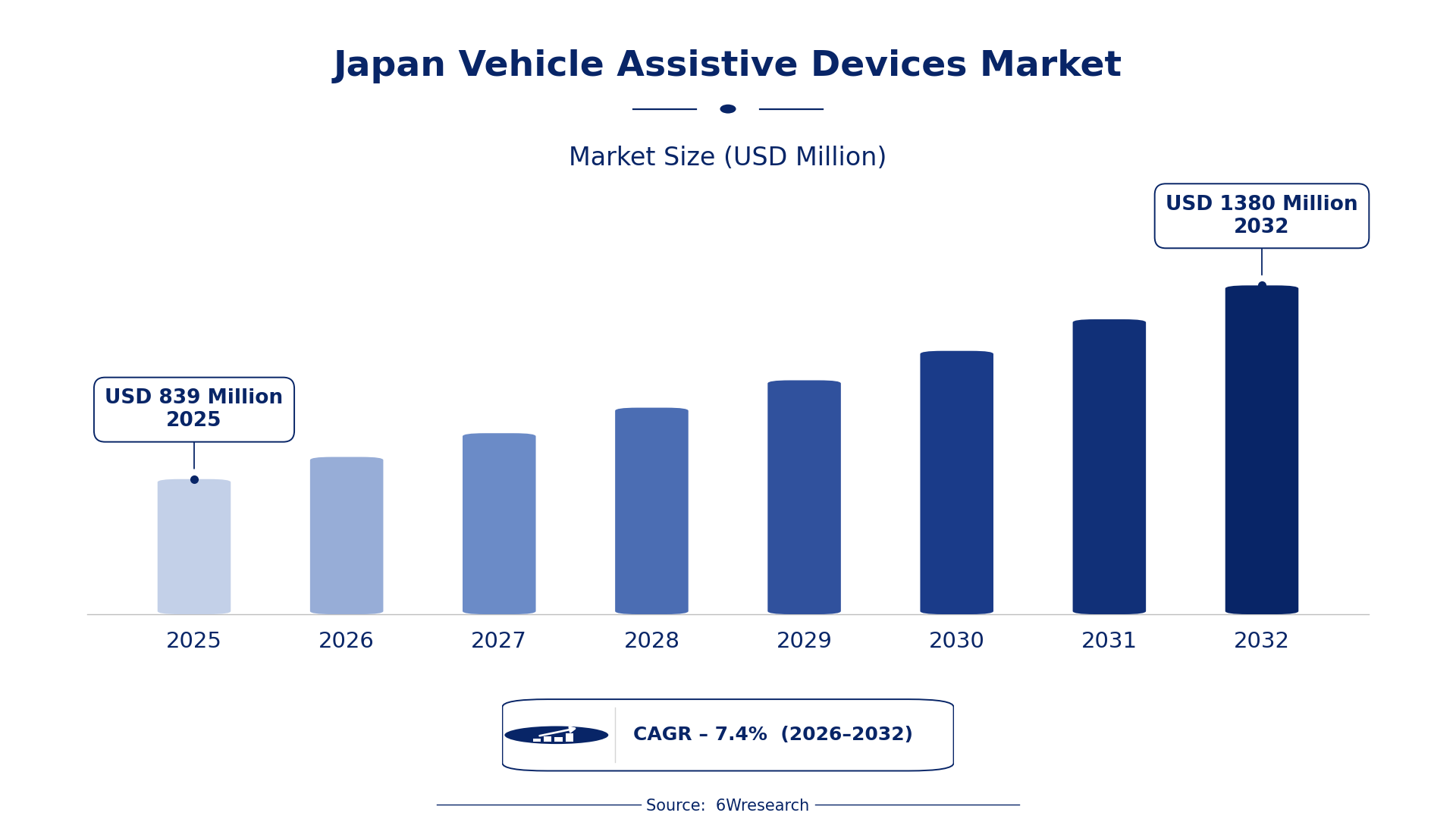
According to 6Wresearch internal database and industry insights, the Japan Vehicle Assistive Devices Market was valued at USD 839 Million in 2025 and is projected to reach USD 1,380 Million by 2032, growing at a CAGR of approximately 7.4% during 2026–2032.
Japan Vehicle Assistive Devices Market Highlights
| Report Metric | Details |
| Report Name | Japan Vehicle Assistive Devices Market (2026-2032) |
| Market Size 2025 | USD 839 Million |
| Market Size 2032 | USD 1,380 Million |
| Absolute Growth 2025–2032 | USD 541 Million |
| CAGR 2026–2032 | 7.4% |
| Peak Annual Growth | 8.3% in 2032 |
| Forecast Period | 2026–2032 |
| Historical Data | 2022–2025 |
| Base Year | 2025 |
| Leading Device Type, 2025 | Pedal Extenders (41% share) |
| Leading Operation Type, 2025 | Mechanical (45% share) |
| Leading Vehicle Compatibility, 2025 | Cars (51% share) |
| Leading End User, 2025 | Elderly Drivers (51% share) |
| Fastest-Growing Device Type | Hand Controls (10.2% CAGR) |
| Fastest-Growing Operation Type | Hydraulic (10.6% CAGR) |
| Fastest-Growing Vehicle Compatibility | Vans (9.4% CAGR) |
| Fastest-Growing End User | Physically Disabled (9.5% CAGR) |
| Growing Sector | Elderly Mobility Solutions |
| Key End Users | Elderly Drivers, Physically Disabled, Rehabilitation Clinics, Mobility Assistance Organizations |
Japan Vehicle Assistive Devices Market Year-wise Growth Rate and Key Drivers (2022–2032)
This graph illustrates the annual growth rates of the market from 2022 to 2032, highlighting a steady upward trajectory and projected market expansion over the forecast period.
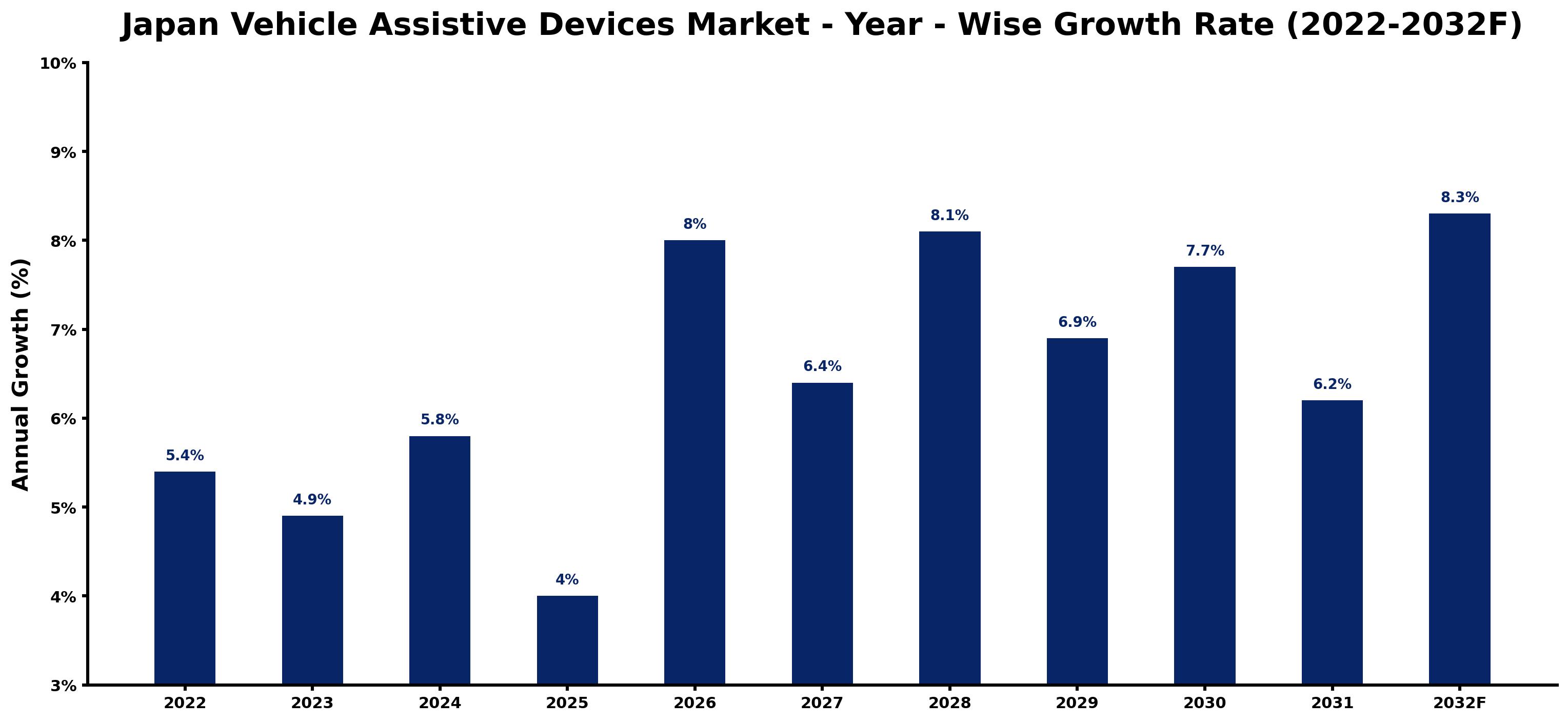
Below, each year's estimated growth is shown next to the factor that most influenced it.
| Year | Estimated Annual Growth (%) | Market Rationale |
| 2022 | 5.4 | The market showed steady growth as the elderly population continued to rise. |
| 2023 | 4.9 | Growth slowed slightly due to market saturation in certain device categories. |
| 2024 | 5.8 | Increased awareness of mobility solutions drove faster growth compared to the previous year. |
| 2025 | 4.0 | Competition intensified among assistive device manufacturers, leading to slower growth. |
| 2026 | 8.0 | Demand is expected to surge as new technologies improve device functionality and accessibility. |
| 2027 | 6.4 | Growth is projected to slow due to market adjustments following rapid technological advancements. |
| 2028 | 8.1 | Increased adoption of electric assistive devices is expected to spur higher growth rates. |
| 2029 | 6.9 | As the market stabilises, growth will slow after several years of rapid expansion. |
| 2030 | 7.7 | Demand is expected to increase again as more elderly drivers seek mobility solutions. |
| 2031 | 6.2 | Market maturity begins to set in for assistive technologies, leading to slower growth. |
| 2032 | 8.3 | The market is expected to peak with rising demand for advanced assistive devices. |
Note: Market size estimations and growth projections presented in this report are based on 6Wresearch's proprietary forecasting methodology, utilizing the latest available industry data, government publications, and primary research inputs.
Japan Vehicle Assistive Devices Market Synopsis
These devices include hand controls, wheelchair lifts, and steering aids, manufactured with advanced engineering for reliability. The Japan Vehicle Assistive Devices Market is growing due to an increasing elderly population, projected to reach 36 million by 2040, alongside a commitment to accessibility in transportation. Government initiatives to promote mobility for the elderly are driving higher demand from various buyer groups, particularly elderly drivers and rehabilitation clinics. The focus on improving transportation accessibility is shaping the market's evolution.
Market Dynamics Impact Analysis (2026–2032)
| Factor | Type | Impact | Primary Segment Affected |
| Aging population drives demand for assistive devices. | Driver | High | Hand Controls |
| Technological advancements enhance device functionality. | Driver | High | Electric |
| Growing elderly population creates a significant market. | Opportunity | High | Wheelchair Lifts |
| Increased awareness of mobility solutions among families. | Opportunity | High | Pedal Extenders |
| High costs of advanced assistive devices limit access. | Restraint | High | Steering Aids |
| Limited insurance coverage for assistive devices restricts purchases. | Restraint | Medium | Hand Controls |
| Competition among manufacturers drives prices down. | Challenge | Medium | Electric |
| Technological complexity may deter some buyers. | Challenge | Medium | Wheelchair Lifts |
Evaluation of Drivers in Japan Vehicle Assistive Devices Market (2026–2032)
The factors lifting demand, and the evidence behind each, are summarised below.
| Drivers | Primary Segment Affected | Why It Matters (Evidence) |
| Increasing elderly population requiring mobility solutions. | Wheelchair Lifts | With 29.3% of the population aged 65 or older, demand for wheelchair lifts is rising as they provide essential access. |
| Technological advancements in assistive devices. | Electric | A 20% increase in adoption from 2020 to 2023 shows how technology is improving device functionality. |
| Government initiatives promoting mobility for the elderly. | Pedal Extenders | The Ministry of Health, Labour and Welfare's 2023 program supports the elderly, increasing demand for pedal extenders. |
| Growing awareness of accessibility needs in families. | Hand Controls | As families seek solutions for elderly drivers, demand for hand controls is rising, evidenced by increased referrals from rehabilitation clinics. |
| Rising healthcare expenditures increase focus on mobility aids. | Steering Aids | Japan's national medical care expenditure reached JPY 46.7 trillion in 2022, highlighting the growing investment in health-related solutions. |
Behind the steady rise in orders sits a notable increase in the elderly population, projected to reach 36 million by 2040. This demographic shift drives demand for wheelchair lifts, which provide essential access for users. Technological advancements have also played a role, with electric assistive devices seeing a 20% adoption increase from 2020 to 2023. Rising healthcare expenditures highlight the focus on mobility aids, prompting increased purchases across various buyer groups, including rehabilitation clinics and elderly drivers.
Evaluation of Restraints in Japan Vehicle Assistive Devices Market
Several factors work against faster growth; the main ones are summarised below.
| Market Restraint | Primary Segment Affected | Why It Matters (Evidence) |
| High costs of advanced assistive devices limit access. | Hand Controls | Many potential buyers find the prices of advanced hand controls prohibitively high, limiting market penetration. |
| Limited insurance coverage for assistive devices restricts purchases. | Wheelchair Lifts | Insurance often does not cover the costs of wheelchair lifts, making them less accessible for users. |
| Market saturation in certain device categories slows growth. | Electric | As the market matures, competition and saturation are leading to slower growth rates in electric devices. |
| Technological complexity may deter some buyers. | Steering Aids | The advanced technology in steering aids can intimidate potential users, reducing their willingness to purchase. |
| Regulatory hurdles can delay product approvals. | Pedal Extenders | Manufacturers face challenges in meeting stringent safety standards, delaying the introduction of new pedal extenders. |
Japan Vehicle Assistive Devices Market Challenges
In 2023, the average cost of durable materials for vehicle assistive devices rose by 15%, increasing production expenses for manufacturers. Supply chain disruptions are causing hospitals to experience delays of up to six weeks for critical device installations, impacting patient care. Competition intensifies as the elderly population grows, compelling producers to lower prices and squeezing profit margins. Technological advancements require substantial investment, hindering smaller manufacturers from keeping pace, which limits options for buyers seeking affordable assistive solutions.
Trends in the Japan Vehicle Assistive Devices Market
These developments are changing demand patterns in the Japan Vehicle Assistive Devices Market.
- Shift from Mechanical to Electric Devices: Electric assistive devices are gaining popularity, with a 20% rise in adoption from 2020 to 2023. This shift reflects a growing preference for technology that improves control and ease of use, particularly among elderly drivers.
- Surge in Demand for Wheelchair Lifts: The elderly population is driving a surge in demand for wheelchair lifts, with over 1 million registered physically disabled individuals in Japan. This trend highlights the need for accessible transportation solutions.
- Emphasis on Accessibility Initiatives: In 2023, the government allocated ¥5 billion for accessibility initiatives in public transport. This funding aims to improve mobility options for the elderly and disabled, influencing market trends.
- Growth of Hand Controls for Elderly Drivers: With 15% of new vehicle registrations including modifications for assistive technologies in 2022, hand controls are increasingly being adopted to support elderly drivers in maintaining independence.
Investment Opportunities in the Japan Vehicle Assistive Devices Market
The following opportunities in the Japan Vehicle Assistive Devices Market pair current demand with a clear way in.
- Elderly Drivers Seeking Mobility Solutions: As the elderly population grows, there is an opportunity to supply advanced assistive devices. The government’s initiatives highlight the need for innovative solutions, with the elderly population projected to reach 36 million by 2040.
- Rehabilitation Clinics Requiring Assistive Technologies: Rehabilitation clinics are increasingly recommending assistive devices, creating a demand for partnerships. With over 8,100 hospitals in Japan, collaboration can facilitate device distribution.
- Gap in Insurance Coverage for Assistive Devices: With limited insurance coverage for assistive devices, there is an opportunity to develop affordable solutions. Targeting families of elderly drivers can help bridge this gap effectively.
- Growing Market for Electric Assistive Devices: The increasing popularity of electric devices presents a promising opportunity. Manufacturers can enter this market by partnering with local firms to enhance distribution channels.
Government Initiatives in the Japan Vehicle Assistive Devices Market
The Long-Term Care Insurance Act, established in 1997 and in force since 2000, provides financial support for acquiring assistive devices, ensuring that they are accessible to those in need. This law complements existing regulations by facilitating the purchase of mobility aids for the elderly population. By funding these devices, the Act improves mobility options for users, allowing them to maintain independence while driving.
The Pharmaceuticals and Medical Devices Agency (PMDA) reviews and monitors the safety of assistive devices, ensuring compliance with national standards. This agency plays a critical role in approving new technologies, which helps maintain high safety standards for users. In 2023, the PMDA approved several new assistive devices, contributing to the market's growth and ensuring that users have access to the latest advancements.
Future Insight of the Japan Vehicle Assistive Devices Market
By 2032, hospitals will see improved patient access to assistive devices as government funding for accessibility initiatives increases, with ¥5 billion already allocated in 2023. The elderly population is projected to reach 36 million, driving demand for new device designs. New JIS standards will improve safety and reliability for users, benefiting both buyers and suppliers. Continued government support for accessibility programmes will encourage collaboration between manufacturers and healthcare providers, creating a more inclusive environment for individuals with mobility challenges.
Market Segmentation Analysis
Japan Vehicle Assistive Devices Market report covers a detailed analysis of the following market segments:
By Device Type – Pedal Extenders Lead, Hand Controls Expected to Grow Fastest
According to Saurav Kr Singh, Senior Research Analyst at 6Wresearch, the largest device type category in 2025 was Pedal Extenders, at 41% of revenue. Pedal extenders hold the largest share as they are essential for shorter drivers to reach vehicle pedals comfortably, facilitating independence in driving. This segment benefits from the growing elderly population, which is projected to reach 36 million by 2040, increasing the demand for such devices. Over 2026–2032, Hand Controls are expected to post the fastest growth, at a CAGR of 10.2%. Hand controls are experiencing rapid growth due to a notable increase in referrals for assistive driving devices, with rehabilitation clinics in Osaka reporting a 30% rise. As the elderly population expands, the need for devices that allow safe vehicle operation for those with limited leg use will continue to grow. Suppliers should focus on developing and promoting hand controls to meet the rising demand among elderly and disabled drivers.
By Operation Type – Mechanical Leads, Hydraulic Expected to Grow Fastest
With 45% of operation type revenue in 2025, Mechanical was the largest category. Mechanical systems maintain the largest share as they are commonly found in simpler assistive devices, appealing to a broad range of users. Their reliability and established presence in the market ensure continued preference among various applications. The quickest growth will come from Hydraulic, forecast to expand at a CAGR of 10.6% between 2026 and 2032. Hydraulic systems are gaining traction due to their incorporation in assistive devices that enhance user experience, particularly in lifts and controls. As manufacturers innovate, the adoption of hydraulic systems is expected to accelerate in future products. Suppliers should focus on advancements in hydraulic technology to meet the rising demand in this segment.
By Vehicle Compatibility – Cars Lead, Vans Expected to Grow Fastest
In 2025, Cars led the vehicle compatibility split with a 51% share. Cars are the predominant vehicle type for assistive devices, ensuring accessibility for a wide range of users. The modification of 15% of new vehicle registrations for assistive technologies underscores their critical role in this market. Vans are set to record the highest CAGR in this split, 9.4% over 2026–2032. Vans are rapidly gaining popularity for assistive devices due to their suitability for modifications that enhance accessibility. This trend is likely to continue as the elderly population increasingly seeks adaptable transport solutions. Suppliers should broaden their offerings to include modifications for vans to capitalise on this expanding market segment.
By End User – Elderly Drivers Lead, Physically Disabled Expected to Grow Fastest
Elderly Drivers took 51% of end user revenue in 2025, more than any other category. Elderly drivers represent the largest user group, significantly benefiting from assistive devices that facilitate independent driving. With Japan's elderly population projected to reach 36 million by 2040, this segment is crucial for ongoing market growth. Physically Disabled is projected to grow fastest, at a CAGR of 9.5% during 2026–2032. Physically disabled individuals are the fastest-growing user group, as they depend on assistive technologies for safe driving. The increasing number of registered physically disabled individuals, exceeding 1 million, will further drive demand for tailored solutions. Suppliers must prioritise the creation of products specifically designed for physically disabled users to address the growing market needs.
Key Attractiveness of the Report
- 10 Years of Market Numbers
- Historical Data Starting from 2022 to 2025
- Base Year 2025
- Forecast Data until 2032
- Key Performance Indicators Impacting the Market
- Major Upcoming Developments and Projects
Key Highlights of the Report:
- Japan Vehicle Assistive Devices Market Outlook
- Market Size of Japan Vehicle Assistive Devices Market, 2025
- Forecast of Japan Vehicle Assistive Devices Market, 2032
- Historical Data and Forecast of Japan Vehicle Assistive Devices Revenues & Volume for the Period 2022-2032F
- Japan Vehicle Assistive Devices Market Trend Evolution
- Japan Vehicle Assistive Devices Market Drivers and Challenges
- Japan Vehicle Assistive Devices Price Trends
- Japan Vehicle Assistive Devices Porter's Five Forces
- Japan Vehicle Assistive Devices Industry Life Cycle
- Historical Data and Forecast of Japan Vehicle Assistive Devices Market Revenues & Volume By Device Type for the Period 2022-2032F
- Historical Data and Forecast of Japan Vehicle Assistive Devices Market Revenues & Volume By Pedal Extenders for the Period 2022-2032F
- Historical Data and Forecast of Japan Vehicle Assistive Devices Market Revenues & Volume By Hand Controls for the Period 2022-2032F
- Historical Data and Forecast of Japan Vehicle Assistive Devices Market Revenues & Volume By Wheelchair Lifts for the Period 2022-2032F
- Historical Data and Forecast of Japan Vehicle Assistive Devices Market Revenues & Volume By Steering Aids for the Period 2022-2032F
- Historical Data and Forecast of Japan Vehicle Assistive Devices Market Revenues & Volume By Operation Type for the Period 2022-2032F
- Historical Data and Forecast of Japan Vehicle Assistive Devices Market Revenues & Volume By Mechanical for the Period 2022-2032F
- Historical Data and Forecast of Japan Vehicle Assistive Devices Market Revenues & Volume By Hydraulic for the Period 2022-2032F
- Historical Data and Forecast of Japan Vehicle Assistive Devices Market Revenues & Volume By Electric for the Period 2022-2032F
- Historical Data and Forecast of Japan Vehicle Assistive Devices Market Revenues & Volume By Electronic for the Period 2022-2032F
- Historical Data and Forecast of Japan Vehicle Assistive Devices Market Revenues & Volume By Vehicle Compatibility for the Period 2022-2032F
- Historical Data and Forecast of Japan Vehicle Assistive Devices Market Revenues & Volume By Cars for the Period 2022-2032F
- Historical Data and Forecast of Japan Vehicle Assistive Devices Market Revenues & Volume By Vans for the Period 2022-2032F
- Historical Data and Forecast of Japan Vehicle Assistive Devices Market Revenues & Volume By Buses for the Period 2022-2032F
- Historical Data and Forecast of Japan Vehicle Assistive Devices Market Revenues & Volume By SUVs for the Period 2022-2032F
- Historical Data and Forecast of Japan Vehicle Assistive Devices Market Revenues & Volume By End User for the Period 2022-2032F
- Historical Data and Forecast of Japan Vehicle Assistive Devices Market Revenues & Volume By Elderly Drivers for the Period 2022-2032F
- Historical Data and Forecast of Japan Vehicle Assistive Devices Market Revenues & Volume By Physically Disabled for the Period 2022-2032F
- Historical Data and Forecast of Japan Vehicle Assistive Devices Market Revenues & Volume By Mobility Assistance Orgs for the Period 2022-2032F
- Historical Data and Forecast of Japan Vehicle Assistive Devices Market Revenues & Volume By Rehabilitation Clinics for the Period 2022-2032F
- Japan Vehicle Assistive Devices Import Export Trade Statistics
- Market Opportunity Assessment By Device Type
- Market Opportunity Assessment By Operation Type
- Market Opportunity Assessment By Vehicle Compatibility
- Market Opportunity Assessment By End User
- Japan Vehicle Assistive Devices Top Companies Market Share
- Japan Vehicle Assistive Devices Competitive Benchmarking By Technical and Operational Parameters
- Japan Vehicle Assistive Devices Company Profiles
- Japan Vehicle Assistive Devices Key Strategic Recommendations
Market Covered
The report covers the following segments.
By Device Type
- Pedal Extenders
- Hand Controls
- Wheelchair Lifts
- Steering Aids
By Operation Type
- Mechanical
- Hydraulic
- Electric
- Electronic
By Vehicle Compatibility
- Cars
- Vans
- Buses
- SUVs
By End User
- Elderly Drivers
- Physically Disabled
- Mobility Assistance Orgs
- Rehabilitation Clinics































