Japan Vehicle Authentication System Market Size & Growth Rate
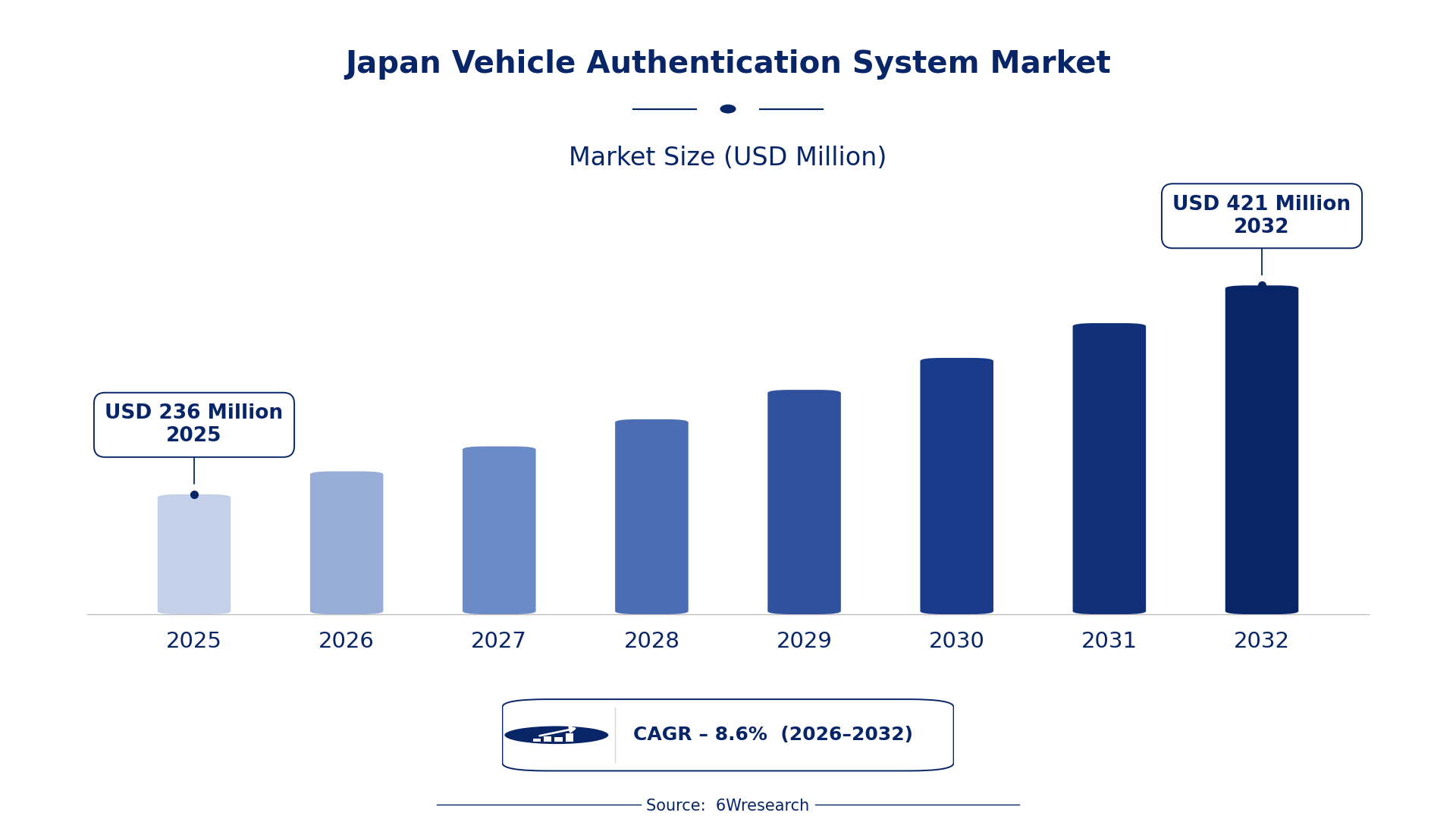
According to 6Wresearch internal database and industry insights, the Japan Vehicle Authentication System Market was valued at USD 236 Million in 2025 and is projected to reach USD 421 Million by 2032, growing at a CAGR of approximately 8.6% during 2026–2032.
Japan Vehicle Authentication System Market Highlights
| Report Metric | Details |
| Report Name | Japan Vehicle Authentication System Market (2026-2032) |
| Market Size 2025 | USD 236 Million |
| Market Size 2032 | USD 421 Million |
| Absolute Growth 2025–2032 | USD 185 Million |
| CAGR 2026–2032 | 8.6% |
| Peak Annual Growth | 9.7% in 2029 |
| Forecast Period | 2026–2032 |
| Historical Data | 2022–2025 |
| Base Year | 2025 |
| Leading Authentication Type, 2025 | Biometric Authentication (45% share) |
| Leading Technology Used, 2025 | Fingerprint Recognition (42% share) |
| Leading Access Mode, 2025 | Touch-Based (44% share) |
| Leading End User, 2025 | Luxury Car OEMs (37% share) |
| Fastest-Growing Authentication Type | Facial Recognition System (12.7% CAGR) |
| Fastest-Growing Technology Used | Camera-Based (12.3% CAGR) |
| Fastest-Growing Access Mode | Contactless (11.8% CAGR) |
| Fastest-Growing End User | Smart Vehicle Manufacturers (11.7% CAGR) |
| Growing Sector | Smart Vehicle Manufacturers |
| Key End Users | Luxury Car OEMs, Fleet Operators, Smart Vehicle Manufacturers, Connected Vehicle Users |
Japan Vehicle Authentication System Market Year-wise Growth Rate and Key Drivers (2022–2032)
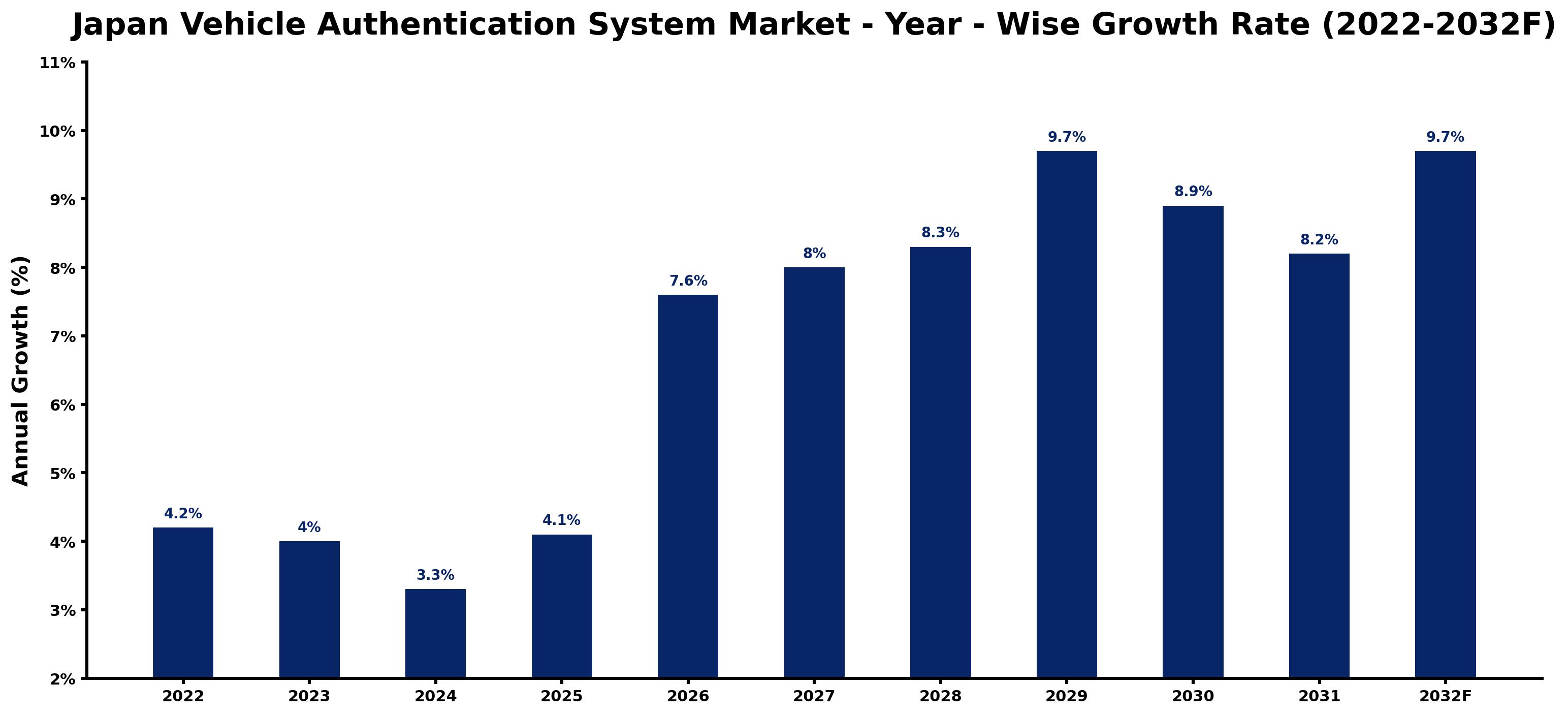
This graph illustrates the annual growth rates of the market from 2022 to 2032, highlighting a steady upward trajectory and projected market expansion over the forecast period.
Each row of the following table gives one year's estimated growth and the event or demand shift that explains it.
| Year | Estimated Annual Growth (%) | Market Rationale |
| 2022 | 4.2 | The market experienced steady growth due to increasing demand for vehicle security systems. |
| 2023 | 4.0 | Growth slowed as manufacturers adjusted to new technologies and market conditions. |
| 2024 | 3.3 | The market continued to grow, albeit at a slower pace, as luxury car sales stabilised. |
| 2025 | 4.1 | Growth accelerated as luxury car OEMs increased investments in advanced authentication systems. |
| 2026 | 7.6 | Demand is expected to surge as the adoption of connected vehicles expands across the country. |
| 2027 | 8.0 | The market will continue to rise as biometric technologies become more mainstream in vehicles. |
| 2028 | 8.3 | Growth is projected to remain strong, driven by the integration of advanced technologies in new models. |
| 2029 | 9.7 | The market is expected to peak as luxury car manufacturers embrace advanced authentication systems. |
| 2030 | 8.9 | Growth will slow slightly as market saturation begins to affect new vehicle sales. |
| 2031 | 8.2 | The market is projected to continue growing, supported by ongoing technological advancements and user demand. |
| 2032 | 9.7 | Growth is expected to accelerate again as new regulations and standards drive further adoption. |
Note: Market size estimations and growth projections presented in this report are based on 6Wresearch's proprietary forecasting methodology, utilizing the latest available industry data, government publications, and primary research inputs.
Japan Vehicle Authentication System Market Synopsis
Vehicle Authentication Systems utilise advanced technologies such as biometric sensors and RFID to verify vehicle identity and user access. These systems improve security, prevent theft, and provide convenient access for users. The Japan Vehicle Authentication System Market is expanding due to rising demand from luxury car manufacturers and fleet operators, with over 5 million luxury vehicles in the country and a growing number of connected vehicles, reaching 3 million in 2022.
Market Dynamics Impact Analysis (2026–2032)
| Factor | Type | Impact | Primary Segment Affected |
| Increasing investments in biometric technologies to enhance vehicle security | Driver | High | Biometric Authentication |
| Growing adoption of connected vehicles requiring advanced access systems | Driver | High | RFID-Based Entry |
| Rising demand for luxury vehicles with advanced security features | Opportunity | High | Luxury Car OEMs |
| Expansion of fleet operators seeking improved vehicle management solutions | Opportunity | Medium | Fleet Operators |
| High costs associated with implementing advanced authentication systems | Restraint | High | Facial Recognition System |
| Limited awareness among consumers regarding the benefits of these systems | Restraint | Medium | Smartphone App Unlock |
| Challenges in integrating new technologies with existing vehicle systems | Challenge | High | Camera-Based |
| Competition from traditional keyless entry systems affecting market growth | Challenge | Medium | Touch-Based |
Evaluation of Drivers in Japan Vehicle Authentication System Market (2026–2032)
Below are the drivers that matter most for revenue growth, with supporting evidence.
| Drivers | Primary Segment Affected | Why It Matters (Evidence) |
| Growing luxury vehicle sales | Luxury Car OEMs | The number of luxury vehicles in Japan exceeds 5 million, driving demand for advanced security systems. |
| Increased focus on vehicle cybersecurity | Connected Vehicle Users | The 2023 initiative to improve vehicle cybersecurity has spurred investment in authentication technologies. |
| Rising consumer preference for biometric authentication | Biometric Authentication | Fingerprint recognition technology is widely adopted, increasing user trust and security in vehicles. |
| Expansion of smart vehicle manufacturers | Smart Vehicle Manufacturers | The integration of advanced authentication systems into connected vehicles is becoming a standard practice. |
| Growing fleet operator needs for security | Fleet Operators | As of 2023, 60% of fleet operators are using advanced authentication systems for better management. |
Purchasing is picking up as luxury vehicle sales continue to rise, with over 5 million luxury vehicles in Japan. Biometric authentication, particularly fingerprint recognition, is widely adopted, increasing consumer trust. The integration of these systems into connected vehicles is becoming standard, particularly among smart vehicle manufacturers. Fleet operators are increasingly utilising advanced systems, with 60% adoption reported in 2023, improving their security and management capabilities.
Evaluation of Restraints in Japan Vehicle Authentication System Market
The key brakes on demand, and where they bite hardest, are shown below.
| Market Restraint | Primary Segment Affected | Why It Matters (Evidence) |
| High implementation costs of advanced authentication systems | Facial Recognition System | The cost of integrating advanced systems can exceed JPY 1 million per vehicle, limiting adoption. |
| Consumer awareness of benefits remains low | Smartphone App Unlock | Many consumers are unaware of the advantages of advanced authentication, hindering market growth. |
| Integration challenges with existing vehicle technologies | Camera-Based | Existing vehicles may not support new authentication technologies, complicating upgrades. |
| Competition from traditional keyless entry systems | Touch-Based | Traditional systems are still prevalent, making it difficult for advanced systems to gain market share. |
| Regulatory compliance costs for manufacturers | RFID-Based Entry | Manufacturers must invest in compliance with standards like ISO/IEC 27001, increasing costs. |
Japan Vehicle Authentication System Market Challenges
Producers experience delays in vehicle authentication due to reliance on outdated technology, which hampers system upgrades and can lead to operational downtime costing fleet operators up to 20% in potential revenue per vehicle. Buyers face supply chain issues stemming from a shortage of advanced components, particularly biometric sensors, leading to postponed system rollouts by six months. Competition among luxury car manufacturers escalates, forcing producers to invest over 15% of their annual budgets in R&D to maintain market position. Compliance with ISO/IEC 27001 standards imposes additional financial burdens, potentially consuming 10% of operational costs for manufacturers.
Trends in the Japan Vehicle Authentication System Market
Buyers and suppliers in the Japan Vehicle Authentication System Market are adjusting to the following trends.
- Shift from Traditional to Biometric Authentication: In 2023, biometric authentication systems gained traction, with fingerprint recognition technology widely adopted in luxury vehicles, accounting for 42% of the market.
- Rise of Connected Vehicle Technologies: The number of connected vehicles in Japan reached 3 million in 2022, driving demand for advanced authentication systems that improve security and user access.
- Increase in Government Initiatives for Cybersecurity: The 2023 initiative aims to improve vehicle cybersecurity, prompting manufacturers to invest in advanced authentication technologies.
- Transition from Keyless Entry to Contactless Systems: Contactless access systems are gaining popularity, with a projected CAGR of 11.8% from 2026 to 2032, reflecting changing consumer preferences.
Investment Opportunities in the Japan Vehicle Authentication System Market
Several openings in the Japan Vehicle Authentication System Market merit attention from investors.
- Current demand for advanced vehicle security systems: With over 5 million luxury vehicles in Japan, there is an opportunity to supply advanced authentication systems to luxury car OEMs.
- Investment in biometric technologies: The rising preference for biometric authentication presents an opportunity to supply fingerprint recognition systems, particularly to fleet operators seeking improved security.
- Expansion of smart vehicle manufacturing facilities: As smart vehicle manufacturers grow, there is a need for advanced authentication systems, creating opportunities for suppliers in regions with high automotive activity.
- Entry through partnerships with local manufacturers: Collaborating with local automotive manufacturers can facilitate market entry, particularly for companies looking to supply RFID-based systems.
Government Initiatives in the Japan Vehicle Authentication System Market
The GX Promotion Act, enacted in 2023, establishes a legal framework for promoting advanced vehicle technologies, improving the regulatory environment for vehicle authentication systems. This act complements previous measures like the Green Growth Strategy, which targets carbon neutrality by 2050, encouraging manufacturers to invest in sustainable technologies.
The Ministry of Land, Infrastructure, Transport and Tourism oversees vehicle regulations and approves advanced authentication systems. Their funding initiatives support projects aimed at improving vehicle security, contributing to the growth of the vehicle authentication market.
Future Insight of the Japan Vehicle Authentication System Market
A policy-driven shift towards net zero emissions will reshape the market by 2032, prompting widespread adoption of advanced vehicle authentication systems. The 2023 government initiative will catalyse investments in vehicle cybersecurity, creating opportunities for both buyers and suppliers. As connected vehicles in Japan surpass 3 million, the integration of RFID technology in over 70% of new vehicle access systems will become standard. The Tokyo Motor Show will continue to showcase innovations, influencing market trends and driving advancements in authentication systems.
Market Segmentation Analysis
Japan Vehicle Authentication System Market report covers a detailed analysis of the following market segments:
By Authentication Type – Biometric Authentication Leads, Facial Recognition System Expected to Grow Fastest
According to Saurav Kr Singh, Senior Research Analyst at 6Wresearch, the largest authentication type category in 2025 was Biometric Authentication, at 45% of revenue. Biometric Authentication is the leading method because it is widely implemented in over 5 million luxury vehicles, providing secure access and preventing theft. This technology is particularly prevalent in high-value markets like the Tokyo metropolitan area, where security is paramount. The quickest growth will come from Facial Recognition System, forecast to expand at a CAGR of 12.7% between 2026 and 2032. The Facial Recognition System is gaining traction as it enhances security through precise user identification, aligning with the growing emphasis on advanced vehicle technologies. Events like the Tokyo Motor Show showcase these advancements, increasing interest among manufacturers. Suppliers must focus on advancing biometric technologies to meet the rising demand from luxury vehicle manufacturers.
By Technology Used – Fingerprint Recognition Leads, Camera-Based Expected to Grow Fastest
Fingerprint Recognition held 42% of the Japan Vehicle Authentication System Market by technology used in 2025. Fingerprint Recognition leads the market as it offers secure user authentication, making it the preferred choice for luxury vehicles. Its established presence ensures a strong installed base among high-end automotive brands in Japan. Camera-Based is projected to grow fastest, at a CAGR of 12.3% during 2026–2032. Camera-Based technology is growing quickly due to its critical role in facial recognition applications, which are increasingly adopted in modern vehicles. This growth is further supported by government initiatives that promote vehicle cybersecurity. Buyers should invest in camera-based systems to maintain competitiveness in the automotive sector.
By Access Mode – Touch-Based Leads, Contactless Expected to Grow Fastest
Touch-Based accounted for 44% of the market by access mode in 2025. Touch-Based access maintains the largest share as it is still utilised in some older systems, appealing to users who prefer traditional methods. Despite a decline in popularity, it remains relevant among specific market segments. Contactless is set to record the highest CAGR in this split, 11.8% over 2026–2032. Contactless access is rapidly gaining traction as a key feature for modern access systems, driven by consumer demand for convenience. This trend is particularly pronounced in urban areas where speed and ease of access are critical. Suppliers must adapt to the rising preference for contactless systems to seize emerging market opportunities.
By End User – Luxury Car OEMs Lead, Smart Vehicle Manufacturers Expected to Grow Fastest
Luxury Car OEMs took 37% of end user revenue in 2025, more than any other category. Luxury Car OEMs lead the market as they heavily invest in advanced authentication systems, prioritising vehicle security and consumer satisfaction. Their commitment to integrating these systems reflects a robust demand driven by high-value vehicles. Over 2026–2032, Smart Vehicle Manufacturers are expected to post the fastest growth, at a CAGR of 11.7%. Smart Vehicle Manufacturers are rapidly adopting advanced authentication systems, integrating them into connected vehicles to meet the increasing trend towards connectivity. This segment represents a significant opportunity for growth in automotive technology. Suppliers should aim to engage with smart vehicle manufacturers to leverage growth opportunities in connected vehicle systems.
Key Attractiveness of the Report
- 10 Years of Market Numbers
- Historical Data Starting from 2022 to 2025
- Base Year 2025
- Forecast Data until 2032
- Key Performance Indicators Impacting the Market
- Major Upcoming Developments and Projects
Key Highlights of the Report:
- Japan Vehicle Authentication System Market Outlook
- Market Size of Japan Vehicle Authentication System Market, 2025
- Forecast of Japan Vehicle Authentication System Market, 2032
- Historical Data and Forecast of Japan Vehicle Authentication System Revenues & Volume for the Period 2022-2032F
- Japan Vehicle Authentication System Market Trend Evolution
- Japan Vehicle Authentication System Market Drivers and Challenges
- Japan Vehicle Authentication System Price Trends
- Japan Vehicle Authentication System Porter's Five Forces
- Japan Vehicle Authentication System Industry Life Cycle
- Historical Data and Forecast of Japan Vehicle Authentication System Market Revenues & Volume By Authentication Type for the Period 2022-2032F
- Historical Data and Forecast of Japan Vehicle Authentication System Market Revenues & Volume By Biometric Authentication for the Period 2022-2032F
- Historical Data and Forecast of Japan Vehicle Authentication System Market Revenues & Volume By RFID-Based Entry for the Period 2022-2032F
- Historical Data and Forecast of Japan Vehicle Authentication System Market Revenues & Volume By Facial Recognition System for the Period 2022-2032F
- Historical Data and Forecast of Japan Vehicle Authentication System Market Revenues & Volume By Smartphone App Unlock for the Period 2022-2032F
- Historical Data and Forecast of Japan Vehicle Authentication System Market Revenues & Volume By Technology Used for the Period 2022-2032F
- Historical Data and Forecast of Japan Vehicle Authentication System Market Revenues & Volume By Fingerprint Recognition for the Period 2022-2032F
- Historical Data and Forecast of Japan Vehicle Authentication System Market Revenues & Volume By RFID Tags for the Period 2022-2032F
- Historical Data and Forecast of Japan Vehicle Authentication System Market Revenues & Volume By Camera-Based for the Period 2022-2032F
- Historical Data and Forecast of Japan Vehicle Authentication System Market Revenues & Volume By Bluetooth/NFC for the Period 2022-2032F
- Historical Data and Forecast of Japan Vehicle Authentication System Market Revenues & Volume By Access Mode for the Period 2022-2032F
- Historical Data and Forecast of Japan Vehicle Authentication System Market Revenues & Volume By Touch-Based for the Period 2022-2032F
- Historical Data and Forecast of Japan Vehicle Authentication System Market Revenues & Volume By Proximity-Based for the Period 2022-2032F
- Historical Data and Forecast of Japan Vehicle Authentication System Market Revenues & Volume By Contactless for the Period 2022-2032F
- Historical Data and Forecast of Japan Vehicle Authentication System Market Revenues & Volume By Mobile-Based for the Period 2022-2032F
- Historical Data and Forecast of Japan Vehicle Authentication System Market Revenues & Volume By End User for the Period 2022-2032F
- Historical Data and Forecast of Japan Vehicle Authentication System Market Revenues & Volume By Luxury Car OEMs for the Period 2022-2032F
- Historical Data and Forecast of Japan Vehicle Authentication System Market Revenues & Volume By Fleet Operators for the Period 2022-2032F
- Historical Data and Forecast of Japan Vehicle Authentication System Market Revenues & Volume By Smart Vehicle Manufacturers for the Period 2022-2032F
- Historical Data and Forecast of Japan Vehicle Authentication System Market Revenues & Volume By Connected Vehicle Users for the Period 2022-2032F
- Japan Vehicle Authentication System Import Export Trade Statistics
- Market Opportunity Assessment By Authentication Type
- Market Opportunity Assessment By Technology Used
- Market Opportunity Assessment By Access Mode
- Market Opportunity Assessment By End User
- Japan Vehicle Authentication System Top Companies Market Share
- Japan Vehicle Authentication System Competitive Benchmarking By Technical and Operational Parameters
- Japan Vehicle Authentication System Company Profiles
- Japan Vehicle Authentication System Key Strategic Recommendations
Market Covered
Segments analysed in this report are listed below.
By Authentication Type
- Biometric Authentication
- RFID-Based Entry
- Facial Recognition System
- Smartphone App Unlock
By Technology Used
- Fingerprint Recognition
- RFID Tags
- Camera-Based
- Bluetooth/NFC
By Access Mode
- Touch-Based
- Proximity-Based
- Contactless
- Mobile-Based
By End User
- Luxury Car OEMs
- Fleet Operators
- Smart Vehicle Manufacturers
- Connected Vehicle Users































