Japan Vehicle Autonomy Development Tools Market Size & Growth Rate
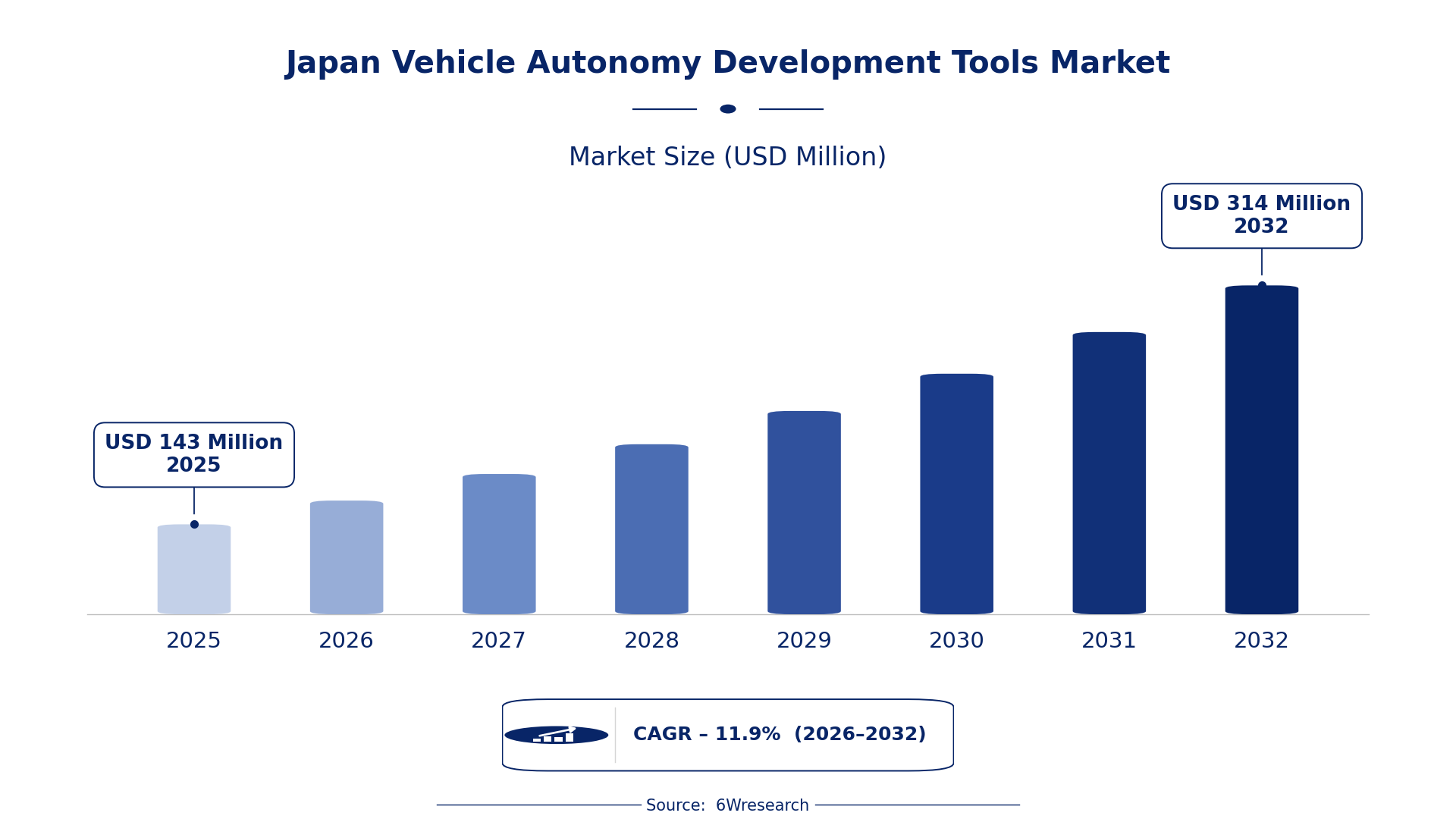
According to 6Wresearch internal database and industry insights, the Japan Vehicle Autonomy Development Tools Market was valued at USD 143 Million in 2025 and is projected to reach USD 314 Million by 2032, growing at a CAGR of approximately 11.9% during 2026–2032.
Japan Vehicle Autonomy Development Tools Market Highlights
| Report Metric | Details |
| Report Name | Japan Vehicle Autonomy Development Tools Market (2026-2032) |
| Market Size 2025 | USD 143 Million |
| Market Size 2032 | USD 314 Million |
| Absolute Growth 2025–2032 | USD 171 Million |
| CAGR 2026–2032 | 11.9% |
| Peak Annual Growth | 12.4% in 2032 |
| Forecast Period | 2026–2032 |
| Historical Data | 2022–2025 |
| Base Year | 2025 |
| Leading Tool Type, 2025 | Simulation Software (40% share) |
| Leading Functionality, 2025 | Virtual Environment (45% share) |
| Leading Integration Type, 2025 | API Compatible (41% share) |
| Leading End User, 2025 | AV Developers (43% share) |
| Fastest-Growing Tool Type | AI Training Platforms (17.3% CAGR) |
| Fastest-Growing Functionality | Data Annotation (16.4% CAGR) |
| Fastest-Growing Integration Type | Cloud-Based (17.4% CAGR) |
| Fastest-Growing End User | Tech Startups (15.7% CAGR) |
| Growing Sector | autonomous vehicle technology |
| Key End Users | AV Developers, Robotics Engineers, ADAS R&D Labs, Tech Startups |
Japan Vehicle Autonomy Development Tools Market Year-wise Growth Rate and Key Drivers (2022–2032)
This graph illustrates the annual growth rates of the market from 2022 to 2032, highlighting a steady upward trajectory and projected market expansion over the forecast period.
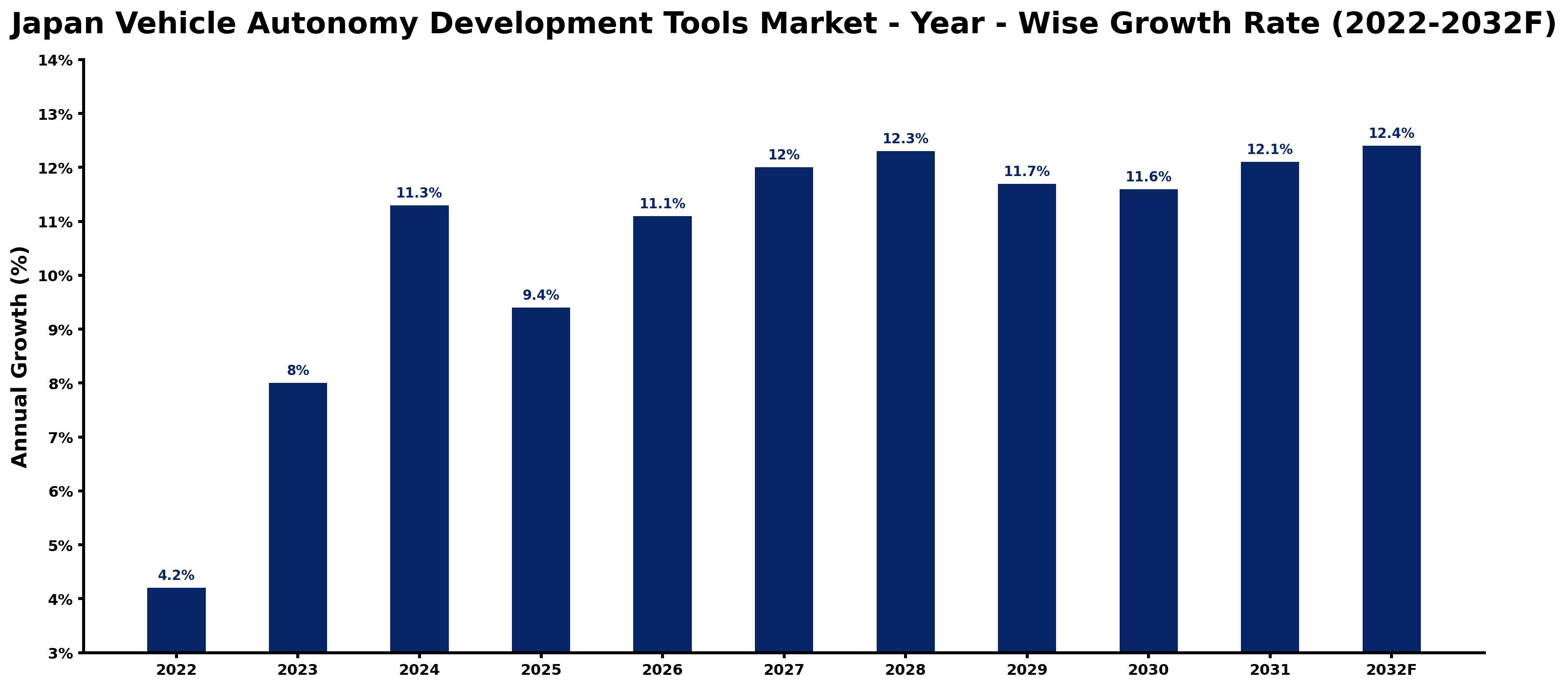
The yearly estimates that follow link every growth rate to its principal driver, so readers can see why the pace changed in each period.
| Year | Estimated Annual Growth (%) | Market Rationale |
| 2022 | 4.2 | The market exhibited steady growth, reflecting ongoing investments in autonomous vehicle technology. |
| 2023 | 8.0 | Demand accelerated as more AV developers entered the market, increasing competition. |
| 2024 | 11.3 | Growth continued to rise, driven by increased funding for research and development. |
| 2025 | 9.4 | The growth rate slowed slightly as the market began to stabilise after rapid expansion. |
| 2026 | 11.1 | Demand is expected to surge again as new technologies and tools are introduced to the market. |
| 2027 | 12.0 | The market is projected to expand further, supported by rising consumer interest in autonomous vehicles. |
| 2028 | 12.3 | Growth is anticipated to remain strong, driven by advancements in AI training platforms and simulation software. |
| 2029 | 11.7 | A slight slowdown is expected as the market adjusts to new technological standards. |
| 2030 | 11.6 | Growth is projected to moderate, reflecting the maturation of the AV development tools sector. |
| 2031 | 12.1 | Demand is expected to pick up again, supported by ongoing investments in AV infrastructure. |
| 2032 | 12.4 | The market is projected to peak, driven by advancements in vehicle autonomy technologies. |
Note: Market size estimations and growth projections presented in this report are based on 6Wresearch's proprietary forecasting methodology, utilizing the latest available industry data, government publications, and primary research inputs.
Japan Vehicle Autonomy Development Tools Market Synopsis
Vehicle Autonomy Development Tools are essential software and hardware for designing and testing autonomous vehicle systems, utilising advanced programming and sensor integration. The Japan Vehicle Autonomy Development Tools Market is experiencing growth due to over 1,000 registered AV developers and substantial government investment, including ¥1 trillion in autonomous vehicle technology by 2025. This growth stems from increasing domestic and international demand, advancements in AI and simulation technologies, and a commitment to decarbonisation, targeting JPY 150 trillion in investments over ten years.
Market Dynamics Impact Analysis (2026–2032)
| Factor | Type | Impact | Primary Segment Affected |
| Growing demand for autonomous vehicles drives the need for advanced simulation software. | Driver | High | Simulation Software |
| The rise in AI training platforms is creating opportunities for innovative development tools. | Driver | High | AI Training Platforms |
| Increased government investment in autonomous vehicle technology presents a significant opportunity. | Opportunity | High | Vehicle Control Frameworks |
| The expansion of AV developers in urban centres creates a demand for simulation tools. | Opportunity | Medium | Virtual Environment |
| High competition among AV developers can lead to price pressures on development tools. | Restraint | High | Sensor Calibration Tools |
| The complexity of integrating various technologies can hinder development timelines. | Restraint | Medium | AI Training Platforms |
| Rising costs of advanced technology development can limit smaller developers' participation. | Challenge | High | AV Developers |
| Compliance with evolving safety standards can delay product launches for developers. | Challenge | Medium | ADAS R&D Labs |
Evaluation of Drivers in Japan Vehicle Autonomy Development Tools Market (2026–2032)
The following drivers explain most of the expected growth.
| Drivers | Primary Segment Affected | Why It Matters (Evidence) |
| Increased investment in autonomous vehicle technology drives demand for simulation software. | Simulation Software | Japan's automotive sector employs over 5 million people, leading to a greater need for effective testing tools. |
| The growing focus on AI capabilities boosts demand for AI training platforms. | AI Training Platforms | With over 1,000 registered AV developers, the need for sophisticated AI models is critical. |
| The push for decarbonisation is increasing the need for vehicle control frameworks. | Vehicle Control Frameworks | Japan targets a 46% cut in greenhouse-gas emissions by 2030, driving innovation in AV technologies. |
| The rise of urban AV testing environments increases demand for virtual environments. | Virtual Environment | The Tokyo Metropolitan Government supports AV testing, creating a need for realistic simulation tools. |
| The integration of cloud-based solutions is essential for data management in AV development. | Cloud-Based | Cloud-based solutions are increasingly adopted, reflecting a shift towards efficient data handling. |
Orders keep climbing as the automotive sector employs over 5 million people, necessitating advanced simulation software for effective testing. The growing focus on AI capabilities drives demand for AI training platforms, with over 1,000 registered AV developers needing sophisticated models. The push for decarbonisation increases the need for vehicle control frameworks, as Japan targets a 46% cut in greenhouse-gas emissions by 2030. The integration of cloud-based solutions is essential for data management, reflecting a trend towards efficient data handling in AV development.
Evaluation of Restraints in Japan Vehicle Autonomy Development Tools Market
The following restraints limit how fast demand can grow.
| Market Restraint | Primary Segment Affected | Why It Matters (Evidence) |
| Intense competition among AV developers can lead to price pressures on development tools. | Sensor Calibration Tools | With numerous developers in Japan, maintaining competitive pricing becomes challenging. |
| The complexity of integrating various technologies can hinder development timelines. | AI Training Platforms | Developers face delays as they navigate the integration of multiple advanced systems. |
| Rising costs of advanced technology development can limit smaller developers' participation. | AV Developers | Smaller firms may struggle to keep pace with escalating development costs. |
| Compliance with evolving safety standards can delay product launches for developers. | ADAS R&D Labs | Adhering to new regulations can extend the timeline for bringing products to market. |
| Limited access to high-quality data for training AI systems can restrict development. | Data Annotation | The need for accurate training data is critical, yet often difficult to obtain. |
Japan Vehicle Autonomy Development Tools Market Challenges
High costs of advanced sensor technologies exceed ¥100 million per unit, which burdens developers and delays project timelines. Stringent safety standards from the Ministry of Land, Infrastructure, Transport and Tourism extend development cycles by up to two years for manufacturers, increasing costs. Supply chain disruptions arise as reliance on imported components leads to delays in production schedules for over 1,000 registered AV developers. Buyers experience uncertainty due to the government's target of 3 million autonomous vehicles on the road by 2030, pressuring manufacturers to meet these ambitious timelines.
Trends in the Japan Vehicle Autonomy Development Tools Market
Four trends stand out in the Japan Vehicle Autonomy Development Tools Market.
- Shift from Traditional Testing to Virtual Environments: Japan is progressively embracing virtual environments for AV testing, minimising the risks associated with physical trials. The Tokyo Metropolitan Government is facilitating this transition by supporting safe testing scenarios. In 2023, more than 200 ADAS R&D labs are making use of these tools.
- Transition from Hardware to Cloud-Based Solutions: The automotive sector is transitioning towards cloud-based solutions for data management, enhancing collaboration among developers. A projected increase in cloud adoption by 17.4% highlights this shift, particularly in urban AV testing facilities.
- Emergence of AI Training Platforms: AI training platforms are becoming indispensable in the development of autonomous vehicles, with an expected CAGR of 17.3%. This trend is propelled by the need for advanced machine learning models in AV development.
- Growing Focus on Decarbonisation in AV Development: Decarbonisation is a central concern for Japan's automotive sector, with the GX Basic Policy aiming for JPY 150 trillion in investments. This commitment drives developers to pursue advancements in sustainable vehicle technologies.
Investment Opportunities in the Japan Vehicle Autonomy Development Tools Market
Where to invest in the Japan Vehicle Autonomy Development Tools Market: the main openings are set out below.
- Tokyo as a Hub for AV Development: Tokyo is emerging as a major hub for AV development, with over 1,000 registered developers. The city offers a supportive environment for innovation, with government backing, creating opportunities for new entrants.
- Investment in AI Training Platforms: The demand for AI training platforms is on the rise, with a projected market size of USD 143 million by 2025. AV developers are seeking advanced tools to improve their capabilities, presenting opportunities for suppliers.
- Expansion of Urban Testing Facilities: The Tokyo Metropolitan Government supports the expansion of urban AV testing facilities, creating a demand for simulation tools. This presents an opportunity for developers to invest in advanced testing technologies.
- Growth in Data Annotation Services: The increasing need for accurate training data for AI systems creates a gap in the market. Suppliers can capitalise on this demand by providing data annotation services to AV developers.
Government Initiatives in the Japan Vehicle Autonomy Development Tools Market
The GX Basic Policy, adopted in 2023, targets JPY 150 trillion in public and private decarbonisation investment over the next decade. This policy directly influences buyers by encouraging the adoption of advanced vehicle autonomy technologies, ensuring compliance with environmental standards and promoting sustainable practices in the automotive sector.
The Ministry of Land, Infrastructure, Transport and Tourism regulates AV standards, ensuring that developers comply with safety and performance requirements. The agency has approved various schemes that facilitate the testing and deployment of autonomous vehicles, providing a structured framework for developers to operate within.
Future Insight of the Japan Vehicle Autonomy Development Tools Market
Japan's policy-driven shift towards decarbonisation will stimulate investment in autonomous vehicle technology, leading to greater innovation in sensor technologies and software solutions. The ongoing development of JIS standards for AV safety will build consumer trust and streamline regulatory compliance. Enhanced collaboration among developers will enable quicker iterations in vehicle design and testing. By 2032, the government aims for ¥150 trillion of public and private decarbonisation investment, which will significantly influence the market's responsiveness to consumer demand.
Market Segmentation Analysis
Japan Vehicle Autonomy Development Tools Market report covers a detailed analysis of the following market segments:
By Tool Type – Simulation Software Leads, AI Training Platforms Expected to Grow Fastest
According to Saurav Kr Singh, Senior Research Analyst at 6Wresearch, Simulation Software held 40% of the Japan Vehicle Autonomy Development Tools Market by tool type in 2025. Simulation Software holds the largest share as it is essential for creating virtual driving environments crucial for testing autonomous vehicle systems. Its extensive use by over 1,000 registered AV developers in Japan emphasises its vital role in the market. AI Training Platforms are set to record the highest CAGR in this split, 17.3% over 2026–2032. AI Training Platforms are rapidly growing due to the increasing demand for effective model development in vehicle autonomy. The Japanese government's investment of ¥1 trillion in autonomous vehicle technology by 2025 is expected to further accelerate this segment's growth. Suppliers should focus on enhancing AI Training Platforms to meet the rising demand from developers.
By Functionality – Virtual Environment Leads, Data Annotation Expected to Grow Fastest
Virtual Environment took 45% of functionality revenue in 2025, more than any other category. Virtual Environment is the leading functionality as it allows for testing scenarios without physical risks, making it indispensable for AV development. Its widespread application among developers ensures its dominant position in the market. The quickest growth will come from Data Annotation, forecast to expand at a CAGR of 16.4% between 2026 and 2032. Data Annotation is experiencing quick growth as it is crucial for preparing training data for effective vehicle autonomy systems. The increasing number of AV developers in Japan is likely to drive further demand for this functionality. Buyers should prioritise tools that offer robust Data Annotation capabilities to remain competitive.
By Integration Type – API Compatible Leads, Cloud-Based Expected to Grow Fastest
With 41% of integration type revenue in 2025, API Compatible was the largest category. API Compatible tools lead the market as they facilitate integration with various systems, making them a preferred choice among developers. Their versatility in connecting different software solutions is a key factor in their widespread adoption. Over 2026–2032, Cloud-Based is expected to post the fastest growth, at a CAGR of 17.4%. Cloud-Based integration is growing rapidly due to its ability to provide scalable storage solutions for data management in AV development. As more developers adopt cloud solutions, this segment is expected to see substantial growth in the coming years. Suppliers should consider expanding their Cloud-Based offerings to cater to the increasing preference for scalable solutions.
By End User – AV Developers Lead, Tech Startups Expected to Grow Fastest
In 2025, AV Developers led the end user split with a 43% share. AV Developers are the primary users of Vehicle Autonomy Development Tools, as they are directly involved in the creation of autonomous vehicles. Their substantial presence in the market, supported by the automotive sector employing over 5 million people, solidifies their leading position. Tech Startups are projected to grow fastest, at a CAGR of 15.7% during 2026–2032. Tech Startups are emerging as the fastest-growing segment, propelled by their innovative approaches to vehicle autonomy and the rising interest in AVs among the population. This trend is likely to continue as more startups enter the market, seeking to capitalise on new technologies. Suppliers should tailor their offerings to meet the specific needs of Tech Startups to capture this growing market segment.
Key Attractiveness of the Report
- 10 Years of Market Numbers
- Historical Data Starting from 2022 to 2025
- Base Year 2025
- Forecast Data until 2032
- Key Performance Indicators Impacting the Market
- Major Upcoming Developments and Projects
Key Highlights of the Report:
- Japan Vehicle Autonomy Development Tools Market Outlook
- Market Size of Japan Vehicle Autonomy Development Tools Market, 2025
- Forecast of Japan Vehicle Autonomy Development Tools Market, 2032
- Historical Data and Forecast of Japan Vehicle Autonomy Development Tools Revenues & Volume for the Period 2022-2032F
- Japan Vehicle Autonomy Development Tools Market Trend Evolution
- Japan Vehicle Autonomy Development Tools Market Drivers and Challenges
- Japan Vehicle Autonomy Development Tools Price Trends
- Japan Vehicle Autonomy Development Tools Porter's Five Forces
- Japan Vehicle Autonomy Development Tools Industry Life Cycle
- Historical Data and Forecast of Japan Vehicle Autonomy Development Tools Market Revenues & Volume By Tool Type for the Period 2022-2032F
- Historical Data and Forecast of Japan Vehicle Autonomy Development Tools Market Revenues & Volume By Simulation Software for the Period 2022-2032F
- Historical Data and Forecast of Japan Vehicle Autonomy Development Tools Market Revenues & Volume By Sensor Calibration Tools for the Period 2022-2032F
- Historical Data and Forecast of Japan Vehicle Autonomy Development Tools Market Revenues & Volume By Vehicle Control Frameworks for the Period 2022-2032F
- Historical Data and Forecast of Japan Vehicle Autonomy Development Tools Market Revenues & Volume By AI Training Platforms for the Period 2022-2032F
- Historical Data and Forecast of Japan Vehicle Autonomy Development Tools Market Revenues & Volume By Functionality for the Period 2022-2032F
- Historical Data and Forecast of Japan Vehicle Autonomy Development Tools Market Revenues & Volume By Virtual Environment for the Period 2022-2032F
- Historical Data and Forecast of Japan Vehicle Autonomy Development Tools Market Revenues & Volume By Lidar/Camera Testing for the Period 2022-2032F
- Historical Data and Forecast of Japan Vehicle Autonomy Development Tools Market Revenues & Volume By Path Planning for the Period 2022-2032F
- Historical Data and Forecast of Japan Vehicle Autonomy Development Tools Market Revenues & Volume By Data Annotation for the Period 2022-2032F
- Historical Data and Forecast of Japan Vehicle Autonomy Development Tools Market Revenues & Volume By Integration Type for the Period 2022-2032F
- Historical Data and Forecast of Japan Vehicle Autonomy Development Tools Market Revenues & Volume By API Compatible for the Period 2022-2032F
- Historical Data and Forecast of Japan Vehicle Autonomy Development Tools Market Revenues & Volume By Plug-In Modules for the Period 2022-2032F
- Historical Data and Forecast of Japan Vehicle Autonomy Development Tools Market Revenues & Volume By Embedded System for the Period 2022-2032F
- Historical Data and Forecast of Japan Vehicle Autonomy Development Tools Market Revenues & Volume By Cloud-Based for the Period 2022-2032F
- Historical Data and Forecast of Japan Vehicle Autonomy Development Tools Market Revenues & Volume By End User for the Period 2022-2032F
- Historical Data and Forecast of Japan Vehicle Autonomy Development Tools Market Revenues & Volume By AV Developers for the Period 2022-2032F
- Historical Data and Forecast of Japan Vehicle Autonomy Development Tools Market Revenues & Volume By Robotics Engineers for the Period 2022-2032F
- Historical Data and Forecast of Japan Vehicle Autonomy Development Tools Market Revenues & Volume By ADAS R&D Labs for the Period 2022-2032F
- Historical Data and Forecast of Japan Vehicle Autonomy Development Tools Market Revenues & Volume By Tech Startups for the Period 2022-2032F
- Japan Vehicle Autonomy Development Tools Import Export Trade Statistics
- Market Opportunity Assessment By Tool Type
- Market Opportunity Assessment By Functionality
- Market Opportunity Assessment By Integration Type
- Market Opportunity Assessment By End User
- Japan Vehicle Autonomy Development Tools Top Companies Market Share
- Japan Vehicle Autonomy Development Tools Competitive Benchmarking By Technical and Operational Parameters
- Japan Vehicle Autonomy Development Tools Company Profiles
- Japan Vehicle Autonomy Development Tools Key Strategic Recommendations
Market Covered
The report covers the following segments.
By Tool Type
- Simulation Software
- Sensor Calibration Tools
- Vehicle Control Frameworks
- AI Training Platforms
By Functionality
- Virtual Environment
- Lidar/Camera Testing
- Path Planning
- Data Annotation
By Integration Type
- API Compatible
- Plug-In Modules
- Embedded System
- Cloud-Based
By End User
- AV Developers
- Robotics Engineers
- ADAS R&D Labs
- Tech Startups































