Japan Vehicle Axles Market Size & Growth Rate
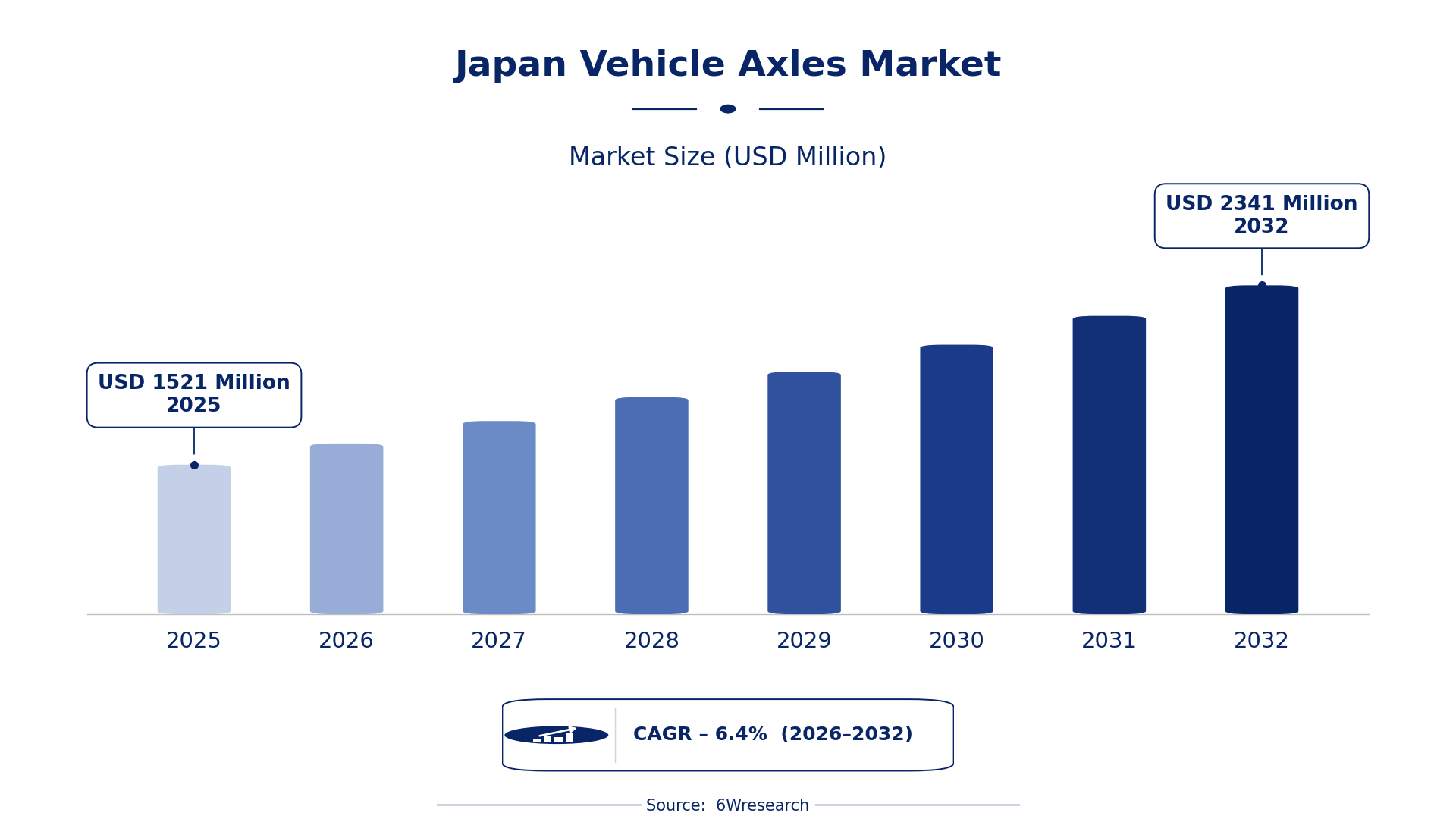
According to 6Wresearch internal database and industry insights, the Japan Vehicle Axles Market was valued at USD 1,521 Million in 2025 and is projected to reach USD 2,341 Million by 2032, growing at a CAGR of approximately 6.4% during 2026–2032.
Japan Vehicle Axles Market Highlights
| Report Metric | Details |
| Report Name | Japan Vehicle Axles Market (2026-2032) |
| Market Size 2025 | USD 1,521 Million |
| Market Size 2032 | USD 2,341 Million |
| Absolute Growth 2025–2032 | USD 820 Million |
| CAGR 2026–2032 | 6.4% |
| Peak Annual Growth | 7.1% in 2028 |
| Forecast Period | 2026–2032 |
| Historical Data | 2022–2025 |
| Base Year | 2025 |
| Leading Axle Type, 2025 | Front Axles (37% share) |
| Leading Drive Type, 2025 | Front-Wheel Drive (51% share) |
| Leading Vehicle Class, 2025 | Compact Cars (51% share) |
| Leading End User, 2025 | Car Manufacturers (49% share) |
| Fastest-Growing Axle Type | Rear Axles (9.0% CAGR) |
| Fastest-Growing Drive Type | Rear-Wheel Drive (9.1% CAGR) |
| Fastest-Growing Vehicle Class | Pickup Trucks (8.4% CAGR) |
| Fastest-Growing End User | Commercial Vehicle Makers (8.3% CAGR) |
| Growing Sector | Commercial Vehicle Makers |
| Key End Users | Car Manufacturers, Commercial Vehicle Makers, Off-Road Vehicle OEMs, Truck Manufacturers |
Japan Vehicle Axles Market Year-wise Growth Rate and Key Drivers (2022–2032)
This graph illustrates the annual growth rates of the market from 2022 to 2032, highlighting a steady upward trajectory and projected market expansion over the forecast period.

The following figures match every annual growth estimate with the main market development of that year, giving the reasoning behind each rise or slowdown.
| Year | Estimated Annual Growth (%) | Market Rationale |
| 2022 | 4.2 | The market showed steady growth due to strong automotive production figures. |
| 2023 | 4.4 | Demand increased as automotive manufacturers ramped up production to meet consumer needs. |
| 2024 | 3.6 | Growth slowed as manufacturers faced supply chain challenges affecting production rates. |
| 2025 | 4.1 | Demand rose again as production stabilised and new models were introduced. |
| 2026 | 5.5 | Investments in electric vehicle technology will support market growth. |
| 2027 | 6.0 | Continued investments in automation and technology will drive demand further. |
| 2028 | 7.1 | Heightened demand from electric vehicle production will peak growth this year. |
| 2029 | 6.4 | Growth will slow as the market adjusts to new production capacities. |
| 2030 | 6.6 | Demand is projected to rise as electric vehicle adoption reaches 20%. |
| 2031 | 5.9 | Growth will moderate as the market stabilises after rapid expansion. |
| 2032 | 7.0 | The market will continue to grow as sustainability initiatives gain traction. |
Note: Market size estimations and growth projections presented in this report are based on 6Wresearch's proprietary forecasting methodology, utilizing the latest available industry data, government publications, and primary research inputs.
Japan Vehicle Axles Market Synopsis
Vehicle axles are essential components in automotive engineering, primarily made from steel or aluminum through forging and machining processes. The Japan Vehicle Axles Market is expanding, supported by automotive production of 8.3 million units in 2022 and a growing emphasis on electric vehicles. Factors such as the push for lightweight materials and increasing focus on sustainability are propelling market growth, creating opportunities for innovation and investment in this sector.
Market Dynamics Impact Analysis (2026–2032)
| Factor | Type | Impact | Primary Segment Affected |
| Rising production of electric vehicles | Driver | High | Front Axles |
| Increased exports of vehicles | Driver | High | Rear Axles |
| Growing demand for lightweight materials | Opportunity | High | Live Axles |
| Expansion of manufacturing capabilities in Aichi | Opportunity | Medium | Tandem Axles |
| Supply chain disruptions affecting component availability | Restraint | High | Heavy-Duty |
| Strict emissions regulations impacting design | Restraint | Medium | Compact Cars |
| High production costs due to material prices | Challenge | High | Pickup Trucks |
| Competition from international manufacturers | Challenge | Medium | SUVs |
Evaluation of Drivers in Japan Vehicle Axles Market (2026–2032)
The main growth drivers and the segments they affect most are set out below.
| Drivers | Primary Segment Affected | Why It Matters (Evidence) |
| Increased automotive production | Front Axles | Japan's automotive production reached 8.3 million units in 2022, boosting axle demand. |
| Growing electric vehicle market | Rear Axles | The government aims for 20% electric vehicle adoption by 2030, driving axle demand. |
| Demand for lightweight vehicles | Live Axles | Research subsidies for lightweight materials are encouraging innovation in axle design. |
| Expansion of manufacturing regions | Tandem Axles | Key automotive hubs are increasing production capacity for axles. |
| Rising exports of vehicles | Heavy-Duty | Japan exported 4.5 million vehicles in 2022, increasing demand for heavy-duty axles. |
A wider customer base explains much of the growth, as the automotive sector in Japan produced 8.3 million units in 2022, leading to increased demand for vehicle axles. The target of 20% electric vehicle adoption by 2030 drives innovation in axle design, particularly for lightweight materials. Major manufacturing hubs such as Aichi contribute to the rising production capacity. Japan's exports of vehicles further stimulate demand for heavy-duty axles, positively impacting the overall market outlook.
Evaluation of Restraints in Japan Vehicle Axles Market
These restraints slow adoption and weigh on supplier margins.
| Market Restraint | Primary Segment Affected | Why It Matters (Evidence) |
| Supply chain disruptions affecting component availability | Heavy-Duty | Supply chain issues have delayed axle production, impacting heavy-duty vehicle availability. |
| Strict emissions regulations impacting design | Compact Cars | Regulations require more efficient designs, complicating production for compact vehicle axles. |
| High production costs due to material prices | Pickup Trucks | Rising steel and aluminum prices increase production costs for pickup truck axles. |
| Competition from international manufacturers | SUVs | Foreign manufacturers are increasing their market share, affecting local axle producers. |
| Limited innovation in traditional axle designs | Live Axles | The focus on electric vehicles has slowed advancements in traditional axle technology. |
Japan Vehicle Axles Market Challenges
In 2022, Japan's automotive production reached 8.3 million units, generating substantial demand for vehicle axles among manufacturers. Increasing production costs due to stringent emissions regulations raise expenses for suppliers, which may delay axle availability for car makers. Compliance with these regulations necessitates additional investments in technology, potentially slowing production timelines for suppliers. A shortage of skilled workers in advanced manufacturing processes further undermines efficiency, costing suppliers valuable time and escalating operational costs, ultimately affecting buyers' ability to meet market demands.
Trends in the Japan Vehicle Axles Market
The shifts below are changing how Japan Vehicle Axles Market products are bought and supplied.
- Shift in Focus to Electric Vehicles: Car manufacturers are prioritising electric vehicle production, with a government target of 20% adoption by 2030. This shift reshapes axle design requirements to accommodate new technologies.
- Transition from Steel to Lightweight Materials: The automotive sector is moving towards lightweight materials to improve fuel efficiency. Research subsidies are promoting this transition, with investments in innovative materials expected in the coming years.
- Emergence of Advanced Manufacturing Techniques: The adoption of advanced manufacturing techniques is on the rise, enhancing production efficiency. In 2023, the government launched initiatives to support automation in manufacturing processes.
- Growing Demand for Heavy-Duty Axles: Heavy-duty vehicle production is increasing, driven by rising logistics demands. In 2022, heavy-duty vehicles accounted for 15% of total vehicle production in Japan, highlighting the need for durable axle solutions.
Investment Opportunities in the Japan Vehicle Axles Market
The opportunities below stand out in the Japan Vehicle Axles Market for new entrants and existing suppliers.
- Car Manufacturers Seeking Lightweight Solutions: Car manufacturers are looking for lightweight axle solutions to meet new regulations. With a 40% market share in compact cars, suppliers can invest in advanced materials to cater to this demand.
- Expansion of Electric Vehicle Components: The electric vehicle segment is expanding rapidly, creating a need for specialised axles. Suppliers can focus on developing components tailored for electric vehicles to tap into this growing market.
- Investment in Manufacturing Facilities: With over 5 major automotive manufacturing regions, there is a need for modernised facilities. Investing in new production plants in Aichi can increase capacity and efficiency.
- Rising Exports of Heavy-Duty Vehicles: Japan's heavy-duty vehicle exports are increasing, creating demand for durable axles. Suppliers should target commercial vehicle makers to meet this growing need.
Government Initiatives in the Japan Vehicle Axles Market
The Green Growth Strategy Through Achieving Carbon Neutrality in 2050, adopted in December 2020, aims to promote sustainable practices in the automotive sector. This strategy encourages manufacturers to invest in eco-friendly technologies, influencing axle design and production processes.
The Ministry of Land, Infrastructure, Transport and Tourism oversees vehicle safety standards and approves new axle designs. Their regulations ensure compliance with safety and emissions standards, impacting how axles are produced and marketed.
Future Insight of the Japan Vehicle Axles Market
Investment in electric vehicle production will drive demand for innovative axle designs by 2032, as the government targets 20% adoption. Advanced manufacturing technologies will enhance production efficiency, benefiting both suppliers and buyers. New industry standards will ensure higher quality and safety in vehicle axles, fostering greater market trust. The commitment to reducing greenhouse gas emissions will stimulate innovation in materials and design, creating opportunities for suppliers to develop lighter and more efficient axle solutions.
Market Segmentation Analysis
Japan Vehicle Axles Market report covers a detailed analysis of the following market segments:
By Axle Type – Front Axles Lead, Rear Axles Expected to Grow Fastest
According to Saurav Kr Singh, Senior Research Analyst at 6Wresearch, Front Axles took 37% of axle type revenue in 2025, more than any other category. Front axles hold the largest share in Japan due to their essential role in vehicle movement and stability, particularly in compact cars, which account for approximately 40% of the vehicle market. The high production volume of over 8.3 million vehicles in 2022 supports the demand for front axles. Rear Axles are projected to grow fastest, at a CAGR of 9.0% during 2026–2032. Rear axles are witnessing rapid growth, primarily because of their critical function in load distribution and traction, especially with heavy-duty vehicles constituting 15% of total vehicle production. As the commercial vehicle market expands, the demand for rear axles is expected to rise significantly. Suppliers should focus on enhancing production capabilities for rear axles to meet the increasing market demand.
By Drive Type – Front-Wheel Drive Leads, Rear-Wheel Drive Expected to Grow Fastest
The largest drive type category in 2025 was Front-Wheel Drive, at 51% of revenue. Front-wheel drive systems are prevalent in compact and mid-size vehicles, making them the leading drive type in Japan's automotive market. This configuration supports the high volume of compact cars, which represent approximately 40% of the vehicle market. Over 2026–2032, Rear-Wheel Drive is expected to post the fastest growth, at a CAGR of 9.1%. Rear-wheel drive systems are gaining traction due to their preference in performance and luxury vehicles, which are becoming more popular among consumers. This shift indicates a potential increase in demand for rear-wheel drive axles as vehicle preferences evolve. Manufacturers should consider investing in rear-wheel drive axle technologies to capitalise on emerging market trends.
By Vehicle Class – Compact Cars Lead, Pickup Trucks Expected to Grow Fastest
Compact Cars held 51% of the Japan Vehicle Axles Market by vehicle class in 2025. Compact cars dominate the vehicle class segment, representing a substantial portion of Japan's passenger vehicle market as manufacturers prioritise fuel efficiency. This segment's prominence is evident in the automotive industry's output, which reached 8.3 million units in 2022. The quickest growth will come from Pickup Trucks, forecast to expand at a CAGR of 8.4% between 2026 and 2032. Pickup trucks are experiencing the fastest growth rate, driven by their utility in commercial applications and rising demand for versatile vehicles. This trend will likely continue as businesses require reliable transport solutions for diverse needs. Suppliers need to adapt their product offerings to cater to the growing demand for pickup trucks in the commercial sector.
By End User – Car Manufacturers Lead, Commercial Vehicle Makers Expected to Grow Fastest
With 49% of end user revenue in 2025, Car Manufacturers was the largest category. Car manufacturers are the primary users of vehicle axles, driving the largest share in the market as they produce millions of vehicles annually. Their continuous innovation and production volume ensure sustained demand for axles. Commercial Vehicle Makers are set to record the highest CAGR in this split, 8.3% over 2026–2032. Commercial vehicle makers are experiencing the fastest growth in axle demand, driven by the rising need for heavy-duty applications in logistics and transportation sectors. This trend highlights the increasing significance of commercial vehicles in Japan's economy. Suppliers need to align their strategies with the growing requirements of commercial vehicle makers to capture new opportunities.
Key Attractiveness of the Report
- 10 Years of Market Numbers
- Historical Data Starting from 2022 to 2025
- Base Year 2025
- Forecast Data until 2032
- Key Performance Indicators Impacting the Market
- Major Upcoming Developments and Projects
Key Highlights of the Report:
- Japan Vehicle Axles Market Outlook
- Market Size of Japan Vehicle Axles Market, 2025
- Forecast of Japan Vehicle Axles Market, 2032
- Historical Data and Forecast of Japan Vehicle Axles Revenues & Volume for the Period 2022-2032F
- Japan Vehicle Axles Market Trend Evolution
- Japan Vehicle Axles Market Drivers and Challenges
- Japan Vehicle Axles Price Trends
- Japan Vehicle Axles Porter's Five Forces
- Japan Vehicle Axles Industry Life Cycle
- Historical Data and Forecast of Japan Vehicle Axles Market Revenues & Volume By Axle Type for the Period 2022-2032F
- Historical Data and Forecast of Japan Vehicle Axles Market Revenues & Volume By Front Axles for the Period 2022-2032F
- Historical Data and Forecast of Japan Vehicle Axles Market Revenues & Volume By Rear Axles for the Period 2022-2032F
- Historical Data and Forecast of Japan Vehicle Axles Market Revenues & Volume By Live Axles for the Period 2022-2032F
- Historical Data and Forecast of Japan Vehicle Axles Market Revenues & Volume By Tandem Axles for the Period 2022-2032F
- Historical Data and Forecast of Japan Vehicle Axles Market Revenues & Volume By Drive Type for the Period 2022-2032F
- Historical Data and Forecast of Japan Vehicle Axles Market Revenues & Volume By Front-Wheel Drive for the Period 2022-2032F
- Historical Data and Forecast of Japan Vehicle Axles Market Revenues & Volume By Rear-Wheel Drive for the Period 2022-2032F
- Historical Data and Forecast of Japan Vehicle Axles Market Revenues & Volume By Four-Wheel Drive for the Period 2022-2032F
- Historical Data and Forecast of Japan Vehicle Axles Market Revenues & Volume By Heavy-Duty for the Period 2022-2032F
- Historical Data and Forecast of Japan Vehicle Axles Market Revenues & Volume By Vehicle Class for the Period 2022-2032F
- Historical Data and Forecast of Japan Vehicle Axles Market Revenues & Volume By Compact Cars for the Period 2022-2032F
- Historical Data and Forecast of Japan Vehicle Axles Market Revenues & Volume By Pickup Trucks for the Period 2022-2032F
- Historical Data and Forecast of Japan Vehicle Axles Market Revenues & Volume By SUVs for the Period 2022-2032F
- Historical Data and Forecast of Japan Vehicle Axles Market Revenues & Volume By Trailers for the Period 2022-2032F
- Historical Data and Forecast of Japan Vehicle Axles Market Revenues & Volume By End User for the Period 2022-2032F
- Historical Data and Forecast of Japan Vehicle Axles Market Revenues & Volume By Car Manufacturers for the Period 2022-2032F
- Historical Data and Forecast of Japan Vehicle Axles Market Revenues & Volume By Commercial Vehicle Makers for the Period 2022-2032F
- Historical Data and Forecast of Japan Vehicle Axles Market Revenues & Volume By Off-Road Vehicle OEMs for the Period 2022-2032F
- Historical Data and Forecast of Japan Vehicle Axles Market Revenues & Volume By Truck Manufacturers for the Period 2022-2032F
- Japan Vehicle Axles Import Export Trade Statistics
- Market Opportunity Assessment By Axle Type
- Market Opportunity Assessment By Drive Type
- Market Opportunity Assessment By Vehicle Class
- Market Opportunity Assessment By End User
- Japan Vehicle Axles Top Companies Market Share
- Japan Vehicle Axles Competitive Benchmarking By Technical and Operational Parameters
- Japan Vehicle Axles Company Profiles
- Japan Vehicle Axles Key Strategic Recommendations
Market Covered
Segments analysed in this report are listed below.
By Axle Type
- Front Axles
- Rear Axles
- Live Axles
- Tandem Axles
By Drive Type
- Front-Wheel Drive
- Rear-Wheel Drive
- Four-Wheel Drive
- Heavy-Duty
By Vehicle Class
- Compact Cars
- Pickup Trucks
- SUVs
- Trailers
By End User
- Car Manufacturers
- Commercial Vehicle Makers
- Off-Road Vehicle OEMs
- Truck Manufacturers































