Japan Vehicle Battery Monitoring Sensors Market Size & Growth Rate
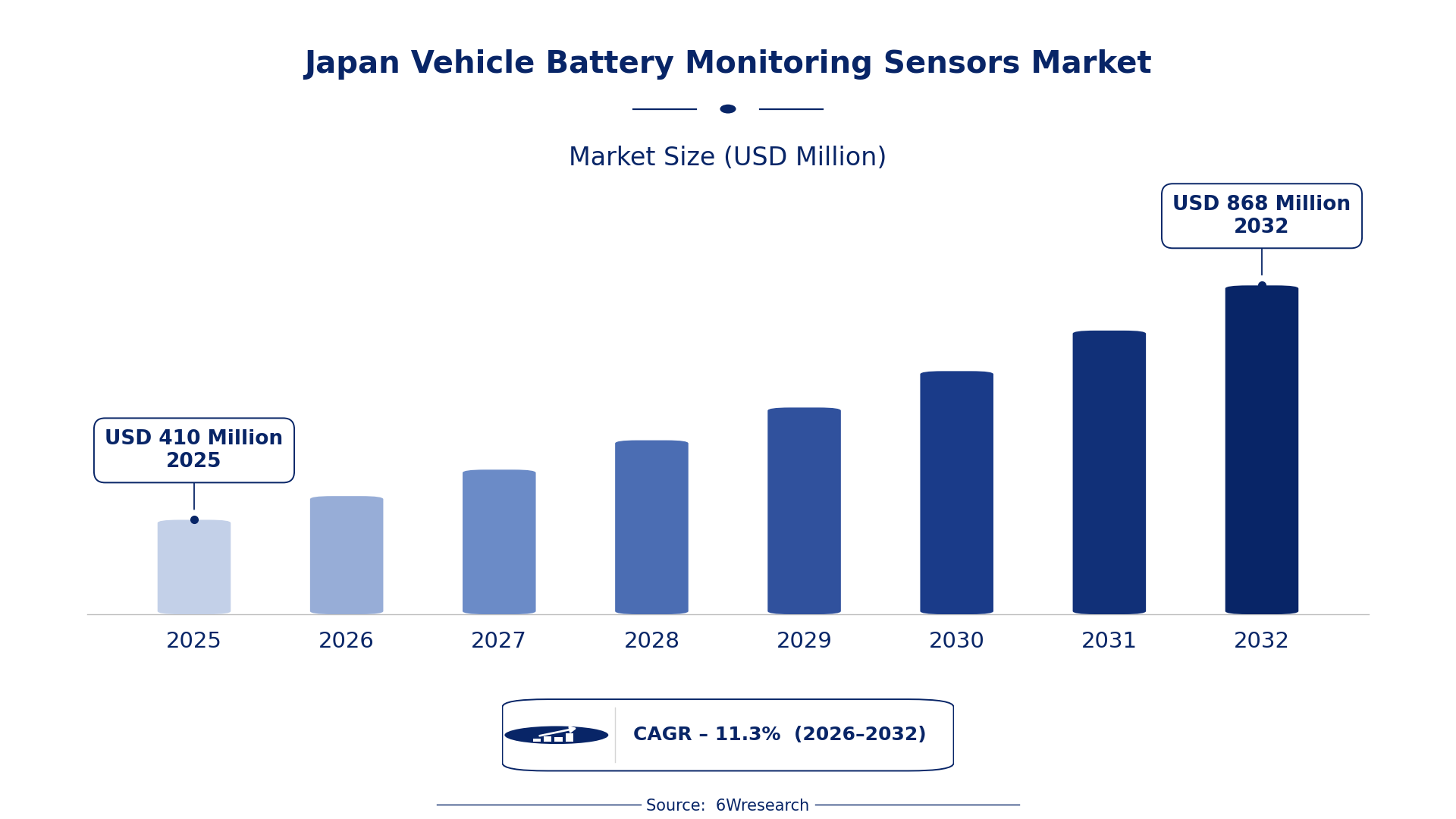
According to 6Wresearch internal database and industry insights, the Japan Vehicle Battery Monitoring Sensors Market was valued at USD 410 Million in 2025 and is projected to reach USD 868 Million by 2032, growing at a CAGR of approximately 11.3% during 2026–2032.
Japan Vehicle Battery Monitoring Sensors Market Highlights
| Report Metric | Details |
| Report Name | Japan Vehicle Battery Monitoring Sensors Market (2026-2032) |
| Market Size 2025 | USD 410 Million |
| Market Size 2032 | USD 868 Million |
| Absolute Growth 2025–2032 | USD 458 Million |
| CAGR 2026–2032 | 11.3% |
| Peak Annual Growth | 13.2% in 2032 |
| Forecast Period | 2026–2032 |
| Historical Data | 2022–2025 |
| Base Year | 2025 |
| Leading Sensor Type, 2025 | Voltage Sensors (52% share) |
| Leading Parameter Measured, 2025 | Battery Health (44% share) |
| Leading Integration Level, 2025 | Embedded (46% share) |
| Leading End User, 2025 | Electric Vehicle Makers (48% share) |
| Fastest-Growing Sensor Type | Current Sensors (16.7% CAGR) |
| Fastest-Growing Parameter Measured | Charging Rate (14.7% CAGR) |
| Fastest-Growing Integration Level | External Interface (15.4% CAGR) |
| Fastest-Growing End User | Battery Management System (14.9% CAGR) |
| Growing Sector | Electric Vehicles |
| Key End Users | Electric Vehicle Makers, Automotive OEMs, Energy Storage Units, Battery Management System |
Japan Vehicle Battery Monitoring Sensors Market Year-wise Growth Rate and Key Drivers (2022–2032)
This graph illustrates the annual growth rates of the market from 2022 to 2032, highlighting a steady upward trajectory and projected market expansion over the forecast period.
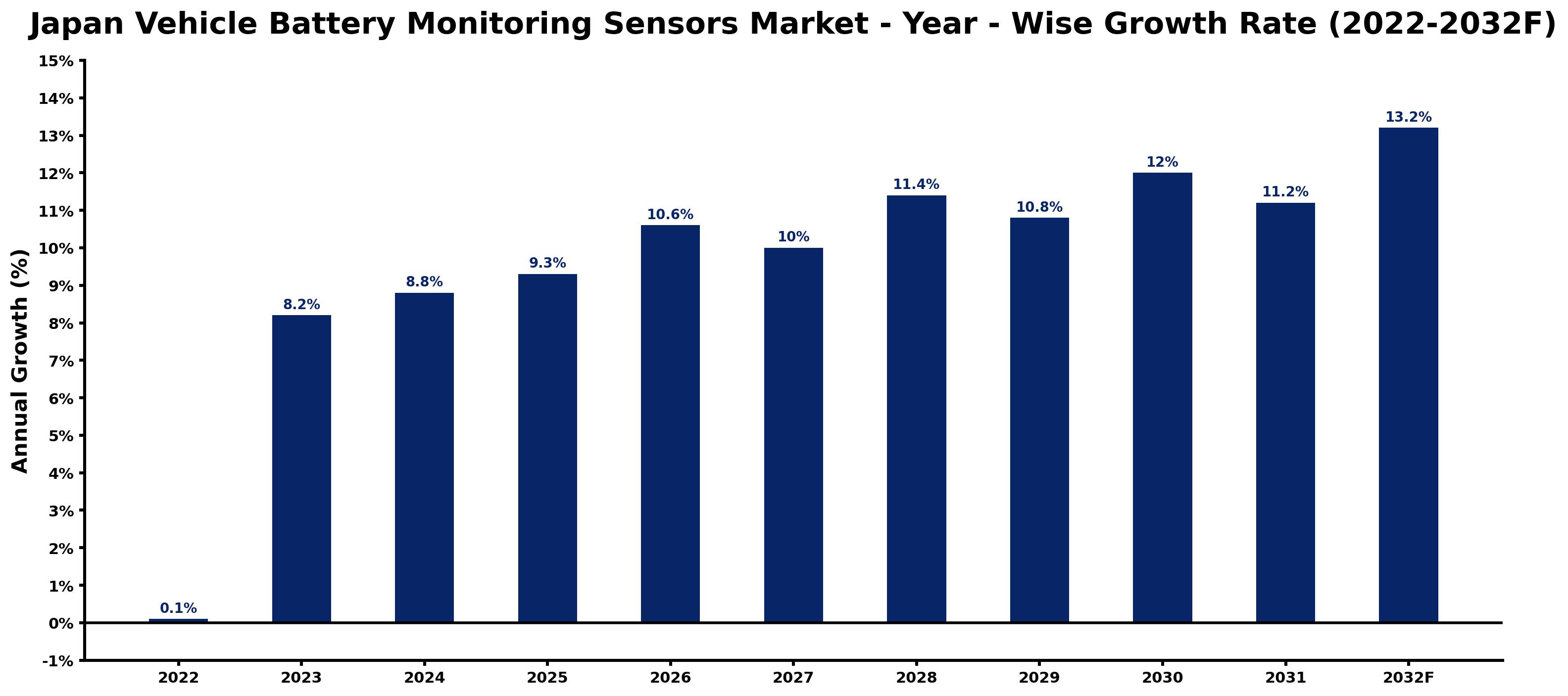
The table below sets out the estimated growth rate for each year and the main factor behind it.
| Year | Estimated Annual Growth (%) | Market Rationale |
| 2022 | 0.1 | The market experienced minimal growth as initial demand began to surface. |
| 2023 | 8.2 | Demand accelerated due to increased electric vehicle production in the Tokyo region. |
| 2024 | 8.8 | Growth continued as more manufacturers adopted battery monitoring technology. |
| 2025 | 9.3 | The market peaked historically, driven by heightened electric vehicle registrations. |
| 2026 | 10.6 | Demand increased further as battery management systems became essential for manufacturers. |
| 2027 | 10.0 | Growth slowed slightly as the market began to stabilise after rapid expansion. |
| 2028 | 11.4 | A resurgence in demand occurred as technology advancements were implemented. |
| 2029 | 10.8 | Growth decelerated again, reflecting a normalisation in the market pace. |
| 2030 | 12.0 | Demand surged as Japan's energy storage capacity targets were pursued. |
| 2031 | 11.2 | The market grew at a slower rate as it adjusted to previous peaks. |
| 2032 | 13.2 | Demand peaked again due to the push for net-zero emissions by 2050. |
Note: Market size estimations and growth projections presented in this report are based on 6Wresearch's proprietary forecasting methodology, utilizing the latest available industry data, government publications, and primary research inputs.
Japan Vehicle Battery Monitoring Sensors Market Synopsis
Vehicle Battery Monitoring Sensors are critical devices that monitor the performance and condition of vehicle batteries, especially in electric vehicles. These sensors improve safety, optimise performance, and extend battery life. The Japan Vehicle Battery Monitoring Sensors Market is growing due to increased electric vehicle production, government backing for decarbonisation, and the demand for advanced battery management systems. With over 500,000 electric vehicles registered in Japan as of 2023, the market is poised for substantial growth, driven by technological advancements and rising investment in battery infrastructure.
Market Dynamics Impact Analysis (2026–2032)
| Factor | Type | Impact | Primary Segment Affected |
| Rising electric vehicle production in the Tokyo region | Driver | High | Battery Health |
| Government initiatives promoting clean energy technologies | Driver | High | Voltage Sensors |
| Growing demand for battery recycling programs | Opportunity | Medium | Temperature Sensors |
| Increased investment in energy storage solutions | Opportunity | Medium | Current Sensors |
| High competition among manufacturers for advanced technology | Restraint | High | SoC (State of Charge) Sensors |
| Challenges in integrating new technologies into existing systems | Restraint | Medium | Charging Rate |
| Limited supply chain resilience for critical materials | Challenge | High | Battery Management System |
| Dependence on semiconductor availability for production | Challenge | Medium | Automotive OEMs |
Evaluation of Drivers in Japan Vehicle Battery Monitoring Sensors Market (2026–2032)
These are the developments adding the most demand over the forecast period.
| Drivers | Primary Segment Affected | Why It Matters (Evidence) |
| Increased electric vehicle registrations | Battery Health | The installed base of electric vehicles in Japan surpassed 300,000 in 2022, driving demand for monitoring solutions. |
| Government subsidies for EV infrastructure | Voltage Sensors | In 2023, a 2 billion yen subsidy was announced, encouraging manufacturers to adopt battery monitoring technology. |
| Technological advancements in battery management systems | Temperature Sensors | Research shows that battery monitoring can improve battery life by 20%, prompting manufacturers to invest. |
| Rising energy storage capacity | Current Sensors | Japan's energy storage capacity is projected to reach 3 GWh by 2025, increasing demand for monitoring sensors. |
| Regulatory support for clean energy initiatives | SoC (State of Charge) Sensors | Japan's GX Basic Policy targets JPY 150 trillion in decarbonisation investment, boosting demand for battery technologies. |
The strongest pull on demand comes from the Tokyo region, where electric vehicle registrations exceeded 300,000 in 2022, prompting manufacturers to invest in battery monitoring solutions. Technological advancements, such as improvements that extend battery lifespan by 20%, motivate manufacturers to integrate monitoring sensors into their designs. Japan's energy storage capacity is projected to reach 3 GWh by 2025, increasing the need for effective monitoring solutions.
Evaluation of Restraints in Japan Vehicle Battery Monitoring Sensors Market
The table below lists the restraints and the evidence behind each.
| Market Restraint | Primary Segment Affected | Why It Matters (Evidence) |
| High competition among manufacturers | Battery Health | The competitive pressures compel manufacturers to innovate rapidly, increasing costs and complexity. |
| Integration challenges with existing systems | Voltage Sensors | Many manufacturers encounter difficulties in incorporating new technologies into established battery management systems. |
| Supply chain vulnerabilities for critical materials | Temperature Sensors | Dependence on global supply chains creates risks for timely production and delivery of sensors, affecting availability. |
| Technological obsolescence risks | Current Sensors | Rapid advancements in technology may render existing products outdated, impacting sales and market presence. |
| Limited consumer awareness of benefits | SoC (State of Charge) Sensors | Consumers may not fully understand the advantages of battery monitoring, hindering market growth. |
Japan Vehicle Battery Monitoring Sensors Market Challenges
Complex regulations arise from the JIS C 8714 standard, which imposes strict requirements on battery monitoring systems. This complexity can delay product launches for producers, limiting their responsiveness to the growing electric vehicle market. Buyers face challenges in sourcing reliable battery monitoring sensors as the number of registered electric vehicles surpassed 300,000 in 2022, creating intense competition. Supply chain disruptions stem from reliance on specific components, resulting in longer lead times and increased costs for producers. Rising compliance costs can inflate prices for buyers, influencing their purchasing decisions.
Trends in the Japan Vehicle Battery Monitoring Sensors Market
The trends below show where the Japan Vehicle Battery Monitoring Sensors Market is heading.
- Shift from Traditional to Smart Battery Monitoring: In 2023, the adoption of smart battery monitoring systems increased, with over 500,000 electric vehicles in Japan benefiting from real-time data feeds. This shift improves battery performance and safety.
- Transition to Integrated Battery Management Systems: The Battery Management System sector is evolving, with a projected growth rate of 14.9% for 2026-2032. This change is driven by the need for more efficient energy use in electric vehicles.
- Electric Vehicle Makers Prioritising Battery Health: Electric Vehicle Makers are focusing on battery health, with a 44% market share in 2025. This emphasis is important for ensuring long-term vehicle performance and customer satisfaction.
- Emerging Standards for Battery Performance Testing: The introduction of the JIS Z 8801 standard in 2023 has set new benchmarks for battery performance testing, ensuring higher quality and reliability in battery monitoring systems.
Investment Opportunities in the Japan Vehicle Battery Monitoring Sensors Market
The openings below show where demand in the Japan Vehicle Battery Monitoring Sensors Market is visible and how suppliers can enter.
- Partnerships for Local Manufacturing: With Japan's push for domestic battery manufacturing, local partnerships are essential now. Collaborating with Electric Vehicle Makers can facilitate entry into the market and enhance production capabilities.
- Investment in Energy Storage Solutions: The projected growth of Japan's energy storage capacity to 3 GWh by 2025 presents an opportunity. Focusing on Battery Management Systems can meet the rising demand from energy storage units.
- Expansion of Recycling Programs: The 2023 government initiatives for battery recycling create a timely opportunity. Engaging with the Ministry of the Environment can help establish effective recycling solutions.
- Development of Advanced Monitoring Technologies: The increasing demand for battery monitoring solutions necessitates investment in innovative technologies. Collaborating with Automotive OEMs can enhance product offerings and market reach.
Government Initiatives in the Japan Vehicle Battery Monitoring Sensors Market
Japan's Semiconductor and Digital Industry Strategy, established in June 2021, supports domestic semiconductor manufacturing capabilities, ensuring a stable supply chain for critical components used in Vehicle Battery Monitoring Sensors. This measure builds on previous laws, enhancing the overall production capacity.
Electric Vehicle Makers benefit from the Economic Security Promotion Act, which promotes supply-chain resilience. This law aids manufacturers in securing essential materials for battery production, ensuring consistent availability and reducing operational risks.
Future Insight of the Japan Vehicle Battery Monitoring Sensors Market
The introduction of smart grid technologies will enhance energy management, benefiting both buyers and suppliers. By 2032, battery recycling initiatives will advance, promoting sustainability and reducing environmental impact. The Tokyo Electric Power Company plans to expand its energy storage capabilities, which will bolster the electric vehicle ecosystem. Research indicates that battery monitoring can improve battery life by 20%, encouraging greater consumer adoption of electric vehicles and driving demand for monitoring sensors.
Market Segmentation Analysis
Japan Vehicle Battery Monitoring Sensors Market report covers a detailed analysis of the following market segments:
By Sensor Type – Voltage Sensors Lead, Current Sensors Expected to Grow Fastest
According to Saurav Kr Singh, Senior Research Analyst at 6Wresearch, with 52% of sensor type revenue in 2025, Voltage Sensors was the largest category. Voltage Sensors are crucial for monitoring battery voltage levels, which is vital for electric vehicle manufacturers to maintain optimal performance. The extensive installed base of over 500,000 electric vehicles in Japan highlights the strong demand for these sensors. Current Sensors are set to record the highest CAGR in this split, 16.7% over 2026–2032. Current Sensors are increasingly essential for measuring battery current flow, particularly as the focus shifts towards enhancing efficiency in battery management. This emphasis on optimising battery performance is driving the swift adoption of current sensors. Suppliers should prioritise the development of current sensors to meet the rising efficiency demands in battery management.
By Parameter Measured – Battery Health Leads, Charging Rate Expected to Grow Fastest
Battery Health took 44% of parameter measured revenue in 2025, more than any other category. Battery Health is vital for evaluating the overall condition of vehicle batteries, a key factor for electric vehicle makers. The focus on battery longevity and performance within Japan's automotive sector solidifies its leading position in this category. Charging Rate is projected to grow fastest, at a CAGR of 14.7% during 2026–2032. Charging Rate is gaining importance for tracking battery charging efficiency, especially given the average charging time for electric vehicles is around 30 minutes. This heightened focus on efficiency is propelling the rapid growth of this parameter measured. Buyers must ensure their battery monitoring solutions effectively track charging rates to enhance operational efficiency.
By Integration Level – Embedded Leads, External Interface Expected to Grow Fastest
Embedded accounted for 46% of the market by integration level in 2025. Embedded systems are fundamental to battery systems for real-time monitoring, making them indispensable for electric vehicle manufacturers. This integration supports the growing trend towards advanced battery management solutions in Japan. The quickest growth will come from External Interface, forecast to expand at a CAGR of 15.4% between 2026 and 2032. External Interface systems are becoming more popular as they allow connections to external diagnostic tools, thereby improving overall monitoring capabilities. This trend reflects the industry's push for better interoperability in battery management. Suppliers should consider expanding their offerings to include external interface options to meet changing customer needs.
By End User – Electric Vehicle Makers Lead, Battery Management System Expected to Grow Fastest
The largest end user category in 2025 was Electric Vehicle Makers, at 48% of revenue. Electric Vehicle Makers are the primary users of battery monitoring technology, reflecting the substantial investment in electric vehicle production in Japan. Their emphasis on performance and safety drives the demand for advanced monitoring solutions in this sector. Over 2026–2032, Battery Management System is expected to post the fastest growth, at a CAGR of 14.9%. Battery Management Systems are increasingly critical to battery management solutions, particularly as the industry aims for 100% electric vehicle adoption by 2050. This trend indicates a robust future for battery management technologies. Suppliers must align their product development with the requirements of battery management systems to capitalise on market opportunities.
Key Attractiveness of the Report
- 10 Years of Market Numbers
- Historical Data Starting from 2022 to 2025
- Base Year 2025
- Forecast Data until 2032
- Key Performance Indicators Impacting the Market
- Major Upcoming Developments and Projects
Key Highlights of the Report:
- Japan Vehicle Battery Monitoring Sensors Market Outlook
- Market Size of Japan Vehicle Battery Monitoring Sensors Market, 2025
- Forecast of Japan Vehicle Battery Monitoring Sensors Market, 2032
- Historical Data and Forecast of Japan Vehicle Battery Monitoring Sensors Revenues & Volume for the Period 2022-2032F
- Japan Vehicle Battery Monitoring Sensors Market Trend Evolution
- Japan Vehicle Battery Monitoring Sensors Market Drivers and Challenges
- Japan Vehicle Battery Monitoring Sensors Price Trends
- Japan Vehicle Battery Monitoring Sensors Porter's Five Forces
- Japan Vehicle Battery Monitoring Sensors Industry Life Cycle
- Historical Data and Forecast of Japan Vehicle Battery Monitoring Sensors Market Revenues & Volume By Sensor Type for the Period 2022-2032F
- Historical Data and Forecast of Japan Vehicle Battery Monitoring Sensors Market Revenues & Volume By Voltage Sensors for the Period 2022-2032F
- Historical Data and Forecast of Japan Vehicle Battery Monitoring Sensors Market Revenues & Volume By Current Sensors for the Period 2022-2032F
- Historical Data and Forecast of Japan Vehicle Battery Monitoring Sensors Market Revenues & Volume By Temperature Sensors for the Period 2022-2032F
- Historical Data and Forecast of Japan Vehicle Battery Monitoring Sensors Market Revenues & Volume By SoC (State of Charge) Sensors for the Period 2022-2032F
- Historical Data and Forecast of Japan Vehicle Battery Monitoring Sensors Market Revenues & Volume By Parameter Measured for the Period 2022-2032F
- Historical Data and Forecast of Japan Vehicle Battery Monitoring Sensors Market Revenues & Volume By Battery Health for the Period 2022-2032F
- Historical Data and Forecast of Japan Vehicle Battery Monitoring Sensors Market Revenues & Volume By Charging Rate for the Period 2022-2032F
- Historical Data and Forecast of Japan Vehicle Battery Monitoring Sensors Market Revenues & Volume By Thermal Control for the Period 2022-2032F
- Historical Data and Forecast of Japan Vehicle Battery Monitoring Sensors Market Revenues & Volume By Capacity Status for the Period 2022-2032F
- Historical Data and Forecast of Japan Vehicle Battery Monitoring Sensors Market Revenues & Volume By Integration Level for the Period 2022-2032F
- Historical Data and Forecast of Japan Vehicle Battery Monitoring Sensors Market Revenues & Volume By Embedded for the Period 2022-2032F
- Historical Data and Forecast of Japan Vehicle Battery Monitoring Sensors Market Revenues & Volume By External Interface for the Period 2022-2032F
- Historical Data and Forecast of Japan Vehicle Battery Monitoring Sensors Market Revenues & Volume By Real-Time Data Feed for the Period 2022-2032F
- Historical Data and Forecast of Japan Vehicle Battery Monitoring Sensors Market Revenues & Volume By CAN Bus for the Period 2022-2032F
- Historical Data and Forecast of Japan Vehicle Battery Monitoring Sensors Market Revenues & Volume By End User for the Period 2022-2032F
- Historical Data and Forecast of Japan Vehicle Battery Monitoring Sensors Market Revenues & Volume By Electric Vehicle Makers for the Period 2022-2032F
- Historical Data and Forecast of Japan Vehicle Battery Monitoring Sensors Market Revenues & Volume By Battery Management System for the Period 2022-2032F
- Historical Data and Forecast of Japan Vehicle Battery Monitoring Sensors Market Revenues & Volume By Automotive OEMs for the Period 2022-2032F
- Historical Data and Forecast of Japan Vehicle Battery Monitoring Sensors Market Revenues & Volume By Energy Storage Units for the Period 2022-2032F
- Japan Vehicle Battery Monitoring Sensors Import Export Trade Statistics
- Market Opportunity Assessment By Sensor Type
- Market Opportunity Assessment By Parameter Measured
- Market Opportunity Assessment By Integration Level
- Market Opportunity Assessment By End User
- Japan Vehicle Battery Monitoring Sensors Top Companies Market Share
- Japan Vehicle Battery Monitoring Sensors Competitive Benchmarking By Technical and Operational Parameters
- Japan Vehicle Battery Monitoring Sensors Company Profiles
- Japan Vehicle Battery Monitoring Sensors Key Strategic Recommendations
Market Covered
Coverage by segment is as follows.
By Sensor Type
- Voltage Sensors
- Current Sensors
- Temperature Sensors
- SoC (State of Charge) Sensors
By Parameter Measured
- Battery Health
- Charging Rate
- Thermal Control
- Capacity Status
By Integration Level
- Embedded
- External Interface
- Real-Time Data Feed
- CAN Bus
By End User
- Electric Vehicle Makers
- Battery Management System
- Automotive OEMs
- Energy Storage Units































