Japan Vehicle Body Materials Market Size & Growth Rate
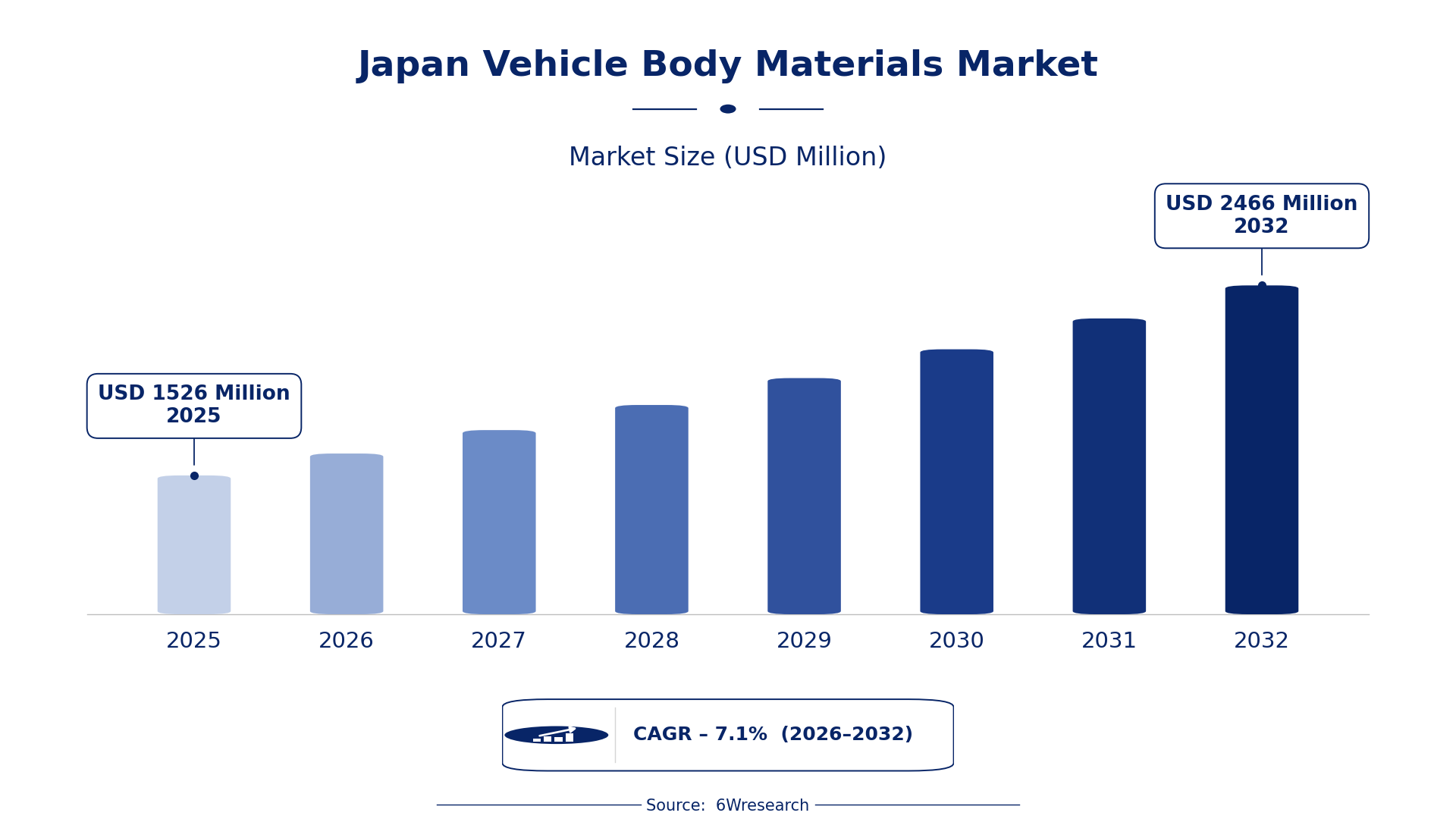
According to 6Wresearch internal database and industry insights, the Japan Vehicle Body Materials Market was valued at USD 1,526 Million in 2025 and is projected to reach USD 2,466 Million by 2032, growing at a CAGR of approximately 7.1% during 2026–2032.
Japan Vehicle Body Materials Market Highlights
| Report Metric | Details |
| Report Name | Japan Vehicle Body Materials Market (2026-2032) |
| Market Size 2025 | USD 1,526 Million |
| Market Size 2032 | USD 2,466 Million |
| Absolute Growth 2025–2032 | USD 940 Million |
| CAGR 2026–2032 | 7.1% |
| Peak Annual Growth | 7.8% in 2026 |
| Forecast Period | 2026–2032 |
| Historical Data | 2022–2025 |
| Base Year | 2025 |
| Leading Material Type, 2025 | High Strength Steel (44% share) |
| Leading Composition Type, 2025 | Lightweight (49% share) |
| Leading Application Area, 2025 | Passenger Cars (43% share) |
| Leading End User, 2025 | Auto Part Suppliers (39% share) |
| Fastest-Growing Material Type | Carbon Fiber Composites (10.1% CAGR) |
| Fastest-Growing Application Area | Electric Vehicles (8.6% CAGR) |
| Fastest-Growing End User | EV OEMs (9.2% CAGR) |
| Growing Sector | Electric Vehicles |
| Key End Users | Passenger Cars, Electric Vehicles, Sports Cars, Bumper Panels |
Japan Vehicle Body Materials Market Year-wise Growth Rate and Key Drivers (2022–2032)
This graph illustrates the annual growth rates of the market from 2022 to 2032, highlighting a steady upward trajectory and projected market expansion over the forecast period.
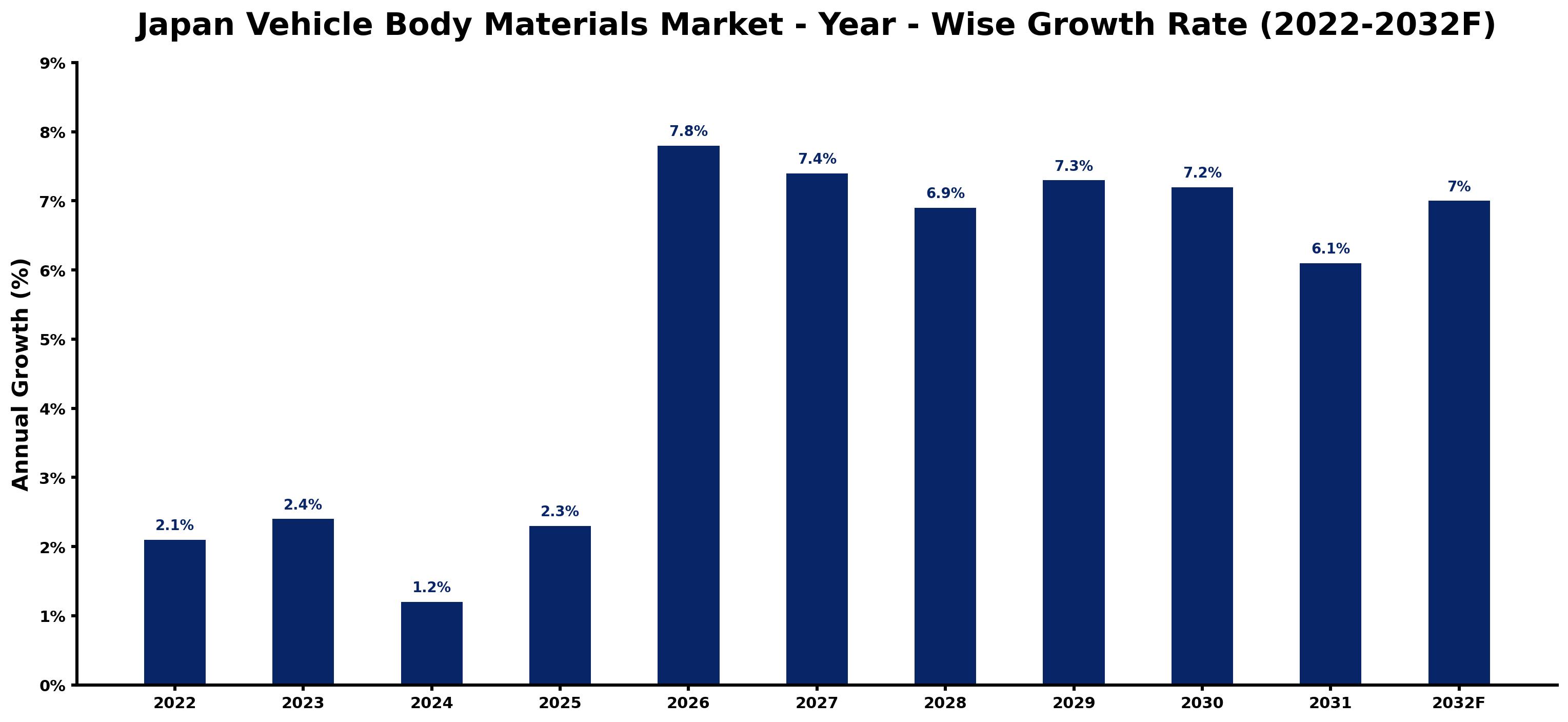
Year by year, the estimates below pair each growth rate with the development that shaped it.
| Year | Estimated Annual Growth (%) | Market Rationale |
| 2022 | 2.1 | The market experienced moderate growth due to stable automotive production levels. |
| 2023 | 2.4 | Growth accelerated as demand for vehicle body materials increased among domestic manufacturers. |
| 2024 | 1.2 | Growth slowed as manufacturers faced challenges in sourcing raw materials. |
| 2025 | 2.3 | Demand rose again as investments in innovation within the automotive sector gained momentum. |
| 2026 | 7.8 | The market is expected to peak due to investments in electric vehicle production. |
| 2027 | 7.4 | Growth is projected to slow slightly as the market stabilises after rapid expansion. |
| 2028 | 6.9 | A further slowdown is expected as the market adjusts to new production capacities. |
| 2029 | 7.3 | Demand picks up again as consumer interest in electric vehicles continues to grow. |
| 2030 | 7.2 | Growth is projected to slow as the market matures and competition intensifies. |
| 2031 | 6.1 | A slowdown is expected as manufacturers focus on efficiency and cost management. |
| 2032 | 7.0 | Demand is expected to rise again as new technologies in vehicle materials are introduced. |
Note: Market size estimations and growth projections presented in this report are based on 6Wresearch's proprietary forecasting methodology, utilizing the latest available industry data, government publications, and primary research inputs.
Japan Vehicle Body Materials Market Synopsis
Vehicle body materials are essential components in vehicle manufacturing, primarily consisting of metals and polymers. In Japan, the Vehicle Body Materials Market is driven by the production of approximately 8 million vehicles in 2022, with notable demand from domestic manufacturers. Growth is supported by increased investments in electric vehicle production, aiming for a 46% reduction in greenhouse gas emissions by 2030, and the push for lightweight materials to improve fuel efficiency and safety features. The automotive industry is projected to invest ¥1 trillion in innovation by 2025, further stimulating demand.
Market Dynamics Impact Analysis (2026–2032)
| Factor | Type | Impact | Primary Segment Affected |
| Growing demand for lightweight materials in electric vehicles | Driver | High | Lightweight |
| Increased focus on carbon neutrality in the automotive sector | Driver | High | High Strength Steel |
| Expansion of electric vehicle manufacturing capabilities | Opportunity | High | Electric Vehicles |
| Rising investments in research and development for advanced materials | Opportunity | Medium | Carbon Fiber Composites |
| Challenges in sourcing raw materials for production | Restraint | High | Aluminum Alloys |
| Regulatory compliance costs for automotive materials | Restraint | Medium | Thermoplastic Polymers |
| Competition from alternative materials in vehicle manufacturing | Challenge | High | Carbon Fiber Composites |
| Technological advancements requiring constant adaptation | Challenge | Medium | High Strength Steel |
Evaluation of Drivers in Japan Vehicle Body Materials Market (2026–2032)
Below are the drivers that matter most for revenue growth, with supporting evidence.
| Drivers | Primary Segment Affected | Why It Matters (Evidence) |
| Increased production of electric vehicles | Electric Vehicles | The demand for lightweight materials has surged, with a projected 1 million electric vehicles expected by 2025. |
| Rising investments in automotive innovation | Lightweight | The automotive industry plans to invest ¥1 trillion in innovation by 2025, driving demand for advanced materials. |
| Growing consumer preference for fuel-efficient vehicles | Passenger Cars | Approximately 8 million vehicles were produced in 2022, reflecting strong demand for efficient designs. |
| Development of new manufacturing technologies | Carbon Fiber Composites | The automotive sector is increasingly adopting advanced composites for high-performance applications. |
| Government initiatives targeting carbon neutrality | High Strength Steel | Japan aims for a 46% reduction in greenhouse gas emissions by 2030, promoting sustainable materials. |
Spending rises because the Tokyo region is experiencing a surge in electric vehicle production, with a target of 1 million units by 2025. The automotive industry is investing ¥1 trillion in innovation by 2025, driving demand for lightweight materials. High Strength Steel usage accounts for 50% of vehicle body materials, reflecting a strong focus on structural integrity. The growing consumer preference for fuel-efficient vehicles further supports this trend, as approximately 8 million vehicles were produced in 2022, indicating a strong market. New manufacturing technologies are being adopted, improving performance in vehicle materials.
Evaluation of Restraints in Japan Vehicle Body Materials Market
The main factors holding the market back are set out below.
| Market Restraint | Primary Segment Affected | Why It Matters (Evidence) |
| A shortage of skilled workers in the automotive sector | Electric Vehicles | This shortage has led to delays in production, hindering manufacturers' ability to meet rising demand. |
| Rapid technological advancements in vehicle materials | High Strength Steel | Suppliers struggle to keep pace, resulting in increased costs for manufacturers investing in new technologies. |
| Stringent regulations around emissions and safety standards | Lightweight | These regulations impose additional compliance costs, which can delay product launches for producers. |
| Intense competition from international markets | Passenger Cars | This competition pressures local manufacturers to reduce prices, impacting profit margins for domestic suppliers. |
| Supply chain disruptions due to global events | Carbon Fiber Composites | These disruptions can lead to material shortages, affecting production timelines for manufacturers. |
Japan Vehicle Body Materials Market Challenges
Delays in production occur due to a shortage of skilled workers in the automotive sector, impacting suppliers' ability to meet demand for vehicle body materials. Rapid technological advancements create a knowledge gap, forcing producers to invest heavily in training and new equipment, which can increase costs by up to 20%. Compliance with emissions regulations leads to additional expenses, delaying product launches for manufacturers and affecting their competitiveness. Competition from international markets pressures local suppliers to reduce prices, squeezing profit margins and limiting their capacity to invest in innovation.
Trends in the Japan Vehicle Body Materials Market
These developments are changing demand patterns in the Japan Vehicle Body Materials Market.
- Shift in Focus to Electric Vehicles: Auto part suppliers are increasingly prioritising electric vehicle components, reflecting a growing market demand. With a target of 1 million electric vehicles by 2025, this shift is reshaping supplier strategies.
- Transition to Lightweight Materials: The automotive industry is moving towards lightweight materials to improve fuel efficiency. The rising use of Aluminum Alloys in electric vehicles, which has increased by 15% since 2020, illustrates this trend.
- Growing Adoption of Advanced Composites: Manufacturers are increasingly adopting Carbon Fiber Composites for high-performance applications. This trend is particularly evident in sports cars, where performance demands drive material innovation.
- Expansion of Safety Standards: The automotive sector is enhancing safety standards, with Japan leading globally. The implementation of ISO 9001 among manufacturers ensures quality and safety in vehicle body materials.
Investment Opportunities in the Japan Vehicle Body Materials Market
The following opportunities in the Japan Vehicle Body Materials Market pair current demand with a clear way in.
- Investment in Electric Vehicle Infrastructure: The Tokyo region is a key area for investment in electric vehicle infrastructure, with a projected demand for 1 million units by 2025. Suppliers can enter this market through partnerships with local manufacturers.
- Supply of Lightweight Materials: With the automotive industry targeting a 46% reduction in emissions by 2030, there is a growing demand for lightweight materials. Collaborating with auto part suppliers can facilitate market entry.
- Development of Advanced Manufacturing Technologies: The automotive sector is investing ¥1 trillion in innovation by 2025, creating opportunities for suppliers of advanced manufacturing technologies. Engaging with component manufacturers can enhance market presence.
- Focus on Carbon Neutrality Initiatives: Japan's commitment to carbon neutrality by 2050 opens avenues for suppliers of sustainable materials. Engaging with the Japan Automobile Manufacturers Association can provide valuable insights for market entry.
Government Initiatives in the Japan Vehicle Body Materials Market
In 2023, Japan launched a programme to promote electric vehicle manufacturing, building on existing laws like the PRTR Law (1999) that requires businesses to report chemical substance releases. This new initiative strengthens the regulatory framework for sustainable practices in the automotive sector.
Funding of approximately ¥150 trillion over 10 years supports R&D for lightweight materials, administered by the Ministry of Economy, Trade and Industry. This funding aims to boost innovation in vehicle body materials.
Future Insight of the Japan Vehicle Body Materials Market
A planned investment of ¥1 trillion in innovation by 2025 will drive demand for vehicle body materials, particularly as the government aims for 50% electric vehicle sales by 2030. By 2032, advancements in manufacturing technologies will enhance production efficiency, allowing suppliers to respond swiftly to market changes. The commitment to carbon neutrality will promote the use of alternative materials, reshaping product offerings for buyers. Increased collaboration between the government and the automotive industry will accelerate the development of lightweight materials.
Market Segmentation Analysis
Japan Vehicle Body Materials Market report covers a detailed analysis of the following market segments:
By Material Type – High Strength Steel Leads, Carbon Fiber Composites Expected to Grow Fastest
According to Saurav Kr Singh, Senior Research Analyst at 6Wresearch, High Strength Steel held 44% of the Japan Vehicle Body Materials Market by material type in 2025. High Strength Steel holds the largest share as it is essential for maintaining the structural integrity of vehicles. Its extensive use across various vehicle types, particularly in Japan's automotive sector, highlights its critical role in ensuring safety and durability. Carbon Fiber Composites are set to record the highest CAGR in this split, 10.1% over 2026–2032. Carbon Fiber Composites are experiencing rapid growth due to their rising adoption in high-performance vehicles, where reducing weight is vital. This trend is further accelerated by the increasing demand for electric vehicles, which gain efficiency from lighter materials. Suppliers must focus on developing advanced materials to meet the growing need for lightweight solutions in the automotive market.
By Composition Type – Lightweight Leads and Records the Fastest Growth
With 49% of composition type revenue in 2025, Lightweight was the largest category. Lightweight materials dominate the market as they are essential for fuel-efficient vehicle design, directly addressing the need for lower emissions. This trend is driven by manufacturers' efforts to comply with stringent environmental regulations and consumer demand for efficiency. Its lead should widen, with a projected CAGR of 9.7% during 2026–2032, the highest in this split. The lightweight segment is also the fastest growing, as manufacturers are increasingly prioritising fuel efficiency in response to evolving government regulations and shifting consumer preferences. This focus on lightweight solutions will likely continue to shape future vehicle designs. Buyers will gain a competitive edge by investing in lightweight materials to meet environmental standards and improve vehicle performance.
By Application Area – Passenger Cars Lead, Electric Vehicles Expected to Grow Fastest
Passenger Cars took 43% of application area revenue in 2025, more than any other category. Passenger Cars account for the largest share as they represent the majority of vehicles produced in Japan. The high production volume of these vehicles ensures a consistent demand for vehicle body materials. The quickest growth will come from Electric Vehicles, forecast to expand at a CAGR of 8.6% between 2026 and 2032. Electric Vehicles are the fastest growing application area, driven by the increasing consumer demand for sustainable transportation solutions. The government's target of 50% electric vehicle sales by 2030 further propels this growth. Suppliers must adapt their offerings to cater to the rising demand for materials specifically designed for electric vehicles.
By End User – Auto Part Suppliers Lead, EV OEMs Expected to Grow Fastest
Auto Part Suppliers accounted for 39% of the market by end user in 2025. Auto Part Suppliers dominate the market as they play a crucial role in the automotive supply chain, providing key components to manufacturers. Their established connections with vehicle producers ensure a steady demand for vehicle body materials, especially in Japan's strong automotive sector. EV OEMs are projected to grow fastest, at a CAGR of 9.2% during 2026–2032. EV OEMs are the fastest growing end user group, reflecting a notable shift towards electric vehicle production driven by government policies and consumer preferences for sustainable options. This growth signifies a major change in the automotive industry. Suppliers should adjust their strategies to cater to the specific requirements of EV OEMs as the market increasingly transitions towards electric vehicles.
Key Attractiveness of the Report
- 10 Years of Market Numbers
- Historical Data Starting from 2022 to 2025
- Base Year 2025
- Forecast Data until 2032
- Key Performance Indicators Impacting the Market
- Major Upcoming Developments and Projects
Key Highlights of the Report:
- Japan Vehicle Body Materials Market Outlook
- Market Size of Japan Vehicle Body Materials Market, 2025
- Forecast of Japan Vehicle Body Materials Market, 2032
- Historical Data and Forecast of Japan Vehicle Body Materials Revenues & Volume for the Period 2022-2032F
- Japan Vehicle Body Materials Market Trend Evolution
- Japan Vehicle Body Materials Market Drivers and Challenges
- Japan Vehicle Body Materials Price Trends
- Japan Vehicle Body Materials Porter's Five Forces
- Japan Vehicle Body Materials Industry Life Cycle
- Historical Data and Forecast of Japan Vehicle Body Materials Market Revenues & Volume By Material Type for the Period 2022-2032F
- Historical Data and Forecast of Japan Vehicle Body Materials Market Revenues & Volume By High Strength Steel for the Period 2022-2032F
- Historical Data and Forecast of Japan Vehicle Body Materials Market Revenues & Volume By Aluminum Alloys for the Period 2022-2032F
- Historical Data and Forecast of Japan Vehicle Body Materials Market Revenues & Volume By Carbon Fiber Composites for the Period 2022-2032F
- Historical Data and Forecast of Japan Vehicle Body Materials Market Revenues & Volume By Thermoplastic Polymers for the Period 2022-2032F
- Historical Data and Forecast of Japan Vehicle Body Materials Market Revenues & Volume By Composition Type for the Period 2022-2032F
- Historical Data and Forecast of Japan Vehicle Body Materials Market Revenues & Volume By Alloyed for the Period 2022-2032F
- Historical Data and Forecast of Japan Vehicle Body Materials Market Revenues & Volume By Lightweight for the Period 2022-2032F
- Historical Data and Forecast of Japan Vehicle Body Materials Market Revenues & Volume By Reinforced for the Period 2022-2032F
- Historical Data and Forecast of Japan Vehicle Body Materials Market Revenues & Volume By Moldable for the Period 2022-2032F
- Historical Data and Forecast of Japan Vehicle Body Materials Market Revenues & Volume By Application Area for the Period 2022-2032F
- Historical Data and Forecast of Japan Vehicle Body Materials Market Revenues & Volume By Passenger Cars for the Period 2022-2032F
- Historical Data and Forecast of Japan Vehicle Body Materials Market Revenues & Volume By Electric Vehicles for the Period 2022-2032F
- Historical Data and Forecast of Japan Vehicle Body Materials Market Revenues & Volume By Sports Cars for the Period 2022-2032F
- Historical Data and Forecast of Japan Vehicle Body Materials Market Revenues & Volume By Bumper Panels for the Period 2022-2032F
- Historical Data and Forecast of Japan Vehicle Body Materials Market Revenues & Volume By End User for the Period 2022-2032F
- Historical Data and Forecast of Japan Vehicle Body Materials Market Revenues & Volume By Auto Part Suppliers for the Period 2022-2032F
- Historical Data and Forecast of Japan Vehicle Body Materials Market Revenues & Volume By EV OEMs for the Period 2022-2032F
- Historical Data and Forecast of Japan Vehicle Body Materials Market Revenues & Volume By Performance Vehicle Makers for the Period 2022-2032F
- Historical Data and Forecast of Japan Vehicle Body Materials Market Revenues & Volume By Component Manufacturers for the Period 2022-2032F
- Japan Vehicle Body Materials Import Export Trade Statistics
- Market Opportunity Assessment By Material Type
- Market Opportunity Assessment By Composition Type
- Market Opportunity Assessment By Application Area
- Market Opportunity Assessment By End User
- Japan Vehicle Body Materials Top Companies Market Share
- Japan Vehicle Body Materials Competitive Benchmarking By Technical and Operational Parameters
- Japan Vehicle Body Materials Company Profiles
- Japan Vehicle Body Materials Key Strategic Recommendations
Market Covered
This report examines the market across the segments below.
By Material Type
- High Strength Steel
- Aluminum Alloys
- Carbon Fiber Composites
- Thermoplastic Polymers
By Composition Type
- Alloyed
- Lightweight
- Reinforced
- Moldable
By Application Area
- Passenger Cars
- Electric Vehicles
- Sports Cars
- Bumper Panels
By End User
- Auto Part Suppliers
- EV OEMs
- Performance Vehicle Makers
- Component Manufacturers































