Japan Vehicle Body Panel Market Size & Growth Rate
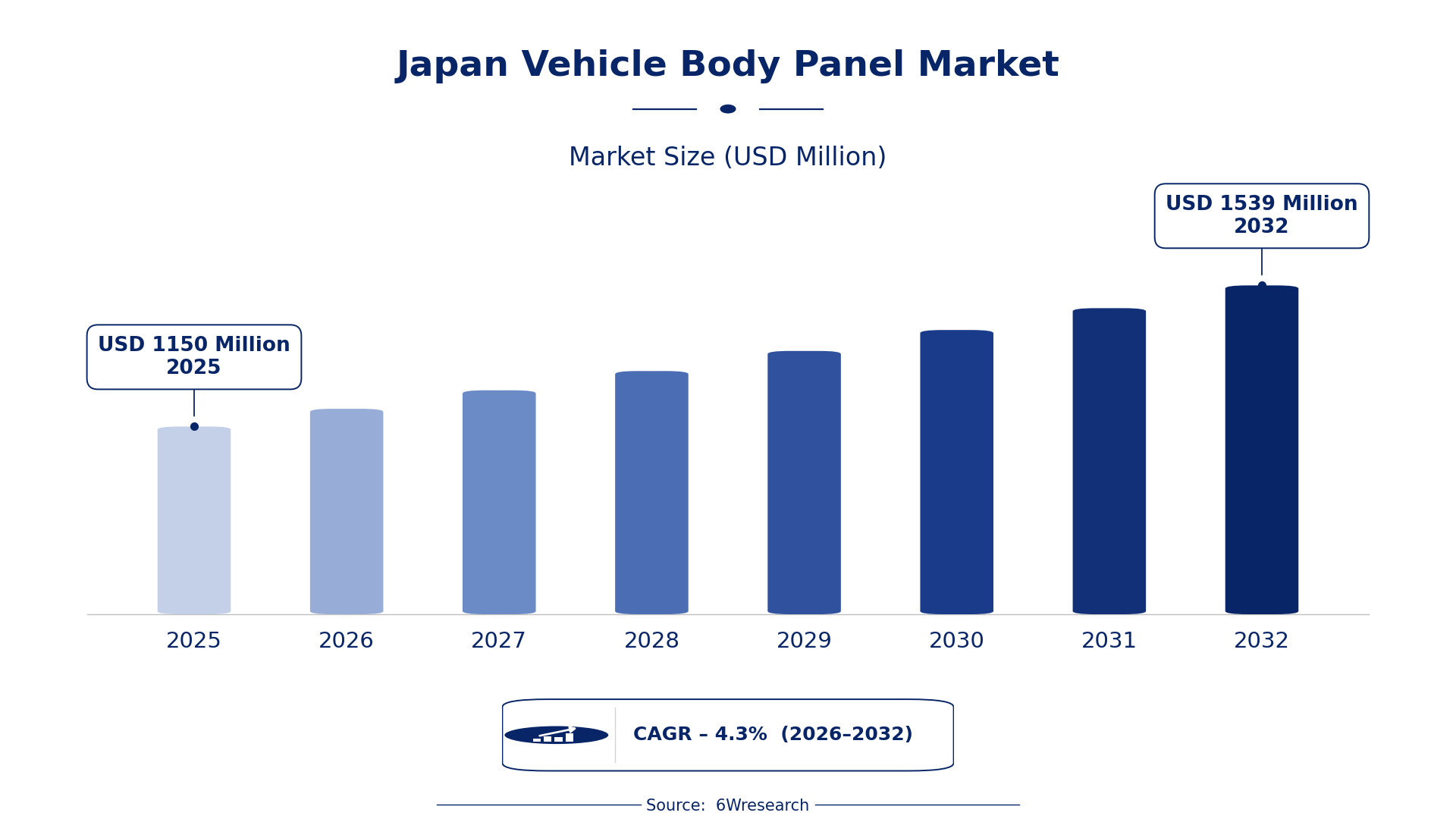
According to 6Wresearch internal database and industry insights, the Japan Vehicle Body Panel Market was valued at USD 1,150 Million in 2025 and is projected to reach USD 1,539 Million by 2032, growing at a CAGR of approximately 4.3% during 2026–2032.
Japan Vehicle Body Panel Market Highlights
| Report Metric | Details |
| Report Name | Japan Vehicle Body Panel Market (2026-2032) |
| Market Size 2025 | USD 1,150 Million |
| Market Size 2032 | USD 1,539 Million |
| Absolute Growth 2025–2032 | USD 389 Million |
| CAGR 2026–2032 | 4.3% |
| Peak Annual Growth | 5.3% in 2028 |
| Forecast Period | 2026–2032 |
| Historical Data | 2022–2025 |
| Base Year | 2025 |
| Leading Panel Type, 2025 | Door Panels (44% share) |
| Leading Manufacturing Method, 2025 | Press Formed (42% share) |
| Leading Material Type, 2025 | Aluminum (36% share) |
| Leading End User, 2025 | Vehicle Assemblers (38% share) |
| Fastest-Growing Panel Type | Roof Panels (6.1% CAGR) |
| Fastest-Growing Manufacturing Method | Stamped (6.6% CAGR) |
| Fastest-Growing Material Type | Steel (6.4% CAGR) |
| Fastest-Growing End User | Automotive OEMs (5.6% CAGR) |
| Growing Sector | Automotive OEMs |
| Key End Users | Vehicle Assemblers, Automotive OEMs, Auto Part Suppliers, Sports Car OEMs |
Japan Vehicle Body Panel Market Year-wise Growth Rate and Key Drivers (2022–2032)
This graph illustrates the annual growth rates of the market from 2022 to 2032, highlighting a steady upward trajectory and projected market expansion over the forecast period.
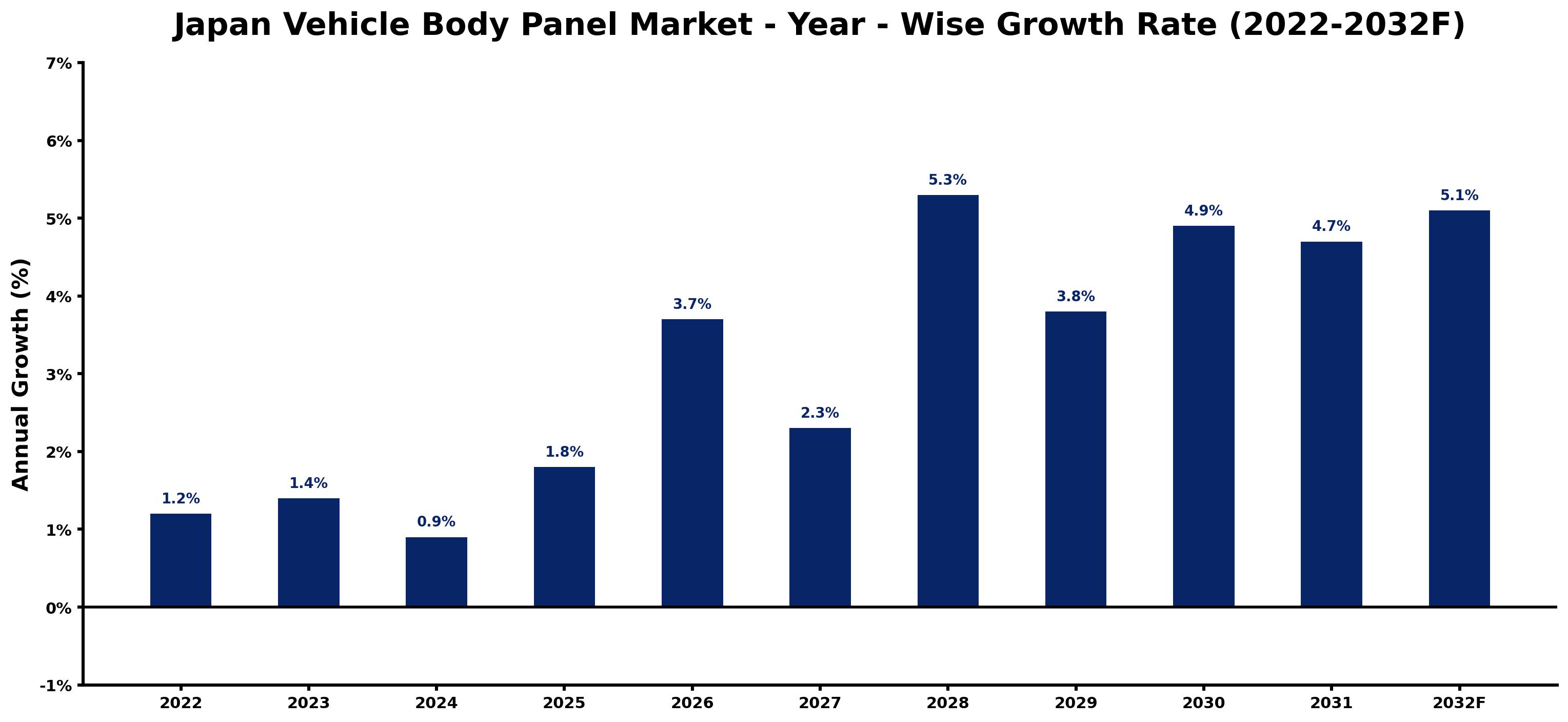
The following figures match every annual growth estimate with the main market development of that year, giving the reasoning behind each rise or slowdown.
| Year | Estimated Annual Growth (%) | Market Rationale |
| 2022 | 1.2 | The market showed steady growth with increasing vehicle production levels. |
| 2023 | 1.4 | Demand rose due to a recovery in automotive manufacturing after disruptions. |
| 2024 | 0.9 | Growth slowed as supply chain issues affected production timelines. |
| 2025 | 1.8 | The market experienced faster growth driven by rising consumer demand for vehicles. |
| 2026 | 3.7 | Demand surged as manufacturers adopted more advanced materials in production. |
| 2027 | 2.3 | Growth slowed as market saturation began to affect new orders. |
| 2028 | 5.3 | The market peaked with substantial investments in electric vehicle production. |
| 2029 | 3.8 | Growth decelerated as manufacturers adjusted to changing consumer preferences. |
| 2030 | 4.9 | Demand increased with the introduction of new vehicle models and technologies. |
| 2031 | 4.7 | Growth slowed slightly as the market stabilised after a peak in 2028. |
| 2032 | 5.1 | The market continued to grow with sustained investments in sustainability. |
Note: Market size estimations and growth projections presented in this report are based on 6Wresearch's proprietary forecasting methodology, utilizing the latest available industry data, government publications, and primary research inputs.
Japan Vehicle Body Panel Market Synopsis
Vehicle body panels are essential components made from various materials, primarily used in automobile manufacturing. The Japan Vehicle Body Panel Market is experiencing growth driven by rising vehicle production, which reached approximately 8 million units in 2022, and increasing demand for lightweight materials. The shift towards electric vehicles and stringent environmental regulations are also contributing to new demand, as manufacturers seek to improve fuel efficiency and reduce emissions. With a focus on sustainability, the market is expected to see further advancements in material technology and production methods, aligning with Japan's goal of a 46% cut in greenhouse gas emissions by 2030.
Market Dynamics Impact Analysis (2026–2032)
| Factor | Type | Impact | Primary Segment Affected |
| Rising vehicle production levels | Driver | High | Door Panels |
| Increasing adoption of lightweight materials | Driver | High | Door Panels |
| Growing demand for electric vehicles | Opportunity | High | Door Panels |
| Expansion of automotive manufacturing facilities | Opportunity | Medium | Door Panels |
| Supply chain disruptions affecting material availability | Restraint | High | Door Panels |
| High costs associated with advanced materials | Restraint | Medium | Door Panels |
| Fluctuating raw material prices | Challenge | High | Door Panels |
| Technological advancements requiring new skills | Challenge | Medium | Door Panels |
Evaluation of Drivers in Japan Vehicle Body Panel Market (2026–2032)
The following drivers explain most of the expected growth.
| Drivers | Primary Segment Affected | Why It Matters (Evidence) |
| Increased vehicle production | Door Panels | Japan produced approximately 8 million vehicles in 2022, driving demand for body panels. |
| Shift towards lightweight materials | Aluminum | Aluminum usage rose to 36% in 2025, as manufacturers aim for fuel efficiency. |
| Investment in electric vehicle production | Door Panels | The push for electric vehicles will increase demand for body panels as new models require advanced components. |
| Technological advancements in manufacturing | Door Panels | New stamping techniques are improving production efficiency, leading to increased orders from manufacturers. |
| Growing automotive OEMs in Japan | Automotive OEMs | Automotive OEMs accounted for 38% of the market share in 2025, driving demand. |
Orders continue to rise as vehicle production in Japan hit approximately 8 million units in 2022, increasing the need for body panels. Manufacturers are progressively utilising lightweight materials, with aluminium consumption expected to reach 36% by 2025, improving fuel efficiency. Investment in electric vehicle production is stimulating demand for body panels, as new models necessitate advanced components. Innovations in manufacturing processes, including new stamping techniques, are enhancing efficiency and enabling manufacturers to respond to growing demand more effectively.
Evaluation of Restraints in Japan Vehicle Body Panel Market
These are the pressures that could keep growth below its potential.
| Market Restraint | Primary Segment Affected | Why It Matters (Evidence) |
| Intense competition from global manufacturers | Door Panels | This competition leads to price wars that erode profit margins for local producers. |
| Rising costs for raw materials | Aluminum | Increased demand for eco-friendly options has pushed prices up, impacting buyers' budgets. |
| Skills shortages in advanced manufacturing techniques | Door Panels | These shortages hinder production efficiency, increasing lead times for critical components. |
| Supply chain disruptions | Door Panels | Ongoing disruptions have delayed production timelines, affecting delivery schedules. |
| Regulatory compliance costs | Aluminum | Meeting stringent environmental regulations increases operational costs for manufacturers. |
Japan Vehicle Body Panel Market Challenges
Producers in the vehicle body panel market face rising costs due to increased competition from global manufacturers, which can inflate prices by up to 15%. This competition exists because Japan aims for a 46% reduction in greenhouse gas emissions by 2030, compelling local producers to innovate rapidly or risk market share loss. Suppliers encounter higher raw material costs as the transition to eco-friendly materials can delay deliveries by three months, disrupting production schedules for manufacturers. A shortage of skilled workers in advanced manufacturing techniques forces producers to rely on outdated methods, increasing lead times by 20% for essential components, which hampers overall efficiency.
Trends in the Japan Vehicle Body Panel Market
Buyers and suppliers in the Japan Vehicle Body Panel Market are adjusting to the following trends.
- Shift towards Lightweight Materials: Vehicle assemblers are increasingly adopting lightweight materials, with aluminium usage projected to rise to 36% by 2025. This shift is driven by the need for improved fuel efficiency and reduced emissions.
- Transition to Electric Vehicle Production: The introduction of new electric vehicle models is reshaping the market. By 2025, electric vehicles are expected to account for a significant share of new vehicle sales, prompting increased demand for body panels.
- Emergence of Advanced Manufacturing Techniques: Innovations in manufacturing processes are becoming more prevalent. New stamping techniques are improving production efficiency, enabling manufacturers to meet rising demand more effectively.
- Prioritisation of Sustainability in Manufacturing: The focus on sustainability is reshaping production practices. By 2030, Japan aims for a 46% cut in greenhouse gas emissions from 2013 levels, influencing material choices and production methods.
Investment Opportunities in the Japan Vehicle Body Panel Market
Investors looking at the Japan Vehicle Body Panel Market should consider the following areas.
- Joint Ventures for Electric Vehicle Components: Local partnerships are essential for entering the electric vehicle market, which is expected to grow rapidly. Collaborating with automotive OEMs can facilitate access to new technologies and markets.
- Investment in Lightweight Material Technologies: With aluminium usage expected to rise, investing in lightweight material technologies presents a lucrative opportunity. Vehicle assemblers are actively seeking suppliers who can provide innovative materials.
- Expansion of Production Facilities: The demand for body panels is increasing, necessitating new production facilities. Investing in advanced manufacturing capabilities will position suppliers to meet future demand effectively.
- Focus on Eco-Friendly Manufacturing Practices: The current emphasis on sustainability creates opportunities for suppliers of eco-friendly materials. Engaging with automotive OEMs focused on reducing emissions can open new market avenues.
Government Initiatives in the Japan Vehicle Body Panel Market
The GX Promotion Act (2023) establishes a legal framework for Japan's decarbonisation strategy, supporting sustainable practices in the automotive sector. This act targets approximately JPY 150 trillion in public-private investment over ten years, which will benefit producers of vehicle body panels by promoting eco-friendly manufacturing methods.
The Ministry of Economy, Trade and Industry (METI) approves funding for projects aligned with the Green Growth Strategy. This includes initiatives aimed at boosting domestic battery manufacturing capacity, which supports the production of electric vehicles and related components, thereby influencing demand for vehicle body panels.
Future Insight of the Japan Vehicle Body Panel Market
By 2032, new manufacturing facilities focused on electric vehicle components will emerge, aligning with Japan's net zero emissions goal. Investment in automation technologies will streamline production processes, enhancing efficiency. Buyers will benefit from reduced lead times and improved product quality. The adoption of innovative materials will elevate vehicle performance while minimising environmental impact. Enhanced collaboration between suppliers and manufacturers will be essential to meet the evolving demands of the electric vehicle market.
Market Segmentation Analysis
Japan Vehicle Body Panel Market report covers a detailed analysis of the following market segments:
By Panel Type – Door Panels Lead, Roof Panels Expected to Grow Fastest
According to Saurav Kr Singh, Senior Research Analyst at 6Wresearch, Door Panels took 44% of panel type revenue in 2025, more than any other category. Door panels command a large market share due to their essential role in vehicle structure and design, predominantly used in passenger vehicles that lead Japan's automotive market. This is evident from the high production rates and frequent replacements associated with these components. Roof Panels are set to record the highest CAGR in this split, 6.1% over 2026–2032. Roof panels are experiencing rapid growth as manufacturers increasingly focus on lightweight construction to improve fuel efficiency, with new vehicle models anticipated to significantly boost demand. This trend aligns with Japan's stringent greenhouse-gas emissions reduction goals, further propelling the sector. Suppliers must concentrate on developing advanced materials and designs for roof panels to capitalise on the growing market opportunities.
By Manufacturing Method – Press Formed Leads, Stamped Expected to Grow Fastest
Press Formed accounted for 42% of the market by manufacturing method in 2025. Press formed methods are prevalent in the market due to their efficiency and ability to produce complex shapes, making them suitable for high-volume production. This method is widely used in the manufacturing of various vehicle body panels, ensuring consistency and quality. Over 2026–2032, Stamped is expected to post the fastest growth, at a CAGR of 6.6%. Stamped methods are gaining traction as they allow for quicker production cycles and lower costs, appealing to manufacturers seeking to optimise operations. The shift towards stamped methods is likely to accelerate as competition in the automotive sector intensifies. Buyers may benefit from negotiating better pricing as suppliers adopt more cost-effective manufacturing methods.
By Material Type – Aluminum Leads, Steel Expected to Grow Fastest
Aluminum held 36% of the Japan Vehicle Body Panel Market by material type in 2025. Aluminum holds the largest market share due to its lightweight properties that enhance overall vehicle efficiency, making it a preferred material across various vehicle types. Its prevalent use is particularly notable in electric vehicles, where minimising weight is vital for optimal performance. Steel is projected to grow fastest, at a CAGR of 6.4% during 2026–2032. Steel is rapidly gaining traction as manufacturers seek more economical options without compromising on performance, with advancements enabling the production of lighter and stronger steel parts. The increasing emphasis on sustainability in vehicle manufacturing further fuels the demand for steel, owing to its recyclability. Suppliers should investigate avenues to broaden their steel offerings to meet the escalating needs within the automotive industry.
By End User – Vehicle Assemblers Lead, Automotive OEMs Expected to Grow Fastest
The largest end user category in 2025 was Vehicle Assemblers, at 38% of revenue. Vehicle assemblers hold the largest share as they are the primary buyers of body panels, directly influencing production volumes in the automotive industry. Their purchasing decisions are critical in shaping market trends and material preferences. The quickest growth will come from Automotive OEMs, forecast to expand at a CAGR of 5.6% between 2026 and 2032. Automotive OEMs are experiencing the fastest growth due to their focus on developing new models that meet stringent environmental regulations. This shift is expected to continue as the industry adapts to Japan's emissions targets. Suppliers must align their strategies with the evolving needs of automotive OEMs to capture emerging opportunities.
Key Attractiveness of the Report
- 10 Years of Market Numbers
- Historical Data Starting from 2022 to 2025
- Base Year 2025
- Forecast Data until 2032
- Key Performance Indicators Impacting the Market
- Major Upcoming Developments and Projects
Key Highlights of the Report:
- Japan Vehicle Body Panel Market Outlook
- Market Size of Japan Vehicle Body Panel Market, 2025
- Forecast of Japan Vehicle Body Panel Market, 2032
- Historical Data and Forecast of Japan Vehicle Body Panel Revenues & Volume for the Period 2022-2032F
- Japan Vehicle Body Panel Market Trend Evolution
- Japan Vehicle Body Panel Market Drivers and Challenges
- Japan Vehicle Body Panel Price Trends
- Japan Vehicle Body Panel Porter's Five Forces
- Japan Vehicle Body Panel Industry Life Cycle
- Historical Data and Forecast of Japan Vehicle Body Panel Market Revenues & Volume By Panel Type for the Period 2022-2032F
- Historical Data and Forecast of Japan Vehicle Body Panel Market Revenues & Volume By Door Panels for the Period 2022-2032F
- Historical Data and Forecast of Japan Vehicle Body Panel Market Revenues & Volume By Roof Panels for the Period 2022-2032F
- Historical Data and Forecast of Japan Vehicle Body Panel Market Revenues & Volume By Quarter Panels for the Period 2022-2032F
- Historical Data and Forecast of Japan Vehicle Body Panel Market Revenues & Volume By Hood Panels for the Period 2022-2032F
- Historical Data and Forecast of Japan Vehicle Body Panel Market Revenues & Volume By Manufacturing Method for the Period 2022-2032F
- Historical Data and Forecast of Japan Vehicle Body Panel Market Revenues & Volume By Press Formed for the Period 2022-2032F
- Historical Data and Forecast of Japan Vehicle Body Panel Market Revenues & Volume By Stamped for the Period 2022-2032F
- Historical Data and Forecast of Japan Vehicle Body Panel Market Revenues & Volume By Injection Molded for the Period 2022-2032F
- Historical Data and Forecast of Japan Vehicle Body Panel Market Revenues & Volume By Composite Fabricated for the Period 2022-2032F
- Historical Data and Forecast of Japan Vehicle Body Panel Market Revenues & Volume By Material Type for the Period 2022-2032F
- Historical Data and Forecast of Japan Vehicle Body Panel Market Revenues & Volume By Aluminum for the Period 2022-2032F
- Historical Data and Forecast of Japan Vehicle Body Panel Market Revenues & Volume By Steel for the Period 2022-2032F
- Historical Data and Forecast of Japan Vehicle Body Panel Market Revenues & Volume By Thermoplastics for the Period 2022-2032F
- Historical Data and Forecast of Japan Vehicle Body Panel Market Revenues & Volume By Carbon Fiber for the Period 2022-2032F
- Historical Data and Forecast of Japan Vehicle Body Panel Market Revenues & Volume By End User for the Period 2022-2032F
- Historical Data and Forecast of Japan Vehicle Body Panel Market Revenues & Volume By Vehicle Assemblers for the Period 2022-2032F
- Historical Data and Forecast of Japan Vehicle Body Panel Market Revenues & Volume By Automotive OEMs for the Period 2022-2032F
- Historical Data and Forecast of Japan Vehicle Body Panel Market Revenues & Volume By Auto Part Suppliers for the Period 2022-2032F
- Historical Data and Forecast of Japan Vehicle Body Panel Market Revenues & Volume By Sports Car OEMs for the Period 2022-2032F
- Japan Vehicle Body Panel Import Export Trade Statistics
- Market Opportunity Assessment By Panel Type
- Market Opportunity Assessment By Manufacturing Method
- Market Opportunity Assessment By Material Type
- Market Opportunity Assessment By End User
- Japan Vehicle Body Panel Top Companies Market Share
- Japan Vehicle Body Panel Competitive Benchmarking By Technical and Operational Parameters
- Japan Vehicle Body Panel Company Profiles
- Japan Vehicle Body Panel Key Strategic Recommendations
Market Covered
The study includes the following segmentation.
By Panel Type
- Door Panels
- Roof Panels
- Quarter Panels
- Hood Panels
By Manufacturing Method
- Press Formed
- Stamped
- Injection Molded
- Composite Fabricated
By Material Type
- Aluminum
- Steel
- Thermoplastics
- Carbon Fiber
By End User
- Vehicle Assemblers
- Automotive OEMs
- Auto Part Suppliers
- Sports Car OEMs































