Japan Vehicle Brake Control Systems Market Size & Growth Rate
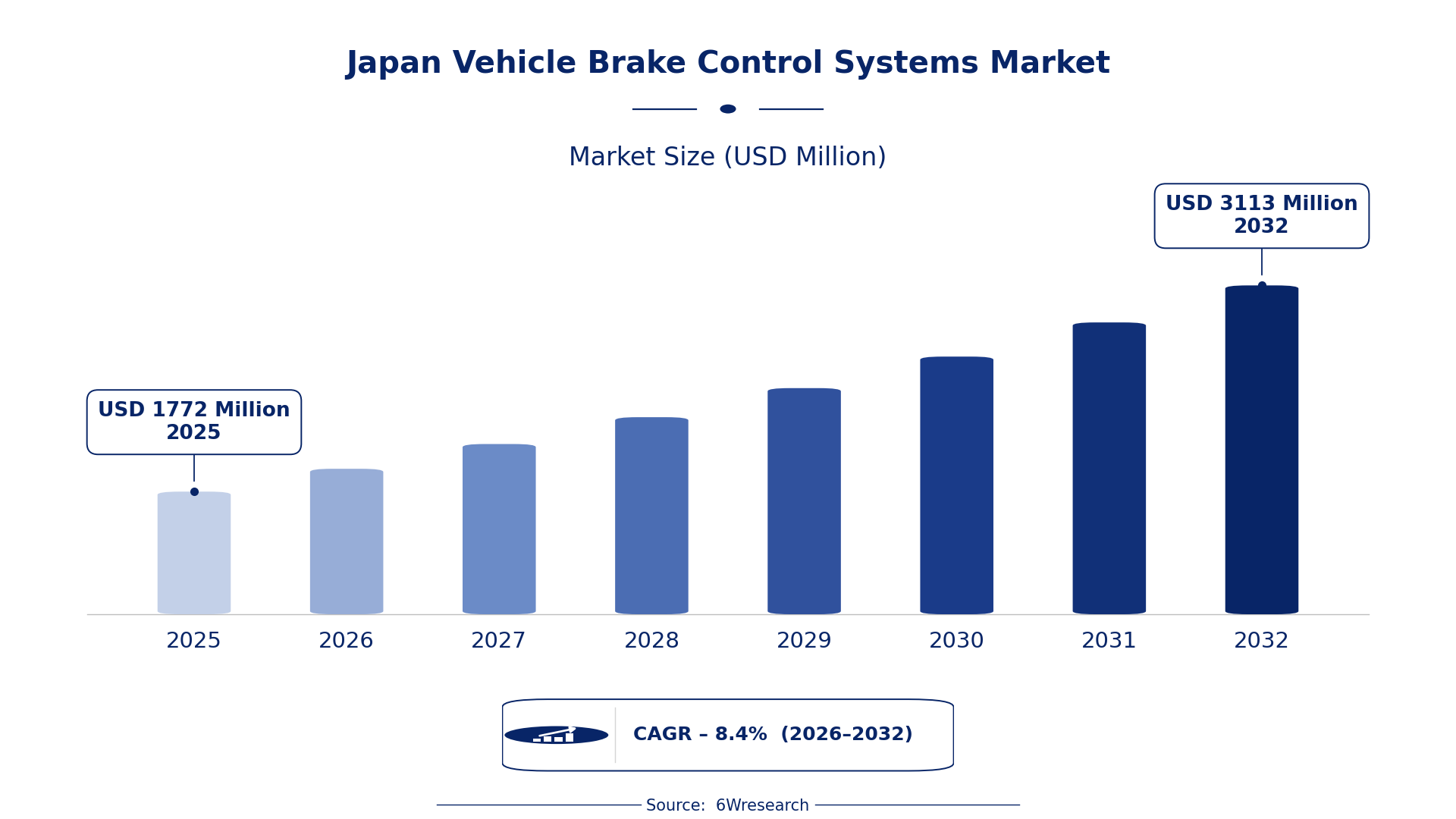
According to 6Wresearch internal database and industry insights, the Japan Vehicle Brake Control Systems Market was valued at USD 1,772 Million in 2025 and is projected to reach USD 3,113 Million by 2032, growing at a CAGR of approximately 8.4% during 2026–2032.
Japan Vehicle Brake Control Systems Market Highlights
| Report Metric | Details |
| Report Name | Japan Vehicle Brake Control Systems Market (2026-2032) |
| Market Size 2025 | USD 1,772 Million |
| Market Size 2032 | USD 3,113 Million |
| Absolute Growth 2025–2032 | USD 1,341 Million |
| CAGR 2026–2032 | 8.4% |
| Peak Annual Growth | 9.7% in 2028 |
| Forecast Period | 2026–2032 |
| Historical Data | 2022–2025 |
| Base Year | 2025 |
| Leading System Type, 2025 | ABS (Anti-lock Brakes) (49% share) |
| Leading Control Technology, 2025 | Electronic (48% share) |
| Leading Brake Type, 2025 | Disc Brakes (44% share) |
| Leading End User, 2025 | Passenger Car OEMs (38% share) |
| Fastest-Growing System Type | EBD (Brakeforce Distribution) (11.3% CAGR) |
| Fastest-Growing Control Technology | Sensor-Based (11.8% CAGR) |
| Fastest-Growing Brake Type | Drum Brakes (12.3% CAGR) |
| Fastest-Growing End User | Fleet Vehicle Makers (10.9% CAGR) |
| Growing Sector | automotive safety technology |
| Key End Users | Passenger Car OEMs, Fleet Vehicle Makers, Autonomous Vehicle Firms, EV OEMs |
Japan Vehicle Brake Control Systems Market Year-wise Growth Rate and Key Drivers (2022–2032)
This graph illustrates the annual growth rates of the market from 2022 to 2032, highlighting a steady upward trajectory and projected market expansion over the forecast period.
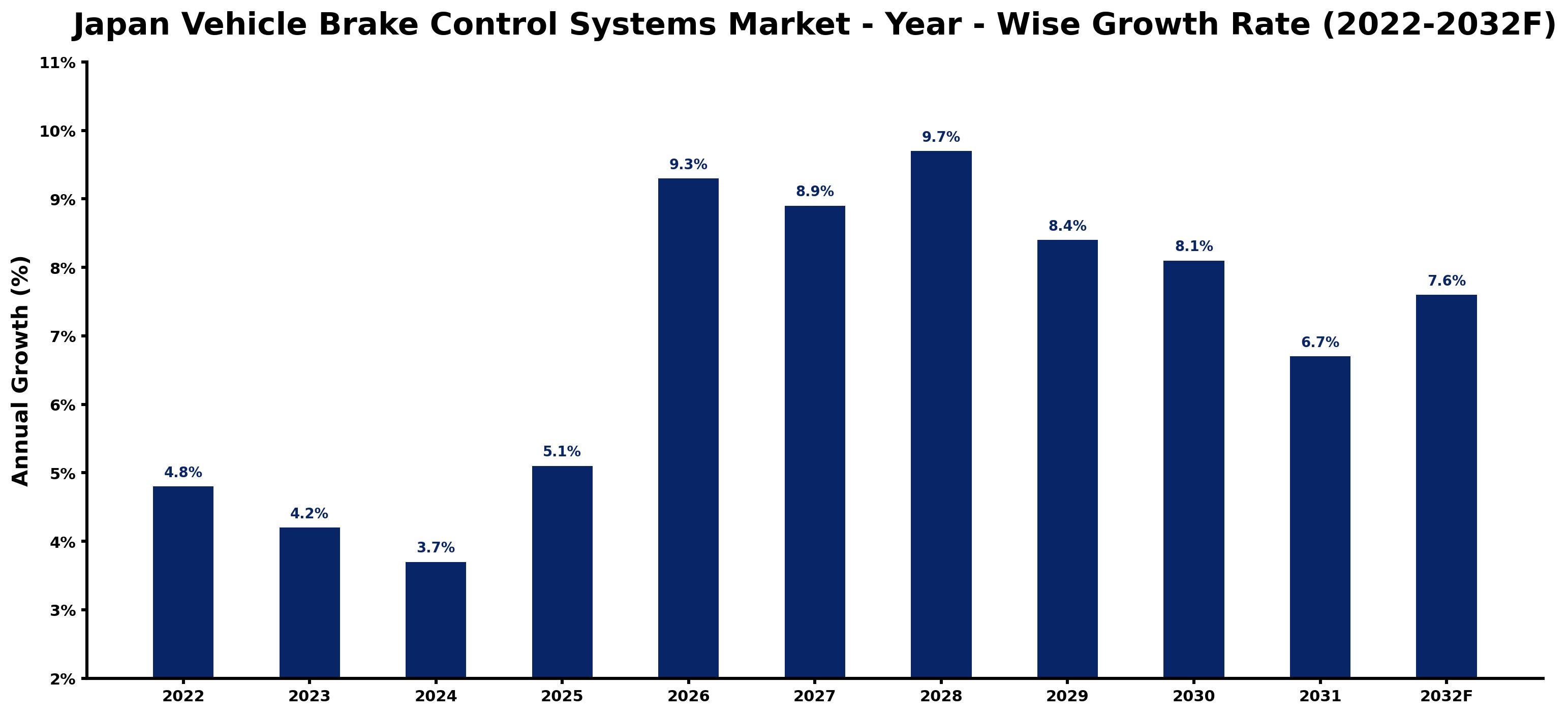
The table below sets out the estimated growth rate for each year and the main factor behind it.
| Year | Estimated Annual Growth (%) | Market Rationale |
| 2022 | 4.8 | The market experienced steady growth due to strong automotive production levels. |
| 2023 | 4.2 | Growth slowed as manufacturers faced supply chain disruptions impacting production rates. |
| 2024 | 3.7 | Demand continued to decelerate as the market adjusted to previous supply chain challenges. |
| 2025 | 5.1 | Growth accelerated with increased investments in automotive safety technologies. |
| 2026 | 9.3 | Demand is expected to surge as manufacturers adopt advanced brake control systems to improve safety. |
| 2027 | 8.9 | Growth is projected to slow slightly as the market stabilises after a rapid expansion phase. |
| 2028 | 9.7 | The market is expected to peak with heightened demand for advanced braking technologies. |
| 2029 | 8.4 | Growth is projected to decelerate as the market begins to normalise after peak demand. |
| 2030 | 8.1 | Demand is expected to continue slowing as the market adjusts to previous high growth rates. |
| 2031 | 6.7 | The market is projected to experience further deceleration as investments stabilise. |
| 2032 | 7.6 | Growth is expected to rebound as new technologies and regulations drive demand. |
Note: Market size estimations and growth projections presented in this report are based on 6Wresearch's proprietary forecasting methodology, utilizing the latest available industry data, government publications, and primary research inputs.
Japan Vehicle Brake Control Systems Market Synopsis
Vehicle Brake Control Systems improve vehicle safety and performance by preventing wheel lock-up and optimising brake force distribution. The Japan Vehicle Brake Control Systems Market is expanding due to the automotive industry's production of over 8 million vehicles annually, alongside increased investments in safety technologies, with ¥3 billion allocated in 2023. The rising sales of electric vehicles, which reached 1.5 million in 2022, further drive demand for regenerative braking systems, ensuring a continuous need for advanced braking solutions.
Market Dynamics Impact Analysis (2026–2032)
| Factor | Type | Impact | Primary Segment Affected |
| Rising electric vehicle sales | Driver | High | Regenerative Brakes |
| Increased focus on vehicle safety standards | Driver | High | ABS (Anti-lock Brakes) |
| Growing demand for advanced braking systems | Opportunity | High | Brake Assist Systems |
| Investment in automotive safety technology | Opportunity | Medium | Electronic |
| Aging vehicle fleet requiring upgrades | Restraint | High | Disc Brakes |
| Supply chain disruptions affecting production | Restraint | Medium | EBD (Brakeforce Distribution) |
| High costs of advanced technology integration | Challenge | High | ESC (Stability Control) |
| Compliance with stringent safety regulations | Challenge | Medium | Sensor-Based |
Evaluation of Drivers in Japan Vehicle Brake Control Systems Market (2026–2032)
The main growth drivers and the segments they affect most are set out below.
| Drivers | Primary Segment Affected | Why It Matters (Evidence) |
| Increased electric vehicle production | Regenerative Brakes | In 2022, 1.5 million electric vehicles were sold, boosting demand for regenerative braking technology. |
| Focus on safety standards compliance | ABS (Anti-lock Brakes) | The JIS D 5101 standard governs brake system performance, driving demand for compliant systems. |
| Growing automotive safety investments | Brake Assist Systems | Japan invested ¥3 billion in automotive safety technology development in 2023, increasing system adoption. |
| Rising vehicle production rates | Electronic | Japan's automotive industry produced over 8 million vehicles in 2022, necessitating advanced brake technologies. |
| Increased consumer awareness of safety features | ESC (Stability Control) | The government aims to reduce traffic fatalities by 50% by 2030, promoting advanced safety systems. |
Most of the extra volume comes from the rising production of electric vehicles, with 1.5 million units sold in 2022, increasing the need for regenerative braking systems. Compliance with the JIS D 5101 standard drives demand for ABS, ensuring performance. Investments in automotive safety technology, amounting to ¥3 billion in 2023, further boost the adoption of advanced braking solutions. Japan's automotive industry, producing over 8 million vehicles in 2022, necessitates advanced electronic brake technologies to improve performance. Consumer awareness of safety features aligns with targets to reduce traffic fatalities by 50% by 2030, reinforcing demand for stability control systems.
Evaluation of Restraints in Japan Vehicle Brake Control Systems Market
The following restraints limit how fast demand can grow.
| Market Restraint | Primary Segment Affected | Why It Matters (Evidence) |
| Aging vehicle fleet requiring upgrades | Disc Brakes | The average age of vehicles in Japan is 13 years, increasing the need for brake system upgrades. |
| Supply chain disruptions affecting production | EBD (Brakeforce Distribution) | Manufacturing delays due to supply chain issues have reduced system availability. |
| High costs of advanced technology integration | ESC (Stability Control) | Integrating advanced technologies raises costs for manufacturers, limiting widespread adoption. |
| Limited awareness of advanced braking technologies | Brake Assist Systems | Consumer knowledge gaps about advanced systems hinder market growth. |
| Compliance costs with safety regulations | Sensor-Based | Meeting stringent safety regulations incurs additional costs for producers, impacting pricing. |
Japan Vehicle Brake Control Systems Market Challenges
Producers face rising operational costs as Japan's national minimum wage increases to JPY 1,055 per hour, which directly raises prices for brake control systems. Compliance with the JIS D 5101 standard requires significant investments in testing and quality assurance, causing delays in product launches for manufacturers. Supply chain issues stem from a heavy reliance on imported electronic components, leading to longer lead times and potential shortages for producers. A lack of skilled workers in advanced automotive technologies restricts innovation, delaying the rollout of upgraded systems that buyers increasingly seek.
Trends in the Japan Vehicle Brake Control Systems Market
The following changes are redrawing the Japan Vehicle Brake Control Systems Market.
- Shift towards Electric Vehicle Integration: Fleet Vehicle Makers are increasingly adopting regenerative braking systems, with 1.5 million electric vehicles sold in 2022. This shift improves energy recovery and efficiency in braking.
- Transition to Improved Safety Standards: Since 2023, the JIS D 5101 standard has driven manufacturers to enhance brake system performance, ensuring compliance with safety regulations and improving vehicle safety.
- Emergence of AI in Brake Control: The 2023 government program promoting AI in automotive safety is encouraging innovations in brake control systems, improving predictive capabilities and performance.
- Focus on Sustainability in Automotive Manufacturing: The Chubu region is becoming a hub for sustainable automotive manufacturing, with a target of reducing greenhouse gas emissions by 46% by 2030.
Investment Opportunities in the Japan Vehicle Brake Control Systems Market
The openings below show where demand in the Japan Vehicle Brake Control Systems Market is visible and how suppliers can enter.
- Strategic Partnerships for Advanced Technology: Now is the time for partnerships in the Chubu region, where automotive innovation is thriving, to develop advanced brake systems that meet evolving standards.
- Investment in Regenerative Braking Systems: With a growing number of electric vehicles sold, there is a strong opportunity for suppliers to provide regenerative brake systems, improving vehicle performance.
- Expansion in Fleet Vehicle Safety Upgrades: Fleet Vehicle Makers are increasingly seeking reliable braking systems, creating opportunities for suppliers to provide advanced solutions.
- Certification for Safety Compliance: With the JIS D 5101 standard in place, suppliers can focus on certification to ensure their products meet safety requirements, facilitating market entry.
Government Initiatives in the Japan Vehicle Brake Control Systems Market
The Electrical Appliance and Material Safety Act regulates the safety of electrical components in brake systems, ensuring that manufacturers comply with safety standards. This measure impacts producers by requiring rigorous testing and certification of brake control systems, improving overall vehicle safety. The government aims to reduce traffic fatalities by 50% by 2030, necessitating compliance with these standards.
The Ministry of Land, Infrastructure, Transport and Tourism oversees vehicle safety regulations, approving technologies that meet safety standards. This agency supports manufacturers by facilitating the certification process for advanced braking systems, ensuring compliance with national regulations. In 2023, the ministry approved over 100 new technologies to improve vehicle safety.
Future Insight of the Japan Vehicle Brake Control Systems Market
A shift towards electric vehicles will reshape the market by 2032, driven by government initiatives aimed at reducing greenhouse-gas emissions by 46% by 2030. Investment in automotive safety technology, including AI applications, will improve system performance and reliability for buyers. The Tokyo Motor Show will showcase new innovations, prompting suppliers to refine their offerings. With the average vehicle age at 13 years, the demand for modern braking systems will remain robust, ensuring continued growth in the sector.
Market Segmentation Analysis
Japan Vehicle Brake Control Systems Market report covers a detailed analysis of the following market segments:
By System Type – ABS (Anti-lock Brakes) Leads, EBD (Brakeforce Distribution) Expected to Grow Fastest
According to Saurav Kr Singh, Senior Research Analyst at 6Wresearch, ABS (Anti-lock Brakes) accounted for 49% of the market by system type in 2025. ABS holds the largest share as it is essential for preventing wheel lock-up during braking, significantly enhancing vehicle safety. Its widespread adoption in vehicles manufactured in the Tokyo Metropolitan area underscores its importance in the automotive landscape. Over 2026–2032, EBD (Brakeforce Distribution) is expected to post the fastest growth, at a CAGR of 11.3%. EBD is experiencing rapid growth because it optimises brake force according to load conditions, addressing the increasing demand for improved vehicle stability. The production of over 8 million vehicles in 2022 further accelerates this trend, ensuring EBD's relevance in modern braking systems. Suppliers should prioritise the development of advanced EBD technologies to align with the increasing safety requirements in the automotive industry.
By Control Technology – Electronic Leads, Sensor-Based Expected to Grow Fastest
The largest control technology category in 2025 was Electronic, at 48% of revenue. The Electronic control technology segment leads the market as it is vital for modern brake control systems, ensuring both performance and safety. Its prevalence is highlighted by adherence to the JIS D 5101 standard, which governs brake system performance in Japan. The quickest growth will come from Sensor-Based, forecast to expand at a CAGR of 11.8% between 2026 and 2032. Sensor-Based technology is the fastest-growing segment, driven by the necessity for real-time monitoring and adjustments in braking systems. The government's ¥3 billion investment in automotive safety technology development in 2023 emphasises the focus on enhancing sensor capabilities. Buyers should seek vehicles equipped with advanced sensor-based technologies to guarantee optimal safety and performance.
By Brake Type – Disc Brakes Lead, Drum Brakes Expected to Grow Fastest
With 44% of brake type revenue in 2025, Disc Brakes was the largest category. Disc Brakes dominate the market due to their efficient heat dissipation, making them the preferred option for contemporary vehicles. Their extensive use in Japan's automotive production, which exceeded 8 million vehicles in 2022, highlights their critical role in ensuring vehicle safety. Drum Brakes are projected to grow fastest, at a CAGR of 12.3% during 2026–2032. Drum Brakes are witnessing growth primarily due to the increasing demand for reliable braking systems in older models, which constitute a significant portion of the vehicle fleet. With the average age of vehicles in Japan now at 13 years, there is a pressing need for brake upgrades for these older units. Suppliers should focus on the aftermarket demand for drum brakes to effectively meet the needs of older vehicles.
By End User – Passenger Car OEMs Lead, Fleet Vehicle Makers Expected to Grow Fastest
Passenger Car OEMs took 38% of end user revenue in 2025, more than any other category. Passenger Car OEMs lead the market as they are the primary users of brake control systems, ensuring safety and performance in their vehicles. The automotive sector's contribution of 20% to Japan's GDP reflects the critical role these manufacturers play in the economy. Fleet Vehicle Makers are set to record the highest CAGR in this split, 10.9% over 2026–2032. Fleet Vehicle Makers are the fastest-growing segment, driven by their need for reliable braking systems to ensure safety across their fleets. The government's initiative to reduce traffic fatalities by 50% by 2030 further amplifies the focus on safety in fleet operations. Suppliers should tailor their offerings to meet the specific needs of fleet vehicle makers, focusing on reliability and safety.
Key Attractiveness of the Report
- 10 Years of Market Numbers
- Historical Data Starting from 2022 to 2025
- Base Year 2025
- Forecast Data until 2032
- Key Performance Indicators Impacting the Market
- Major Upcoming Developments and Projects
Key Highlights of the Report:
- Japan Vehicle Brake Control Systems Market Outlook
- Market Size of Japan Vehicle Brake Control Systems Market, 2025
- Forecast of Japan Vehicle Brake Control Systems Market, 2032
- Historical Data and Forecast of Japan Vehicle Brake Control Systems Revenues & Volume for the Period 2022-2032F
- Japan Vehicle Brake Control Systems Market Trend Evolution
- Japan Vehicle Brake Control Systems Market Drivers and Challenges
- Japan Vehicle Brake Control Systems Price Trends
- Japan Vehicle Brake Control Systems Porter's Five Forces
- Japan Vehicle Brake Control Systems Industry Life Cycle
- Historical Data and Forecast of Japan Vehicle Brake Control Systems Market Revenues & Volume By System Type for the Period 2022-2032F
- Historical Data and Forecast of Japan Vehicle Brake Control Systems Market Revenues & Volume By ABS (Anti-lock Brakes) for the Period 2022-2032F
- Historical Data and Forecast of Japan Vehicle Brake Control Systems Market Revenues & Volume By EBD (Brakeforce Distribution) for the Period 2022-2032F
- Historical Data and Forecast of Japan Vehicle Brake Control Systems Market Revenues & Volume By ESC (Stability Control) for the Period 2022-2032F
- Historical Data and Forecast of Japan Vehicle Brake Control Systems Market Revenues & Volume By Brake Assist Systems for the Period 2022-2032F
- Historical Data and Forecast of Japan Vehicle Brake Control Systems Market Revenues & Volume By Control Technology for the Period 2022-2032F
- Historical Data and Forecast of Japan Vehicle Brake Control Systems Market Revenues & Volume By Electronic for the Period 2022-2032F
- Historical Data and Forecast of Japan Vehicle Brake Control Systems Market Revenues & Volume By Sensor-Based for the Period 2022-2032F
- Historical Data and Forecast of Japan Vehicle Brake Control Systems Market Revenues & Volume By Integrated ECU for the Period 2022-2032F
- Historical Data and Forecast of Japan Vehicle Brake Control Systems Market Revenues & Volume By AI-Enabled for the Period 2022-2032F
- Historical Data and Forecast of Japan Vehicle Brake Control Systems Market Revenues & Volume By Brake Type for the Period 2022-2032F
- Historical Data and Forecast of Japan Vehicle Brake Control Systems Market Revenues & Volume By Disc Brakes for the Period 2022-2032F
- Historical Data and Forecast of Japan Vehicle Brake Control Systems Market Revenues & Volume By Drum Brakes for the Period 2022-2032F
- Historical Data and Forecast of Japan Vehicle Brake Control Systems Market Revenues & Volume By Hybrid Braking Systems for the Period 2022-2032F
- Historical Data and Forecast of Japan Vehicle Brake Control Systems Market Revenues & Volume By Regenerative Brakes for the Period 2022-2032F
- Historical Data and Forecast of Japan Vehicle Brake Control Systems Market Revenues & Volume By End User for the Period 2022-2032F
- Historical Data and Forecast of Japan Vehicle Brake Control Systems Market Revenues & Volume By Passenger Car OEMs for the Period 2022-2032F
- Historical Data and Forecast of Japan Vehicle Brake Control Systems Market Revenues & Volume By Fleet Vehicle Makers for the Period 2022-2032F
- Historical Data and Forecast of Japan Vehicle Brake Control Systems Market Revenues & Volume By Autonomous Vehicle Firms for the Period 2022-2032F
- Historical Data and Forecast of Japan Vehicle Brake Control Systems Market Revenues & Volume By EV OEMs for the Period 2022-2032F
- Japan Vehicle Brake Control Systems Import Export Trade Statistics
- Market Opportunity Assessment By System Type
- Market Opportunity Assessment By Control Technology
- Market Opportunity Assessment By Brake Type
- Market Opportunity Assessment By End User
- Japan Vehicle Brake Control Systems Top Companies Market Share
- Japan Vehicle Brake Control Systems Competitive Benchmarking By Technical and Operational Parameters
- Japan Vehicle Brake Control Systems Company Profiles
- Japan Vehicle Brake Control Systems Key Strategic Recommendations
Market Covered
Segments analysed in this report are listed below.
By System Type
- ABS (Anti-lock Brakes)
- EBD (Brakeforce Distribution)
- ESC (Stability Control)
- Brake Assist Systems
By Control Technology
- Electronic
- Sensor-Based
- Integrated ECU
- AI-Enabled
By Brake Type
- Disc Brakes
- Drum Brakes
- Hybrid Braking Systems
- Regenerative Brakes
By End User
- Passenger Car OEMs
- Fleet Vehicle Makers
- Autonomous Vehicle Firms
- EV OEMs































