Japan Vehicle Braking System Lubricants Market Size & Growth Rate
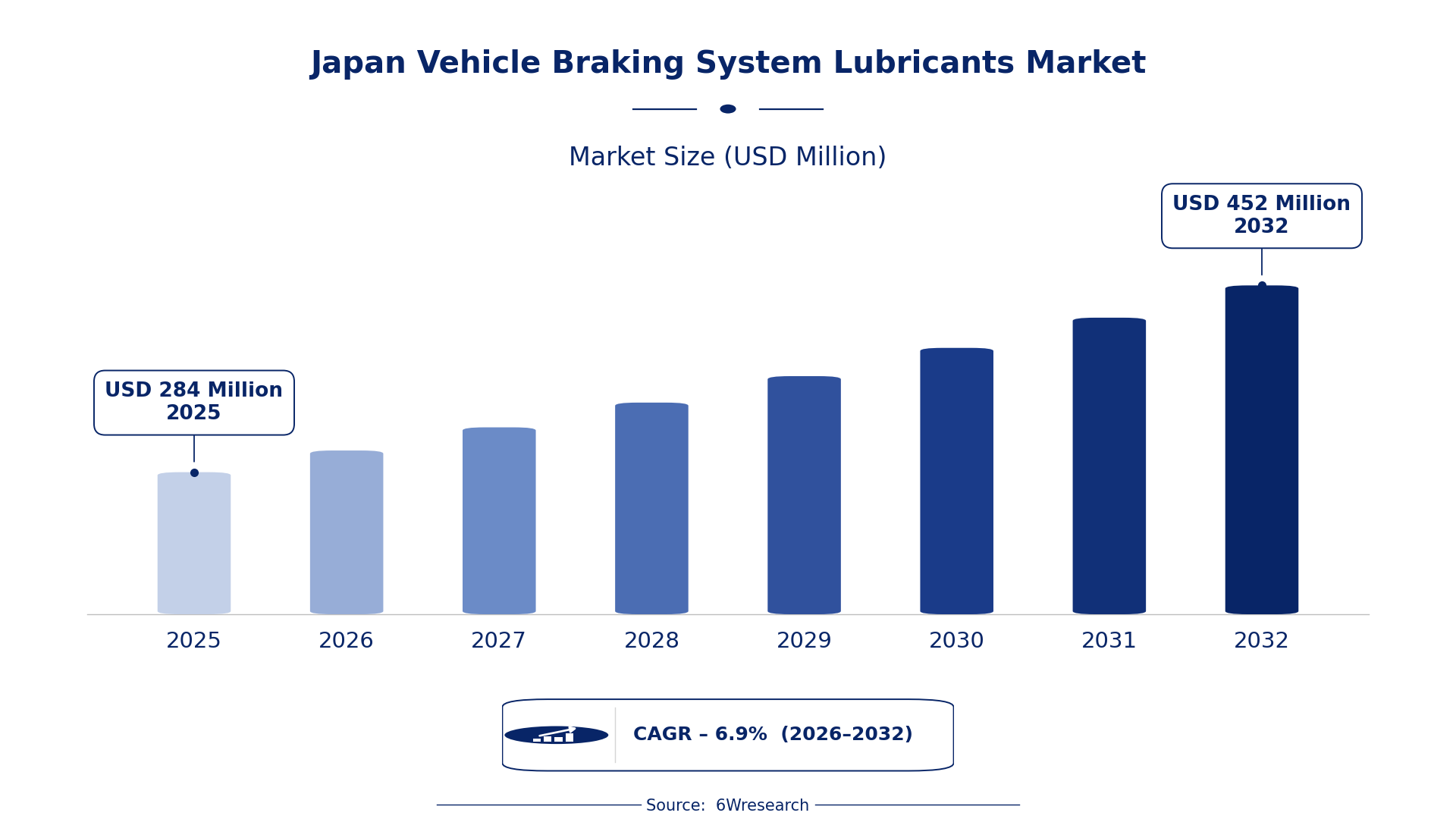
According to 6Wresearch internal database and industry insights, the Japan Vehicle Braking System Lubricants Market was valued at USD 284 Million in 2025 and is projected to reach USD 452 Million by 2032, growing at a CAGR of approximately 6.9% during 2026–2032.
Japan Vehicle Braking System Lubricants Market Highlights
| Report Metric | Details |
| Report Name | Japan Vehicle Braking System Lubricants Market (2026-2032) |
| Market Size 2025 | USD 284 Million |
| Market Size 2032 | USD 452 Million |
| Absolute Growth 2025–2032 | USD 168 Million |
| CAGR 2026–2032 | 6.9% |
| Peak Annual Growth | 7.7% in 2029 |
| Forecast Period | 2026–2032 |
| Historical Data | 2022–2025 |
| Base Year | 2025 |
| Leading Lubricant Type, 2025 | Brake Caliper Grease (48% share) |
| Leading Base Material, 2025 | Silicone-Based (49% share) |
| Leading Application Area, 2025 | High Temp Zones (48% share) |
| Leading End User, 2025 | Workshop Mechanics (35% share) |
| Fastest-Growing Lubricant Type | Ceramic Brake Lubricants (9.4% CAGR) |
| Fastest-Growing Base Material | Synthetic-Based (9.7% CAGR) |
| Fastest-Growing Application Area | Disc Pads (8.0% CAGR) |
| Fastest-Growing End User | OEM Service Stations (8.7% CAGR) |
| Growing Sector | automotive maintenance |
| Key End Users | workshop mechanics, OEM service stations, maintenance service firms |
Japan Vehicle Braking System Lubricants Market Year-wise Growth Rate and Key Drivers (2022–2032)
This graph illustrates the annual growth rates of the market from 2022 to 2032, highlighting a steady upward trajectory and projected market expansion over the forecast period.
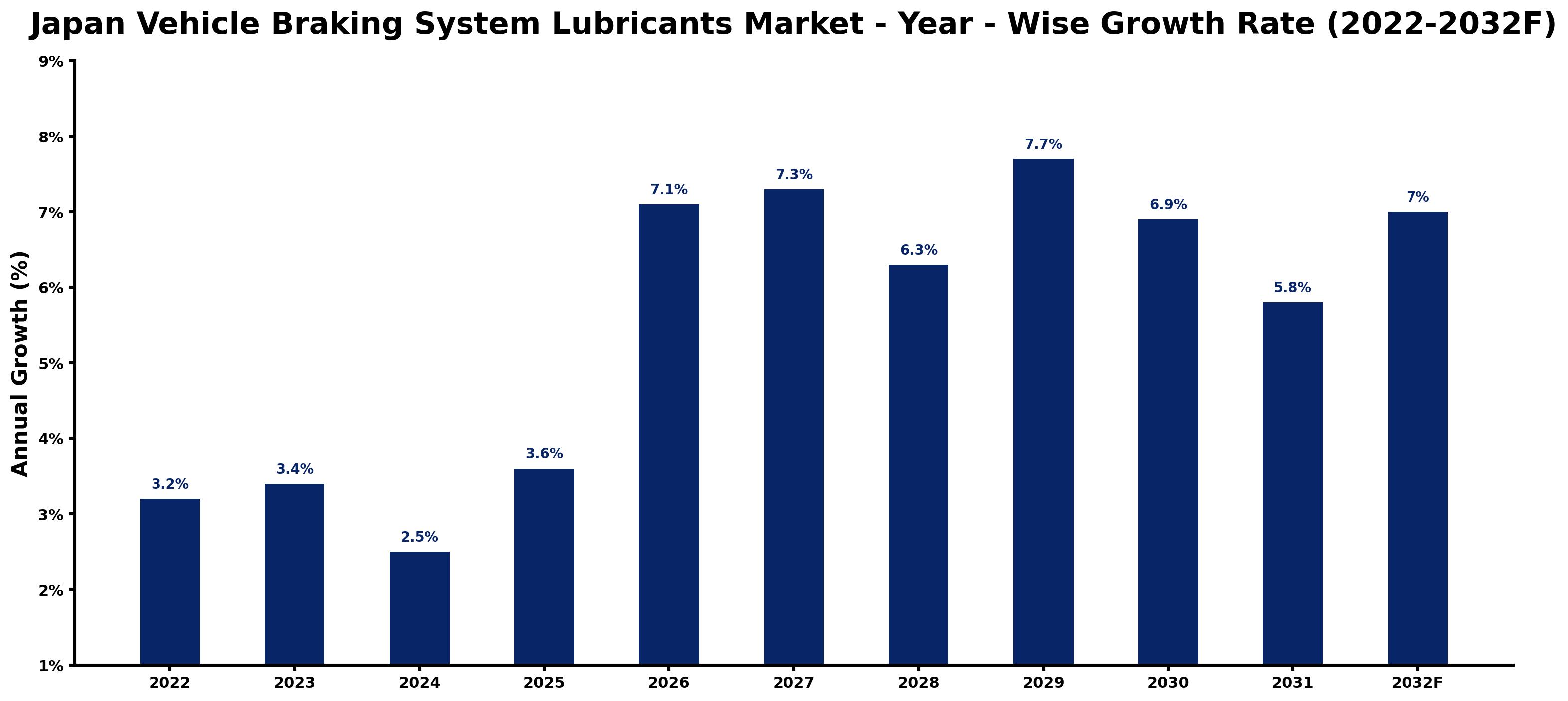
For each year, the table pairs the estimated growth rate with the leading influence on demand, showing how the drivers changed across the period.
| Year | Estimated Annual Growth (%) | Market Rationale |
| 2022 | 3.2 | The market showed steady growth supported by ongoing vehicle maintenance services. |
| 2023 | 3.4 | Demand increased due to heightened awareness of brake system performance and safety. |
| 2024 | 2.5 | Growth slowed as manufacturers faced supply chain disruptions affecting lubricant availability. |
| 2025 | 3.6 | The market rebounded with rising production in the automotive sector and service demand. |
| 2026 | 7.1 | Demand is expected to surge as electric vehicle production increases, driving lubricant needs. |
| 2027 | 7.3 | Growth is projected to continue with the introduction of new high-performance lubricant formulations. |
| 2028 | 6.3 | A slight slowdown is anticipated as market saturation begins in certain lubricant types. |
| 2029 | 7.7 | The market is expected to peak due to investments in eco-friendly lubricant technologies. |
| 2030 | 6.9 | Growth will moderate as the market adjusts to new environmental regulations. |
| 2031 | 5.8 | Demand is projected to continue rising as consumers shift towards high-temperature lubricants. |
| 2032 | 7.0 | The market is expected to grow due to ongoing innovations in lubricant formulations. |
Note: Market size estimations and growth projections presented in this report are based on 6Wresearch's proprietary forecasting methodology, utilizing the latest available industry data, government publications, and primary research inputs.
Japan Vehicle Braking System Lubricants Market Synopsis
Vehicle braking system lubricants are specialised substances designed to reduce friction and wear in braking components. The automotive sector in Japan employs over 5 million people, driving substantial demand for these lubricants. The Japan Vehicle Braking System Lubricants Market is growing due to increased vehicle maintenance, a shift towards electric vehicles, and the introduction of eco-friendly lubricants, supported by government initiatives aimed at reducing emissions and improving efficiency. The automotive aftermarket in Japan is valued at approximately 20 billion USD, reflecting the rising investment in advanced lubricant technologies.
Market Dynamics Impact Analysis (2026–2032)
| Factor | Type | Impact | Primary Segment Affected |
| Growing automotive production and maintenance services | Driver | High | Brake Caliper Grease |
| Rising demand for eco-friendly lubricants | Driver | High | Ceramic Brake Lubricants |
| Shift towards high-performance lubricants | Opportunity | High | Synthetic-Based |
| Increasing use of lubricants in electric vehicles | Opportunity | High | High Temp Zones |
| Supply chain disruptions affecting lubricant availability | Restraint | High | Brake Hardware |
| Market saturation in certain lubricant types | Restraint | Medium | Disc Pads |
| High costs of developing eco-friendly formulations | Challenge | High | Brake Caliper Grease |
| Competition from alternative lubrication technologies | Challenge | Medium | Ceramic Brake Lubricants |
Evaluation of Drivers in Japan Vehicle Braking System Lubricants Market (2026–2032)
The following drivers explain most of the expected growth.
| Drivers | Primary Segment Affected | Why It Matters (Evidence) |
| Increased vehicle maintenance services | Brake Caliper Grease | The automotive sector employs over 5 million people, driving demand for lubricants. |
| Shift towards high-performance lubricants | Synthetic-Based | Synthetic lubricants are preferred for their superior performance in extreme conditions, with a market share of 49%. |
| Growing adoption of eco-friendly lubricants | Ceramic Brake Lubricants | The 2023 government initiative promotes eco-friendly automotive lubricants, aligning with sustainability goals. |
| Rising electric vehicle production | High Temp Zones | The demand for lubricants is projected to rise with the increase in electric vehicle production. |
| Expansion of OEM service stations | OEM Service Stations | Japan has over 4,000 OEM service stations providing maintenance services, increasing lubricant consumption. |
Buyers are adding capacity as the automotive sector employs over 5 million people, boosting lubricant demand. High-temperature lubricants are gaining traction in high-performance vehicles, reflecting a shift in consumer preferences. The growing adoption of electric vehicles will elevate lubricant needs in the coming years, with maintenance service firms increasingly focusing on high-performance products. The expansion of service stations is driving increased consumption of brake lubricants across the country.
Evaluation of Restraints in Japan Vehicle Braking System Lubricants Market
These restraints slow adoption and weigh on supplier margins.
| Market Restraint | Primary Segment Affected | Why It Matters (Evidence) |
| Supply chain disruptions affecting lubricant availability | Brake Hardware | The automotive sector faced challenges that limited the supply of essential lubricants. |
| Market saturation in certain lubricant types | Disc Pads | As the market matures, growth in specific lubricant types is slowing down. |
| High costs of developing eco-friendly formulations | Brake Caliper Grease | Investments in eco-friendly technologies can be prohibitively expensive for manufacturers. |
| Competition from alternative lubrication technologies | Ceramic Brake Lubricants | Emerging technologies may divert demand from traditional lubricant solutions. |
| Regulatory compliance costs | Synthetic-Based | Manufacturers face increasing costs to meet stringent environmental regulations. |
Japan Vehicle Braking System Lubricants Market Challenges
A lack of skilled workers in Japan's automotive lubricant industry hampers production efficiency, delaying supply for maintenance service firms that rely on timely deliveries. Rising production costs stem from the need for advanced materials in eco-friendly lubricants, increasing prices for suppliers and burdening maintenance service firms with higher expenses. Local producers face intense competition from lower-priced imported lubricants, which pressures them to reduce their prices and can diminish profit margins. Compliance with stringent regulations set by the Ministry of Economy, Trade and Industry adds further costs for manufacturers, potentially slowing down the introduction of new products.
Trends in the Japan Vehicle Braking System Lubricants Market
Four trends stand out in the Japan Vehicle Braking System Lubricants Market.
- Shift towards Eco-Friendly Lubricants: Maintenance service firms are increasingly adopting eco-friendly lubricants, driven by a government initiative launched in 2023 promoting sustainability. This shift is expected to improve lubricant efficiency and reduce environmental impact.
- Transition to High-Performance Lubricants: The Tokyo Motor Show in 2023 highlighted advancements in high-performance lubricants, reflecting a growing trend among automotive manufacturers to improve vehicle performance and safety.
- Emergence of Electric Vehicle Lubricants: The rise in electric vehicle production is prompting the development of specialised lubricants, with demand projected to increase as manufacturers adapt to new technologies.
- Growing Demand for High-Temperature Lubricants: Workshop mechanics are increasingly using high-temperature lubricants, essential for maintaining performance in high-temp braking areas, as the average lifespan of brake components reaches approximately 50,000 kilometres.
Investment Opportunities in the Japan Vehicle Braking System Lubricants Market
Where to invest in the Japan Vehicle Braking System Lubricants Market: the main openings are set out below.
- Timing for Eco-Friendly Lubricants: With Japan targeting a 46% reduction in greenhouse gas emissions by 2030, there is an opportunity to invest in eco-friendly lubricant technologies that align with these goals.
- Investment in High-Performance Lubricants: The demand for synthetic-based lubricants is rising, presenting an opportunity for suppliers to invest in high-performance formulations that meet evolving automotive standards.
- Entry into Electric Vehicle Lubricant Market: The increasing production of electric vehicles creates a gap in the market for specialised lubricants, offering opportunities for partnerships with automotive manufacturers.
- Expansion of OEM Service Stations: With over 4,000 OEM service stations in Japan, there is a growing opportunity to supply lubricants tailored for vehicle maintenance and servicing.
Government Initiatives in the Japan Vehicle Braking System Lubricants Market
The Fire Service Act ensures the safe storage and handling of hazardous materials, including petroleum products, which is essential for lubricant producers and users. Compliance with this act is critical for manufacturers to operate legally and safely in Japan's automotive sector, impacting production costs and operational efficiency.
The Ministry of Economy, Trade and Industry oversees regulations for automotive lubricants, ensuring that manufacturers adhere to the JIS K 2234 standard. This standard specifies requirements for brake lubricants, impacting how buyers select products for their vehicles and ensuring safety and performance.
Future Insight of the Japan Vehicle Braking System Lubricants Market
Investment in advanced lubricant technologies will rise as government initiatives encourage the development of high-performance products. The demand for synthetic lubricants will grow, with production capacity projected to increase as manufacturers adapt to evolving standards. The shift towards electric vehicles will drive the need for specialised braking solutions, expanding opportunities for lubricant suppliers. The Tokyo region will continue to serve as a key centre for automotive innovation, leveraging its robust infrastructure to support advancements in the lubricant market.
Market Segmentation Analysis
Japan Vehicle Braking System Lubricants Market report covers a detailed analysis of the following market segments:
By Lubricant Type – Brake Caliper Grease Leads, Ceramic Brake Lubricants Expected to Grow Fastest
According to Saurav Kr Singh, Senior Research Analyst at 6Wresearch, the largest lubricant type category in 2025 was Brake Caliper Grease, at 48% of revenue. Brake caliper grease holds the largest share due to its essential role in ensuring the smooth operation of brake calipers, which is critical for vehicle safety. Its widespread application across various vehicle types, especially in high-performance models, reinforces its dominant market position. Ceramic Brake Lubricants are projected to grow fastest, at a CAGR of 9.4% during 2026–2032. Ceramic brake lubricants are witnessing rapid growth as they are increasingly preferred in high-performance vehicles that require enhanced noise reduction and operational efficiency. This trend towards advanced braking systems is likely to further accelerate the segment's expansion. Suppliers should focus on developing ceramic brake lubricants to meet the rising market demand.
By Base Material – Silicone-Based Leads, Synthetic-Based Expected to Grow Fastest
Silicone-Based accounted for 49% of the market by base material in 2025. Silicone-based lubricants dominate the market because of their excellent high-temperature resistance, making them suitable for brake systems operating under extreme conditions. Their extensive use across a variety of vehicle types solidifies their leading position in the market. Synthetic-Based is set to record the highest CAGR in this split, 9.7% over 2026–2032. Synthetic-based lubricants are experiencing the fastest growth as they are favoured for their superior performance in challenging conditions, which modern vehicles increasingly require. The shift towards electric vehicles is further driving the demand for these high-performance lubricants. Buyers should consider investing in synthetic-based lubricants to enhance vehicle performance and longevity.
By Application Area – High Temp Zones Lead, Disc Pads Expected to Grow Fastest
In 2025, High Temp Zones led the application area split with a 48% share. High-temperature zones lead the market as they are crucial for maintaining performance in areas where braking systems face extreme heat. Effective lubrication in these zones is vital for ensuring safety and efficiency in braking operations. The quickest growth will come from Disc Pads, forecast to expand at a CAGR of 8.0% between 2026 and 2032. Disc pads are seeing the fastest growth since lubricants are essential for their effective functioning, particularly in modern braking systems that demand precise performance. The increasing adoption of advanced disc brake systems in new vehicles is propelling this segment's rapid growth. Suppliers must ensure their products meet the specific requirements for disc pad applications to capture this expanding market.
By End User – Workshop Mechanics Lead, OEM Service Stations Expected to Grow Fastest
With 35% of end user revenue in 2025, Workshop Mechanics was the largest category. Workshop mechanics are the primary users of vehicle braking system lubricants, as they perform maintenance and repairs on a wide range of vehicles. Their significant role in the automotive service sector guarantees a steady demand for these lubricants. Over 2026–2032, OEM Service Stations are expected to post the fastest growth, at a CAGR of 8.7%. OEM service stations are experiencing the fastest growth as they are major users in both vehicle assembly and servicing, particularly with the rise in electric vehicle production. The increasing complexity of modern vehicles is driving the demand for high-quality lubricants in these facilities. Suppliers should target OEM service stations to align with trends in vehicle production and servicing.
Key Attractiveness of the Report
- 10 Years of Market Numbers
- Historical Data Starting from 2022 to 2025
- Base Year 2025
- Forecast Data until 2032
- Key Performance Indicators Impacting the Market
- Major Upcoming Developments and Projects
Key Highlights of the Report:
- Japan Vehicle Braking System Lubricants Market Outlook
- Market Size of Japan Vehicle Braking System Lubricants Market, 2025
- Forecast of Japan Vehicle Braking System Lubricants Market, 2032
- Historical Data and Forecast of Japan Vehicle Braking System Lubricants Revenues & Volume for the Period 2022-2032F
- Japan Vehicle Braking System Lubricants Market Trend Evolution
- Japan Vehicle Braking System Lubricants Market Drivers and Challenges
- Japan Vehicle Braking System Lubricants Price Trends
- Japan Vehicle Braking System Lubricants Porter's Five Forces
- Japan Vehicle Braking System Lubricants Industry Life Cycle
- Historical Data and Forecast of Japan Vehicle Braking System Lubricants Market Revenues & Volume By Lubricant Type for the Period 2022-2032F
- Historical Data and Forecast of Japan Vehicle Braking System Lubricants Market Revenues & Volume By Brake Caliper Grease for the Period 2022-2032F
- Historical Data and Forecast of Japan Vehicle Braking System Lubricants Market Revenues & Volume By Ceramic Brake Lubricants for the Period 2022-2032F
- Historical Data and Forecast of Japan Vehicle Braking System Lubricants Market Revenues & Volume By Anti-Seize Compounds for the Period 2022-2032F
- Historical Data and Forecast of Japan Vehicle Braking System Lubricants Market Revenues & Volume By Dry Film Lubricants for the Period 2022-2032F
- Historical Data and Forecast of Japan Vehicle Braking System Lubricants Market Revenues & Volume By Base Material for the Period 2022-2032F
- Historical Data and Forecast of Japan Vehicle Braking System Lubricants Market Revenues & Volume By Silicone-Based for the Period 2022-2032F
- Historical Data and Forecast of Japan Vehicle Braking System Lubricants Market Revenues & Volume By Synthetic-Based for the Period 2022-2032F
- Historical Data and Forecast of Japan Vehicle Braking System Lubricants Market Revenues & Volume By Copper/Aluminum for the Period 2022-2032F
- Historical Data and Forecast of Japan Vehicle Braking System Lubricants Market Revenues & Volume By PTFE-Based for the Period 2022-2032F
- Historical Data and Forecast of Japan Vehicle Braking System Lubricants Market Revenues & Volume By Application Area for the Period 2022-2032F
- Historical Data and Forecast of Japan Vehicle Braking System Lubricants Market Revenues & Volume By High Temp Zones for the Period 2022-2032F
- Historical Data and Forecast of Japan Vehicle Braking System Lubricants Market Revenues & Volume By Disc Pads for the Period 2022-2032F
- Historical Data and Forecast of Japan Vehicle Braking System Lubricants Market Revenues & Volume By Brake Lines for the Period 2022-2032F
- Historical Data and Forecast of Japan Vehicle Braking System Lubricants Market Revenues & Volume By Brake Hardware for the Period 2022-2032F
- Historical Data and Forecast of Japan Vehicle Braking System Lubricants Market Revenues & Volume By End User for the Period 2022-2032F
- Historical Data and Forecast of Japan Vehicle Braking System Lubricants Market Revenues & Volume By Workshop Mechanics for the Period 2022-2032F
- Historical Data and Forecast of Japan Vehicle Braking System Lubricants Market Revenues & Volume By OEM Service Stations for the Period 2022-2032F
- Historical Data and Forecast of Japan Vehicle Braking System Lubricants Market Revenues & Volume By Industrial Vehicle Users for the Period 2022-2032F
- Historical Data and Forecast of Japan Vehicle Braking System Lubricants Market Revenues & Volume By Maintenance Service Firms for the Period 2022-2032F
- Japan Vehicle Braking System Lubricants Import Export Trade Statistics
- Market Opportunity Assessment By Lubricant Type
- Market Opportunity Assessment By Base Material
- Market Opportunity Assessment By Application Area
- Market Opportunity Assessment By End User
- Japan Vehicle Braking System Lubricants Top Companies Market Share
- Japan Vehicle Braking System Lubricants Competitive Benchmarking By Technical and Operational Parameters
- Japan Vehicle Braking System Lubricants Company Profiles
- Japan Vehicle Braking System Lubricants Key Strategic Recommendations
Market Covered
The following segment groups are covered in the report.
By Lubricant Type
- Brake Caliper Grease
- Ceramic Brake Lubricants
- Anti-Seize Compounds
- Dry Film Lubricants
By Base Material
- Silicone-Based
- Synthetic-Based
- Copper/Aluminum
- PTFE-Based
By Application Area
- High Temp Zones
- Disc Pads
- Brake Lines
- Brake Hardware
By End User
- Workshop Mechanics
- OEM Service Stations
- Industrial Vehicle Users
- Maintenance Service Firms































