Japan Vehicle Braking System Market Size & Growth Rate
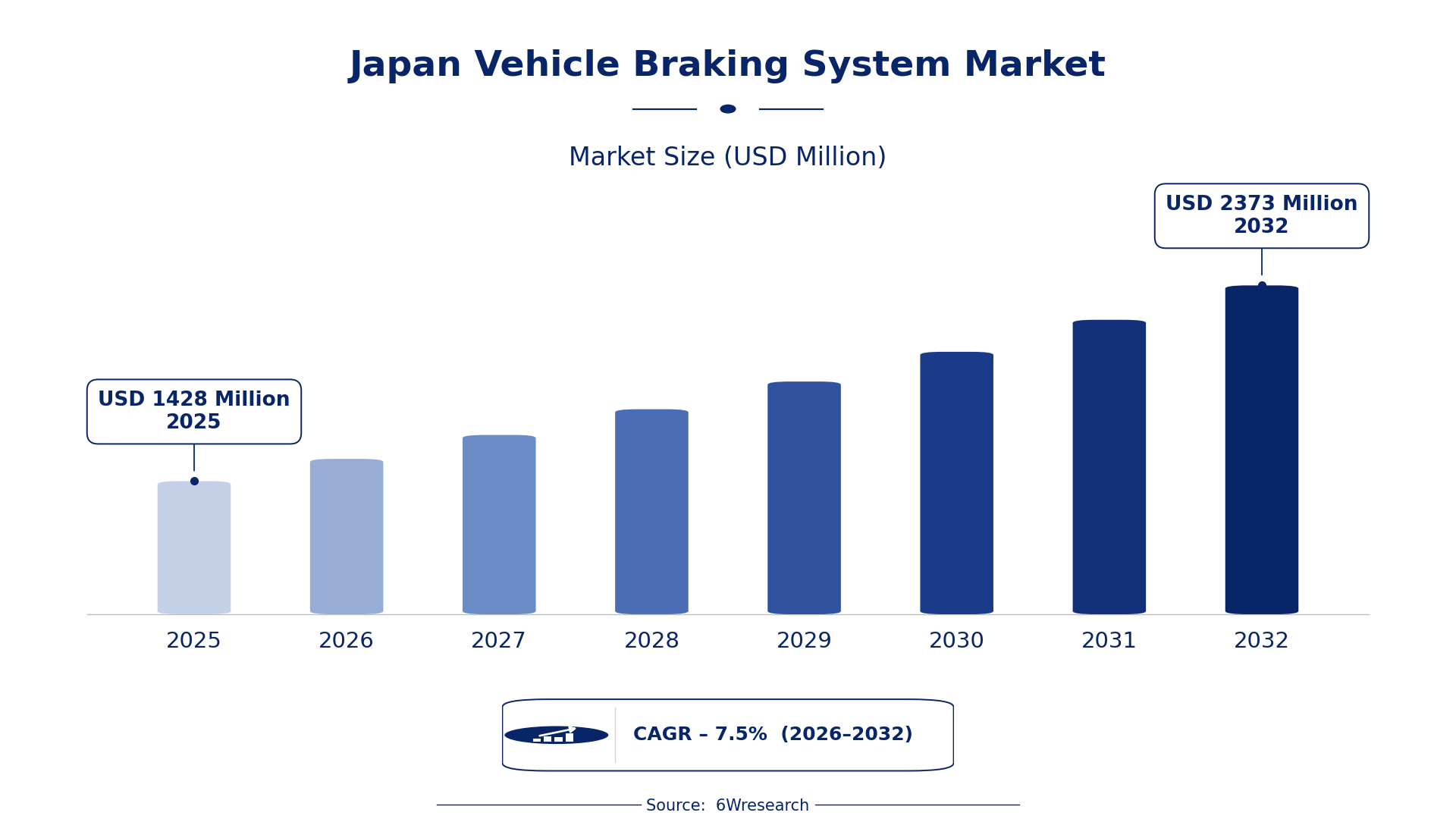
According to 6Wresearch internal database and industry insights, the Japan Vehicle Braking System Market was valued at USD 1,428 Million in 2025 and is projected to reach USD 2,373 Million by 2032, growing at a CAGR of approximately 7.5% during 2026–2032.
Japan Vehicle Braking System Market Highlights
| Report Metric | Details |
| Report Name | Japan Vehicle Braking System Market (2026-2032) |
| Market Size 2025 | USD 1,428 Million |
| Market Size 2032 | USD 2,373 Million |
| Absolute Growth 2025–2032 | USD 945 Million |
| CAGR 2026–2032 | 7.5% |
| Peak Annual Growth | 8.6% in 2028 |
| Forecast Period | 2026–2032 |
| Historical Data | 2022–2025 |
| Base Year | 2025 |
| Leading Brake Type, 2025 | Disc Brakes (37% share) |
| Leading Actuation Method, 2025 | Hydraulic (44% share) |
| Leading Vehicle Segment, 2025 | Passenger Cars (34% share) |
| Leading End User, 2025 | Vehicle OEMs (44% share) |
| Fastest-Growing Brake Type | Drum Brakes (10.6% CAGR) |
| Fastest-Growing Actuation Method | Mechanical (10.8% CAGR) |
| Fastest-Growing Vehicle Segment | Commercial Vehicles (9.9% CAGR) |
| Fastest-Growing End User | Truck Manufacturers (9.8% CAGR) |
| Growing Sector | Truck Manufacturers |
| Key End Users | Vehicle OEMs, Truck Manufacturers, EV Startups, Logistics Operators |
Japan Vehicle Braking System Market Year-wise Growth Rate and Key Drivers (2022–2032)
This graph illustrates the annual growth rates of the market from 2022 to 2032, highlighting a steady upward trajectory and projected market expansion over the forecast period.
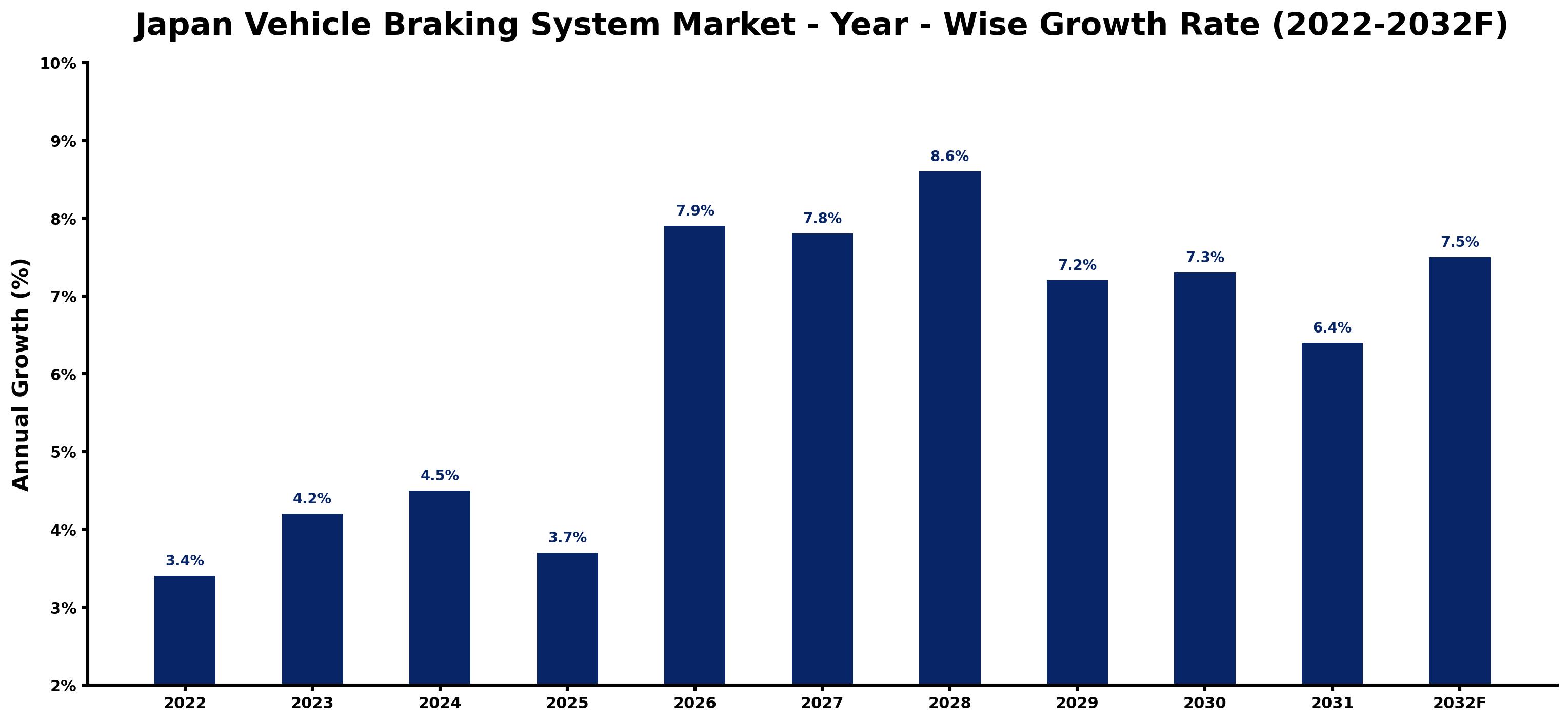
The yearly estimates that follow link every growth rate to its principal driver, so readers can see why the pace changed in each period.
| Year | Estimated Annual Growth (%) | Market Rationale |
| 2022 | 3.4 | The market experienced steady growth, driven by strong vehicle production figures. |
| 2023 | 4.2 | Demand increased as manufacturers ramped up production to meet market needs. |
| 2024 | 4.5 | Growth continued as vehicle safety regulations prompted upgrades in braking systems. |
| 2025 | 3.7 | The market saw a slowdown as manufacturers adjusted to changing consumer preferences. |
| 2026 | 7.9 | Demand surged due to the rising adoption of electric vehicles and their braking technologies. |
| 2027 | 7.8 | The market maintained growth, supported by ongoing investments in automotive safety standards. |
| 2028 | 8.6 | Peak growth occurred as advanced braking technologies gained traction in the market. |
| 2029 | 7.2 | Growth slowed as manufacturers faced challenges in meeting evolving safety regulations. |
| 2030 | 7.3 | Demand rose again as the government pushed for electric vehicle adoption targets. |
| 2031 | 6.4 | The market experienced a slowdown as manufacturers adjusted to new compliance requirements. |
| 2032 | 7.5 | Growth is projected to accelerate with increased investments in advanced braking technologies. |
Note: Market size estimations and growth projections presented in this report are based on 6Wresearch's proprietary forecasting methodology, utilizing the latest available industry data, government publications, and primary research inputs.
Japan Vehicle Braking System Market Synopsis
Vehicle braking systems are critical safety components in automobiles, encompassing parts such as brake pads and hydraulic systems. The Japan Vehicle Braking System Market is growing due to increased domestic vehicle production, which reached 8.3 million units in 2022, alongside a rising electric vehicle segment aiming for 20% EVs by 2030. This transition is driving demand for advanced braking technologies that improve safety and efficiency in vehicles.
Market Dynamics Impact Analysis (2026–2032)
| Factor | Type | Impact | Primary Segment Affected |
| Rising vehicle production drives demand for braking systems. | Driver | High | Disc Brakes |
| Growing electric vehicle adoption increases demand for regenerative braking systems. | Driver | High | Regenerative Brakes |
| Investment in electric vehicle technologies creates opportunities for innovative braking solutions. | Opportunity | High | Electric Vehicles |
| Increased focus on vehicle safety standards opens avenues for advanced braking systems. | Opportunity | High | Passenger Cars |
| High production costs of advanced braking systems may limit market growth. | Restraint | High | Air Brakes |
| Compliance with stringent safety regulations can delay product approvals. | Restraint | High | Disc Brakes |
| Rising raw material costs impact manufacturers' profitability and pricing strategies. | Challenge | High | Hydraulic |
| Limited capacity for innovation in traditional braking systems poses a risk. | Challenge | Medium | Drum Brakes |
Evaluation of Drivers in Japan Vehicle Braking System Market (2026–2032)
The factors lifting demand, and the evidence behind each, are summarised below.
| Drivers | Primary Segment Affected | Why It Matters (Evidence) |
| Increased vehicle production drives demand for braking systems. | Disc Brakes | Japan produced 8.3 million vehicles in 2022, leading to higher braking system needs. |
| Electric vehicle adoption boosts regenerative braking system demand. | Regenerative Brakes | The target of 20% electric vehicles by 2030 increases requirements for braking technology. |
| Focus on safety standards increases demand for advanced braking systems. | Passenger Cars | A program launched in 2023 aims to improve vehicle safety, driving demand for better braking systems. |
| Technological advancements in braking systems attract investment. | Electric Vehicles | Quality improvements in braking systems, driven by standards, appeal to manufacturers. |
| Growing logistics sector requires effective braking systems for safety. | Heavy-Duty Trucks | The logistics industry relies on safe commercial vehicles, increasing demand for effective braking solutions. |
A wider customer base explains much of the growth, as vehicle production in Japan reached 8.3 million units in 2022, driving the need for braking systems. The target of 20% electric vehicles by 2030 is pushing manufacturers to adopt regenerative braking technologies, improving efficiency. Quality improvements in braking systems are prompting manufacturers to invest, which boosts the need for effective solutions. The logistics sector's reliance on heavy-duty trucks further drives the need for effective braking systems.
Evaluation of Restraints in Japan Vehicle Braking System Market
These restraints slow adoption and weigh on supplier margins.
| Market Restraint | Primary Segment Affected | Why It Matters (Evidence) |
| Rising costs due to increased competition among braking system suppliers. | Disc Brakes | This competition drives prices up, reducing profit margins for manufacturers. |
| Stricter regulations on emissions and safety standards impose compliance costs. | Passenger Cars | These regulations delay product launches by up to six months, affecting market supply. |
| Longer lead times as suppliers struggle to meet evolving standards. | Heavy-Duty Trucks | This impacts vehicle production schedules, frustrating buyers and manufacturers. |
| Skills shortages in precision engineering hinder innovation. | Electric Vehicles | This results in a potential decrease in production efficiency for suppliers. |
| Limited availability of advanced materials for braking systems. | Regenerative Brakes | This restricts the development of new braking technologies, affecting market growth. |
Japan Vehicle Braking System Market Challenges
Heavy-duty truck operators face rising costs due to intensifying competition among braking system manufacturers, which squeezes their profit margins. Stricter emissions regulations from the Ministry of Land, Infrastructure, Transport and Tourism impose compliance costs on manufacturers, potentially delaying product launches by up to six months for suppliers. Buyers of braking systems are experiencing longer lead times as suppliers struggle to meet rigorous safety standards, which could disrupt vehicle production schedules. A shortage of skilled precision engineers limits suppliers' capacity to innovate, potentially reducing production efficiency by 15%, thereby impacting overall supply chain reliability.
Trends in the Japan Vehicle Braking System Market
The trends below show where the Japan Vehicle Braking System Market is heading.
- Shift towards Electric Vehicle Braking Technologies: The Tokyo region is witnessing a shift towards advanced braking technologies for electric vehicles, with 20% of all vehicles targeted to be electric by 2030. This transition is prompting suppliers to develop new braking solutions.
- Transition from Traditional to Regenerative Braking: The introduction of regenerative braking systems is becoming more prevalent in electric vehicles, improving energy efficiency. This trend is supported by the growing electric vehicle segment, which is expected to capture significant market share.
- Emergence of Advanced Safety Standards: New safety standards established by the Japanese Automotive Standards Organization are shaping the braking system market. These standards are expected to drive manufacturers to innovate and improve braking technologies.
- Prioritisation of Quality Management Standards: ISO 9001 standards are increasingly prioritised in the automotive industry, ensuring high-quality production of braking systems. This focus is essential for manufacturers aiming to meet consumer safety expectations.
Investment Opportunities in the Japan Vehicle Braking System Market
Several openings in the Japan Vehicle Braking System Market merit attention from investors.
- Partnerships for Advanced Braking Solutions: Establishing joint ventures with local manufacturers can facilitate entry into the market for advanced braking systems. The Tokyo region is a key area for automotive innovation, providing opportunities for collaboration.
- Investment in Electric Vehicle Braking Technologies: Investing in regenerative braking systems is essential as the electric vehicle market expands. Vehicle OEMs are seeking advanced solutions to meet the growing demand for electric models.
- Supply of High-Quality Brake Components: There is an opportunity to supply high-quality brake components to vehicle manufacturers. The passenger car segment is actively seeking improvements in braking efficiency.
- Development of Safety-Centric Braking Systems: Focusing on safety-centric braking systems aligns with the rising safety standards in the industry. Truck manufacturers are particularly interested in solutions that enhance vehicle safety.
Government Initiatives in the Japan Vehicle Braking System Market
The Battery Industry Strategy, established by METI in August 2022, aims to strengthen domestic battery manufacturing capacity, which is vital for the electric vehicle market and its braking system needs. The GX Promotion Act, adopted in 2023, lays the foundation for the GX strategy, encouraging investments in green technologies, including advanced braking systems.
In 2023, a new programme was launched to enhance vehicle safety standards, focusing on improving braking system performance. This initiative is managed by the Ministry of Land, Infrastructure, Transport and Tourism, which ensures compliance and quality assurance for braking systems.
Future Insight of the Japan Vehicle Braking System Market
Advancements in regenerative braking technology will transform demand for braking systems by 2032, as electric vehicles become more widespread. The government's target for a 46% reduction in greenhouse gas emissions by 2030 will require new braking solutions tailored for electric models. Innovations presented at the Tokyo Motor Show 2023 will encourage suppliers to adapt their designs, improving braking performance. Stricter safety standards established by the Ministry of Land, Infrastructure, Transport and Tourism will compel buyers to seek higher quality systems, creating opportunities for suppliers to differentiate their products.
Market Segmentation Analysis
Japan Vehicle Braking System Market report covers a detailed analysis of the following market segments:
By Brake Type – Disc Brakes Lead, Drum Brakes Expected to Grow Fastest
According to Saurav Kr Singh, Senior Research Analyst at 6Wresearch, in 2025, Disc Brakes led the brake type split with a 37% share. Disc brakes maintain the largest share due to their prevalent use in the majority of vehicles, ensuring effective stopping power. Their importance is highlighted by the 8.3 million vehicles produced in Japan in 2022, all of which rely on this technology for safe operation. The quickest growth will come from Drum Brakes, forecast to expand at a CAGR of 10.6% between 2026 and 2032. The rapid growth of drum brakes is attributed to their continued application in older vehicle models and certain commercial vehicles. As the automotive industry evolves, the necessity to retrofit these older models with dependable braking solutions accelerates this segment's expansion. Suppliers should focus on improving drum brake performance to meet the demands of older vehicle models.
By Actuation Method – Hydraulic Leads, Mechanical Expected to Grow Fastest
Hydraulic accounted for 44% of the market by actuation method in 2025. Hydraulic actuation is the leading method in modern braking systems, offering reliable performance across a wide range of vehicles. This method's dominance is particularly evident in the Tokyo region, a significant centre for automotive manufacturing adhering to stringent quality standards. Mechanical is set to record the highest CAGR in this split, 10.8% over 2026–2032. Mechanical actuation is witnessing increased demand due to its straightforward design and cost-effectiveness in specific applications. As manufacturers pursue varied braking solutions, the rising interest in mechanical systems will likely contribute to their swift growth. Buyers may benefit from considering mechanical actuation options for economical solutions in specialised applications.
By Vehicle Segment – Passenger Cars Lead, Commercial Vehicles Expected to Grow Fastest
The largest vehicle segment category in 2025 was Passenger Cars, at 34% of revenue. Passenger cars represent the largest segment, employing various braking technologies to ensure safety and performance. The strong workforce of over 5 million people in the automotive industry underpins the ongoing demand for braking systems in this segment. Commercial Vehicles are projected to grow fastest, at a CAGR of 9.9% during 2026–2032. Commercial vehicles are seeing heightened demand for specialised braking systems, driven by growth in logistics and transportation. This trend is expected to continue as economic development increases the need for efficient freight transport solutions. Suppliers should customise their products to address the unique braking requirements of the commercial vehicle segment.
By End User – Vehicle OEMs Lead, Truck Manufacturers Expected to Grow Fastest
Vehicle OEMs held 44% of the Japan Vehicle Braking System Market by end user in 2025. Vehicle OEMs are the primary producers of braking systems, ensuring compliance with safety standards across all vehicle types. Their central role in the automotive supply chain highlights the necessity of reliable braking solutions in vehicle manufacturing. Over 2026–2032, Truck Manufacturers are expected to post the fastest growth, at a CAGR of 9.8%. Truck manufacturers are increasingly focusing on heavy-duty braking solutions to address the demands of a growing logistics sector. This trend is expected to accelerate as the market for commercial vehicles expands and safety regulations become stricter. Suppliers must align their product development with the specific requirements of truck manufacturers to seize market opportunities.
Key Attractiveness of the Report
- 10 Years of Market Numbers
- Historical Data Starting from 2022 to 2025
- Base Year 2025
- Forecast Data until 2032
- Key Performance Indicators Impacting the Market
- Major Upcoming Developments and Projects
Key Highlights of the Report:
- Japan Vehicle Braking System Market Outlook
- Market Size of Japan Vehicle Braking System Market, 2025
- Forecast of Japan Vehicle Braking System Market, 2032
- Historical Data and Forecast of Japan Vehicle Braking System Revenues & Volume for the Period 2022-2032F
- Japan Vehicle Braking System Market Trend Evolution
- Japan Vehicle Braking System Market Drivers and Challenges
- Japan Vehicle Braking System Price Trends
- Japan Vehicle Braking System Porter's Five Forces
- Japan Vehicle Braking System Industry Life Cycle
- Historical Data and Forecast of Japan Vehicle Braking System Market Revenues & Volume By Brake Type for the Period 2022-2032F
- Historical Data and Forecast of Japan Vehicle Braking System Market Revenues & Volume By Disc Brakes for the Period 2022-2032F
- Historical Data and Forecast of Japan Vehicle Braking System Market Revenues & Volume By Drum Brakes for the Period 2022-2032F
- Historical Data and Forecast of Japan Vehicle Braking System Market Revenues & Volume By Regenerative Brakes for the Period 2022-2032F
- Historical Data and Forecast of Japan Vehicle Braking System Market Revenues & Volume By Air Brakes for the Period 2022-2032F
- Historical Data and Forecast of Japan Vehicle Braking System Market Revenues & Volume By Actuation Method for the Period 2022-2032F
- Historical Data and Forecast of Japan Vehicle Braking System Market Revenues & Volume By Hydraulic for the Period 2022-2032F
- Historical Data and Forecast of Japan Vehicle Braking System Market Revenues & Volume By Mechanical for the Period 2022-2032F
- Historical Data and Forecast of Japan Vehicle Braking System Market Revenues & Volume By Electric Motor Driven for the Period 2022-2032F
- Historical Data and Forecast of Japan Vehicle Braking System Market Revenues & Volume By Pneumatic for the Period 2022-2032F
- Historical Data and Forecast of Japan Vehicle Braking System Market Revenues & Volume By Vehicle Segment for the Period 2022-2032F
- Historical Data and Forecast of Japan Vehicle Braking System Market Revenues & Volume By Passenger Cars for the Period 2022-2032F
- Historical Data and Forecast of Japan Vehicle Braking System Market Revenues & Volume By Commercial Vehicles for the Period 2022-2032F
- Historical Data and Forecast of Japan Vehicle Braking System Market Revenues & Volume By Electric Vehicles for the Period 2022-2032F
- Historical Data and Forecast of Japan Vehicle Braking System Market Revenues & Volume By Heavy-Duty Trucks for the Period 2022-2032F
- Historical Data and Forecast of Japan Vehicle Braking System Market Revenues & Volume By End User for the Period 2022-2032F
- Historical Data and Forecast of Japan Vehicle Braking System Market Revenues & Volume By Vehicle OEMs for the Period 2022-2032F
- Historical Data and Forecast of Japan Vehicle Braking System Market Revenues & Volume By Truck Manufacturers for the Period 2022-2032F
- Historical Data and Forecast of Japan Vehicle Braking System Market Revenues & Volume By EV Startups for the Period 2022-2032F
- Historical Data and Forecast of Japan Vehicle Braking System Market Revenues & Volume By Logistics Operators for the Period 2022-2032F
- Japan Vehicle Braking System Import Export Trade Statistics
- Market Opportunity Assessment By Brake Type
- Market Opportunity Assessment By Actuation Method
- Market Opportunity Assessment By Vehicle Segment
- Market Opportunity Assessment By End User
- Japan Vehicle Braking System Top Companies Market Share
- Japan Vehicle Braking System Competitive Benchmarking By Technical and Operational Parameters
- Japan Vehicle Braking System Company Profiles
- Japan Vehicle Braking System Key Strategic Recommendations
Market Covered
Coverage by segment is as follows.
By Brake Type
- Disc Brakes
- Drum Brakes
- Regenerative Brakes
- Air Brakes
By Actuation Method
- Hydraulic
- Mechanical
- Electric Motor Driven
- Pneumatic
By Vehicle Segment
- Passenger Cars
- Commercial Vehicles
- Electric Vehicles
- Heavy-Duty Trucks
By End User
- Vehicle OEMs
- Truck Manufacturers
- EV Startups
- Logistics Operators































