Japan Vehicle Cabin Air Quality Systems Market Size & Growth Rate
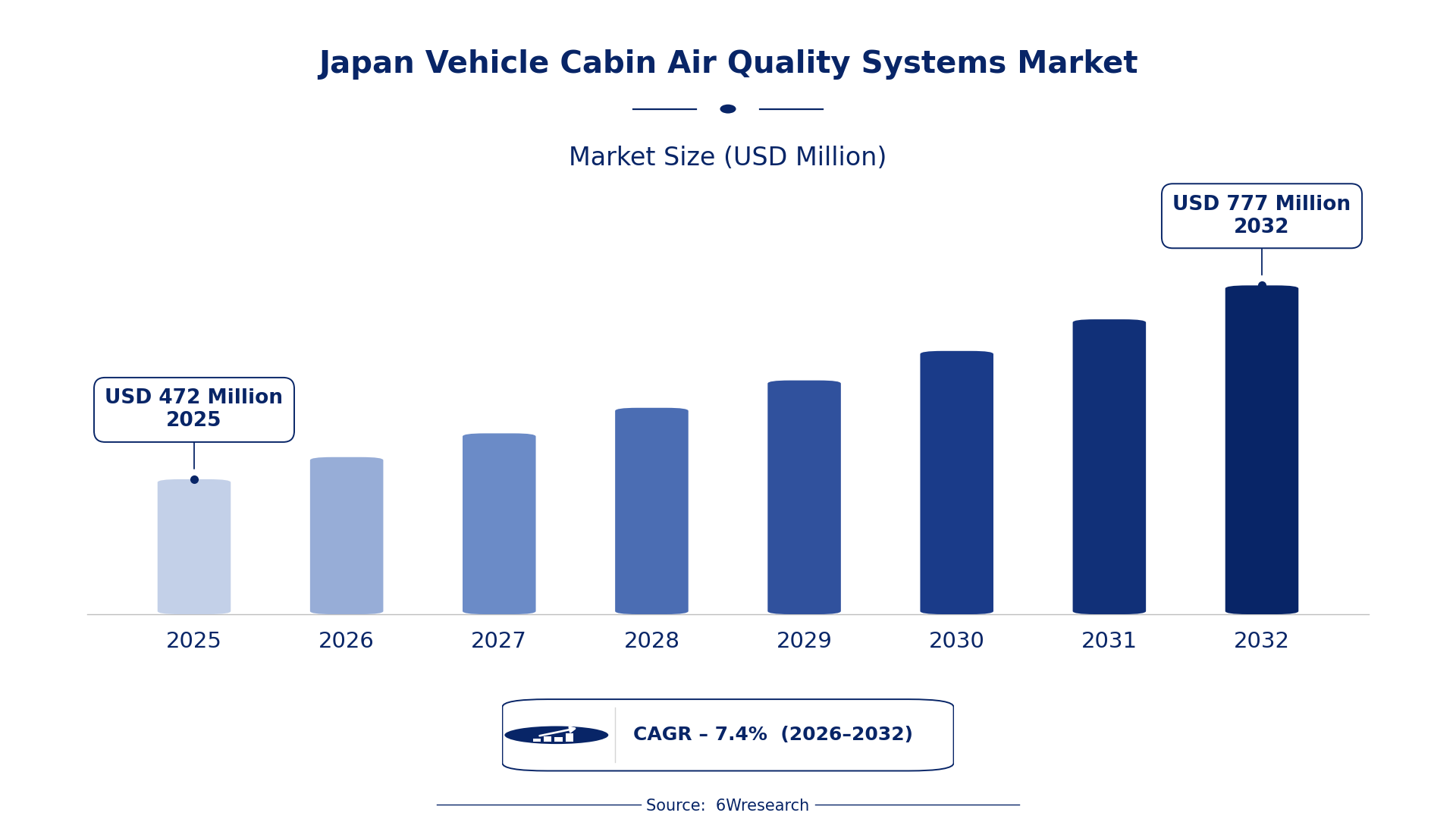
According to 6Wresearch internal database and industry insights, the Japan Vehicle Cabin Air Quality Systems Market was valued at USD 472 Million in 2025 and is projected to reach USD 777 Million by 2032, growing at a CAGR of approximately 7.4% during 2026–2032.
Japan Vehicle Cabin Air Quality Systems Market Highlights
| Report Metric | Details |
| Report Name | Japan Vehicle Cabin Air Quality Systems Market (2026-2032) |
| Market Size 2025 | USD 472 Million |
| Market Size 2032 | USD 777 Million |
| Absolute Growth 2025–2032 | USD 305 Million |
| CAGR 2026–2032 | 7.4% |
| Peak Annual Growth | 8.4% in 2026 |
| Forecast Period | 2026–2032 |
| Historical Data | 2022–2025 |
| Base Year | 2025 |
| Leading System Type, 2025 | HVAC Integrated Systems (43% share) |
| Leading Filtration Technology, 2025 | HEPA Filter (44% share) |
| Leading Vehicle Class, 2025 | Passenger Cars (38% share) |
| Leading End User, 2025 | OEMs (38% share) |
| Fastest-Growing System Type | Standalone Air Purifiers (10.5% CAGR) |
| Fastest-Growing Filtration Technology | Ionization (10.6% CAGR) |
| Fastest-Growing Vehicle Class | SUVs (9.3% CAGR) |
| Fastest-Growing End User | Luxury Car Makers (9.7% CAGR) |
| Growing Sector | Luxury Car Makers |
| Key End Users | OEMs, Luxury Car Makers, Fleet Operators, Smart Car OEMs |
Japan Vehicle Cabin Air Quality Systems Market Year-wise Growth Rate and Key Drivers (2022–2032)
This graph illustrates the annual growth rates of the market from 2022 to 2032, highlighting a steady upward trajectory and projected market expansion over the forecast period.
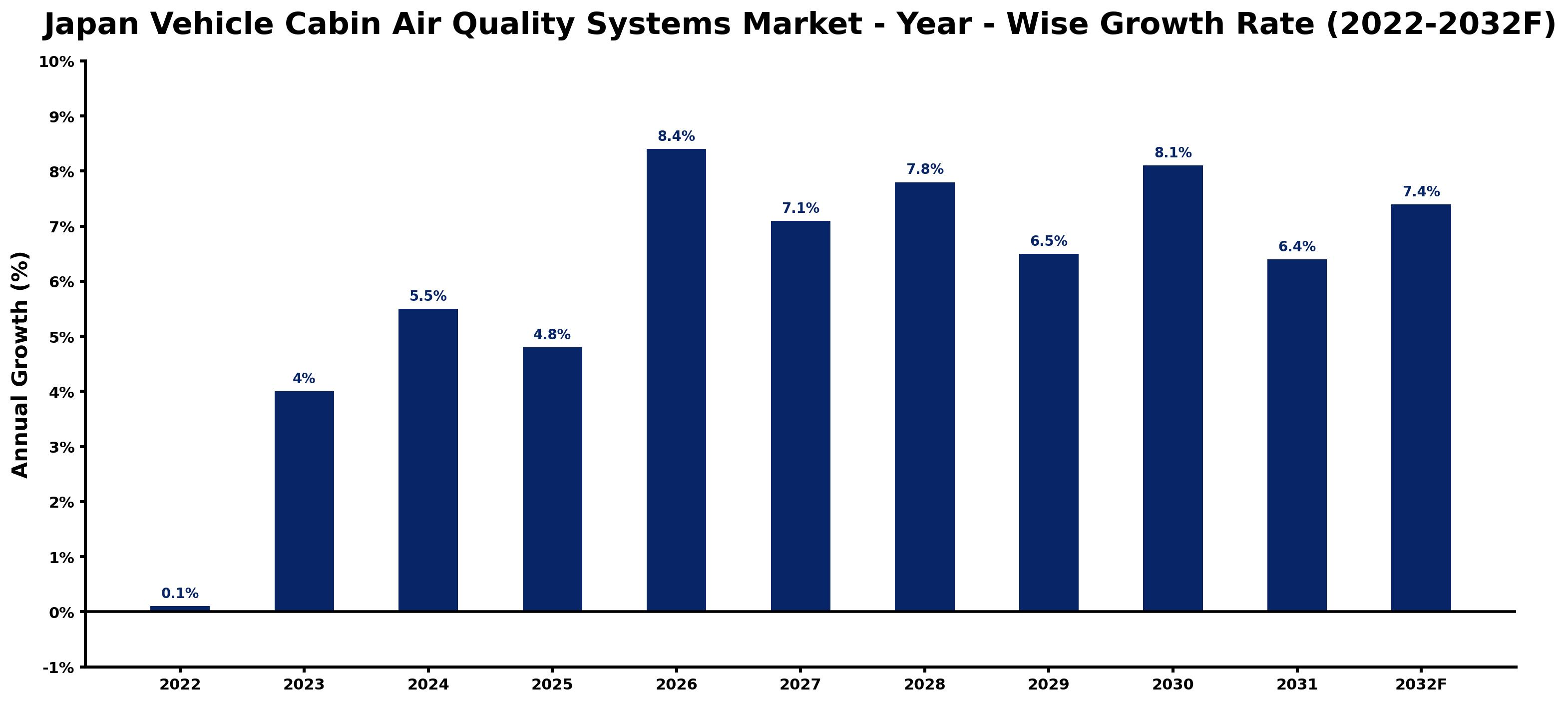
The yearly estimates that follow link every growth rate to its principal driver, so readers can see why the pace changed in each period.
| Year | Estimated Annual Growth (%) | Market Rationale |
| 2022 | 0.1 | The market experienced minimal growth due to limited adoption of new technologies. |
| 2023 | 4.0 | Growth accelerated as consumer awareness of air quality improved. |
| 2024 | 5.5 | The market continued to expand with increasing vehicle production and demand for cleaner air. |
| 2025 | 4.8 | Growth slowed slightly as the market adjusted to new standards and technologies. |
| 2026 | 8.4 | The market surged as new regulations and consumer preferences intensified demand. |
| 2027 | 7.1 | A slowdown occurred as the market stabilised after peak growth in the previous year. |
| 2028 | 7.8 | Growth picked up again as technological advancements in air quality systems emerged. |
| 2029 | 6.5 | The market experienced a slowdown as competition intensified among manufacturers. |
| 2030 | 8.1 | Demand increased again due to heightened focus on environmental sustainability. |
| 2031 | 6.4 | The market slowed as the adoption of advanced systems reached maturity. |
| 2032 | 7.4 | Growth remains strong as new innovations in air quality systems are introduced. |
Note: Market size estimations and growth projections presented in this report are based on 6Wresearch's proprietary forecasting methodology, utilizing the latest available industry data, government publications, and primary research inputs.
Japan Vehicle Cabin Air Quality Systems Market Synopsis
Vehicle Cabin Air Quality Systems improve air quality within vehicles through advanced filtration technologies and sensors. The Japan Vehicle Cabin Air Quality Systems Market is expanding as consumer awareness of air quality rises, with over 5 million vehicles produced annually and government initiatives promoting cleaner technologies. As electric vehicle adoption grows, these systems are becoming essential for improving passenger comfort and health while ensuring compliance with environmental standards.
Market Dynamics Impact Analysis (2026–2032)
| Factor | Type | Impact | Primary Segment Affected |
| Increasing consumer awareness of air quality | Driver | High | HEPA Filter |
| Government regulations promoting cleaner air standards | Driver | High | PM2.5 Sensors |
| Growing demand for luxury vehicles with advanced air quality systems | Opportunity | High | Luxury Car Makers |
| Expansion of electric vehicle adoption focusing on air quality features | Opportunity | High | EVs |
| High costs associated with advanced air quality technologies | Restraint | Medium | HVAC Integrated Systems |
| Limited adoption of air quality systems in older vehicle models | Restraint | Medium | Passenger Cars |
| Intense competition among manufacturers leading to pricing pressures | Challenge | High | OEMs |
| Technological integration challenges in existing vehicle platforms | Challenge | Medium | Standalone Air Purifiers |
Evaluation of Drivers in Japan Vehicle Cabin Air Quality Systems Market (2026–2032)
Demand rests on the following drivers, each shown with the segment it touches most.
| Drivers | Primary Segment Affected | Why It Matters (Evidence) |
| Rising consumer awareness of air quality | HEPA Filter | Over 70% of new passenger vehicles in Japan use HEPA filters, driving demand from consumers prioritising health. |
| Government regulations on air quality | PM2.5 Sensors | The adoption rate of PM2.5 sensors in new vehicles is expected to reach 50% by 2025, increasing compliance needs. |
| Demand for luxury vehicles | Luxury Car Makers | Luxury car makers are integrating advanced air quality systems, responding to consumer preferences for improved comfort. |
| Growth in electric vehicle adoption | EVs | Japan's focus on EVs, supported by a 46% greenhouse gas reduction target by 2030, boosts demand for air quality features. |
| Technological advancements in filtration systems | Activated Carbon | Activated carbon systems are increasingly used in luxury vehicles, improving air quality and attracting buyers. |
Much of the new demand stems from rising consumer awareness of air quality, with over 70% of new passenger vehicles in Japan featuring advanced filtration technologies. The adoption of PM2.5 sensors is projected to reach 50% by 2025, reflecting the increasing compliance needs among manufacturers. Demand for luxury vehicles is on the rise as manufacturers respond to consumer preferences for improved comfort, while the growth in electric vehicle adoption aligns with Japan's greenhouse gas reduction targets. Technological advancements in filtration systems, particularly activated carbon, are attracting buyers seeking effective air quality solutions.
Evaluation of Restraints in Japan Vehicle Cabin Air Quality Systems Market
Several factors work against faster growth; the main ones are summarised below.
| Market Restraint | Primary Segment Affected | Why It Matters (Evidence) |
| High costs associated with advanced air quality technologies | HVAC Integrated Systems | The integration of advanced systems can increase vehicle production costs, impacting affordability for consumers. |
| Limited adoption of air quality systems in older vehicle models | Passenger Cars | The average age of vehicles in Japan is around 10 years, limiting the market for new technologies. |
| Intense competition leading to pricing pressures | OEMs | Increased competition among manufacturers can drive down prices, affecting profitability and investment in innovation. |
| Technological integration challenges in existing platforms | Standalone Air Purifiers | Existing vehicle platforms may struggle to accommodate new air quality technologies, delaying adoption. |
| Variability in consumer demand for air quality systems | Luxury Car Makers | Consumer preferences can shift, resulting in unpredictable demand for advanced air quality features. |
Japan Vehicle Cabin Air Quality Systems Market Challenges
In Japan, over 5 million vehicles produced annually encounter a skills shortage in advanced air quality technology, hindering innovation for producers. The average vehicle age is around 10 years, causing buyers to grapple with outdated air quality systems that compromise comfort and health. Compliance with air quality standards raises operational costs for suppliers, which can increase prices for buyers by up to 15%. Technology adoption remains slow, with only 70% of new passenger vehicles equipped with HEPA filters, limiting choices for buyers seeking enhanced air quality solutions.
Trends in the Japan Vehicle Cabin Air Quality Systems Market
Several trends are reshaping the Japan Vehicle Cabin Air Quality Systems Market; the most important are set out below.
- Shift towards Integrated Air Quality Systems: The trend is shifting towards integrated air quality systems within vehicles, with over 43% of systems expected to be HVAC integrated by 2025. This movement reflects a growing preference for technology that enhances passenger comfort.
- Rise in Luxury Vehicle Air Quality Features: In 2023, luxury vehicles increasingly adopted advanced air quality systems, with a notable rise in demand. This trend is driven by consumer expectations for improved comfort and health benefits.
- Growing Adoption of PM2.5 Sensors: The adoption of PM2.5 sensors in new vehicles is anticipated to reach 50% by 2025, reflecting heightened awareness of air quality issues among consumers and manufacturers alike.
- Increase in Electric Vehicle Air Quality Innovations: Since 2023, electric vehicles have experienced a surge in air quality features, with advanced systems being integrated to meet consumer expectations and environmental standards.
Investment Opportunities in the Japan Vehicle Cabin Air Quality Systems Market
The openings below show where demand in the Japan Vehicle Cabin Air Quality Systems Market is visible and how suppliers can enter.
- Collaboration with Local Manufacturers: Forming partnerships with local manufacturers can facilitate entry into the Japanese market, where demand for air quality systems is projected to reach USD 777 million by 2032.
- Investment in Advanced Filtration Technologies: With a projected increase in demand for standalone air purifiers, investing in advanced filtration technologies presents an opportunity for suppliers targeting the luxury market.
- Focus on Electric Vehicle Air Quality Systems: The growing EV market, with an emphasis on air quality features, offers opportunities for suppliers to develop tailored solutions for OEMs in Japan.
- Expansion into the Luxury Vehicle Segment: Investing in air quality systems designed for luxury vehicles can tap into a high-demand segment, especially as consumer preferences evolve.
Government Initiatives in the Japan Vehicle Cabin Air Quality Systems Market
The Air Pollution Control Act and JIS guidelines set the foundation for air quality standards in vehicles, ensuring compliance among manufacturers. These regulations promote the use of advanced filtration technologies, such as HEPA filters, which are now standard in over 70% of new passenger vehicles in Japan. The government continues to support initiatives for cleaner vehicle technologies, improving the overall air quality in urban areas.
In 2023, a program was launched to boost EV adoption, focusing on air quality features, with an investment of JPY 150 trillion over the next decade. The Ministry of the Environment oversees this initiative, ensuring that manufacturers comply with the latest air quality standards, which will drive further innovation in vehicle cabin air quality systems.
Future Insight of the Japan Vehicle Cabin Air Quality Systems Market
By 2032, domestic users will increasingly seek advanced air quality systems, driven by Japan's target for a 46% reduction in greenhouse gas emissions. A new programme to promote EV adoption will highlight air quality features, offering buyers more sustainable vehicle options. Compliance with JIS guidelines will compel suppliers to develop better filtration technologies, improving air quality within vehicles. As the automotive sector progresses, buyers will benefit from enhanced systems that provide cleaner air and greater comfort.
Market Segmentation Analysis
Japan Vehicle Cabin Air Quality Systems Market report covers a detailed analysis of the following market segments:
By System Type – HVAC Integrated Systems Lead, Standalone Air Purifiers Expected to Grow Fastest
According to Saurav Kr Singh, Senior Research Analyst at 6Wresearch, HVAC Integrated Systems held 43% of the Japan Vehicle Cabin Air Quality Systems Market by system type in 2025. HVAC Integrated Systems hold the largest share in the market as they are essential for climate control within vehicles, ensuring passenger comfort. Their integration into over 5 million vehicles produced annually in Japan highlights their widespread adoption and importance in the automotive sector. The quickest growth will come from Standalone Air Purifiers, forecast to expand at a CAGR of 10.5% between 2026 and 2032. Standalone Air Purifiers are experiencing rapid growth, particularly in models that focus on superior air quality features. The recent programme launched in 2023 to enhance EV adoption is expected to further boost demand for these systems. Suppliers should focus on developing advanced features for HVAC systems to meet the growing consumer interest in air quality.
By Filtration Technology – HEPA Filter Leads, Ionization Expected to Grow Fastest
In 2025, HEPA Filter led the filtration technology split with a 44% share. HEPA Filters dominate the market due to their effectiveness in high-efficiency filtration, crucial for maintaining optimal air quality in vehicles. Their installation in over 70% of new passenger vehicles in Japan underscores their critical role in ensuring compliance with air quality standards. Over 2026–2032, Ionization is expected to post the fastest growth, at a CAGR of 10.6%. Ionization technology is witnessing significant growth, particularly in niche applications where enhanced air purification is required. This trend is driven by increasing consumer awareness regarding health benefits associated with improved air quality. Buyers should consider prioritising advanced filtration technologies to ensure superior air quality in vehicles.
By Vehicle Class – Passenger Cars Lead, SUVs Expected to Grow Fastest
With 38% of vehicle class revenue in 2025, Passenger Cars was the largest category. Passenger Cars represent the largest segment, as they constitute the majority of vehicles equipped with air quality systems, reflecting consumer demand for comfort and health. This category is pivotal in Japan's automotive market, which prioritises quality and innovation in vehicle design. SUVs are projected to grow fastest, at a CAGR of 9.3% during 2026–2032. SUVs are the fastest-growing segment, with a notable increase in consumer preference for larger vehicles that offer enhanced comfort and advanced features. The rising popularity of SUVs indicates a shift towards vehicles that prioritise superior air quality systems. Suppliers should tailor their products to address the specific needs of the SUV market to capitalise on this growth.
By End User – OEMs Lead, Luxury Car Makers Expected to Grow Fastest
The largest end user category in 2025 was OEMs, at 38% of revenue. OEMs lead the market as they are the primary manufacturers of vehicle air quality systems, ensuring their integration into new vehicle models. Their role is vital for adhering to regulatory standards and fulfilling consumer expectations regarding air quality. Luxury Car Makers are set to record the highest CAGR in this split, 9.7% over 2026–2032. Luxury Car Makers are experiencing the fastest growth due to their heightened demand for advanced air quality systems that enhance passenger comfort and health. The focus on premium features in luxury vehicles accelerates this segment's expansion. Suppliers must align their product offerings with the preferences of luxury car makers to seize emerging opportunities.
Key Attractiveness of the Report
- 10 Years of Market Numbers
- Historical Data Starting from 2022 to 2025
- Base Year 2025
- Forecast Data until 2032
- Key Performance Indicators Impacting the Market
- Major Upcoming Developments and Projects
Key Highlights of the Report:
- Japan Vehicle Cabin Air Quality Systems Market Outlook
- Market Size of Japan Vehicle Cabin Air Quality Systems Market, 2025
- Forecast of Japan Vehicle Cabin Air Quality Systems Market, 2032
- Historical Data and Forecast of Japan Vehicle Cabin Air Quality Systems Revenues & Volume for the Period 2022-2032F
- Japan Vehicle Cabin Air Quality Systems Market Trend Evolution
- Japan Vehicle Cabin Air Quality Systems Market Drivers and Challenges
- Japan Vehicle Cabin Air Quality Systems Price Trends
- Japan Vehicle Cabin Air Quality Systems Porter's Five Forces
- Japan Vehicle Cabin Air Quality Systems Industry Life Cycle
- Historical Data and Forecast of Japan Vehicle Cabin Air Quality Systems Market Revenues & Volume By System Type for the Period 2022-2032F
- Historical Data and Forecast of Japan Vehicle Cabin Air Quality Systems Market Revenues & Volume By HVAC Integrated Systems for the Period 2022-2032F
- Historical Data and Forecast of Japan Vehicle Cabin Air Quality Systems Market Revenues & Volume By Standalone Air Purifiers for the Period 2022-2032F
- Historical Data and Forecast of Japan Vehicle Cabin Air Quality Systems Market Revenues & Volume By Carbon Filter Systems for the Period 2022-2032F
- Historical Data and Forecast of Japan Vehicle Cabin Air Quality Systems Market Revenues & Volume By PM2.5 Sensors for the Period 2022-2032F
- Historical Data and Forecast of Japan Vehicle Cabin Air Quality Systems Market Revenues & Volume By Filtration Technology for the Period 2022-2032F
- Historical Data and Forecast of Japan Vehicle Cabin Air Quality Systems Market Revenues & Volume By HEPA Filter for the Period 2022-2032F
- Historical Data and Forecast of Japan Vehicle Cabin Air Quality Systems Market Revenues & Volume By Ionization for the Period 2022-2032F
- Historical Data and Forecast of Japan Vehicle Cabin Air Quality Systems Market Revenues & Volume By Activated Carbon for the Period 2022-2032F
- Historical Data and Forecast of Japan Vehicle Cabin Air Quality Systems Market Revenues & Volume By Optical Sensor-Based for the Period 2022-2032F
- Historical Data and Forecast of Japan Vehicle Cabin Air Quality Systems Market Revenues & Volume By Vehicle Class for the Period 2022-2032F
- Historical Data and Forecast of Japan Vehicle Cabin Air Quality Systems Market Revenues & Volume By Passenger Cars for the Period 2022-2032F
- Historical Data and Forecast of Japan Vehicle Cabin Air Quality Systems Market Revenues & Volume By SUVs for the Period 2022-2032F
- Historical Data and Forecast of Japan Vehicle Cabin Air Quality Systems Market Revenues & Volume By Commercial Vehicles for the Period 2022-2032F
- Historical Data and Forecast of Japan Vehicle Cabin Air Quality Systems Market Revenues & Volume By EVs for the Period 2022-2032F
- Historical Data and Forecast of Japan Vehicle Cabin Air Quality Systems Market Revenues & Volume By End User for the Period 2022-2032F
- Historical Data and Forecast of Japan Vehicle Cabin Air Quality Systems Market Revenues & Volume By OEMs for the Period 2022-2032F
- Historical Data and Forecast of Japan Vehicle Cabin Air Quality Systems Market Revenues & Volume By Luxury Car Makers for the Period 2022-2032F
- Historical Data and Forecast of Japan Vehicle Cabin Air Quality Systems Market Revenues & Volume By Fleet Operators for the Period 2022-2032F
- Historical Data and Forecast of Japan Vehicle Cabin Air Quality Systems Market Revenues & Volume By Smart Car OEMs for the Period 2022-2032F
- Japan Vehicle Cabin Air Quality Systems Import Export Trade Statistics
- Market Opportunity Assessment By System Type
- Market Opportunity Assessment By Filtration Technology
- Market Opportunity Assessment By Vehicle Class
- Market Opportunity Assessment By End User
- Japan Vehicle Cabin Air Quality Systems Top Companies Market Share
- Japan Vehicle Cabin Air Quality Systems Competitive Benchmarking By Technical and Operational Parameters
- Japan Vehicle Cabin Air Quality Systems Company Profiles
- Japan Vehicle Cabin Air Quality Systems Key Strategic Recommendations
Market Covered
Segments analysed in this report are listed below.
By System Type
- HVAC Integrated Systems
- Standalone Air Purifiers
- Carbon Filter Systems
- PM2.5 Sensors
By Filtration Technology
- HEPA Filter
- Ionization
- Activated Carbon
- Optical Sensor-Based
By Vehicle Class
- Passenger Cars
- SUVs
- Commercial Vehicles
- EVs
By End User
- OEMs
- Luxury Car Makers
- Fleet Operators
- Smart Car OEMs































