Japan Vehicle Cabin Comfort Material Market Size & Growth Rate
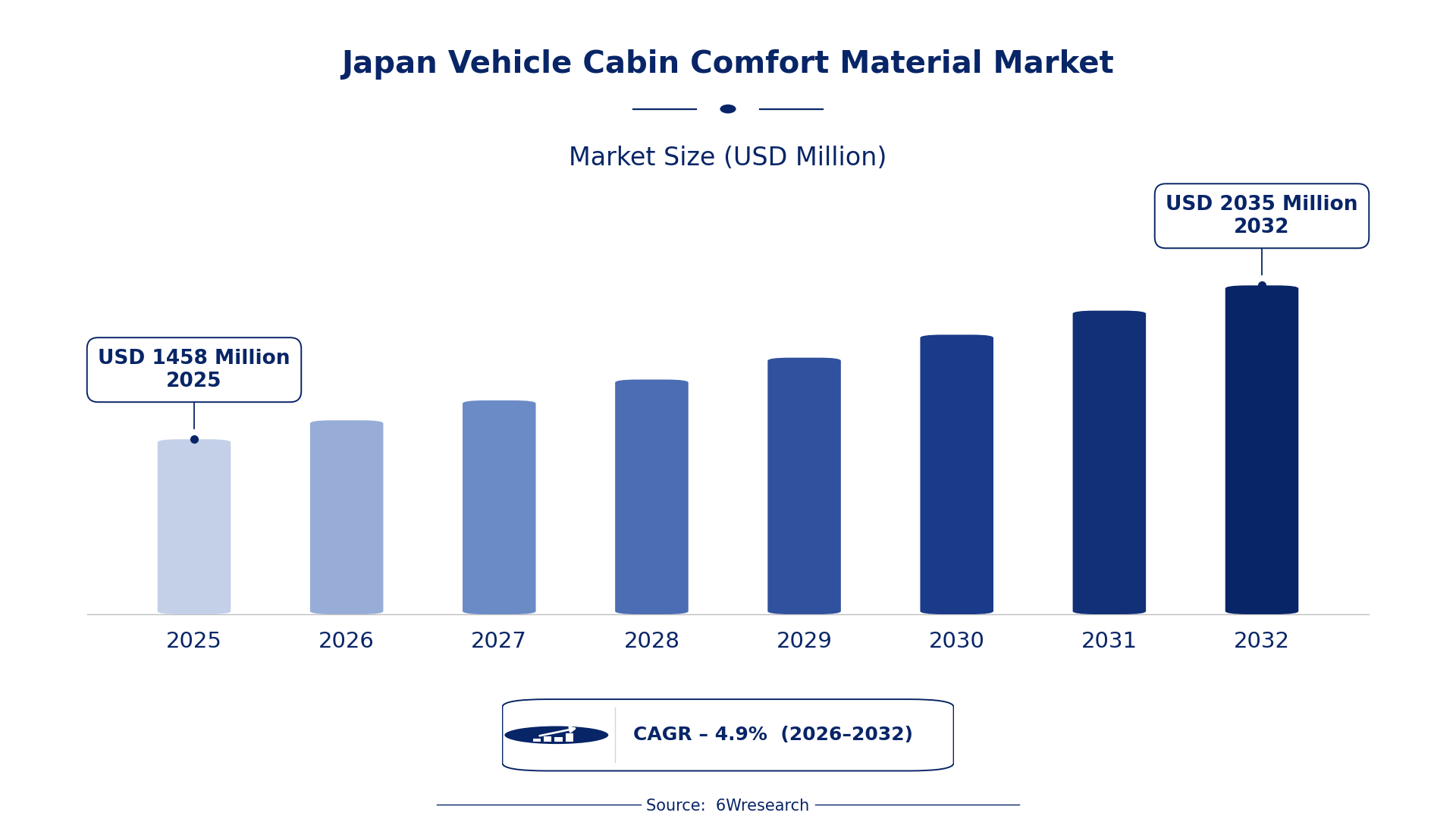
According to 6Wresearch internal database and industry insights, the Japan Vehicle Cabin Comfort Material Market was valued at USD 1,458 Million in 2025 and is projected to reach USD 2,035 Million by 2032, growing at a CAGR of approximately 4.9% during 2026–2032.
Japan Vehicle Cabin Comfort Material Market Highlights
| Report Metric | Details |
| Report Name | Japan Vehicle Cabin Comfort Material Market (2026-2032) |
| Market Size 2025 | USD 1,458 Million |
| Market Size 2032 | USD 2,035 Million |
| Absolute Growth 2025–2032 | USD 577 Million |
| CAGR 2026–2032 | 4.9% |
| Peak Annual Growth | 6.2% in 2032 |
| Forecast Period | 2026–2032 |
| Historical Data | 2022–2025 |
| Base Year | 2025 |
| Leading Material Type, 2025 | Polyurethane Foam (42% share) |
| Leading Application Area, 2025 | Upholstery (44% share) |
| Leading Feature Type, 2025 | High Resilience (52% share) |
| Leading End User, 2025 | Auto Interior Manufacturers (47% share) |
| Fastest-Growing Material Type | Breathable Fabrics (7.1% CAGR) |
| Fastest-Growing Application Area | Seat Cushions (6.2% CAGR) |
| Fastest-Growing Feature Type | Ventilation Friendly (6.9% CAGR) |
| Fastest-Growing End User | EV Interior Suppliers (6.6% CAGR) |
| Growing Sector | automotive interior materials |
| Key End Users | auto interior manufacturers, premium car brands, EV interior suppliers, comfort system providers |
Japan Vehicle Cabin Comfort Material Market Year-wise Growth Rate and Key Drivers (2022–2032)
This graph illustrates the annual growth rates of the market from 2022 to 2032, highlighting a steady upward trajectory and projected market expansion over the forecast period.
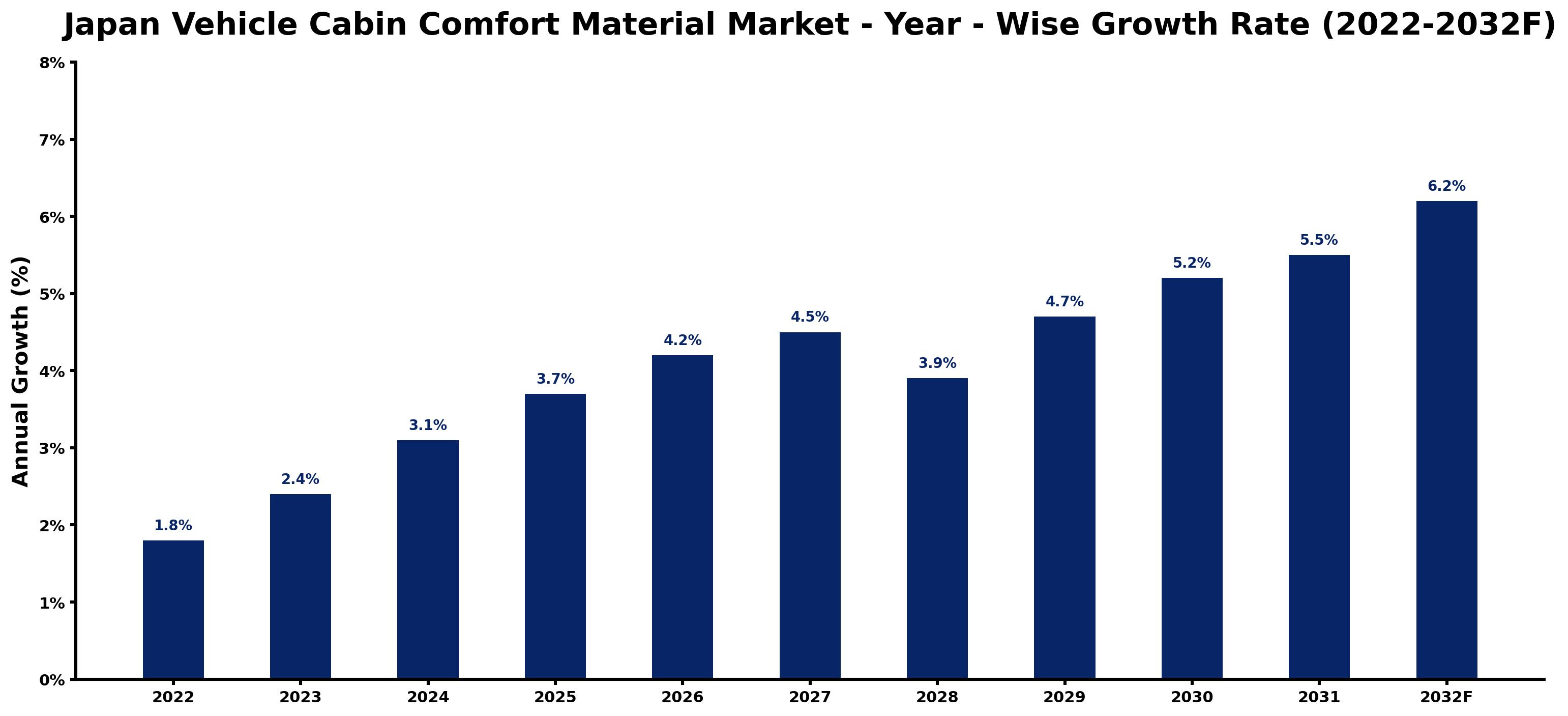
Below, each year's estimated growth is shown next to the factor that most influenced it.
| Year | Estimated Annual Growth (%) | Market Rationale |
| 2022 | 1.8 | The automotive sector showed steady demand for comfort materials amid stable vehicle registrations. |
| 2023 | 2.4 | Increased consumer focus on vehicle comfort spurred higher material purchases this year. |
| 2024 | 3.1 | Growing interest in sound insulation drove demand for acoustic materials in vehicles. |
| 2025 | 3.7 | The introduction of new vehicle models boosted the need for innovative cabin materials. |
| 2026 | 4.2 | Rising investments in electric vehicles increased demand for sustainable materials. |
| 2027 | 4.5 | Demand for high-quality upholstery materials continued to rise with premium vehicle sales. |
| 2028 | 3.9 | A slowdown in growth occurred as the market adjusted to previous high demand levels. |
| 2029 | 4.7 | Renewed interest in comfort features led to increased purchases of cabin materials. |
| 2030 | 5.2 | Technological advancements in materials enhanced demand for innovative comfort solutions. |
| 2031 | 5.5 | Growing environmental regulations prompted shifts towards eco-friendly materials in vehicles. |
| 2032 | 6.2 | The market peaked as manufacturers focused on high-performance comfort materials. |
Note: Market size estimations and growth projections presented in this report are based on 6Wresearch's proprietary forecasting methodology, utilizing the latest available industry data, government publications, and primary research inputs.
Japan Vehicle Cabin Comfort Material Market Synopsis
Vehicle Cabin Comfort Material encompasses a range of materials aimed at improving the comfort and functionality of vehicle interiors through processes such as foaming and textile weaving. The market is expanding due to rising demand from domestic auto manufacturers and premium car brands, coupled with an emphasis on sustainability. Japan's automotive sector, valued at around 14 trillion yen, is propelling investments in new materials, with a goal of achieving a 46% reduction in greenhouse gas emissions by 2030, further increasing the need for eco-friendly solutions.
Market Dynamics Impact Analysis (2026–2032)
| Factor | Type | Impact | Primary Segment Affected |
| Increased investment in electric vehicle production | Driver | High | Breathable Fabrics |
| Rising consumer preference for comfort and aesthetics | Driver | High | Upholstery |
| Growing demand for sound insulation materials due to noise regulations | Opportunity | High | Acoustic Insulation Foam |
| Expansion of premium car brands requiring high-quality materials | Opportunity | Medium | Synthetic Leather |
| Cost pressures from raw material sourcing | Restraint | High | Polyurethane Foam |
| Regulatory compliance for environmental standards | Restraint | Medium | Breathable Fabrics |
| Capacity constraints in manufacturing facilities | Challenge | High | Seat Cushions |
| Compliance with stringent safety regulations | Challenge | Medium | High Resilience |
Evaluation of Drivers in Japan Vehicle Cabin Comfort Material Market (2026–2032)
Key forces behind demand, with the segment each one moves most, are listed below.
| Drivers | Primary Segment Affected | Why It Matters (Evidence) |
| Investment in electric vehicle infrastructure | Breathable Fabrics | The government allocated 100 billion yen for EV infrastructure development, driving demand for sustainable materials. |
| Consumer demand for luxury interiors | Upholstery | A focus on aesthetics leads to increased purchases of high-quality upholstery materials, with the automotive sector valuing premium finishes. |
| Technological advancements in sound insulation | Acoustic Insulation Foam | Noise regulations push manufacturers to invest in advanced sound absorption technologies, enhancing cabin comfort. |
| Growing market for electric vehicles | Synthetic Leather | With over 5 million electric vehicles registered, demand for sustainable materials is rising, influencing interior design choices. |
| Focus on environmental sustainability | Polyurethane Foam | The automotive industry aims for a 46% reduction in CO2 emissions by 2030, boosting eco-friendly material demand. |
Spending rises because investments in electric vehicle infrastructure are driving demand for sustainable materials, with 100 billion yen allocated for development. With over 5 million electric vehicles registered, demand for sustainable materials is rising. The industry's aim for a 46% reduction in CO2 emissions by 2030 is boosting eco-friendly material demand, as manufacturers seek solutions that align with these targets.
Evaluation of Restraints in Japan Vehicle Cabin Comfort Material Market
The table below lists the restraints and the evidence behind each.
| Market Restraint | Primary Segment Affected | Why It Matters (Evidence) |
| High raw material costs affecting profit margins | Polyurethane Foam | Rising prices of petrochemical products are squeezing margins for manufacturers. |
| Challenges in meeting environmental regulations | Breathable Fabrics | Compliance with ISO 14001 certification increases operational costs for producers. |
| Limited manufacturing capacity for high-demand materials | Seat Cushions | Increased demand exceeds production capabilities, leading to supply shortages. |
| Complex safety compliance requirements | High Resilience | Stringent regulations require extensive testing, delaying product launches. |
| Volatility in supply chain logistics | Acoustic Insulation Foam | Disruptions in logistics impact timely delivery of essential materials. |
Japan Vehicle Cabin Comfort Material Market Challenges
Domestic auto manufacturers face supply chain disruptions that result in material shortages, potentially delaying vehicle production by up to six months. A skills gap exists among suppliers, with the demand for advanced manufacturing techniques outpacing workforce training, leading to increased labour costs that can rise by 20% for producers. Buyers encounter rising prices for vehicle cabin comfort materials, driven by increased demand for sound insulation due to stricter noise regulations, which can inflate costs by 15%. Regulatory pressures to meet environmental standards compel suppliers to invest in sustainable materials, raising production costs that ultimately increase prices for buyers.
Trends in the Japan Vehicle Cabin Comfort Material Market
Buyers and suppliers in the Japan Vehicle Cabin Comfort Material Market are adjusting to the following trends.
- Shift towards Sustainable Materials: The automotive industry is progressively adopting eco-friendly materials, as highlighted in the GX Basic Policy, which aims for JPY 150 trillion in decarbonisation investment over the next decade.
- Transition from Traditional to High-Performance Fabrics: Since 2022, there has been a marked shift towards breathable fabrics in vehicle interiors, with a CAGR of 7.1% expected as manufacturers prioritise comfort and sustainability.
- Emergence of Advanced Sound Insulation Solutions: In response to noise regulations, manufacturers are focusing on acoustic insulation foam, with demand increasing due to a rise in vehicle registrations, which reached around 78 million in 2022.
- Prioritisation of Aesthetic Upgrades: The trend towards premium interiors has resulted in a surge in demand for upholstery materials, projected to capture a 44% market share by 2025, reflecting consumer preferences for luxury.
Investment Opportunities in the Japan Vehicle Cabin Comfort Material Market
The following areas offer the clearest openings for investors and suppliers in the Japan Vehicle Cabin Comfort Material Market.
- Collaborate with local manufacturers: With a JPY 150 trillion investment in decarbonisation, local partnerships can facilitate market entry, particularly for sustainable materials.
- Target Aichi Prefecture's automotive hubs: Aichi Prefecture is a pivotal region for automotive manufacturing, offering opportunities for suppliers of comfort materials as vehicle production increases.
- Capitalize on the demand for sound absorption: The market gap for acoustic insulation foam is substantial, with noise regulations driving demand, presenting an opportunity for suppliers to innovate.
- Develop compliance solutions for safety regulations: As manufacturers navigate complex compliance requirements, creating solutions that streamline testing and certification can capture market share.
Government Initiatives in the Japan Vehicle Cabin Comfort Material Market
The PRTR Law mandates businesses to report chemical substance releases, impacting producers of vehicle cabin materials by ensuring compliance with environmental standards. This law, alongside the Chemical Substances Control Law, requires manufacturers to evaluate and control chemical substances, influencing material choices in production. The Battery Industry Strategy aims for substantial domestic battery manufacturing capacity by 2030, supporting auto interior manufacturers by promoting the use of sustainable materials in vehicle production.
The Ministry of Economy, Trade and Industry oversees initiatives that encourage sustainable practices in the automotive sector. This includes funding for projects that aim to promote the use of eco-friendly materials in vehicle production, benefiting auto interior manufacturers and aligning with national decarbonisation goals.
Future Insight of the Japan Vehicle Cabin Comfort Material Market
Technological advancements in sustainable materials will reshape demand by 2032, as manufacturers increasingly integrate eco-friendly options. The automotive sector's commitment to a 46% reduction in CO2 emissions by 2030 will propel the transition towards greener materials, influencing design choices throughout the industry. Stricter noise regulations will necessitate the adoption of advanced sound insulation technologies, enhancing both compliance and the driving experience. The government's investment of approximately JPY 150 trillion in decarbonisation initiatives will further accelerate the development of environmentally friendly vehicle interiors.
Market Segmentation Analysis
Japan Vehicle Cabin Comfort Material Market report covers a detailed analysis of the following market segments:
By Material Type – Polyurethane Foam Leads, Breathable Fabrics Expected to Grow Fastest
According to Saurav Kr Singh, Senior Research Analyst at 6Wresearch, in 2025, Polyurethane Foam led the material type split with a 42% share. Polyurethane Foam holds the largest share because it is crucial for cushioning and insulation in seats, which enhances overall vehicle comfort. Its widespread application among auto manufacturers in regions like Tokyo and Aichi Prefecture solidifies its dominant position. The quickest growth will come from Breathable Fabrics, forecast to expand at a CAGR of 7.1% between 2026 and 2032. Breathable Fabrics is experiencing rapid growth as consumer demand for seat covers that enhance comfort rises, particularly with the increasing focus on vehicle interior quality. The surge in electric vehicle registrations also fuels the search for sustainable materials, propelling this segment's expansion. Suppliers should prioritise the development of breathable fabrics to capitalise on the growing market demand.
By Application Area – Upholstery Leads, Seat Cushions Expected to Grow Fastest
Upholstery accounted for 44% of the market by application area in 2025. Upholstery commands the largest share as it plays a vital role in covering seats and interior surfaces, impacting both aesthetics and comfort. The average vehicle age of around 13 years in Japan drives the need for upgrades in upholstery materials. Seat Cushions are set to record the highest CAGR in this split, 6.2% over 2026–2032. Seat Cushions are witnessing rapid growth due to their essential function in providing comfort and support, which consumers increasingly value. The heightened emphasis on interior comfort, especially with new vehicle models, accelerates this segment's expansion. Buyers will increasingly seek high-quality upholstery solutions to meet the rising demand for vehicle interior enhancements.
By Feature Type – High Resilience Leads, Ventilation Friendly Expected to Grow Fastest
High Resilience took 52% of feature type revenue in 2025, more than any other category. High Resilience materials dominate the market as they deliver essential durability and comfort in seating, crucial for consumer satisfaction. Their extensive use among auto interior manufacturers highlights their importance in the sector. Ventilation Friendly is projected to grow fastest, at a CAGR of 6.9% during 2026–2032. Ventilation Friendly materials are growing swiftly as they enhance comfort through improved air circulation, aligning with consumer preferences for a pleasant driving experience. This trend is particularly relevant as manufacturers aim to meet increasing comfort standards. Suppliers should focus on developing ventilation friendly materials to address the rising demand for enhanced comfort features.
By End User – Auto Interior Manufacturers Lead, EV Interior Suppliers Expected to Grow Fastest
Auto Interior Manufacturers held 47% of the Japan Vehicle Cabin Comfort Material Market by end user in 2025. Auto Interior Manufacturers represent the largest share as they are the primary consumers of vehicle cabin comfort materials, directly influencing production choices. Their established relationships with material suppliers ensure consistent demand for these products. Over 2026–2032, EV Interior Suppliers are expected to post the fastest growth, at a CAGR of 6.6%. EV Interior Suppliers are rapidly growing as they focus on sustainable and innovative materials that align with the transition towards electric vehicles. Government initiatives promoting electric vehicle adoption further accelerate this segment's expansion. Suppliers must tailor their offerings to meet the specific needs of EV interior suppliers to remain competitive.
Key Attractiveness of the Report
- 10 Years of Market Numbers
- Historical Data Starting from 2022 to 2025
- Base Year 2025
- Forecast Data until 2032
- Key Performance Indicators Impacting the Market
- Major Upcoming Developments and Projects
Key Highlights of the Report:
- Japan Vehicle Cabin Comfort Material Market Outlook
- Market Size of Japan Vehicle Cabin Comfort Material Market, 2025
- Forecast of Japan Vehicle Cabin Comfort Material Market, 2032
- Historical Data and Forecast of Japan Vehicle Cabin Comfort Material Revenues & Volume for the Period 2022-2032F
- Japan Vehicle Cabin Comfort Material Market Trend Evolution
- Japan Vehicle Cabin Comfort Material Market Drivers and Challenges
- Japan Vehicle Cabin Comfort Material Price Trends
- Japan Vehicle Cabin Comfort Material Porter's Five Forces
- Japan Vehicle Cabin Comfort Material Industry Life Cycle
- Historical Data and Forecast of Japan Vehicle Cabin Comfort Material Market Revenues & Volume By Material Type for the Period 2022-2032F
- Historical Data and Forecast of Japan Vehicle Cabin Comfort Material Market Revenues & Volume By Polyurethane Foam for the Period 2022-2032F
- Historical Data and Forecast of Japan Vehicle Cabin Comfort Material Market Revenues & Volume By Synthetic Leather for the Period 2022-2032F
- Historical Data and Forecast of Japan Vehicle Cabin Comfort Material Market Revenues & Volume By Acoustic Insulation Foam for the Period 2022-2032F
- Historical Data and Forecast of Japan Vehicle Cabin Comfort Material Market Revenues & Volume By Breathable Fabrics for the Period 2022-2032F
- Historical Data and Forecast of Japan Vehicle Cabin Comfort Material Market Revenues & Volume By Application Area for the Period 2022-2032F
- Historical Data and Forecast of Japan Vehicle Cabin Comfort Material Market Revenues & Volume By Seat Cushions for the Period 2022-2032F
- Historical Data and Forecast of Japan Vehicle Cabin Comfort Material Market Revenues & Volume By Upholstery for the Period 2022-2032F
- Historical Data and Forecast of Japan Vehicle Cabin Comfort Material Market Revenues & Volume By Floor & Roof Panels for the Period 2022-2032F
- Historical Data and Forecast of Japan Vehicle Cabin Comfort Material Market Revenues & Volume By Headliners & Door Panels for the Period 2022-2032F
- Historical Data and Forecast of Japan Vehicle Cabin Comfort Material Market Revenues & Volume By Feature Type for the Period 2022-2032F
- Historical Data and Forecast of Japan Vehicle Cabin Comfort Material Market Revenues & Volume By High Resilience for the Period 2022-2032F
- Historical Data and Forecast of Japan Vehicle Cabin Comfort Material Market Revenues & Volume By Heat Resistant for the Period 2022-2032F
- Historical Data and Forecast of Japan Vehicle Cabin Comfort Material Market Revenues & Volume By Sound Absorption for the Period 2022-2032F
- Historical Data and Forecast of Japan Vehicle Cabin Comfort Material Market Revenues & Volume By Ventilation Friendly for the Period 2022-2032F
- Historical Data and Forecast of Japan Vehicle Cabin Comfort Material Market Revenues & Volume By End User for the Period 2022-2032F
- Historical Data and Forecast of Japan Vehicle Cabin Comfort Material Market Revenues & Volume By Auto Interior Manufacturers for the Period 2022-2032F
- Historical Data and Forecast of Japan Vehicle Cabin Comfort Material Market Revenues & Volume By Premium Car Brands for the Period 2022-2032F
- Historical Data and Forecast of Japan Vehicle Cabin Comfort Material Market Revenues & Volume By EV Interior Suppliers for the Period 2022-2032F
- Historical Data and Forecast of Japan Vehicle Cabin Comfort Material Market Revenues & Volume By Comfort System Providers for the Period 2022-2032F
- Japan Vehicle Cabin Comfort Material Import Export Trade Statistics
- Market Opportunity Assessment By Material Type
- Market Opportunity Assessment By Application Area
- Market Opportunity Assessment By Feature Type
- Market Opportunity Assessment By End User
- Japan Vehicle Cabin Comfort Material Top Companies Market Share
- Japan Vehicle Cabin Comfort Material Competitive Benchmarking By Technical and Operational Parameters
- Japan Vehicle Cabin Comfort Material Company Profiles
- Japan Vehicle Cabin Comfort Material Key Strategic Recommendations
Market Covered
The study includes the following segmentation.
By Material Type
- Polyurethane Foam
- Synthetic Leather
- Acoustic Insulation Foam
- Breathable Fabrics
By Application Area
- Seat Cushions
- Upholstery
- Floor & Roof Panels
- Headliners & Door Panels
By Feature Type
- High Resilience
- Heat Resistant
- Sound Absorption
- Ventilation Friendly
By End User
- Auto Interior Manufacturers
- Premium Car Brands
- EV Interior Suppliers
- Comfort System Providers































