Japan Vehicle Camera-Based Safety Market Size & Growth Rate
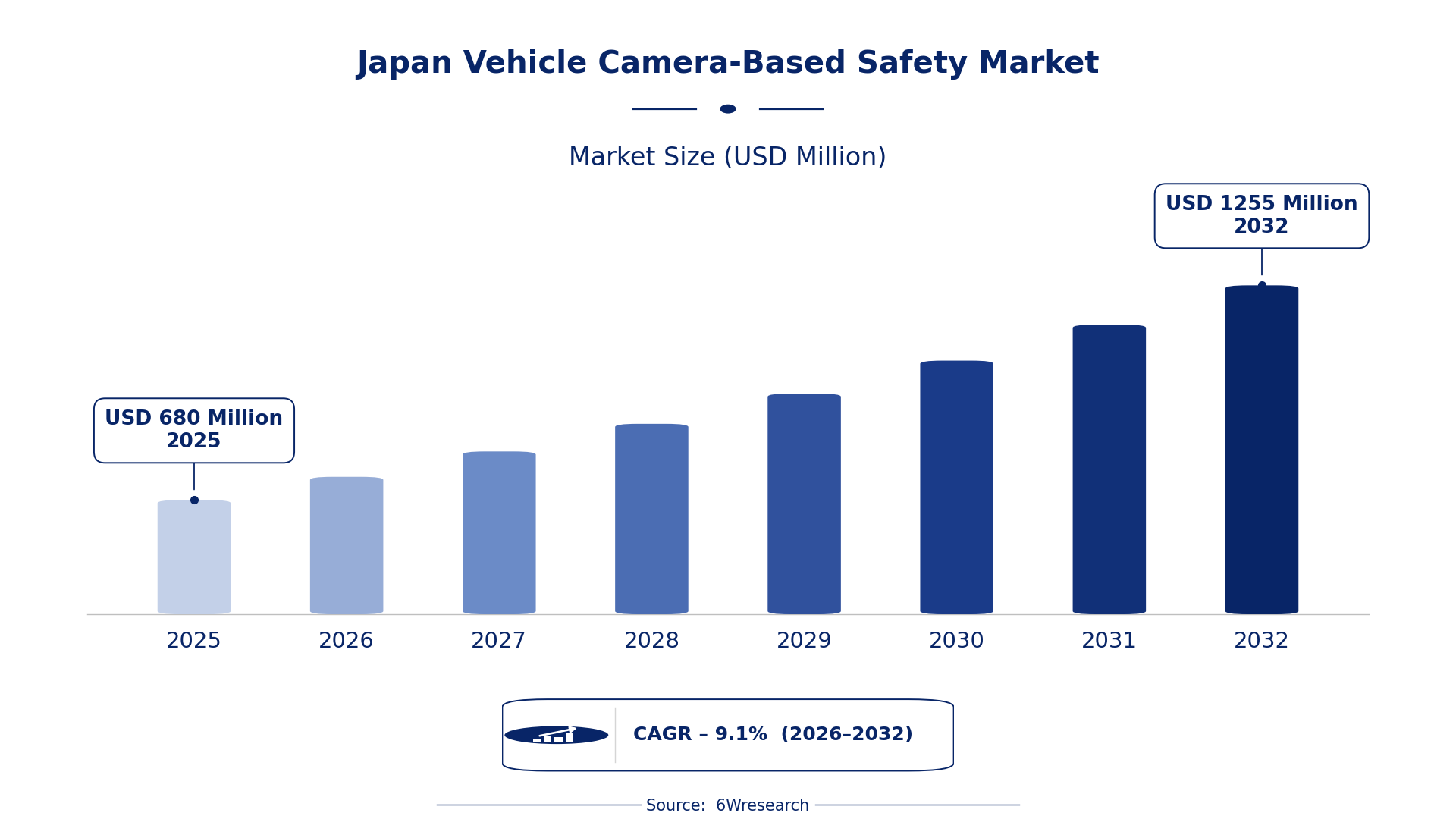
According to 6Wresearch internal database and industry insights, the Japan Vehicle Camera-Based Safety Market was valued at USD 680 Million in 2025 and is projected to reach USD 1,255 Million by 2032, growing at a CAGR of approximately 9.1% during 2026–2032.
Japan Vehicle Camera-Based Safety Market Highlights
| Report Metric | Details |
| Report Name | Japan Vehicle Camera-Based Safety Market (2026-2032) |
| Market Size 2025 | USD 680 Million |
| Market Size 2032 | USD 1,255 Million |
| Absolute Growth 2025–2032 | USD 575 Million |
| CAGR 2026–2032 | 9.1% |
| Peak Annual Growth | 11.5% in 2026 |
| Forecast Period | 2026–2032 |
| Historical Data | 2022–2025 |
| Base Year | 2025 |
| Leading Safety System Type, 2025 | Lane Departure Warning (46% share) |
| Leading Camera Type, 2025 | Forward-Facing Camera (35% share) |
| Leading Use Case, 2025 | Highway Safety (36% share) |
| Leading End User, 2025 | Passenger Vehicle OEMs (35% share) |
| Fastest-Growing Safety System Type | Pedestrian Detection (12.4% CAGR) |
| Fastest-Growing Camera Type | Stereo Vision Camera (12.9% CAGR) |
| Fastest-Growing Use Case | Urban Driving (11.9% CAGR) |
| Fastest-Growing End User | Smart Car Companies (12.0% CAGR) |
| Growing Sector | automotive safety technology |
| Key End Users | Passenger Vehicle OEMs, Fleet Safety Providers, Smart Car Companies, Autonomous System Vendors |
Japan Vehicle Camera-Based Safety Market Year-wise Growth Rate and Key Drivers (2022–2032)
This graph illustrates the annual growth rates of the market from 2022 to 2032, highlighting a steady upward trajectory and projected market expansion over the forecast period.
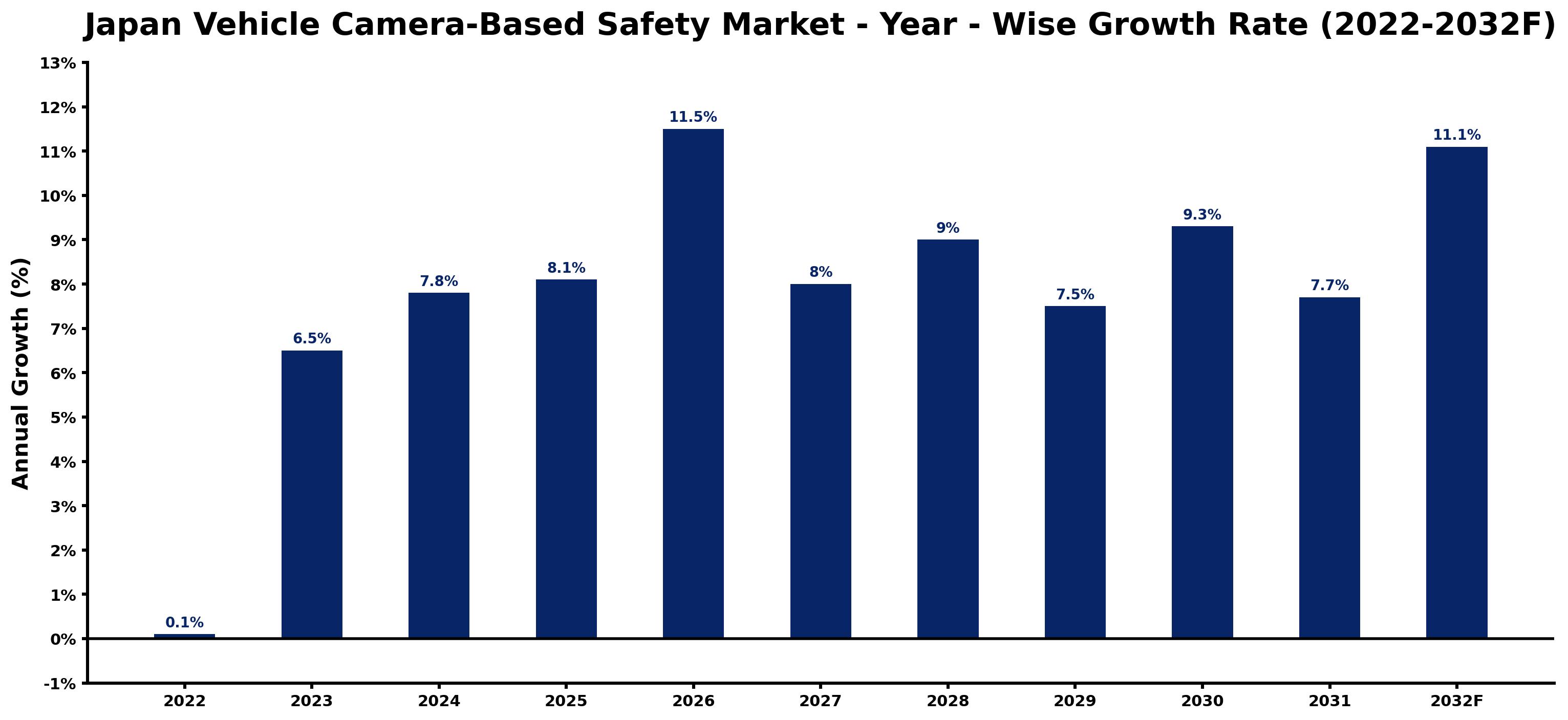
Year by year, the estimates below pair each growth rate with the development that shaped it.
| Year | Estimated Annual Growth (%) | Market Rationale |
| 2022 | 0.1 | The market showed minimal growth as vehicle safety technologies were gaining traction. |
| 2023 | 6.5 | Increased awareness of road safety led to faster growth in demand for vehicle camera systems. |
| 2024 | 7.8 | The introduction of new safety regulations further accelerated the adoption of these technologies. |
| 2025 | 8.1 | The market peaked historically as manufacturers focused on integrating advanced safety features. |
| 2026 | 11.5 | Stricter safety standards will drive a surge in demand for camera-based systems. |
| 2027 | 8.0 | Growth is projected to slow as the market stabilises after the peak in 2026. |
| 2028 | 9.0 | Demand is expected to increase again as urban driving safety concerns gain prominence in metropolitan areas. |
| 2029 | 7.5 | A slight slowdown is projected as growth rates normalise following previous high levels. |
| 2030 | 9.3 | Continued investment in safety technologies is expected to support a rebound in growth for vehicle cameras. |
| 2031 | 7.7 | The market is projected to experience another slowdown as growth rates adjust to sustainable levels. |
| 2032 | 11.1 | Strong demand for advanced systems is expected to drive growth in the coming years. |
Note: Market size estimations and growth projections presented in this report are based on 6Wresearch's proprietary forecasting methodology, utilizing the latest available industry data, government publications, and primary research inputs.
Japan Vehicle Camera-Based Safety Market Synopsis
Vehicle camera-based safety systems utilise advanced imaging technology for real-time monitoring and alerts, employing high-resolution cameras and sophisticated algorithms. The Japan Vehicle Camera-Based Safety Market is expanding due to increasing safety regulations, heightened vehicle production, and growing interest in autonomous vehicle technologies. By 2025, the market is projected to reach 1.5 million units, driven by domestic manufacturers and urban safety demands, particularly in the Tokyo metropolitan area.
Market Dynamics Impact Analysis (2026–2032)
| Factor | Type | Impact | Primary Segment Affected |
| Increasing vehicle production and safety regulations drive demand for safety systems. | Driver | High | Collision Avoidance System |
| Growing urbanisation in regions like Tokyo increases the need for safety technologies. | Driver | High | Urban Driving |
| The push for advanced safety measures creates opportunities for system providers. | Opportunity | High | Pedestrian Detection |
| Fleet safety providers are expanding their adoption of safety systems to enhance safety across fleets. | Opportunity | Medium | Fleet Safety Providers |
| The average age of vehicles in Japan necessitates retrofitting safety systems. | Restraint | High | Lane Departure Warning |
| High costs associated with advanced safety systems may hinder broader adoption. | Restraint | Medium | Driver Drowsiness Monitor |
| Limited supply chain capacity could restrict the availability of necessary components. | Challenge | High | Stereo Vision Camera |
| Competition among manufacturers may lead to pricing pressures affecting profitability. | Challenge | Medium | Forward-Facing Camera |
Evaluation of Drivers in Japan Vehicle Camera-Based Safety Market (2026–2032)
The factors lifting demand, and the evidence behind each, are summarised below.
| Drivers | Primary Segment Affected | Why It Matters (Evidence) |
| Increased vehicle production in Japan drives demand for safety systems. | Collision Avoidance System | The Japanese automotive industry produced over 8 million vehicles in 2022, boosting safety system adoption. |
| Urbanisation in metropolitan areas raises the need for safety technologies. | Urban Driving | The Tokyo region accounts for 30% of Japan's vehicle registrations, increasing demand for safety features. |
| Stricter safety regulations mandate the integration of advanced safety systems in new vehicles. | Lane Departure Warning | Lane Departure Warning systems are mandated in new vehicles under Japanese safety regulations. |
| Growing consumer awareness of road safety drives demand for advanced features. | Pedestrian Detection | The government aims to reduce traffic fatalities by 50% by 2030, encouraging technology adoption. |
| Fleet safety providers are increasingly adopting collision avoidance systems to improve safety. | Fleet Safety Providers | Adoption is expected to increase by 20% by 2025, reflecting growing safety concerns. |
Several shifts outside the market lift sales. The Japanese automotive industry produced over 8 million vehicles in 2022, increasing demand for safety systems, particularly in urban areas. Fleet safety providers are expected to adopt collision avoidance systems at an increasing rate, reflecting heightened safety concerns.
Evaluation of Restraints in Japan Vehicle Camera-Based Safety Market
These are the pressures that could keep growth below its potential.
| Market Restraint | Primary Segment Affected | Why It Matters (Evidence) |
| The average age of vehicles in Japan is around 13 years, increasing retrofitting needs. | Lane Departure Warning | Older vehicles require investment for safety system upgrades, limiting immediate adoption. |
| High costs of advanced safety systems may deter some consumers from purchasing. | Driver Drowsiness Monitor | The price sensitivity of buyers can limit the market for high-end safety technologies. |
| Supply chain disruptions could lead to delays in component availability for manufacturers. | Stereo Vision Camera | Limited availability of critical components may slow down production and deployment. |
| Competition among manufacturers can lead to pricing pressures affecting profitability. | Forward-Facing Camera | Price competition may reduce margins for suppliers, impacting their ability to invest in innovation. |
| Consumer awareness of safety technologies varies, affecting overall adoption rates. | Pedestrian Detection | Some buyers may not fully understand the benefits of advanced safety systems, hindering growth. |
Japan Vehicle Camera-Based Safety Market Challenges
High production costs for vehicle camera systems stem from the need for advanced imaging technology, inflating prices by up to 25% for manufacturers. Stringent safety regulations, such as ISO 26262, create delays in product development, causing suppliers to experience a six-month lag in bringing new systems to market. Continuous investment in technological advancements burdens smaller producers, limiting their competitiveness in a rapidly evolving market. Supply chain disruptions in sourcing high-resolution cameras can delay deliveries by up to 40%, impacting buyers who depend on timely installations for their vehicles.
Trends in the Japan Vehicle Camera-Based Safety Market
These developments are changing demand patterns in the Japan Vehicle Camera-Based Safety Market.
- Shift towards Urban Safety Standards: The Tokyo Motor Show 2023 highlighted innovations in vehicle safety technologies, indicating a shift towards urban safety standards. This trend is expected to increase demand for urban driving safety systems, with projections indicating significant growth in this area.
- Transition from Basic to Advanced Safety Features: Since 2022, the Japanese automotive industry has transitioned from basic safety features to advanced systems like collision avoidance. This shift is driven by increasing regulatory requirements and consumer expectations for improved safety, with a notable rise in adoption rates.
- Emergence of Integrated Safety Systems: The integration of multiple camera types into a single system is becoming prevalent, particularly in luxury vehicles. This trend is highlighted by the growing use of Cabin IR Cameras for driver monitoring, which enhances overall vehicle safety.
- Prioritisation of Autonomous Vehicle Safety: As autonomous vehicle technologies advance, there is a growing emphasis on safety systems that support self-driving capabilities. This push aligns with Japan's goal of achieving net-zero emissions by 2050, driving demand for advanced safety technologies.
Investment Opportunities in the Japan Vehicle Camera-Based Safety Market
Investors looking at the Japan Vehicle Camera-Based Safety Market should consider the following areas.
- Passenger Vehicle OEMs seeking advanced safety solutions: Passenger Vehicle OEMs are increasingly looking for advanced safety solutions to comply with new regulations. With the market projected to reach 1.5 million units by 2025, suppliers can enter through partnerships with local manufacturers.
- Demand for advanced safety systems in urban areas: The Tokyo metropolitan area, accounting for 30% of vehicle registrations, presents a prime opportunity for suppliers of safety systems. Investing in local partnerships can facilitate market entry and growth.
- Supply of advanced collision avoidance systems: There is a rising demand for advanced collision avoidance systems among fleet safety providers. By establishing joint ventures with local firms, suppliers can effectively meet this growing need.
- Expansion of safety technologies in luxury vehicles: Luxury vehicle manufacturers are increasingly adopting advanced safety technologies, particularly Cabin IR Cameras. Suppliers can enter this market by obtaining necessary certifications and collaborating with OEMs.
Government Initiatives in the Japan Vehicle Camera-Based Safety Market
The Industrial Safety and Health Act (1972) mandates employer responsibilities for hazardous machinery, impacting vehicle safety producers. Compliance with this law requires manufacturers to implement rigorous testing and safety protocols, ensuring that their systems meet established standards for reliability and effectiveness. The government has also set a target of reducing traffic fatalities by 50% by 2030, which encourages manufacturers to enhance their safety technologies.
The Ministry of Land, Infrastructure, Transport and Tourism promotes advanced vehicle safety technologies through various initiatives. The government has allocated funding to support the development of safety systems, aiming for a 50% reduction in traffic fatalities by 2030. This funding directly benefits producers and buyers by facilitating the adoption of new safety technologies.
Future Insight of the Japan Vehicle Camera-Based Safety Market
Japan's commitment to achieving net zero emissions by 2050 will drive the adoption of advanced vehicle camera technologies by 2032, as manufacturers align with new environmental standards. The government's target to reduce traffic fatalities by 50% will stimulate increased funding for safety initiatives, prompting suppliers to innovate. Urban areas, particularly Tokyo, will see heightened demand for vehicle safety systems as safety measures are prioritised. With the average vehicle age reaching around 15 years, retrofitting opportunities will expand, creating a vibrant market for aftermarket safety solutions.
Market Segmentation Analysis
Japan Vehicle Camera-Based Safety Market report covers a detailed analysis of the following market segments:
By Safety System Type – Lane Departure Warning Leads, Pedestrian Detection Expected to Grow Fastest
According to Saurav Kr Singh, Senior Research Analyst at 6Wresearch, in 2025, Lane Departure Warning led the safety system type split with a 46% share. Lane Departure Warning systems hold the largest share due to their critical role in providing alerts that prevent unintentional lane departures, thereby enhancing highway safety. Their mandated inclusion in new vehicles under Japanese safety regulations ensures extensive adoption throughout the automotive market. Over 2026–2032, Pedestrian Detection is expected to post the fastest growth, at a CAGR of 12.4%. Pedestrian Detection is rapidly growing as urban environments become more complex, necessitating improved safety measures for pedestrians. The high vehicle traffic density in the Tokyo metropolitan area underscores the urgent need for these systems to prevent accidents. Suppliers must focus on developing advanced pedestrian detection technologies to meet the increasing demand in urban areas.
By Camera Type – Forward-Facing Camera Leads, Stereo Vision Camera Expected to Grow Fastest
Forward-Facing Camera held 35% of the Japan Vehicle Camera-Based Safety Market by camera type in 2025. The Forward-Facing Camera leads the market as it is a primary component in many safety systems, capturing essential forward views that are crucial for collision prevention. Its fundamental role across various safety applications solidifies its position in the automotive sector. The quickest growth will come from Stereo Vision Camera, forecast to expand at a CAGR of 12.9% between 2026 and 2032. Stereo Vision Cameras are experiencing rapid growth due to their capability to provide depth perception and accurate obstacle detection, which are vital for advanced safety features. The rising emphasis on autonomous vehicles further fuels the demand for this technology. Buyers should invest in stereo vision technology to improve their vehicle safety systems.
By Use Case – Highway Safety Leads, Urban Driving Expected to Grow Fastest
Highway Safety accounted for 36% of the market by use case in 2025. Highway Safety is the leading use case as it is critical for maintaining safety on high-speed roadways, where the risk of severe accidents is heightened. The Japanese automotive industry, producing over 8 million vehicles, prioritises this aspect to ensure compliance with safety regulations. Urban Driving is projected to grow fastest, at a CAGR of 11.9% during 2026–2032. Urban Driving is rapidly gaining traction as cities become more congested, requiring advanced safety measures to navigate complex environments safely. The Tokyo region, accounting for 30% of vehicle registrations, highlights the urgent need for systems tailored to urban settings. Suppliers must adapt their offerings to cater to the unique challenges posed by urban driving scenarios.
By End User – Passenger Vehicle OEMs Lead, Smart Car Companies Expected to Grow Fastest
With 35% of end user revenue in 2025, Passenger Vehicle OEMs was the largest category. Passenger Vehicle OEMs dominate the market as they are the primary users of vehicle safety technologies, integrating these systems into their new models. With the average vehicle age in Japan around 13 years, there is a strong motivation for OEMs to retrofit safety systems in older vehicles. Smart Car Companies are set to record the highest CAGR in this split, 12.0% over 2026–2032. Smart Car Companies are rapidly expanding as they focus on incorporating advanced safety features into their vehicles, aligning with the trend towards smarter automotive solutions. This growth is driven by consumer demand for enhanced safety and connectivity. Suppliers should target smart car companies to stay competitive in the evolving vehicle safety market.
Key Attractiveness of the Report
- 10 Years of Market Numbers
- Historical Data Starting from 2022 to 2025
- Base Year 2025
- Forecast Data until 2032
- Key Performance Indicators Impacting the Market
- Major Upcoming Developments and Projects
Key Highlights of the Report:
- Japan Vehicle Camera-Based Safety Market Outlook
- Market Size of Japan Vehicle Camera-Based Safety Market, 2025
- Forecast of Japan Vehicle Camera-Based Safety Market, 2032
- Historical Data and Forecast of Japan Vehicle Camera-Based Safety Revenues & Volume for the Period 2022-2032F
- Japan Vehicle Camera-Based Safety Market Trend Evolution
- Japan Vehicle Camera-Based Safety Market Drivers and Challenges
- Japan Vehicle Camera-Based Safety Price Trends
- Japan Vehicle Camera-Based Safety Porter's Five Forces
- Japan Vehicle Camera-Based Safety Industry Life Cycle
- Historical Data and Forecast of Japan Vehicle Camera-Based Safety Market Revenues & Volume By Safety System Type for the Period 2022-2032F
- Historical Data and Forecast of Japan Vehicle Camera-Based Safety Market Revenues & Volume By Lane Departure Warning for the Period 2022-2032F
- Historical Data and Forecast of Japan Vehicle Camera-Based Safety Market Revenues & Volume By Pedestrian Detection for the Period 2022-2032F
- Historical Data and Forecast of Japan Vehicle Camera-Based Safety Market Revenues & Volume By Driver Drowsiness Monitor for the Period 2022-2032F
- Historical Data and Forecast of Japan Vehicle Camera-Based Safety Market Revenues & Volume By Collision Avoidance System for the Period 2022-2032F
- Historical Data and Forecast of Japan Vehicle Camera-Based Safety Market Revenues & Volume By Camera Type for the Period 2022-2032F
- Historical Data and Forecast of Japan Vehicle Camera-Based Safety Market Revenues & Volume By Forward-Facing Camera for the Period 2022-2032F
- Historical Data and Forecast of Japan Vehicle Camera-Based Safety Market Revenues & Volume By Stereo Vision Camera for the Period 2022-2032F
- Historical Data and Forecast of Japan Vehicle Camera-Based Safety Market Revenues & Volume By Cabin IR Camera for the Period 2022-2032F
- Historical Data and Forecast of Japan Vehicle Camera-Based Safety Market Revenues & Volume By Multi-Cam Array for the Period 2022-2032F
- Historical Data and Forecast of Japan Vehicle Camera-Based Safety Market Revenues & Volume By Use Case for the Period 2022-2032F
- Historical Data and Forecast of Japan Vehicle Camera-Based Safety Market Revenues & Volume By Highway Safety for the Period 2022-2032F
- Historical Data and Forecast of Japan Vehicle Camera-Based Safety Market Revenues & Volume By Urban Driving for the Period 2022-2032F
- Historical Data and Forecast of Japan Vehicle Camera-Based Safety Market Revenues & Volume By Long-Haul Trucking for the Period 2022-2032F
- Historical Data and Forecast of Japan Vehicle Camera-Based Safety Market Revenues & Volume By High-Speed Driving for the Period 2022-2032F
- Historical Data and Forecast of Japan Vehicle Camera-Based Safety Market Revenues & Volume By End User for the Period 2022-2032F
- Historical Data and Forecast of Japan Vehicle Camera-Based Safety Market Revenues & Volume By Passenger Vehicle OEMs for the Period 2022-2032F
- Historical Data and Forecast of Japan Vehicle Camera-Based Safety Market Revenues & Volume By Smart Car Companies for the Period 2022-2032F
- Historical Data and Forecast of Japan Vehicle Camera-Based Safety Market Revenues & Volume By Fleet Safety Providers for the Period 2022-2032F
- Historical Data and Forecast of Japan Vehicle Camera-Based Safety Market Revenues & Volume By Autonomous System Vendors for the Period 2022-2032F
- Japan Vehicle Camera-Based Safety Import Export Trade Statistics
- Market Opportunity Assessment By Safety System Type
- Market Opportunity Assessment By Camera Type
- Market Opportunity Assessment By Use Case
- Market Opportunity Assessment By End User
- Japan Vehicle Camera-Based Safety Top Companies Market Share
- Japan Vehicle Camera-Based Safety Competitive Benchmarking By Technical and Operational Parameters
- Japan Vehicle Camera-Based Safety Company Profiles
- Japan Vehicle Camera-Based Safety Key Strategic Recommendations
Market Covered
Coverage by segment is as follows.
By Safety System Type
- Lane Departure Warning
- Pedestrian Detection
- Driver Drowsiness Monitor
- Collision Avoidance System
By Camera Type
- Forward-Facing Camera
- Stereo Vision Camera
- Cabin IR Camera
- Multi-Cam Array
By Use Case
- Highway Safety
- Urban Driving
- Long-Haul Trucking
- High-Speed Driving
By End User
- Passenger Vehicle OEMs
- Smart Car Companies
- Fleet Safety Providers
- Autonomous System Vendors































