Japan Vehicle Camera Systems Market Size & Growth Rate
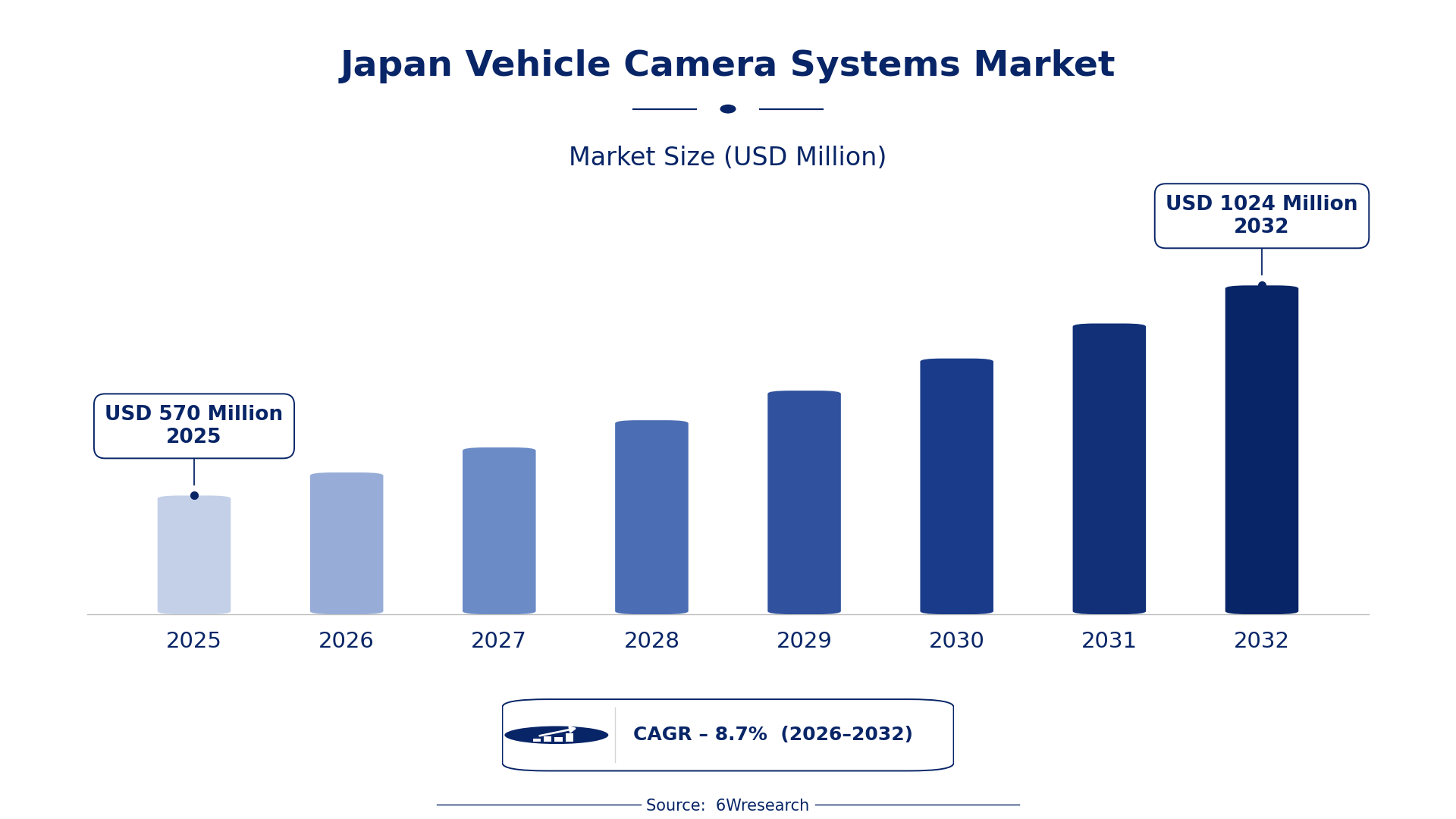
According to 6Wresearch internal database and industry insights, the Japan Vehicle Camera Systems Market was valued at USD 570 Million in 2025 and is projected to reach USD 1,024 Million by 2032, growing at a CAGR of approximately 8.7% during 2026–2032.
Japan Vehicle Camera Systems Market Highlights
| Report Metric | Details |
| Report Name | Japan Vehicle Camera Systems Market (2026-2032) |
| Market Size 2025 | USD 570 Million |
| Market Size 2032 | USD 1,024 Million |
| Absolute Growth 2025–2032 | USD 454 Million |
| CAGR 2026–2032 | 8.7% |
| Peak Annual Growth | 10.1% in 2032 |
| Forecast Period | 2026–2032 |
| Historical Data | 2022–2025 |
| Base Year | 2025 |
| Leading Camera Type, 2025 | Rear-View Cameras (42% share) |
| Leading Mounting Location, 2025 | Rear Bumper (54% share) |
| Leading Feature Functionality, 2025 | Reverse Assistance (42% share) |
| Leading End User, 2025 | Passenger Car OEMs (39% share) |
| Fastest-Growing Camera Type | Surround View Cameras (12.2% CAGR) |
| Fastest-Growing Mounting Location | All Sides (11.3% CAGR) |
| Fastest-Growing Feature Functionality | 360-Degree Monitoring (11.6% CAGR) |
| Fastest-Growing End User | Premium Vehicle Brands (11.9% CAGR) |
| Growing Sector | automotive safety technology |
| Key End Users | Passenger Car OEMs, Premium Vehicle Brands, ADAS System Integrators |
Japan Vehicle Camera Systems Market Year-wise Growth Rate and Key Drivers (2022–2032)
This graph illustrates the annual growth rates of the market from 2022 to 2032, highlighting a steady upward trajectory and projected market expansion over the forecast period.
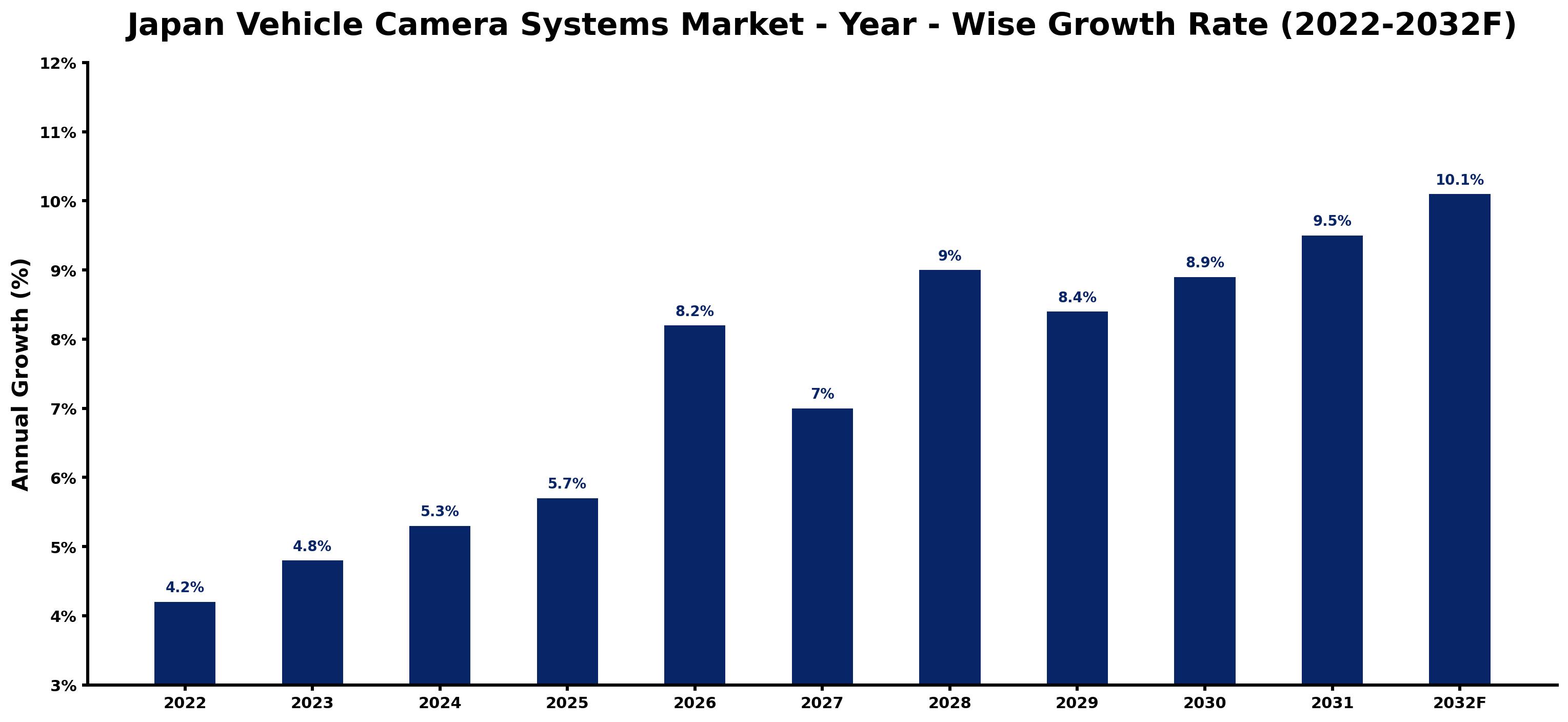
Annual growth estimates for each year appear below with the principal reason behind them, explaining the shifts that set the pace of the market.
| Year | Estimated Annual Growth (%) | Market Rationale |
| 2022 | 4.2 | The market showed steady growth as vehicle safety technologies gained traction. |
| 2023 | 4.8 | Demand increased due to rising awareness of road safety and advanced driver-assistance systems. |
| 2024 | 5.3 | Growth continued as manufacturers integrated more camera systems into new vehicle models. |
| 2025 | 5.7 | The market peaked historically as consumer preferences shifted towards improved safety features. |
| 2026 | 8.2 | Growth accelerated with investments in automotive safety technologies expected to reach ¥1 trillion by 2025. |
| 2027 | 7.0 | The market growth slowed slightly as the adoption rate stabilised among manufacturers. |
| 2028 | 9.0 | Demand surged again as new safety initiatives were introduced by the government. |
| 2029 | 8.4 | Growth moderated as the market adjusted to new safety standards and regulations. |
| 2030 | 8.9 | Demand increased again as manufacturers aimed for compliance with stricter safety regulations. |
| 2031 | 9.5 | The market continued to grow as consumer demand for safety features remained high. |
| 2032 | 10.1 | The market is expected to peak as advanced technologies become standard in vehicles. |
Note: Market size estimations and growth projections presented in this report are based on 6Wresearch's proprietary forecasting methodology, utilizing the latest available industry data, government publications, and primary research inputs.
Japan Vehicle Camera Systems Market Synopsis
Vehicle camera systems are electronic devices that improve visibility and safety in automobiles, utilising advanced imaging technology and sensors. The Japan Vehicle Camera Systems Market is expanding, driven by a population exceeding 126 million and a strong automotive sector. Key factors include a growing focus on safety; over 5 million registered vehicles equipped with rear-view cameras and an adoption rate of surround view cameras in premium vehicles exceeding 60% support this trend.
Market Dynamics Impact Analysis (2026–2032)
| Factor | Type | Impact | Primary Segment Affected |
| Increased focus on vehicle safety features | Driver | High | Rear-View Cameras |
| Growing integration of ADAS technologies | Driver | High | Surround View Cameras |
| Rising demand for retrofitting older vehicles | Opportunity | High | Rear-View Cameras |
| Government funding for automotive safety research | Opportunity | High | All Sides |
| High costs of advanced camera systems | Restraint | Medium | Front Cameras |
| Slow adoption in lower-end vehicle segments | Restraint | Medium | Cabin Cameras |
| Competition from alternative safety technologies | Challenge | High | Surround View Cameras |
| Challenges in standard compliance and certification | Challenge | Medium | Rear-View Cameras |
Evaluation of Drivers in Japan Vehicle Camera Systems Market (2026–2032)
Below are the drivers that matter most for revenue growth, with supporting evidence.
| Drivers | Primary Segment Affected | Why It Matters (Evidence) |
| Growing consumer awareness of road safety | Rear-View Cameras | Over 5 million registered vehicles equipped with rear-view cameras increase demand for safety features. |
| Integration of advanced driver-assistance systems (ADAS) | Surround View Cameras | The adoption rate of surround view cameras in premium vehicles exceeds 60%, driving demand. |
| Government initiatives promoting vehicle safety technologies | Front Cameras | In 2023, a new safety initiative was launched, encouraging manufacturers to adopt advanced camera systems. |
| Increasing average age of vehicles on the road | Cabin Cameras | With an average vehicle age of approximately 13 years, there is a need for retrofitting with modern safety features. |
| Investment in automotive safety technology | All Sides | The automotive sector is projected to invest ¥1 trillion in safety technologies by 2025. |
Purchasing is picking up as consumer awareness of road safety rises, leading to increased demand for vehicle camera systems, with over 5 million vehicles already equipped with rear-view cameras. The integration of advanced driver-assistance systems is driving the adoption of surround view cameras, which have a 60% uptake in premium vehicles. The average age of vehicles on Japanese roads is around 13 years, creating a need for retrofitting older models with additional safety features. Investments in automotive safety technology, projected to reach ¥1 trillion by 2025, further support market growth, particularly in the Tokyo region where automotive technology is rapidly evolving.
Evaluation of Restraints in Japan Vehicle Camera Systems Market
The main factors holding the market back are set out below.
| Market Restraint | Primary Segment Affected | Why It Matters (Evidence) |
| High costs associated with advanced camera systems | Front Cameras | The average cost of a rear-view camera system is around ¥50,000, limiting adoption in budget vehicles. |
| Slow adoption rates in lower-end vehicle segments | Cabin Cameras | Many budget models lack the infrastructure for advanced safety features, hindering market penetration. |
| Competition from alternative safety technologies | Surround View Cameras | Emerging technologies may divert investment away from traditional camera systems. |
| Challenges in compliance with safety standards | Rear-View Cameras | The JIS D 0205 standard requires rigorous testing and certification, complicating market entry. |
| Limited awareness among consumers regarding safety benefits | All Sides | Many consumers remain unaware of the advantages of advanced camera systems, affecting demand. |
Japan Vehicle Camera Systems Market Challenges
In Japan, the complexity of integrating advanced imaging technology in vehicle camera systems delays development timelines. This issue arises from the wide variety of vehicle models, causing manufacturers to extend development periods by up to six months, impacting suppliers' ability to meet market demand. Supply chain disruptions further complicate the situation, with semiconductor shortages leading to a 20% rise in production costs for producers. Compliance with the JIS D 0205 standard adds rigorous testing requirements, prolonging time-to-market for manufacturers. The average cost of ¥50,000 for rear-view camera systems restricts access for buyers, especially in the retrofitting segment.
Trends in the Japan Vehicle Camera Systems Market
Below are the shifts with the largest effect on the Japan Vehicle Camera Systems Market.
- Shift towards Comprehensive Safety Solutions: Japanese consumers are increasingly prioritising comprehensive safety solutions, as seen in the growing adoption of surround view cameras. In 2023, the Tokyo Motor Show showcased numerous innovations in this area, reflecting a shift in consumer preferences towards improved vehicle safety.
- Rising Adoption of Cabin Cameras in Luxury Vehicles: Cabin cameras are becoming more prevalent in luxury vehicles, driven by increasing demand for driver monitoring systems. In 2023, the adoption rate of these systems in premium vehicles rose significantly, indicating a trend towards improved safety features.
- Transition from Basic to Advanced Driver Assistance Systems: There is a noticeable transition from basic safety features to advanced driver assistance systems in Japanese vehicles. The 2023 initiative from the Ministry of Land, Infrastructure, Transport and Tourism supports this shift, promoting the integration of advanced camera technologies.
- Increasing Focus on Retrofit Solutions for Older Vehicles: As the average age of vehicles on Japanese roads approaches 13 years, there is a growing focus on retrofit solutions. The government has allocated ¥10 billion for automotive safety technology research, encouraging upgrades to older models.
Investment Opportunities in the Japan Vehicle Camera Systems Market
Below are the investment opportunities with the strongest case in the Japan Vehicle Camera Systems Market.
- Forming Partnerships with Local Manufacturers: Now is an ideal time to establish partnerships with local manufacturers to supply vehicle camera systems, given the projected ¥1 trillion investment in safety technologies by 2025.
- Targeting the Tokyo Metropolitan Area: With the Tokyo region accounting for 30% of all vehicle camera system installations in Japan, focusing on this area presents a substantial opportunity for suppliers.
- Investing in Retrofit Solutions for Older Vehicles: The average age of vehicles on Japanese roads is approximately 13 years, creating a gap for retrofit solutions. Suppliers can target passenger car OEMs for upgrades.
- Utilising Government Subsidies for Safety Technology Upgrades: The 2023 government subsidy program for safety technology upgrades offers an opportunity for suppliers to enter the market and support vehicle manufacturers.
Government Initiatives in the Japan Vehicle Camera Systems Market
The regulatory environment for vehicle camera systems in Japan is shaped by various laws, including the JIS D 0205 standard, which governs automotive camera systems. The GX Promotion Act, adopted in 2023, aims to enhance safety technologies in vehicles while targeting a reduction in greenhouse gas emissions by 2030. These regulations compel manufacturers to comply with stringent safety standards, ensuring the integration of advanced camera systems in new vehicles.
The Ministry of Land, Infrastructure, Transport and Tourism plays a key role in approving and funding automotive safety technology initiatives. In 2023, the ministry allocated ¥10 billion for research into automotive safety technologies, promoting the development and integration of vehicle camera systems. This funding supports manufacturers in improving their vehicle safety features, aligning with national safety goals.
Future Insight of the Japan Vehicle Camera Systems Market
A policy-driven shift will reshape vehicle camera systems in Japan by 2032, as initiatives focus on reducing greenhouse gas emissions. The government’s allocation of ¥10 billion for automotive safety technology research will stimulate advancements in camera functionalities. New regulations, including ISO 26262, will ensure higher safety standards, benefiting both buyers and suppliers. With the average age of vehicles remaining around 13 years, the demand for retrofitting will expand, creating significant opportunities for advanced camera systems and enhancing overall road safety.
Market Segmentation Analysis
Japan Vehicle Camera Systems Market report covers a detailed analysis of the following market segments:
By Camera Type – Rear-View Cameras Lead, Surround View Cameras Expected to Grow Fastest
According to Saurav Kr Singh, Senior Research Analyst at 6Wresearch, Rear-View Cameras accounted for 42% of the market by camera type in 2025. Rear-view cameras hold the largest share due to their essential role in reversing safety, with over 5 million registered passenger vehicles in Japan equipped with these systems. This widespread adoption underscores their importance for everyday driving and compliance with safety standards. Surround View Cameras are projected to grow fastest, at a CAGR of 12.2% during 2026–2032. Surround view cameras are experiencing rapid growth as they offer comprehensive vehicle awareness, with adoption rates exceeding 60% in premium vehicles. This trend is likely to continue as manufacturers increasingly focus on enhancing safety features in their offerings. Suppliers should prioritise the development of surround view technologies to meet the growing consumer demand.
By Mounting Location – Rear Bumper Leads, All Sides Expected to Grow Fastest
Rear Bumper held 54% of the Japan Vehicle Camera Systems Market by mounting location in 2025. The rear bumper is the most common mounting location for cameras, directly supporting reversing safety features in vehicles. This prevalence is reinforced by the high number of vehicles already equipped with rear-view cameras, ensuring a strong market presence. The quickest growth will come from All Sides, forecast to expand at a CAGR of 11.3% between 2026 and 2032. Mounting cameras on all sides is growing swiftly as it is essential for 360-degree monitoring systems, which are becoming standard in premium vehicles. The increasing focus on safety features is driving this trend among manufacturers. Buyers will increasingly seek vehicles equipped with all sides camera systems for enhanced safety and convenience.
By Feature Functionality – Reverse Assistance Leads, 360-Degree Monitoring Expected to Grow Fastest
With 42% of feature functionality revenue in 2025, Reverse Assistance was the largest category. Reverse assistance functionality is critical for safe reversing, making it the leading feature in vehicle camera systems. Its importance is emphasised by the substantial number of vehicles outfitted with rear-view cameras that provide this essential capability. Over 2026–2032, 360-Degree Monitoring is expected to post the fastest growth, at a CAGR of 11.6%. The functionality of 360-degree monitoring is gaining popularity as it enhances overall vehicle safety, appealing to consumers who value comprehensive awareness while driving. The market shift towards advanced safety features is propelling its rapid growth. Suppliers must focus on integrating 360-degree monitoring capabilities to remain competitive in the market.
By End User – Passenger Car OEMs Lead, Premium Vehicle Brands Expected to Grow Fastest
In 2025, Passenger Car OEMs led the end user split with a 39% share. Passenger car OEMs are the largest user group for vehicle camera systems, reflecting strong demand from both domestic manufacturers and imports in Japan. Their significant investments in safety technologies are a key driver for market growth. Premium Vehicle Brands are set to record the highest CAGR in this split, 11.9% over 2026–2032. Premium vehicle brands are witnessing the fastest growth as they concentrate on advanced safety features, appealing to a consumer base that prioritises high-quality safety technologies. This trend indicates a shift in consumer preferences towards luxury and enhanced safety. Suppliers should engage with premium brands to align with the increasing demand for advanced safety features.
Key Attractiveness of the Report
- 10 Years of Market Numbers
- Historical Data Starting from 2022 to 2025
- Base Year 2025
- Forecast Data until 2032
- Key Performance Indicators Impacting the Market
- Major Upcoming Developments and Projects
Key Highlights of the Report:
- Japan Vehicle Camera Systems Market Outlook
- Market Size of Japan Vehicle Camera Systems Market, 2025
- Forecast of Japan Vehicle Camera Systems Market, 2032
- Historical Data and Forecast of Japan Vehicle Camera Systems Revenues & Volume for the Period 2022-2032F
- Japan Vehicle Camera Systems Market Trend Evolution
- Japan Vehicle Camera Systems Market Drivers and Challenges
- Japan Vehicle Camera Systems Price Trends
- Japan Vehicle Camera Systems Porter's Five Forces
- Japan Vehicle Camera Systems Industry Life Cycle
- Historical Data and Forecast of Japan Vehicle Camera Systems Market Revenues & Volume By Camera Type for the Period 2022-2032F
- Historical Data and Forecast of Japan Vehicle Camera Systems Market Revenues & Volume By Rear-View Cameras for the Period 2022-2032F
- Historical Data and Forecast of Japan Vehicle Camera Systems Market Revenues & Volume By Surround View Cameras for the Period 2022-2032F
- Historical Data and Forecast of Japan Vehicle Camera Systems Market Revenues & Volume By Front Cameras for the Period 2022-2032F
- Historical Data and Forecast of Japan Vehicle Camera Systems Market Revenues & Volume By Cabin Cameras for the Period 2022-2032F
- Historical Data and Forecast of Japan Vehicle Camera Systems Market Revenues & Volume By Mounting Location for the Period 2022-2032F
- Historical Data and Forecast of Japan Vehicle Camera Systems Market Revenues & Volume By Rear Bumper for the Period 2022-2032F
- Historical Data and Forecast of Japan Vehicle Camera Systems Market Revenues & Volume By All Sides for the Period 2022-2032F
- Historical Data and Forecast of Japan Vehicle Camera Systems Market Revenues & Volume By Windshield for the Period 2022-2032F
- Historical Data and Forecast of Japan Vehicle Camera Systems Market Revenues & Volume By Inside Vehicle for the Period 2022-2032F
- Historical Data and Forecast of Japan Vehicle Camera Systems Market Revenues & Volume By Feature Functionality for the Period 2022-2032F
- Historical Data and Forecast of Japan Vehicle Camera Systems Market Revenues & Volume By Reverse Assistance for the Period 2022-2032F
- Historical Data and Forecast of Japan Vehicle Camera Systems Market Revenues & Volume By 360-Degree Monitoring for the Period 2022-2032F
- Historical Data and Forecast of Japan Vehicle Camera Systems Market Revenues & Volume By Lane Assist for the Period 2022-2032F
- Historical Data and Forecast of Japan Vehicle Camera Systems Market Revenues & Volume By Driver Monitoring for the Period 2022-2032F
- Historical Data and Forecast of Japan Vehicle Camera Systems Market Revenues & Volume By End User for the Period 2022-2032F
- Historical Data and Forecast of Japan Vehicle Camera Systems Market Revenues & Volume By Passenger Car OEMs for the Period 2022-2032F
- Historical Data and Forecast of Japan Vehicle Camera Systems Market Revenues & Volume By Premium Vehicle Brands for the Period 2022-2032F
- Historical Data and Forecast of Japan Vehicle Camera Systems Market Revenues & Volume By ADAS System Integrators for the Period 2022-2032F
- Historical Data and Forecast of Japan Vehicle Camera Systems Market Revenues & Volume By Autonomous Fleet Operators for the Period 2022-2032F
- Japan Vehicle Camera Systems Import Export Trade Statistics
- Market Opportunity Assessment By Camera Type
- Market Opportunity Assessment By Mounting Location
- Market Opportunity Assessment By Feature Functionality
- Market Opportunity Assessment By End User
- Japan Vehicle Camera Systems Top Companies Market Share
- Japan Vehicle Camera Systems Competitive Benchmarking By Technical and Operational Parameters
- Japan Vehicle Camera Systems Company Profiles
- Japan Vehicle Camera Systems Key Strategic Recommendations
Market Covered
The study includes the following segmentation.
By Camera Type
- Rear-View Cameras
- Surround View Cameras
- Front Cameras
- Cabin Cameras
By Mounting Location
- Rear Bumper
- All Sides
- Windshield
- Inside Vehicle
By Feature Functionality
- Reverse Assistance
- 360-Degree Monitoring
- Lane Assist
- Driver Monitoring
By End User
- Passenger Car OEMs
- Premium Vehicle Brands
- ADAS System Integrators
- Autonomous Fleet Operators































