Japan Vehicle Certification Services Market Size & Growth Rate
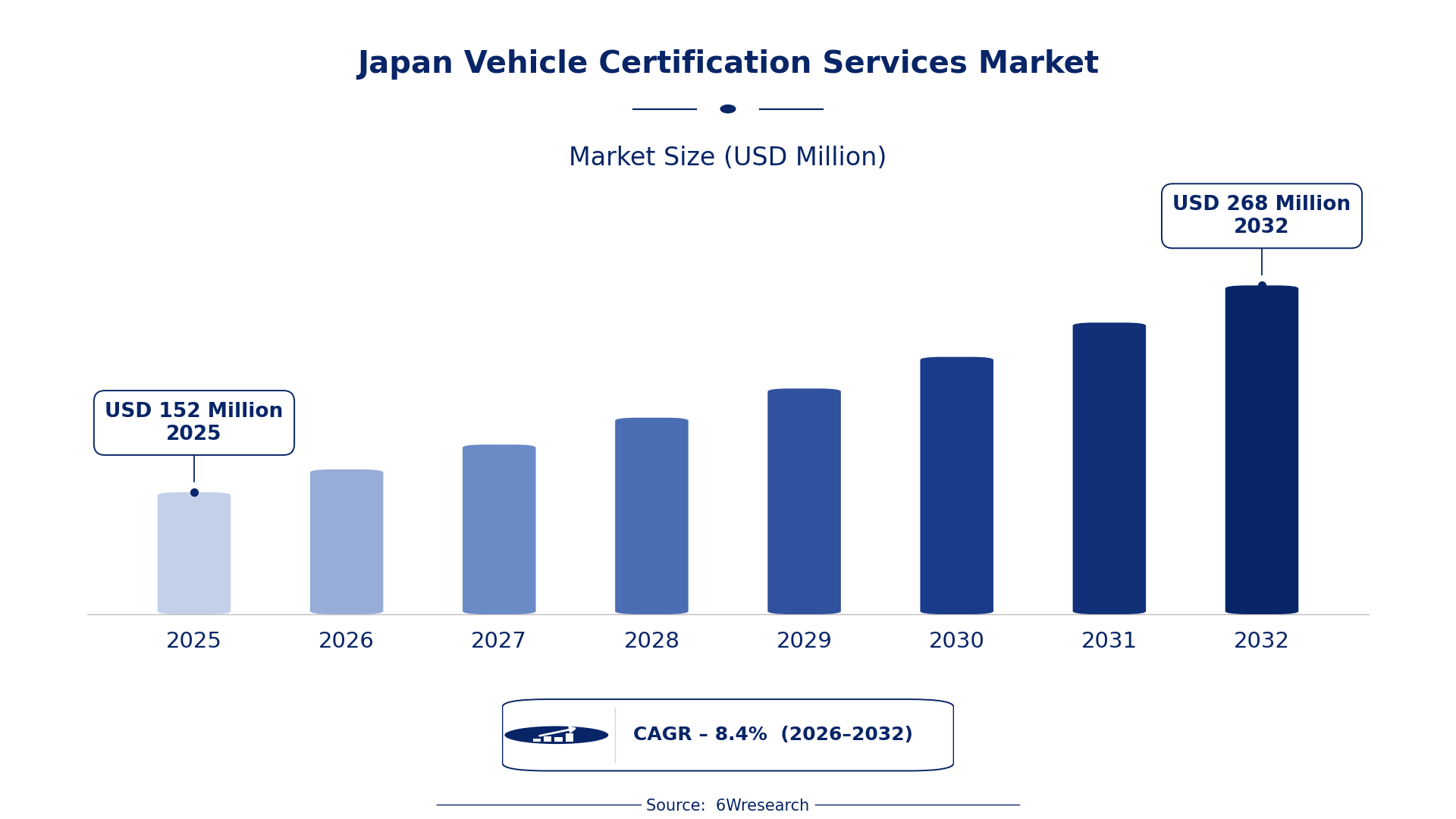
According to 6Wresearch internal database and industry insights, the Japan Vehicle Certification Services Market was valued at USD 152 Million in 2025 and is projected to reach USD 268 Million by 2032, growing at a CAGR of approximately 8.4% during 2026–2032.
Japan Vehicle Certification Services Market Highlights
| Report Metric | Details |
| Report Name | Japan Vehicle Certification Services Market (2026-2032) |
| Market Size 2025 | USD 152 Million |
| Market Size 2032 | USD 268 Million |
| Absolute Growth 2025–2032 | USD 116 Million |
| CAGR 2026–2032 | 8.4% |
| Peak Annual Growth | 9.1% in 2028 |
| Forecast Period | 2026–2032 |
| Historical Data | 2022–2025 |
| Base Year | 2025 |
| Leading Certification Type, 2025 | Emission Certification (49% share) |
| Leading Regulation Standard, 2025 | BS-VI / Euro-6 (48% share) |
| Leading Vehicle Category, 2025 | Passenger Cars (42% share) |
| Leading End User, 2025 | Automotive OEMs (38% share) |
| Fastest-Growing Certification Type | Electric Certification (11.9% CAGR) |
| Fastest-Growing Regulation Standard | AIS 156 / UN R100 (11.4% CAGR) |
| Fastest-Growing Vehicle Category | EVs (10.6% CAGR) |
| Fastest-Growing End User | EV Startups (11.0% CAGR) |
| Growing Sector | Electric Vehicles |
| Key End Users | Automotive OEMs, Testing Agencies, EV Startups, Regulatory Consultants |
Japan Vehicle Certification Services Market Year-wise Growth Rate and Key Drivers (2022–2032)
This graph illustrates the annual growth rates of the market from 2022 to 2032, highlighting a steady upward trajectory and projected market expansion over the forecast period.
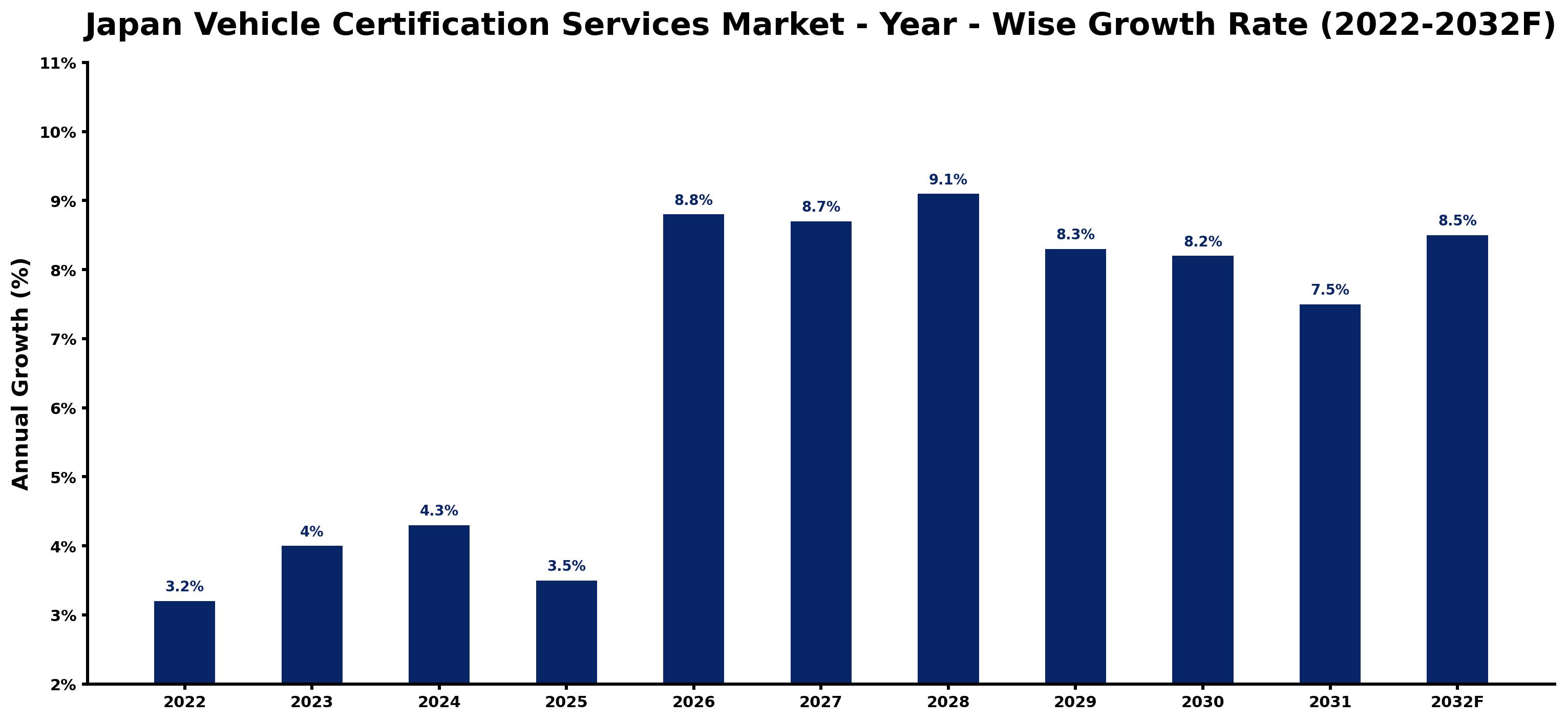
The yearly estimates that follow link every growth rate to its principal driver, so readers can see why the pace changed in each period.
| Year | Estimated Annual Growth (%) | Market Rationale |
| 2022 | 3.2 | The market experienced steady growth due to ongoing regulatory compliance needs. |
| 2023 | 4.0 | Demand increased as stricter emission standards were implemented in Japan. |
| 2024 | 4.3 | Growth continued with rising vehicle registrations and safety compliance requirements. |
| 2025 | 3.5 | Market growth slowed as the impact of new regulations began to stabilise. |
| 2026 | 8.8 | Demand is expected to surge with the growing adoption of electric vehicles and associated certifications. |
| 2027 | 8.7 | A slight slowdown is projected as certification processes become more streamlined. |
| 2028 | 9.1 | Growth is expected to accelerate as new electric vehicle models enter the market, boosting certification needs. |
| 2029 | 8.3 | A slowdown is projected as the market adjusts to the influx of certified electric vehicles. |
| 2030 | 8.2 | Demand is expected to stabilise as the market matures with established certification processes. |
| 2031 | 7.5 | The market will continue to grow as new regulations for emissions compliance are introduced. |
| 2032 | 8.5 | Demand is projected to increase with the government's push for more electric vehicles on the road. |
Note: Market size estimations and growth projections presented in this report are based on 6Wresearch's proprietary forecasting methodology, utilizing the latest available industry data, government publications, and primary research inputs.
Japan Vehicle Certification Services Market Synopsis
Vehicle Certification Services ensure compliance with safety, emissions, and electric vehicle standards through rigorous testing. The Japan Vehicle Certification Services Market is growing due to rising electric vehicle sales, which surpassed 200,000 units in 2022. Government initiatives, including stricter emission standards aligned with Euro-6, are driving further demand. The commitment to achieving net zero emissions by 2050 is increasing the need for these services as manufacturers adapt to evolving regulatory requirements.
Market Dynamics Impact Analysis (2026–2032)
| Factor | Type | Impact | Primary Segment Affected |
| Increasing electric vehicle sales | Driver | High | Electric Certification |
| Stricter emission regulations | Driver | High | Emission Certification |
| Rising demand for electric vehicle certifications | Opportunity | High | Electric Certification |
| Expansion of testing agencies in urban areas | Opportunity | Medium | Safety Compliance |
| High costs associated with compliance testing | Restraint | High | Safety Compliance |
| Lengthy certification process for new models | Restraint | Medium | Electric Certification |
| Limited capacity of testing agencies to meet demand | Challenge | High | Emission Certification |
| Increased competition among certification agencies | Challenge | Medium | Safety Compliance |
Evaluation of Drivers in Japan Vehicle Certification Services Market (2026–2032)
Key forces behind demand, with the segment each one moves most, are listed below.
| Drivers | Primary Segment Affected | Why It Matters (Evidence) |
| Growing electric vehicle sales | Electric Certification | Electric vehicle sales in Japan reached over 200,000 units in 2022, driving the need for certifications. |
| Implementation of stricter emission standards | Emission Certification | In 2023, Japan aligned its emission standards with Euro-6, necessitating compliance for new vehicles. |
| Rising consumer awareness of safety standards | Safety Compliance | Mandatory NCAP ratings for new passenger vehicles sold in Japan increase safety certification needs. |
| Government incentives for electric vehicle adoption | Electric Certification | The government allocated ¥10 billion for EV infrastructure development in 2023, increasing certification needs. |
| Support from industry associations | Safety Compliance | The Automotive Industry Association of Japan promotes compliance with safety standards, boosting demand for certifications. |
The strongest pull on demand comes from the Tokyo region, where electric vehicle sales exceeded 200,000 units in 2022, increasing the need for electric certifications. Stricter emission standards implemented in 2023, aligned with Euro-6, further drive demand for emission certifications. Mandatory NCAP ratings for new passenger vehicles sold in Japan increase consumer awareness of safety standards, leading to heightened demand for safety compliance certifications. Industry associations actively promote adherence to safety standards, reinforcing the need for thorough certification services.
Evaluation of Restraints in Japan Vehicle Certification Services Market
These restraints slow adoption and weigh on supplier margins.
| Market Restraint | Primary Segment Affected | Why It Matters (Evidence) |
| High costs associated with compliance testing | Safety Compliance | Certification processes can be expensive, with costs impacting smaller manufacturers disproportionately. |
| Lengthy certification process for new models | Electric Certification | The average time for vehicle certification is approximately 3-6 months, delaying market entry. |
| Limited capacity of testing agencies to meet demand | Emission Certification | The number of testing agencies may not be sufficient to handle the increasing volume of certifications. |
| Increased competition among certification agencies | Safety Compliance | As more agencies enter the market, price competition can affect service quality. |
| Complexity of regulatory requirements | Electric Certification | Navigating the various standards can be challenging for new entrants in the electric vehicle market. |
Japan Vehicle Certification Services Market Challenges
Lengthy certification processes hinder supply, with an average time of 3-6 months delaying producers from launching new models. Compliance costs are rising due to stricter emission standards, with small suppliers facing testing fees that can consume up to 15% of their budgets. Competition escalates as new electric vehicle startups increase by 30%, compelling established producers to invest heavily in compliance, which can divert resources from innovation. Regulatory changes, such as the 2023 emission standards, impose additional operational costs on testing agencies, impacting their ability to deliver timely services to manufacturers.
Trends in the Japan Vehicle Certification Services Market
Below are the shifts with the largest effect on the Japan Vehicle Certification Services Market.
- Transition to Electric Vehicles: Since 2022, the automotive sector has seen a shift towards electric vehicles, with over 200,000 units sold in Japan. This change means increased demand for electric vehicle certifications, particularly AIS 156.
- Focus on Safety Compliance: In 2023, mandatory NCAP ratings for new passenger vehicles heightened the focus on safety compliance. This shift drives automotive OEMs to invest more in safety certifications to meet consumer expectations.
- Government Investment in EV Infrastructure: In 2023, the government allocated ¥10 billion for EV infrastructure development, signalling a commitment to electric vehicle adoption. This investment is expected to spur demand for related certification services.
- Rise of New Certification Agencies: The last two years have seen a 30% increase in the number of EV startups in Japan, leading to a rise in new certification agencies. This trend reflects the growing need for diverse certification services in the expanding electric vehicle market.
Investment Opportunities in the Japan Vehicle Certification Services Market
The following areas offer the clearest openings for investors and suppliers in the Japan Vehicle Certification Services Market.
- Growing Demand for Electric Vehicle Certifications: With electric vehicle sales exceeding 200,000 units in 2022, there is a strong opportunity for certification services. Automotive OEMs are increasingly seeking compliance for new electric models.
- Expansion of Testing Facilities in Urban Areas: The Tokyo region, a major hub for vehicle certification services, presents an opportunity for new testing facilities. With over 5 million registered passenger cars, the demand for certification is high.
- Investment in Advanced Compliance Technology: As the market grows, investing in advanced compliance technologies can streamline certification processes. Testing agencies can improve their capabilities by adopting ISO 9001 standards.
- Partnerships with Regulatory Consultants: Collaborating with regulatory consultants can help navigate complex compliance requirements. This approach is particularly beneficial for EV startups entering the market.
Government Initiatives in the Japan Vehicle Certification Services Market
The GX Promotion Act of 2023 serves as the legal foundation for the government's green growth strategy, which aims for a reduction in greenhouse gas emissions by 46% from fiscal 2013 levels by fiscal 2030. This act encourages vehicle manufacturers to comply with stricter emissions standards, facilitating the certification process for new vehicles. The government aims for 1 million EVs on the road by 2030, increasing the demand for certification services.
The Ministry of Land, Infrastructure, Transport and Tourism oversees vehicle safety regulations and has implemented measures to support compliance. Agencies involved in testing and certification benefit from government funding, which promotes adherence to safety and environmental standards, ensuring that vehicle certification services meet the latest regulatory requirements.
Future Insight of the Japan Vehicle Certification Services Market
New electric vehicle infrastructure projects will reshape certification services by 2032, driven by government funding of ¥10 billion. Japan's target of 1 million EVs on the road will boost certification demand, creating opportunities for suppliers. The adoption of ISO 9001 standards will streamline testing processes, allowing buyers to benefit from quicker approvals. As over 5 million registered vehicles require certification annually, the need for innovative testing technologies will become crucial to meet rising compliance demands.
Market Segmentation Analysis
Japan Vehicle Certification Services Market report covers a detailed analysis of the following market segments:
By Certification Type – Emission Certification Leads, Electric Certification Expected to Grow Fastest
According to Saurav Kr Singh, Senior Research Analyst at 6Wresearch, Emission Certification held 49% of the Japan Vehicle Certification Services Market by certification type in 2025. Emission Certification holds the largest share as it is essential for compliance with Japan's stringent emissions regulations. The requirement for over 5 million registered passenger cars to undergo this certification annually underscores its critical importance in the automotive sector. Over 2026–2032, Electric Certification is expected to post the fastest growth, at a CAGR of 11.9%. Electric Certification is experiencing rapid growth due to the surge in electric vehicle sales, which exceeded 200,000 units in 2022. As Japan targets 1 million EVs on the road by 2030, the demand for these certifications will continue to rise. Suppliers must enhance their capabilities in electric certification to effectively address the rising demand.
By Regulation Standard – BS-VI / Euro-6 Leads, AIS 156 / UN R100 Expected to Grow Fastest
The largest regulation standard category in 2025 was BS-VI / Euro-6, at 48% of revenue. BS-VI / Euro-6 standards lead the market as they are mandatory for emissions compliance in new vehicles sold in Japan. The introduction of stricter emission regulations reinforces their critical role in vehicle certification processes. The quickest growth will come from AIS 156 / UN R100, forecast to expand at a CAGR of 11.4% between 2026 and 2032. AIS 156 standards are gaining traction as they are crucial for ensuring electric vehicle safety and performance. The increase in electric vehicle startups indicates a growing need for compliance with these standards. Buyers must ensure their vehicles comply with AIS 156 standards to remain competitive in the expanding electric vehicle market.
By Vehicle Category – Passenger Cars Lead, EVs Expected to Grow Fastest
Passenger Cars took 42% of vehicle category revenue in 2025, more than any other category. Passenger Cars represent the largest segment requiring compliance certification due to their widespread use and regulatory requirements. The high volume of passenger vehicles necessitates comprehensive certification processes for safety and emissions compliance. EVs are set to record the highest CAGR in this split, 10.6% over 2026–2032. EVs are the fastest-growing category as the market shifts towards electric mobility, necessitating specific certifications for these vehicles. With government incentives promoting electric vehicle adoption, this segment's growth trajectory is expected to continue. Suppliers should invest in capabilities specifically for the electric vehicle segment to capitalise on this growth opportunity.
By End User – Automotive OEMs Lead, EV Startups Expected to Grow Fastest
With 38% of end user revenue in 2025, Automotive OEMs was the largest category. Automotive OEMs are the primary users of certification services, as they require compliance for their vehicles to be market-ready. Their established presence in the market ensures a consistent demand for certification services. EV Startups are projected to grow fastest, at a CAGR of 11.0% during 2026–2032. EV Startups are rapidly increasing their involvement in certification processes for new electric models, driven by the surge in electric vehicle development. As the number of EV startups has grown by 30% in the last two years, this trend will likely continue. Suppliers must adapt their services to cater to the unique needs of EV startups entering the market.
Key Attractiveness of the Report
- 10 Years of Market Numbers
- Historical Data Starting from 2022 to 2025
- Base Year 2025
- Forecast Data until 2032
- Key Performance Indicators Impacting the Market
- Major Upcoming Developments and Projects
Key Highlights of the Report:
- Japan Vehicle Certification Services Market Outlook
- Market Size of Japan Vehicle Certification Services Market, 2025
- Forecast of Japan Vehicle Certification Services Market, 2032
- Historical Data and Forecast of Japan Vehicle Certification Services Revenues & Volume for the Period 2022-2032F
- Japan Vehicle Certification Services Market Trend Evolution
- Japan Vehicle Certification Services Market Drivers and Challenges
- Japan Vehicle Certification Services Price Trends
- Japan Vehicle Certification Services Porter's Five Forces
- Japan Vehicle Certification Services Industry Life Cycle
- Historical Data and Forecast of Japan Vehicle Certification Services Market Revenues & Volume By Certification Type for the Period 2022-2032F
- Historical Data and Forecast of Japan Vehicle Certification Services Market Revenues & Volume By Emission Certification for the Period 2022-2032F
- Historical Data and Forecast of Japan Vehicle Certification Services Market Revenues & Volume By Safety Compliance for the Period 2022-2032F
- Historical Data and Forecast of Japan Vehicle Certification Services Market Revenues & Volume By Electric Certification for the Period 2022-2032F
- Historical Data and Forecast of Japan Vehicle Certification Services Market Revenues & Volume By Component Testing for the Period 2022-2032F
- Historical Data and Forecast of Japan Vehicle Certification Services Market Revenues & Volume By Regulation Standard for the Period 2022-2032F
- Historical Data and Forecast of Japan Vehicle Certification Services Market Revenues & Volume By BS-VI / Euro-6 for the Period 2022-2032F
- Historical Data and Forecast of Japan Vehicle Certification Services Market Revenues & Volume By NCAP / FMVSS for the Period 2022-2032F
- Historical Data and Forecast of Japan Vehicle Certification Services Market Revenues & Volume By AIS 156 / UN R100 for the Period 2022-2032F
- Historical Data and Forecast of Japan Vehicle Certification Services Market Revenues & Volume By ISO / IEC for the Period 2022-2032F
- Historical Data and Forecast of Japan Vehicle Certification Services Market Revenues & Volume By Vehicle Category for the Period 2022-2032F
- Historical Data and Forecast of Japan Vehicle Certification Services Market Revenues & Volume By ICE Vehicles for the Period 2022-2032F
- Historical Data and Forecast of Japan Vehicle Certification Services Market Revenues & Volume By Passenger Cars for the Period 2022-2032F
- Historical Data and Forecast of Japan Vehicle Certification Services Market Revenues & Volume By EVs for the Period 2022-2032F
- Historical Data and Forecast of Japan Vehicle Certification Services Market Revenues & Volume By Tier 1 Components for the Period 2022-2032F
- Historical Data and Forecast of Japan Vehicle Certification Services Market Revenues & Volume By End User for the Period 2022-2032F
- Historical Data and Forecast of Japan Vehicle Certification Services Market Revenues & Volume By Automotive OEMs for the Period 2022-2032F
- Historical Data and Forecast of Japan Vehicle Certification Services Market Revenues & Volume By Testing Agencies for the Period 2022-2032F
- Historical Data and Forecast of Japan Vehicle Certification Services Market Revenues & Volume By EV Startups for the Period 2022-2032F
- Historical Data and Forecast of Japan Vehicle Certification Services Market Revenues & Volume By Regulatory Consultants for the Period 2022-2032F
- Japan Vehicle Certification Services Import Export Trade Statistics
- Market Opportunity Assessment By Certification Type
- Market Opportunity Assessment By Regulation Standard
- Market Opportunity Assessment By Vehicle Category
- Market Opportunity Assessment By End User
- Japan Vehicle Certification Services Top Companies Market Share
- Japan Vehicle Certification Services Competitive Benchmarking By Technical and Operational Parameters
- Japan Vehicle Certification Services Company Profiles
- Japan Vehicle Certification Services Key Strategic Recommendations
Market Covered
The report covers the following segments.
By Certification Type
- Emission Certification
- Safety Compliance
- Electric Certification
- Component Testing
By Regulation Standard
- BS-VI / Euro-6
- NCAP / FMVSS
- AIS 156 / UN R100
- ISO / IEC
By Vehicle Category
- ICE Vehicles
- Passenger Cars
- EVs
- Tier 1 Components
By End User
- Automotive OEMs
- Testing Agencies
- EV Startups
- Regulatory Consultants































