Japan Vehicle Chassis Components Market Size & Growth Rate
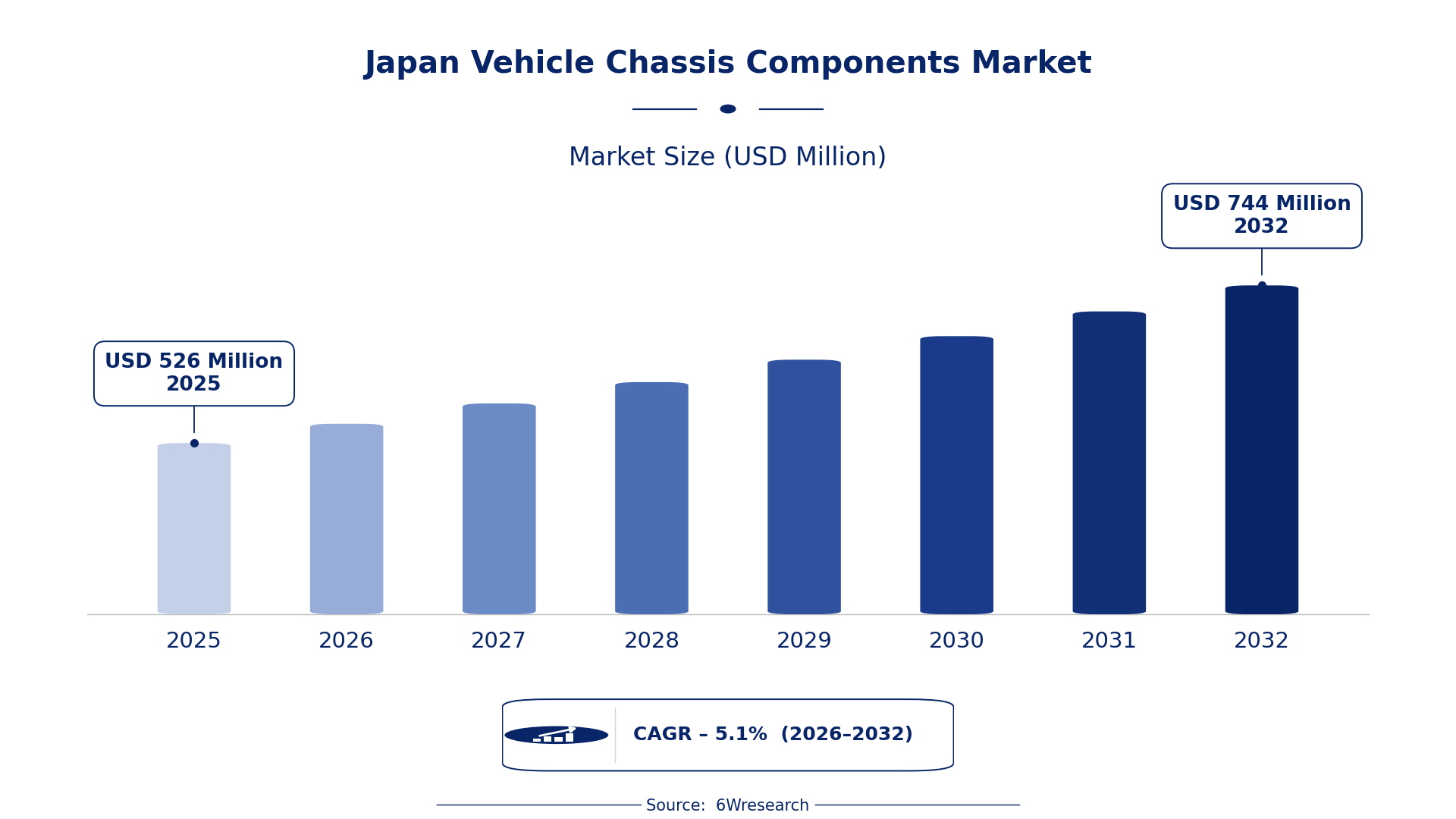
According to 6Wresearch internal database and industry insights, the Japan Vehicle Chassis Components Market was valued at USD 526 Million in 2025 and is projected to reach USD 744 Million by 2032, growing at a CAGR of approximately 5.1% during 2026–2032.
Japan Vehicle Chassis Components Market Highlights
| Report Metric | Details |
| Report Name | Japan Vehicle Chassis Components Market (2026-2032) |
| Market Size 2025 | USD 526 Million |
| Market Size 2032 | USD 744 Million |
| Absolute Growth 2025–2032 | USD 218 Million |
| CAGR 2026–2032 | 5.1% |
| Peak Annual Growth | 6.0% in 2032 |
| Forecast Period | 2026–2032 |
| Historical Data | 2022–2025 |
| Base Year | 2025 |
| Leading Component Type, 2025 | Cross Members (43% share) |
| Leading Material Type, 2025 | High-Strength Steel (46% share) |
| Leading Application Area, 2025 | Frame Support (48% share) |
| Leading End User, 2025 | Passenger Car OEMs (42% share) |
| Fastest-Growing Component Type | Control Arms (7.2% CAGR) |
| Fastest-Growing Material Type | Forged Aluminum (7.7% CAGR) |
| Fastest-Growing Application Area | Suspension Systems (6.2% CAGR) |
| Fastest-Growing End User | Sports Car Makers (6.6% CAGR) |
| Growing Sector | automotive |
| Key End Users | Passenger Car OEMs, Truck OEMs, Sports Car Makers, Compact Car OEMs |
Japan Vehicle Chassis Components Market Year-wise Growth Rate and Key Drivers (2022–2032)
This graph illustrates the annual growth rates of the market from 2022 to 2032, highlighting a steady upward trajectory and projected market expansion over the forecast period.
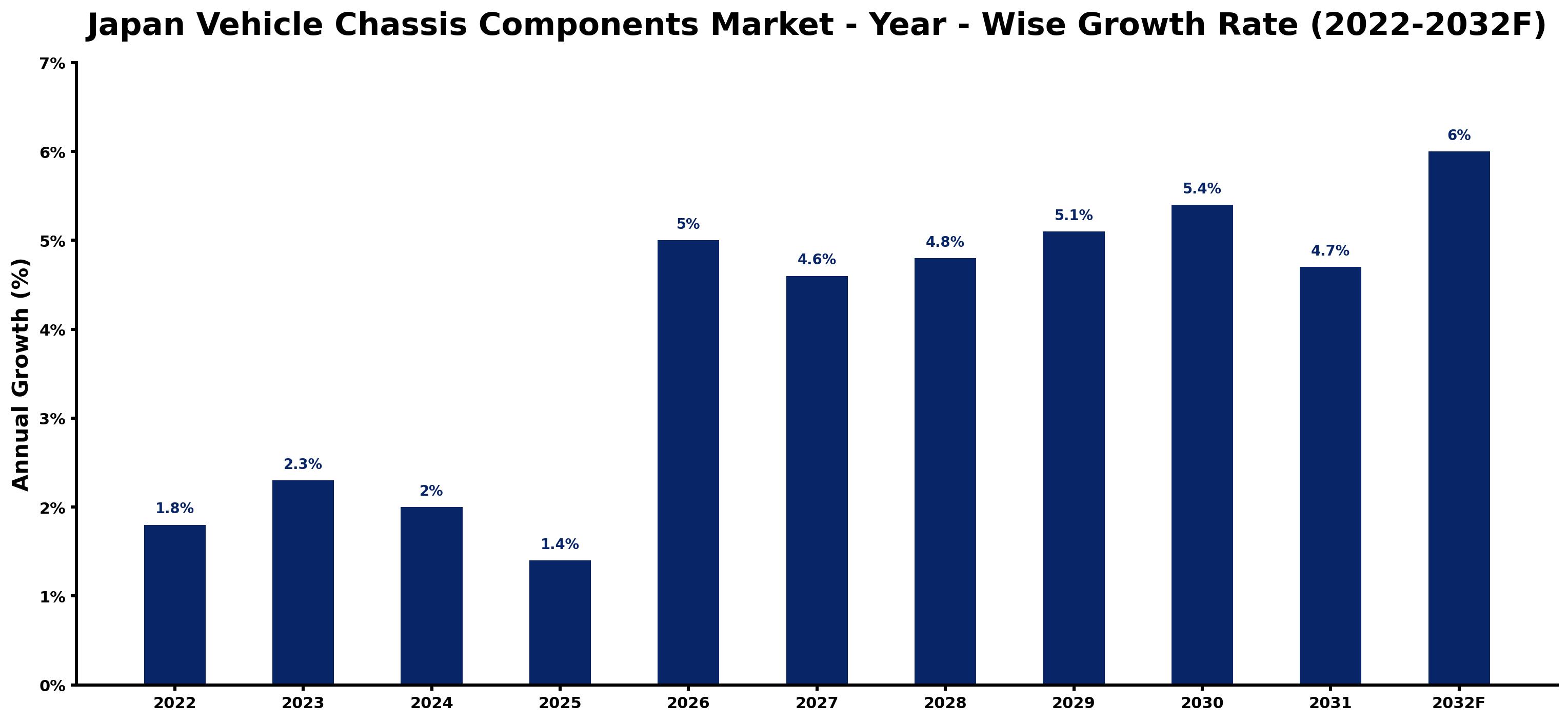
Annual growth estimates for each year appear below with the principal reason behind them, explaining the shifts that set the pace of the market.
| Year | Estimated Annual Growth (%) | Market Rationale |
| 2022 | 1.8 | The market experienced steady growth, reflecting ongoing demand from the automotive sector. |
| 2023 | 2.3 | Growth accelerated due to increased vehicle production and rising demand for chassis components. |
| 2024 | 2.0 | The growth rate slowed slightly as manufacturers adjusted to supply chain challenges. |
| 2025 | 1.4 | A further slowdown occurred as production stabilised and demand normalised. |
| 2026 | 5.0 | Growth is expected to rebound sharply as investments in lightweight materials begin to materialise. |
| 2027 | 4.6 | The market is projected to continue growing, although at a slower pace due to market saturation. |
| 2028 | 4.8 | Growth is expected to pick up again as new technologies in chassis components gain traction. |
| 2029 | 5.1 | The upward trend is projected to persist as demand for high-performance vehicles increases. |
| 2030 | 5.4 | Growth will remain strong, driven by ongoing investments in automotive innovation. |
| 2031 | 4.7 | A slight slowdown is expected as market conditions begin to stabilise. |
| 2032 | 6.0 | The market is projected to peak, driven by heightened demand for advanced chassis technologies. |
Note: Market size estimations and growth projections presented in this report are based on 6Wresearch's proprietary forecasting methodology, utilizing the latest available industry data, government publications, and primary research inputs.
Japan Vehicle Chassis Components Market Synopsis
Vehicle chassis components are critical for providing structural support and stability in vehicles, primarily manufactured from high-strength steel, aluminum, and composites through processes such as forging and machining. The Japan Vehicle Chassis Components Market is experiencing growth due to increased vehicle production, with approximately 9.7 million vehicles produced in 2022, and a rising focus on lightweight materials. The 2023 programme by the Ministry of Economy, Trade and Industry to promote lightweight materials further fuels demand, particularly among passenger car OEMs and sports car makers.
Market Dynamics Impact Analysis (2026–2032)
| Factor | Type | Impact | Primary Segment Affected |
| Increased vehicle production drives demand for chassis components. | Driver | High | Cross Members |
| Growing emphasis on lightweight materials enhances performance and efficiency. | Driver | High | Forged Aluminum |
| Rising demand for electric vehicles creates opportunities for innovative chassis solutions. | Opportunity | High | Control Arms |
| Investment in advanced manufacturing technologies supports new product development. | Opportunity | Medium | Subframes |
| Supply chain disruptions can delay component availability and increase costs. | Restraint | High | Torsion Beams |
| The average age of vehicles in Japan impacts the replacement parts market. | Restraint | Medium | Frame Support |
| Competition from international suppliers pressures local manufacturers' pricing. | Challenge | High | Suspension Systems |
| Technological advancements require continuous investment, straining smaller firms. | Challenge | Medium | Load Distribution |
Evaluation of Drivers in Japan Vehicle Chassis Components Market (2026–2032)
The factors lifting demand, and the evidence behind each, are summarised below.
| Drivers | Primary Segment Affected | Why It Matters (Evidence) |
| Increased vehicle production in Japan boosts demand for chassis components. | Cross Members | Approximately 9.7 million vehicles were produced in 2022, leading to higher component orders. |
| Growing focus on lightweight materials improves vehicle performance and efficiency. | Forged Aluminum | The use of aluminum in chassis components is increasing, particularly in sports and luxury vehicles. |
| The push for electric vehicles necessitates advanced chassis solutions. | Control Arms | Japan targets a 46% cut in greenhouse-gas emissions by 2030, driving demand for efficient components. |
| Investment in advanced manufacturing technologies supports new product development. | Subframes | The Kanagawa Prefecture is known for its advanced automotive manufacturing facilities. |
| Rising average vehicle age increases demand for replacement chassis components. | Torsion Beams | The average age of vehicles in Japan is 13 years, impacting the replacement parts market. |
A wider customer base explains much of the growth, as increased vehicle production in Japan boosts demand for chassis components. In 2022, approximately 9.7 million vehicles were produced, leading to higher orders for components. The growing focus on lightweight materials improves vehicle performance, with aluminum use rising, particularly in sports and luxury vehicles. Japan's target to cut greenhouse-gas emissions by 46% by 2030 necessitates advanced chassis solutions. Investment in advanced manufacturing technologies, especially in Kanagawa Prefecture, supports new product development, while the rising average age of vehicles increases demand for replacement components.
Evaluation of Restraints in Japan Vehicle Chassis Components Market
Below are the constraints most often cited by buyers and suppliers, with the segment each affects.
| Market Restraint | Primary Segment Affected | Why It Matters (Evidence) |
| Supply chain disruptions can delay component availability and increase costs. | Torsion Beams | Manufacturers faced challenges in sourcing materials, impacting production timelines. |
| The average age of vehicles in Japan impacts the replacement parts market. | Frame Support | Older vehicles require more frequent replacement of chassis components, straining supply. |
| Competition from international suppliers pressures local manufacturers' pricing. | Suspension Systems | Local producers must compete with lower-priced imports, affecting profitability. |
| Technological advancements require continuous investment, straining smaller firms. | Load Distribution | Smaller manufacturers may struggle to keep pace with rapid technological changes. |
| Regulatory compliance can increase production costs for manufacturers. | Cross Members | Adhering to standards like ISO 9001 requires investment in quality management systems. |
Japan Vehicle Chassis Components Market Challenges
Japan's regulations aimed at reducing greenhouse-gas emissions are increasing compliance costs for producers, with estimates indicating a rise of up to 10% in operational expenses. As manufacturers shift to lightweight materials, production timelines can extend by several weeks, delaying deliveries for buyers who depend on just-in-time inventory. Supply chain challenges arise from reliance on high-strength steel and aluminium, inflating input costs by approximately 15% for producers. Technological advancements in chassis design require substantial investments, which may strain smaller suppliers and limit their competitiveness against larger firms.
Trends in the Japan Vehicle Chassis Components Market
The shifts below are changing how Japan Vehicle Chassis Components Market products are bought and supplied.
- Shift to Lightweight Materials in Automotive Manufacturing: The Tokyo region is increasingly adopting lightweight materials for chassis components, driven by the need for better fuel efficiency. In 2023, the Ministry of Economy, Trade and Industry launched a programme promoting these materials.
- Growing Use of High-Strength Steel: High-strength steel is becoming the preferred choice for chassis components, accounting for about 60% of usage. This shift improves vehicle durability and safety, aligning with the industry's focus on performance.
- Emphasis on Sustainability in Vehicle Design: Japan's automotive sector is prioritising sustainable practices, with a target to reduce vehicle emissions by 30% by 2030. This trend influences chassis design, pushing for eco-friendly materials.
- Increased Demand for Performance Components: Sports car makers are driving demand for high-performance chassis components, with a CAGR of 6.6% expected from 2026 to 2032. This trend reflects a growing consumer preference for performance vehicles.
Investment Opportunities in the Japan Vehicle Chassis Components Market
Where to invest in the Japan Vehicle Chassis Components Market: the main openings are set out below.
- Investment in Advanced Manufacturing Facilities: The Kanagawa Prefecture is expanding its automotive manufacturing capabilities, creating opportunities for suppliers of chassis components. With a projected investment of JPY 150 trillion over ten years, this region is ripe for partnerships.
- Focus on Electric Vehicle Components: As Japan targets a 46% cut in greenhouse-gas emissions by 2030, there is a growing need for chassis solutions tailored for electric vehicles. Suppliers can enter this market by collaborating with local OEMs.
- Expansion of Lightweight Material Applications: The 2023 programme promoting lightweight materials presents a timely opportunity for manufacturers. By supplying high-strength steel and aluminum components, businesses can meet the evolving demands of the automotive sector.
- Partnerships with Passenger Car OEMs: With passenger car OEMs accounting for 42% of chassis component demand, suppliers can benefit from strategic partnerships. Establishing local joint ventures can facilitate market entry and growth.
Government Initiatives in the Japan Vehicle Chassis Components Market
The regulatory framework for vehicle chassis components in Japan is shaped by laws such as the Green Growth Strategy, which identifies growth sectors for sustainable development. The GX Promotion Act of 2023 establishes a legal basis for promoting green technologies, influencing manufacturers to adopt eco-friendly practices in chassis production.
The Ministry of Economy, Trade and Industry (METI) oversees the approval and funding of initiatives aimed at advancing the automotive sector. METI's Battery Industry Strategy supports the demand for lightweight chassis components, indirectly benefiting manufacturers.
Future Insight of the Japan Vehicle Chassis Components Market
Investment in lightweight materials will increase, driven by government initiatives promoting reduced vehicle emissions. By 2032, the demand for high-strength steel will evolve as aluminium usage rises, particularly in luxury vehicles. New design standards will emerge, compelling suppliers to develop advanced chassis solutions that align with sustainability goals. The Japanese automotive market, valued at approximately $45 billion in 2022, is projected to expand as these trends create opportunities for both buyers and suppliers.
Market Segmentation Analysis
Japan Vehicle Chassis Components Market report covers a detailed analysis of the following market segments:
By Component Type – Cross Members Lead, Control Arms Expected to Grow Fastest
According to Saurav Kr Singh, Senior Research Analyst at 6Wresearch, in 2025, Cross Members led the component type split with a 43% share. Cross members are essential for providing structural integrity to vehicle frames, which is critical for manufacturers prioritising safety. The robust production of approximately 9.7 million vehicles in Japan in 2022 illustrates the ongoing demand for these components. Control Arms are projected to grow fastest, at a CAGR of 7.2% during 2026–2032. Control arms play a vital role in suspension systems, which are increasingly emphasised in modern vehicle design for better handling. This focus on enhancing vehicle dynamics is likely to drive the rapid growth of this segment. Suppliers should focus on advancements in control arm technologies to meet the rising demands from manufacturers.
By Material Type – High-Strength Steel Leads, Forged Aluminum Expected to Grow Fastest
High-Strength Steel took 46% of material type revenue in 2025, more than any other category. High-strength steel accounts for about 60% of chassis components due to its durability and strength, making it the preferred choice for manufacturers. This extensive use underscores the industry's commitment to producing safe and reliable vehicles. The quickest growth will come from Forged Aluminum, forecast to expand at a CAGR of 7.7% between 2026 and 2032. Forged aluminum is gaining traction, especially in performance vehicles where lightweight components are crucial for speed and efficiency. The automotive industry's shift towards lighter materials is a key factor propelling this segment's growth. Buyers are expected to seek suppliers capable of providing advanced lightweight materials to enhance vehicle performance.
By Application Area – Frame Support Leads, Suspension Systems Expected to Grow Fastest
With 48% of application area revenue in 2025, Frame Support was the largest category. Frame support is integral to maintaining vehicle structure and safety, making it a primary focus for manufacturers in the automotive sector. This importance is reflected in the sector's employment of approximately 5.5 million people in Japan, highlighting the need for reliable components. Suspension Systems are set to record the highest CAGR in this split, 6.2% over 2026–2032. Suspension systems are critical for vehicle stability and comfort, leading to increased investments in this area. As manufacturers strive to improve ride quality, this segment is well-positioned for rapid growth. Suppliers should consider developing advanced suspension technologies to meet the changing requirements of automotive manufacturers.
By End User – Passenger Car OEMs Lead, Sports Car Makers Expected to Grow Fastest
Passenger Car OEMs accounted for 42% of the market by end user in 2025. Passenger car OEMs are the primary consumers of chassis components, producing mass-market vehicles that require reliable and cost-effective solutions. Their significant market presence ensures a consistent demand for these components. Over 2026–2032, Sports Car Makers are expected to post the fastest growth, at a CAGR of 6.6%. Sports car makers are increasingly incorporating high-performance chassis components to enhance vehicle performance, reflecting a trend towards premium offerings. This emphasis on performance is likely to accelerate growth in this segment. Suppliers must align their products with the high-performance standards expected by sports car manufacturers to capitalise on this expanding market.
Key Attractiveness of the Report
- 10 Years of Market Numbers
- Historical Data Starting from 2022 to 2025
- Base Year 2025
- Forecast Data until 2032
- Key Performance Indicators Impacting the Market
- Major Upcoming Developments and Projects
Key Highlights of the Report:
- Japan Vehicle Chassis Components Market Outlook
- Market Size of Japan Vehicle Chassis Components Market, 2025
- Forecast of Japan Vehicle Chassis Components Market, 2032
- Historical Data and Forecast of Japan Vehicle Chassis Components Revenues & Volume for the Period 2022-2032F
- Japan Vehicle Chassis Components Market Trend Evolution
- Japan Vehicle Chassis Components Market Drivers and Challenges
- Japan Vehicle Chassis Components Price Trends
- Japan Vehicle Chassis Components Porter's Five Forces
- Japan Vehicle Chassis Components Industry Life Cycle
- Historical Data and Forecast of Japan Vehicle Chassis Components Market Revenues & Volume By Component Type for the Period 2022-2032F
- Historical Data and Forecast of Japan Vehicle Chassis Components Market Revenues & Volume By Cross Members for the Period 2022-2032F
- Historical Data and Forecast of Japan Vehicle Chassis Components Market Revenues & Volume By Control Arms for the Period 2022-2032F
- Historical Data and Forecast of Japan Vehicle Chassis Components Market Revenues & Volume By Subframes for the Period 2022-2032F
- Historical Data and Forecast of Japan Vehicle Chassis Components Market Revenues & Volume By Torsion Beams for the Period 2022-2032F
- Historical Data and Forecast of Japan Vehicle Chassis Components Market Revenues & Volume By Material Type for the Period 2022-2032F
- Historical Data and Forecast of Japan Vehicle Chassis Components Market Revenues & Volume By High-Strength Steel for the Period 2022-2032F
- Historical Data and Forecast of Japan Vehicle Chassis Components Market Revenues & Volume By Forged Aluminum for the Period 2022-2032F
- Historical Data and Forecast of Japan Vehicle Chassis Components Market Revenues & Volume By Composite Materials for the Period 2022-2032F
- Historical Data and Forecast of Japan Vehicle Chassis Components Market Revenues & Volume By Cast Iron for the Period 2022-2032F
- Historical Data and Forecast of Japan Vehicle Chassis Components Market Revenues & Volume By Application Area for the Period 2022-2032F
- Historical Data and Forecast of Japan Vehicle Chassis Components Market Revenues & Volume By Frame Support for the Period 2022-2032F
- Historical Data and Forecast of Japan Vehicle Chassis Components Market Revenues & Volume By Suspension Systems for the Period 2022-2032F
- Historical Data and Forecast of Japan Vehicle Chassis Components Market Revenues & Volume By Load Distribution for the Period 2022-2032F
- Historical Data and Forecast of Japan Vehicle Chassis Components Market Revenues & Volume By Rear Suspension for the Period 2022-2032F
- Historical Data and Forecast of Japan Vehicle Chassis Components Market Revenues & Volume By End User for the Period 2022-2032F
- Historical Data and Forecast of Japan Vehicle Chassis Components Market Revenues & Volume By Truck OEMs for the Period 2022-2032F
- Historical Data and Forecast of Japan Vehicle Chassis Components Market Revenues & Volume By Passenger Car OEMs for the Period 2022-2032F
- Historical Data and Forecast of Japan Vehicle Chassis Components Market Revenues & Volume By Sports Car Makers for the Period 2022-2032F
- Historical Data and Forecast of Japan Vehicle Chassis Components Market Revenues & Volume By Compact Car OEMs for the Period 2022-2032F
- Japan Vehicle Chassis Components Import Export Trade Statistics
- Market Opportunity Assessment By Component Type
- Market Opportunity Assessment By Material Type
- Market Opportunity Assessment By Application Area
- Market Opportunity Assessment By End User
- Japan Vehicle Chassis Components Top Companies Market Share
- Japan Vehicle Chassis Components Competitive Benchmarking By Technical and Operational Parameters
- Japan Vehicle Chassis Components Company Profiles
- Japan Vehicle Chassis Components Key Strategic Recommendations
Market Covered
This report examines the market across the segments below.
By Component Type
- Cross Members
- Control Arms
- Subframes
- Torsion Beams
By Material Type
- High-Strength Steel
- Forged Aluminum
- Composite Materials
- Cast Iron
By Application Area
- Frame Support
- Suspension Systems
- Load Distribution
- Rear Suspension
By End User
- Truck OEMs
- Passenger Car OEMs
- Sports Car Makers
- Compact Car OEMs































