Japan Vehicle Comfort Sensors Market Size & Growth Rate
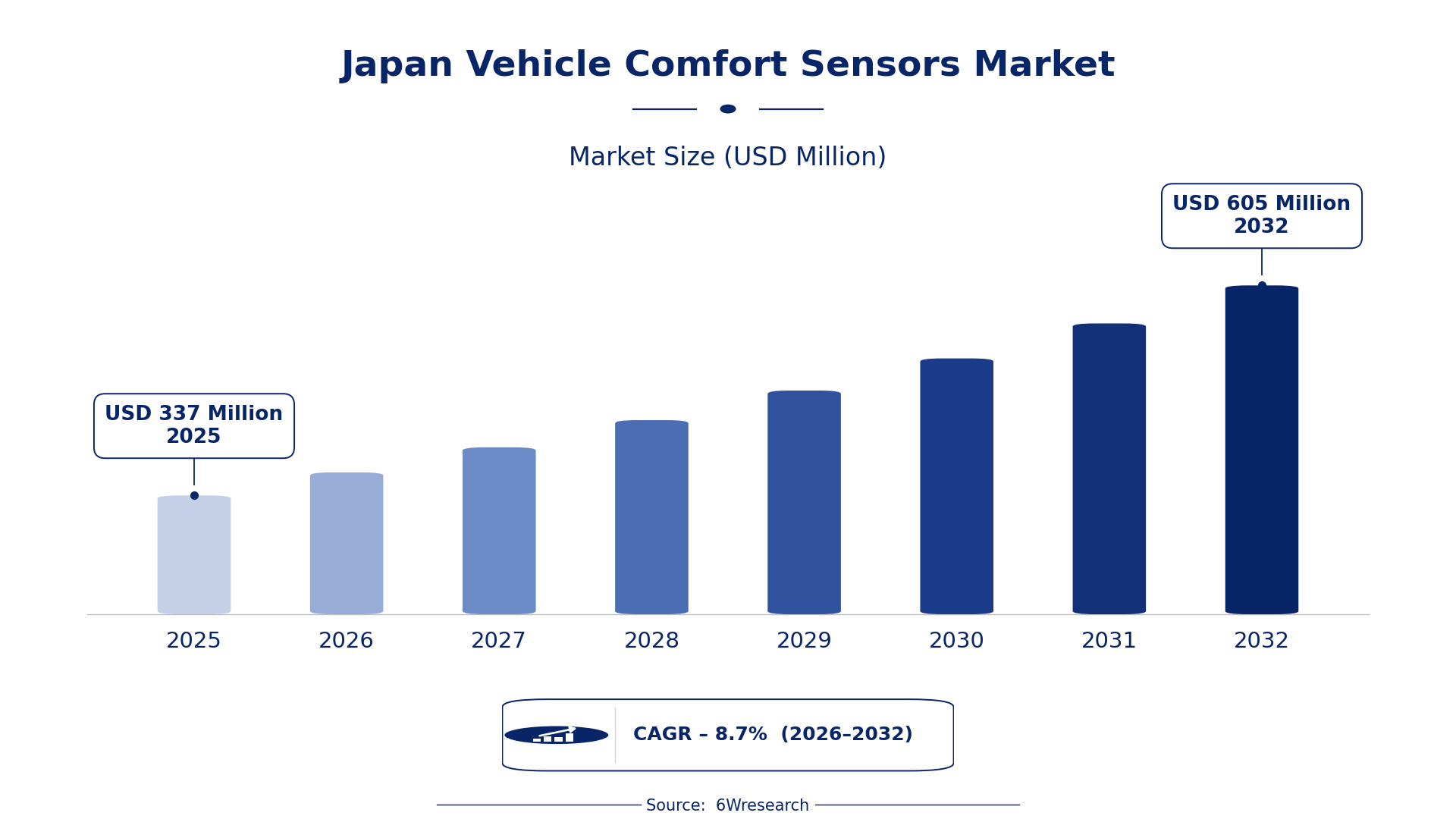
According to 6Wresearch internal database and industry insights, the Japan Vehicle Comfort Sensors Market was valued at USD 337 Million in 2025 and is projected to reach USD 605 Million by 2032, growing at a CAGR of approximately 8.7% during 2026–2032.
Japan Vehicle Comfort Sensors Market Highlights
| Report Metric | Details |
| Report Name | Japan Vehicle Comfort Sensors Market (2026-2032) |
| Market Size 2025 | USD 337 Million |
| Market Size 2032 | USD 605 Million |
| Absolute Growth 2025–2032 | USD 268 Million |
| CAGR 2026–2032 | 8.7% |
| Peak Annual Growth | 9.5% in 2032 |
| Forecast Period | 2026–2032 |
| Historical Data | 2022–2025 |
| Base Year | 2025 |
| Leading Sensor Type, 2025 | Cabin Temperature Sensors (39% share) |
| Leading Functionality, 2025 | Presence Detection (37% share) |
| Leading Integration Area, 2025 | HVAC (38% share) |
| Leading End User, 2025 | Luxury Vehicle OEMs (52% share) |
| Fastest-Growing Sensor Type | Humidity Sensors (12.8% CAGR) |
| Fastest-Growing Functionality | Auto Tint Adjustment (11.3% CAGR) |
| Fastest-Growing Integration Area | Cabin Seating (10.4% CAGR) |
| Fastest-Growing End User | Interior System OEMs (11.2% CAGR) |
| Growing Sector | automotive |
| Key End Users | Luxury Vehicle OEMs, Interior System OEMs, Safety Component Integrators |
Japan Vehicle Comfort Sensors Market Year-wise Growth Rate and Key Drivers (2022–2032)
This graph illustrates the annual growth rates of the market from 2022 to 2032, highlighting a steady upward trajectory and projected market expansion over the forecast period.
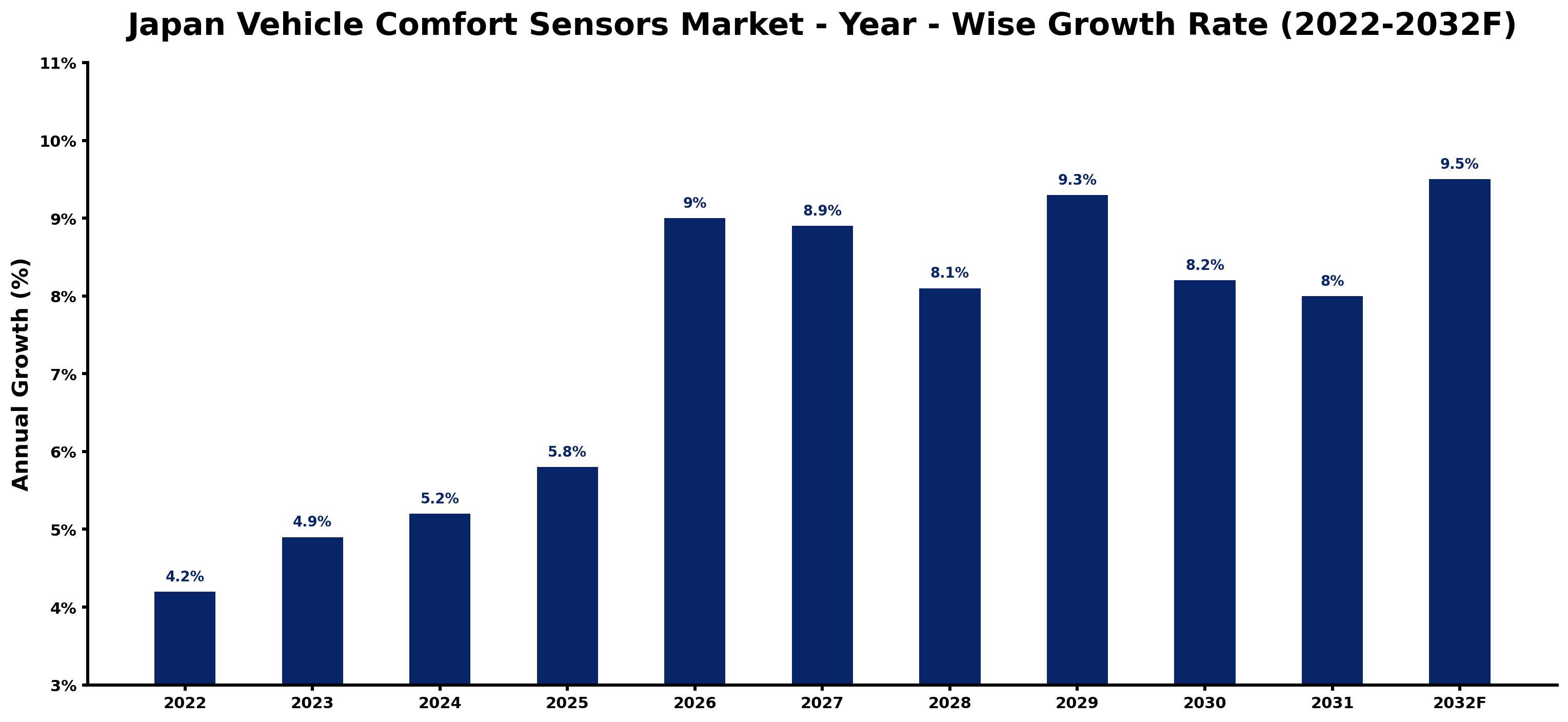
For each year, the table pairs the estimated growth rate with the leading influence on demand, showing how the drivers changed across the period.
| Year | Estimated Annual Growth (%) | Market Rationale |
| 2022 | 4.2 | Demand was stable as the automotive industry continued to recover from previous disruptions. |
| 2023 | 4.9 | Growth accelerated due to increased consumer interest in advanced vehicle features and technologies. |
| 2024 | 5.2 | Rising sales of luxury vehicles drove demand for comfort sensors and related technologies. |
| 2025 | 5.8 | The introduction of new safety regulations boosted sensor integration across various vehicle models. |
| 2026 | 9.0 | Demand is expected to surge as manufacturers focus on improving passenger comfort and safety features. |
| 2027 | 8.9 | Growth is projected to slow slightly as market saturation begins in certain segments of the automotive industry. |
| 2028 | 8.1 | Continued innovation in sensor technology is expected to maintain positive growth in the market. |
| 2029 | 9.3 | Demand will increase again as electric vehicles gain popularity, requiring advanced sensor technologies. |
| 2030 | 8.2 | A slight slowdown is anticipated as the market adjusts to evolving industry standards and requirements. |
| 2031 | 8.0 | Growth will continue to slow, reflecting a maturing market with established technologies. |
| 2032 | 9.5 | Demand is projected to peak as manufacturers adopt the latest comfort and safety technologies in vehicles. |
Note: Market size estimations and growth projections presented in this report are based on 6Wresearch's proprietary forecasting methodology, utilizing the latest available industry data, government publications, and primary research inputs.
Japan Vehicle Comfort Sensors Market Synopsis
Vehicle comfort sensors are electronic devices that improve passenger safety and comfort in automobiles. These sensors detect occupancy, regulate temperature, and adjust window tints. The Japan Vehicle Comfort Sensors Market is growing as luxury vehicle manufacturers increase their output, which accounted for 20% of new sales in 2023. The automotive sector's emphasis on advanced safety features and new programmes promoting smart vehicle technologies are driving investment in sensor integration throughout the industry.
Market Dynamics Impact Analysis (2026–2032)
| Factor | Type | Impact | Primary Segment Affected |
| Growing demand for luxury vehicles drives sensor integration for enhanced comfort features. | Driver | High | Cabin Temperature Sensors |
| Increased adoption of electric vehicles creates a need for advanced climate control systems. | Driver | High | Humidity Sensors |
| The shift towards electric vehicles presents opportunities for sensor manufacturers to innovate. | Opportunity | High | Cabin Temperature Sensors |
| Rising consumer expectations for comfort and safety features in vehicles create demand. | Opportunity | High | Presence Detection |
| High production costs for advanced sensors may limit market entry for new players. | Restraint | Medium | Cabin Temperature Sensors |
| Supply chain disruptions can delay sensor production and delivery schedules. | Restraint | Medium | Humidity Sensors |
| Compliance with stringent safety regulations can increase operational costs for manufacturers. | Challenge | High | Presence Detection |
| Limited availability of skilled workforce affects production capacity in sensor manufacturing. | Challenge | Medium | Cabin Temperature Sensors |
Evaluation of Drivers in Japan Vehicle Comfort Sensors Market (2026–2032)
The main growth drivers and the segments they affect most are set out below.
| Drivers | Primary Segment Affected | Why It Matters (Evidence) |
| Increased production of luxury vehicles drives demand for comfort sensors. | Cabin Temperature Sensors | Luxury vehicles represented 20% of new sales in 2023, boosting sensor integration. |
| The growing electric vehicle market requires advanced climate control solutions. | Humidity Sensors | In 2023, humidity sensors became essential for effective climate control in electric vehicles. |
| Rising average vehicle age necessitates sensor upgrades for improved safety and comfort. | Presence Detection | With an average vehicle age of 11.5 years, upgrades are essential for safety. |
| Technological advancements in sensor technology improve functionality and performance. | Cabin Temperature Sensors | Innovations at the Tokyo Motor Show 2023 highlighted new comfort technologies. |
| Government initiatives support the adoption of smart vehicle technologies. | Humidity Sensors | A new programme launched in 2023 promotes smart vehicle technologies. |
The strongest pull on demand comes from the increased production of luxury vehicles, which represented 20% of new sales in 2023, creating a need for more comfort sensors. The electric vehicle market is expanding, necessitating advanced climate control solutions, with humidity sensors being increasingly implemented. The average vehicle age in Japan is 11.5 years, leading to a demand for sensor upgrades to ensure safety and comfort. Innovations presented at the Tokyo Motor Show 2023 have improved sensor functionality.
Evaluation of Restraints in Japan Vehicle Comfort Sensors Market
The main factors holding the market back are set out below.
| Market Restraint | Primary Segment Affected | Why It Matters (Evidence) |
| High production costs for advanced sensors limit market entry for new players. | Cabin Temperature Sensors | The average number of sensors in a luxury vehicle is around 30, increasing overall costs. |
| Supply chain disruptions can delay sensor production and delivery schedules. | Humidity Sensors | The automotive supply chain in Japan includes over 5,000 suppliers, complicating logistics. |
| Compliance with stringent safety regulations increases operational costs for manufacturers. | Presence Detection | The JIS B 8350 standard applies to automotive sensors, necessitating compliance. |
| Limited availability of skilled workforce affects production capacity in sensor manufacturing. | Cabin Temperature Sensors | The automotive sector accounted for 20% of Japan's total manufacturing output in 2022. |
| Market saturation in certain segments may hinder growth potential. | Humidity Sensors | The automotive safety market in Japan is projected to grow by 2025. |
Japan Vehicle Comfort Sensors Market Challenges
Producers of vehicle comfort sensors face a skills shortage, as the rapid pace of automotive technology development outstrips workforce training, delaying product launches for manufacturers. Regulatory hurdles stem from the JIS B 8350 standard, necessitating extensive testing and certification, which can extend time-to-market for new sensor technologies by up to six months. Supply chain disruptions arise as over 5,000 suppliers struggle to secure semiconductor materials, potentially leading to production delays of several weeks. Rising operational costs, driven by Japan's minimum wage increase to JPY 1,055 per hour, further squeeze profit margins for producers, forcing them to reconsider pricing strategies.
Trends in the Japan Vehicle Comfort Sensors Market
Buyers and suppliers in the Japan Vehicle Comfort Sensors Market are adjusting to the following trends.
- Shift from Conventional to Smart Vehicle Technologies: Since 2023, Japan has seen a shift towards smart vehicle technologies, as consumer demand for improved comfort features rises. The Tokyo Motor Show 2023 showcased innovations, with over 30 new sensor types introduced.
- Transition from Basic to Advanced Sensor Integration: Vehicle manufacturers are increasingly integrating advanced sensors into their models. The focus on comfort and safety has led to a rise in demand for sophisticated systems, with luxury vehicles leading the way.
- Emergence of Climate Control Sensors in Electric Vehicles: As electric vehicles gain popularity, the demand for climate control sensors has surged. In 2023, humidity sensors became essential for maintaining comfort in these vehicles, reflecting changing consumer preferences.
- Prioritisation of Safety Features in Vehicle Design: The automotive industry is prioritising safety features, particularly in luxury vehicles. The presence detection segment is expanding rapidly, driven by regulatory requirements and consumer expectations.
Investment Opportunities in the Japan Vehicle Comfort Sensors Market
Below are the investment opportunities with the strongest case in the Japan Vehicle Comfort Sensors Market.
- Joint Ventures for Sensor Development: Establishing partnerships with local manufacturers can enhance sensor development capabilities. Luxury vehicle OEMs are seeking advanced sensor solutions, creating a gap for new entrants.
- Investment in Electric Vehicle Sensor Technologies: With the electric vehicle market expected to grow, investing in humidity sensors is crucial. Interior system OEMs are looking for innovative solutions to meet increasing demand.
- Expansion of Sensor Production Facilities: The Tokyo region, known for its automotive R&D facilities, presents opportunities for expanding sensor production. A projected increase in sensor demand necessitates local partnerships.
- Certification for Compliance with Safety Standards: Obtaining certification for compliance with safety standards can open new markets. The automotive safety market is expected to grow by 2025, creating opportunities for certified products.
Government Initiatives in the Japan Vehicle Comfort Sensors Market
The Semiconductor and Digital Industry Strategy, introduced in June 2021, establishes measures to secure domestic semiconductor manufacturing, essential for vehicle comfort sensors. This strategy promotes innovation and investment in sensor technology, benefiting producers by ensuring a stable supply chain and reducing dependency on imports. The Economic Security Promotion Act of 2022 supports supply-chain resilience for critical products, strengthening the operational framework for sensor manufacturers.
In 2023, Japan launched a programme targeting a 150 GWh domestic battery manufacturing capacity by 2030, overseen by the Ministry of Economy, Trade and Industry. This initiative aims to strengthen the electric vehicle market, indirectly benefiting sensor manufacturers by increasing demand for advanced comfort technologies in electric vehicles.
Future Insight of the Japan Vehicle Comfort Sensors Market
Japan's policy-driven shift towards a 46% reduction in greenhouse-gas emissions will drive advancements in vehicle comfort sensors, particularly in electric vehicles that demand sophisticated climate control technologies. New initiatives promoting smart vehicle technologies will encourage suppliers to invest in research and development, enhancing sensor integration capabilities. As the average vehicle age of 11.5 years influences upgrade cycles, buyers will increasingly seek advanced features, prompting manufacturers to innovate. The Tokyo Motor Show will continue to showcase emerging automotive technologies, solidifying Japan's position as a leader in vehicle comfort advancements.
Market Segmentation Analysis
Japan Vehicle Comfort Sensors Market report covers a detailed analysis of the following market segments:
By Sensor Type – Cabin Temperature Sensors Lead, Humidity Sensors Expected to Grow Fastest
According to Saurav Kr Singh, Senior Research Analyst at 6Wresearch, with 39% of sensor type revenue in 2025, Cabin Temperature Sensors was the largest category. Cabin temperature sensors hold the largest share as they are crucial for climate control systems, which are essential for passenger comfort in vehicles. Their importance is underscored by the fact that luxury vehicles, which represent 20% of new sales, rely heavily on these sensors. The quickest growth will come from Humidity Sensors, forecast to expand at a CAGR of 12.8% between 2026 and 2032. Humidity sensors are witnessing rapid growth as they are increasingly used in electric vehicles for climate control, reflecting a broader trend towards advanced comfort technologies. This surge is further supported by government initiatives that promote electric vehicle adoption through various subsidies. Suppliers should enhance their humidity sensor offerings to meet the rising demand in the electric vehicle segment.
By Functionality – Presence Detection Leads, Auto Tint Adjustment Expected to Grow Fastest
Presence Detection held 37% of the Japan Vehicle Comfort Sensors Market by functionality in 2025. Presence detection leads the functionality segment as it is vital for airbag deployment systems, ensuring the safety of passengers in vehicles. This functionality is not only critical for safety but also a regulatory requirement, solidifying its dominant position in the market. Over 2026–2032, Auto Tint Adjustment is expected to post the fastest growth, at a CAGR of 11.3%. Auto tint adjustment is growing rapidly as it significantly improves passenger comfort, particularly in luxury vehicles where comfort features are highly sought after. The increasing focus on advanced comfort technologies is further driving this trend. Buyers may prioritise suppliers that provide advanced auto tint adjustment solutions to meet the evolving consumer expectations for comfort.
By Integration Area – HVAC Leads, Cabin Seating Expected to Grow Fastest
HVAC took 38% of integration area revenue in 2025, more than any other category. HVAC is the primary integration area for vehicle comfort sensors, serving as the main domain for sensor integration that directly impacts climate control systems. The need to maintain optimal cabin conditions drives the demand for these sensors in vehicles. Cabin Seating is set to record the highest CAGR in this split, 10.4% over 2026–2032. Cabin seating is emerging as the fastest-growing integration area, as it is essential for integrating sensors that enhance passenger comfort. With changes in vehicle designs, there is an increasing need for advanced seating systems that incorporate sensor technologies. Suppliers should focus on innovations in cabin seating sensor integration to remain competitive in the changing market.
By End User – Luxury Vehicle OEMs Lead, Interior System OEMs Expected to Grow Fastest
Luxury Vehicle OEMs accounted for 52% of the market by end user in 2025. Luxury vehicle OEMs dominate the market due to their substantial demand for advanced comfort features, which drives the need for various comfort sensors. This segment's commitment to premium offerings ensures a steady market for suppliers. Interior System OEMs are projected to grow fastest, at a CAGR of 11.2% during 2026–2032. Interior system OEMs are the fastest-growing end users as they are the primary users of comfort sensors, highlighting a trend towards integrated comfort solutions in vehicles. Their increasing focus on enhancing passenger experience is fuelling this growth. Suppliers should target interior system OEMs to align with the rising trend of integrated comfort solutions in the automotive sector.
Key Attractiveness of the Report
- 10 Years of Market Numbers
- Historical Data Starting from 2022 to 2025
- Base Year 2025
- Forecast Data until 2032
- Key Performance Indicators Impacting the Market
- Major Upcoming Developments and Projects
Key Highlights of the Report:
- Japan Vehicle Comfort Sensors Market Outlook
- Market Size of Japan Vehicle Comfort Sensors Market, 2025
- Forecast of Japan Vehicle Comfort Sensors Market, 2032
- Historical Data and Forecast of Japan Vehicle Comfort Sensors Revenues & Volume for the Period 2022-2032F
- Japan Vehicle Comfort Sensors Market Trend Evolution
- Japan Vehicle Comfort Sensors Market Drivers and Challenges
- Japan Vehicle Comfort Sensors Price Trends
- Japan Vehicle Comfort Sensors Porter's Five Forces
- Japan Vehicle Comfort Sensors Industry Life Cycle
- Historical Data and Forecast of Japan Vehicle Comfort Sensors Market Revenues & Volume By Sensor Type for the Period 2022-2032F
- Historical Data and Forecast of Japan Vehicle Comfort Sensors Market Revenues & Volume By Seat Occupancy Sensors for the Period 2022-2032F
- Historical Data and Forecast of Japan Vehicle Comfort Sensors Market Revenues & Volume By Cabin Temperature Sensors for the Period 2022-2032F
- Historical Data and Forecast of Japan Vehicle Comfort Sensors Market Revenues & Volume By Humidity Sensors for the Period 2022-2032F
- Historical Data and Forecast of Japan Vehicle Comfort Sensors Market Revenues & Volume By Sunlight Sensors for the Period 2022-2032F
- Historical Data and Forecast of Japan Vehicle Comfort Sensors Market Revenues & Volume By Functionality for the Period 2022-2032F
- Historical Data and Forecast of Japan Vehicle Comfort Sensors Market Revenues & Volume By Presence Detection for the Period 2022-2032F
- Historical Data and Forecast of Japan Vehicle Comfort Sensors Market Revenues & Volume By Thermal Regulation for the Period 2022-2032F
- Historical Data and Forecast of Japan Vehicle Comfort Sensors Market Revenues & Volume By Fog Prevention for the Period 2022-2032F
- Historical Data and Forecast of Japan Vehicle Comfort Sensors Market Revenues & Volume By Auto Tint Adjustment for the Period 2022-2032F
- Historical Data and Forecast of Japan Vehicle Comfort Sensors Market Revenues & Volume By Integration Area for the Period 2022-2032F
- Historical Data and Forecast of Japan Vehicle Comfort Sensors Market Revenues & Volume By Cabin Seating for the Period 2022-2032F
- Historical Data and Forecast of Japan Vehicle Comfort Sensors Market Revenues & Volume By HVAC for the Period 2022-2032F
- Historical Data and Forecast of Japan Vehicle Comfort Sensors Market Revenues & Volume By Windshield Area for the Period 2022-2032F
- Historical Data and Forecast of Japan Vehicle Comfort Sensors Market Revenues & Volume By Side Windows for the Period 2022-2032F
- Historical Data and Forecast of Japan Vehicle Comfort Sensors Market Revenues & Volume By End User for the Period 2022-2032F
- Historical Data and Forecast of Japan Vehicle Comfort Sensors Market Revenues & Volume By Airbag System Suppliers for the Period 2022-2032F
- Historical Data and Forecast of Japan Vehicle Comfort Sensors Market Revenues & Volume By Interior System OEMs for the Period 2022-2032F
- Historical Data and Forecast of Japan Vehicle Comfort Sensors Market Revenues & Volume By Safety Component Integrators for the Period 2022-2032F
- Historical Data and Forecast of Japan Vehicle Comfort Sensors Market Revenues & Volume By Luxury Vehicle OEMs for the Period 2022-2032F
- Japan Vehicle Comfort Sensors Import Export Trade Statistics
- Market Opportunity Assessment By Sensor Type
- Market Opportunity Assessment By Functionality
- Market Opportunity Assessment By Integration Area
- Market Opportunity Assessment By End User
- Japan Vehicle Comfort Sensors Top Companies Market Share
- Japan Vehicle Comfort Sensors Competitive Benchmarking By Technical and Operational Parameters
- Japan Vehicle Comfort Sensors Company Profiles
- Japan Vehicle Comfort Sensors Key Strategic Recommendations
Market Covered
Coverage by segment is as follows.
By Sensor Type
- Seat Occupancy Sensors
- Cabin Temperature Sensors
- Humidity Sensors
- Sunlight Sensors
By Functionality
- Presence Detection
- Thermal Regulation
- Fog Prevention
- Auto Tint Adjustment
By Integration Area
- Cabin Seating
- HVAC
- Windshield Area
- Side Windows
By End User
- Airbag System Suppliers
- Interior System OEMs
- Safety Component Integrators
- Luxury Vehicle OEMs































