Japan Vehicle Communication Infrastructure Market Size & Growth Rate
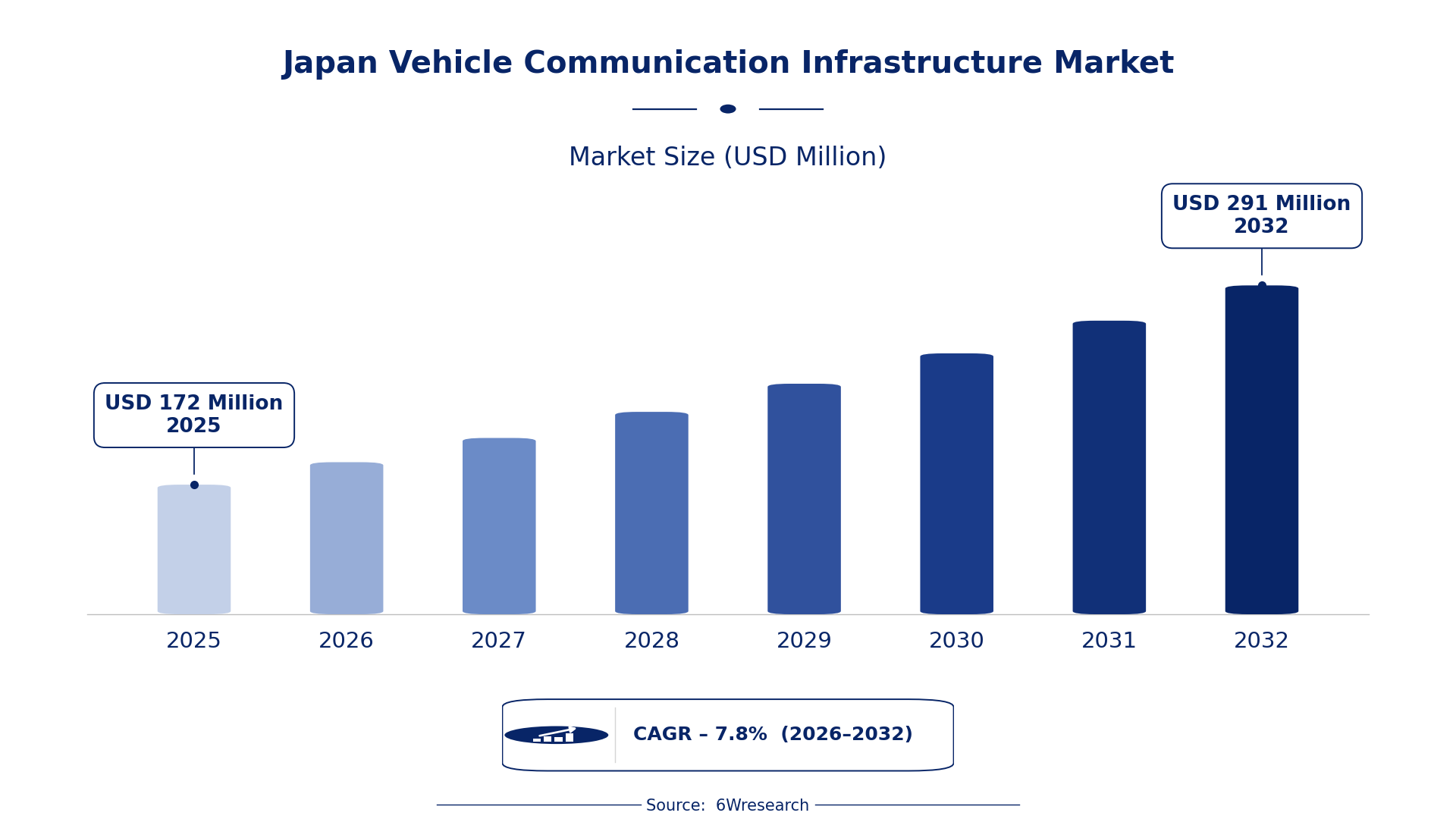
According to 6Wresearch internal database and industry insights, the Japan Vehicle Communication Infrastructure Market was valued at USD 172 Million in 2025 and is projected to reach USD 291 Million by 2032, growing at a CAGR of approximately 7.8% during 2026–2032.
Japan Vehicle Communication Infrastructure Market Highlights
| Report Metric | Details |
| Report Name | Japan Vehicle Communication Infrastructure Market (2026-2032) |
| Market Size 2025 | USD 172 Million |
| Market Size 2032 | USD 291 Million |
| Absolute Growth 2025–2032 | USD 119 Million |
| CAGR 2026–2032 | 7.8% |
| Peak Annual Growth | 9.5% in 2026 |
| Forecast Period | 2026–2032 |
| Historical Data | 2022–2025 |
| Base Year | 2025 |
| Leading Infrastructure Type, 2025 | C-V2X Roadside Units (40% share) |
| Leading Connectivity Mode, 2025 | Cellular-Based (50% share) |
| Leading Deployment Area, 2025 | Urban Intersections (49% share) |
| Leading End User, 2025 | Government Agencies (51% share) |
| Fastest-Growing Connectivity Mode | Short-Range Wireless (10.1% CAGR) |
| Fastest-Growing Deployment Area | Highways (9.0% CAGR) |
| Fastest-Growing End User | Mobility Solution Providers (10.2% CAGR) |
| Growing Sector | Mobility Solution Providers |
| Key End Users | Government Agencies, Smart City Planners, Mobility Solution Providers, Automotive IoT Companies |
Japan Vehicle Communication Infrastructure Market Year-wise Growth Rate and Key Drivers (2022–2032)
This graph illustrates the annual growth rates of the market from 2022 to 2032, highlighting a steady upward trajectory and projected market expansion over the forecast period.
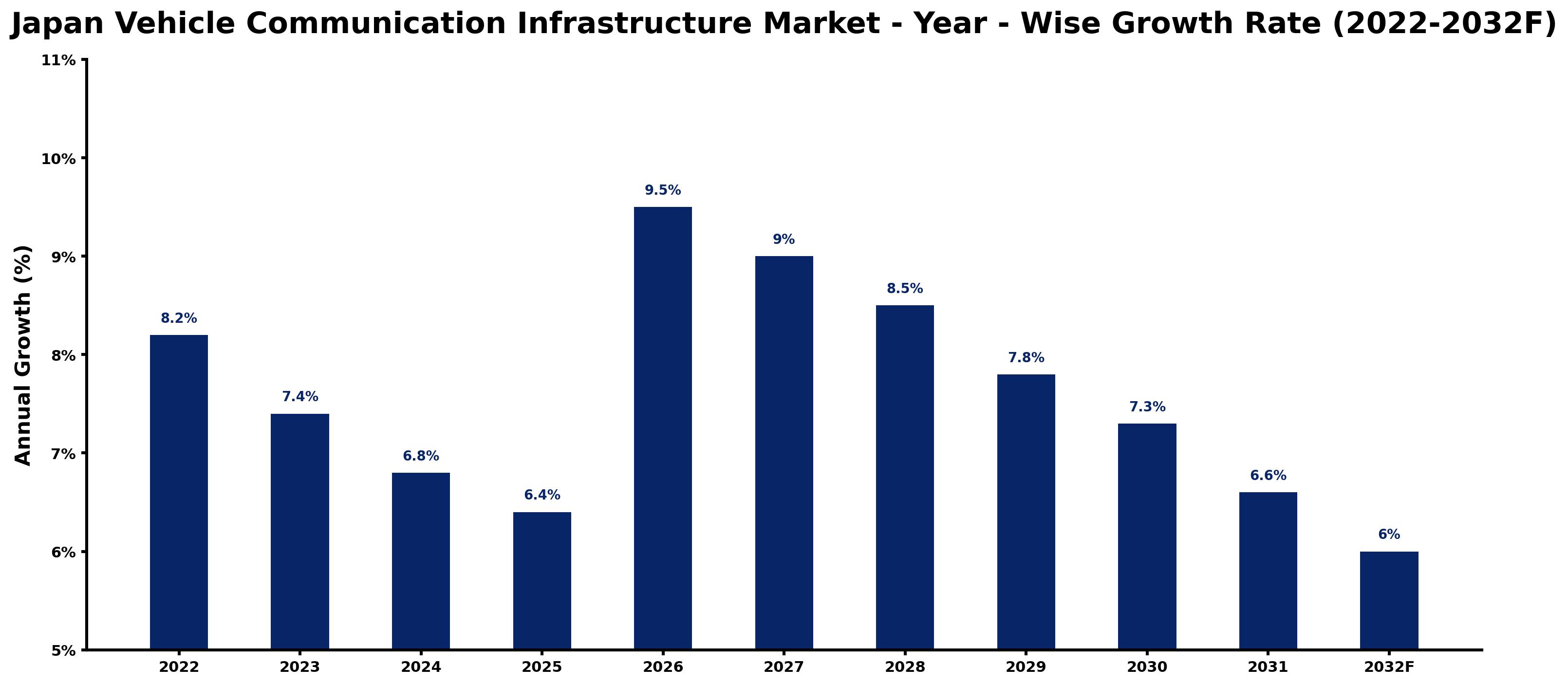
Year by year, the estimates below pair each growth rate with the development that shaped it.
| Year | Estimated Annual Growth (%) | Market Rationale |
| 2022 | 8.2 | The market showed strong activity with various government initiatives in smart city development. |
| 2023 | 7.4 | Growth slowed as the market adjusted to high levels of investment and adoption from previous years. |
| 2024 | 6.8 | Demand continued to rise, but at a slower pace due to market saturation in certain areas. |
| 2025 | 6.4 | The market growth decelerated as investments began to stabilise across various sectors and technologies. |
| 2026 | 9.5 | Growth is expected to accelerate with renewed investments in intelligent transport systems across urban areas. |
| 2027 | 9.0 | The market will continue to grow, albeit at a slower rate as initial projects mature and stabilise. |
| 2028 | 8.5 | Demand is projected to remain strong, but growth will slow as the market reaches a more mature phase. |
| 2029 | 7.8 | Growth is anticipated to slow as competition intensifies among technology providers and solutions. |
| 2030 | 7.3 | The market is expected to show signs of stabilisation as investments become more strategic and focused. |
| 2031 | 6.6 | Growth will decelerate further as the market adjusts to increased competition and evolving needs. |
| 2032 | 6.0 | The market is projected to grow steadily as infrastructure projects reach completion and integration. |
Note: Market size estimations and growth projections presented in this report are based on 6Wresearch's proprietary forecasting methodology, utilizing the latest available industry data, government publications, and primary research inputs.
Japan Vehicle Communication Infrastructure Market Synopsis
Vehicle Communication Infrastructure enables interaction between vehicles and urban infrastructure through advanced networking technologies. The Japan Vehicle Communication Infrastructure Market is growing due to rising urbanisation and investments in smart city initiatives. The Tokyo Metropolitan Government's commitment to these projects, alongside a strategy for intelligent transport systems, is driving demand. By 2025, the government aims to deploy vehicle communication infrastructure in 50% of urban areas, creating substantial investment opportunities in this sector.
Market Dynamics Impact Analysis (2026–2032)
| Factor | Type | Impact | Primary Segment Affected |
| Increasing urbanisation and smart city initiatives drive demand for vehicle communication infrastructure. | Driver | High | Urban Intersections |
| Government investments in intelligent transport systems create opportunities for technology providers. | Driver | High | C-V2X Roadside Units |
| Growing demand for smart mobility solutions presents opportunities for infrastructure providers. | Opportunity | High | Government Agencies |
| High vehicle ownership rates indicate a strong market for vehicle communication technologies. | Opportunity | High | Mobility Solution Providers |
| Market saturation in certain urban areas may limit growth potential. | Restraint | Medium | C-V2X Roadside Units |
| Regulatory complexities can hinder timely deployment of new technologies. | Restraint | Medium | DSRC Road Units |
| Competition among technology providers may lead to pricing pressures. | Challenge | High | Short-Range Wireless |
| Supply chain disruptions could delay infrastructure projects and implementation. | Challenge | Medium | RSU-Gateway Hubs |
Evaluation of Drivers in Japan Vehicle Communication Infrastructure Market (2026–2032)
The factors lifting demand, and the evidence behind each, are summarised below.
| Drivers | Primary Segment Affected | Why It Matters (Evidence) |
| Government investments in smart city initiatives boost demand for vehicle communication systems. | C-V2X Roadside Units | The Tokyo Metropolitan Government has invested heavily in smart city projects, improving urban traffic management. |
| High vehicle ownership rates create a larger market for vehicle communication technologies. | Urban Intersections | With approximately 590 vehicles per 1,000 people, demand for communication infrastructure is substantial in urban areas. |
| The national strategy for intelligent transport systems promotes infrastructure deployment across urban areas. | DSRC Road Units | The government aims for 50% deployment in urban areas by 2025, driving technology adoption and investment. |
| The push for improved road safety increases demand for vehicle communication technologies. | C-V2X Roadside Units | Japan targets a 46% cut in greenhouse-gas emissions by 2030, necessitating smart mobility solutions. |
| Technological advancements in communication protocols enhance system capabilities and adoption. | Short-Range Wireless | Innovations in communication technology are being tested in prefectures like Tokyo and Osaka, demonstrating their effectiveness. |
Much of the new demand traces back to substantial investments in urban infrastructure, particularly in Tokyo, where over 1,200 urban intersections are equipped with vehicle communication systems. The high vehicle ownership rate in Japan creates a strong market for advanced communication technologies. Aiming for a 46% reduction in greenhouse-gas emissions by 2030 is prompting investments in smart mobility solutions. These factors create a strong demand for vehicle communication infrastructure across the country.
Evaluation of Restraints in Japan Vehicle Communication Infrastructure Market
Several factors work against faster growth; the main ones are summarised below.
| Market Restraint | Primary Segment Affected | Why It Matters (Evidence) |
| Market saturation in urban areas may limit growth potential. | C-V2X Roadside Units | As more urban intersections become equipped, the incremental demand diminishes, affecting future investments. |
| Regulatory complexities can hinder timely deployment of new technologies. | DSRC Road Units | Compliance with various standards can delay project timelines and increase costs for providers. |
| High competition among technology providers may lead to pricing pressures. | Short-Range Wireless | With many players in the market, price competition can reduce profit margins for suppliers. |
| Supply chain disruptions could delay infrastructure projects and implementation. | RSU-Gateway Hubs | Global supply chain issues have affected the availability of critical components needed for deployment. |
| Limited public awareness of vehicle communication benefits may slow adoption. | Urban Intersections | Without clear understanding, stakeholders may hesitate to invest in necessary technologies. |
Japan Vehicle Communication Infrastructure Market Challenges
Producers face rising costs due to fierce competition among vehicle communication providers, pushing prices up by 15% in urban areas. Buyers struggle with outdated technology, as many existing systems do not comply with ISO 26262 standards, leading to deployment delays of up to six months for public transport integrations. Limited availability of advanced networking components disrupts the supply chain, extending project timelines by several months for suppliers. Municipalities encounter difficulties scaling solutions, as the government aims for 50% infrastructure deployment by 2025, straining budgets and resources for urban planners.
Trends in the Japan Vehicle Communication Infrastructure Market
The following changes are redrawing the Japan Vehicle Communication Infrastructure Market.
- Shift from Traditional to Smart Traffic Management: Since 2023, Japan has transitioned towards smart traffic management systems, particularly in urban areas like Tokyo. The deployment of intelligent transport systems is improving traffic flow and safety, with over 1,200 urban intersections now equipped with advanced technologies.
- Transition from DSRC to C-V2X Technologies: Beginning in 2023, there has been a shift towards C-V2X technology in Japan, particularly in urban centres. This transition is driven by the need for more reliable and efficient vehicle communication, with ongoing tests in Tokyo and Osaka highlighting its advantages.
- Emergence of Smart City Initiatives: Smart City Japan has become a key player in promoting vehicle communication technologies since 2023. The association's efforts are backed by government funding, targeting deployment of communication infrastructure in 50% of urban areas by 2025.
- Prioritisation of Road Safety Technologies: The focus on road safety has intensified since 2023, with initiatives highlighting the importance of vehicle communication systems. The national strategy for intelligent transport systems aims to improve safety measures across urban environments.
Investment Opportunities in the Japan Vehicle Communication Infrastructure Market
The openings below show where demand in the Japan Vehicle Communication Infrastructure Market is visible and how suppliers can enter.
- Urban Intersections as a Growth Hub: Urban intersections in Japan are critical for deploying vehicle communication infrastructure, with over 1,200 already equipped. The government aims for 50% deployment by 2025, creating opportunities for partnerships with local authorities.
- Investment in Smart City Initiatives: With the Tokyo Metropolitan Government investing heavily in smart city projects, there is a pressing need for advanced vehicle communication technologies. Collaborating with local agencies can facilitate entry into this growing market.
- Focus on Road Safety Solutions: The push for improved road safety presents an opportunity for suppliers of vehicle communication technologies. Engaging with government agencies can help align offerings with national safety targets.
- Expansion of Mobility Solutions: Mobility solution providers are seeking advanced communication technologies to enhance their services. Investing in partnerships with these providers can yield significant returns as demand for smart mobility grows.
Government Initiatives in the Japan Vehicle Communication Infrastructure Market
The GX Basic Policy adopted in 2023 aims for approximately JPY 150 trillion of public-private decarbonisation investment over ten years, significantly impacting vehicle communication infrastructure. This policy encourages producers to invest in technologies that align with national decarbonisation goals, ensuring compliance with emerging standards.
The Ministry of Land, Infrastructure, Transport and Tourism oversees regulations for vehicle communication technologies, ensuring compliance with ISO 26262 standards. This oversight is crucial for buyers, as it mandates safety certifications that enhance the reliability of deployed systems.
Future Insight of the Japan Vehicle Communication Infrastructure Market
Investment in vehicle communication infrastructure will grow, driven by government initiatives and urban planning needs. By 2032, the integration of intelligent transport systems will enhance road safety and traffic management across urban areas. The Tokyo Metropolitan Government's commitment to smart city projects will increase the demand for these technologies. With vehicle ownership at around 590 vehicles per 1,000 people, the need for advanced communication solutions will rise, creating new opportunities for both suppliers and buyers.
Market Segmentation Analysis
Japan Vehicle Communication Infrastructure Market report covers a detailed analysis of the following market segments:
By Infrastructure Type – C-V2X Roadside Units Lead and Record the Fastest Growth
According to Saurav Kr Singh, Senior Research Analyst at 6Wresearch, C-V2X Roadside Units held 40% of the Japan Vehicle Communication Infrastructure Market by infrastructure type in 2025. C-V2X Roadside Units dominate the market as they are crucial for enabling cellular vehicle communication in urban environments. Their deployment across over 1,200 urban intersections illustrates their role in improving traffic management and road safety. C-V2X Roadside Units are also forecast to expand faster than any other category, at a CAGR of 10.4% over 2026–2032. The growth of C-V2X Roadside Units is propelled by the 2023 national strategy for intelligent transport systems, which aims to enhance road safety significantly. This established infrastructure will likely attract further investments and demand. Suppliers must focus on enhancing C-V2X technologies to meet the increasing infrastructure needs in urban settings.
By Connectivity Mode – Cellular-Based Leads, Short-Range Wireless Expected to Grow Fastest
Cellular-Based took 50% of connectivity mode revenue in 2025, more than any other category. Cellular-Based connectivity leads the market due to its extensive coverage capabilities, allowing vehicles to communicate effectively across various regions. This mode is essential for the seamless integration of vehicle communication systems within the broader transport network. Short-Range Wireless is projected to grow fastest, at a CAGR of 10.1% during 2026–2032. Short-Range Wireless is experiencing rapid growth as it is vital for immediate vehicle communication, especially in densely populated urban areas. The rising emphasis on urban mobility solutions will further fuel the demand for this connectivity mode. Buyers should invest in both connectivity options to ensure comprehensive vehicle communication capabilities.
By Deployment Area – Urban Intersections Lead, Highways Expected to Grow Fastest
In 2025, Urban Intersections led the deployment area split with a 49% share. Urban Intersections are the leading deployment area, critical for managing traffic flows in cities. The government's goal to implement vehicle communication infrastructure in 50% of urban areas by 2025 underscores their importance in urban planning. Over 2026–2032, Highways are expected to post the fastest growth, at a CAGR of 9.0%. Highways represent the fastest-growing deployment area, as they enhance safety and efficiency on major roads, which is increasingly necessary given Japan's rising vehicle ownership. This focus aligns with national safety initiatives and infrastructure improvements. Suppliers should prioritise developing solutions tailored for highway applications to capitalise on this growth opportunity.
By End User – Government Agencies Lead, Mobility Solution Providers Expected to Grow Fastest
With 51% of end user revenue in 2025, Government Agencies was the largest category. Government Agencies are the primary end users, serving as key stakeholders in the deployment and regulation of vehicle communication infrastructure. Their involvement ensures alignment with national strategies and secures funding for essential projects. The quickest growth will come from Mobility Solution Providers, forecast to expand at a CAGR of 10.2% between 2026 and 2032. Mobility Solution Providers are rapidly growing as they develop solutions leveraging vehicle communication infrastructure, driven by the demand for smart mobility. Their contributions are crucial for advancing transportation solutions. Collaboration between government agencies and mobility solution providers is essential for the effective implementation of vehicle communication infrastructure.
Key Attractiveness of the Report
- 10 Years of Market Numbers
- Historical Data Starting from 2022 to 2025
- Base Year 2025
- Forecast Data until 2032
- Key Performance Indicators Impacting the Market
- Major Upcoming Developments and Projects
Key Highlights of the Report:
- Japan Vehicle Communication Infrastructure Market Outlook
- Market Size of Japan Vehicle Communication Infrastructure Market, 2025
- Forecast of Japan Vehicle Communication Infrastructure Market, 2032
- Historical Data and Forecast of Japan Vehicle Communication Infrastructure Revenues & Volume for the Period 2022-2032F
- Japan Vehicle Communication Infrastructure Market Trend Evolution
- Japan Vehicle Communication Infrastructure Market Drivers and Challenges
- Japan Vehicle Communication Infrastructure Price Trends
- Japan Vehicle Communication Infrastructure Porter's Five Forces
- Japan Vehicle Communication Infrastructure Industry Life Cycle
- Historical Data and Forecast of Japan Vehicle Communication Infrastructure Market Revenues & Volume By Infrastructure Type for the Period 2022-2032F
- Historical Data and Forecast of Japan Vehicle Communication Infrastructure Market Revenues & Volume By DSRC Road Units for the Period 2022-2032F
- Historical Data and Forecast of Japan Vehicle Communication Infrastructure Market Revenues & Volume By C-V2X Roadside Units for the Period 2022-2032F
- Historical Data and Forecast of Japan Vehicle Communication Infrastructure Market Revenues & Volume By Vehicular Edge Servers for the Period 2022-2032F
- Historical Data and Forecast of Japan Vehicle Communication Infrastructure Market Revenues & Volume By RSU-Gateway Hubs for the Period 2022-2032F
- Historical Data and Forecast of Japan Vehicle Communication Infrastructure Market Revenues & Volume By Connectivity Mode for the Period 2022-2032F
- Historical Data and Forecast of Japan Vehicle Communication Infrastructure Market Revenues & Volume By Short-Range Wireless for the Period 2022-2032F
- Historical Data and Forecast of Japan Vehicle Communication Infrastructure Market Revenues & Volume By Cellular-Based for the Period 2022-2032F
- Historical Data and Forecast of Japan Vehicle Communication Infrastructure Market Revenues & Volume By Cloud-Edge Sync for the Period 2022-2032F
- Historical Data and Forecast of Japan Vehicle Communication Infrastructure Market Revenues & Volume By Network Backbone for the Period 2022-2032F
- Historical Data and Forecast of Japan Vehicle Communication Infrastructure Market Revenues & Volume By Deployment Area for the Period 2022-2032F
- Historical Data and Forecast of Japan Vehicle Communication Infrastructure Market Revenues & Volume By Urban Intersections for the Period 2022-2032F
- Historical Data and Forecast of Japan Vehicle Communication Infrastructure Market Revenues & Volume By Highways for the Period 2022-2032F
- Historical Data and Forecast of Japan Vehicle Communication Infrastructure Market Revenues & Volume By Parking/Charging Zones for the Period 2022-2032F
- Historical Data and Forecast of Japan Vehicle Communication Infrastructure Market Revenues & Volume By Suburban Routes for the Period 2022-2032F
- Historical Data and Forecast of Japan Vehicle Communication Infrastructure Market Revenues & Volume By End User for the Period 2022-2032F
- Historical Data and Forecast of Japan Vehicle Communication Infrastructure Market Revenues & Volume By Smart City Planners for the Period 2022-2032F
- Historical Data and Forecast of Japan Vehicle Communication Infrastructure Market Revenues & Volume By Government Agencies for the Period 2022-2032F
- Historical Data and Forecast of Japan Vehicle Communication Infrastructure Market Revenues & Volume By Mobility Solution Providers for the Period 2022-2032F
- Historical Data and Forecast of Japan Vehicle Communication Infrastructure Market Revenues & Volume By Automotive IoT Companies for the Period 2022-2032F
- Japan Vehicle Communication Infrastructure Import Export Trade Statistics
- Market Opportunity Assessment By Infrastructure Type
- Market Opportunity Assessment By Connectivity Mode
- Market Opportunity Assessment By Deployment Area
- Market Opportunity Assessment By End User
- Japan Vehicle Communication Infrastructure Top Companies Market Share
- Japan Vehicle Communication Infrastructure Competitive Benchmarking By Technical and Operational Parameters
- Japan Vehicle Communication Infrastructure Company Profiles
- Japan Vehicle Communication Infrastructure Key Strategic Recommendations
Market Covered
The following segment groups are covered in the report.
By Infrastructure Type
- DSRC Road Units
- C-V2X Roadside Units
- Vehicular Edge Servers
- RSU-Gateway Hubs
By Connectivity Mode
- Short-Range Wireless
- Cellular-Based
- Cloud-Edge Sync
- Network Backbone
By Deployment Area
- Urban Intersections
- Highways
- Parking/Charging Zones
- Suburban Routes
By End User
- Smart City Planners
- Government Agencies
- Mobility Solution Providers
- Automotive IoT Companies































