Japan Vehicle Compliance Market Size & Growth Rate
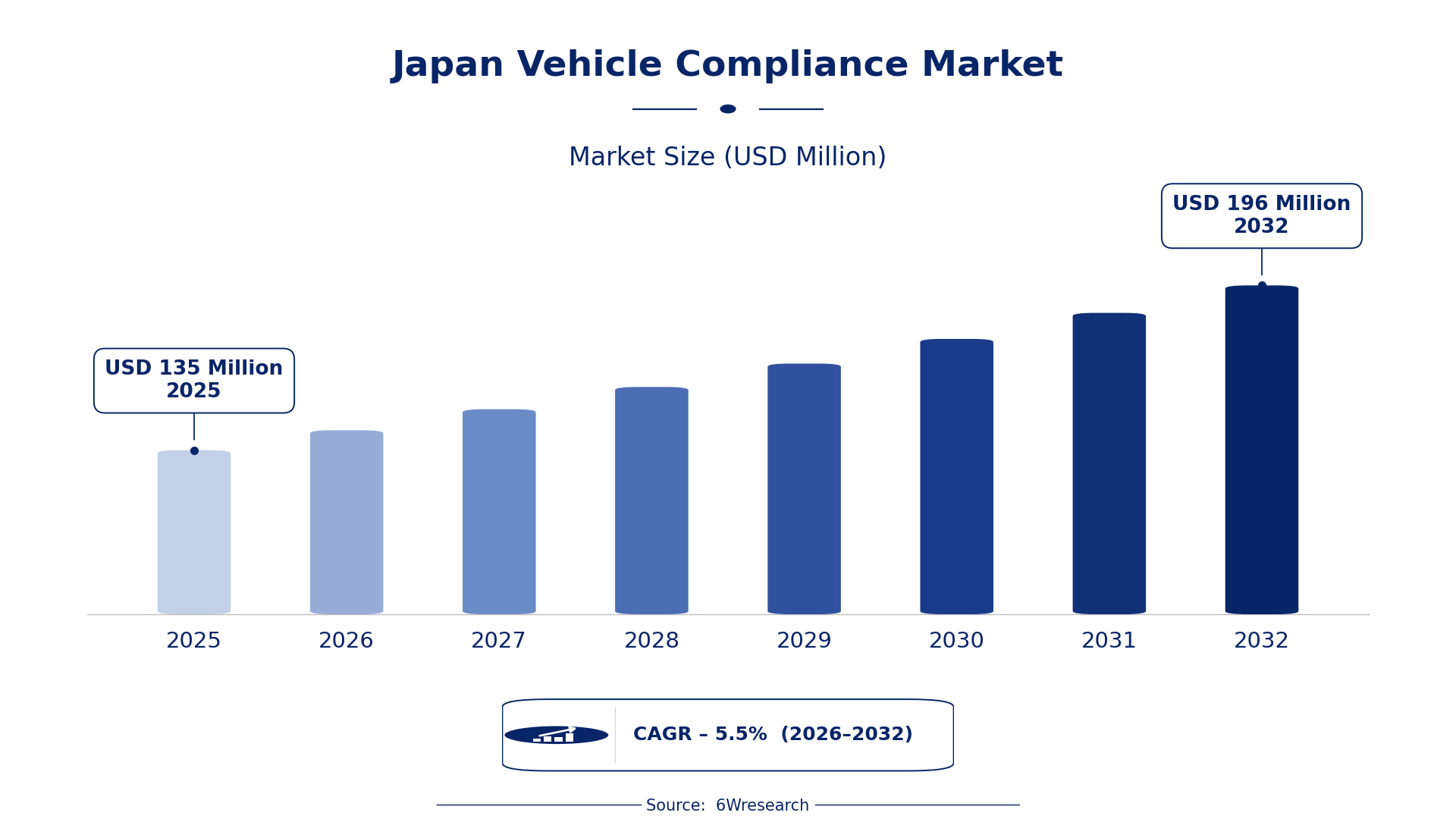
According to 6Wresearch internal database and industry insights, the Japan Vehicle Compliance Market was valued at USD 135 Million in 2025 and is projected to reach USD 196 Million by 2032, growing at a CAGR of approximately 5.5% during 2026–2032.
Japan Vehicle Compliance Market Highlights
| Report Metric | Details |
| Report Name | Japan Vehicle Compliance Market (2026-2032) |
| Market Size 2025 | USD 135 Million |
| Market Size 2032 | USD 196 Million |
| Absolute Growth 2025–2032 | USD 61 Million |
| CAGR 2026–2032 | 5.5% |
| Peak Annual Growth | 6.1% in 2028 |
| Forecast Period | 2026–2032 |
| Historical Data | 2022–2025 |
| Base Year | 2025 |
| Leading Compliance Area, 2025 | Emissions Compliance (38% share) |
| Leading Regulation Type, 2025 | Euro 6 / EPA (47% share) |
| Leading Vehicle Category, 2025 | ICE Vehicles (45% share) |
| Leading End User, 2025 | OEMs (37% share) |
| Fastest-Growing Compliance Area | Safety Regulation (6.9% CAGR) |
| Fastest-Growing Regulation Type | NCAP / AIS (7.8% CAGR) |
| Fastest-Growing Vehicle Category | Passenger Vehicles (7.4% CAGR) |
| Fastest-Growing End User | Government Testing Bodies (7.5% CAGR) |
| Growing Sector | Government Testing Bodies |
| Key End Users | OEMs, Government Testing Bodies, Telematics Providers, EV Manufacturers |
Japan Vehicle Compliance Market Year-wise Growth Rate and Key Drivers (2022–2032)
This graph illustrates the annual growth rates of the market from 2022 to 2032, highlighting a steady upward trajectory and projected market expansion over the forecast period.
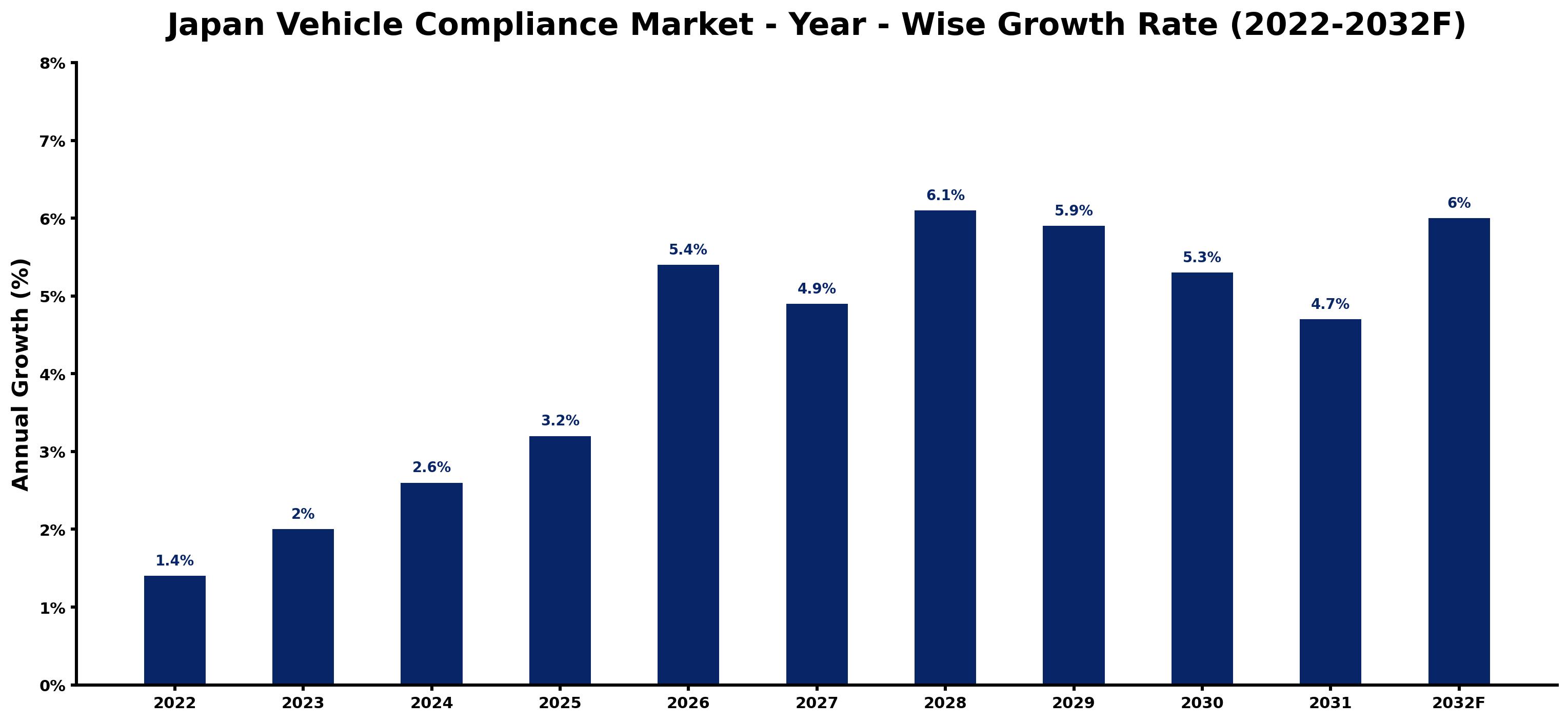
Annual growth estimates for each year appear below with the principal reason behind them, explaining the shifts that set the pace of the market.
| Year | Estimated Annual Growth (%) | Market Rationale |
| 2022 | 1.4 | The market witnessed stable demand due to established compliance requirements. |
| 2023 | 2.0 | Growth accelerated as more vehicles were tested under updated regulations. |
| 2024 | 2.6 | The introduction of new compliance standards supported increased activity in the sector. |
| 2025 | 3.2 | Demand surged as manufacturers adapted to the latest Euro 6 standards. |
| 2026 | 5.4 | The market expanded significantly due to heightened investments in electric vehicle compliance. |
| 2027 | 4.9 | Growth slowed slightly as the market adjusted to regulatory changes and testing capacities. |
| 2028 | 6.1 | The peak growth year saw heightened demand for safety compliance testing. |
| 2029 | 5.9 | A slight slowdown occurred as the market stabilised after peak growth. |
| 2030 | 5.3 | The market continued to grow, driven by ongoing investments in EV technologies. |
| 2031 | 4.7 | Growth decelerated as the market matured and compliance processes became standardised. |
| 2032 | 6.0 | The market rebounded with renewed interest in compliance for connected vehicles. |
Note: Market size estimations and growth projections presented in this report are based on 6Wresearch's proprietary forecasting methodology, utilizing the latest available industry data, government publications, and primary research inputs.
Japan Vehicle Compliance Market Synopsis
Vehicle Compliance in Japan encompasses regulations that ensure vehicles meet safety, emissions, and cybersecurity standards. This market thrives on stringent government regulations and technological advancements, with strong demand from domestic manufacturers. Japan's automotive industry contributes approximately 20% to its GDP, and the government's green vehicle subsidy program launched in 2023 is stimulating investment in compliance for electric vehicles, indicating robust growth in the coming years.
Market Dynamics Impact Analysis (2026–2032)
| Factor | Type | Impact | Primary Segment Affected |
| Stringent government regulations are enforcing compliance standards across the automotive sector. | Driver | High | Emissions Compliance |
| Technological advancements in vehicle safety and cybersecurity are driving compliance needs. | Driver | High | Cybersecurity Compliance |
| The shift towards electric vehicles is creating a demand for new compliance services. | Opportunity | High | EV Battery Compliance |
| The increasing number of registered passenger vehicles is expanding the compliance testing market. | Opportunity | Medium | Passenger Vehicles |
| Limited testing facilities may slow down compliance processes for manufacturers. | Restraint | High | Safety Regulation |
| High costs associated with compliance testing can deter smaller manufacturers from entering the market. | Restraint | Medium | ICE Vehicles |
| The high costs of implementing compliance measures can strain budgets for manufacturers. | Challenge | High | OEMs |
| The rapid pace of technological change can make compliance standards obsolete quickly. | Challenge | Medium | Connected Vehicles |
Evaluation of Drivers in Japan Vehicle Compliance Market (2026–2032)
The following drivers explain most of the expected growth.
| Drivers | Primary Segment Affected | Why It Matters (Evidence) |
| Government regulations mandating emissions standards are driving compliance testing. | Emissions Compliance | Japan targets a 46% cut in greenhouse-gas emissions by 2030, increasing testing demand. |
| Technological advancements in vehicle safety systems are increasing compliance needs. | Safety Regulation | The collaboration between local agencies and international bodies strengthens safety standards, leading to higher compliance activity. |
| The rise in electric vehicle registrations is boosting demand for specific compliance services. | EV Battery Compliance | Over 1 million electric vehicles were registered in Japan as of 2023, necessitating compliance checks. |
| The growing focus on cybersecurity in vehicles is driving compliance requirements. | Cybersecurity Compliance | ISO 21434 was adopted in Japan in 2022, mandating cybersecurity compliance for automotive systems. |
| The expansion of testing facilities is supporting compliance for new vehicle models. | Passenger Vehicles | Testing facilities in major automotive hubs like Aichi Prefecture are increasing capacity for compliance assessments. |
Volumes grow on the back of over 5 million registered passenger vehicles in Japan, prompting manufacturers to invest in compliance testing. The adoption of advanced safety systems is pushing OEMs to refine their compliance processes. As of 2023, the rise in electric vehicle registrations creates a strong demand for compliance services tailored to EVs. Testing facilities across major automotive hubs are enhancing their capabilities, supporting timely compliance assessments. The focus on cybersecurity is also prompting manufacturers to ensure their vehicles meet the latest standards, resulting in increased compliance activity.
Evaluation of Restraints in Japan Vehicle Compliance Market
These restraints slow adoption and weigh on supplier margins.
| Market Restraint | Primary Segment Affected | Why It Matters (Evidence) |
| Outdated testing technology delays compliance certification by up to six months, impacting new model launches. | Emissions Compliance | Domestic manufacturers face challenges in upgrading testing technology, causing delays. |
| Rising costs of compliance testing have increased by 15% since 2021, straining budgets. | Safety Regulation | Manufacturers must allocate more resources to meet evolving regulatory standards. |
| Stringent regulations create bottlenecks, leading to potential fines of up to ¥10 million for non-compliance. | Cybersecurity Compliance | Smaller manufacturers are disproportionately affected by high compliance costs. |
| Skills shortages in the workforce hinder the ability to meet ISO 21434 standards, causing project delays. | EV Battery Compliance | The lack of trained personnel affects compliance timelines for electric vehicle manufacturers. |
| Limited testing facilities restrict the capacity to certify new vehicle models in a timely manner. | Passenger Vehicles | The concentration of testing facilities in specific regions can lead to backlogs. |
Japan Vehicle Compliance Market Challenges
Manufacturers encounter outdated testing technology, causing compliance certification delays of up to six months, which impacts timely model launches. Increased compliance testing costs have risen by 15% since 2021, forcing producers to reallocate budgets from essential development areas. Stringent regulations from the Ministry of Land, Infrastructure, Transport and Tourism create bottlenecks, risking fines of up to ¥10 million for non-compliance, which disproportionately burdens smaller manufacturers. A shortage of skilled workers in the automotive sector, especially in cybersecurity, restricts the ability to meet ISO 21434 standards, resulting in project delays for suppliers.
Trends in the Japan Vehicle Compliance Market
The shifts below are changing how Japan Vehicle Compliance Market products are bought and supplied.
- Shift from Traditional to Electric Vehicle Compliance: Japan is transitioning from traditional vehicle compliance to electric vehicle standards, as evidenced by the green vehicle subsidy program launched in 2023, which aims to increase EV registrations significantly.
- Rise of Cybersecurity Standards: The adoption of ISO 21434 in 2022 marks a shift towards prioritising cybersecurity in vehicles, reflecting the growing importance of connected vehicle safety in Japan.
- Investment Surge in Testing Facilities: Investment in testing facilities is increasing, particularly in automotive hubs like Aichi Prefecture, where infrastructure improvements are enhancing compliance capabilities for new vehicle models.
- Growing Emphasis on Safety Compliance: The focus on safety compliance is intensifying, with the National Highway Traffic Safety Administration collaborating with Japanese agencies to strengthen safety regulations across the automotive sector.
Investment Opportunities in the Japan Vehicle Compliance Market
Several openings in the Japan Vehicle Compliance Market merit attention from investors.
- Gap in EV Compliance Services: With over 1 million electric vehicles registered, there is a strong demand for EV compliance services, particularly in urban areas like Tokyo, where investment in testing facilities is needed.
- Expansion of Safety Compliance Testing: The growing emphasis on safety compliance presents opportunities for testing facilities to expand their services, especially in regions with high vehicle production like Aichi Prefecture.
- Investment in Cybersecurity Solutions: The adoption of ISO 21434 creates a demand for cybersecurity compliance solutions, particularly among OEMs focusing on connected vehicles in metropolitan areas.
- Compliance Services for Connected Vehicles: As the market for connected vehicles grows, there is a need for compliance services that meet new standards, particularly in technology hubs like Kanagawa Prefecture.
Government Initiatives in the Japan Vehicle Compliance Market
The Ministry of Land, Infrastructure, Transport and Tourism regulates vehicle compliance, ensuring vehicles meet safety and emissions standards. The latest Euro 6 standards implemented in 2021 have reinforced compliance requirements, while ISO 21434 mandates cybersecurity measures for automotive systems, adopted in 2022.
The National Highway Traffic Safety Administration collaborates with Japanese agencies to promote compliance with international standards. The government launched the green vehicle subsidy program in 2023, supporting the adoption of electric vehicles and their compliance with safety and emissions standards.
Future Insight of the Japan Vehicle Compliance Market
By 2032, suppliers will see the integration of advanced testing technologies that will reduce compliance times by 30%. The green vehicle subsidy program will significantly increase electric vehicle registrations, with over 3 million expected by 2030. Enhanced collaboration among regulatory bodies will simplify compliance processes, elevating safety standards for buyers. The commitment to a 100% electric vehicle sales target by 2035 will compel suppliers to innovate and adapt to new regulatory frameworks.
Market Segmentation Analysis
Japan Vehicle Compliance Market report covers a detailed analysis of the following market segments:
By Compliance Area – Emissions Compliance Leads, Safety Regulation Expected to Grow Fastest
According to Saurav Kr Singh, Senior Research Analyst at 6Wresearch, Emissions Compliance accounted for 38% of the market by compliance area in 2025. Emissions Compliance commands the largest share because it is vital for adhering to Japan's stringent environmental laws. The government's goal of a 46% reduction in greenhouse gas emissions by 2030 drives extensive compliance efforts across the automotive industry. Safety Regulation is set to record the highest CAGR in this split, 6.9% over 2026–2032. Safety Regulation is growing rapidly due to its critical role in vehicle approval, especially with heightened consumer safety concerns. The adoption of NCAP standards has further accelerated the focus on safety compliance in the automotive sector. Suppliers need to focus on emissions and safety compliance to meet regulatory demands and consumer expectations.
By Regulation Type – Euro 6 / EPA Leads, NCAP / AIS Expected to Grow Fastest
With 47% of regulation type revenue in 2025, Euro 6 / EPA was the largest category. Euro 6 / EPA leads the market as it serves as the primary standard for emissions in vehicles, ensuring compliance with environmental laws. Its adoption is critical for manufacturers aiming to meet both domestic and international standards. NCAP / AIS is projected to grow fastest, at a CAGR of 7.8% during 2026–2032. NCAP / AIS is growing quickly as it evaluates vehicle safety performance, reflecting the rising consumer demand for safer vehicles. The increasing collaboration between the National Highway Traffic Safety Administration and Japanese agencies further accelerates this trend. Suppliers should focus on meeting Euro 6 / EPA and NCAP / AIS standards to remain competitive in the compliance market.
By Vehicle Category – ICE Vehicles Lead, Passenger Vehicles Expected to Grow Fastest
ICE Vehicles held 45% of the Japan Vehicle Compliance Market by vehicle category in 2025. ICE Vehicles dominate the market as they represent the traditional vehicle category that must adhere to established regulations. With over 5 million registered passenger vehicles, this segment remains vital for compliance initiatives. The quickest growth will come from Passenger Vehicles, forecast to expand at a CAGR of 7.4% between 2026 and 2032. Passenger Vehicles are the fastest-growing segment as they constitute the largest group requiring compliance, especially with the increasing safety and emissions standards. The growing number of registered passenger vehicles highlights the escalating need for compliance services. Suppliers must adapt their compliance strategies to meet the rising demand from the passenger vehicle segment.
By End User – OEMs Lead, Government Testing Bodies Expected to Grow Fastest
OEMs took 37% of end user revenue in 2025, more than any other category. OEMs are the primary end users of compliance services, as they are responsible for ensuring their vehicles meet all regulatory standards. Their central role in the automotive supply chain reinforces their dominance in the compliance market. Over 2026–2032, Government Testing Bodies are expected to post the fastest growth, at a CAGR of 7.5%. Government Testing Bodies are witnessing rapid growth as they manage compliance testing, reflecting the increasing regulatory oversight in the automotive industry. Their role is becoming more critical with the introduction of new regulations. Suppliers should collaborate with OEMs and government testing bodies to ensure compliance with changing regulatory standards.
Key Attractiveness of the Report
- 10 Years of Market Numbers
- Historical Data Starting from 2022 to 2025
- Base Year 2025
- Forecast Data until 2032
- Key Performance Indicators Impacting the Market
- Major Upcoming Developments and Projects
Key Highlights of the Report:
- Japan Vehicle Compliance Market Outlook
- Market Size of Japan Vehicle Compliance Market, 2025
- Forecast of Japan Vehicle Compliance Market, 2032
- Historical Data and Forecast of Japan Vehicle Compliance Revenues & Volume for the Period 2022-2032F
- Japan Vehicle Compliance Market Trend Evolution
- Japan Vehicle Compliance Market Drivers and Challenges
- Japan Vehicle Compliance Price Trends
- Japan Vehicle Compliance Porter's Five Forces
- Japan Vehicle Compliance Industry Life Cycle
- Historical Data and Forecast of Japan Vehicle Compliance Market Revenues & Volume By Compliance Area for the Period 2022-2032F
- Historical Data and Forecast of Japan Vehicle Compliance Market Revenues & Volume By Emissions Compliance for the Period 2022-2032F
- Historical Data and Forecast of Japan Vehicle Compliance Market Revenues & Volume By Safety Regulation for the Period 2022-2032F
- Historical Data and Forecast of Japan Vehicle Compliance Market Revenues & Volume By Cybersecurity Compliance for the Period 2022-2032F
- Historical Data and Forecast of Japan Vehicle Compliance Market Revenues & Volume By EV Battery Compliance for the Period 2022-2032F
- Historical Data and Forecast of Japan Vehicle Compliance Market Revenues & Volume By Regulation Type for the Period 2022-2032F
- Historical Data and Forecast of Japan Vehicle Compliance Market Revenues & Volume By Euro 6 / EPA for the Period 2022-2032F
- Historical Data and Forecast of Japan Vehicle Compliance Market Revenues & Volume By NCAP / AIS for the Period 2022-2032F
- Historical Data and Forecast of Japan Vehicle Compliance Market Revenues & Volume By ISO 21434 for the Period 2022-2032F
- Historical Data and Forecast of Japan Vehicle Compliance Market Revenues & Volume By UN ECE R100 for the Period 2022-2032F
- Historical Data and Forecast of Japan Vehicle Compliance Market Revenues & Volume By Vehicle Category for the Period 2022-2032F
- Historical Data and Forecast of Japan Vehicle Compliance Market Revenues & Volume By ICE Vehicles for the Period 2022-2032F
- Historical Data and Forecast of Japan Vehicle Compliance Market Revenues & Volume By Passenger Vehicles for the Period 2022-2032F
- Historical Data and Forecast of Japan Vehicle Compliance Market Revenues & Volume By Connected Vehicles for the Period 2022-2032F
- Historical Data and Forecast of Japan Vehicle Compliance Market Revenues & Volume By Electric Vehicles for the Period 2022-2032F
- Historical Data and Forecast of Japan Vehicle Compliance Market Revenues & Volume By End User for the Period 2022-2032F
- Historical Data and Forecast of Japan Vehicle Compliance Market Revenues & Volume By OEMs for the Period 2022-2032F
- Historical Data and Forecast of Japan Vehicle Compliance Market Revenues & Volume By Government Testing Bodies for the Period 2022-2032F
- Historical Data and Forecast of Japan Vehicle Compliance Market Revenues & Volume By Telematics Providers for the Period 2022-2032F
- Historical Data and Forecast of Japan Vehicle Compliance Market Revenues & Volume By EV Manufacturers for the Period 2022-2032F
- Japan Vehicle Compliance Import Export Trade Statistics
- Market Opportunity Assessment By Compliance Area
- Market Opportunity Assessment By Regulation Type
- Market Opportunity Assessment By Vehicle Category
- Market Opportunity Assessment By End User
- Japan Vehicle Compliance Top Companies Market Share
- Japan Vehicle Compliance Competitive Benchmarking By Technical and Operational Parameters
- Japan Vehicle Compliance Company Profiles
- Japan Vehicle Compliance Key Strategic Recommendations
Market Covered
Coverage by segment is as follows.
By Compliance Area
- Emissions Compliance
- Safety Regulation
- Cybersecurity Compliance
- EV Battery Compliance
By Regulation Type
- Euro 6 / EPA
- NCAP / AIS
- ISO 21434
- UN ECE R100
By Vehicle Category
- ICE Vehicles
- Passenger Vehicles
- Connected Vehicles
- Electric Vehicles
By End User
- OEMs
- Government Testing Bodies
- Telematics Providers
- EV Manufacturers































